steering wheel AUDI Q5 2013 Owner's Manual
[x] Cancel search | Manufacturer: AUDI, Model Year: 2013, Model line: Q5, Model: AUDI Q5 2013Pages: 316, PDF Size: 78.89 MB
Page 200 of 316
198 Intelligent technology
Dynamic ste ering *
On vehicles with dynamic stee ring* , ES C helps
stabilize the st eering in critical s ituations .
Selective wh eel torque c ontrol
The selective whee l torque control operates
when dr iv ing through curves . T he front wheel
on the inside of the curve or both wheels on
the inside of the curv e are braked selective ly
as needed. This m inimizes sliding in the front
wheels and allows for more pr ecise driving
through curves . T he system may not act ivate
when driving in wet or snowy cond itions .
A WARNING
-ESC, ABS, ASR, EDL dynamic steering"
and the se lective wheel torque control
cannot overcome the laws of physics .
Th is is especially important on slippery
or wet roads.
If the systems begin act ing
to stabilize yo ur vehicle , you sho uld im
med iately change your speed to ma tch
the road and traffic condit ions. Do not
let the increased safety provided by
these systems tempt you to take risks. Do ing so wi ll increase the risk of a loss of
vehicle control, collision and serious per
sonal injuries .
- Always adapt your speed to road, traff ic
and weather condit ions. The risk of Los-
-
ing cont ro l of the veh icle increases when
dr iv ing too fast, especially th rough
c u rves and on slippery o r wet roads, and
when d riving too close to vehi cles up
ahead. ESC, A BS, the brake assis t sys
tem, AS R, EDL, dynamic steering* and
the se lective wheel torque control can
not prevent collis ions.
-Always acce lerate with specia l care on
even, smooth surfaces s uch as those that
are wet or covered with ice and snow.
The drive wheels can spin even with
these ass istance systems that cannot al
ways help to reduce the risk of loss of ve
hicle control.
(D Tips
- ABS and ASR only wo rk correctly when
all four wheels are equipped with identi
cal tires. Different tire si zes can lead to a
reduction in engine power .
- Yo u may hear noises when the systems
described are working.
- If the ind icator light
DJ or E (USA
mode ls)/ m] (Canada models) appears,
there may be a malfunction
q page 15 ,
q page 17.
-When i nstalling a factory -supplied roof
rack system on the roof railing, the ESC
will adapt itse lf to a different center of
gravity .
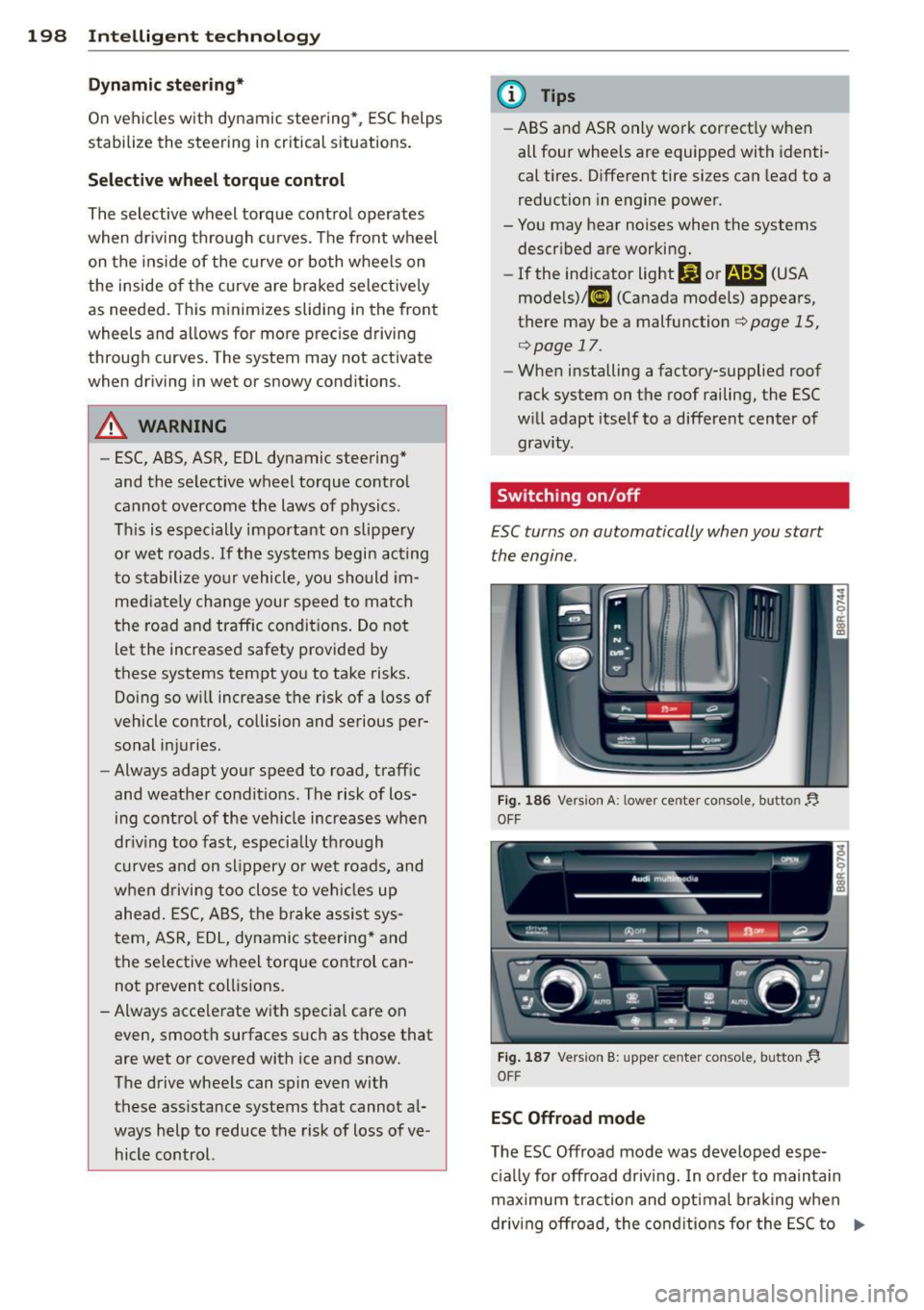
Switching on/off
ESC turns on automatically when you start
the engine.
F ig. 1 86 Vers ion A: l owe r ce nte r con so le, butto n YJ
OFF
Fig. 1 87 Version B: upper cente r console, button YJ
OFF
ESC Offroad mode
The ESC Off road mode was developed espe
c ia lly for offroad driving . In o rder to maintain
max imum trac tion and optimal b raking when
driv ing offroad, the cond it ions for the ESC to
IJII,
Page 203 of 316
Fa u lts in th e brake sy stem
If you should notice a sudden increase in
brake peda l travel, then one of the two brake
circuits may have failed~.&. .
Low brak e flu id level
Malfunct ions can occur in the brake system if
the brake fl uid leve l is too low . T he b rake fluid
l eve l is monito red electronically .
Brake booster
The brake booster increases the pressure that
you generate w ith the brake pedal.
It only op
e rates while the eng ine is running or with the
i gnit ion sw itched on (hybr id dr ive*) ~.&, .
Brake lining wear statu s
Brake lining wear may be checked by visual in
spection of the condition of the brake pads
through the openings in the whee l. If neces
sa ry, the wheel may be removed for this in
spection
~ page 2 74, Changing a wheel.
.&_ WARNING
=
- You should perform braking maneuvers
for the purpose of clean ing the brake
system on ly if road conditions permit.
Other road users must not be put at risk -
you may cause an acc ident!
- Before descending a steep grade, reduce
speed and shift transmiss ion into a lower
gear or lower driving range . Do not ride
the brakes or hold the pedal down too long or too often . This could cause the
brakes to get hot and dimin ish b raking
efficiency .
- Do not "ride the brakes" by resting your
foot on the pedal when you do not intend
to brake . Th is may cause the b rakes to
overheat, premat ure wear and increased
stopping distance .
- Under certain climat ic and operating
condit ions such as passing through wa
ter , driving in heavy rain or after wash ing
the vehicle, the effectiveness of the brakes can be reduced. In winter, ice can
accumulate on the brake pads, linings,
discs and drums . Carefully apply brakes
Int ellig ent technolog y 201
for a test. Brakes will dry and ice coat
ings w ill be cleaned off after a few care
ful brake applicat ions.
- Driving for an extended period of time on
salt-covered roads without using your
brakes can also affect braking efficiency.
Clean off accumulated salt coating from
brake discs and pads with a few careful
brake applications.
- If you damage the front spoiler, or if you install a different spoiler, be sure the air
f low to the front brakes is not obst ruct
ed. Otherw ise the brake system could
overhea t reducing the effectiveness of
the entire brake system .
- Failure of one brake circuit will impair
the braking capability resulting in an in
creased stopping distance . Avoid driving
the vehicle and have it towed to the near
est a uthori zed Audi dea ler or qualified
workshop.
- Never let the vehicle roll to a stop with
the engine shut off .
- If the brake booster is not working, for
examp le when towing your vehicle, or
because the brake booster has somehow
been damaged, the brake pedal must be
pressed considerably harder to make up
for the lack of booster assistance .
Electromechanical
power assist, Dynamic
steering
The electromechanical power assist helps the
driver when s teering.
Power ste ering adapts electronically based on
the vehicle speed.
Indicator lights an d m ess age s
• Steeri ng defe ctive ! D o n ot dr ive vehi cle!
If this indicator light turns on and stays on
and this message appears, the power steer ing
may have failed .
Stop the vehicle in a safe location as soon as poss ible . Do
no t continue driving . See your ..,.
•
•
Page 204 of 316
202 Intelligent technology
authorized Audi dealer or other qualified re
pair facility for assistance.
'I-ij Dynamic steering: System fault! You can
continue driving
If the indicator light turns on and the mes
sage appears, the steer ing may be more diffi
cul t to move or mo re sensitive than usual. The
steer ing may also be at an angle when driving
straight.
Drive slowly to your author ized Audi dealer or
qualified workshop to have the malfu nction
cor rected.
(;:r,ij Dynamic steering : Initializing
Aud i drive select": if the indicator light blinks
and the driver message appears, the dynam ic
steering* is reinitialized. Once you start the
engine after this is finished, the steering
wheel will be easy to move. Re-initialization might be necessary if the steering wheel was
moved hard to the left and right while the ve
hicle was not moving. The display turns off if
the initialization was successfu l.
(D Tips
-If the . or 'Tj indicator light only stays
on for a short time, yo u may continue
driving.
- The dynamic steering* stability systems
opoge 197 are not ava ilable in the event
of a system malfunction.
- For additional information on dynamic
steering*
o page 120 .
Driving with your
quattro ®
With all-wheel drive, all four wheels are driv
en .
General information
With all-wheel dr ive, power is distributed to
all four wheels. This happens automatically
depending on your dr iving style and the road
conditions at the time . See also ¢
page 197.
A center different ial distr ibutes the dr iv ing
power var iably to the front and rear axle.
It
works together with selective wheel torque
control, which activates when driving through
curves
¢ page 198.
The all-wheel drive concept is des igned for
high engine power. Your veh icle is exception
ally powerfu l and has excellent driving charac
teristics both under normal driving conditions
and on snow and ice. Always read and follow
safety precaut ions¢ &.
Winter tires
When driving in the winter, yo ur vehicle with
all -wheel drive has an advantage, even with
regular tires. In winter road conditions it may
be advisable to mount winter tires (or all-sea
son tires) for improved driveability and brak
ing: these tires must be mounted o n
all four
wheels .
See also¢ page 263, Winter tires.
Tire chains
Where tire chains are mandatory on certain
roads, this normally also app lies to veh icles
with all-wheel drive¢
page 264, Snow
chains.
Replacing wheels/tires
Vehicles with all -wheel drive must always
have tires of the same s ize. A lso avoid tires
with different tread depths. For deta ils see
page
o page 2 59, New tires and replacing
tires and wheels.
A WARNING
-Always adjust your dr iv ing to road and traf-
fic conditions. Do not let the extra safety
afforded by all-wheel drive tempt you into
taking extra risks.
- Altho ugh the all-wheel drive is very ef
fective, always remember that braking
capacity is limited by tire traction. You
should therefore not d rive at excessive
speeds on icy or slippery road surfaces.
- On wet road surfaces, be careful not to
drive too fast because the front wheels
could begin to slide on top of the water
(aquaplaning). If this should occur, you
Page 251 of 316
-Never mount used tires on yo ur vehicle if
yo u are not sure of their "previous histo
ry." Old used tires may have been dam
aged even though the damage cannot be
seen that can lead to sudden tire failure
and loss of vehicle control.
- If you notice unusual vibration or if the
vehicle pulls to one side when d riving, al
ways stop as soon as it is safe to do so
and check the wheels and tires for dam
age .
(D Note
Please note that summe r and wi nte r tires
are designed for the cond itions that are
Glossary of tire and loading terminology
Accessory weight means the comb ined weight (in excess of
those sta ndard items which may be rep laced)
of au toma tic transmission, power steer ing ,
power brakes, power windows, power seats,
radio, and heater, to the extent that these
items are availab le as factory-installed equip
ment (whether installed or not) .
Aspect ratio
means the rat io o f the height to the w idth of
the tire in percent . Numbers of 55 or lower in
dicate a low sidewall for improved steering re
sponse and better overa ll handling on dry
pavement .
Bead
means the part of the t ire t hat is made o f
steel wires, wrapped or reinforced by ply cords
and that is shaped to fit the r im.
Bead separation
means a b reakdown of the bond between
components in the bead .
Cord means the strands forming the plies in the
tire.
Tire s an d wheel s 249
typica l in those seasons . Aud i recommends
using winter tires during the winter
months . Low temperatures signif icant ly
dec rease the e lasticity of summer t ires,
which affects tract ion and brak ing ability.
If summer t ires are used i n very co ld tem
peratures, cracks ca n form o n the tread
bars , res ulting in perma nen t tire damage
that can cause loud driving noise and un
bala nced ti re s. Audi i s not respon sible for
th is type of damage .
Cold tire inflation pressure
means the t ire p ress ure recommended by t he
vehicle manufacture r fo r a tire o f a des ignated
s ize t hat has not bee n driven for more than a
coup le o f miles (k ilometers) at low speeds in
the three hour period before the tire press ure
is m easured or adjusted.
Curb weight
me ans the we ight of a motor ve hicle with
st andard equipmen t incl ud ing the max imum
capacity of fuel, oi l, and coolant, air condi
tioning and additional weig ht of optiona l
equipment.
Extra load tire
means a t ire design to oper ate a t higher load s
and at higher inflation pressures than the cor
responding standa rd tire . Extra load tires may
be identified as "XL", "x l", "EXTRA LOAD", o r
"RF" on the sidewal l.
Gross Axle Weight Rating ("GAWR")
me ans the load-ca rry ing capac ity of a single
axle system , measured at the tire -ground in
te rfaces.
Gross Vehicle Weight Rating ( "GVWR ")
mea ns the maximum total loaded we ight of
the ve hicl e. .,..
•
•
Page 260 of 316
258 Tires and wheels
Tire service life
The service life of tires depends on a lot of
different things including proper installation
and balancing, correct tire pressure and driv
ing style.
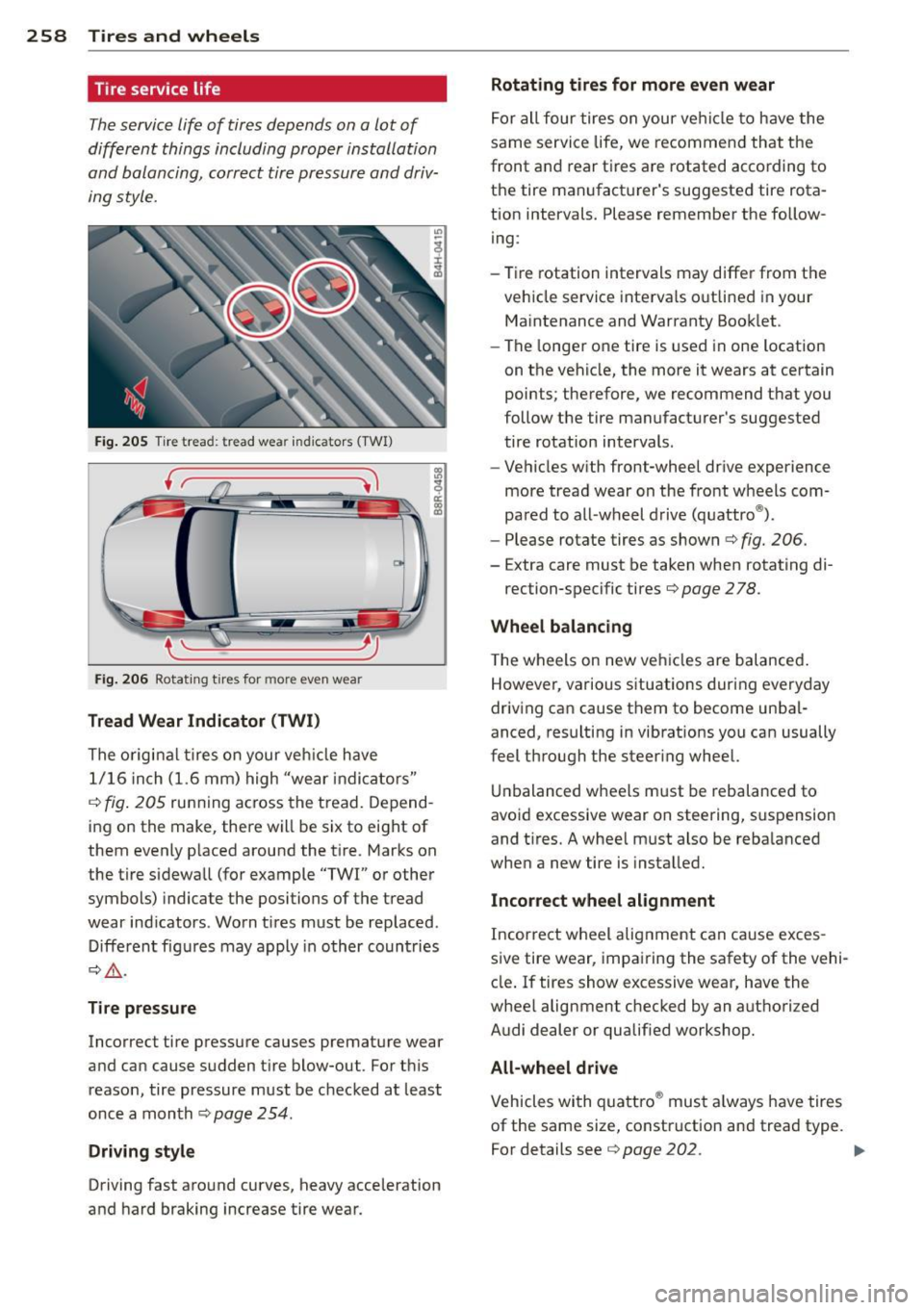
F ig. 20 5 Tire tread: tre ad wea r ind icators (TWI)
F ig. 206 Rotat ing t ires for more ev en wea r
Tread Wear Indicator (TWI)
The o rigi na l tires on your veh icle have
1/16 inch (1.6 mm) high "wear indicators"
c::> fig . 205 running across the tread. Depend
i ng on the make, there will be six to eight of
them evenly p laced around the t ire. Marks on
the tire sidewa ll (for example "TWI" or other
symbols) indicate the positions of the tread
wear ind icators . Worn t ires must be replaced .
Different fig ures may apply in o ther countries
c::> & .
Tire p ressure
Incorrect tire pressure causes premature wear
a nd can cause sudden t ire blow-out. For th is
reason, tire pressure must be checked at least
once a month
c::> page 254.
Driving style
Driving fast aro und curves, heavy acce leration
and hard braking increase tire wear.
Rotating tires for more even wear
F or all four tires on your ve hicl e to h ave the
same service life, we recommend that the
front and rear t ires are rotated according to
the tire manufacturer's suggested tire rota
tion intervals. Please remember the follow
ing :
- Tire rotation intervals may differ from the
vehicle service inte rva ls o utlined in your
Ma intenance and Warranty Book let .
- The longer one tire is used in one location
on the vehicle, the more it wears at certain
points; therefore, we recommend that you
follow the tire manufact urer's suggested
tire rotation intervals .
- Vehi cles w ith front-wheel dr ive experience
more tread wear on the front wheels com
pa red to all-wheel drive (quattro ®).
- Please rotate tires as shown
c::> fig. 206.
-Extra care must be taken when rotating di-
rection-specific tires
c::> page 278 .
Wheel balancing
The wheels on new ve hicles are balanced .
However, various situations during everyday
driving can cause them to become unbal
anced, re sulting in vibrat ions you can usually
feel through the steer ing wheel.
Un balanced whee ls must be rebalanced to
avoid excessive wear on steering, suspension
and t ires. A whee l m ust also be reba lanced
when a new tire is insta lled.
Incorrect wheel alignment
Incor rect wheel alig nment can cause exces
sive tire wear, impairing the safety of the veh i
cle . If tires show excessive wear, have the
whee l alignment checked by an authori zed
Audi dealer or qualif ied workshop .
All-wheel driv e
Vehicles with q uattro ® mus t always have tires
of the same size, construction and tread type .
For details see
c::> page 202 . ..,.
Page 312 of 316
310 Index
Selector lever ..... ..... ... .. .. .... . 123
Emergency release . . . . . . . . . . . . . . . . . 128
Service and disposal
Safety belt p retens ioner . .. .. .. .. .. .
156
Service interval d isp lay ....... ... .. .. .. 22
Service pos ition for windshield wipers .. . 55
SET button . . . . . . . . . . . . . . . . . . . . . . . . . 1 1
Shift buttons .............. .. .. .... . 127
Ship transport ...................... 106
Side airbags
Descr ipt ion . .............. ... .. ...
172
H owtheywork .................... 174
Side assist
Ac tiva ting and deactivating . .. .. .. .. .
118
Adjusting the brightness ............ 118
C leaning sensors .............. .... 2 19
D escr ipt ion ... ........... .. .. .... . 116
Sensor range . . . . . . . . . . . . . . . . . . . . . 117
Side curta in airbags ........ .. .. .. .. . 175
Descr ipt ion . .............. ... .. ... 175
H owtheywo rk .................... 176
Safety instructions ......... ... .. .. . 177
Side marker lights ................... 49
Snow chains .... ... .... ... .. .. .... . 264
Socket .. ... ................... ... .. 75
Sound system display
Driver information display . . . . . . . . . . . .
20
Sources o f informat io n about c hild re-
straints and their use .. ... .. .. .. .... .
19 6
Speedometer ... .... ...... .. .. .. .. .. 13
Speed rating letter code ..... .. .. .. .. . 260
Speed warn ing system ................ 93
Start-Stop-System . . . . . . . . . . . . . . . . . . . 91
Eng ine does not switched off ... ...... 92
E ng ine starts automatically .......... 92
Ind icator lights . . . . . . . . . . . . . . . . . . . . 92
M essages . . . . . . . . . . . . . . . . . . . . . . . . . 93
S tarting/stopping the eng ine . .. .... .. 92
Sw itching off/on . ..... ... .. .. .... .. 93
START ENGINE STOP button (Conven ience
key) . . . . . . . . . . . . . . . . . . . . . . . . . . .
86, 87
Starting from rest .......... .. .. .... .. 90
Starting off with a tra ile r .. .. .. .. .. .. . . 90
Starting the eng ine . . . . . . . . . . . . . . 83, 86
Start ing (engine) . . . . . . . . . . . . . . . . . . . . 98
Stee ring
E lectromechanical power assist . . .
201, 0
Indicator light ... ... .. ..... ... .. .. 201
Locking the steering ............... . 83
Malfunction . . . . . . . . . . . . . . . . . . . . . . . 31
Manually adjusting the steering wheel . . 83
also refer to Electromechanical power as-
s ist ......... ....................
201
Steering wheel column
Adjusting manually .............. .. .
83
Steps for determin ing correct load limit . 257
Stopping the eng ine . . . . . . . . . . . . . . 85, 87
Stopping (engine) ... .............. .. . 98
Storage ............................ 76
Cu pholder door pockets . . . . . . . . . . . . . . 7 4
G love compartment . . . . . . . . . . . . . . . . .
76
Sun shade ........ .. .............. .. 54
Sun visors .. .. .. .. .. ........... .... . 54
Supplementa ry (climate contro l) ... .... . 82
Switches
Emergency flashe rs . . . . . . . . . . . . . . . . .
52
Symbols
Red ..............................
28
Yellow .... .... .. ............. .... . 31
T
Tachometer ..... .. ............. .... . 11
Technical modifications .......... .... 298
Tether anchors .. .................. . 194
Tether strap . ..... ... .. ..... ... .. .. 194
T he first 1,000 miles (1,500 km) and after -
wa rds .............................
205
Tie-down rings . . . . . . . . . . . . . . . . . 68, 146
tiptronic ... .... .. .. ... ..... ... .. .. 123
Automatic Shift Lock (ASL) ... .... . .. 124
Driving . .. .. .. .. ............. .. .. 125
Emergency mode .... .......... .. .. 128
Hill descent control .............. .. 126
K ick -down ........................ 127
Manual shift prog ram .. ....... ... .. 127
Se lector lever .. .. ............. .. .. 123
Tire Mobility System . . . . . . . . . . . . 104, 272
T ire pressure . ... .. .. .... .... ... .. .. 254
T ire pressure mon itoring system ....... 266
Loss of ai r pressure . . . . . . . . . . . . 16, 267