wheel AUDI Q5 2013 Owner's Guide
[x] Cancel search | Manufacturer: AUDI, Model Year: 2013, Model line: Q5, Model: AUDI Q5 2013Pages: 316, PDF Size: 78.89 MB
Page 181 of 316
-Always install rear-facing child safety
seats on the rear seat.
- If you must install a rearward facing
child safety seat on the front passenger
seat in exceptional circumstances and
the
PASSENGER AIR BAG OFF light does
not come on and stay on, immediately
install the rear-facing child safety seat in
a rear seating position and have the air
bag system inspected immediately by
your Audi dealer.
_& WARNING
If, in exceptional circumstances, you must
install a forward-facing child restraint on
the front passenger's seat:
- Always make sure the forward-facing
seat has been designed and certified by its manufacturer for use on a front seat
with a passenger front and side airbag.
- Always follow the manufacturer's in
structions provided with the child safety
seat or carrier.
- Always move the passenger seat into its
rearmost position in the seat's fore and
aft adjustment range, as far away from
the airbag as possible before installing
the child restraint. The backrest must be
adjusted to an upright position .
- Always make sure that the
PASSENGER
AIR BAG OFF
light comes on and stays
on all the time whenever the ignition is
switched on.
(D Tips
Always replace child restraints that were
installed in a vehicle during a crash. Dam
age to a child restraint that is not visible
could cause it to fail in another collision
situation.
Advanced front airbag system and children
Your vehicle is equipped with a front "Ad
vanced Airbag System" in compliance with United States Federal Motor Vehicle Safety
Child Safety 1 79
Standard (FMVSS) 208 as applicable at the
time your vehicle was manufactured.
The Advanced Airbag system in your vehicle
has been certified to meet the "low-risk" re
quirements for 3- and 6-year old children on
the passenger side and small adults on the driver side. The low risk deployment criteria
are intended to reduce the risk of injury
through interaction with the airbag that can
occur, for example, by being too close to the
steering wheel and instrument panel when
the airbag inflates . In addition, the system
has been certified to comply with the "sup
pression" requirements of the Safety Stand
ard, to turn off the front airbag for infants up
to 12 months who are restrained on the front
passenger seat in child restraints that are list
ed in the Standard.
Even though your vehicle is equipped with an
Advanced Airbag system, all children, espe cially those 12 years and younger, should al
ways ride in the back seat properly restrained
for their age and size. The airbag on the pas
senger side makes the front seat a potentially dangerous place for a child to ride . The front
seat is not the safest place for a child in a for
ward-facing child safety seat. It can be a very
dangerous place for an infant or a larger child
in a rearward-facing seat .
Advanced Airbags and the weight
sensing mat in the front seat
The Advanced Airbag System in your vehicle
detects the presence of an infant or child in a
child restraint on the front passenger seat us
ing the weight -sensing mat in the seat cush
ion and the sensor below the safety belt latch
on the front passenger seat that measures the
tension on the safety belt.
The weight -sensing mat measures total
weight of the child and the child safety seat
and a child blanket on the front passenger seat. The weight on the front passenger seat
is related to the design of the child restraint
and its "footprint", the size and shape of the
bottom of the child restraint as it sits on the ..,.
•
•
Page 199 of 316
Intelligent technology Notice about data
recorded by vehicle
control modules
Your vehicle is not equipped with an Event Da
ta Recorder (EDR), installed by some manu
facturers for the express purpose of capturing
data for retrieval after an accident or crash
event. EDR's are sometimes called "crash re
corders".
Some state laws restrict the retr ieval or down
loading of data stored by EDR's that were in
stalled in a vehicle for the express purpose of
retrieving data after an accident or crash
event without the owner's consent.
Although your vehicle is not equipped with an
EDR, it is equipped with a number of electron
ic control modules for various vehicle systems
such as, for examp le, engine function, emis
sion control, as well as for the airbags and
safety belts.
These electronic control modules also record
vehicle-related data during norma l vehicle op
eration for diagnostic and repair purposes.
The recording capacity of the electronic con
trol modules is limited to data (no sound is re
corded) and only a small amount of data is ac
tually recorded over a very limited period of
time and stored when a system fault or other
condition is sensed by a control unit. Some of
the data then stored may relate to vehicle
speed, direction, braking as we ll as restraint
system use and performance in the event of a
crash or other condition. Stored data can only be read and downloaded with special equip
ment.
Electronic Stabilization
Control (ESC)
Description
The Electronic Stabilization Control (ESC) rein
forces driver safety. It reduces the risk of slip
ping and improves driving stability. ESC de
tects critical s ituations such as the vehicle
Intelligent technology 197
oversteering and understeering or the whee ls
spinning . The vehicle is stabilized by applying
the brakes or reducing eng ine torque . Once
the ESC is active, the indicator light
G1 blinks
in the instrument cluster.
ESC includes the anti-lock brake system (ABS),
brake assist system, anti-slip regulation
(ASR), electronic differential lock (EDL), dy
namic steering*, hill descent assist and selec
tive wheel torque control.
Anti-lock braking system (ABS)
ABS prevents the whee ls from locking up
when braking . The vehicle can still be steered
even during hard braking. App ly steady pres
sure to the brake pedal. Do not pump the ped
al. A pulsing in the brake pedal indicates that
the system is helping you to brake the vehicle .
Brake assist system
The brake assist system can decrease braking
distance. It increases braking power when the
driver presses the brake pedal quickly in emer
gency situations . You must press and hold the
brake pedal until the situation is over . In
vehicles with adaptive cruise control*, the
brake assist system is more sensitive if the
distance detected to the vehicle ahead is too
small.
Anti-slip regulation (ASR)
ASR reduces engine power when the drive
wheels beg in to sp in and adapts the force to
the road conditions. This makes it easier to
start, accelerate and drive up hill s.
Electronic differential lock (EDL)
The EDL brakes wheels that are spinning and
transfers the drive power to the othe r whee ls .
T his function is available up to about 78 mph
(125 km/h) .
In extreme cases, EDL automatically switches
off to help keep the brake on the braked wheel
from overheat ing. EDL will switch on again au
tomatically when conditions have returned to
normal.
•
•
Page 200 of 316
198 Intelligent technology
Dynamic ste ering *
On vehicles with dynamic stee ring* , ES C helps
stabilize the st eering in critical s ituations .
Selective wh eel torque c ontrol
The selective whee l torque control operates
when dr iv ing through curves . T he front wheel
on the inside of the curve or both wheels on
the inside of the curv e are braked selective ly
as needed. This m inimizes sliding in the front
wheels and allows for more pr ecise driving
through curves . T he system may not act ivate
when driving in wet or snowy cond itions .
A WARNING
-ESC, ABS, ASR, EDL dynamic steering"
and the se lective wheel torque control
cannot overcome the laws of physics .
Th is is especially important on slippery
or wet roads.
If the systems begin act ing
to stabilize yo ur vehicle , you sho uld im
med iately change your speed to ma tch
the road and traffic condit ions. Do not
let the increased safety provided by
these systems tempt you to take risks. Do ing so wi ll increase the risk of a loss of
vehicle control, collision and serious per
sonal injuries .
- Always adapt your speed to road, traff ic
and weather condit ions. The risk of Los-
-
ing cont ro l of the veh icle increases when
dr iv ing too fast, especially th rough
c u rves and on slippery o r wet roads, and
when d riving too close to vehi cles up
ahead. ESC, A BS, the brake assis t sys
tem, AS R, EDL, dynamic steering* and
the se lective wheel torque control can
not prevent collis ions.
-Always acce lerate with specia l care on
even, smooth surfaces s uch as those that
are wet or covered with ice and snow.
The drive wheels can spin even with
these ass istance systems that cannot al
ways help to reduce the risk of loss of ve
hicle control.
(D Tips
- ABS and ASR only wo rk correctly when
all four wheels are equipped with identi
cal tires. Different tire si zes can lead to a
reduction in engine power .
- Yo u may hear noises when the systems
described are working.
- If the ind icator light
DJ or E (USA
mode ls)/ m] (Canada models) appears,
there may be a malfunction
q page 15 ,
q page 17.
-When i nstalling a factory -supplied roof
rack system on the roof railing, the ESC
will adapt itse lf to a different center of
gravity .
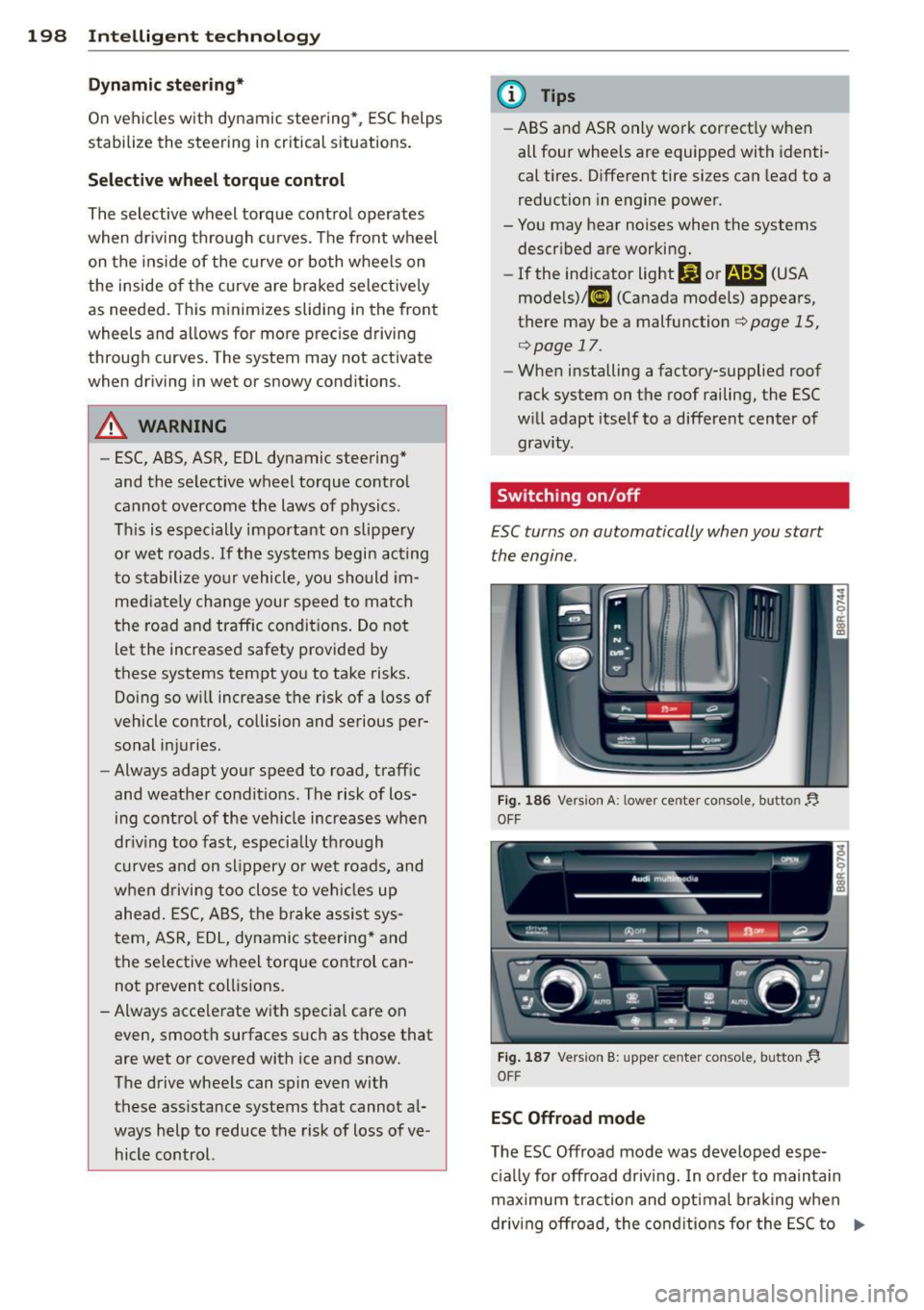
Switching on/off
ESC turns on automatically when you start
the engine.
F ig. 1 86 Vers ion A: l owe r ce nte r con so le, butto n YJ
OFF
Fig. 1 87 Version B: upper cente r console, button YJ
OFF
ESC Offroad mode
The ESC Off road mode was developed espe
c ia lly for offroad driving . In o rder to maintain
max imum trac tion and optimal b raking when
driv ing offroad, the cond it ions for the ESC to
IJII,
Page 201 of 316
work are reduced to such a degree , that the
vehicle wheels could start to spin. The stab i
liz ing effects start to work later which results
in lim ited vehicle stability.
The ESC Offroad mode should then be used
under the fo llowing situat ions:
- rock ing the veh icle when it is stuck
- driv ing in deep snow or on loose ground
- dr iv ing on uneven roads w ith the wheel
heavily loaded (axle limitation)
- driv ing with snow chains
- driv ing downh ill wh ile braking on loose
ground
F or your safety, switch off the ESC offroad
mode in advance .
Switching on th e ESC Offroad mode
Press the I~ O FF I bu tton ¢ fig. 186 or
¢ fig . 187 . The indicator light fl illuminates
and
Stabil iz ation cont rol (ESC ): Off road.
W arning! Re stri cted stability
appears in the
driver information system display .
Switching off the ESC Offroad mode
Press 1-~ O FF I button again to switch the ESC
back on. The indicator light
fl goes out and
Stabilization control (ESC ): On appears in
the driver information system display.
A WARNING
- You should switch on the ESC Offroad
mode only when you are driving offroad
o r when driving w ith snow chains .
- Please note that the driving wheels can
spin and the vehicle can swerve when
ESC Offroad mode is switched on .
- Driv ing stability is reduced in the ESC
Offroad mode .
-
Intelligent technolog y 199
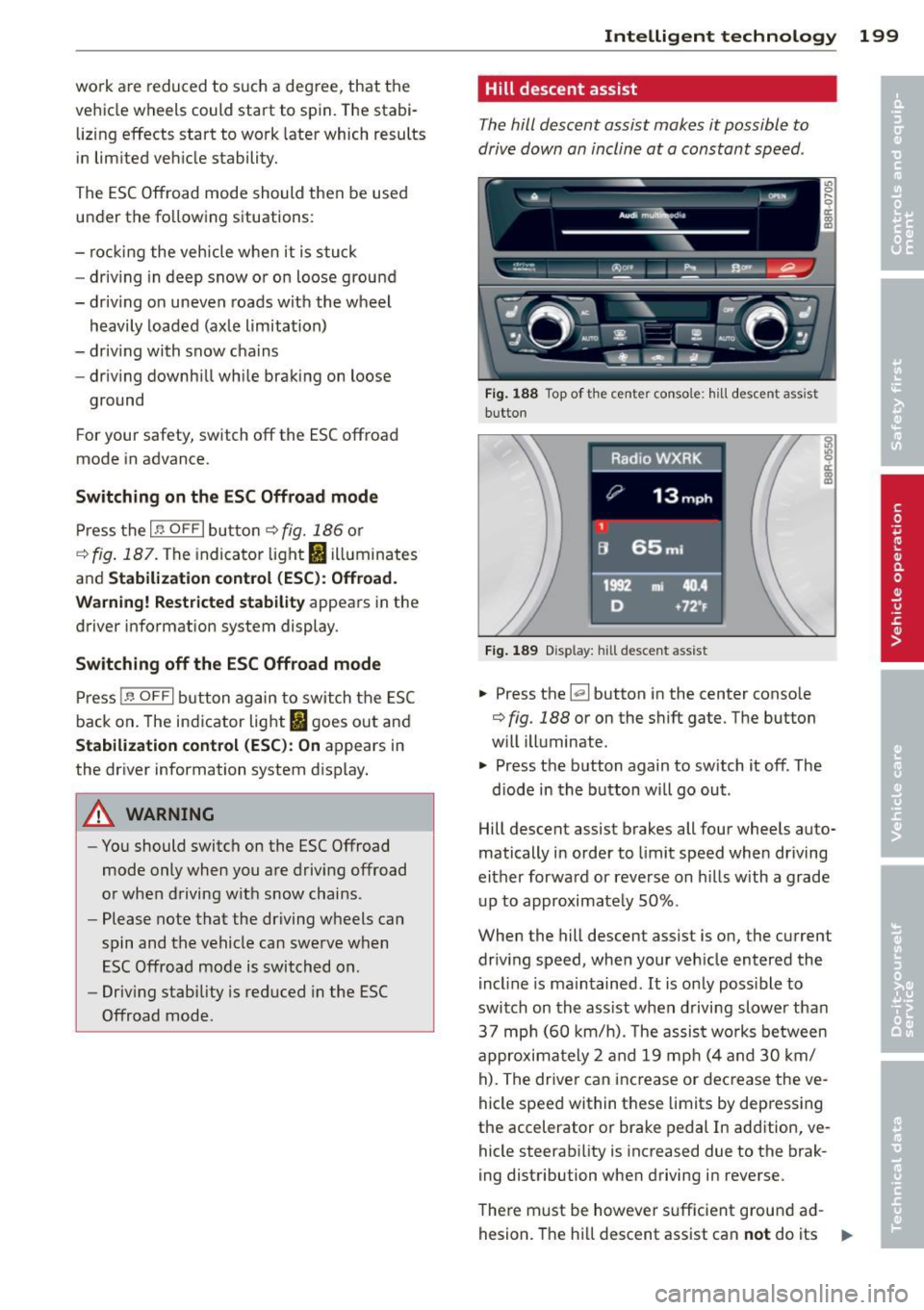
Hill descent assist
The hill descent assist makes it possible to
drive down an incline at a constant speed .
Fig . 1 88 Top of t he center conso le : h ill desce nt ass ist
button
F ig . 1 89 Disp lay: h ill des cent ass ist
.. Press the [el button in the center conso le
¢ fig. 188 or on the shift gate . The button
w ill illuminate .
.. Press the button again to sw itch it off . The
diode in the button wi ll go out .
Hill descent assist brakes all four wheels auto
matically in order to limit speed when driving
either forwa rd or reverse on h il ls with a grade
up to approximate ly 50% .
When the hill descent assist is on, the current
driv ing speed, when your veh icle entered the
i ncl ine is maintained .
It is only possible to
switch on the ass ist when driving slower tha n
37 mp h (60 km/h). The assist wo rks between
approximately 2 and 19 mp h (4 and 30 km/
h). The driver can inc rease or dec rease the ve
hicle speed within these limits by dep ressing
the accelerator or brake pedal In add ition, ve
hicle steerability is increased due to the brak
i ng distribution when driving in reverse .
The re m ust be however s ufficient ground ad
hesion. The h ill descent assist can
not do its "'"
Page 203 of 316
Fa u lts in th e brake sy stem
If you should notice a sudden increase in
brake peda l travel, then one of the two brake
circuits may have failed~.&. .
Low brak e flu id level
Malfunct ions can occur in the brake system if
the brake fl uid leve l is too low . T he b rake fluid
l eve l is monito red electronically .
Brake booster
The brake booster increases the pressure that
you generate w ith the brake pedal.
It only op
e rates while the eng ine is running or with the
i gnit ion sw itched on (hybr id dr ive*) ~.&, .
Brake lining wear statu s
Brake lining wear may be checked by visual in
spection of the condition of the brake pads
through the openings in the whee l. If neces
sa ry, the wheel may be removed for this in
spection
~ page 2 74, Changing a wheel.
.&_ WARNING
=
- You should perform braking maneuvers
for the purpose of clean ing the brake
system on ly if road conditions permit.
Other road users must not be put at risk -
you may cause an acc ident!
- Before descending a steep grade, reduce
speed and shift transmiss ion into a lower
gear or lower driving range . Do not ride
the brakes or hold the pedal down too long or too often . This could cause the
brakes to get hot and dimin ish b raking
efficiency .
- Do not "ride the brakes" by resting your
foot on the pedal when you do not intend
to brake . Th is may cause the b rakes to
overheat, premat ure wear and increased
stopping distance .
- Under certain climat ic and operating
condit ions such as passing through wa
ter , driving in heavy rain or after wash ing
the vehicle, the effectiveness of the brakes can be reduced. In winter, ice can
accumulate on the brake pads, linings,
discs and drums . Carefully apply brakes
Int ellig ent technolog y 201
for a test. Brakes will dry and ice coat
ings w ill be cleaned off after a few care
ful brake applicat ions.
- Driving for an extended period of time on
salt-covered roads without using your
brakes can also affect braking efficiency.
Clean off accumulated salt coating from
brake discs and pads with a few careful
brake applications.
- If you damage the front spoiler, or if you install a different spoiler, be sure the air
f low to the front brakes is not obst ruct
ed. Otherw ise the brake system could
overhea t reducing the effectiveness of
the entire brake system .
- Failure of one brake circuit will impair
the braking capability resulting in an in
creased stopping distance . Avoid driving
the vehicle and have it towed to the near
est a uthori zed Audi dea ler or qualified
workshop.
- Never let the vehicle roll to a stop with
the engine shut off .
- If the brake booster is not working, for
examp le when towing your vehicle, or
because the brake booster has somehow
been damaged, the brake pedal must be
pressed considerably harder to make up
for the lack of booster assistance .
Electromechanical
power assist, Dynamic
steering
The electromechanical power assist helps the
driver when s teering.
Power ste ering adapts electronically based on
the vehicle speed.
Indicator lights an d m ess age s
• Steeri ng defe ctive ! D o n ot dr ive vehi cle!
If this indicator light turns on and stays on
and this message appears, the power steer ing
may have failed .
Stop the vehicle in a safe location as soon as poss ible . Do
no t continue driving . See your ..,.
•
•
Page 204 of 316
202 Intelligent technology
authorized Audi dealer or other qualified re
pair facility for assistance.
'I-ij Dynamic steering: System fault! You can
continue driving
If the indicator light turns on and the mes
sage appears, the steer ing may be more diffi
cul t to move or mo re sensitive than usual. The
steer ing may also be at an angle when driving
straight.
Drive slowly to your author ized Audi dealer or
qualified workshop to have the malfu nction
cor rected.
(;:r,ij Dynamic steering : Initializing
Aud i drive select": if the indicator light blinks
and the driver message appears, the dynam ic
steering* is reinitialized. Once you start the
engine after this is finished, the steering
wheel will be easy to move. Re-initialization might be necessary if the steering wheel was
moved hard to the left and right while the ve
hicle was not moving. The display turns off if
the initialization was successfu l.
(D Tips
-If the . or 'Tj indicator light only stays
on for a short time, yo u may continue
driving.
- The dynamic steering* stability systems
opoge 197 are not ava ilable in the event
of a system malfunction.
- For additional information on dynamic
steering*
o page 120 .
Driving with your
quattro ®
With all-wheel drive, all four wheels are driv
en .
General information
With all-wheel dr ive, power is distributed to
all four wheels. This happens automatically
depending on your dr iving style and the road
conditions at the time . See also ¢
page 197.
A center different ial distr ibutes the dr iv ing
power var iably to the front and rear axle.
It
works together with selective wheel torque
control, which activates when driving through
curves
¢ page 198.
The all-wheel drive concept is des igned for
high engine power. Your veh icle is exception
ally powerfu l and has excellent driving charac
teristics both under normal driving conditions
and on snow and ice. Always read and follow
safety precaut ions¢ &.
Winter tires
When driving in the winter, yo ur vehicle with
all -wheel drive has an advantage, even with
regular tires. In winter road conditions it may
be advisable to mount winter tires (or all-sea
son tires) for improved driveability and brak
ing: these tires must be mounted o n
all four
wheels .
See also¢ page 263, Winter tires.
Tire chains
Where tire chains are mandatory on certain
roads, this normally also app lies to veh icles
with all-wheel drive¢
page 264, Snow
chains.
Replacing wheels/tires
Vehicles with all -wheel drive must always
have tires of the same s ize. A lso avoid tires
with different tread depths. For deta ils see
page
o page 2 59, New tires and replacing
tires and wheels.
A WARNING
-Always adjust your dr iv ing to road and traf-
fic conditions. Do not let the extra safety
afforded by all-wheel drive tempt you into
taking extra risks.
- Altho ugh the all-wheel drive is very ef
fective, always remember that braking
capacity is limited by tire traction. You
should therefore not d rive at excessive
speeds on icy or slippery road surfaces.
- On wet road surfaces, be careful not to
drive too fast because the front wheels
could begin to slide on top of the water
(aquaplaning). If this should occur, you
Page 205 of 316
will have no warning from a sudden in
crease in engine speed as with a front
wheel drive vehicle. A lways drive at
speeds wh ic h are suited to the road con
ditions -risk of crash .
Energy management
Starting ability is optimized
Energy management controls the distribution
of electrical energy and thus optimizes the
availability of electrical energy for starting
the engine.
If a vehicle with a conventional energy system
i s not driven for a long pe riod o f time, the bat
tery is discharged by idling current consumers
(e .g. immobilizer) . In certain circumstances it
can result in there being insufficient energy
avai lab le to start the engine.
I ntelligen t energy management in your vehi
cle hand les the distribution of electrical ener
gy . Starting ability is marked ly improved and
the life of the battery is extended .
Basically, energy management consists o f
batter y diagno sis, idling cur rent man age
m ent
and dyn amic en e rg y m anagement.
Battery diagnosis
B attery d iagnosis continuously dete rmines
the state of the battery. Sensors determ ine
battery vo ltage, battery current and battery
temperature. This determines the current
state of charge and the power of the battery.
Idling curr ent management
Idling current management redu ces energy
consumption while the vehicle is stand ing.
With the ignition switched off, it contro ls the
energy supply to the various electrica l compo
nents . Data from battery diagnosis is consid
ered.
Depending on the battery's state of charge,
individual consumers are grad ually turned off
to prevent excessive discharge of the battery
and thus mainta in start ing capability.
Int ellig ent technolog y 203
Dynamic energy management
While the vehi cle is being driven, dynamic en
ergy management distrib utes the energy gen
erated according to the needs of the individ u
al components. It regulates consumption, so
that more e lectrical energy is not being used
than is being generated and ensures an opti
mal state of charge fo r the battery .
{!) Tips
- But even energy management cannot
negate the limits of physics. Consider
that the power and life of a battery are
limited .
- If start ing ability is threatened, the indi
cator light(•] appears ¢
page 34.
What you should know
The highest priority is given to maintaining
starting capability.
The battery is severe ly taxed in short -distance
driv ing, in city traff ic and during the cold time
of year. Abundant electrical energy is re
quired, but on ly a little is generated . It is also
c rit ical if the engine is not running and electri
ca l components are turned on . In this in
stance ene rgy is be ing consumed but none is
being genera ted .
It is in precisely these situations t hat you will
notice ene rgy management active ly regu lat
i ng the d istribu tion of ene rgy.
Vehicle stands for an extended period
If you do not drive your vehicle over a period
of several days or weeks, electr ical compo
nents are gradually cut back or switched off .
T h is reduces energy consumption and ma in
ta ins start ing capability over a longer pe riod .
Some of the convenience functions may not
operate, such as the interior ligh ts or the
power seat adjustment. The convenience
functions wi ll be available again when you
switch on the ignition and start the engine.
•
•
Page 211 of 316

Driving off road
Driving in difficult road
conditions and offroad
General information
The operation of the E lectronic Stabilization
Control (ESC) is expanded fo r operation away
from paved roads. In situations where slip or a
differential lock ing funct ion is required, the
ESC offroad mode can be act ivated
c> page 197 . Your Audi also has permanent
all-wheel drive in addition .
However, your Aud i is not a pure offroad ve hi
cle . It was not built for driving under extreme
conditions, e .g . for trips that are in the nature
of an expedition .
D riv e only on roads and offro ad sections
which match the des ign of your vehicle and
your abil it ie s as a driver . Ne ver take ri sks!
Before dri ving offroad
- Check the engine oi l level, tire pressure,
coolant leve l, and the fluid level in the w ind
shield washer reservo ir.
- Stow luggage items and other objects in the
lu ggage compartment, and secure them
against slid ing around .
After driv ing offroad
- After trips offroad, remove any twigs and other foreign objects from the grill, the un
derbody and the wheels. Pay specia l atten
t ion to fore ign objects (stones) which have
become lodged in the tire tread.
- Clean the body and the vehicle unders ide,
and inspect the veh icle for possible damage.
- Clean dirty windows, headlamp lenses, rear
lights, and license plates.
- Perform a brake check (particu larly after
trave lling through water) .
A WARNING
- Drive especially attentive ly and plan
ahead in difficult road conditions and
w hen offroad . Excess ive speed or incor-
-
Driving off road 209
rect maneuvers can cause injuries and
damage to the vehicle.
- Always adapt your speed and driving
style to road, offroad, traff ic, and weath
er conditions. Drive especially slowly off
road when your v iew is restricted.
- Please be aware that in ESC offroad
mode, particularly on a smooth and slip
pery road, the wheels may have an in
creased tendency to spin and the vehicle
may break away - danger of skidding!
- Stability is limited in the ESC offroad mode.
@) For the sake of the environment
Avoid damage to the environment and re
spect nature .
(D Tips
Only drive where it is permitted and stay
on marked roads and paths.
Explanation of some technical terms
The following data refer to ideal cond itions .
Depend ing on veh icle load and ground condi
tions and the environment, the numbers may
vary. It is the d rive r's responsibi lity to decide
whethe r a veh icle can overcome a specific s it
u at ion
c::> .&. .
Gradient angle
The number of meters in alt itude ga ined over
a d istance of 109 .4 yards or 100 meters
(grade) a re given as a pe rcentage o r degrees .
Info rmation abou t the gr ad ient the veh icle
can climb under i ts own power (depends in
part on the road surface and engine power).
Max imum permitted grade : 3 1
°
Late ral angle (slope of vehicle )
Ind icates the angle up to which the vehicle
can be d riven diagona lly or across the fall line
on a slope wi tho ut the vehicle tipping over
sideways (depends o n center of gravity) . Maxi-
mum permitted lateral angle: 25 ° .,.
•
•
Page 217 of 316
@ Tips
-Do not tow a traile r during the break-in
period o f your vehicle .
- If you tow a t railer, your A udi may re
quire more frequent maintenance due to
the extra load
¢ page 295.
Parking on a slope
Do not park on a slope with a trailer. If it can
not be avoided, do so only after doing the fol
lowing:
When parking:
.,. Apply t he foo t brake .
.,. Have someone place c hocks under bo th the
vehicle and the trai ler whee ls .
.,. With chocks in p lace, s lowly re lease the
brakes unti l th e wheel chocks absorb the
l oad .
.,. Turn the wheels towards the curb .
.,. Apply t he pa rking brake .
.,. Mov e the sel ecto r leve r to P .
When restarting after parking:
.,. Apply the foot brake .
.,. Start the eng ine .
.,. Move the selecto r lever to D/S .
.,. Re lease th e par kin g b rake and slowly pull
out and away from the whee l cho cks .
.,. Stop and have someone re tr ieve the w hee l
chocks.
(D Tips
If you move the selector lever of t he a uto
mat ic t ran sm ission to P before app lyi ng
t he p ark in g br ake an d bef ore blocking the
wheels, you may have to use mo re force
later to move the lever out of t he P posi
tion.
Trailer towin g 215
•
•
Page 218 of 316
216 Cleaning and protection
Cleaning and protect ion
General information
Regular core preserves vehicle value .
Any automobile is exposed to industr ial
fumes, corrosive road salt, etc. A well cared
for Audi can look like new many years after
p ur chase . Reg ular and correct care w ill con
tr ibute to maintain ing the beauty and valu e of
your Aud i.
Furthermore, good care may be a condition
for substantiating a warranty claim should
corrosion damage or paint defects occur.
Your auth orized Audi dealer has a variety of
dedicated vehicle-care products and can ad
v ise wh ich ones to use for cleaning the ext eri
or a nd inte rior o f you r vehi cle.
Whether you use products recommended by
Aud i or other commercially ava ilable clean ing
agen ts, pleas e make sure you apply t hem cor
r ectly .
A WARNING
-Cleani ng agen ts m ay be poi sonous. Kee p
them o ut of t he rea ch of childre n.
- H eed a ll ca ution labels.
- Always read directions on th e co ntai ner
b efore using a ny produc t. Follow the di
rec tions caref ully.
- Most chemical cleaners a re concentrat ed
and have to be diluted.
- Use spot removing flui ds only i n well
ventila ted areas.
- Do not use gasoline, ke rosene, d iesel
fuel, nail pol is h remov er or ot her volati le
fluid s. T hey may be to xic, flammab le or
h azar dou s in other w ays. D o not was h,
w ax or dry the vehicle wi th the ig nit ion
on or the eng ine running .
- D o not cl ean t he under sides of ch assis,
f en ders, wheel cove rs , etc. without pro
tectin g your hands and a rms. You may
c u t yourself on s harp-ed ged metal parts . -
Moisture and ice on b rakes may impair
brak ing eff ic iency
c::> page 200 , Broke sys
tem .
Test the brakes carefully each t ime
you was h the vehicle .
@ For the sake of the environment
Select on ly environ mentally frien dly clean
i ng products. Leftover cleaning pr oducts
s hou ld not d isposed of in the househo ld
waste .
Care of exterior
Washing
Frequent washing protec ts the vehicle .
The best p rotection against environmen tal i n
fluences is
frequ ent wash ing and waxing . H ow
often t his is requ ire d d epends o n:
- How much t he ve hicle is used
- W he re the veh icle is parked (garage, i n the
open under trees, etc .)
- The seasona l and weather conditions
- Environmental infl uences
T he longer b ird d roppings, inse cts, tree res in,
r oad and indus trial grime, t ar, soo t, ro ad salt
and other mater ials remain on the veh icle
body, the mo re lasting their destr uctive ef
f ects w ill be . Hig h temperatures ca used by ex
pos ure to intense su nlight i ntens ify the c orro
s ive effect, particular ly when hum id ity is high
as wel l.
U nder certa in circumstances,
weekly washing
may be necessary. Unde r other cond itions, a
monthly washing and waxi ng may be ade
quate .
After the winter, the unders ide of the vehicle
sho uld be thoroughly washed, preferab ly in a
professional ca r wash.
Vehicles with matte finish paint*
¢ page 219.
A WARNING
-Always read and heed all WARNINGS and
other in fo rmation¢
page 216.