ECU AUDI Q5 2013 Service Manual
[x] Cancel search | Manufacturer: AUDI, Model Year: 2013, Model line: Q5, Model: AUDI Q5 2013Pages: 316, PDF Size: 78.89 MB
Page 235 of 316
Checking and filling Engine hood
Releasing the engine hood
The engine hood is released from inside the
vehicle .
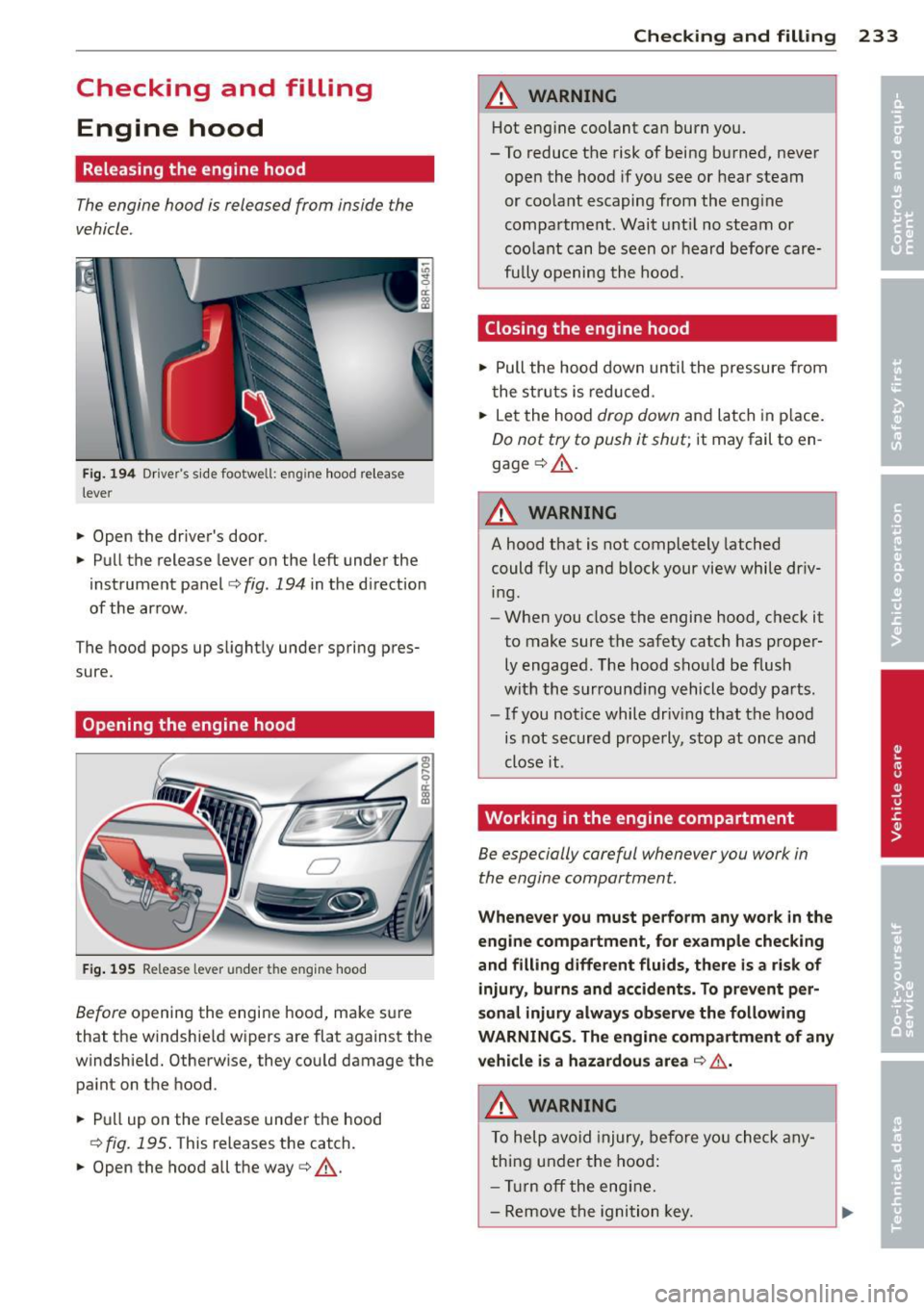
Fig. 19 4 Driver's s ide footwell: engine hood release
lever
"' Open the driver's door .
"' Pull the release lever on the left under the
instrument panel
i=:> fig. 194 in the d irection
of the arrow.
The hood pops up slightly under spring pres
sure.
Opening the engine hood
F ig . 195 Re lease lever under the engine hood
Before opening the engine hood, make sure
that the windshield wipers are flat against the
windshie ld. Otherwise, they could damage the
paint on the hood.
"' Pull up on the release under the hood
c;, fig. 195 . This releases the catch.
"' Open the hood all the way
c::> &,.
Checkin g and fillin g 233
A WARNING
Hot engine coolant can burn you.
- To reduce the risk of being burned, never
open the hood if you see or hear steam
or coolant escaping from the eng ine
compartment. Wait unt il no steam or
coolant can be seen or heard before care
fu lly opening the hood.
Closing the engine hood
"' Pull the hood down un til the pressure from
the struts is reduced.
"' Let the hood
drop down and latch in p lace.
Do not try to push it shut; it may fail to en
gage
c;, &, .
A WARNING
--
A hood that is not completely latched
could fly up and block your view while dr iv
ing.
- When you close the engine hood, check it
to make sure the safety catch has proper
ly engaged. The hood should be flush
with the surround ing vehicle body parts.
- If you notice while driv ing that the hood
is not secured properly, stop at once and
close it .
Working in the engine compartment
Be especially careful whenever you work in
the engine compartment.
Whenever yo u must pe rform any w ork in the
e n g ine com pa rt ment, for e xample ch e cki ng
and filling differ ent fluids, th ere is a risk of
injury , burn s and accid ent s. T o pr eve nt per
so nal injury alwa ys obs erve the foll owing
WARNINGS . Th e en gine co mpa rtm ent of an y
v e hicl e is a hazardou s ar ea
c;, Lh, .
A WARNING ~
To help avoid injury, be fo re you check any
thing under the hood:
- Turn off the engine.
- Remove the ignition key.
Page 258 of 316
256 Tire s and wheel s
-If the tire is not flat and you do not have
to change a wheel immed iately, drive at
reduced speed to the nearest service sta
t ion to check the tire pressure and add
air as required .
(D Note
Driving without va lve stem caps can cause
damage to the t ire valves . To prevent this,
always make sure that factory installed
valve stem caps on all wheels are securely mounted on the
valve .
@) For the sake of the environment
Underinf lated tires will a lso increase the
fue l consumption .
Tires and vehicle load limits
There are limits to the amount of load or
weight that any veh icle and any t ire ca n car ry.
A vehicle that is overloaded w ill not ha ndle
well a nd is more difficult to stop. Over load ing
can not on ly lead to loss of vehicle contro l,
but can a lso damage important parts of the
ve hicle and can lead to sudden tire failure , in
cluding a blowout and sudden deflation that
can cause the veh icle to crash .
Your safety and that of yo ur passenge rs a lso
depends on making sure that load limits are not exceeded. Vehicle load includes everybody
a nd everyth ing in and on the vehicle . T hese
load limits are tech nica lly refe rred to as the
ve hicle 's
Gross V ehicle Weight Rating
("GVWR").
The "GVWR" includes the we ight of the basic
vehicle, all factory insta lled accesso ries, a full
tank of fuel, oi l, coo la nt and othe r fluids pl us
maximum load. The maxim um load includes
the number of passengers that t he vehi cle is
intended to carry ("seating capacity") w ith an
assumed weight o f 150 lbs (6 8 kg) for each
passenger at a designated seating pos ition
and the tota l weight of any l uggage in th e
ve
hicle. If you tow a trailer, the weight of the
trailer hitch and the tongue weig ht of the loaded tra
ile r must be included as part of the
vehicle load .
T he
Gro ss Axle Weight Rating (" GAWR") is
the max imum load th at can be applied at e ach
of the vehicle's two axles .
T he Gross Vehicle Weight Rat ing and the
G ross Ax le Weight Ra ting are listed on the
sa fety comp liance s ticke r label lo cated on the
driver's side B-pillar. Your Audi has 5 seat ing
positions, 2 in the front and 3 in the rear fo r
total seat ing capac ity of 5. Each seating posi
t ion has a seat be lt
c:> page 149, Safety bel ts.
The fact that there is an upper limit to yo ur
vehicle's G ross Vehicle Weight Rating means
that the total weight of whatever is being car
ried in the vehicle ( includ ing the weight of a
tra iler hitch and the tongue weight of the
loaded tra iler) is lim ited . The more passen
gers in the vehicle or passenge rs w ho are
heavier than th e standard we ights assumed
mea n tha t less we ight can be carried as lug
gage .
T he t ire pressure label on your Aud i also lis ts
the max imum combi ned weig ht of a ll of the
occupants and luggage or other cargo that
the vehi cle can carry . For t he lo ca tion of the
label <=>page 252, fig. 203.
A WARNING
Overloading a vehicle can cause loss of ve
hi cle cont ro l, a c rash or other accident, se
rious personal injury, and even death.
- Ca rrying more we ight than your veh icle
was des igned to carry wi ll prevent the
veh icle from handling pr operly and in
crease the risk of the loss of vehicle con
trol.
- The brakes on a vehicle that has been
overloaded may not be able to stop the
veh icle w ith in a safe distance.
- Tires on a vehicle that has been overload
ed can fail s uddenly, including a blowout
a nd sudden defla tion, causing loss of
contro l and a c rash .
~
Page 267 of 316
driving a few yards and correct if neces
sary . Follow the instructions from the
snow cha in manufacturer when doing so.
(D Tips
Where snow chains are mandatory oncer
tain roads, this norma lly also applies to
veh icles with all-whee l dr ive .
Wheel bolts
Wheel bolts must always be tightened to the
correct torque.
The design o f whee l bolts is matched to the
factory insta lled r ims . If different rims are fit
ted, the correct wheel bo lts wit h the right
l ength and correctly shaped bolt heads must
be used. This ensures that wheels are f itted
securely and that the brake system functions
correctly .
In certain circumstances, you may not use
wheel bo lts from a different vehicle -even if it
is the same model<=>
page 297.
A WARNING
Improperly tightened or maintained wheel
bolts can become loose caus ing loss of
cont ro l, a co llision and serious persona l in
Jury .
- Always keep the w heel bolts and the
threads in the wheel hubs clea n so the
w hee l bolts can t urn easily and be p rop
erly t igh tened.
- Never grease or oil the wheel bolts and
the threads in the wheel h ubs. They can
become loose wh ile d riving if greased or
oiled, even if tightened to the specified
torq ue.
- Only use whee l bo lts that belong to the
rim being installed .
- Never use different whee ls bolts on your
vehicle.
- Alw ays m ain ta in the co rrec t tig hten ing
torq ue fo r the wheel bo lts to reduce the
risk of a wheel loss . If the tightening tor
que of the wheel bo lts is too low, they
can loosen and come out when the vehi-
Tire s an d wheel s 265
cle is mov ing. If the tightening torq ue is
too high, the wheel bolts and threads
can be damaged and the whee l can be
come loose.
@ Note
The specified torque for the whee l bolts is
105 ft lb (140 Nm) with a to lerance of
± 7,4 ft lb(± 10 Nm). Torque wheel bolts
diagonally . After changi ng a wheel, the
torque m ust be checked as soon as poss i
ble with a to rque wrench -preferably by an
a uthorized Aud i dea le r or qualified wor k
shop.
Low aspect ratio tires
Your A udi is fac tory -eq uipped w ith low aspect
ratio tires . These tires have been tho ro ughly
tested and been se lected specifically for your
model for their superb performance, road fee l
and handling under a variety of driving condi
tions . Ask your authorized Aud i dealer for
more details.
The low aspect ratio of these t ires is ind icated
by a numeral of
55 or less in the tire's size
designation. The numera l represents the ratio
of the tire's sidewa ll height in relation to its
tread width exp ressed in percentage. Conven
tiona l tires have a he ight/w idth ratio of 60 or
more.
The performance of low-a spect-r atio tire s is
particularly sensit ive to improper inflation
pre ssure. It is therefor e important that low
a spect ratio tire s are inflated to the specified
pres sure and that th e inflation pr essure i s
regularly checked and maintained. Tire pre s
sure s should be chec ked at lea st once a
month and always before a long trip
<=> page 2 54, Checking tire pressure.
What you can do to avo id tire and rim
damage
Low aspect ratio tires can be damaged mo re
easily by impact w ith potholes, curbs, gull ies
or ridges on the road, particularly if the tire is
under inflated . ..,.
•
•
Page 271 of 316
What do I do now?
Jack, tools and
inflatable spare tire
Onboard tool kit and vehicle jack
The vehicle tools and vehicle jack* are stored
in the luggage compartment under the floor
cover.
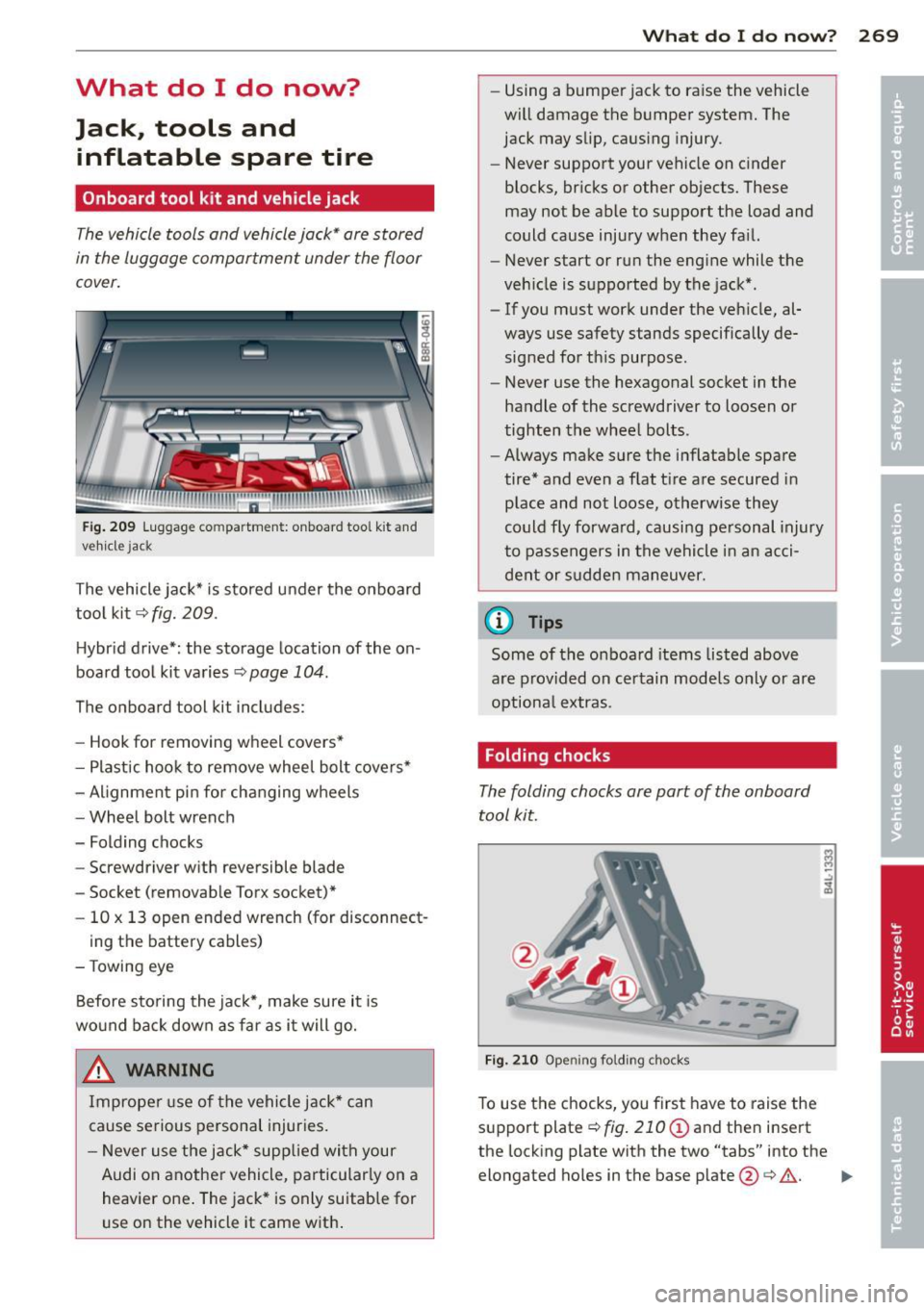
Fig . 209 Luggage co mpa rtment: onboard too l kit and
v e hicle jack
The vehicle jack* is sto red under the on board
tool kit¢
fig. 209.
Hybr id drive*: the storage location of the on
board tool kit varies
¢ page 104.
The on board tool kit includes:
- Hook for removing wheel covers*
- Plastic hook to remove wheel bolt covers*
- Al ignment p in for changing wheels
- Wheel bolt wrench
- Folding chocks
- Screwdriver with reversible blade
- Socket (removable Torx socket)*
- 10 x 13 open ended wrench (for disconnect-
ing the battery cables)
- Towing eye
Before storing the jack*, make sure it is
wound back down as far as it will go.
A WARNING
Imprope r use of the vehicle jack* can
cause serious personal injuries.
- Never use the j ack* supplied with your
Audi on another vehicle, particularly on a heavier one . The jack* is only suitable for
use on the vehicle it came with .
What do I d o now ? 269
-Using a bumper jack to ra ise the vehicle
will damage the bumper system. The
jack may slip, causing injury.
- Never support your vehicle on cinder
blocks, br icks or other objects. These
may not be able to support the load and
could cause injury when they fa il.
- Never start or run the engine while the
veh icle is supported by the jack* .
- If you must work under the vehicle, al
ways use safety stands specifically de signed for th is purpose .
- Never use the hexagonal socket in the
handle of the screwdriver to loosen or
tighten the wheel bolts .
- Always make sure the inflatable spare
tire* and even a flat tire are secured in
place and not loose, otherwise they
could fly forward, causi ng personal injury
to passengers in the vehicle in an acci
dent or sudden maneuver.
(0 Tips
Some of the on board items listed above
a re provided on certain models only or are
optiona l extras.
Folding chocks
The folding chocks are part of the on board
tool kit.
Fig . 210 Ope ning folding chocks .
To use the chocks, you first have to raise the
support plate¢
fig. 210 (D and then insert
the locking plate with the two "tabs" into the
elongated holes in the base plate@¢& . ""
Page 272 of 316
2 70 What do I do now ?
& WARNING
-The ch ock cannot fulfil its function and
may lose its stab ility if t he "tabs" on the
s u pport plate are not inserted cor rectly
in to the elongat ed ho les i n th e b ase
pla te. If th is happens, the veh icle may
sta rt to move wh ile a wheel is being
change d.
- N ever u se the f old ing chocks if they are
damaged o r if th ey have no t been assem
bled correc tly .
Removing bass box
Appl ies to vehicles: wit h bass box
Before the inflatable spare tire" can be taken
out, the bass box mus t be removed.
Fig . 211 Spare w hee l well : Bas s box
Removing bass box
., Lift up the cargo floor using the hand le .
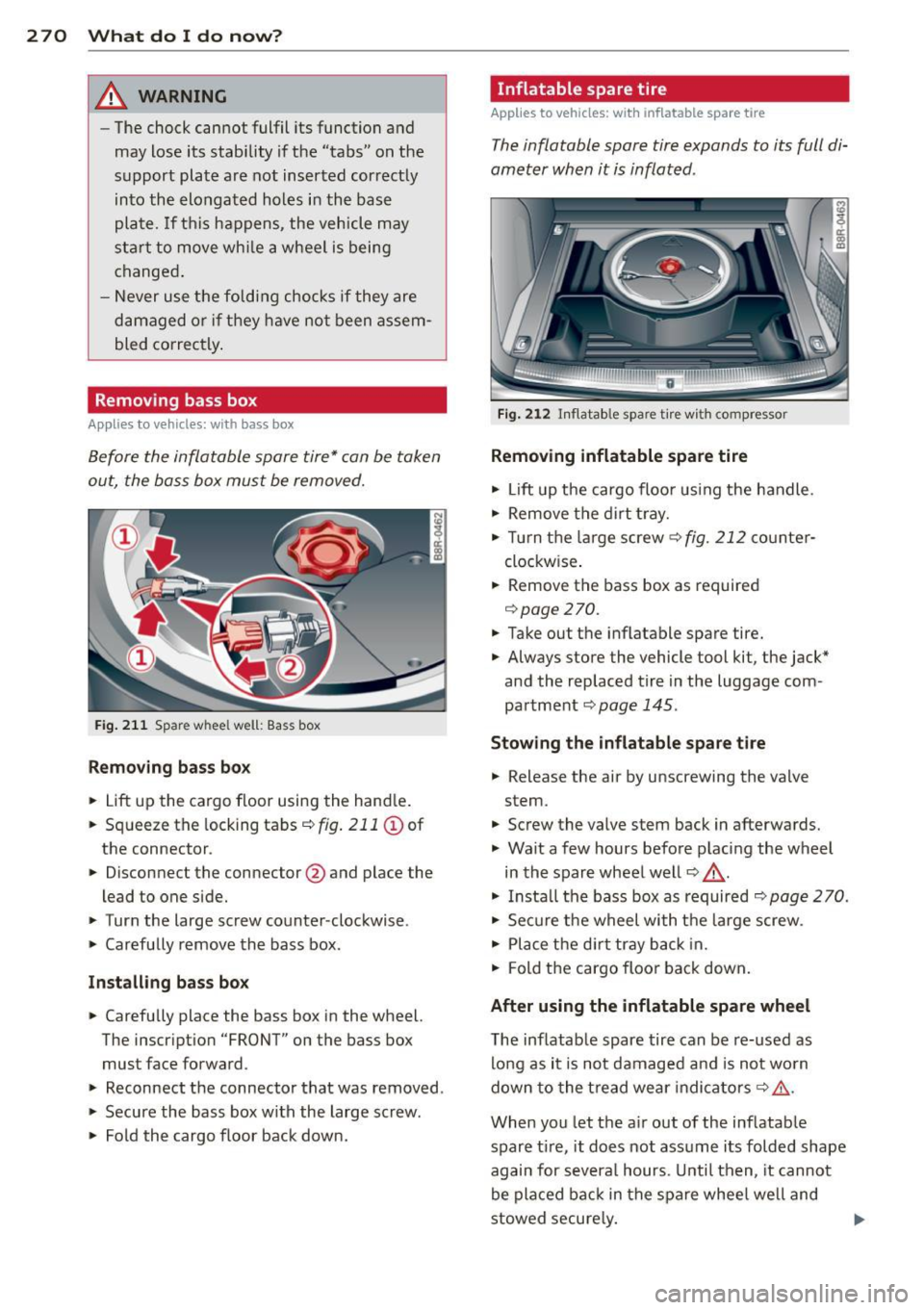
., Sq ueeze the locking ta bs
c:::> fig . 211 © of
the connector .
., Disconnect the connector @and place the
l ead to one side.
., Turn the large screw counter -cloc kwise .
., Carefully remove the bass box .
Installing bass box
., Carefully place the bass box in the wheel.
The inscr ipt io n "FRO NT" on the bass box
must face forward .
., Reconnect the connector that was removed .
., Secure the bass box wi th the large sc rew.
., Fold the cargo floor back down.
Inflatable spare tire
Applies to vehicles: w ith inflatable spare t ire
The inflatable spare tire expands to its full di
ameter when it is inflated .
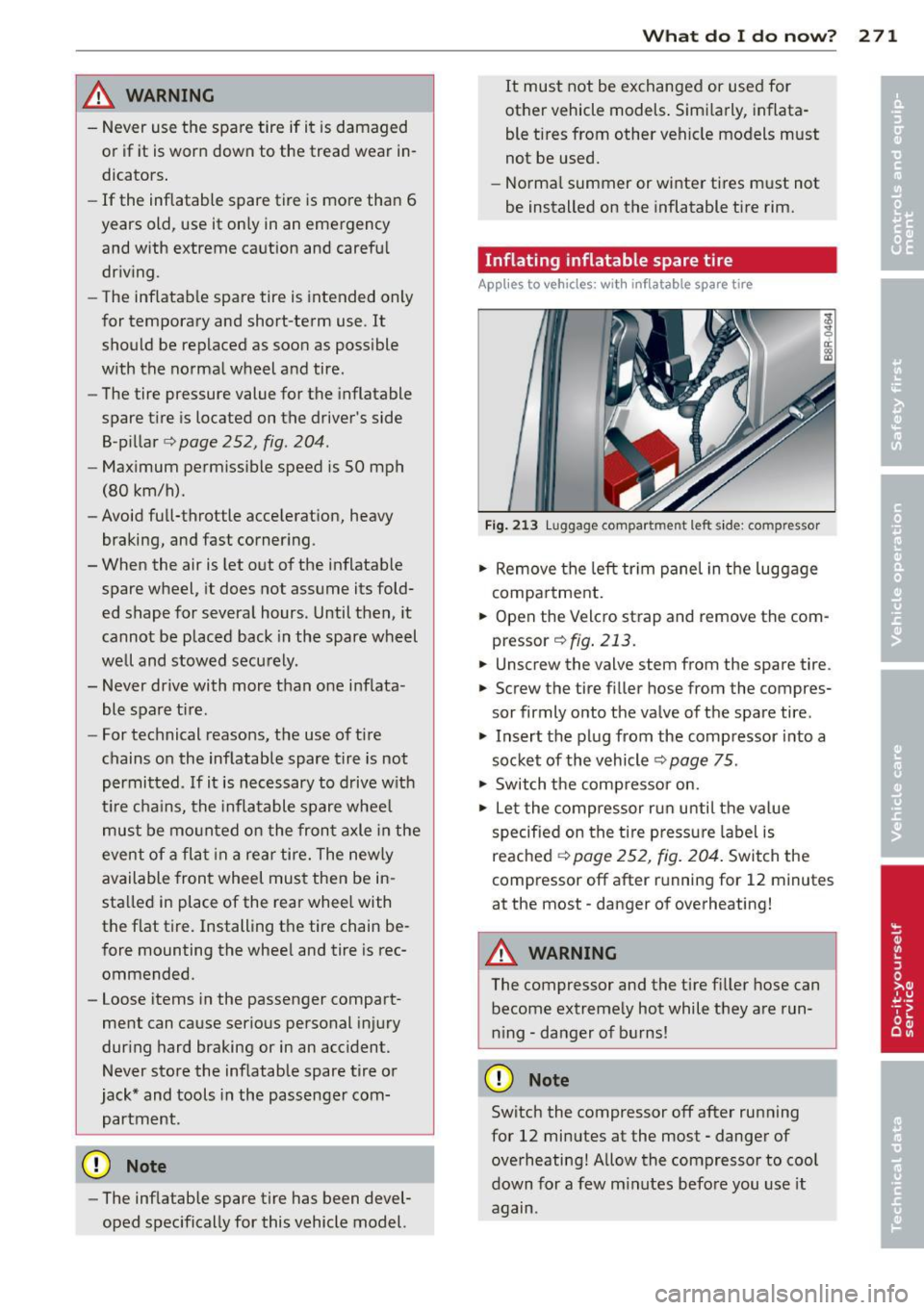
Fig . 2 12 In flatable spa re t ire wi th compresso r
Removing inflatable spare tire
., Lift up t he cargo floo r using the handle .
., Remove the dirt t ray .
., Tur n the large screw
c:::>fig. 212 co u nte r
clockw ise .
., Remove the bass box as required
¢ page 270 .
., Take out the inflatable spa re tire .
., Always store the vehicle tool kit, the jack*
and the rep laced tire in the luggage com
pa rtment
¢ page 145.
Stow ing the inflatable spare tire
., Release the air by unscrewing the va lve
stem .
., Screw the valve stem back in afterwards .
., Wait a few hours before p lacing the wheel
in the spare wheel well¢
A-
., Inst all the bass box as required¢ page 270.
., Se cure t he wheel with t he large screw .
., Place the d irt tr ay b ack in .
., Fold t he cargo floor back down.
After using the inflatable spare wheel
T he inflatab le spare tire can be re-used as
lo ng as it is not damaged a nd is not wo rn
down to the t read wear indi ca tors ¢
_A .
When you let the a ir out of the inf latab le
spar e tir e, it does not ass ume its folded shape
again for severa l hours . U nti l then, it cannot
be pla ced ba ck in the spare whee l we ll and
stowed secu re ly.
Page 273 of 316
/! WARNING
-Never use the spare tire if it is damaged
or if it is worn down to the tread wear in
dicators .
- If the inflatable spare tire is more than 6
years old, use it on ly in an emergency
and with extreme ca ution and carefu l
dr iv ing.
- The inflatab le spare tire is intended only
for temporary and short-term use . It
should be replaced as soon as poss ible
with the no rma l wheel and tire.
- The tire pressure value for the inflatable
spare t ire is located on the driver's side
8-p illar
c::> page 252, fig. 204.
- Maximum permiss ible speed is 50 mph
(80 km/h).
- Avoid full-throttle acce lerat ion, heavy
braking, and fast corner ing.
- When the air is let out of the inflatable
spare wheel, it does not assume its fold
ed shape for severa l hours. Until then, it
cannot be placed back in the spare wheel
well and stowed secu rely.
- Never drive with more than one inflata
ble spare tire.
- For technical reasons, the use of tire
chains on the inf latable spare tire is not
permitted .
If it is necessary to d rive w it h
t ir e cha ins, the inflatable spare whee l
must be mo unted on the fron t axle in the
event of a fla t in a rea r tire. The new ly
available front wheel must then be in
sta lled in place of the rear whee l with
the flat tire. Installing t he tire chain be
f ore mounting the whee l and tire is rec
ommended.
- loose items in the passenger compart
me nt can cause serious personal in jury
dur ing hard braking or in an acc ident.
Never store the inf latable spare tire o r
jack* and tools in the passenge r com
partment .
CD Note
-The inf latable spare tire has been devel
oped spec ifically for this vehicle model.
What do I d o now ? 271
It must not be exchanged or used for
ot her vehicle models . Sim ila rly, inflata
ble t ires from other vehicle models must
not be used.
- Norma l summer or winte r ti res m ust not
be installed on the inf latable tire rim.
Inflating inflatable spare tire
Applies to vehicles: with inflatable spare tire
Fig. 2 13 Lu ggage compartme nt left s ide: comp ressor
.,. Remove the left tr im panel in the luggage
compa rtment.
.,. Open the Velcro strap and
remove the com
pressor ¢
fig. 213.
.,. Unscrew the valve stem from the spare tire .
.,. Screw the tire f iller hose from the compres
sor firmly onto the va lve of the spare tire .
.,. Insert the pl ug from the comp ressor into a
socket of th e vehicle ¢
page 75.
.,. Switch t he comp ressor on.
.,. let the compressor r un unti l t h e va lue
specif ied on the ti re press ure la bel is
reached
c::> page 2 52, fig . 204 . Switch the
compressor off after r unning for 12 minutes
at the most -danger of overheating!
A WARNING
The compressor and the tire filler hose can
become extreme ly hot while t hey a re run
n ing -da nger of b urns!
CD Note
Switch the compressor off after running
for 12 mi nutes at the most -danger of
ove rheating! Allow the compressor to cool
down for a few m inutes befo re you use it
again .
Page 279 of 316
exactly one location for each whee l. The jack*
must not be positioned at any other location
¢ &. ¢ (D .
An unsta bl e s urface under the ja ck* can cause
the vehicle to slip off the jack* . Always provide
a firm base for the jack* on the ground. If nec
essary place a sturdy board or s imilar support
under the jack*. On
ha rd , sli ppery surfaces
(such as tiles) use a rubber mat or simi lar to
prevent the jack* from slipp ing
<=> &. .
A WARNING
- Yo u or your passengers could be injured
wh ile chang ing a whee l if you do not fol
low these safety precautions:
- Position the jack * only at the designat
ed lift ing points and align the jack*.
Otherwise, the jack* could slip and
cause an injury if it does not have suff i
cient hold on the vehicle.
- A soft or unstable surface under the
jack* may cause the vehicle to slip off the jack*. Always provide a firm base
for the jack* on the ground . If necessa
ry, use a sturdy board under the jack*.
- On ha rd, slippe ry surface (such as tiles)
use a rubber mat o r similar to prevent
the jack* from slippi ng.
- T o he lp p revent injury to yourself and
yo ur passengers:
- Do not raise the vehicle unti l you are
sure the jack* is securely engaged.
- Passengers must not remain in the ve
h icle when it is jac ked up .
- Make s ure t hat passengers wait in a
safe place away from the vehicle and
well away from the road and traffic.
- Make sure jack position is correct, ad
just as necessary and then contin ue to
ra ise the jack *.
(D Note
Do not lift the vehicle by the s ill. Pos ition
the jack * on ly at the des ignated lifting
points o n the sil l. Otherwise, your vehicle
will be damaged.
What do I d o now ? 277
Taking the wheel off/installing the
inflatable spare tire
Follow these instructions step-by-step for
changing the wheel
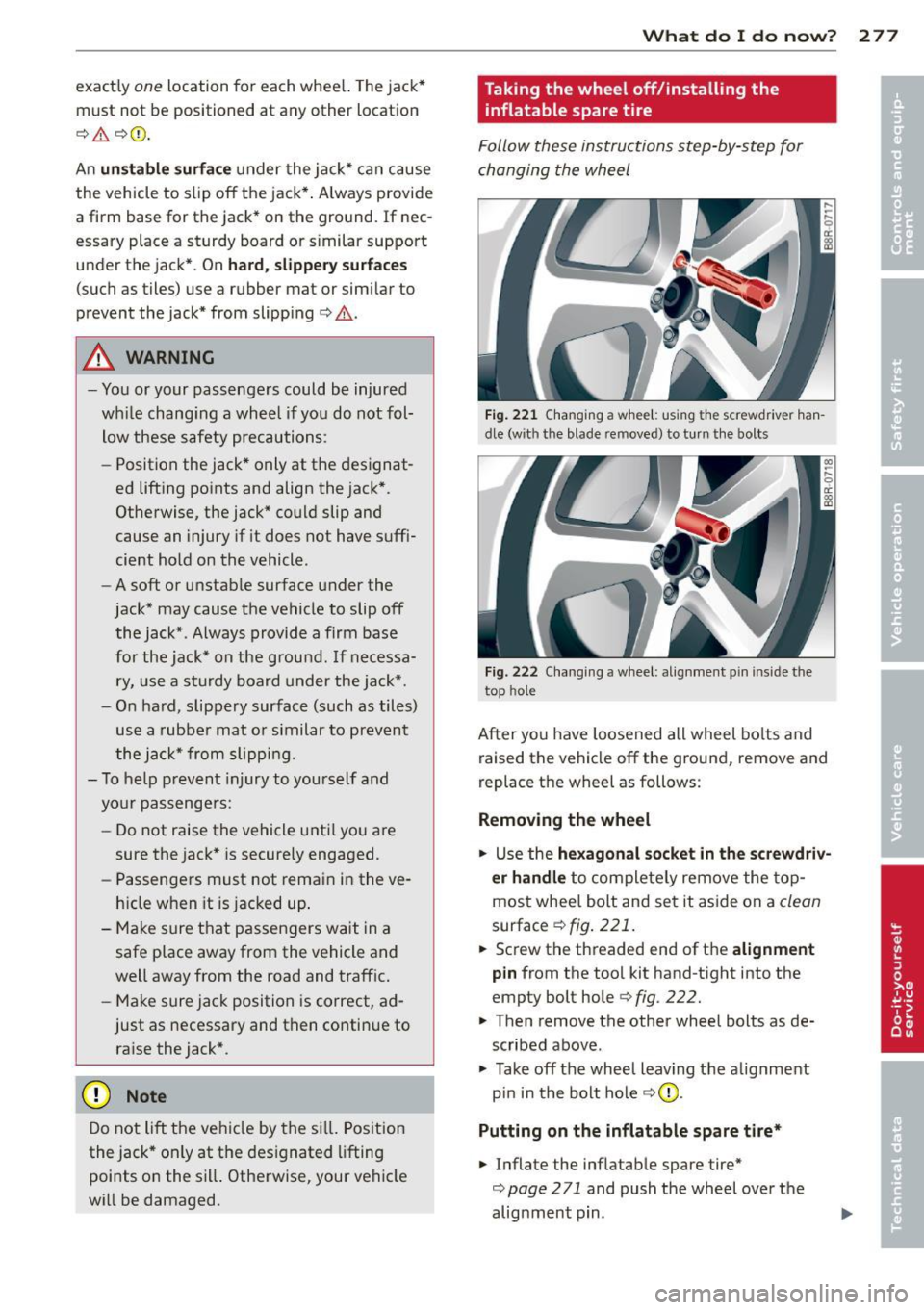
Fig . 2 21 Changing a whee l: using the screwdriver han
dle (w it h the blade removed) to turn the bolts
Fig. 222 Cha ngi ng a wheel: align ment p in inside the
top hole
After yo u have loosened all wheel bo lts and
raised the vehicle off the ground, remove and
replace the wheel as follows :
Removing the wheel
... Use the hexag onal so cket in the screwdri v
er handle
to completely remove the top
most whee l bolt and set it aside on a
clean
surface ¢ fig. 221.
... Screw the threaded end of the alignm ent
p in from the tool kit hand-tight into the
empty bolt hole
<=> fig. 222.
... Then remove the other wheel bolts as de
scribed above.
... Take off the wheel leaving the a lignment
pin in the bolt hole
¢ (D .
Putting o n the inflat able sp are t ire*
... Inflate the inflatable spare tire*
<=> page 2 71 and push the wheel over the
alignment pin .
Page 281 of 316
-Replace the flat tire with a new one and
have it installed on your vehicle a s soon as
possible. Remount the wheel co ve r.
U ntil th en, driv e with extr a car e and at re
du ced speeds .
~ WARNING
-
-If you are going to equip your vehicle
with t ires or rims wh ich differ from those
wh ich were factory installed, then be
sure to read the informat ion
c:> page 259,
New tires and replacing tires and
wheels.
- Always make sure the damaged wheel or
even a flat tire and the jack * and tool kit
are properly secured in th e luggage com·
partment and are not loose in the pas·
senger compartment.
- In an accident o r sudden maneuver they
c ou ld fly forward, inju ring anyone in the
vehicle .
- Always store damaged w heel, jac k* and
tools secure ly in the luggage compart
ment. Otherw ise, in an acc iden t or sud
den maneuver they cou ld fly forward,
causing injury to passenge rs i n the vehi·
cle .
What do I do now? 2 79
•
•
Page 288 of 316
28 6 Em ergency sit uat ions
_& WARNING
To avoid serious personal injury and dam
age to the vehicle, heed all warnings and
instructions of the jumper cable manufac
turer. If in doubt, call for road serv ice.
- Jumper cables must be long enough so
that the vehicles do not touch.
- When connecting jumper cables, make
surethattheycannotgetca ughtinany
moving parts in the eng ine compart
ment.
- Do not bend over the batteries -danger
of chemical burns!
- The battery cell locking screws must be
t ightened securely.
- Before you check anything in the engine
compartment, always read and heed all
WARNINGS
c:> page 226, Engine com
partment .
Improper hook-up of jumper cables can ru
in the generator.
- Always connect POSITIVE( +) to POS I
TIVE(+), and NEGATIVE( -) to NEGATIVE
(-) ground post of the battery manager
control unit.
- Check that a ll screw plugs on the battery
cells are screwed in firmly . If not, tighten
plugs prior to connecting clamp on nega
tive battery terminal.
- Please note that the procedure for con
nect ing a jumper cable as described
above applies spec ifically to the case of
your vehicle being jump started. When
you are giving a jump start to anothe r ve
hicle, do
not connect the negat ive (-) ca
ble to the negat ive (-) term inal on the
discharged bat tery ©
c:> fig. 2 28. In
stead, securely connect the negative(-)
cable to e ithe r a solid metal component
that is firm ly bolted to the engine block
or to the engine block itse lf. If the bat
tery that is being charged does not vent
to the outside, escaping battery gas
could ignite and exp lode!
-
Emergency towing
with commercial tow
truck
General hints
Your Audi requires special handling for tow
ing.
T he following information is to be used by
commercial tow truck operators who know
how to op erate their equipment safely.
- Nev er tow your Audi , towing will cau se
damage to the engine and tr an smi ssion .
- Ne ver wrap th e safety chain s or winch ca
ble s around the brak e lines.
- To pre vent unne ce ss ary damage, your Audi
mus t be tr an sp o rt ed with a flat bed tru ck.
- To load th e vehi cle on to th e flat b ed, use
the towing l oop found in the ve hicle to ols
an d att ach to th e front or r ea r a ncho rage
c:>page 287 and Qpage 287.
_& WARNING
= -
A vehicle being towed is not safe for pas
sengers. Never allow anyone to ride in a
vehicle being towed, for any reason.
Page 290 of 316
288 Emergency situations
Vehicles with a trailer hitch*
.,. Install the trailer hitch .
.,. Attach the towing bar o r the towing cab le
to the trai ler hitc h.
Unscrew the towing loop again a fter use and
i nstall the cover in the b umpe r. Re tur n the
towing loop to t he vehicle too lk it . Be sure to
have the towing loop stored in the vehicle at
a ll t imes.
A WARNING
- If the towing loop is not screwed in as far
as it will go, t he thread ca n pull out when
the vehicle is towed - potential risk of an acc ident .
- If your veh icle has a
trailer hitch* on ly
use a specia l towing bar to p revent dam
aging the ball h itch . Th ese towing bars
have been specially designed for trailer
t owing hitches.
- If your veh icle has a
trailer hitch* use on
ly specia l towing cables .
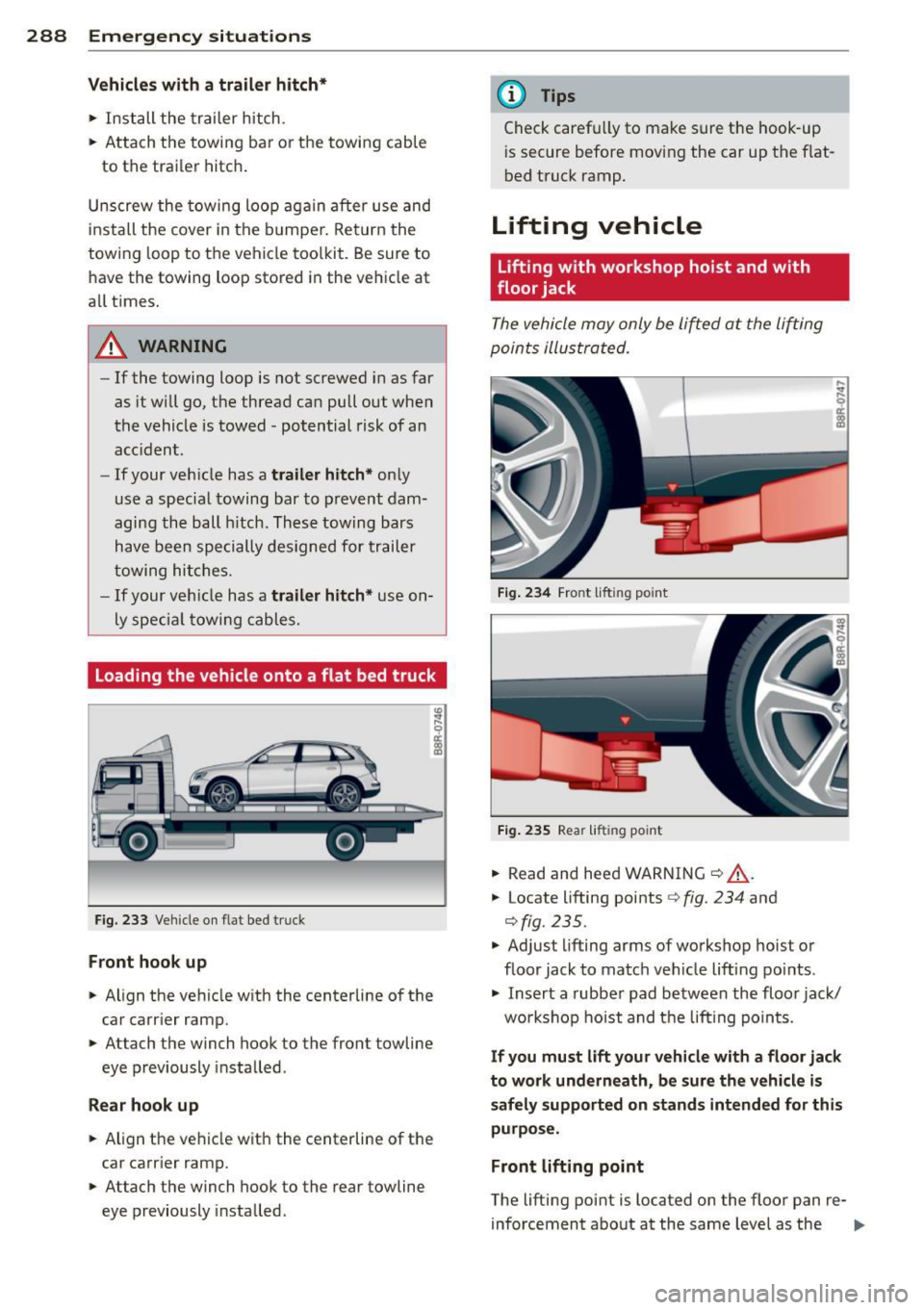
Loading the vehicle onto a flat bed truck
Fig. 2 33 Veh icle on flat bed truck
F ront hook up
.,. Align the vehicle w ith the centerline of the
car carrier ramp .
.,. Atta ch the winch hook to the front towline
eye previously insta lled .
Rear hook up
.,. Align the ve hicle with the centerline of the
car carr ier ramp .
.,. Attach the winch hook to the rear towline
eye previously installed .
(D Tips
Check caref ully to make sure t he hook -up
i s secure before mov ing the car up the f lat
b ed truck ramp .
Lifting vehicle
Lifting with workshop hoist and with
floor jack
The vehicle may only be lifted at the lif ting
points illustr ated.
Fig. 2 34 Fro nt li ftin g point
Fig . 2 3 5 Rea r liftin g po int
.,. Read and heed WARNING c::> .&._ .
.,. Locate lifting points c::> fig . 234 and
<=:>fig. 235 .
.,. Adjust lifting arms of workshop hoist o r
floor jack to matc h ve hicle lift ing po ints .
.,. Insert a rubbe r pad b etween the floo r jack/
workshop hoist and t he lift ing poin ts.
If you must lift your vehicle with a floor jack
to work undern eath, be sure the vehicle is
safely supported on stand s intended for this
purpo se .
Front lifting point
The lifting poi nt is located on the floor pan re-
inforcement abo ut at the same level as the
II>