ESP AUDI Q5 2013 Workshop Manual
[x] Cancel search | Manufacturer: AUDI, Model Year: 2013, Model line: Q5, Model: AUDI Q5 2013Pages: 316, PDF Size: 78.89 MB
Page 197 of 316
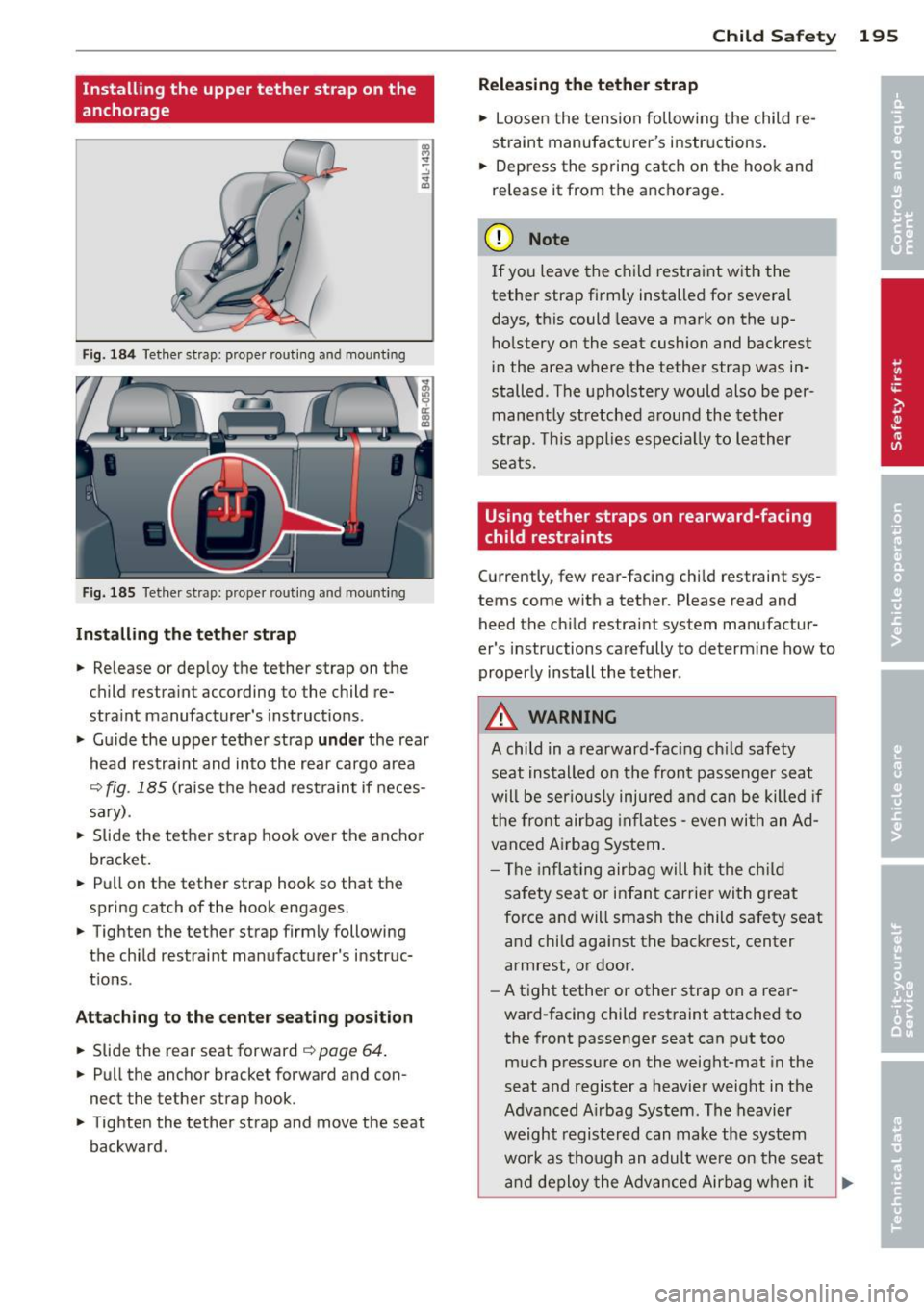
Installing the upper tether strap on the
anchorage
Fig. 184 Tether strap: proper routi ng and mounting
Fig. 185 Tether strap: proper rou ting and mounting
In sta ll ing the tether strap
• Release or deploy the tether strap on the
child restra int according to the child re
straint manufacturer's instructions .
• Gu ide the upper tether strap
under the rear
head restraint and into the rear cargo area
Q fig. 185 (raise the head restraint if neces
sary) .
• Slide the tether st rap hook over the ancho r
bracket.
• Pu ll on the tether strap hook so that the
spring catch of the hook engages.
• Tighten the tether strap firmly following
the child restrai nt manufacturer's instruc
t ions .
Attaching to the cent er seating po sition
• Slide the rear seat forward ¢ page 64.
• Pull the anchor bracket forward and con
nect the tether strap hook.
• Tighten the tether strap and move the seat
backward .
Child Safet y 195
Releasing th e teth er strap
• Loosen the tension following the child re
straint manufacturer's instructions.
• Depress the spring catch on the hook and
release it from the anchorage.
(D Note
If you leave the child restraint w ith the
tether strap firmly installed fo r several
days, t his could leave a mark on the up
holstery on the seat cushion and backrest
in the area where the tether strap was in
stalled . The upholstery would also be per
manently stretched around the tether
strap. This applies especia lly to leather
seats.
Using tether straps on rearward-facing
child restraints
Currently, few rear-facing child restraint sys
tems come with a tether. Please read and
heed the ch ild restraint system manufactur
er's instructions carefully to determine how to
properly install the tether .
A WARNING
A child in a rearward-fac ing ch ild safety
seat installed on the front passenger seat
will be ser ious ly injured and can be killed if
the front airbag inflates -even with an Ad
vanced Airbag System.
- The inflating airbag will h it the ch ild
safety seat or infant carrier with great
force and will smash the child safety seat
and child against the backrest, center
armrest, or door.
- A tight tether or other strap on a rear
ward-facing child restraint attached to
the front passenger seat can put too
much pressure on the weight-mat in the
seat and register a heavier weight in the
Advanced A irbag System. The heavier
weight registered can make the system
wo rk as though an adult we re on the seat
a nd deploy the Advanced Airbag when it
Page 200 of 316
198 Intelligent technology
Dynamic ste ering *
On vehicles with dynamic stee ring* , ES C helps
stabilize the st eering in critical s ituations .
Selective wh eel torque c ontrol
The selective whee l torque control operates
when dr iv ing through curves . T he front wheel
on the inside of the curve or both wheels on
the inside of the curv e are braked selective ly
as needed. This m inimizes sliding in the front
wheels and allows for more pr ecise driving
through curves . T he system may not act ivate
when driving in wet or snowy cond itions .
A WARNING
-ESC, ABS, ASR, EDL dynamic steering"
and the se lective wheel torque control
cannot overcome the laws of physics .
Th is is especially important on slippery
or wet roads.
If the systems begin act ing
to stabilize yo ur vehicle , you sho uld im
med iately change your speed to ma tch
the road and traffic condit ions. Do not
let the increased safety provided by
these systems tempt you to take risks. Do ing so wi ll increase the risk of a loss of
vehicle control, collision and serious per
sonal injuries .
- Always adapt your speed to road, traff ic
and weather condit ions. The risk of Los-
-
ing cont ro l of the veh icle increases when
dr iv ing too fast, especially th rough
c u rves and on slippery o r wet roads, and
when d riving too close to vehi cles up
ahead. ESC, A BS, the brake assis t sys
tem, AS R, EDL, dynamic steering* and
the se lective wheel torque control can
not prevent collis ions.
-Always acce lerate with specia l care on
even, smooth surfaces s uch as those that
are wet or covered with ice and snow.
The drive wheels can spin even with
these ass istance systems that cannot al
ways help to reduce the risk of loss of ve
hicle control.
(D Tips
- ABS and ASR only wo rk correctly when
all four wheels are equipped with identi
cal tires. Different tire si zes can lead to a
reduction in engine power .
- Yo u may hear noises when the systems
described are working.
- If the ind icator light
DJ or E (USA
mode ls)/ m] (Canada models) appears,
there may be a malfunction
q page 15 ,
q page 17.
-When i nstalling a factory -supplied roof
rack system on the roof railing, the ESC
will adapt itse lf to a different center of
gravity .
Switching on/off
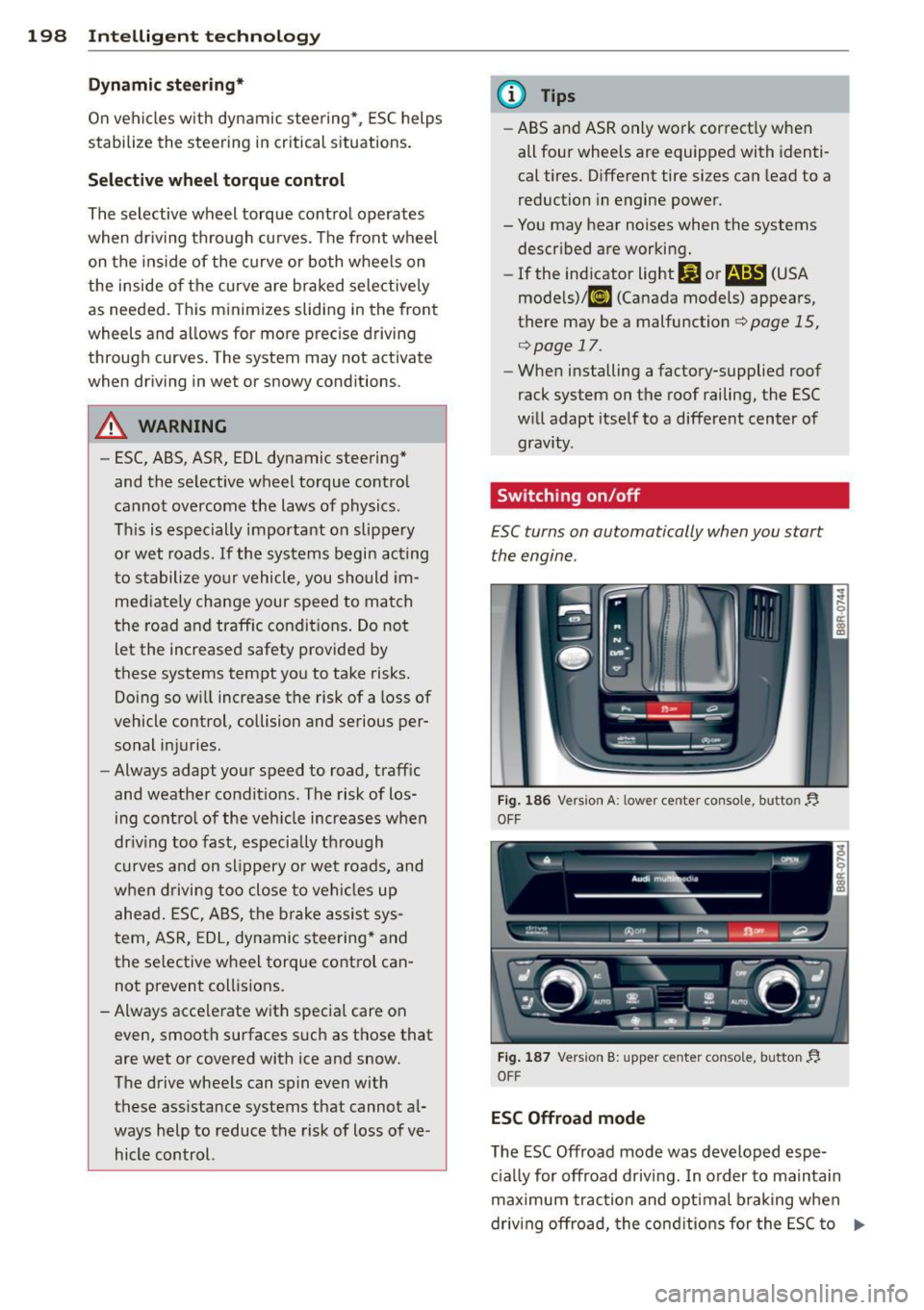
ESC turns on automatically when you start
the engine.
F ig. 1 86 Vers ion A: l owe r ce nte r con so le, butto n YJ
OFF
Fig. 1 87 Version B: upper cente r console, button YJ
OFF
ESC Offroad mode
The ESC Off road mode was developed espe
c ia lly for offroad driving . In o rder to maintain
max imum trac tion and optimal b raking when
driv ing offroad, the cond it ions for the ESC to
IJII,
Page 206 of 316
204 Intelligent technology
With the engine turned off
If you listen to the radio, for example, with
the engine turned off or use othe r MMI* func
tions, the battery is being discharged .
If sta rting capability is jeopardized due to en
e rgy consumption, the following warning ap
pears in the radio or MMI* display:
Please start engine, otherwise system will
switch off in 3 minute s.
The warning ind icates that the system will be
turned off automatically after 3 m inutes .
If
you wish to continue using the functions , you
have to start the engi ne.
With the engine running
Although electrical energy is generated when
the vehicle is being driven, the battery can be
come discharged . This happens most ly when
l ittle energy is be ing generated and a great
deal consumed and the battery's state of
cha rge is not optimal.
To br ing the energy balance back into equili
brium, consumers which require especially
l arge amounts of energy are tempo rari ly cut
back or switched off. Heating sys tems in par
ticular requi re a great dea l of energy . If you
notice, for example , that the heated seats* or
the heated rear window are not heating, they
have been temporar ily cut back or switched
off. These systems will be ava ilable again as
soon as the energy balance has bee n restored.
You will a lso notice that engine idle speed has
been increased slightly. This is norma l and not
a cause for concern . By increasing engine idle
speed the add itional energy required is gener
ated and the battery is charged .
Page 208 of 316
206 Driving and en vir onm ent
Catalytic converter
It is very important that your emission con
trol system (catalytic converter) is function
ing properly to ensure that your vehicle is run
ning in an environmentally sound manner .
• Always use lead-free gasoline¢ page 228,
Fuel supply.
• Never run the tank down all the way to
empty .
• Never put too much motor oil in your en-
gine ¢
page 238, Adding engine oil~-
., Never try to push- or tow -start your veh icle.
The catalytic converter is an eff ic ient "clean
up" device built into the exhaust system of
the vehicle. The catalytic converter burns many of the pollutants in the exhaust gas be
fore they are released into the atmosphere.
The exclusive use of unleaded fuel is critically
important for the life of the cata lytic conve rt
e r and proper functioning of the engine.
& WARNING
-
- Do not park o r operate the vehicle in
areas where the hot exhaust system may
come in contact with dry grass, brush,
fuel spill or other material which can cause a fire.
- Do not apply additional undercoating or
rustproofing on or near the exhaust
man ifold, exhaust p ipes, catalytic con
verter or heat shields . During driving, the
substance used for undercoating could
overheat and cause a fire .
@ Note
-Be aware that just one tank filling with
leaded fuel will already seriously de
grade the performance of the catalytic
conve rter .
- Do not exceed the correct engine oil level
¢ page 238.
-Do not drive until the fuel tank becomes
completely empty. The eng ine could mis
fire . U nburned f uel could a lso get into the exhaust system and this co
uld cause
the cata lytic converter to overheat .
- Do not turn off the ignition while the ve
hicle is moving.
- Do not continue to ope rate your veh icle
under these conditions, as otherwise fuel
can reach the catalytic converter. This
cou ld result in overheating of the con
verter, requir ing its replacement.
- To assure efficient operation of the Emis
sion Control System:
- H ave your vehicle maintained properly
and in accordance w it h the service rec
ommendat ions in your Warranty &
M ain tenance book let.
- L ack of prope r maintenance as we ll as
improper use of the vehi cle will impair
the function of the em iss ion contro l
system and could lead to damage .
@ For the sake of the environment
Even when the Emiss ion Control System is
operat ing proper ly, the exha ust gas can
have a sul fur -li ke exhaust gas smell under
some operating states . This depends on
the sulfur content of the fuel being used .
Using a different brand of fue l may help,
or f il li ng the tank with lead-free super
grade gasoline .
Avoid damaging the
vehicle
When you are d rivi ng on poor roads, or over
c u rbs, steep ramps, etc., ma ke certai n that
low- ly ing parts s uch as spoilers and exha ust
system parts do not bottom o ut and get dam
aged.
T his is espe cially true for ve hicles with low
s lung chassis (spor ts chassis)* and fully load
ed vehicles .
Page 209 of 316
Operate your vehicle
economically and minimize pollution
General
Your personal style of driving will determine
the economy of your vehicle, as well as ex
haust and noise levels .
Fue l economy, environmental impact, and
wear on your engine, brakes and tires largely
depend on three factors:
- your persona l driving style
- opera ting conditions
- technical limitations
If you anticipate what you need to do next and
drive economically, you can easily cut your
fuel consumption by 10-15 percent . This sec
tion will give you some t ips on how you can
he lp the environment and your pocketbook.
(D Tips
The consumpt io n estimates as published
by ENVIRONMEN TAL PROTECTION AGENCY
(EPA) and Transport Ca nada may not corre
spond to your act ual consumption on the
road, wh ich will vary depending upon vehi
cle load and speed, road and weather con
ditions, trip length, etc .
Drive smoothly and keep a lookout
ahead
Vehicles use the most fuel when they are ac
celerating.
" Avoid unnecessary acce lerating and braking .
Vehicles use the most fue l when they are ac
celerating . If you anticipate what is go ing to
h appen next, you will need to brake less and,
thus, accelerate less. Let the vehicle coast
whenever poss ible -for example when you see
that the next traffic light is red.
Dri vin g and en vironm ent 207
Avoid full throttle
Driving at moderate speeds saves fuel and
improves your mileage .
" Try and keep well below your car 's maxi-
mum speed .
Acce lerat ing gently reduces fue l consump
tion, eng ine wear, and does not disturb the
environment.
Fuel consumption, exhaust emissions and en
gine noise increase disproportionately at h igh
speeds. If you drive at approximately three
quarters of top speed, fuel consumption w ill
be reduced by one half. Never drive faster
than the posted speed l imit and weather con
ditions perm it.
Reducing unnecessary idling
Even when your car is just idling it burns up
fuel .
" Shut the eng ine off when you are not driv
ing the vehicle .
" Do not warm up the ve hicle by letting the
eng ine run at id le.
The idling phase is automatically reduced for
vehicles with the Start -Stop-System* . It is ef
ficient to switch off the engine in vehicles
without the Sta rt-Stop-System * when stopped
at rai lroad cross ings and long red lig hts . T urn
ing the engine off for jus t 30-40 seconds
saves more fuel than is b urned by s tarting the
engine again.
It takes a long t ime for the engine to warm up
f ully when i t is runn ing a t id le. However, wea r
and noxious emissions are especia lly high
when the engi ne is warming up. So you shou ld
drive away as soon as you start the engine and
avo id running at high rpms while the engine is
still warming up.
(D Note
Do not leave engine idling unattended af
ter start ing . If warning lights sho uld come
on to indicate improper operation, they ..,.
•
•
Page 211 of 316

Driving off road
Driving in difficult road
conditions and offroad
General information
The operation of the E lectronic Stabilization
Control (ESC) is expanded fo r operation away
from paved roads. In situations where slip or a
differential lock ing funct ion is required, the
ESC offroad mode can be act ivated
c> page 197 . Your Audi also has permanent
all-wheel drive in addition .
However, your Aud i is not a pure offroad ve hi
cle . It was not built for driving under extreme
conditions, e .g . for trips that are in the nature
of an expedition .
D riv e only on roads and offro ad sections
which match the des ign of your vehicle and
your abil it ie s as a driver . Ne ver take ri sks!
Before dri ving offroad
- Check the engine oi l level, tire pressure,
coolant leve l, and the fluid level in the w ind
shield washer reservo ir.
- Stow luggage items and other objects in the
lu ggage compartment, and secure them
against slid ing around .
After driv ing offroad
- After trips offroad, remove any twigs and other foreign objects from the grill, the un
derbody and the wheels. Pay specia l atten
t ion to fore ign objects (stones) which have
become lodged in the tire tread.
- Clean the body and the vehicle unders ide,
and inspect the veh icle for possible damage.
- Clean dirty windows, headlamp lenses, rear
lights, and license plates.
- Perform a brake check (particu larly after
trave lling through water) .
A WARNING
- Drive especially attentive ly and plan
ahead in difficult road conditions and
w hen offroad . Excess ive speed or incor-
-
Driving off road 209
rect maneuvers can cause injuries and
damage to the vehicle.
- Always adapt your speed and driving
style to road, offroad, traff ic, and weath
er conditions. Drive especially slowly off
road when your v iew is restricted.
- Please be aware that in ESC offroad
mode, particularly on a smooth and slip
pery road, the wheels may have an in
creased tendency to spin and the vehicle
may break away - danger of skidding!
- Stability is limited in the ESC offroad mode.
@) For the sake of the environment
Avoid damage to the environment and re
spect nature .
(D Tips
Only drive where it is permitted and stay
on marked roads and paths.
Explanation of some technical terms
The following data refer to ideal cond itions .
Depend ing on veh icle load and ground condi
tions and the environment, the numbers may
vary. It is the d rive r's responsibi lity to decide
whethe r a veh icle can overcome a specific s it
u at ion
c::> .&. .
Gradient angle
The number of meters in alt itude ga ined over
a d istance of 109 .4 yards or 100 meters
(grade) a re given as a pe rcentage o r degrees .
Info rmation abou t the gr ad ient the veh icle
can climb under i ts own power (depends in
part on the road surface and engine power).
Max imum permitted grade : 3 1
°
Late ral angle (slope of vehicle )
Ind icates the angle up to which the vehicle
can be d riven diagona lly or across the fall line
on a slope wi tho ut the vehicle tipping over
sideways (depends o n center of gravity) . Maxi-
mum permitted lateral angle: 25 ° .,.
•
•
Page 215 of 316
Operating instructions
6"
~ ~
I 1,2 ..
-{ }
l::_
-
2
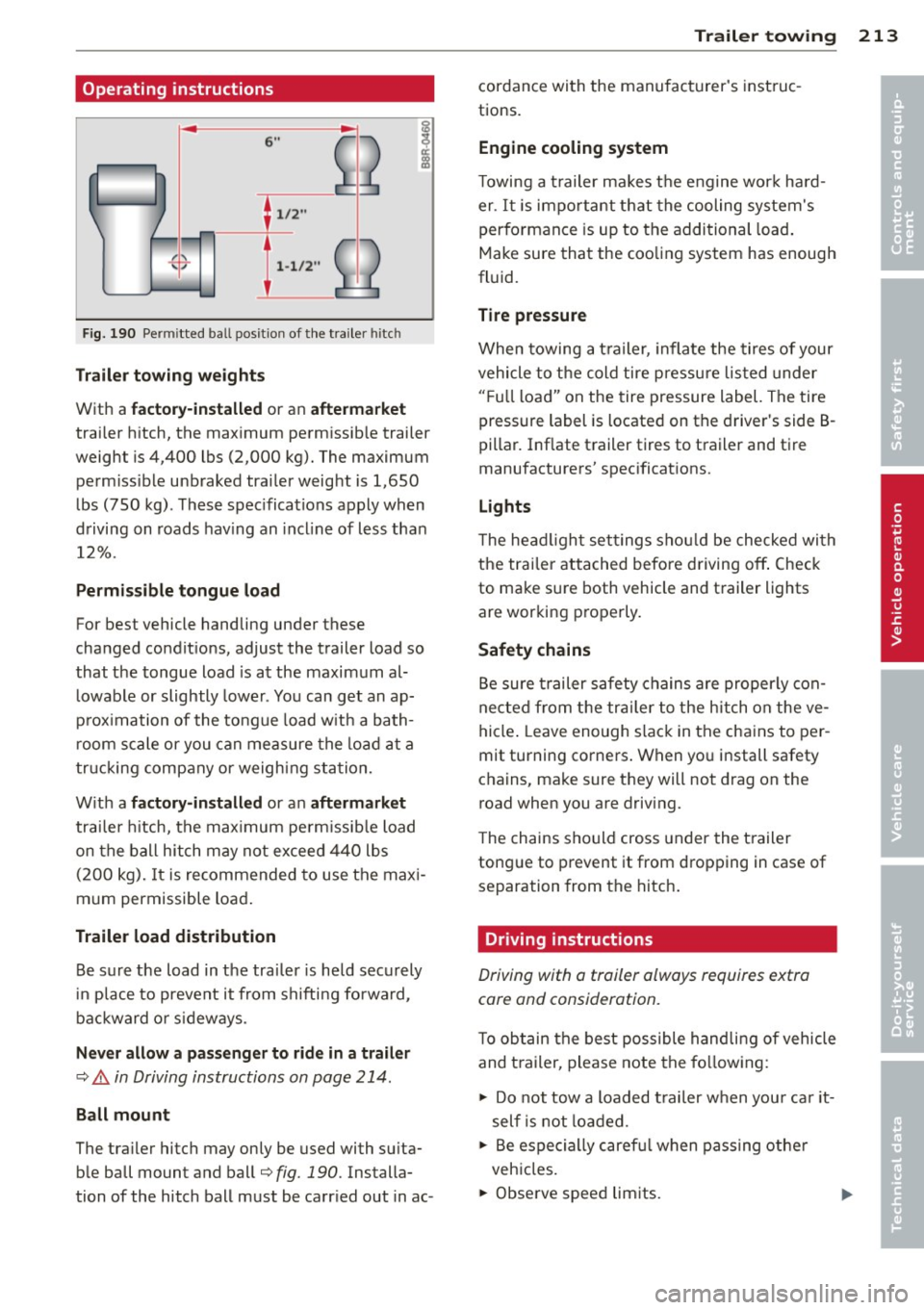
Fig. 190 Permit ted ball position of the trailer hitch
Trailer towing weights
With a factory-installed or an aftermarket
trailer hitch, the maximum permissible trailer
weight is 4,400 lbs (2,000 kg). The maximum permissible unbraked trailer weight is 1,650
lbs (750 kg) . These specifications apply when
driving on roads having an incline of less than
12%.
Permissible tongue load
For best vehicle handling under these
changed conditions, adjust the trailer load so
that the tongue load is at the maximum al
lowable or slightly lower . You can get an ap
proximation of the tongue load with a bath
room scale or you can measure the load at a
trucking company or weighing station.
With a
factory-installed or an aftermarket
trailer hitch, the maximum permissible load
on the ball hitch may not exceed 440 lbs
(200 kg).
It is recommended to use the maxi
mum permissible load.
Trailer load distribution
Be sure the load in the trailer is held securely
in place to prevent it from shifting forward,
backward or sideways.
Never allow a passenger to ride in a trailer
¢.&. in Driving instructions on page 214.
Ball mount
The trailer hitch may only be used with suita
ble ball mount and ball¢
fig. 190. Installa
tion of the hitch ball must be carried out in ac-
Trailer towing 213
cordance with the manufacturer's instruc
tions.
Engine cooling system
Towing a trailer makes the engine work hard
er .
It is important that the cooling system's
performance is up to the additional load.
Make sure that the cooling system has enough
fluid.
Tire pressure
When towing a trailer, inflate the tires of your
vehicle to the cold tire pressure listed under
"Full load" on the tire pressure label. The tire
pressure label is located on the driver's side B
pillar. Inflate trailer tires to trailer and tire
manufacturers' specifications.
Lights
The headlight settings should be checked with
the trailer attached before driving off. Check
to make sure both vehicle and trailer lights
are working properly.
Safety chains
Be sure trailer safety chains are properly con
nected from the trailer to the hitch on the ve
hicle. Leave enough slack in the chains to per
mit turning corners. When you install safety
chains, make sure they will not drag on the
road when you are driving.
The chains should cross under the trailer
tongue to prevent it from dropping in case of
separation from the hitch.
Driving instructions
Driving with a trailer always requires extra
care and consideration.
To obtain the best possible handling of vehicle
and trailer, please note the following :
.,. Do not tow a loaded trailer when your car it
self is not loaded .
.,. Be especially careful when passing other
vehicles.
.,. Observe speed limits.
•
•
Page 216 of 316
214 Trailer towing
• Do not drive at the maximum permissible
speed.
• Always apply brakes early .
• Monitor the temperature gauge.
W eig ht distribution
Towing a loaded tra ile r with an empty car re
sults in a highly unstable distribution of
weight . If this cannot be avoided, drive at very
low speeds only to avoid the risk of losing
steering control.
A "balanced" rig is easier to operate and con
trol. This means that the tow vehicle should
be loaded to the extent possible and permissi
b le, while keeping the trailer as light as possi
ble under the circumstances. Whenever possi
ble, transfer some cargo to the luggage com
partment of the tow vehicle wh ile observing
tongue load requirements and vehicle loading
considerations .
Speed
The higher the speed, the more difficult it be
comes for the driver to control the rig . Do not
drive at the maximum permissible speed . Re
duce your speed eve n mo re if load, weathe r or
wind condi tions are unfavorable -part icu larly
when going dow nhill.
Reduce vehicle speed immediately if the t rail
e r shows the slightest sign of swaying. Do not
tr y to s top the sw ayin g by acce ler atin g.
Observe speed limits . In some areas, speeds
for vehicles towing trailers are lower tha n for
regula r vehicles.
Always apply brakes early . When driv ing
downhill, shift into a lower gear to use the en
g ine b raking effect to slow the vehicle. Use of
the brakes alone can cause them to overheat
and fail.
Coolant temperature
T he coolant temperature gauge
c:> page 10
must be observed carefully . If the needle
moves close to the upper end of the scale , re
duce speed immed iate ly and/or turn off the
a ir cond itione r. If the coolant temperature warning light in
the instr ument cluster starts flashing., pull
off the road, stop and let the engine
idle for
about two minutes to prevent heat build-up.
A WARNING
Anyone not properly restrained in a mov
i ng vehicle is at a much greater risk in a n
accident . Never let anyone ride in your ca r
who is not p roperly wea ring the rest raints
p rov ided by Audi.
Trailer towing tips
Important to know
Your vehicle handles d ifferently when towing
-
a trai ler because of the additional weight and
different weight distr ibut ion. Safety, perform
ance and economy will greatly depend on how ca refully you load your trai ler and ope rate
you r rig.
Befo re you actually tow your tra iler, practice
turning, stopping and backing up in an area
away from t raffic. Keep pract ic ing unt il you
have become completely familiar wit h the way
yo ur vehicle-tra iler combination behaves and
responds.
Backi ng up is difficult and requ ires practice.
Backi ng up w ith a t railer gene rally requires
stee ring action opposite to tha t when backing
u p you r vehicle witho ut a tr ailer.
Maintai n a greater d ista nce between your ve
hicle and the one in front of you. You w ill need
more room to stop. To compensate fo r the
t railer, you w ill need a larger than normal
tu rning rad ius.
When passing, remembe r that you cannot ac
ce le rate as fas t as you no rma lly would be
ca use of the added load. Make sure yo u have
enough room to pass . After passing, a llow
plenty of room for yo ur trailer before cha ng
ing lanes again.
Avoid jer ky s tarts, sharp t urns o r rapid lane
changes.
Page 222 of 316
220 Cleaning and protec tio n
- do not clean the camera lenses and the
area around them with the pressure
washer.
- Never use warm or hot water to remove
snow or ice from the camera lens. T his
could cause the lens to crack.
- Never clean the camera lens with abra
sive prod ucts .
Waxing and Polishing
Wa xing
A good wax coating protects the vehicle paint
to a large extent against the environmental
factors listed under
qpage 216, Washing and
even against slight scratches .
You can use a liquid car wax to protect your pa int as soon as one week after your veh icle
has been delivered.
Even if you regularly use a
w axi ng process in
automatic car washes, we recommend that
you manua lly app ly a coat of wax to give the
pa int extra protection, particularly if water no
longer beads on the clean paint .
Protect p lastic body parts with car wax in the
same way as the vehicle body.
During wa rm weather dead insects tend to
collect on the front bumper and on the for
ward area of the hood . They are much easier
to remove from paint that is waxed
often.
P oli shing
Polish your vehicle on ly if the paint has lost its
shine and the g loss cannot be brought back
with wax .
I f the polish used does not contain preserva
tive compounds, the paint must be waxed af
terwards .
_&. WARNING
Always read and heed a ll WARNINGS and
other information
9 page 216.
@ Note
Donotusecarwaxon -
matte o r anodized meta l trim
- rubber or rubber- like t rim.
Trim strips
Metal trim needs special care.
For environmental reasons, Audi fabricates
the bright trim strips and trim p ieces from
pure chromium-free aluminum .
Dirt and marks on the trim strips should be
removed with a
pH-b alan ced cleaning agent
(do not use a chrome cleaner) . Authorized
Audi dealers carry cleaning products which have been tested for use on you r vehicle and
are not ha rmfu l to the environment.
To avoid corrosion on the exter ior trim strips ,
only a pH-ba lanced solution shou ld be used
for the windsh ield washer.
_&. WARNING
A lways read and heed all WARNINGS and
other information
q page 216.
Plastic and vinyl
Plastic needs special care.
Use a clean, damp cloth or sponge to remove
dust and light surface dirt . For othe r soil, use
a lukewa rm all-pu rpose cleaning solution or a
mild saddle soap for v inyl tr im . Remove wate r
spots and traces of soap wi th a clean, damp
cloth or sponge. Use a clean, soft cloth to rub
dry.
G rease , tar or oil sta ins can be removed with a
cle an cloth or sponge soaked wi th a ll-purpose
cleaner or with a solvent designed especia lly
to clean vinyl.
O ccas ional ly app ly a colorless v inyl or leather
preservative to re tain the materia l's luster
and pliability.
_&. WARNING
A lways read and heed all WAR NINGS and
other information
q page 216.
Page 227 of 316
By contrast, leather types that are covered by
a co lored finish layer are more durable. This
has a posit ive effect on the leather's resist
ance to wear and soiling in daily use. On the
other hand, the typical characterist ics of natu
ral leather are barely or not apparent . Howev
er, this does not mean that the leather itself
i s of infer ior quality.
C ar e and h and ling
Because of the exclusive nature of the types of
leather that Audi uses and the ir unique prop
erties (such as sensitivity to o ils, grease, so il
ing, etc.), you will need to be somewhat care
fu l w ith these leathers, and a certain type of
care is required. For examp le, da rk clot hing
materia ls can d iscolor leather seats (especial
l y i f such clothing is damp and was not dyed
correctly) . Dust and dirt particles in pores,
fo lds, and seams can have an abrasive effect
and can damage the leather surface as we ll as
weaken seams.
The leather sho uld be cleaned regularly as
needed. After having been used for a re lative ly
long time, your leather seats will acquire a
rich aged finish. This is a characteristic of nat
ura l leather and a sign of true quality.
In order to maintain the va lue of this natura l
product over the life of your vehicle, you
should follow the recommendations below:
(D Note
- To keep your leather from bleaching out,
do not a llow it to be exposed to bright
sunlight for long periods of time. If you
have to leave the vehicle parked outside
for long periods, cover the leather to
protect it from d irect exposure to su n
light.
- Sharp objects on clothing, such as zip
pers, rivets or sharp pieces on be lts can
l eave pe rmanent scratches o r sc rape
mar ks on the surface of the lea ther.
{O) Tips
-After each time you clean the leathe r and
at regu la r i nte rva ls, use a leather prese r-
Cleaning and protec tion 225
vative c ream that contains UV -b locke rs
and that works into the leather. This
cream wi ll nour ish and mo isturize the
leather, helping it to breathe and stay
supple. It also helps to build up a protec
t ive coating on the surface.
- Clean the leather every 2 - 3 months,
and clean any areas that get soiled.
- Remove fresh marks made by ballpo int
pens, ink, lipstick, shoe polish, etc. as
soon as poss ible.
- Preserve the color of the leather as need
ed by us ing a specia l co lored leather care
cream to touch up areas of uneve n color .
Cleaning and caring for leather
upholstery and trim
Applies to vehicles: wi th natural leather
Natural leather requires special care and at
tention .
Normal cleaning
.. Clean soiled areas with a slightly moistened
cotton or woolen cloth.
More stubborn dirt
.. More st ubborn dirt can be removed using a
cloth saturated with a mild soap solut ion
(2
tablespoons mild liquid soap).
.. Never allow the soap solution to saturate
the leather, and make certain that no water
soaks into the seams .
.. Wipe off the soap so lution with a soft, dry
cloth.
Cleaning spo ts
.. Remove fresh water-based spots (such as
coffee, tea, juices, blood) with an absorbent
cloth or pape r towel.
.. Remove fresh
grease or oil -based spots
(suc h as bu tte r, mayonnaise, chocolate) with
an absorben t cloth or paper towel, o r use
t he cleaner from the leather care kit if the
spot has not yet penetrated into t he surface
of the leathe r.
.. Use an oil/grease dissolving spray, if
oil /
grease spots ha ve dried on.
•
•