brake AUDI Q5 2013 Workshop Manual
[x] Cancel search | Manufacturer: AUDI, Model Year: 2013, Model line: Q5, Model: AUDI Q5 2013Pages: 316, PDF Size: 78.89 MB
Page 207 of 316
Driving and
environment
The first 1
1000
miles
(11500 km) and
afterwards
New engine
The engine needs to be run-in during the first
1,000 miles (1 ,500 km) .
For the first 600 mile s (1,000
kilometers ):
.,. Do not use full throttle.
.,. Do not d rive at engine speeds that are more
than 2/3 of the max imum permitted RPM .
From 600 to 1,000 miles (1 ,000 to
1,500 kilometers ):
.. Speeds ca n gradually be increased to the
maximum perm iss ible road or eng ine speed .
During and after break-in period
.. Do not rev the eng ine up to h igh speeds
when it is cold. Th is applies whether the
transmission is in N (Neutral) or in gear.
After the break- in peri od
.. Do not exceed maximum eng ine speed un
der any circumstances.
.. Upshift into the next higher gear
before
reaching the red area at the end of the tach
ometer scale
c.> page 10.
During the first few hours of driving, the en
g ine's internal friction is higher than later
when all the moving parts have been broken
in . How well this break -in process is done de
pends to a considerable extent on the way the
vehicle is driven du ring the first 1,000 miles
(1,500 k ilome ters).
(D Note
Extremely h igh engine speeds are auto
mat ica lly reduc ed. However , th ese rpm
lim its are programmed for a n engine well
r u n- in, not a new engine.
Driving and environment 205
@) For the sake of the environment
Do not drive with unnecessarily high en
g ine speeds -upshifting ear ly saves f uel,
reduces noise and protects the environ
ment.
New tires
If your vehicle is running on new tires, drive
very carefully for the first 350 miles (500 ki lo
meters) after fitting.
.&, WARNING
N ew tires tend to be sl ippery and mus t al
so be "b roken -in" . Be sure to remember
this dur ing the f irst 350 m iles (500 kilo
meters) . Brake gently . Avoid fo llowing
closely behind other vehicles or other sit
uations that m ight require sudden, hard
b raking .
New brake pads
Remember that new brake pads do not have a
full brak ing effect dur ing the first 250 m iles
(400 ki lomete rs) afte r they are installed.
New brake pads have to be "burnished in" be
fore they have optima l grab
c.> .&. .
During the brea k-in period, yo u should avo id
putting severe loads on the brakes. Severe
l oads include , for example, sudden hard brak
i ng, in particular at very h igh speeds or, for
example, on mounta in passes .
.&, WARNING
New b rake pads don 't have the best stop
p ing power and must be "broken-i n" dur
ing the initi al 100 to 150 miles (150 to
2 00 kilometers) o f no rma l ci ty driving . You
can compensate for this by pressing the b rake peda l more fi rm ly . This also applies
later when new pads are installed.
•
•
Page 209 of 316
Operate your vehicle
economically and minimize pollution
General
Your personal style of driving will determine
the economy of your vehicle, as well as ex
haust and noise levels .
Fue l economy, environmental impact, and
wear on your engine, brakes and tires largely
depend on three factors:
- your persona l driving style
- opera ting conditions
- technical limitations
If you anticipate what you need to do next and
drive economically, you can easily cut your
fuel consumption by 10-15 percent . This sec
tion will give you some t ips on how you can
he lp the environment and your pocketbook.
(D Tips
The consumpt io n estimates as published
by ENVIRONMEN TAL PROTECTION AGENCY
(EPA) and Transport Ca nada may not corre
spond to your act ual consumption on the
road, wh ich will vary depending upon vehi
cle load and speed, road and weather con
ditions, trip length, etc .
Drive smoothly and keep a lookout
ahead
Vehicles use the most fuel when they are ac
celerating.
" Avoid unnecessary acce lerating and braking .
Vehicles use the most fue l when they are ac
celerating . If you anticipate what is go ing to
h appen next, you will need to brake less and,
thus, accelerate less. Let the vehicle coast
whenever poss ible -for example when you see
that the next traffic light is red.
Dri vin g and en vironm ent 207
Avoid full throttle
Driving at moderate speeds saves fuel and
improves your mileage .
" Try and keep well below your car 's maxi-
mum speed .
Acce lerat ing gently reduces fue l consump
tion, eng ine wear, and does not disturb the
environment.
Fuel consumption, exhaust emissions and en
gine noise increase disproportionately at h igh
speeds. If you drive at approximately three
quarters of top speed, fuel consumption w ill
be reduced by one half. Never drive faster
than the posted speed l imit and weather con
ditions perm it.
Reducing unnecessary idling
Even when your car is just idling it burns up
fuel .
" Shut the eng ine off when you are not driv
ing the vehicle .
" Do not warm up the ve hicle by letting the
eng ine run at id le.
The idling phase is automatically reduced for
vehicles with the Start -Stop-System* . It is ef
ficient to switch off the engine in vehicles
without the Sta rt-Stop-System * when stopped
at rai lroad cross ings and long red lig hts . T urn
ing the engine off for jus t 30-40 seconds
saves more fuel than is b urned by s tarting the
engine again.
It takes a long t ime for the engine to warm up
f ully when i t is runn ing a t id le. However, wea r
and noxious emissions are especia lly high
when the engi ne is warming up. So you shou ld
drive away as soon as you start the engine and
avo id running at high rpms while the engine is
still warming up.
(D Note
Do not leave engine idling unattended af
ter start ing . If warning lights sho uld come
on to indicate improper operation, they ..,.
•
•
Page 211 of 316

Driving off road
Driving in difficult road
conditions and offroad
General information
The operation of the E lectronic Stabilization
Control (ESC) is expanded fo r operation away
from paved roads. In situations where slip or a
differential lock ing funct ion is required, the
ESC offroad mode can be act ivated
c> page 197 . Your Audi also has permanent
all-wheel drive in addition .
However, your Aud i is not a pure offroad ve hi
cle . It was not built for driving under extreme
conditions, e .g . for trips that are in the nature
of an expedition .
D riv e only on roads and offro ad sections
which match the des ign of your vehicle and
your abil it ie s as a driver . Ne ver take ri sks!
Before dri ving offroad
- Check the engine oi l level, tire pressure,
coolant leve l, and the fluid level in the w ind
shield washer reservo ir.
- Stow luggage items and other objects in the
lu ggage compartment, and secure them
against slid ing around .
After driv ing offroad
- After trips offroad, remove any twigs and other foreign objects from the grill, the un
derbody and the wheels. Pay specia l atten
t ion to fore ign objects (stones) which have
become lodged in the tire tread.
- Clean the body and the vehicle unders ide,
and inspect the veh icle for possible damage.
- Clean dirty windows, headlamp lenses, rear
lights, and license plates.
- Perform a brake check (particu larly after
trave lling through water) .
A WARNING
- Drive especially attentive ly and plan
ahead in difficult road conditions and
w hen offroad . Excess ive speed or incor-
-
Driving off road 209
rect maneuvers can cause injuries and
damage to the vehicle.
- Always adapt your speed and driving
style to road, offroad, traff ic, and weath
er conditions. Drive especially slowly off
road when your v iew is restricted.
- Please be aware that in ESC offroad
mode, particularly on a smooth and slip
pery road, the wheels may have an in
creased tendency to spin and the vehicle
may break away - danger of skidding!
- Stability is limited in the ESC offroad mode.
@) For the sake of the environment
Avoid damage to the environment and re
spect nature .
(D Tips
Only drive where it is permitted and stay
on marked roads and paths.
Explanation of some technical terms
The following data refer to ideal cond itions .
Depend ing on veh icle load and ground condi
tions and the environment, the numbers may
vary. It is the d rive r's responsibi lity to decide
whethe r a veh icle can overcome a specific s it
u at ion
c::> .&. .
Gradient angle
The number of meters in alt itude ga ined over
a d istance of 109 .4 yards or 100 meters
(grade) a re given as a pe rcentage o r degrees .
Info rmation abou t the gr ad ient the veh icle
can climb under i ts own power (depends in
part on the road surface and engine power).
Max imum permitted grade : 3 1
°
Late ral angle (slope of vehicle )
Ind icates the angle up to which the vehicle
can be d riven diagona lly or across the fall line
on a slope wi tho ut the vehicle tipping over
sideways (depends o n center of gravity) . Maxi-
mum permitted lateral angle: 25 ° .,.
•
•
Page 212 of 316
210 Driving off road
Breakover angle
Indicates the angle up to which the veh icle
can drive over a ramp at low speed without
the underside of the vehicle hitting the edge
of the ramp. Maximum permitted breakover
angle: 17°
Approach/departure angle
Transition from the horizontal pla ne to a g ra
dient or from a grade back to level ground. In
dicates the angle up to which the vehicle can
drive onto or off a slope at low speed without
striking the bumper or the underbody. Maxi
mum permitted approach/departure angle :
25° (front), 20° (rear)
Ground clearance
The distance between the road surface and
the lowest point of the vehicle underbody.
Ground clearance 7.9 in (200 mm)
A WARNING
Exceeding the stated maximum figures
-
can result in severe injuries or vehicle dam
age.
- All the information was gathered on lev
el, firm and non-slippery road surfaces,
and under dry weather conditions.
- Ideal conditions do not prevail offroad.
Never utilize the maximum readings to
their fullest, always leave a safety re serve.
Driving tips
On poor road and offroad, there is always on
ly one motto: Plan ahead and drive slowly!
Please observe the following when dr iving
away from paved roads:
• Drive only on roads and offroad sections
wh ich match the design of your vehicle and
your abilities as a dr iver. Never take risks!
• Drive slowly and plan ahead!
• Take into consideration the
ground clear
ance
of your vehicle.
• Activate the
ESC off road mode ~ page 19 7
as needed. •
Use the
hill descent assist¢ page 199
when driving down steep sections on hi lls .
Unpaved roads and offroad
Drive slowly on unfamiliar roads and unknown
offroad sections, and look o ut for unexpected
obstacles (e.g . potholes, ro cks, tree stumps,
etc.).
To prevent the vehicle from bottoming and
avo id damage to the underbody, you should
drive straig ht across severe bumps in the
ground with only one side o f the ve hicle so
that only two of yo ur whee ls cross the bumps.
Drive briskly through sandy or marshy offroad
sections and do not stop , if at all possible.
Driving through water
Note the follow ing to avoid veh icle damage
when driving through water, for example on
flooded roads:
- The water must not be any higher than the
bottom of the vehicle body.
- Do not drive faster than walk ing speed .
Driving on a slope
If you ever find yourse lf not able to climb a
s lope, do not try to turn around, drive back
down in
reverse. Otherwise, you run the r isk
of tipp ing over.
If the vehicle threatens to tip over when
driving across a slope, you must immediate
ly steer downhill in the direction of the
slope.
Do not park your vehicle on steep s lopes or
grades.
T o red uce the risk of tipping over, drive on
s lopes in the direction of the downward slope
(fall line) -
not crosswise.
A WARNING
-~
After driving through water, mud, slush,
etc ., the brakes may be s low to take effect
because of wet brake rotors and pads. Dry
the brakes first by braking carefully to re-
store the full braking effect. .,..
Page 214 of 316
212 Trailertowing
Trailer towing
Driving with a trailer
General information
Your Audi was designed primarily for passen
ger transportation .
If you plan to tow a trai ler, p lease remember
that the additional load will affect durability,
economy and performance .
Trailer towing not on ly places more stress on
the vehicle, it also calls for more concentra
tion from the driver.
For this reason, always fo llow the operating
and driving instructions provided and use
common sense.
Technical requirements
T ra ile r hitch
Use a weight-carrying hitch conforming to the
gross trailer weight. The hitch must be suita
ble for your vehicle and trailer and mu st be
mounted securely on the veh icle's chassis at a
technically sound location. Use only a trailer
h itch with a removable ball mount. A lways
check with the trai ler h itch manufact urer to
make sure that you are using the correct
hitch.
Do n ot use a bumper hi tch.
The hitch must be installed in such a way that
it does not interfere with the impact-absorb
ing bumper system . No modifications should
be made to the vehicle exhaust and brake sys
tems . From t ime to time, check that all hitch
mounting bo lts remain securely fastened.
When you are not towing a trailer, remove the
trailer h itch ball mount. This prevents the
h itch from causing damage should your veh i
cle be struck from behind
¢ A .
Traile r brak es
If your tra iler is equipped w ith a braking sys
tem, check to be sure that it conforms to a ll
regulat ions . The trailer hydraulic brake system must not be
direct ly connected to the vehicle's hydraulic
brake system
~ A .
Saf ety ch ain s
Always use safety chains between your veh icle
and the trai le r.
Trail er light s
Trailer lights must meet all regulations. Be
sure to check w ith your authorized Audi dealer
for correct wiring, sw itches, and relays.
Mirror s
If you are unable to see the traffic behind you
using the regular outside mirrors, then you
must install extended mirrors .
It is important
that you always have clea r vis io n to the rear.
,8. WARNING
- I f a trai ler has electrical brakes p lease
note that these brakes are not activated
by the factory -fitted control unit -risk of
accident!
- Afte r removing the trailer hitch, do not
store it in your vehicle. In case of sudden
braking, the hitch could fly forward and
injure you or your passengers.
- Never install a "weight distributing" or
"load equalizing" trailer hitch on your ve
h icle. The vehicle was not designed for
these kinds of trailer h itches. The h itch
attachment can fail, caus ing the trailer
to tear loose from the veh icle.
- The Gross Vehicle Weight Rating for your
veh icle, found on the safety compliance
label on the driver's s ide B-pillar, must
never be exceeded under any c ircumstan
ces. Exceeding the Gross Vehicle Weight
Rating of yo ur vehicle is likely to damage
your vehicle, and such damage will not
be covered by yo ur Limited New Ve hicle
Warranty . Exceeding the Gross Vehicle
Weight Rating will a lso change the per
formance and handling characteristics of
your veh icle, wh ich could cause a crash
resulting in serious injury or death.
-
Page 215 of 316
Operating instructions
6"
~ ~
I 1,2 ..
-{ }
l::_
-
2
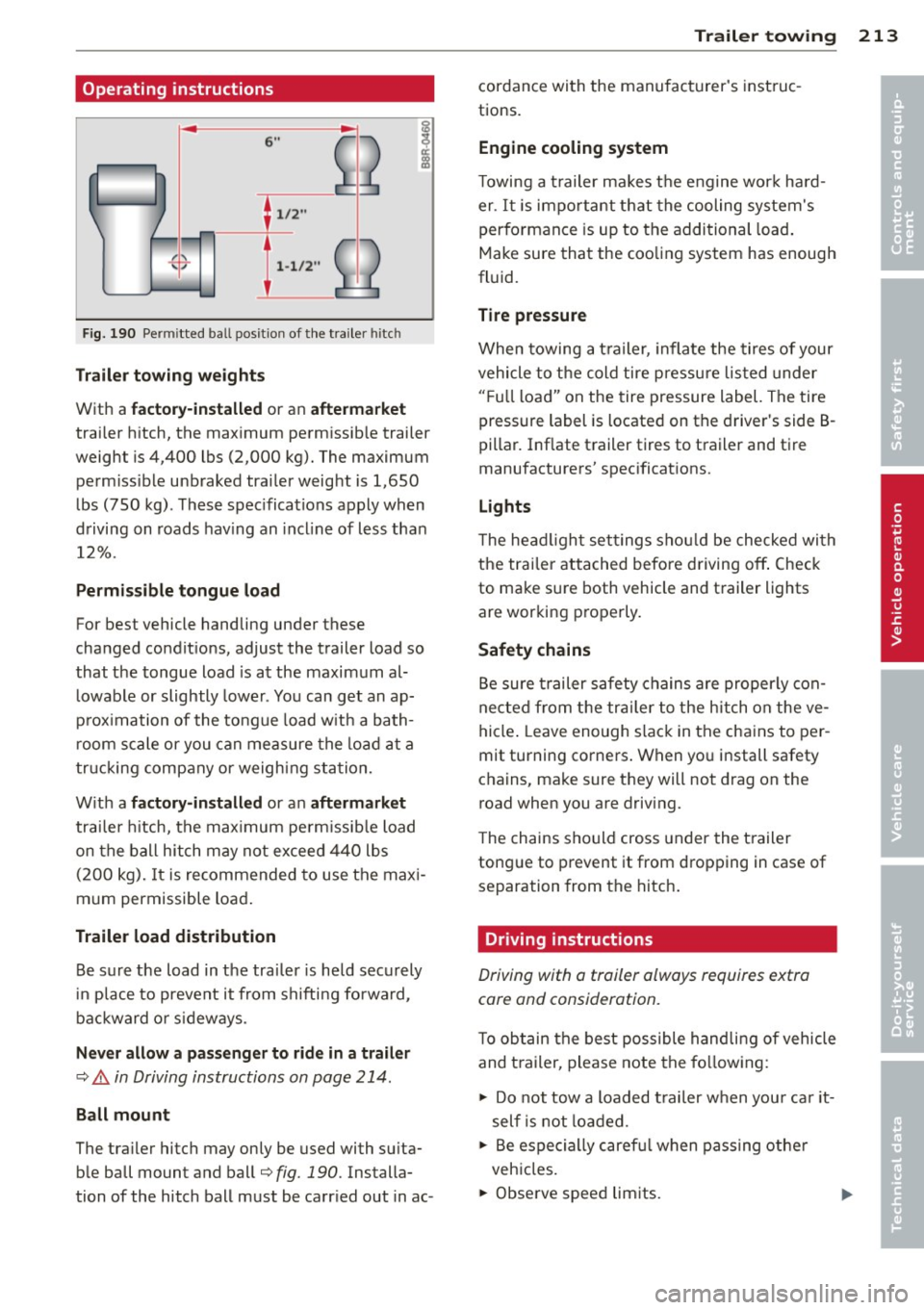
Fig. 190 Permit ted ball position of the trailer hitch
Trailer towing weights
With a factory-installed or an aftermarket
trailer hitch, the maximum permissible trailer
weight is 4,400 lbs (2,000 kg). The maximum permissible unbraked trailer weight is 1,650
lbs (750 kg) . These specifications apply when
driving on roads having an incline of less than
12%.
Permissible tongue load
For best vehicle handling under these
changed conditions, adjust the trailer load so
that the tongue load is at the maximum al
lowable or slightly lower . You can get an ap
proximation of the tongue load with a bath
room scale or you can measure the load at a
trucking company or weighing station.
With a
factory-installed or an aftermarket
trailer hitch, the maximum permissible load
on the ball hitch may not exceed 440 lbs
(200 kg).
It is recommended to use the maxi
mum permissible load.
Trailer load distribution
Be sure the load in the trailer is held securely
in place to prevent it from shifting forward,
backward or sideways.
Never allow a passenger to ride in a trailer
¢.&. in Driving instructions on page 214.
Ball mount
The trailer hitch may only be used with suita
ble ball mount and ball¢
fig. 190. Installa
tion of the hitch ball must be carried out in ac-
Trailer towing 213
cordance with the manufacturer's instruc
tions.
Engine cooling system
Towing a trailer makes the engine work hard
er .
It is important that the cooling system's
performance is up to the additional load.
Make sure that the cooling system has enough
fluid.
Tire pressure
When towing a trailer, inflate the tires of your
vehicle to the cold tire pressure listed under
"Full load" on the tire pressure label. The tire
pressure label is located on the driver's side B
pillar. Inflate trailer tires to trailer and tire
manufacturers' specifications.
Lights
The headlight settings should be checked with
the trailer attached before driving off. Check
to make sure both vehicle and trailer lights
are working properly.
Safety chains
Be sure trailer safety chains are properly con
nected from the trailer to the hitch on the ve
hicle. Leave enough slack in the chains to per
mit turning corners. When you install safety
chains, make sure they will not drag on the
road when you are driving.
The chains should cross under the trailer
tongue to prevent it from dropping in case of
separation from the hitch.
Driving instructions
Driving with a trailer always requires extra
care and consideration.
To obtain the best possible handling of vehicle
and trailer, please note the following :
.,. Do not tow a loaded trailer when your car it
self is not loaded .
.,. Be especially careful when passing other
vehicles.
.,. Observe speed limits.
•
•
Page 216 of 316
214 Trailer towing
• Do not drive at the maximum permissible
speed.
• Always apply brakes early .
• Monitor the temperature gauge.
W eig ht distribution
Towing a loaded tra ile r with an empty car re
sults in a highly unstable distribution of
weight . If this cannot be avoided, drive at very
low speeds only to avoid the risk of losing
steering control.
A "balanced" rig is easier to operate and con
trol. This means that the tow vehicle should
be loaded to the extent possible and permissi
b le, while keeping the trailer as light as possi
ble under the circumstances. Whenever possi
ble, transfer some cargo to the luggage com
partment of the tow vehicle wh ile observing
tongue load requirements and vehicle loading
considerations .
Speed
The higher the speed, the more difficult it be
comes for the driver to control the rig . Do not
drive at the maximum permissible speed . Re
duce your speed eve n mo re if load, weathe r or
wind condi tions are unfavorable -part icu larly
when going dow nhill.
Reduce vehicle speed immediately if the t rail
e r shows the slightest sign of swaying. Do not
tr y to s top the sw ayin g by acce ler atin g.
Observe speed limits . In some areas, speeds
for vehicles towing trailers are lower tha n for
regula r vehicles.
Always apply brakes early . When driv ing
downhill, shift into a lower gear to use the en
g ine b raking effect to slow the vehicle. Use of
the brakes alone can cause them to overheat
and fail.
Coolant temperature
T he coolant temperature gauge
c:> page 10
must be observed carefully . If the needle
moves close to the upper end of the scale , re
duce speed immed iate ly and/or turn off the
a ir cond itione r. If the coolant temperature warning light in
the instr ument cluster starts flashing., pull
off the road, stop and let the engine
idle for
about two minutes to prevent heat build-up.
A WARNING
Anyone not properly restrained in a mov
i ng vehicle is at a much greater risk in a n
accident . Never let anyone ride in your ca r
who is not p roperly wea ring the rest raints
p rov ided by Audi.
Trailer towing tips
Important to know
Your vehicle handles d ifferently when towing
-
a trai ler because of the additional weight and
different weight distr ibut ion. Safety, perform
ance and economy will greatly depend on how ca refully you load your trai ler and ope rate
you r rig.
Befo re you actually tow your tra iler, practice
turning, stopping and backing up in an area
away from t raffic. Keep pract ic ing unt il you
have become completely familiar wit h the way
yo ur vehicle-tra iler combination behaves and
responds.
Backi ng up is difficult and requ ires practice.
Backi ng up w ith a t railer gene rally requires
stee ring action opposite to tha t when backing
u p you r vehicle witho ut a tr ailer.
Maintai n a greater d ista nce between your ve
hicle and the one in front of you. You w ill need
more room to stop. To compensate fo r the
t railer, you w ill need a larger than normal
tu rning rad ius.
When passing, remembe r that you cannot ac
ce le rate as fas t as you no rma lly would be
ca use of the added load. Make sure yo u have
enough room to pass . After passing, a llow
plenty of room for yo ur trailer before cha ng
ing lanes again.
Avoid jer ky s tarts, sharp t urns o r rapid lane
changes.
Page 217 of 316
@ Tips
-Do not tow a traile r during the break-in
period o f your vehicle .
- If you tow a t railer, your A udi may re
quire more frequent maintenance due to
the extra load
¢ page 295.
Parking on a slope
Do not park on a slope with a trailer. If it can
not be avoided, do so only after doing the fol
lowing:
When parking:
.,. Apply t he foo t brake .
.,. Have someone place c hocks under bo th the
vehicle and the trai ler whee ls .
.,. With chocks in p lace, s lowly re lease the
brakes unti l th e wheel chocks absorb the
l oad .
.,. Turn the wheels towards the curb .
.,. Apply t he pa rking brake .
.,. Mov e the sel ecto r leve r to P .
When restarting after parking:
.,. Apply the foot brake .
.,. Start the eng ine .
.,. Move the selecto r lever to D/S .
.,. Re lease th e par kin g b rake and slowly pull
out and away from the whee l cho cks .
.,. Stop and have someone re tr ieve the w hee l
chocks.
(D Tips
If you move the selector lever of t he a uto
mat ic t ran sm ission to P before app lyi ng
t he p ark in g br ake an d bef ore blocking the
wheels, you may have to use mo re force
later to move the lever out of t he P posi
tion.
Trailer towin g 215
•
•
Page 218 of 316
216 Cleaning and protection
Cleaning and protect ion
General information
Regular core preserves vehicle value .
Any automobile is exposed to industr ial
fumes, corrosive road salt, etc. A well cared
for Audi can look like new many years after
p ur chase . Reg ular and correct care w ill con
tr ibute to maintain ing the beauty and valu e of
your Aud i.
Furthermore, good care may be a condition
for substantiating a warranty claim should
corrosion damage or paint defects occur.
Your auth orized Audi dealer has a variety of
dedicated vehicle-care products and can ad
v ise wh ich ones to use for cleaning the ext eri
or a nd inte rior o f you r vehi cle.
Whether you use products recommended by
Aud i or other commercially ava ilable clean ing
agen ts, pleas e make sure you apply t hem cor
r ectly .
A WARNING
-Cleani ng agen ts m ay be poi sonous. Kee p
them o ut of t he rea ch of childre n.
- H eed a ll ca ution labels.
- Always read directions on th e co ntai ner
b efore using a ny produc t. Follow the di
rec tions caref ully.
- Most chemical cleaners a re concentrat ed
and have to be diluted.
- Use spot removing flui ds only i n well
ventila ted areas.
- Do not use gasoline, ke rosene, d iesel
fuel, nail pol is h remov er or ot her volati le
fluid s. T hey may be to xic, flammab le or
h azar dou s in other w ays. D o not was h,
w ax or dry the vehicle wi th the ig nit ion
on or the eng ine running .
- D o not cl ean t he under sides of ch assis,
f en ders, wheel cove rs , etc. without pro
tectin g your hands and a rms. You may
c u t yourself on s harp-ed ged metal parts . -
Moisture and ice on b rakes may impair
brak ing eff ic iency
c::> page 200 , Broke sys
tem .
Test the brakes carefully each t ime
you was h the vehicle .
@ For the sake of the environment
Select on ly environ mentally frien dly clean
i ng products. Leftover cleaning pr oducts
s hou ld not d isposed of in the househo ld
waste .
Care of exterior
Washing
Frequent washing protec ts the vehicle .
The best p rotection against environmen tal i n
fluences is
frequ ent wash ing and waxing . H ow
often t his is requ ire d d epends o n:
- How much t he ve hicle is used
- W he re the veh icle is parked (garage, i n the
open under trees, etc .)
- The seasona l and weather conditions
- Environmental infl uences
T he longer b ird d roppings, inse cts, tree res in,
r oad and indus trial grime, t ar, soo t, ro ad salt
and other mater ials remain on the veh icle
body, the mo re lasting their destr uctive ef
f ects w ill be . Hig h temperatures ca used by ex
pos ure to intense su nlight i ntens ify the c orro
s ive effect, particular ly when hum id ity is high
as wel l.
U nder certa in circumstances,
weekly washing
may be necessary. Unde r other cond itions, a
monthly washing and waxi ng may be ade
quate .
After the winter, the unders ide of the vehicle
sho uld be thoroughly washed, preferab ly in a
professional ca r wash.
Vehicles with matte finish paint*
¢ page 219.
A WARNING
-Always read and heed all WARNINGS and
other in fo rmation¢
page 216.
Page 224 of 316
222 Cleaning and protec tio n
-To h elp prevent dirt fr om scratch ing the
win dow, always scrape in a f orward di
rection -pu shing the scraper away from
you -never back and fo rth.
- Water leaking from the inside of the rear
windows may damage sensitive electrical
components located either under the
rear parcel shelf or in the rear trunk area.
Always ensure that water
never leaks
through the body sect ion of the vehicle.
You can do this by using waterp roof pro
tection
over the vehi cle's electr ical com
ponen ts (e.g., when ins tall ing window
tinting) .
- Damage or malf unct ion of electrical
componen ts due to wa ter damage or any
other outside influence is not covered by
the Audi New Vehicle Limited Warranty .
See your Warranty
& Maintenance book
l et for add itiona l details about your war
ranty.
Cast (light ) alloy wheels
Cast (light) alloy wheels require special care.
... Wash the whee ls w ith a sponge or hose
brush
every other week .
... For deep cleaning afterwards, use only a
dedicated
acid-free cast alloy wheel cleaner.
., Rub a coat of
liquid wa x onto the r ims every
three month . Be sure to reach and treat a ll
parts of the rim .
To preserve the decorat ive appearance of the
cast a lloy whee ls, some specia l care is neces
sary. In add it io n to road dirt and sa lt, b rake
dust is a lso cor ros ive . If left o n for too long,
b rake dust ca n cause pitting.
Use on ly special
acid-free cleaners formulated
for a lloy rims . Safe products are available at
your author ized Audi dealer. Never leave the
cleane r on the r ims longe r than spec ified o n
the label.
If no t rinsed off p romp tly, the a cid
con tained in some cleaners can attack the
threads on the whee l bolts.
Never use ab ras ive or metal polishing clean
i ng agen ts.
If the pro te ct ive coa ting has been chipped, e.g
. by kicked up road dirt, to uch it
u p as soon as possible.
A WARNING
--
- Moisture and ice on b rakes may affect
brak ing eff ic iency
c::> page 200, Brake sys
tem.
Test the brakes carefully each t ime
you wash the vehicle .
- Always read and heed all WARNINGS and
other information
c::> page 216.
Body cavity sealing
The body cavity sealing does not need to be
checked.
All body cavit ies which could be affected by
corros ion have been thorough ly protected at
the factory.
T his sealing does not require any inspection or
additional treatment. If any wax shou ld seep
o ut of the cavity when the ambient tempera
ture is high, it can be
removed with a p lastic
scraper and a suitable solvent .
A WARNING
-Solvents can be dangerous.
- Benz ine is flammab le and toxic. If you
use benz ine for removing the wax, keep
sparks , flame and lighted cigarettes
away . Never dump benz ine on the
g round, into open streams or down sew
age d rains.
- Be s ure to
observe all safety and environ
men tal regulat ions. Follow all instruc
tions on the container.
- Always read and heed all WAR NINGS and
other info rmation
c::> page 216.
Chassis
Have the undercoating checked for damage
from time to time .
The lower body shell of your Aud i is also thor
oughly protected against corros io n.
Any damage to the undercoat ing ca used by
road hazards should be repaired prompt ly.