lock AUDI Q5 2013 Workshop Manual
[x] Cancel search | Manufacturer: AUDI, Model Year: 2013, Model line: Q5, Model: AUDI Q5 2013Pages: 316, PDF Size: 78.89 MB
Page 133 of 316
Switching on and off
Applies to vehicles: with Audi parking system p lus with
rea rview camera
The reorview camera switches on automati
cally together with the acoustic and visual
pork assist when you put the vehicle in re verse .
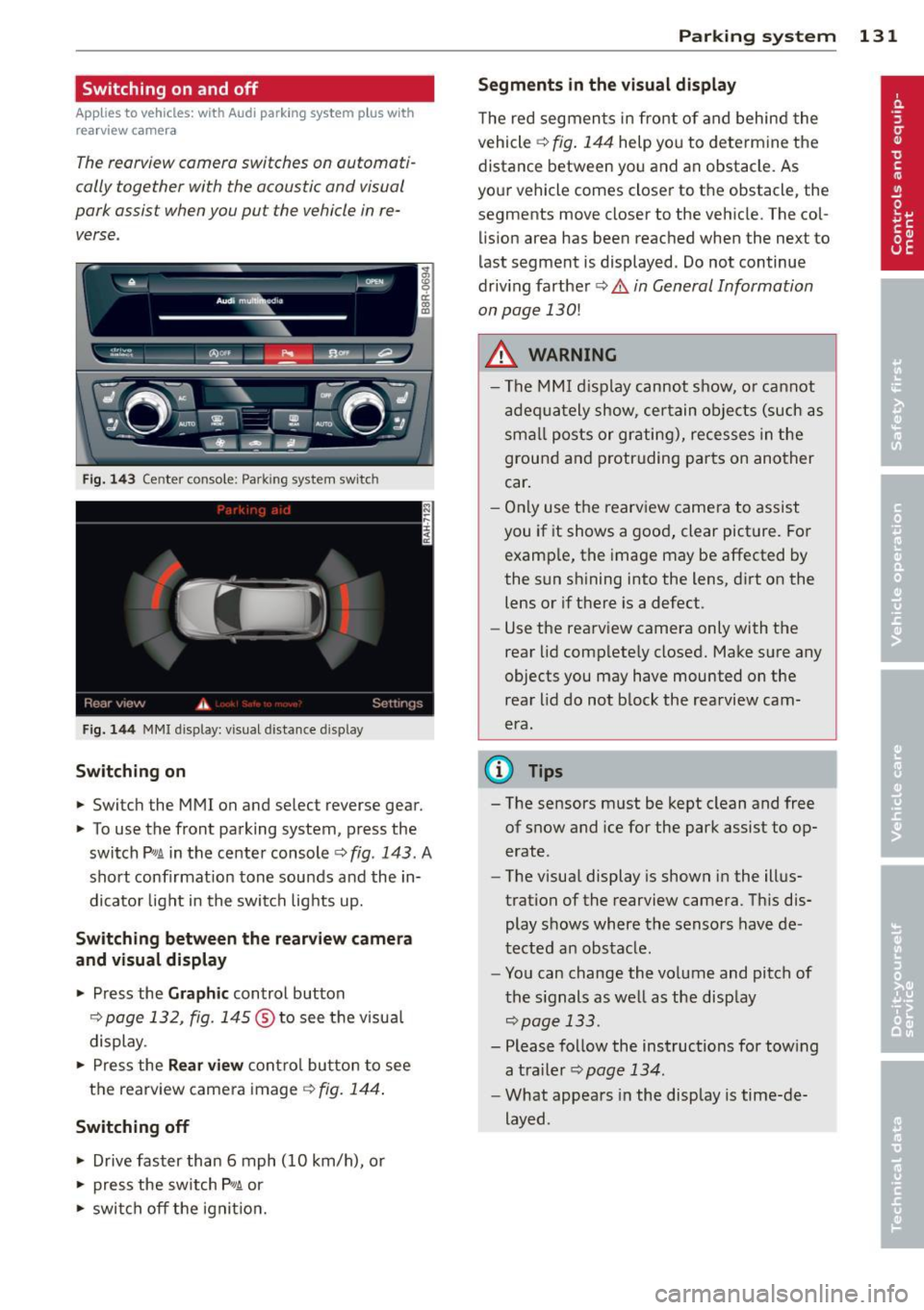
Fig. 14 3 Center co nsole ; Pa rk ing syste m switc h
Fig. 144 MMI disp lay: visu al dista nce display
Switching on
.,. Switch the MMI on and select reverse gear.
.,. To use the front parking system, press the
switch
P w.A in the center console c> fig . 143. A
sho rt confirmat ion tone sounds and the in
dicato r light in the switch lights up.
Switching between the rear view came ra
and visual display
.,. Press the Graphic control button
¢ page 132, fig . 145 ® to see the visua l
display.
.,. Press the
Rear view con trol bu tton to see
the rearview came ra image
¢ fig. 144 .
Switching off
.,. Drive faster than 6 mph (10 km/h), or
.,. press the sw itch
p ,q .A or
.,. swi tch off the ignit io n.
Par king system 131
Segm ents in the vi sual display
T he red segmen ts i n fro nt of and behind the
vehicle
c> fig . 144 help you to determ ine the
distance between yo u and an obstacle. As
you r vehicle comes close r to the obstacle, the
segments move closer to the vehicle. The col lision area has been reached when the next to
l ast segment is displayed . Do not continue
driv ing farther
c> .&. in General Information
on page
130!
A WARNING
- T he MMI display cannot s how, o r ca nnot
a dequa tely show, certain o bje cts (such as
smal l posts or gr ating), recesses in the
ground and p rotruding parts on another
car .
- On ly use the rearv iew came ra to assist
you if it shows a good, clear pict ure. For
examp le, the image may be affected by
the sun sh ining into the lens, d irt on the
lens or if there is a defect.
- Use the rearv iew camera only with the
rear lid comp lete ly closed. Make sure any
o bjects you may have mounted on the
rea r lid do not b lock the rearview cam
era.
(D Tips
- The sensors m ust be kept clean and free
of snow and ice for the park assist to op
erate .
- The visua l display is shown in the illus
tration of the rearview camera. Th is dis
play shows where the sensors have de
tected an obstacle .
- You can change the vo lume and pitch of
t he s ignals as we ll as the disp lay
<=>page 133.
- Please fo llow the instructions for tow ing
a tra iler
c> page 134.
-What appears in the display is time-de
layed .
Page 143 of 316
~ Always keep both feet in the footwell so
that you are in control of the vehicle at all
times.
For detailed information on how to adjust the
driver's seat, see
c:;, page 62.
A WARNING
Drivers who are unbelted, out of position
or too close to the airbag can be seriously
injured by an airbag as it unfolds. To help
reduce the risk of serious personal injury:
- Always adjust the driver's seat and the
steering wheel so that there are at least
10 inches (25 cm) between your breast
bone and the steering wheel.
- Always hold the steering wheel on the
outside of the steering wheel rim with
your hands at the 9 o'clock and 3 o'clock positions to help reduce the risk of per
sonal injury if the driver's airbag inflates.
- Never hold the steering wheel at the
12 o'clock position or with your hands at
other positions inside the steering wheel
rim or on the steering wheel hub. Hold
ing the steering wheel the wrong way
can cause serious injuries to the hands,
arms and head if the driver's airbag de
ploys.
- Pointing the steering wheel toward your
face decreases the ability of the supple
mental driver's airbag to protect you in a
collision .
- Always sit in an upright position and nev
er lean against or place any part of your
body too close to the area where the air
bags are located.
- Before driving, always adjust the front
seats and head restraints properly and
make sure that all passengers are prop
erly restrained.
- Never adjust the seats while the vehicle
is moving . Your seat may move unexpect
edly and you could lose control of the ve
hicle.
- Never drive with the backrest reclined or
tilted far back! The farther the backrests
are tilted back, the greater the risk of in-
Driving Safely 141
jury due to incorrect positioning of the
safety belt and improper seating posi
tion .
- Children must always ride in child safety
seats
c:;, page 178. Special precautions
apply when installing a child safety seat
on the front passenger seat
c:;, page 157 .
Proper seating position for the front
passenger
The proper front passenger seating position
is important for safe, relaxed driving .
For your own safety and to reduce the risk of
injury in the event of an accident, we recom
mend that you adjust the seat for the front
passenger to the following position :
~ Adjust the angle of the seatback so that it is
in an upright position and your back comes
in full contact with it whenever the vehicle is
moving .
~ Adjust the head restraint so the upper edge
is as even as possible with the top of your
head. If that is not possible , try to adjust
the head restraint so that it is as close to
this position as possible
c:;, page 142.
~ Keep both feet flat on the floor in front of
the front passenger seat .
~ Fasten and wear safety bel ts correctly
c:;, page 152.
For detailed information on how to adjust the
front passenger 's seat, see
c:;, page 61.
A WARNING ,_
Front seat passengers who are unbelted,
out of position or too close to the airbag
can be seriously injured or killed by the air
bag as it unfolds. To help reduce the risk of
serious personal injury:
- Passengers must always sit in an upright
position and never lean against or place
any part of their body too close to the
area where the airbags are located.
- Passengers who are unbelted, out of po
sition or too close to the airbag can be
seriously injured by an airbag as it
•
•
Page 147 of 316
Stowing luggage
Loading the luggage compartment
All luggage and other objects must be prop
erly stowed and secured in the luggage com
partment.
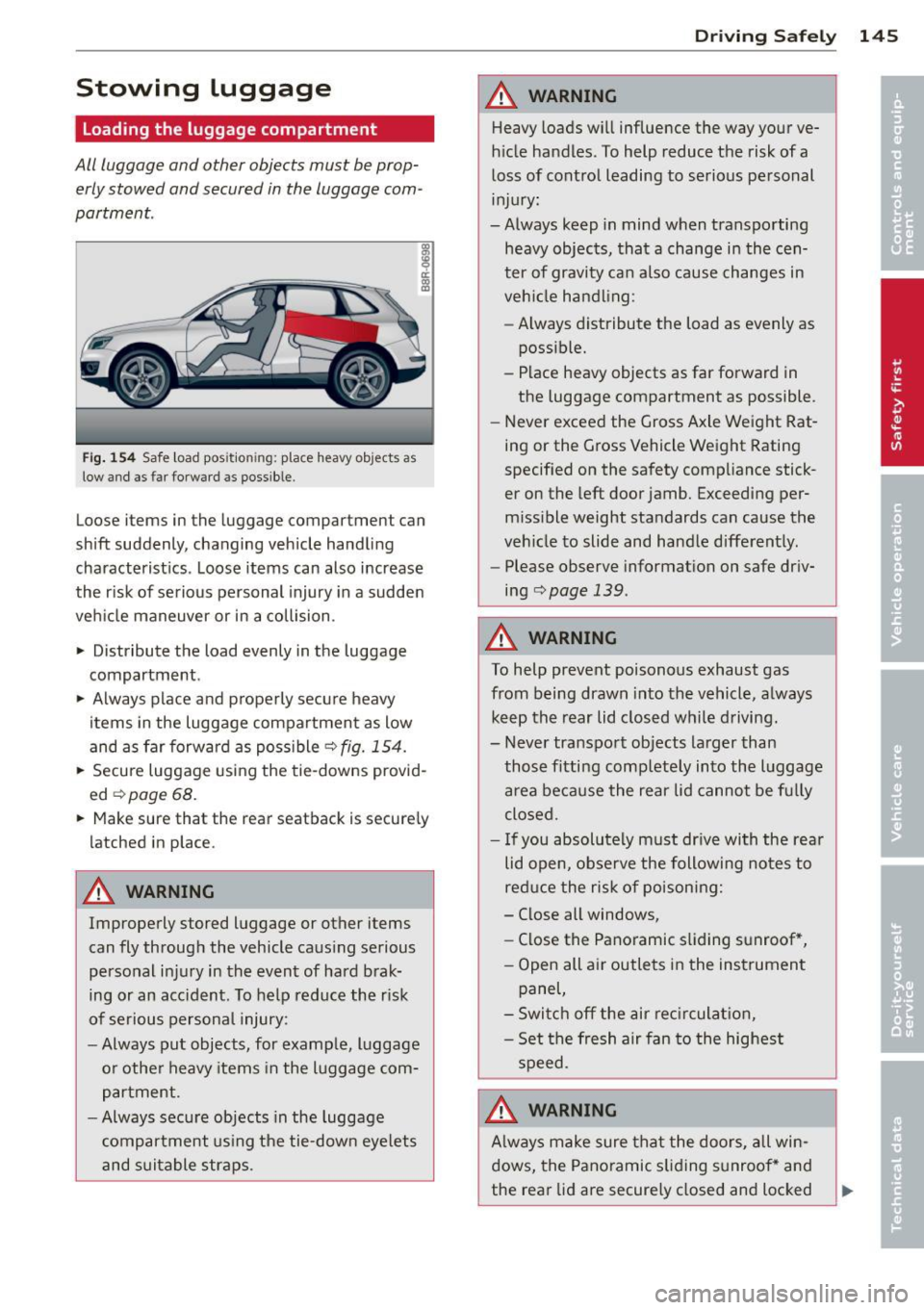
Fig . 154 Safe load pos ition ing: place heavy objects as
low and as far forward as possible.
Loose items in the luggage compartment can
shift suddenly, changing vehicle handling
characteristics . Loose items can also increase
the r isk of serious personal injury in a sudden
veh icle maneuver or in a collision .
.. Distribute the load evenly in the luggage
compartment.
.. Always place and properly secure heavy
items in the luggage compartment as low
and as far forward as poss ible
q fig. 154.
.. Secure luggage using the tie-downs provid
ed
¢ page 68.
.. Make sure that the rear seatback is secure ly
latched in place.
A WARNING
Improperly stored luggage or other items
can fly through the vehicle causing serious
personal injury in the event of hard brak
ing or an acc ident. To help reduce the risk
of serious personal injury:
- Always put objects, for example, luggage
or other heavy items in the luggage com
partment.
- Always secure objects in the luggage
compartment us ing the tie-down eye lets
and suitable straps .
Drivin g Sa fely 145
A WARNING
Heavy loads will influence the way your ve
h icle handles. To help reduce the risk of a
loss of control leading to serious personal
injury:
-Always keep in mind when transporting
heavy objects, that a change in the cen
ter of gravity can also cause changes in
veh icle handling:
- Always distribute the load as evenly as
possible.
- Place heavy objects as far forward in
the luggage compartment as possible.
- Never exceed the Gross Axle Weight Rat
ing or the Gross Vehicle Weight Rating
specified on the safety compliance stick
er on the left door jamb. Exceeding per
missible weight standards can cause the
veh icle to slide and handle differently.
- Please observe information on safe driv
ing
q page 139 .
A WARNING
To help prevent poisonous exhaust gas
from being drawn into the vehicle, a lways
keep the rear lid closed while driving.
- Never transport objects larger than
-
those fitting comp letely into the luggage
area because the rear lid cannot be fu lly
closed .
- If you absolutely must dr ive with the rear
lid open, observe the following notes to
reduce the risk of poisoning:
- Close all windows,
- Close the Panoramic sliding sunroof *,
- Open all air outlets in the inst rument
panel,
- Switch off the air rec irculat ion,
- Set the fresh a ir fan to the highest
speed.
A WARNING
A lways make sure that the doo rs, all win
dows, the Pano ramic s liding sunroof* and
the rear lid are securely closed and locked
Page 148 of 316
146 Driving Safel y
to reduce the risk of inj ury when the vehi
cle is not be ing used.
- After closing the rear lid, always make
sure that it is properly closed and locked.
- Never leave your vehicle unattended es
pecially with the rear lid left open . A
child could crawl into the vehicle through
the luggage compartment and close the
rear lid becoming trapped and unable to
get out . Be ing trapped in a vehicle can
lead to serious persona l injury.
- Never let children p lay in or around the
vehicle .
- Never let passengers r ide in the luggage
compartment . Veh icle occupan ts must
always be proper ly restrained in one of
the vehicle's seating positions.
(D Tips
- Air circulation helps to reduce window
fogging . Sta le air escapes to the o utside
th rough vents in the trim pane l. Be su re
to keep these slots free and open.
- The tire pressure must correspond to the
load . The t ire pr essure is shown on the
tire p ressu re label. The tire pressure la
bel is loc ate d on the driver's s ide B-pi lla r.
The tire pressure label lists the recom
men ded cold t ire inflat ion pressu res for
the veh icle at its maximum capacity
weight and the tires that were on your
vehicle at the time it was manufact ured.
For recommended t ire pressures for nor
mal load conditions, please see chapter
Q page252.
Tie-downs
The luggage compartment is equipped with
four tie-downs to secure luggage and other
items .
Use the tie-downs to secure your cargo prop
erly ¢ page 145, Loading the luggage com
partment .
In a coll is ion, the laws of phys ics mean that
even smaller items that are loose in the vehi
cle will become heavy missiles that can cause se
rious injury. Items in t he vehi cle possess en
ergy which vary with vehicle speed and the
weight of t he item . Vehicle speed is the most
s ignificant factor.
F or example, in a frontal collision at a speed
of 30 mph (48 km/h), the forces acting on a 10 -lb (5 kg) object a re abo ut 20 times the
normal weight of the item. This means that
the weight of the item would sudden ly be
about 200 lbs . (90 kg) . You can imag ine the
injur ies that a 200 lbs . (90 kg) item fly ing
fr ee ly t hro ugh the passenger compa rtment
cou ld cause in a col lision like this.
_& WARNING
We ak, damaged or imprope r straps used
to secure items to tie-downs can fail dur
i ng hard braking or in a collision and cause
se rious pe rsonal injury.
-Always use s uita ble mo unt ing straps an d
p roperly secu re items to the tie-downs in
the l uggage compa rtment to he lp pre
vent items from shift ing or fly ing fo r
ward as dangerous missiles.
- When the rea r seat backrest is folded
down, a lways use suitable mounting
straps and properly secure items to the
tie-downs in the luggage compartment
to hel p prevent items from fly ing for
ward as dangerous missiles into the pas
senger compartment.
- Never attach a chi ld safety seat t ether
s trap to a t ie-down .
Reporting Safety
Defects
Applicable to U.S.A.
If yo u b eli eve that your vehi cle
has a def ect whi ch could cau se
a crash or could cau se injury or
death, you should immediately
inform the National Highway
Traffic Safet y Administration ""
Page 155 of 316
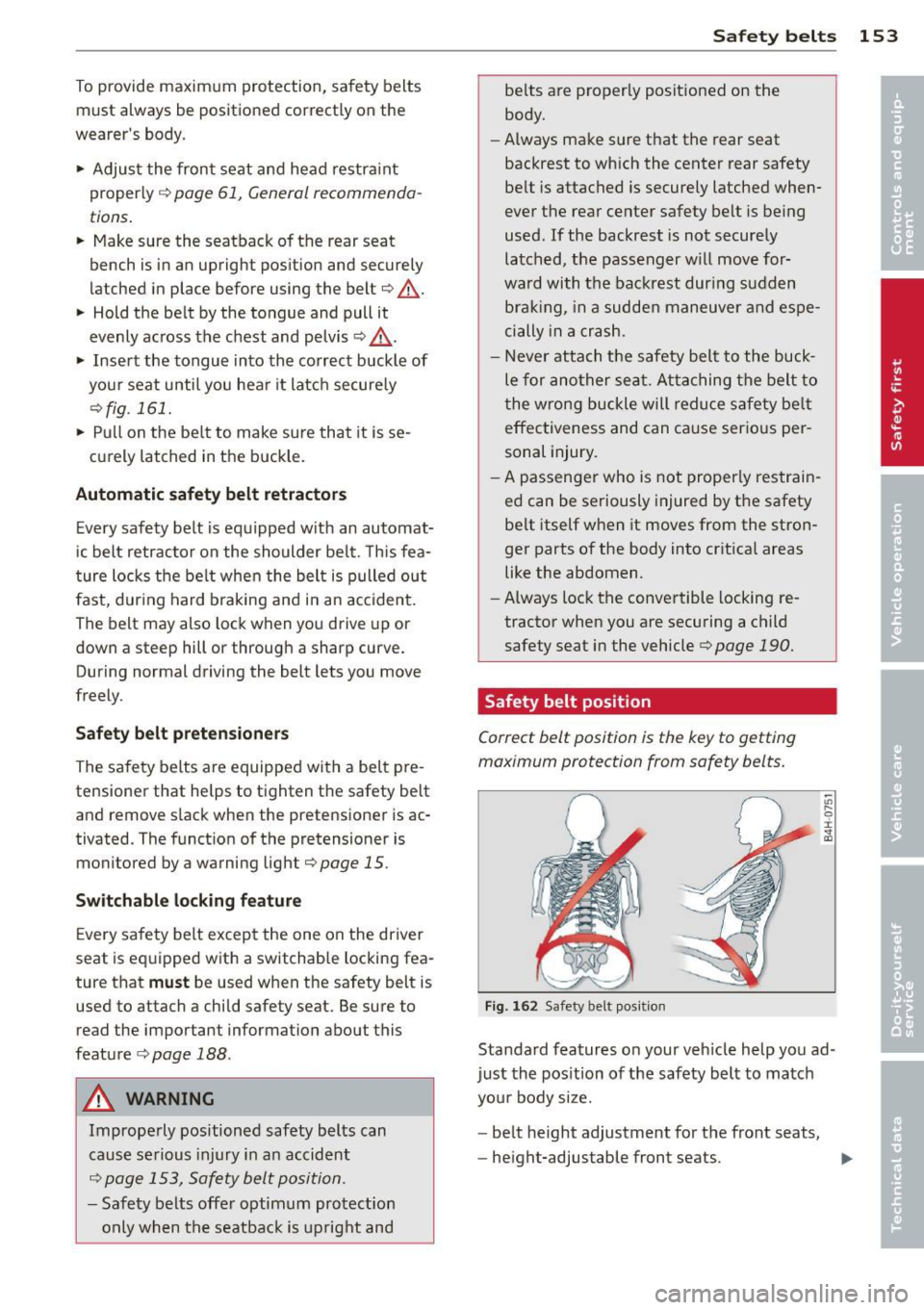
To provide maximum protection, sa fety belts
must always be positioned correctly on the
wearer's body .
... Adjust the front seat and head restra int
properly
c::> page 61, General recommenda
tions .
... Make sure the seatback of the rear seat
bench is in an upright position and securely
latched in place before using the belt
c::> ,&. .
... Hold the be lt by the tongue and pull it
evenly ac ross the chest and pelvis
c::> ,&..
... Insert the tongue into the correct buckle of
your seat until you hea r it latch securely
c::>fig. 161.
... Pu ll on t he be lt to make sure that it is se-
curely latched in the buckle.
Automatic safety belt retractors
Every safety belt is equipped w ith an automat
i c belt retractor on the shoulder be lt. T his fea
ture locks the belt when the belt is pulled out
fast, dur ing hard braking and in an accident.
The belt may also lock when you drive up or
down a steep hill or through a sharp curve. During normal driving the belt lets you move
freely.
Safety belt pretensioners
The safety belts are equipped with a belt pre
tensioner that helps to tighten the safety belt
and remove slack when the pretensioner is ac
tivated. The funct ion of the pretensioner is
monitored by a warning light
c::> page 15.
Sw itchable locking feature
E very sa fety belt except the one on the driver
seat is equipped with a switchable locking fea
ture that
must be used when the safety belt is
used to attach a child safety seat. Be sure to read the important information about this
feature
c::> page 188.
A WARNING
Imprope rly positioned safety belts can
cause serious injury in an accident
o::> page 153, Safety belt position.
-Safety belts offer optimum protect ion
only when the seatback is upright and
Safety belts 153
belts are properly positioned on the
body.
- Always make sure that the rear seat
backrest to which the center rear safety
be lt is attached is securely latched when
ever the rear center safety belt is being
used. If the backrest is not securely
latched, the passenger w ill move for
ward with the backrest during sudden
braking, in a sudden maneuver and espe
cially in a crash .
- Never attach th e safety belt to the buck
le for another seat . Atta ching the belt to
the wrong buckle will reduce s afety be lt
effectiveness and can cause ser ious per
sonal injury.
- A passenger who is not proper ly restrain
ed can be seriously injured by the safety
be lt itself when it moves from the stron
ger parts of the body into cr itical areas
like the abdomen.
- Always lock the convertible locking re
tractor when you are securing a child safety seat in the vehicle
c::> page 190.
Safety belt position
Correct belt position is the key to getting
maximum protection from safety belts.
Fig . 162 Safety belt position
Standa rd features on your veh icle help you ad
just the position of the safety belt to match you r body size.
- belt height adjustment for the front seats,
- height-adjustable front seats.
Page 171 of 316
If the fron t passenger seat is not occupied,
the front airbag will not deploy, and the
PAS
SENGER AIR BAG OF F
light will stay on. Nev
er in sta ll a rearward-fac ing ch ild restra int on
t he fron t passenger seat, the safest place for
a child in any kind of child restraint is at one
of the seating positions on the rear seat
¢ page 158, Child restraints on the front seat
- some important things to know
and
¢ page 178, Child Safety .
If the PASSENGER AIR BAG OFF light c om es
on
when one of the conditions listed above is
met, be sure to check the light regularly to
make certa in that the
PAS SENGER AIR BAG
O FF
light stays on cont inuous ly whenever the
ignition is on . If the
PASSENGER AIR BAG
OFF
light does not appear and not stay on all
the time, stop as soon as it is safe to do so
and
- reactivate the system by turning the ignition
off and then t urning it on again;
- remove and reinstall the child restraint .
Make sure that the child restraint is properly
installed and that the sa fety be lt for the
front passenger seat has been correct ly
routed around the child restraint a s desc ri
bed in the child restraint manufacturer 's in
structions;
- make sure that the convertible locking fea
ture on the safety be lt for the front passen
ger seat has been activated and that the
safety belt has been pulled tight . The belt
mus t not be loose o r have loops of slack so
that the sensor below the safety be lt latch
on the seat can do its job ¢
page 188.
-make su re that th ings that may increase the
weight of the ch ild and child safe ty seat are
not being transported on the front passen
ger seat ;
- make su re that the safety bel t tension sen
sor is not b locked . Shake t he safety belt
l atch on the front passenger seatback and
forth;
- If a strap or tether is being used to tie the
child safety seat to the front passenger
seat, make sure that it is not so tight that it
A irbag system 169
causes the weight -sensing mat to measure
more weight than is act ually on the seat .
If the PASSENGER AIR BAG OFF light still
d oes not come on
and does not stay on con
tin uous ly (when the ignition is switched on) ,
- take the child rest ra int off the front passen-
ge r seat and install it properly a t one of the
rear seat positions. Have the airbag system
inspected by yo ur authorized Audi dealer
immediate ly .
- move the child to a rear seat position and
make sure t hat the child is properly restrain
ed in a c hild restra int that is appropriate for
its size and age.
T he
PASSENGER AIR BAG OFF light sho uld
NOT come on when the ignition is on and an
adult is sitting in a proper seating position on
the front passenger seat. If the
PASSENGER
AIR BAG OFF
ligh t comes on and stays on or
flashes for about 5 seconds wh ile driving, un
der these c ircumstances , make sure that:
- the adult on the front passenger seat is
properly seated on the center of the seat
cushion wi th his or her back up aga inst the
backrest and the backrest is not recl ined
¢ page 140, Proper occupant seating posi
tions,
- the adult is not tak ing weight off the seat by
holding on to the passenger assist handle
above the front passe nger door or support
ing their weight on the armrest ,
- the safety belt is being properly wo rn and
tha t there is not a lot of s lack in the safety
be lt webbing ,
- ac cesso ry seat covers or cushions o r other
t hings tha t may cause an incorrect reading
or impression on the we ight-sensing mat
under the upho lstery of the seat have been
removed from the front passenger seat,
- a sa fety belt exten der has not been left in
the safety belt latch for the front passenger
seat.
In add it ion to the
PASSENGER AIR BAG OFF
li ght in the cente r of the instrumen t panel,
the message
PASSENGER AIR BAG OFF or
PASSENGER AIR BAG ON wi ll briefly appear ll-
•
•
Page 183 of 316
-Model Manufactured on or
after
Evenflo First Choice December 1, 1999
1 204
Graco Infant 8457 December 1, 1999
Graco Snug ride September 25, 2007
Peg Perego Primo Vi -September 25, 200 7
aggio SIP IMUN00US
Subpart C -Forward -fa cing and
c on vertible child restraint s
Model Manufactured on or
after
Britax Roundabout September 25, 2007
E9L02xx
Cosco Touriva 02519 December 1, 1999
Cosco Summit Deluxe September 25, 2007
High Back Booster
2 2-262
! Cosco High Back September 25, 2007
Booster 22-209
E venflo Tribu te V Sep tember 25, 200 7
379xxxx
Evenflo Medallion December 1, 1999
254
Evenflo Generations September 25, 2007
352xxxx
Graco ComfortSport September 25, 2007
Graco Toddler Safety September 25, 2007
Seat Step 2
Graco Platinum Cargo September 25, 2007
A WARNING
To reduce the risk of serious injury, make
sure that the
PASSENGER AIR BAG O FF
light comes on and stays on whenever a
child restraint is installed on the front pas
senger seat and the ignition is switched
on.
- Take the child rest raint off the front pas
senger seat and install it properly at one
of the rea r seat posi tions if the
PASSEN
GER AIR BAG OFF
light does not stay o n.
Child Sa fet y 181
-Have the airbag system inspected by
your author ized Audi dealer immed iate
ly.
(D Tips
The child seats listed in categories A to C have been statically tested by A udi on ly for
the Advanced A irbag function.
Important safety instructions for using
child safety seats
Correct use of child safety seats substantially
reduces the risk of injury in an accident!
As the dr iver, you are responsib le for the safe
ty of everybody in the veh icle, especially ch il
dren:
... Always use the r ight chi ld safety seat for
each child and always use it properly
¢page 184.
... Always carefully fo llow the child safety seat
manufacturer's inst ruct ions on how to route
the safety belt properly through the child
safety sea t .
... When usi ng the vehicle safety belt to install
a child safety seat, you m ust first activate
t he conve rtible locking retractor on the
safety belt to prevent the child safety seat
from mov ing
¢ page 188.
... Push the ch ild safety seat down with your
full weight to get the safety be lt really tight
so that the seat cannot move forward or
sideways more than one inch (2 .5 cm) .
... If a strap o r tethe r is be ing used to tie the
child safety seat to the front passenger
seat , make sure tha t it is not so tigh t that it
causes the weigh t-sens ing ma t to measure
more weight than is act ually on the seat.
... Sec ure unused safety belts on the rear seat
¢ page 183.
Always remember: Even tho ugh yo ur vehicle is
equipped with an Advanced Airbag system, all
c h ildren, especially those 12 years and young
er, shou ld always r ide in the back seat proper-
ly restrained for the ir age and size. ..,. •
•
Page 185 of 316
as possible before installing the child
restraint.
- Always make sure that nothing pre
vents the front passenger's seat from
be ing moved to the rearmost position
in its fore and aft adjustment range.
- Always make sure that the backrest is
in the upr ight position.
- Always buck le the child safety seat firmly
in place even if a child is not sitting in it.
A loose ch ild safety seat can fly around
dur ing a sudden stop or in a col lision .
- Always read and heed all WARNINGS
whenever using a child restrained in ave
hicle is being used
c::> page 149, Safety
belts,
c::> page 157, Airbag system and
c::> page 178, Child Safety.
A WARNING
T o reduce t he ris k of serious injury, make
sure that the
PASSENGER AIR BAG OFF
light comes on and stays on whenever a
child rest raint is installed on the front pas
senger seat and the ignition is switc hed
on.
- Take the child restraint off t he fro nt pas
senger seat and install it properly at one
of the rear seat positions if the
PASSEN ·
GER AIR BAG OFF
light does not stay on.
- Have the airbag system inspected by
your authorized Aud i dealer immediate
ly.
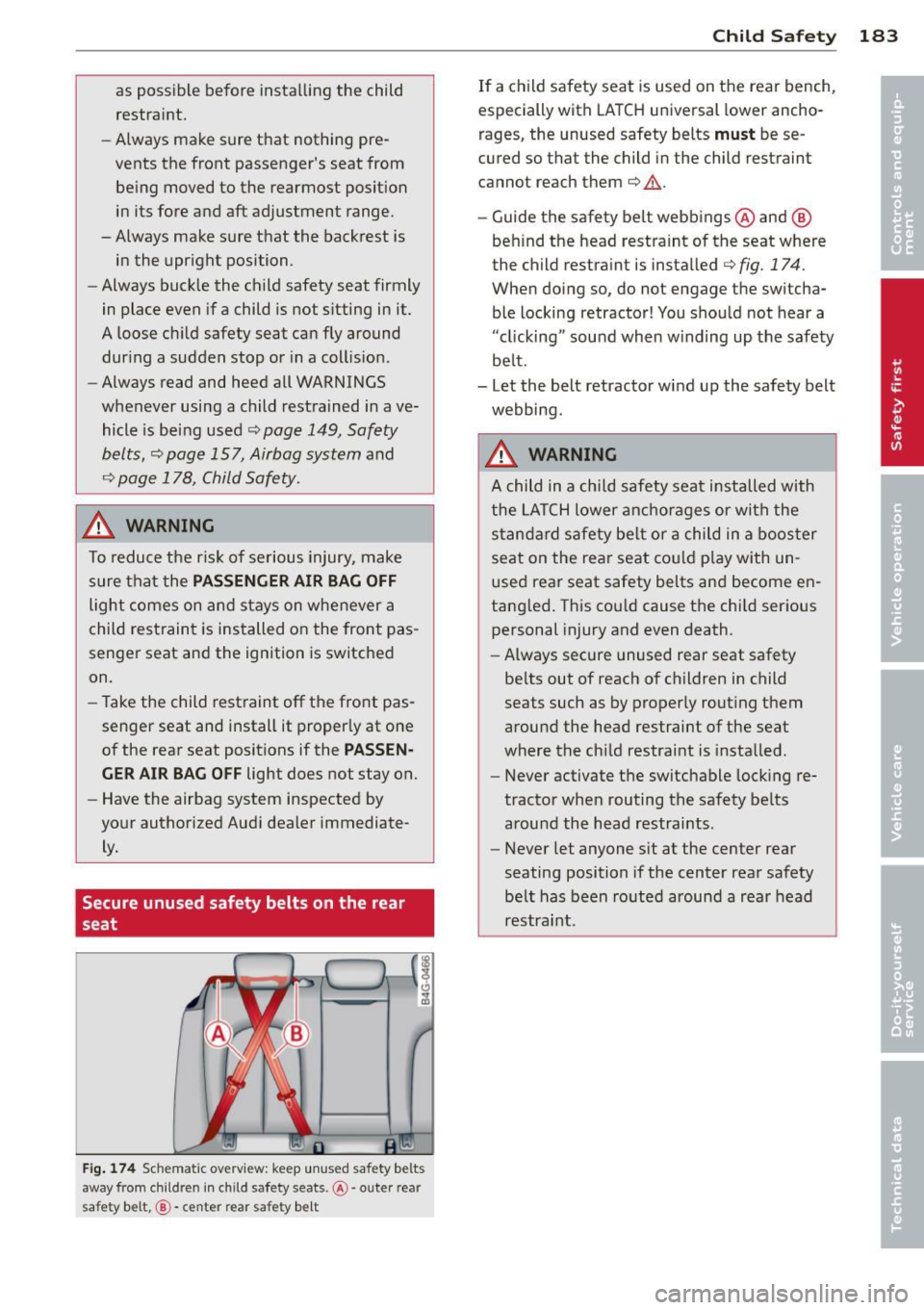
Secure unused safety belts on the rear
seat
F ig. 174 Schematic overv iew: keep un used safety belts
away from children in child safety seats.@-oute r rear
safety belt,
@ -center rear safety belt
Child S afety 183
If a child safety seat is used on the rea r bench,
especially with LATCH universal lower ancho
rages, the unused safety belts
must be se
cured so that the child in the child restraint
cannot reach them
c::> &.
-Guide the safety belt webbings @and @
beh ind the head restraint of the seat where
the child restra int is insta lled
c::> fig. 174.
When doing so, do not engage the switcha
ble locking retractor! You should not hear a
"cl icking" sound when w inding up the safety
be lt .
- Let the belt retractor wind up the safety belt
webbing.
A WARNING
A child in a chi ld safety seat i nstalled with
the LA TCH lower ancho rages or with the
standard s afety be lt or a child in a boos ter
seat on the rea r seat co uld p lay with un
use d rea r seat safety belts and become en
tang led . This could cause t he chi ld ser ious
personal injury and even death.
- Always secure unused rear seat safety
be lts out of reach of children in child
seats such as by proper ly rout ing them
around the head restrai nt of the seat
where the ch ild restraint is installed.
- Never activate t he switchable l ock ing re
tracto r when routing the safety be lts
around the head restraints.
- Never let anyone s it at the center rear
seating position if the center rea r safety
be lt has been routed around a rear head
restraint.
Page 186 of 316
184 Child Safet y
Child safety seats
Infant seats
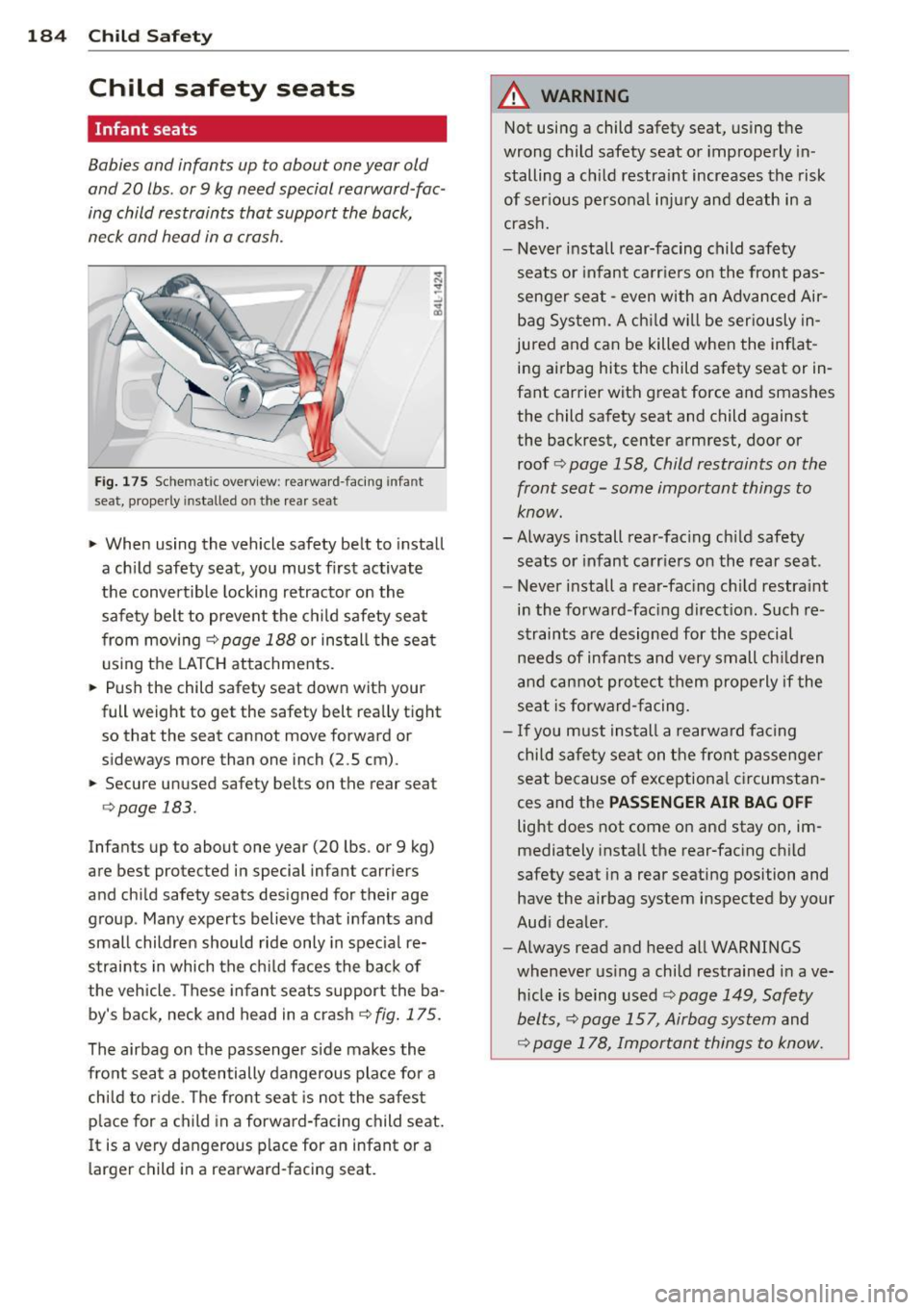
Babies and infants up to about one year old
and 20 lbs. or 9 kg need special rearward-fac
ing child restraints that support the back,
neck and head in a crash.
-- /
Fig . 175 Sche matic overview: rearward- facing infant
seat, properly installed o n the rear seat
> When using the vehicle safety belt to install
a ch ild safety seat, you must first activate
the convertible locking retractor on the
safety belt to prevent the child safety seat
from moving ¢
page 188 or install the seat
using the LATCH attachments.
> Push the child safety seat down with your
full weight to get the safety belt rea lly tight
so that the seat cannot move forward or
sideways more than one inch (2.5 cm).
> Secure unused safety belts on the rear seat
¢page 183.
Infants up to about one year (20 lbs. or 9 kg)
are best protected in special infant carriers
and child safety seats designed for their age
group . Many experts believe that infants and
small children should ride only in spec ial re
straints in which the chi ld faces the back of
the vehicle . These infant seats support the ba
by's back, neck and head in a crash ¢
fig. 175 .
The airbag on the passenger side makes the
front seat a potentially dangerous place for a
child to r ide . The front seat is not the safest
p lace for a child in a forwa rd-facing child seat.
I t is a very dangerous p lace for an infant or a
larger child in a rearward-facing seat.
A WARNING
-Not using a child safety seat, using the
wrong child safety seat or improperly in
stalling a ch ild restra int increases the risk
of ser ious personal in ju ry and death in a
crash.
- Never install rear-facing child safety
seats or infant ca rr ie rs on the front pas
senger sea t -even with an Advanced Air
bag Sys tem. A c hild will be ser iously in
jured and can be killed whe n the inflat
ing ai rbag hits the child safety seat or in
fant carrier with great force and smashes the child safety seat and child against
the backrest, center armrest, door or
roof ¢
page 158, Child restraints on the
front seat -some important things to
know.
- Always install rear-facing ch ild safety
seats or infant ca rr ie rs on the rear seat .
- Never install a rear-fac ing ch ild restra int
in the forward-fac ing direct ion. Such re
straints are designed for the special needs of infants and very small ch ild ren
a nd cannot protect them prope rly if the
seat is forward- facing.
- If you m ust insta ll a rearwa rd fa cing
child safety seat on the fro nt passenger
seat because of exceptiona l circumstan
ces and the
PASSENGER AIR BAG OFF
light does not come o n and stay on, im
mediately insta ll the rear-fac ing child
safety seat in a rear seating position and
have the airbag system inspected by your
Aud i deale r.
- Always read and heed all WARNINGS
whenever us ing a child restrained in ave
h icle is being used
¢ page 149, Safety
belts, ~page 157, Airbag system
and
c::> page 178, Important things to know.
Page 187 of 316
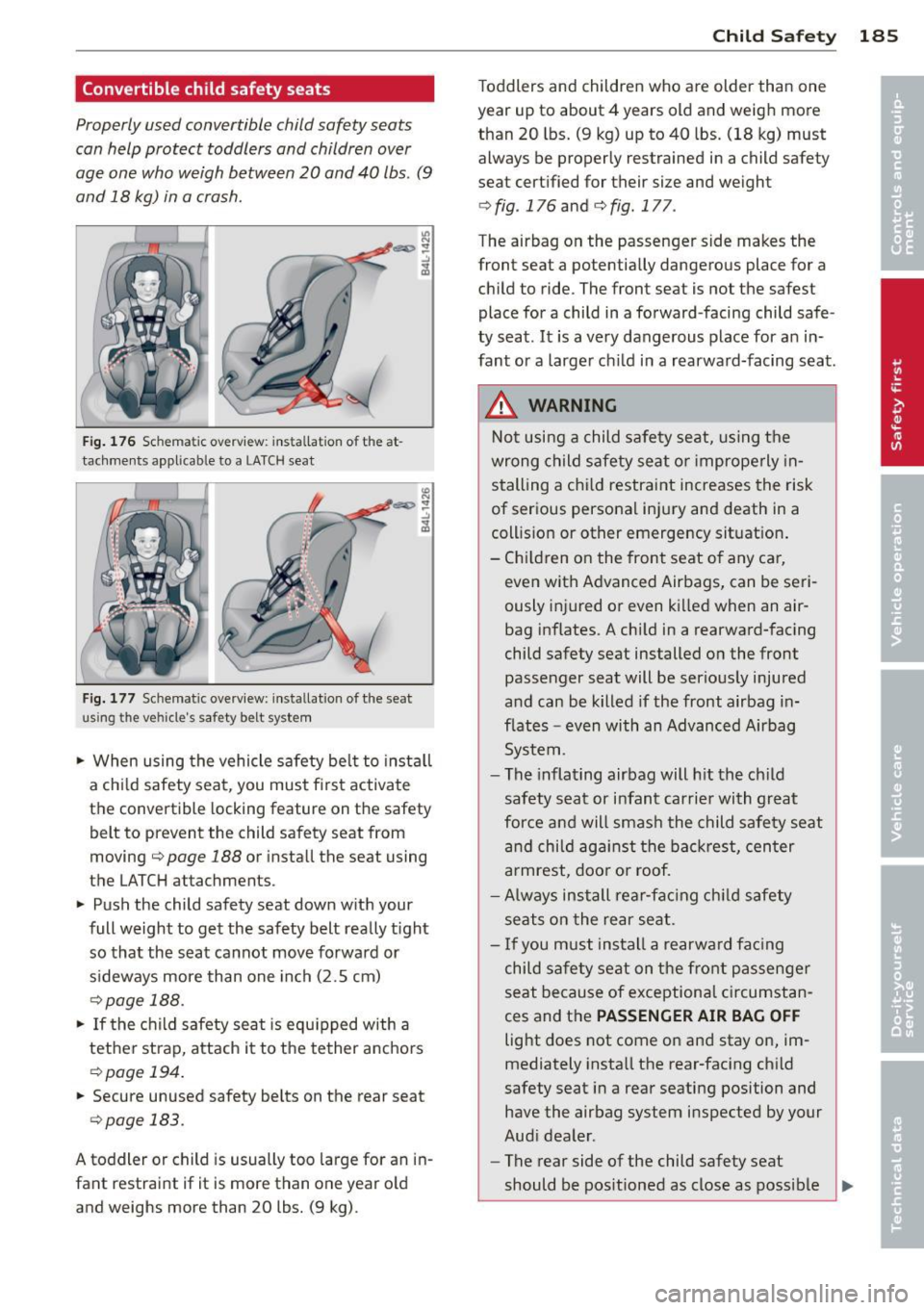
Convertible child safety seats
Properly used convertible child safety seats
can help protect toddlers and children over
age one who weigh between 20 and 40 lbs. (9
and 18 kg) in a crash.
F ig . 176 Sche mati c overvi ew : ins tallat ion o f the at
tachments appl icable to a LA TCH seat
F ig. 177 Schem atic overview: installat ion of t he seat
u sing the ve hicle' s safety b elt sy stem
.. When using the vehicle safety be lt to insta ll
a chi ld safety seat, you must f irst activate
the convertible locking feature on the safety
belt to prevent the child safety seat from
moving
c::> page 188 or install the seat using
the LATCH attachments .
.,. Push the child safety seat down w ith your
full weight to get the safety belt really t ight
so that the seat cannot move forward or s ideways more than one inch (2.5 cm)
c:;, page 188.
.,. If the child safety seat is equ ipped with a
tet her strap, attach it to the tether anchors
c:;, page 194 .
.. Secure unused safety belts on the rear seat
c:;, page 183.
A toddler or child is usually too large for an in
fant restraint if it is more than one year o ld
and weighs more than 20 lbs. (9 kg) . Child S
afety 185
Toddlers and children who are older than one
year up to about 4 years old and weigh more
than 20 lbs. (9 kg) up to 40 lbs. (18 kg) must always be properly restrained in a child safety
seat cert ified for their si ze and weight
c:;, fig . 176 and c:;, fig. 177 .
The airbag on the passenger side makes the
front seat a potentially dangerous place for a
child to ride . The front seat is not the safest
place for a child in a forward -facing child safe
ty seat .
It is a very dangerous place for a n in
fant or a large r ch ild in a rearward-facing seat .
.&_ WARNING
Not using a child safety seat, using the
wrong child s afety seat o r imprope rly in
stalling a chi ld restraint increases the risk
of serious personal injury and death in a
collision or other emergency situation .
- Ch ildren on the front seat o f any car,
even with Advanced Airbags, can be se ri
ously injured or even killed when an air bag inflates. A chi ld in a rearward-facing
child safety seat installed o n the front
passenger seat will be serious ly injured
and can be k illed if the front airbag in
flates -even with an Advanced Airbag
System .
- The inflating airbag will h it the ch ild
safety seat or infant carrier with great
force a nd will smash the child safety seat
and child against the ba ckrest, center
a rmrest, doo r or roof.
- Always install rear-fac ing ch ild safety
seats o n the rear seat .
- If you must install a rearwa rd fac ing
child safety seat on the fro nt passenger
seat because of exceptiona l circumstan
ces and t he
PASSENGER AIR BAG OFF
light does not come on and stay on, im
mediately insta ll the rear -fac ing ch ild
safety seat in a rear seating position and have the airbag system inspected by your
Aud i dea ler .
- The rear side of the child safety seat
should be pos itioned as close as poss ib le
~