engine AUDI Q5 2014 Owners Manual
[x] Cancel search | Manufacturer: AUDI, Model Year: 2014, Model line: Q5, Model: AUDI Q5 2014Pages: 316, PDF Size: 78.41 MB
Page 246 of 316

244 Checking and filling
A WARNING
California Proposition 65 Warning:
- Battery posts, terminals and related ac
cessories contain lead and lead com
pounds, chemicals known to the State of
California to cause cancer and reproduc
tive problems. Wash hands after han
dling.
(D Note
- Do not disconnect the vehicle battery
when the ignition is switched on or when
the engine is running, otherwise, you will
damage electronic components in the
electrical system.
- If your vehicle is going to stand for a
long period of time without being driven,
protect the battery from "freezing ", oth
erwise it will be damaged and will then have to be replaced .
Battery charging
Starting the engine requires a well charged
battery.
Fig. 203 E ng ine compar tment: Connectors for charger
a nd jumper cab les
Always read and heed all WARNINGS below
¢
.&. and ¢ .&. in Working on the battery on
page 243.
• Hybrid drive*: read the important informa
tion concerning a dead high voltage battery
under
¢page 105.
•Turnoff the ignition and all electrical con
sumers.
• Make sure the area is well ventilated when
you charge the battery. •
Open the engin e hood ¢
page 231.
• Remove th e cover (D by pressing on the ar
row
¢fig. 203.
• Open the cover @on the positive terminal.
• Connect the charger co nnectors according to
the instructions to the
jump start bolts .
(Bolts under the cover = "pos itive", Bolts
with hex head= "negative ").
• Only now plug the mains lead for the charg
ing equipment into the wall outlet and turn
it on¢ .&_.
• Make sure the charging rate is not over
30 amps/14.8 Volt.
• When the battery is fully charged: T urn the
charg ing equipment off and remove the
mains lead from the wall outlet.
• Now remove the clamps for the charging
equipment.
• Close the cover @on the positive terminal
and re-install the cover
(D.
• Close the hood¢ page 231.
A discharged battery can freeze at tempera
tures of only 32 °F (0 °C). Allow a frozen bat
tery to thaw completely before attempting to
charge it¢.&.. However, we recommend not
using a thawed battery again because the bat
tery casing can be cracked due to ice forma
tion and can leak battery acid.
Battery charging (Maximum charging rate
of 30 amps/14.8 Volt)
When charging at low voltages (e.g. with a
trickle charger), the battery cables do not
have to be disconnected first. The battery
caps should
not be opened when charging a
battery.
It is not necessary to remove the battery from
the luggage compartment.
Fast charging the battery (charging rate
above 14.8 Volts)
For technical reasons do not use a battery
c h arger that uses voltage greater than 14.8
Volts to charge your vehicle's battery.
A WARNING
--
Charging a battery can be dangerous. ~
Page 247 of 316
-Always follow the operating instructions
provided by the battery charger manu
facturer when charging your battery.
- Never charge a frozen battery.
It may ex
plode because of gas trapped in the ice.
Allow a frozen battery to thaw out first.
- Do not reuse batteries which were fro
zen. The battery housing may have
cracked and weakened when the battery
froze.
- Charge the battery in a well ventilated
area. Keep away from open flame or elec
trical spark. Do not smoke . Hydrogen gas
generated by the battery is explosive.
- To reduce the danger of explosion, never
connect or disconnect charger cables
while the charger is operating.
- Fast charging a battery is dangerous and
should only be attempted by a compe
tent technician with the proper equip
ment.
- Battery acid that may spill during charg
ing should be washed off with a solution
of warm water and baking soda to neu
tralize the acid.
(D Note
Never use a fast charger as a booster to
start the engine. This will seriously dam
age sensitive electronic components, such
as control units, relays, radio, etc., as well
as the battery charger.
Battery replacement
The new battery must have the same specifi
cations and dimensions as the original equip
ment battery.
Intelligent energy management in your vehi
cle is responsible for distributing the electri
cal energy throughout your vehicle
¢ page 203. The intelligent energy manage
ment system will keep the engine battery
charged better then vehicles without this sys
tem . To make sure the additional electrical en
ergy is available once again after you have
changed the battery, we recommend that you
Checking and filling 245
install batteries of the same type and manu
facture only (the same as those installed at
the time your vehicle was delivered). Specifi cations are listed on the battery housing . Your
authorized dealer must code the battery in
the energy management system to enable you
to use the energy management functions cor
rectly after replacing the battery .
If it is not possible to use a battery of this
type , the new battery must have the same ca
pacity, voltage (12 volts), amperage, con
struction and plug sealing .
When installing the battery, make sure the ig nition and all electrical consumers are turned
off .
(D Note
-Make sure the ventilation hose on the
side of the battery is connected, other
wise fumes or battery acid can leak out .
- Vehicles with the Start-Stop-System* are
equipped with a special cycle-proof AGM
battery. Installing a different type of
battery can cause problems in the vehi
cle electrical system. When replacing the
vehicle battery, always install one with
the same specifications as the original
battery.
@ For the sake of the environment
Because of the problem of proper disposal
of a battery, we recommend your author
ized Audi dealer change the battery for
you. Batteries contain sulfuric acid and
lead and must always be disposed of prop
erly in compliance with all environmental
regulations. Disposing of vehicle batteries
improperly is very dangerous to the envi
ronment. •
•
Page 248 of 316

246 Checking and filling
Windshield/headlight
washer container
M N
Fi g. 204 Engine compartme nt: cover on the w inds hield
and headlight * washer fluid rese rvoir
The washer flu id container is marked with t he
symbol Won its cap
Q fig. 204, ¢ page 233,
fig . 198 .
.. Before you check anyt hing in the engine
compartment,
always read and heed all
WARNINGS
¢ & in Working in the engine
compartment on page 2 31 .
.. Lift the filler cap tongue to add washe r flu
id . Yo u can fill the container to the top .
.. Press the cap back onto the fi ller neck after
fill ing t he containe r.
You can find the rese rvoi r
capacity in the tab le
in
Q page 290.
Clean water should be used when fill ing up . If
possib le, use soft wate r to prevent scal ing on
the washe r jets. Always add a glass cleaner
solu tion (w ith fros t protection in the w inte r) .
(D Note
D o not mix engine coo la nt an tifreeze or
a ny ot her ad ditives to fi ll u p t he wind
shie ld washer rese rv o ir.
Page 254 of 316
252 Tire s and wheel s
you have stored . The system does not recog
nize the load condition of your vehicle.
The effectiveness of the tire pressu re monito r
ing system* will be impai red if you store nor
mal load pressures but then operate the vehi
cle at its maximum load¢.&. .
See the illustration¢
fig. 205 for the location
of the label on dr iver's side 8-pillar (color of
the actua l labe l and exact location on the ve
hicle wi ll vary slightly) .
Note that the followi ng tab le is accurate a t
the time o f go ing to press and is subject to
Model / Tire de
signation
change. In the event of discrepancies, the t ire
pressure label located on the driver's side 8-
pillar always takes precedence .
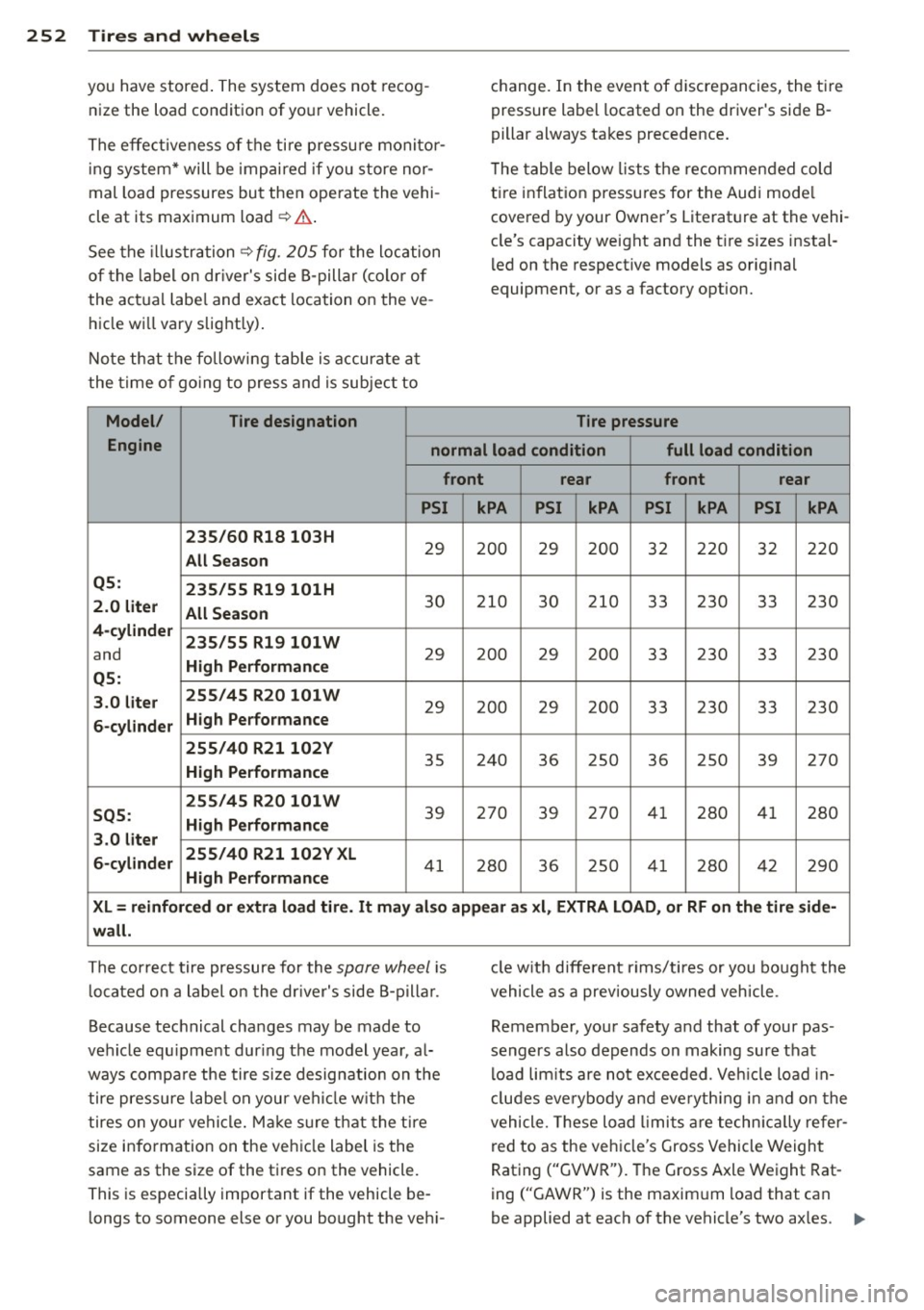
T he table below lists the recommended cold
ti re inflation pressu res for the Audi mode l
covered by your Owner's Literat ure at the vehi
cle's capacity weight and the t ire sizes instal
l ed on the respective models as orig inal
equipment, or as a factory option.
Tire pressure
Engine normal load condition full load condition
front rear
front rear
PSI kPA PSI kPA PSI kPA PSI kPA
2 3 5/60 R18 103H
29 200 29 200 32 220 32 220 All Season
Q5 :
235/ 55 R19 101H
2 .0 liter
All Season
30 210
30 210
33 230
33 230
4-c
ylind er
235/55 R1 9101W
and 29 200 29 200 33 230 33 230 High P erforman ce
QS:
3 .0 l iter 2
55 /45 R 20 101W
29 200 29 200 33 230 33 230
6-cy lind er High Pe
rformance
255 /40 R21102Y
35 240
36 250 36 250 39 270 High Performan ce
25 5/4 5 R20 101W
39 270 39 270 280 280 SQ5:
High Performan ce 41 41
3.0 liter
6-cylind er 255
/40 R21102Y XL
41 280 36 250 41 280 42 290 High Perfo rmance
X L = rei nfo rce d or extra load tir e. It ma y al so a ppea r a s xl , EXTRA LOAD, or RF on th e tire sid e-
wall.
The cor rect tire pressure for the spare wheel is
located on a label on the dr ive r's side 8-pilla r.
Because technical changes may be made to
vehicle equ ipment dur ing the model year, a l
ways compare the tire size designation on the
tire pressure labe l on you r veh icle w it h the
tires on your vehicle. Ma ke su re that the tire
size info rmation on the vehicle label is the
same as the size of the tires on the vehicle.
This is especia lly important if the vehicle be
longs to someone else or you bought the vehi- cle w
ith different rims/t ires or you bought the
vehicle as a prev iously owned vehicle.
Remember, your safety and that of your pas
sengers also depends on making sure that
load lim its are not exceeded. Vehicle load in
cludes eve rybody and everyth ing in and on the
vehicle. These load l imits a re techn ica lly refer
red to as the vehicle's Gross Vehicle Weight
Rating ("GVWR"). The Gross Axle Weight Rat
ing ("GAWR") is the maximum load that can
be applied at each of the vehicle's two axles . .,_
Page 270 of 316
268 What do I do now?
What do I do now?
Jack, tools and
inflatable spare tire
Onboard tool kit and vehicle jack
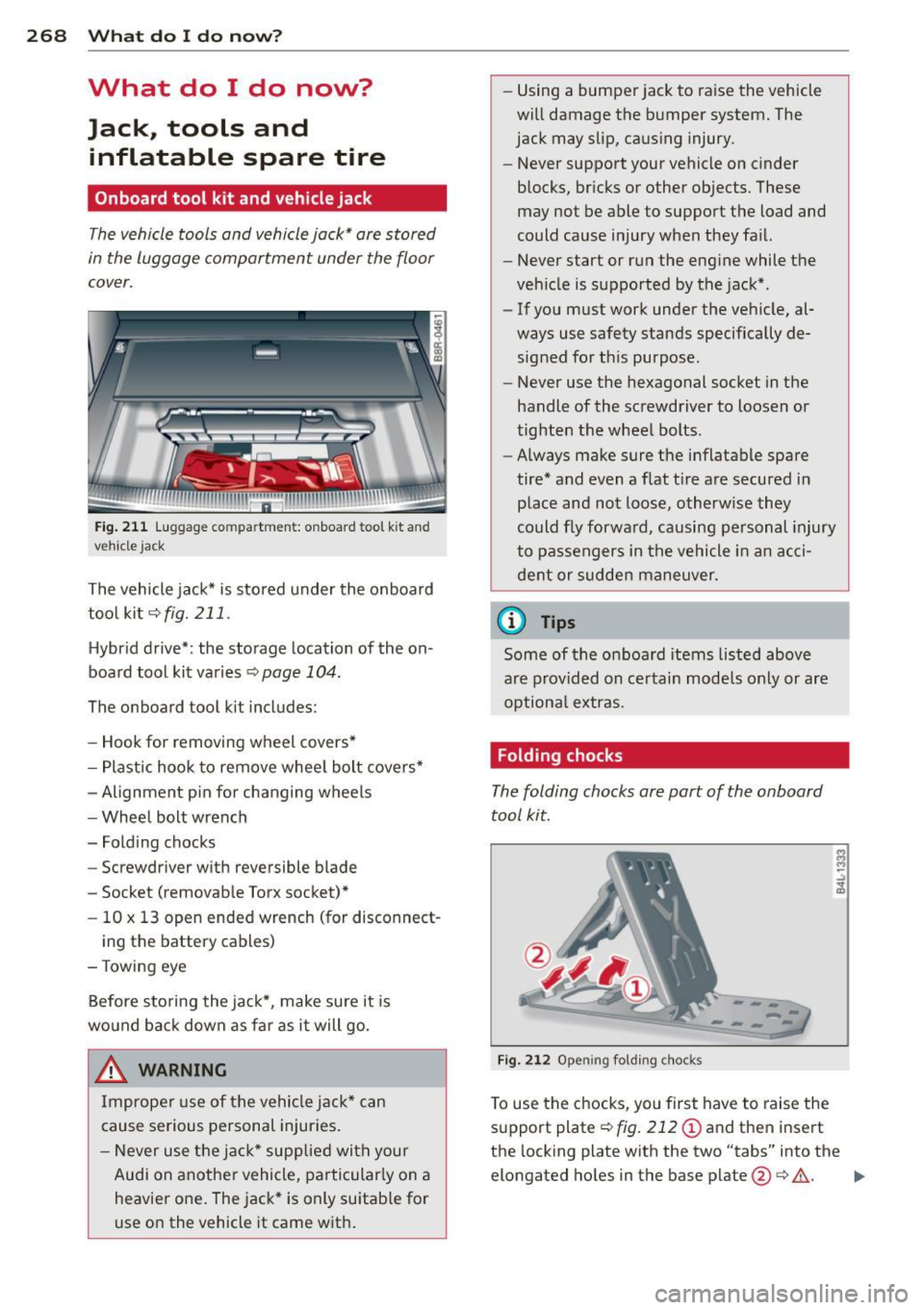
The vehicle tools and vehicle jack* are stored
in the luggage compartment under the floor
cover.
Fig . 211 Luggage compartment: on board tool kit and
vehicle jack
The vehicle jack* is stored under the on board
tool kit¢
fig. 211.
Hybrid drive*: the storage location of the on
board tool kit varies
¢ page 104.
The onboard tool kit includes:
- Hook for removing wheel covers*
- Plastic hook to remove whee l bolt covers*
- Alignment p in for changing wheels
- Wheel bolt wrench
- Folding chocks
- Screwdriver with reversible blade
- Socket (removable Torx socket)*
- 10 x 13 open ended wrench (for disconnect-
ing the battery cables)
-Towing eye
Before storing the jack*, make sure it is
wound back down as far as it will go.
& WARNING
Improper use of the vehicle jack* can
cause serious personal injuries.
- Never use the jack* supplied with your
Audi on another vehicle, particularly on a
heavier one . The jack* is only suitab le for
use on the vehicle it came with . -
Using a bumper jack to raise the vehicle
will damage the bumper system. The
jack may slip, causing injury.
- Never support your vehicle on cinder
blocks, bricks or other objects. These
may not be able to support the load and
could cause injury when they fa il.
- Never start or run the engine while the
veh icle is supported by the jack*.
- If you must work under the vehicle, al
ways use safety stands specifically de
signed for this purpose.
- Never use the hexagonal socket in the
handle of the screwdriver to loosen or
tighten the wheel bolts.
- Always make sure the inflatable spare
tire* and even a flat t ire are secured in
place and not loose, otherw ise they
could fly forward, causing personal injury
to passengers in the vehicle in an acci
dent or sudden maneuver.
@ Tips
Some of the on board items listed above
are provided on certain models only or are
optiona l extras.
Folding chocks
The folding chocks are part of the on board
tool kit.
Fi g. 2 12 Open ing folding choc ks
To use the chocks, you first have to raise the
support plate¢
fig . 212 (D and then insert
the locking plate with the two "tabs" into the
elongated holes in the base plate @¢& .
Ill>
Page 275 of 316
(D Note
Special care is required if you are repairing
the tire on a steep incline.
@ Tips
-Do not operate the compressor for more
than 12 minutes continuously, otherwise it can overheat. Once the compressor has
cooled, you can continue to use it.
- If sealant has spilled out, let it dry and
then you can remove it by peeling it away
like a foil.
- Remember to obtain a new bottle of
sealant from your authorized Audi dealer
after repairing a tire. After this, the func
tionality of the tire repair set is restored.
- Obey all laws.
Changing a wheel
Before changing a wheel
Observe the following precautions for your
own and your passenger's safety when chang
ing a wheel.
.,. After you experience a tire failure, pull the
car well away from moving traffic and try to
reach
level ground before you stop¢_& .
.. All passengers should
leave the car and
move to a safe location (for instance, behind
the guardrail) ¢
_&.
.. Engage the parking brake to prevent your
vehicle from rolling unintentionally¢_&.
.. Move
selector lever to position P ¢ _& .
.,. If you are tow ing a trai ler: unhitch the trail
er from your vehicle.
.,. Block the diagonally opposite wheel with
the folding chocks or other objects.
.. Take the
jack* and the inflatable spare tire*
out of the luggage compartment
¢page 268.
A WARNING
You or your passengers could be injured
while changing a wheel if you do not fol
low these safety precautions:
-
What do I do now? 273
- If you have a flat tire, move a safe dis
tance off the road. Turn off the engine,
turn the emergency flashers on and use
other warning devices to alert other mo
torists.
- Make sure that passengers wait in a safe
place away from the vehicle and well
away from the road and traffic.
- To help prevent the vehicle from moving
suddenly and possibly slipping off the
jack*, always fully set the parking brake
and block the wheel diagonally opposite
the wheel being changed with the fold
ing chocks or other objects. When one
front wheel is lifted off the ground, plac
ing the Automatic Transmission in P
(Park) will
not prevent the vehicle from
moving.
- Before you change a wheel, be sure the
ground is level and firm. If necessary,
use a sturdy board under the jack*.
- Always store the vehicle tool kit, the
jack* and the replaced tire in the luggage
compartment
¢page 145.
Changing a wheel
When you change a wheel, follow the se
quence described below step-by-step and in
exactly that order.
1. Remov e the decorative wheel cover*. For
more details see also
¢ page 274, Deco
rative wheel covers
or ¢ page 2 7 4,
Wheels with wheel bolt cops .
2. Loosen the wheel bolts¢ page 2 75 .
3. Locate the proper mounting point for the
jack* and align the jack* below that point
¢ page 275.
4. Lift the car with the jack* ¢ page 2 75 .
S. Remove the wheel with the flat tire and
then install the
inflatable spare tire*
¢page 276.
6. Tighten all wheel bolts lightly.
7.
Lower the vehicle with the jack*.
8. Use the wheel bolt wrench and
firmly
tighten all wheel bolts¢ page 2 75.
9. Replace the decorative wheel cover*.
•
•
Page 284 of 316
282 Fuses and bulb s
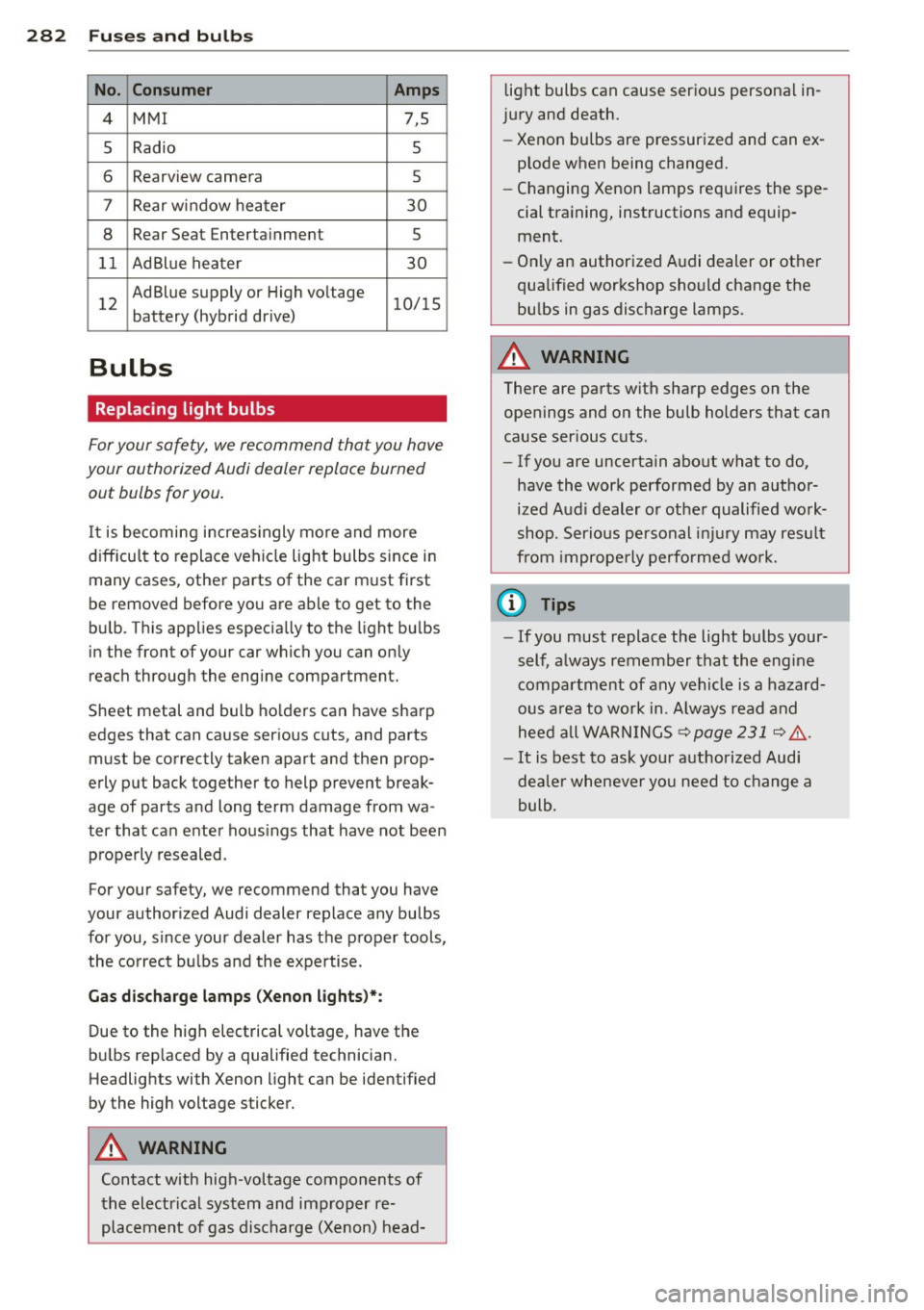
No. Consumer Amps
4 MMI 7,5
5
Radio 5
6 Rearview camera 5
7
Rear w indow heater 30
8 Rear Seat Enterta inment s
1 1 AdBlue hea ter 30
1 2
Ad Blue supply or High vo ltage 1 0/ 15
battery (hybrid dr ive)
Bulbs
Replacing light bulbs
F or your safety, we recommend that you have
your authorized Audi dealer replace burned
out bulbs for you.
It is becoming i ncreas ingly mo re and more
d iff icu lt to replace vehi cle lig ht bulbs s ince in
many cases, other parts of the car m ust first
be removed before yo u are ab le to get to the
bu lb. Th is app lies especia lly to the light bu lbs
in the front of your car which you can on ly
reac h throug h the engine compartment.
Sheet metal and bulb ho lde rs can have sharp
edges that can cause ser ious cuts, and parts
must be correctly taken apart and then prop·
erly put back together t o help prevent break
age of par ts a nd long term damage from wa
ter that ca n ente r hous ings that have not been
p roperly resealed.
For your safety, we recommend that you have
your author ized Audi dealer replace a ny bulbs
for you, since your dealer has the p roper tools,
the co rrect bu lbs and the expertise.
Gas d ischarge lamps (Xenon lights )*:
Due to the hig h electrical vo ltage, have the
bu lbs rep laced by a qualified technician.
Headlig hts with Xenon light can be identified
by the high voltage sticker.
A WARNING
Contact with high-voltage components of
t he electrical system and improper re
pl acement of gas dis charge (Xenon) head- light bulbs can cause ser
ious personal in·
j u ry and death.
- Xenon bulbs are pressur ized and can ex
plode when being changed.
- Changing Xenon lamps re quires the spe
cial tra ining, instructions and equip
ment.
- Only an auth orized A udi dealer or other
qualified wor kshop should change the
bu lbs in gas discharge lamps.
A WARNING
There are parts with sharp edges on the
openings and on the bulb holders that can
cause ser ious c uts.
- If you are uncertain about what to do,
have the work performed by an a uthor
ized Audi dealer or othe r qualified wo rk·
shop. Serious personal in jury may resul t
fr om imprope rly performed wo rk.
(D Tips
- If you must replace the light bulbs your ·
self, a lways remember tha t the eng ine
compar tment of any vehi cle is a hazard
ous area to work in. A lways read a nd
hee d all WARNI NGS
~page 231 ~ & .
-It is best to ask your authorized Audi
de aler whenever yo u need to c hange a
bulb .
-
Page 285 of 316
Emergency situations
General
This chapter i s intended for trained emer
gency crews and working personnel who have the necessary tools and equipment to
perform these operations.
Starting by pushing or
towing
(D Note
Vehicles with an automatic tran smission
cannot be started by pu shing or towing .
Starting with jumper
cables
If necessary, the engine can be started by
connecting it to the battery of another vehi
cle.
If the engine sho uld fail to start because of a
discha rged o r weak battery, the battery can be
connected to the battery o f
another vehicle,
using a
pair of jumper cables to start the en
g ine.
Jumper cables
Use only jumper cables of sufficiently la rge
c ross section to carry the starter c urrent safe
l y. Refer to the man ufacturer's specifications.
Use o nly jumper cables with
insulated te rm i
na l clamps w hich are d istinctly mar ked:
plus (+) cable in mos t cases co lore d red
minus (-) cab le
in most cases colored black .
A WARNING
Batterie s contai n elec tricity, ac id, an d gas.
Any of these c an cause ve ry ser io us or fatal
injury. Foll ow the instr uctions bel ow fo r
safe han dling of your veh icle's b attery .
- Alw ays s hield you r eye s and avoid lean
ing over the bat te ry whenever p ossib le.
- A dis ch arged b attery c an free ze at te m
pera tures ju st be low 3 2 °F ( 0 °C ). Befo re
Emergency situations 283
connecting a jumpe r cab le, you must
thaw the fr ozen battery c omp lete ly, ot h
erwise it could explode.
- Do not allow battery acid to contact eyes
or skin. Fl ush any contacted area with
wate r immediately.
- Improper use of a booster battery to start a vehicle may cause an explosion.
- Vehicle batter ies genera te exp losive gas
es. Keep spar ks, flame and lighted c iga
rettes away from batte ries.
- Do not try to jump start any ve hicle w ith
a low ac id leve l in the battery.
- The vo ltage of the booste r batte ry m ust
a lso have a 12-Vol t rating. T he capacity
(Ah) of the booster battery sho uld not be
lowe r tha n that of the discharged bat
tery . U se of batte rie s of d iffe ren t voltage
or substan tially diffe rent "Ah" rat ing
may c au se a n exp losion and persona l in
JU ry.
- N ever cha rge a fro zen batte ry. Gas tr ap
pe d in t he ice may c ause an explosion.
- Never cha rge or use a batte ry tha t h as
been fr ozen. T he battery case may have
be weakened.
- Us e of b atter ies of differe nt voltage or
sub stant ia lly diff eren t ca pa city (Ah) ra t
i ng may c ause an ex plosion an d injury .
Th e capac ity (Ah) of the booster bat tery
should not be lower than that of the dis
charged batte ry .
- Before you chec k any thing in the engine
compa rtment, always read and hee d all
WARNINGS
¢page 231.
(D Note
-App lyin g a higher vo ltage booster ba t
t ery w ill cause expens ive damage to se n
sit ive e lectronic com ponents, such as
cont ro l units, relays, rad io, etc.
- The re must be no electrical contact be
tween the vehicles as ot herwise c urrent
co uld a lready start to f low as soon as the
p o sit ive(+) term inals a re connected. ..,. •
•
Page 286 of 316
284 Emergency situations
@ Tips
-The discharged battery must be properly
connected to the vehicle's electrical sys
tem. When jump starting or charging the
battery, never connect the negative
ground cable to the battery negative
post because the battery manager sys
tem must be able to detect the battery's
state of charge . Always connect the neg
ative ground cable to the negative
ground post of the battery manager con
trol unit.
Use of jumper cables
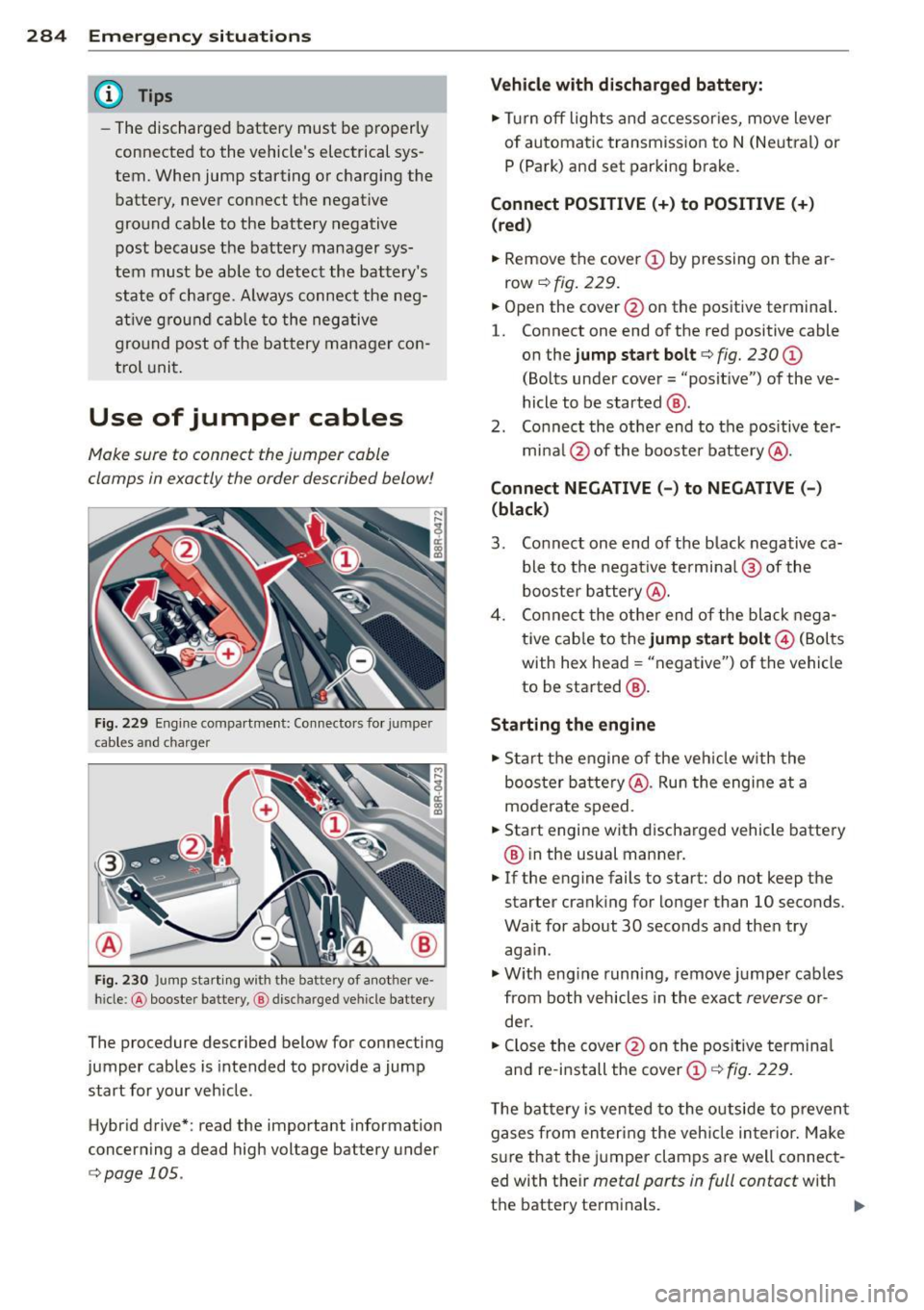
Make sure to connect the jumper coble
clomps in exactly the order described below!
Fig . 229 Engine co mpartment: Conne cto rs fo r jum per
c ables a nd charger
Fig. 230 Ju m p sta rt in g w it h the bat te ry of anot her ve
h icle : @ booster battery ,@ disc harged vehicle battery
The procedure described below for connecting
jumper cables is intended to provide a jump
start for your veh icle .
Hybrid drive*: read the important information
concerning a dead high voltage battery under
c:;, poge 105.
Vehicle with discharged battery:
"Turn off lights and accessor ies, move lever
of automatic transmission
to N (Neutra l) or
P (Park) and set parking brake.
Connect POSITIVE(+) to POSITIVE(+)
(red)
.. Remove the cover CD by pressing on the ar
row
c:;, fig. 229 .
.. Open the cover @on the positive terminal.
l. Connect one end of the red positive cable
on the
jump start bolt c:;, fig. 230 CD
(Bolts under cover= "positive") of the ve
hicle to be started @.
2. Connect the other end to the positive ter-
minal @of the booster battery@.
Connect NEGATIVE( -) to NEGATIVE( -)
(black)
3 . Connect one end of the black negative ca
ble to the negat ive termina l@ of the
booster battery @.
4. Connect the other end of the black nega
tive cab le to the
jump start bolt@ (Bolts
with hex head= "negative") of the vehicle
to be started @.
Starting the engine
"Start the engine of the veh icle w ith the
booster battery@. Run the engine at a
moderate speed .
.. Start engine with discharged vehicle battery
@ in the usual manner .
.. If the engine fails to start: do not keep the
starter cranking for longer than 10 seconds.
Wait for about 30 seconds and then try aga in.
" With engine running, remove jumper cables
from both vehicles in the exact
reverse or·
de r.
" Close the cover @on the positive terminal
and re-install the cover
CD c:;, fig. 229.
The battery is vented to the outside to prevent
gases from entering the vehicle inter ior. Make
sure that the jumper clamps are well connect
ed with their
metal ports in full contact with
the battery terminals.
Page 287 of 316
& WARNING
To avoid serious personal injury and dam
age to the vehicle, heed all warnings and
instructions of the jumper cable manufac
turer. If in doubt, call for road serv ice.
- Jumper cables must be long enough so
that the vehicles do not touch.
- When connecting jumper cables, make
sure that they cannot get caught in any
moving parts in the engine compart
ment.
- Do not bend over the batteries -danger
of chemical burns!
- The battery ce ll locking screws must be
t ightened securely .
- Before you check anything in the engine
compartment, always read and heed all
WARNINGS
~ page 231.
{[) Note
Improper hook-up of jumper cables can ru
in the generator.
- Always connect POSITIVE(+) to POSI
TIVE(+), and NEGATIVE(-) to NEGATIVE
(-) ground post of the battery manager
control unit.
- Check that all screw plugs on the battery
ce lls are screwed in firmly .
If not, tighten
plugs prior to connecting clamp on nega
tive battery terminal.
- Please note that the procedure for con
necting a jumper cable as described
above applies spec ifically to the case of
your vehicle be ing jump started. When
you are giving a jump start to another ve
hicle, do
not connect the negative(-) ca
ble to the negative(-) terminal on the
discharged battery©
c::> fig. 230. In
stead, securely connect the negative(-)
cable to either a solid metal component
that is firmly bolted to the engine block
or to the engine block itself. If the bat
tery that is being charged does not vent
to the outside, escaping battery gas
could ignite and explode!
-
Emergency situations 285
Emergency towing
with commercial tow
truck
General hints
Your Audi requires special handling for tow
ing.
T he following information is to be used by
commercial tow truck operators who know
how to operate their equipment safely.
- Never tow your Audi, towing will cause
damage to the engine and transmission.
- Never wrap the safety chains or winch ca
ble s around the brake lines .
- To prevent unnecessary damage, your Audi
must be transported with a flat bed truck.
- To load the vehicle on to the flat bed , use
the towing loop found in the vehicle tools
and attach to the front or rear anchorage
i::>page 286 and ~page 286.
A WARNING
A vehicle being towed is not safe for pas
sengers. Never allow anyone to ride in a
vehicle be ing towed, for any reason.
-
•
•