warning AUDI Q5 2014 Owners Manual
[x] Cancel search | Manufacturer: AUDI, Model Year: 2014, Model line: Q5, Model: AUDI Q5 2014Pages: 316, PDF Size: 78.41 MB
Page 257 of 316
th e f unct ion of the tire pressure monitor
ing system*.
- Always inflate tires to the recommended
and correct tire pressure before driving
off.
- Driving with under inflated tires bend
more, letting them get too hot resu lting
in tread separation, sudden t ire failure
and loss of control.
- Excessive speed and/overloading can
cause heat build-up, sudden tire fail ure
and loss of control.
- If the t ire pressure is too low or too high,
the tires w ill wea r prematurely and the
vehicle will not hand le we ll.
- If the t i re is not flat and you do not have
to change a w heel immed iate ly, dr ive at
reduced speed to the nearest serv ice sta
t ion to check the tire pressure and add
air as requi red.
{Q) Note
Dr iving without va lve stem caps ca n cause
damage to the tire va lves . To preve nt this,
always ma ke s ure t hat facto ry installed
va lve stem caps on all wheels a re secu re ly
mounte d on the va lve.
@ For the sake of the environment
Unde rinflat ed tires will a lso inc reas e the
fue l cons umption .
Tires and vehicle load limits
There are l imits to the amo un t of load or
weight that any vehicle and any tire can carry .
A veh icle that is overloaded w ill not handle
w ell and is more difficult to stop. Overload ing
can not only lead to loss of vehicle contro l,
but c an a lso damage import ant parts of the
ve hicle and can lead to sudden tire failure, in
cluding a blowout and sudden deflation that
can cause the ve hicle to crash .
Your safety and that of your passengers a lso
depends on making sure that load limits are n ot exceeded. Vehicle load includes everybody
and everyth ing in and on the vehicle . Th ese
Tire s an d wheel s 255
load lim its are technically referred to as the
vehicle's
Gross Vehicle Weight Rating
("GVWR").
T he "GVWR" incl udes the weight of the basic
vehicle, a ll factory installed accessories, a f ull
tan k of fuel, oi l, coo lant and other fluids plus
max imum load. The max imum load incl udes
the n umber of passengers t hat the vehicle is
intended to carry ("seat ing capac ity") with an
ass umed we ight of 150 lbs (68 kg) fo r each
passenger at a designated seating posi tion
and the tota l weight of a ny luggage i n the ve
hicle. If you tow a tra ile r, the we igh t of the
tra iler hi tch and the tongue we igh t of t he
loaded tra iler mus t be included as part of the
vehicle load .
T he
Gro ss Axle Weight Rating (" G AWR ") is
the max imum load th at can be appl ied a t each
of the veh icle's two axles .
T he Gross Vehicle Weight Rat ing and t he
G ross Ax le Weig ht Ra ting are listed on the
sa fe ty comp lian ce sti cke r la bel lo cate d on the
driver's side B-pillar. Yo ur Audi has
5 seat ing
pos itions , 2 in the front and 3 in the rea r for
total seating capacity of 5. Eac h seating posi
tion has a seat be lt
c:> page 149, Safety belts.
T he fac t that there is an upper limit to yo ur
vehicle's Gross Vehicle Weight Rating means
that the total weight of whatever is being car ried in the vehicle ( includ ing the weight of a
trailer hitch and the tongue weight of the
loaded tra iler) is lim ited. The more passen
gers in the vehicle or passengers w ho are
heavier than the sta ndard we ights assumed
mea n that less we ight can be ca rried as lug
gage.
T he tire pressure label on your Audi also lists
the max imum combined weight of all of the
occupants and l uggage or other cargo that
the ve hicl e can ca rry . Fo r th e lo cat ion of the
la bel
c:> page 251, fig. 205 .
_&. WARNING
--==
Overloading a vehicle can cause loss o f ve -
h icle cont ro l, a crash or other accide nt, se-
rious pe rsonal in ju ry, and even death. ..,
•
•
Page 260 of 316
258 Tires and wheels
Incorrect wheel alignment
Incorrect wheel alignment can cause exces
sive tire wear, impairing the safety of the vehi
cle . If tires show excessive wear, have the
wheel alignment checked by an authorized
Audi dealer or qualified workshop .
All-wheel drive
Vehicles with quattro must always have tires
of the same size, construction and tread type.
For details see Qpage 202 .
.&_ WARNING
Sudden tire failure can lead to loss of con
trol, a crash and serious personal injury!
- Never drive a vehicle when the tread on
any tire is worn down to the wear indica
tors.
- Worn tires are a safety hazard, they do
not grip well on wet roads and increase
your risk of"hydroplaning" and loss of
control.
- Always keep chemicals that can cause
tire damage, such as grease, oil, gasoline
and brake fluid away from tires.
- Tires age even if they are not being used
and can fail suddenly, especially at high
speeds. Tires that are more than 6 years
old can only be used in an emergency
and then with special care and at lower
speeds.
- Never mount used tires on your vehicle if
you a re not sure of their "previous histo
ry." Old used tires may have been dam
aged even though the damage cannot be
seen that can lead to sudden tire failure
and loss of vehicle control.
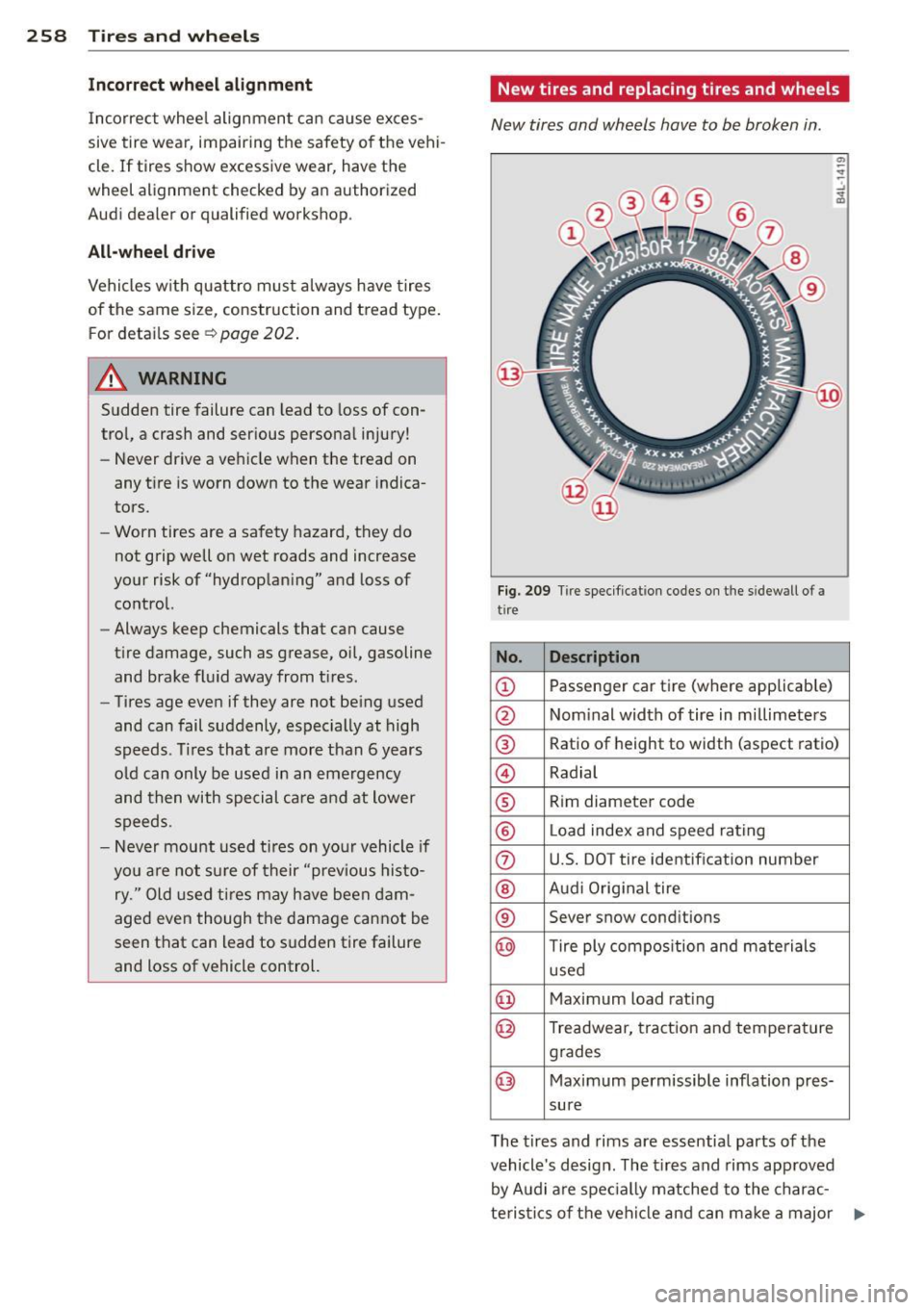
New tires and replacing tires and wheels
New tires and wheels have to be broken in .
Fig. 209 Tir e specificat ion codes on t he s idewall o f a
t ire
No. Description
® Ratio of height to width (aspect ratio)
© Radial
® Rim diameter code
® Load index and speed rating
(J) U.S. DOT tire identification number
® Audi Original tire
® Sever snow conditions
@ Tire ply composition and materials
used
@ Maximum load rating
@ Treadwear, traction and temperature
grades
@ Maximum permissible inflation pres-
sure
The tires and rims are essential parts of the
vehicle's design . The tires and rims approved
by Audi are specially matched to the charac
teristics of the vehicle and can make a major .,..
Page 262 of 316
260 Tire s and wheel s
T up to 118 mph (190 km/h)
U up to 124 mph (200 km/h)
H up to 130 mph (210 km/ h)
V up to 149 mph (240 km/h)
1l
Z over 149 mph (240 km/h)
1l
W up to 168 mph (270 km/h)
1l
Y up to 186 mph (298 km/h)
1 )
Your veh icle is norma lly fac to ry equipped with
tires, which possess excellent driving charac
teristics and give yo ur Audi opt imum driving
comfort . An e lectronic speed limiter
c:> page 27 wi ll normally prevent your vehicle
from go ing faster than the tire speed rating
c:> & .
U.S . DOT Tire Identification Numb er (TIN )
a nd tire manufacture d ate
This is the t ire's "serial number". It begins
with the letters "DOT" and indicates that the
tire meets all federal standards. The next two
numbers or letters indicate the p lant whe re it
was manufactured, and the last four numbers r epresent the week and year of manufacture.
F or example, the numbers 2213 mean tha t
the tire was produced in the 22nd wee k of
2013. The other n umbers are marketing co
des that may or may not be used by the tire manufacturer. This information is used to con
tact consumers if a tire defect requires a re
call.
Aud i O riginal tir e
Tires with the identification "AO" or "RO" have
been spec ially matched with your Aud i. We
recommend using only these tires because
they meet the highest standards regard ing
safety and driving character istics when used
correctly . Your authorized Aud i dealer w ill
g lad ly provide you with more information .
Tire ply composition and materials used
The number of plies indicates the number of
layers of rubber-coated fabric in the t ire. In
general, the greater the numbe r of plies, the
ll For tir es w it h a m ax im um spee d ca pabil ity ove r 149
mph (2 40 km/ h), ti re ma nufac tur ers somet imes use
t h e lett ers " ZR."
more we ight a tire can support. Tire manufac
turers also must indicate the materials in the
t ire, which include stee l, nylon, po lyester, and
others.
Ma ximum Load Rating
This number ind icates the maximum load in
ki log rams and pounds that can be carried by
the tire .
Tire quality grading for treadwear,
traction, and temp eratu re re sis tance
T read wear, t raction and tempe rature grades
c:> poge261 .
Maximum Permissible Inflation Pressure
Th is number is the g reatest amount of a ir
pressure that should ever be put in the tire
u nder norma l dr iv ing cond itions.
A WARNING
- Using incorrect or unmatched tires and/
or wheels or improper tire and wheel
comb inat ions can lead to loss of control,
coll is ion and serio us personal injury.
- Always use t ires, rims and whee l bolts
that meet the specif ications of original
factory- installed tires or other combina
tions that have been specifically ap p roved by the vehicle manufacture r.
- Tires age even if they are not being used
and can fai l sudden ly , especially at high
speeds. Tires that are more than 6 yea rs
old can only be used in an emergency
and then w it h specia l care and at lower
speeds.
- Never mo unt used tires on your veh icle if
you are no t sure of the ir "previo us histo
ry ." O ld used tires may have been dam
aged even though the damage cannot be
seen that ca n lead to sudden tire fa ilure
and loss of vehicle control.
Page 264 of 316
26 2 T ire s and wheel s
The relat ive performance of tires depends
upon the actua l conditions of their use, how
ever, and may depart sign ificantly from the
norm due to va riat ions in dr iving habits, serv
ice practices and differences in road character
istics and climate.
Tr action
The traction grades , from highest to lowest,
are AA, A, Band
C. Those g rades represent the
tire's ability to stop on wet pavement as measured under controlled cond itions on
specified government test surfaces of asphalt
and concrete . A tire marked C may have poor
traction performance ¢.&, .
Temperature
The tempera ture grades are A (the h ighest),
B, and
C, representing the tire's resistance to
the generat ion of heat and its abi lity to dissi
pate heat when tested under controlled cond i
tions on a specified indoor laboratory test
wheel.
Sustained high temperature can cause the
materia l of the tire to degenerate and reduce
tire life, and excessive temperature can lead
to sudden ti re fa il ur e~ .&, .
The grade
C corresponds to a level of perform
ance which all passenger ca r tires must meet
u nder the Federa l Moto r Veh icle Safety Stand
a rd No.
1 09. Grades Band A represent higher
l eve ls of performance on t he laboratory test
wheel than the minimum required by law .
A WARNING
The traction grade assigned to this tire is
based on straight-ahead braking traction
tests, and does not include acceleration,
cornering , hydroplan ing or peak traction
character istics.
A WARNING
The temperature grade for this t ire is es
tablished for a t ire that is properly inflated
and not overloaded . Excessive speed, un
derinflation, or excessive loading, eithe r
-
separately or in combination, can ca use
heat bui ldup and possib le tire failure .
Winter tires
Winter tires can improve vehicle handling on
snow and ice. At temperatures below 45 °F ( 7 °C) we recommend changing to winter
tires.
In some heavy snow areas , local governments
may require true winter or "snow" tires, those
with very deeply cut tread . These tires should
only be used in pairs and be installed on all
four wheels . Make sure you purchase snow
tires that are the same s ize and construction
type as the othe r tires on your vehicle .
Your vehicle is equipped with all-wheel drive,
th is will improve traction during winter driv
i ng, even with the standa rd t ires. However, we
strong ly recommend that you always equip all
four wheels on you r vehicle wi th cor rectly fit
ted win ter tires o r all -season tires, when win
te r road cond itions are expected . This also im
proves the vehicle's braking performance and
reduces stopping distances.
Summe r tires provide less grip on i ce and
snow.
Winter tires (snow tires) must always be fitted on all four whee ls .
Ask your author ized Audi dealer or qualified
workshop for permitted
winter tir e siz es. Use
on ly rad ial winter t ires .
Winter tires lose their effectiveness when the
tread is worn down to a depth of
O .15 7 inch
(4 mm).
Only drive w ith w inter t ires under winter con
ditions. Summer t ires handle better when
there is no snow or ice on the roads and the
temperature is above 45 °F (7
°() .
If you have a flat ti re, see notes on spare
whee l
¢page 258.
Please a lways remember that winter tires may
have a lower speed rating than the tires origi-
nally installed on your vehicle at the time it .,.
Page 265 of 316
was manufactured. Please see ¢ page 259,
Speed rating (letter code) for a listing of the
speed rat ing letter codes and the maximum
speed at which the tires can be driven .
The speed rating letter code(¢
page 250) is
on the side wall of the tire
c::> page 258.
A WARNING
Winter tires have maximum speed limits
that may be lower than your vehicle's max
imum speed. Always know the maximum
speed before driving off . Never drive faster
than the speed permitted for your specific
w inte r tires . This will cause damage to the
tires leading to an ac cident and serious
pe rsonal inj ury to you and yo ur passen
gers .
A WARNING
Driv ing faster than the maximum speed
for which the winter tires on your vehicle
were designed can ca use tire fai lure in
cl uding a blowout and sudden deflat ion,
loss of control, crashes and serious per
sonal injuries . Have worn or damaged tires
rep laced immed iate ly.
- Winter tires have maximum speed rat ing
that may be lower than your veh icle's
maximum speed .
- Never drive faster than the speed for
w hich the winter or other tires installed
on your veh icle are rated .
A WARNING
Always adjust your d rivi ng to the road and
traffic conditions. Neve r let the good ac
c eleration of the w inte r ti res and all-whee l
drive temp t you in to taking extra r is k s . A l
ways remember:
- When bra king, an a ll-wheel d rive vehicle
hand les in the s ame way as a front drive
vehicle.
- Drive carefu lly and reduce your speed on
icy and slippery roads, even winter tires
cannot he lp under blac k ice conditions.
Tire s an d wheel s 263
'
@) For the sake of the environment
Use summer tires when weather condi
tions permit. They are qu ieter, do not wear
as quickly and reduce fuel consumpt ion.
Snow chains
Snow cha ins may be fitted only to the rear
wheels, and o nly to certain tire sizes . Ask your
autho rized Aud i deale r on which tire sizes
snow cha ins can be used .
The snow chains must have low-prof ile links
and must not be th icker than 0.53 inch
(13.5 mm) , includ ing the lock .
Remove wheel center covers and trim discs
before putt ing snow cha ins on your vehicle
c::> Q) . For safety reasons cover caps must then
be fitted over the wheel bolts. These are ava il
able from autho rized Aud i dealers.
A WARNING
Using the wrong snow chai ns for your vehi
cle o r insta lling them incorrect ly can in
crease the risk of loss of cont ro l leading to
serious personal injury.
- Snow chains are available in different
sizes. A lways make sure to follow the in
structions p rov ided by the snow chain
manufacturer.
- When driving with snow chains never
drive faster than the speed permitted for
your specif ic snow chains.
- Always observe local regulations .
(D Note
-Remove snow chains before dr iv ing o n
roads not covered with snow to avoid
damaging tires and wea ring the snow
chains down unnecessarily.
- Snow chains, which come into direct con
tact with the whee l rim , can scratch or
damage it . Therefore, make sure that the
snow chains are suitably covered. Check
the pos ition of the snow chains after
•
•
Page 266 of 316
264 Tire s and wheel s
driving a few yards and correct if neces
sary. Follow the instructions from the
snow cha in manufacturer when doing so.
(D Tips
Where snow chains are mandatory oncer
tain roads, this normally also applies to
veh icles with all-wheel dr ive .
Wheel bolts
Wheel bolts must always be tightened to the
correct torque.
The design of whee l bolts is matched to the
factory insta lled rims . If different rims are fit
ted, the correct wheel bolts with the right l ength and correctly shaped bolt heads must
be used. This ensures that wheels are f itted
securely and that the brake system functions
correctly .
In certain circumstances, you may not use
wheel bolts from a different vehicle -even if it
is the same model
¢ page 295.
.&_ WARNING
Improperly tig htened or maintained wheel
bolts can become loose ca using loss of
cont ro l, a co llision and serious p ersona l in
Jury.
- Always keep the wheel bolts and the
threads in t he wheel hubs clea n so the
wheel bolts can tu rn easily and be prop
erly tigh tened.
- N ever grease or oil the wheel bo lts and
the threads in the wheel h ubs. They can
become loose w hile d riving if greased or
oiled, even if tightened to the specified
torq ue.
- Only use wheel bolts that be long to the
rim being installed.
- N ever use different whee ls bolts on your
vehicle.
- Always mai nta in the co rrec t tighte ning
tor que fo r the wheel bo lts to reduce the
risk of a wheel loss . If the tightening tor
que of the wheel bo lts is too low, they
can loosen and come out when the veh i- cle is moving.
If the tightening torque is
too high, the wheel bolts and threads
can be damaged and the wheel can be
come loose.
(D Note
The specified torque for the whee l bolts is
105 ft lb (140 Nm) with a to lerance of
± 7,4 ft lb(± 10 Nm). Torque wheel bolts
diagonally . After changing a wheel, the
torque must be checked as soon as poss i
ble with a to rque wrench -preferab ly by an
a uthorized Aud i dea le r or qualified wor k
shop.
Low aspect ratio tires
Your A udi is factory -eq uipped w it h low aspect
ratio tires. These tires have been thoroughly
tested and been se lected specifically for your
model for their superb performance, road fee l
and handling under a variety of driving condi
t ions . Ask your authorized Audi dealer for
more details .
The low aspect ratio of these tires is ind icated
by a numeral of
55 or less in the tire's s ize
designation . The numeral represents the ratio
of the tire's sidewall height in relation to its
t read width exp ressed in percentage. Conven
tiona l tires have a he ight/w idth rat io of 60 or
more.
Th e performanc e of low-a spect-ratio tire s is
pa rticularly sensi tive to improp er inflation
pre ssure. It i s ther efor e important that low
a spe ct ratio tir es are inflated to the spe cified
pre ssure and that the inflation pre ssure i s
regula rly checked and mainta ined. Tire pre s
sure s should be checked at lea st once a
month and al way s befo re a long trip
¢ page 2 53, Checking tire pressure.
What you can do to a void tire and rim
damage
Low aspect ratio tires can be damaged more
easily by impact w ith potholes, curbs, gul lies
or ridges on the road, particularly if the tire is
underinflated . ..,.
Page 268 of 316
266 Tire s and wheels
When the malfunction indicator is illuminat
ed, the system may not be able to detect or
signal low t ire pressure as intended. TPMS
malfunctions may occur for a variety of rea
sons, including the installation of replace
ment or alternate tires or wheels on the vehi
cle that prevent the TPMS from funct ioning
properly . Always check the TPMS malfunct ion
tellta le after replacing one or more t ires or
wheels on your veh icle to ensure that the re
p lacement or a lternate tires and wheels allow
the TPMS to continue to function properly.
Tire pressure indicator appears
Applies to vehicles: with tire pressure monitoring system
The tire pressure indicator in the instrument
cluster informs you if the tire pressure is too
low or if there is a system malfunction.
N
I
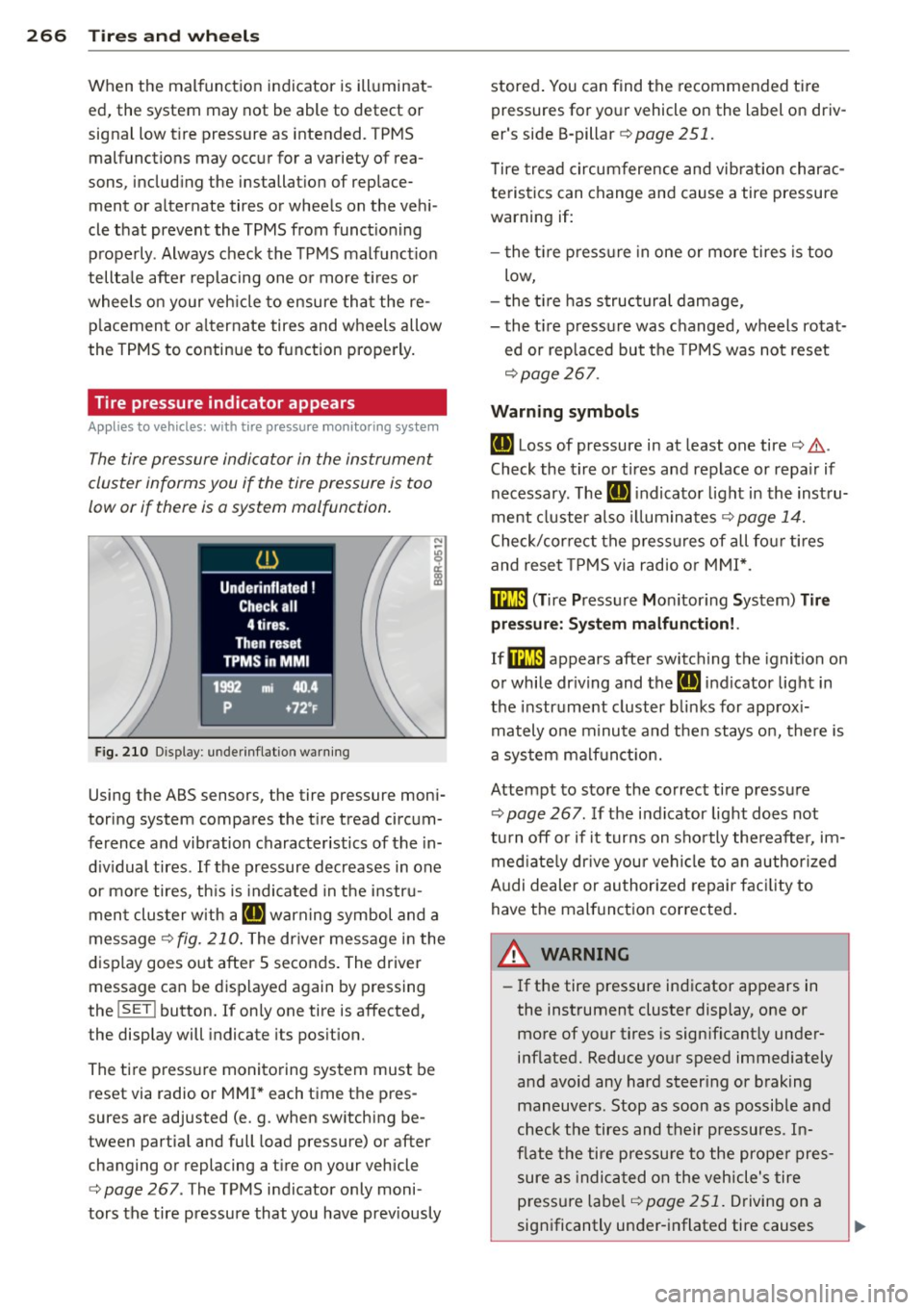
Fig. 210 Display: underinflation warning
Using the ABS sensors, the tire pressure moni
toring system compares the tire tread circum
ference and vibration characteristics of the in
dividual tires. If the pressure decreases in one
or more tires, th is is indicated in the instru
ment cluster w ith a
IE warning symbol and a
message
¢fig . 210. The dr iver message in the
display goes out after 5 seconds. The driver
message can be displayed again by pressing
the
! SET ! button. If on ly one tire is affected,
the display will indicate its position.
The tire pressure monitoring system must be
reset via radio or MMI * each time the pres
sures are adjusted (e. g . when switching be
tween partia l and full load pressure) or after
changing or replacing a tire on your vehicle
¢
page 267. The TPMS indicator only moni
tors the tire pressure that you have prev iously stored
. You can find the recommended tire
pressures for your vehicle on the label on driv
er's side B-pillar ¢
page 251.
Tire tread circumference and vibration charac
teristics can change and cause a tire pressure
warning if:
- the tir e pressure in one or more tires is too
low,
- the tir e has structural damage,
- the tir e pressure was changed, wheels rotat-
ed or replaced but the TPMS was not reset
¢page 267.
Warning symbols
IE Loss of pressure in at least one tire¢ .&..
Check the tire or tires and replace or repa ir if
necessary. The
IE indicato r light in the inst ru
ment cluster als o illuminates
¢ page 14.
Check/correct the pressures of all four tires
and reset TPMS via radio or MMI*.
ffim (T ire Pressure Mon itor ing System) Tire
pressure: System malfunction!.
If@m appears after switching the ignition on
or while dr iving and the
IE indicator light in
the instrume nt cluster blink s for app rox i
mately one minute and then stays on, there is
a system malfunction.
Attempt to store the correct tire pressure
¢
page 267 . If the indicator light does not
tu rn
off or if it turns on shortly thereafter, im
mediately drive you r vehicle to an authorized
A udi dealer or authorized repair facility to
have the malfunction corrected.
A WARNING
=
- If the tire pressure indicator appears in
the instrument cluster display, one or
more of your tires is sign ificant ly under
inflated. Reduce your speed immediately
and avoid any hard steer ing or braking
maneuvers. Stop as soon as possible and
check the tires and their pressures. In
flate the tire pressure to the proper pres
sure as ind icated on the vehicle's tire
p ressu re lab el¢
page 251. Driving on a
significantly under-inflated tire causes
Page 270 of 316
268 What do I do now?
What do I do now?
Jack, tools and
inflatable spare tire
Onboard tool kit and vehicle jack
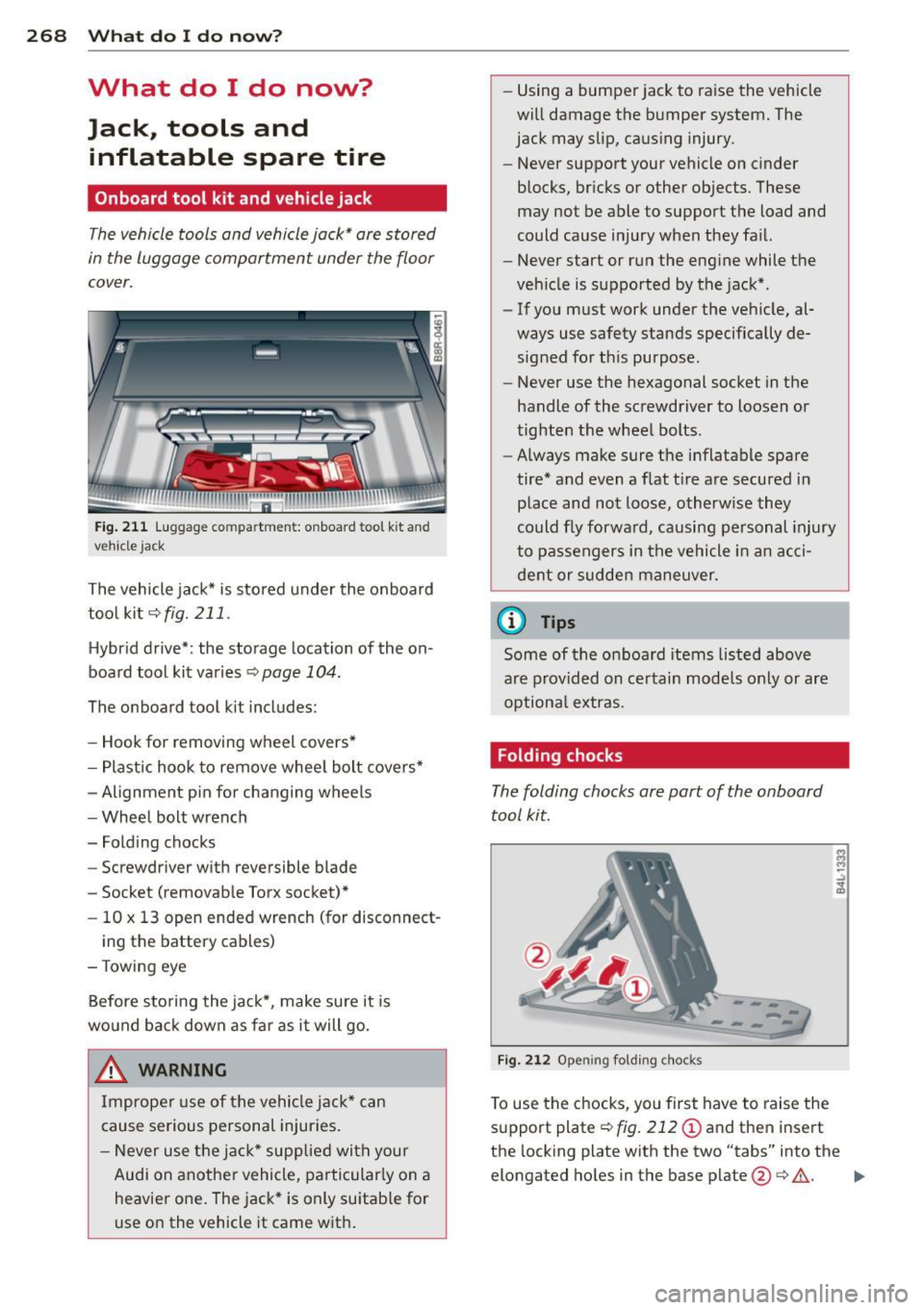
The vehicle tools and vehicle jack* are stored
in the luggage compartment under the floor
cover.
Fig . 211 Luggage compartment: on board tool kit and
vehicle jack
The vehicle jack* is stored under the on board
tool kit¢
fig. 211.
Hybrid drive*: the storage location of the on
board tool kit varies
¢ page 104.
The onboard tool kit includes:
- Hook for removing wheel covers*
- Plastic hook to remove whee l bolt covers*
- Alignment p in for changing wheels
- Wheel bolt wrench
- Folding chocks
- Screwdriver with reversible blade
- Socket (removable Torx socket)*
- 10 x 13 open ended wrench (for disconnect-
ing the battery cables)
-Towing eye
Before storing the jack*, make sure it is
wound back down as far as it will go.
& WARNING
Improper use of the vehicle jack* can
cause serious personal injuries.
- Never use the jack* supplied with your
Audi on another vehicle, particularly on a
heavier one . The jack* is only suitab le for
use on the vehicle it came with . -
Using a bumper jack to raise the vehicle
will damage the bumper system. The
jack may slip, causing injury.
- Never support your vehicle on cinder
blocks, bricks or other objects. These
may not be able to support the load and
could cause injury when they fa il.
- Never start or run the engine while the
veh icle is supported by the jack*.
- If you must work under the vehicle, al
ways use safety stands specifically de
signed for this purpose.
- Never use the hexagonal socket in the
handle of the screwdriver to loosen or
tighten the wheel bolts.
- Always make sure the inflatable spare
tire* and even a flat t ire are secured in
place and not loose, otherw ise they
could fly forward, causing personal injury
to passengers in the vehicle in an acci
dent or sudden maneuver.
@ Tips
Some of the on board items listed above
are provided on certain models only or are
optiona l extras.
Folding chocks
The folding chocks are part of the on board
tool kit.
Fi g. 2 12 Open ing folding choc ks
To use the chocks, you first have to raise the
support plate¢
fig . 212 (D and then insert
the locking plate with the two "tabs" into the
elongated holes in the base plate @¢& .
Ill>
Page 271 of 316
_& WARNING
-The chock cannot fulfil its funct ion and
may lose its stability if the "tabs" on the
support plate are not inserted cor rectly
into the elongated holes in the base
pla te. If th is happens, the vehicle may
st ar t to move whi le a wheel is being
changed .
- Never use the folding chocks if they are
damaged or i f th ey have not been assem
bled correct ly .
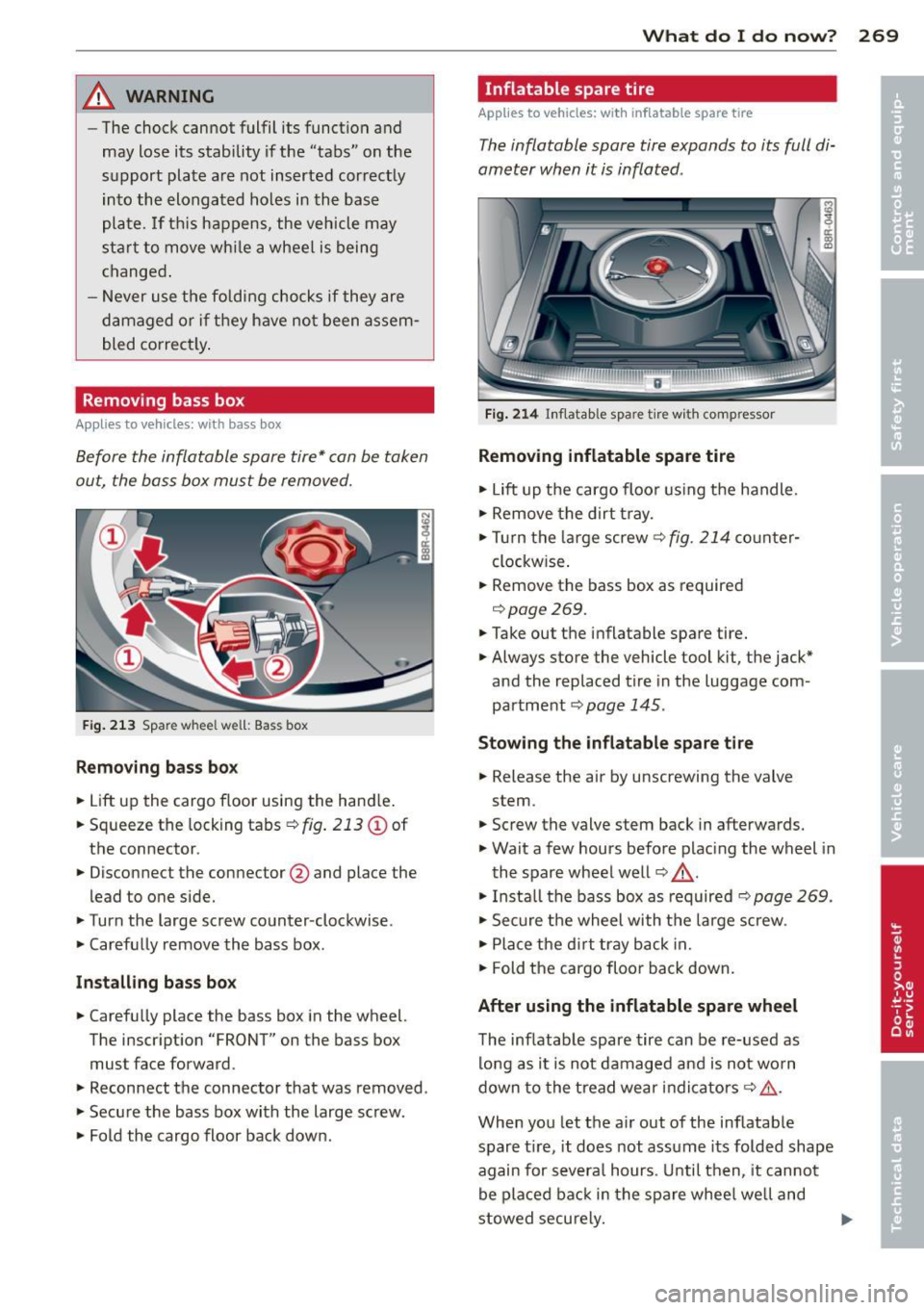
Removing bass box
Applies to vehicles: with bass box
Before the inflatable spare tire* can be taken
out, the bass box must
be removed.
Fig . 2 13 Spare w hee l well : Bas s box
Removing bas s bo x
.,. Lift up the cargo floor using the hand le .
.,. Sq ueeze the locking tabs
c:!;> fig . 213 (D of
the connector.
.,. Disconnect the connector @and place the
lead to one side.
.,. Turn the large screw counter -clockwise .
.,. Carefu lly remove the bass box .
Install ing bas s bo x
.,. Carefu lly place the bass box in the wheel.
The inscr ipt ion "FRONT" on the bass box
must face forward .
.,. Reconnect the connector that was removed .
.,. Secure the bass box with the large screw.
.,. Fold the cargo floor back down.
What do I d o now ? 269
Inflatable spare tire
Applies to vehicles: with inflatable spare tire
The inflatable spare tire expands to its full di
ameter when it is inflated.
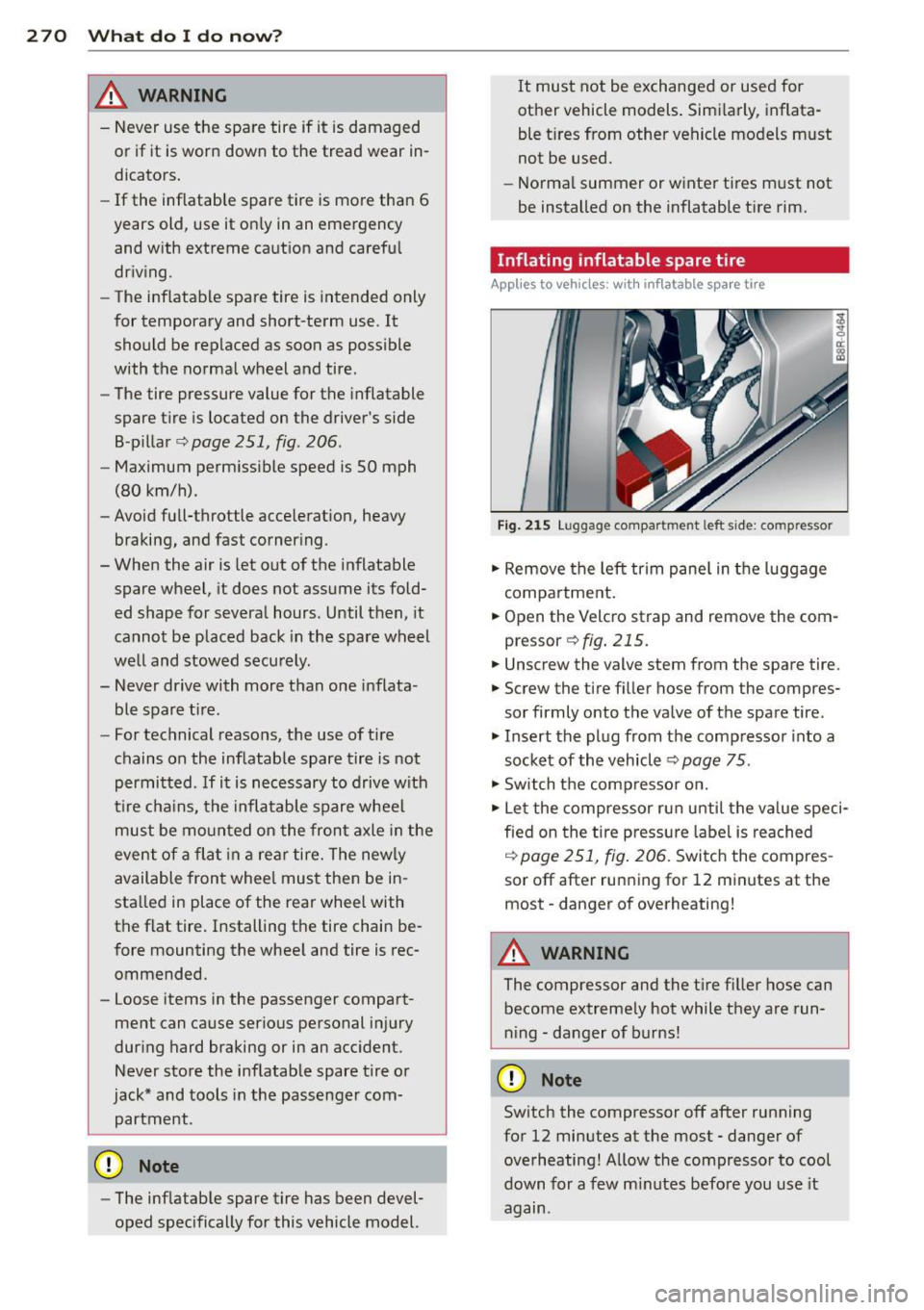
Fi g. 21 4 In flatable spa re t ire w it h comp ressor
Removing inflatable spare tire
.,. Lift up the cargo floo r using t he handle .
.,. Remove the dirt t ray .
.,. Turn the large screw
c:!;> fig. 214 co unter
clockw ise .
.,. Remove the bass box as required
c:!;> page 269 .
.,. Take out the inflatable spare tire .
.,. Always store the vehicle tool kit, the jack*
and the replaced tire in the luggage com
partment
c:!;> page 145.
Stowing the inflatabl e spare t ire
.,. Release the air by unscrewing the valve
stem .
.,. Screw the valve stem back in afterwards .
.,. Wait a few hours befo re placing the wheel in
the spare wheel well
c:!;> .,&. .
"'Insta ll the bass box as required c:!;> page 269 .
.,. Secure the wheel with t he la rge screw .
.,. Place the d irt tr ay back in .
.,. Fold the cargo floor back down.
After using the inflatable spare wheel
T he inflatab le spare tire can be re-used as
l ong as it is not damaged and is not wo rn
down to the t read wea r indica tors
c:!;> ,& .
When you let the a ir out of the inflatab le
spare t ire , it does not assume its folded shape
again for s evera l hours . U nti l then , it canno t
be pla ced ba ck in the spare whee l we ll and
stowed secure ly.
Page 272 of 316
2 70 What do I do now?
A WARNING
-Never use the spare tire if it is damaged
or if it is worn down to the tread wear in
dicators.
- If the inflatable spare tire is more than 6
years old, use it only in an emergency
and with extreme caution and careful
driving.
- The inflatable spare tire is intended only
for temporary and short-term use. It
should be replaced as soon as possible
with the normal wheel and tire.
- The tire pressure value for the inflatable
spare tire is located on the driver's side
8-pillar
¢ page 251, fig. 206.
- Maximum permissible speed is SO mph
(80 km/h).
- Avoid full-throttle acceleration, heavy
braking, and fast cornering .
- When the air is let out of the inflatable
spare wheel, it does not assume its fold
ed shape for several hours. Until then, it
cannot be placed back in the spare wheel
well and stowed securely.
- Never drive with more than one inflata
ble spare tire.
- For technical reasons, the use of tire
chains on the inflatable spare tire is not
permitted .
If it is necessary to drive with
tire chains, the inflatable spare wheel
must be mounted on the front axle in the
event of a flat in a rear tire. The newly
available front wheel must then be in
stalled in place of the rear wheel with
the flat tire. Installing the tire chain be
fore mounting the wheel and tire is rec
ommended.
- Loose items in the passenger compart
ment can cause serious personal injury
during hard braking or in an accident.
Never store the inflatable spare tire or
jack* and tools in the passenger com
partment.
Q) Note
- The inflatable spare tire has been devel
oped specifically for this vehicle model.
It must not be exchanged or used for
other vehicle models. Similarly, inflata
ble tires from other vehicle models must
not be used.
- Normal summer or winter tires must not
be installed on the inflatable tire rim.
Inflating inflatable spare tire
Applies to vehicles : wit h in flatable spa re tire
Fig. 215 L u ggage compartment left side : compressor
.,. Remove the left trim panel in the luggage
compartment.
.,. Open the Velcro strap and remove the com
pressor ¢
fig. 215.
.,. Unscrew the valve stem from the spare tire.
.,. Screw the tire filler hose from the compres
sor firmly onto the valve of the spare tire .
.., Insert the plug from the compressor into a
socket of the vehicle
r=;, page 75 .
.., Switch the compressor on.
.., Let the compressor run until the value speci
fied on the tire pressure label is reached
r=;, page 251, fig. 206. Switch the compres
sor off after running for 12 minutes at the
most -danger of overheating!
A WARNING
= The compressor and the tire filler hose can
become extremely hot while they are run
ning -danger of burns!
(D Note
Switch the compressor off after running
for 12 minutes at the most -danger of
overheating! Allow the compressor to cool
down for a few minutes before you use it
again .