warning AUDI Q5 2014 Owners Manual
[x] Cancel search | Manufacturer: AUDI, Model Year: 2014, Model line: Q5, Model: AUDI Q5 2014Pages: 316, PDF Size: 78.41 MB
Page 228 of 316
226 Fuel suppl y and filli ng your fu el t ank
enter the exhaust system and damage the
catalytic converter.
Refuelling
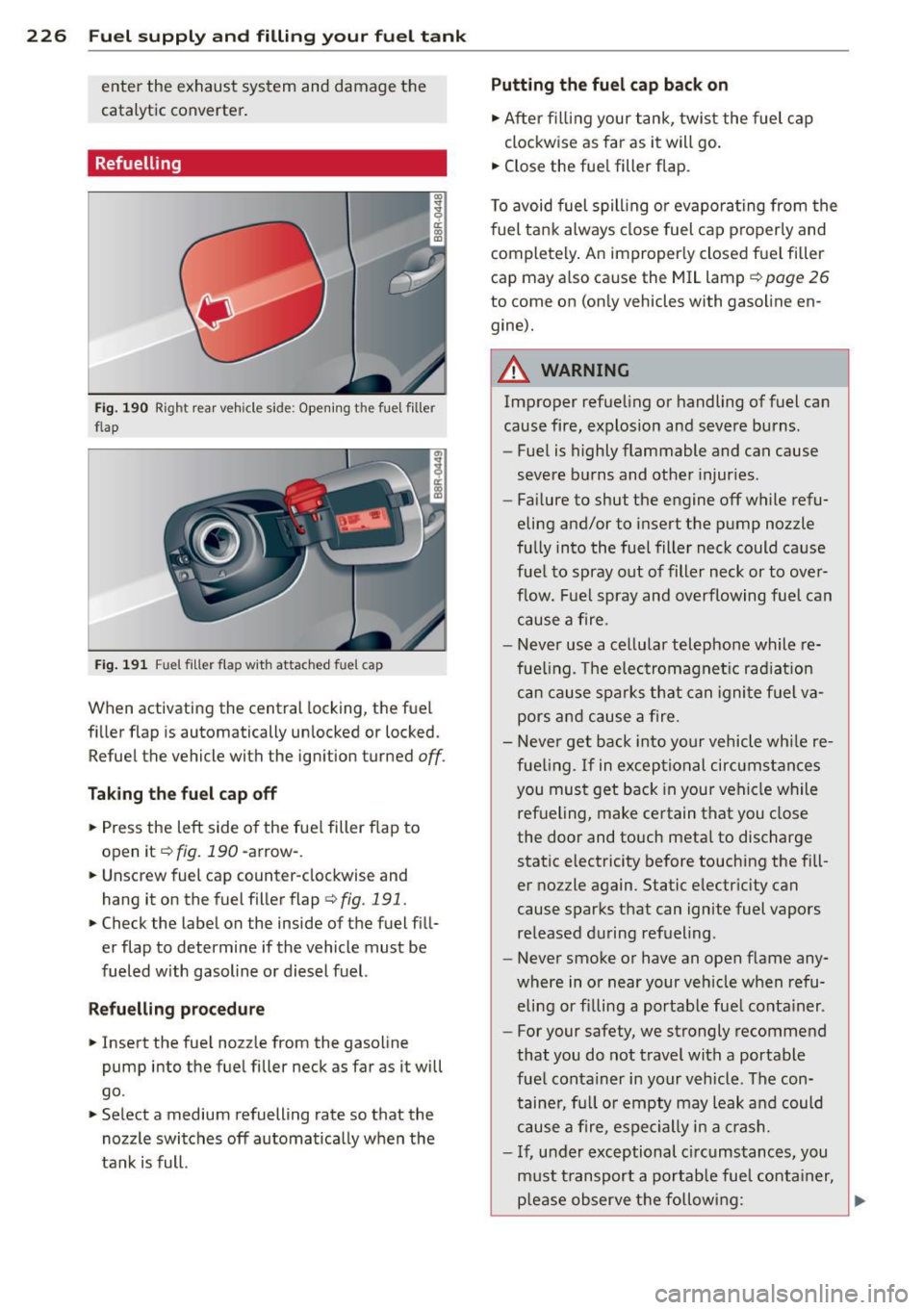
Fig. 190 Righ t rear ve hicle si de: Opening t he fuel filler
fl ap
Fig . 191 Fu el filler fla p w ith attached fuel cap
When activating the central locking, the fuel
filler flap is automatically unlocked or locked.
Refuel the vehicle with the ign ition turned
off .
Tak ing th e fu el cap off
• Press the Left side of the fue l filler flap to
open it ¢
fig. 190 -arrow-.
.. Unscrew fuel cap counter-clockwise and
hang it on the fuel filler flap ¢
fig. 191.
.. Check the Label on the inside of the fuel fill
er flap to determine if the vehicle must be
fueled with gasoline or diesel fuel.
Ref uelling pr ocedu re
.. Insert the fue l no zzle from the gasoline
pump into the fuel filler neck as far as it will
go .
.. Select a medium refuelling rate so that the
nozzle switches off automatically when the
tan k is full .
Putting the fu el cap b ack o n
• After f illing your tank, twist the fuel cap
clockwise as far as it will go .
.. Close the fue l filler flap.
T o avoid fuel spill ing o r evaporating from the
fuel tank always close fuel cap p roperly and
completely . An improperly closed fuel filler
cap may a lso ca use the
MIL Lamp ¢ page 26
to come on (on ly vehicles with gasoline en
gine).
A WARNING
-Improper refueling or handling of fuel can
cause fire, explosion and severe burns .
- Fuel is highly flammable and can cause
severe bu rns and other injur ies.
- Failure to shut the engine off while refu
eling and/or to insert the pump nozzle
fully into the fuel filler neck could cause
fuel to spray out of filler neck or to over
flow. Fue l spray and overflowing fuel can
cause a fire .
- Never use a cellular telephone while re
fue ling. The electromagnet ic rad iat ion
can cause spa rks that can ignite f uel va
pors and cause a fire .
- Never get back into your vehicle whi le re
fue ling.
If in exceptional circ umstances
you must get back in your vehicle while
refueling, make certain that you close
the door and touch metal to discharge
static e lectricity before touching the fill
er nozzle again . Static e lectr icity can
cause sparks that can ignite fuel vapors
released du ring refueling .
- Never smoke or have an open flame any
where in or near your vehicle when refu eling or filling a portable fuel conta iner.
- For your safety, we strongly recommend
that you do not travel with a portable
fuel conta iner in your vehicle . The con
tainer, fu ll o r empty may leak and could
cause a fire, especially i n a c rash.
- If , under exceptional c ircumstances, you
must transport a portab le fuel conta iner,
p lease observe the following: .,.
Page 230 of 316
228 Fuel supply and filling your fuel tank
Selective catalytic
reduction
General information
Applies to vehicles: wit h diese l en gi ne
On vehicles with selective catalytic reduction,
an urea solution (Ad Blue) is injected into the
exhaust system before a nitrogen oxide cata
lytic converter to reduce nitrogen emissions.
The Ad Blue is stored in a separate tank in the
vehicle . The Ad Blue usage accounts for ap
proximately 0.5% to 1.2% of the diesel fuel
that is used.
You must refill the Ad Blue or have it refilled
by your authorized Audi dealer or qualified
workshop as soon as the AdBlue refill mes sage appears in the instrument cluster
c;,page229.
A WARNING
Failure to heed Ad Blue refill information in
the instrument cluster can prevent the ve
hicle from being started and driven. If the
vehicle cannot be driven and an emergency
arises, persona l inju ry can occur.
- Always have the Ad Blue tank refilled well
before the tank ru ns dry.
@ Tips
-The instrument cluster display indicates
the distance remaining that can be driv
en
c;, poge 228. If the Ad Blue tank is
completely empty, the engine will not
start again after the ignition is switched
off.
- AdBlue is required by law to operate this
vehicle.
Indicator in the instrument cluster
display
Applies to veh icles: w ith diesel en gine
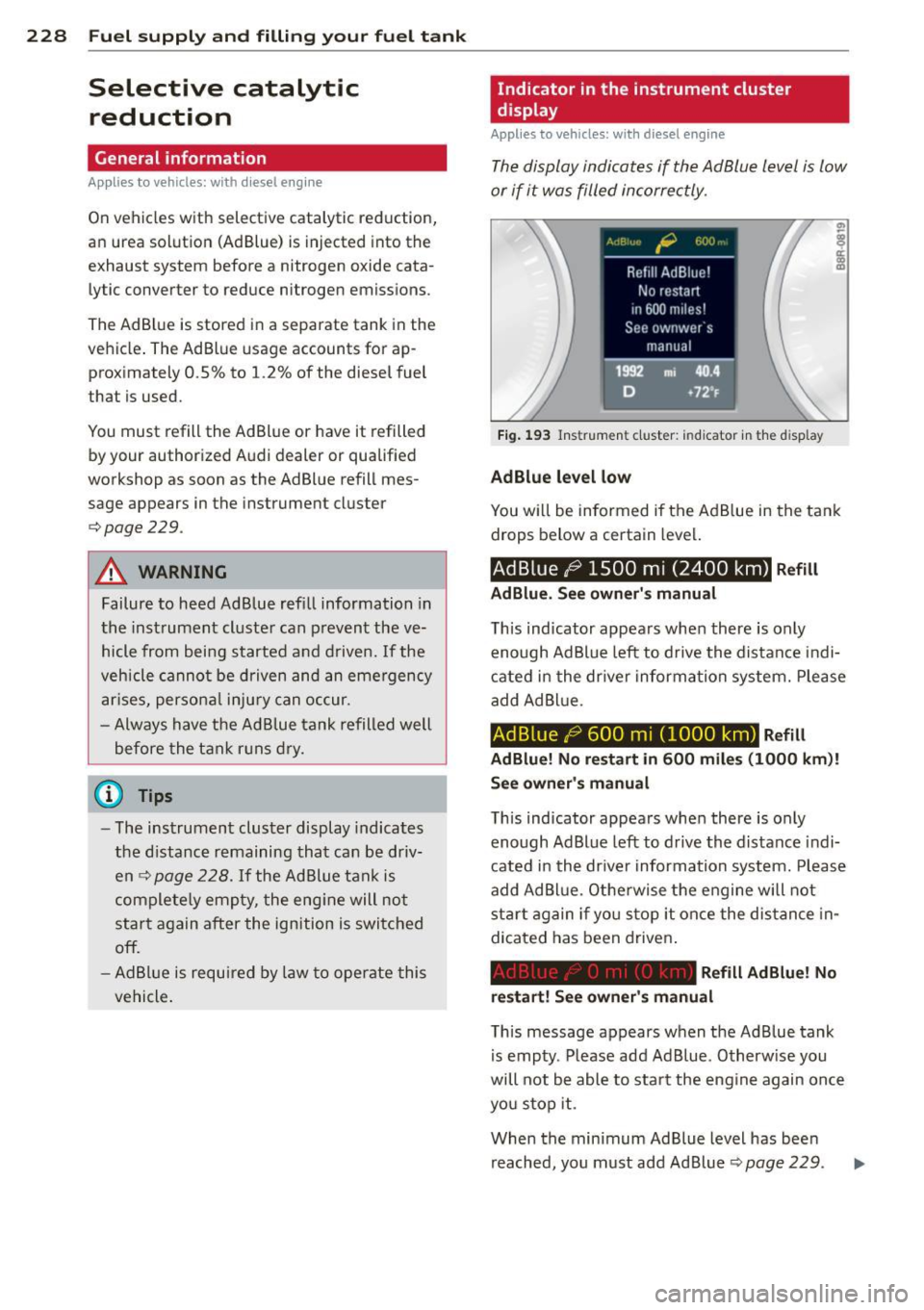
The display indicates if the Ad Blue level is low
or if it was filled incorrectly.
Fig. 193 Ins trumen t cluster : in d icato r in the d isp lay
AdBlue level low
You w ill be informed if the Ad Blue in the tank
drops below a certain level.
Ad Blue l;) 1500 m i (2400 km) Refill
AdBlue. See owner's manual
This indicator appears when there is only
enough Ad Blue left to drive the distance indi
cated in the driver information system. Please
add AdBl ue.
AdBlue l;; 600 mi (1000 km) Refill
AdBlue! No restart in 600 miles (1000 km)!
See owner 's manual
This indicator appears when there is only
enough Ad Blue left to drive the distance indi
cated in the driver information system. Please
add Ad Blue. Otherwise the engine will not
sta rt again if you stop it once the distance in
dicated has been driven .
Refill Ad Blue! No
restart! See owner's manual
This message appears when the Ad Blue tank
is empty. Please add Ad Blue. Otherwise you
will not be able to start the engine again once
you stop it.
When the minimum Ad Blue level has been reached, you must add Ad Blue
c;, page 229.
Page 232 of 316
230 Fuel supply and filling your fuel tank
• If there was no Ad Blue left in the tank and a
range of
O mi (0 km) was displayed in the
instrument cluster, switch the ignition on
for about 15 seconds before starting the en gine.
A WARNING
Ad Blue can irr itate the skin, eyes and res
piratory system. If there is contact with
the fluid, flush immediately with p lenty of
water. Consult a physician if necessary.
0 Note
- Only use Ad Blue that conforms to the
standard ISO 2224 1-1. Do not mix any
additives with the Ad Blue and do not di
lute it with water .
- AdBlue is not a diesel additive . Do not
add it to the diesel tank. If Ad Blue is
mixed w ith diesel fuel, it can lead to
damage to the engine and the Ad Blue
tank system. The Limited New Vehicle
Warranty does not cover such damage.
-Ad Blue attacks surfaces such as painted
vehicle components, plastic and carpet .
Remove the fluid as quickly as possible
with a damp cloth and plenty of cold wa
ter. If the Ad Blue has already crystal
li zed, use warm water and a sponge .
AdBlue res idue that is not removed will
crystallize and can damage the affected
surface.
- Do not store the refill bottle in the vehi
cle. If it leaks, the escap ing Ad Blue could
damage the vehicle inter ior.
- Do not allow Ad Blue to come into con
tact with clothing. If there is contact
with the fluid, flush immediately with
plenty of water.
@ Tips
-You can obtain refill bottles from any au
thorized Audi dealer or other qualified
workshop.
- Follow the Ad Blue manufacturer's in
str uctions for usage and storage.
.
Page 233 of 316
Checking and filling Engine hood
Releasing the engine hood
The engine hood is released from inside the
vehicle .
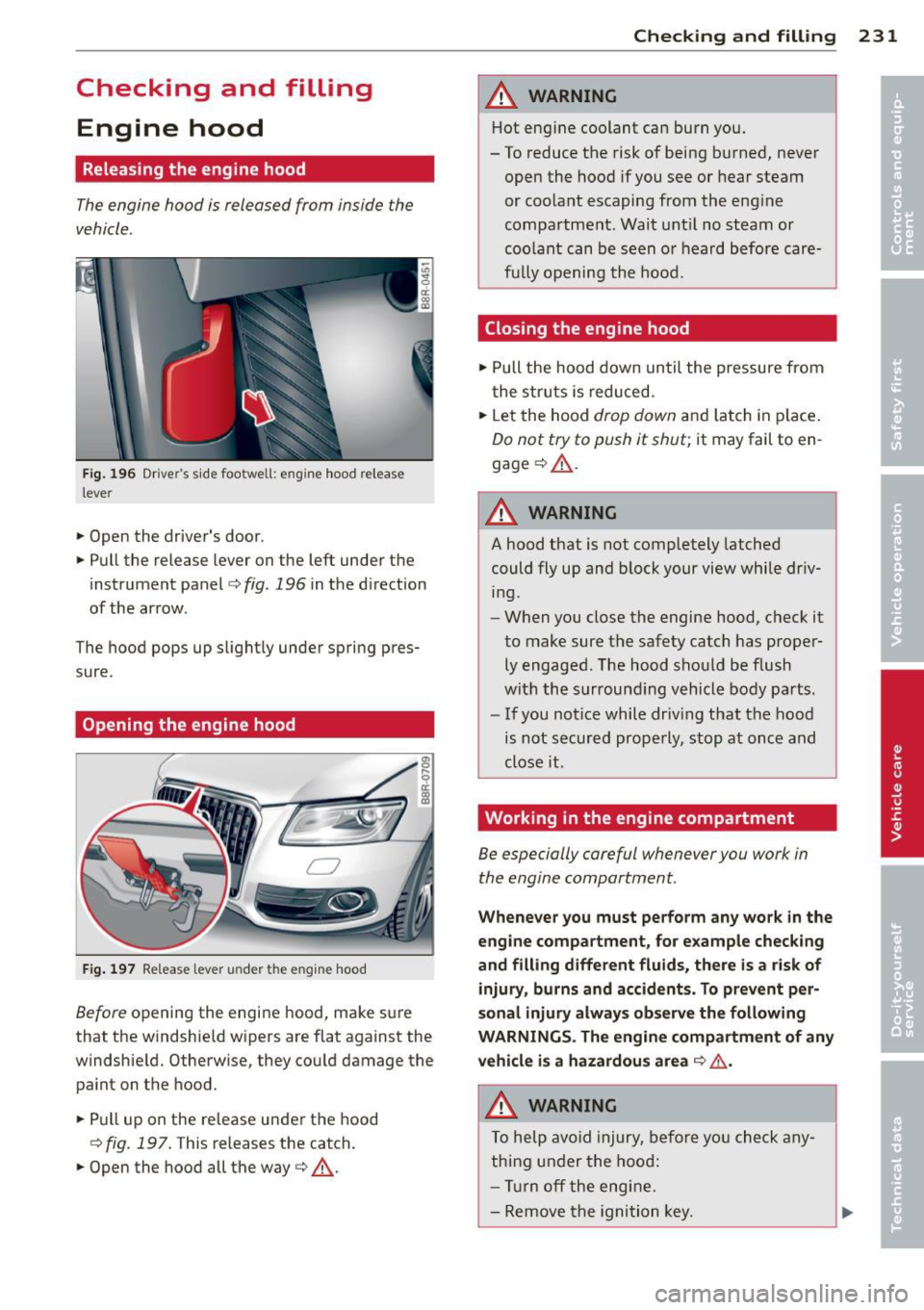
Fig. 196 Dr iver's side footwell: engin e hood release
lever
"' Open the driver's door .
"' Pull the release lever on the left under the
instrument panel
i=> fig. 196 in the d irection
of the arrow .
The hood pops up slightly under spring pres
sure.
Opening the engine hood
F ig . 197 Release lever under the engine hood
Before opening the engine hood, make sure
that the windshield wipers are flat against the
windshie ld. Otherwise, they could damage the
paint on the hood.
"' Pull up on the release under the hood
r::!> fig . 197 . This releases the catch.
"' Open the hood all the way
i=> .&,.
Checkin g and fillin g 231
A WARNING
Hot engine coolant can burn you.
- To reduce the risk of being burned, never
open the hood if you see or hear steam
or coolant escaping from the eng ine
compartment . Wait unt il no steam or
coolant can be seen or heard before care
fu lly opening the hood.
Closing the engine hood
"' Pull the hood down until the pressure from
the struts is reduced.
"' Let the hood
drop down and latch in p lace.
Do not try to push it shut; it may fail to en
gage
c;, .&, .
A WARNING
--
A hood that is not completely latched
could fly up and block your view while dr iv
ing.
- When you close the engine hood, check it
to make sure the safety catch has proper
ly engaged. The hood should be flush
with the surround ing vehicle body parts.
- If you notice while driv ing that the hood
is not secured properly, stop at once and
close it .
Working in the engine compartment
Be especially careful whenever you work in
the engine compartment.
Whenever yo u must pe rform any w ork in the
e n g ine com pa rt ment, for e xample ch ecki ng
and filling different fluids, th ere is a risk of
injury , burn s and accid ent s. T o pr eve nt per
so nal injury alwa ys obs erve the foll owing
WARNINGS . The en gine c ompa rtment of an y
vehicl e is a hazardou s are a
c;, Lh,.
A WARNING ~
To help avoid injury, be fo re you check any
thing under the hood:
- Turn off the engine.
- Remove the ignition key.
Page 234 of 316
232 Checking and filling
-Apply the parking brake.
- Move selector lever of automatic trans- mission to P (Park).
- Always let the engine cool down. Hot components will burn skin on contact.
- To reduce the risk of being burned, never
open the hood if you see or hear steam
or coolant escaping from the engine
compartment. Wait until no steam or
coolant can be seen or heard before care
fully opening the hood.
- Keep children away from the engine com partment.
- Never spill fluids on hot engine compo
nents. They can cause a fire.
- Never touch the radiator fan. The auxili
ary electric fan is temperature controlled
and can switch on suddenly.
- Never open the coolant reservoir cap
when the engine is still warm. The cool
ant system is pressurized and hot cool ant could spray out .
- Protect your face, hands and arm from
steam or hot engine coolant by placing a
thick rag over the cap when you open the
coolant reservoir .
- Do not remove the engine cover under
any circumstances. This increases the
risk of burns.
- If work on the fuel system or the electri
cal system is necessary:
- Always disconnect the battery.
- Never smoke or work near heaters or
open flames. Fluids in the engine com
partment could start a fire.
- Keep an approved fire extinguisher im
mediately available.
- To avoid electrical shock and personal in
jury while the engine is running or being
started, never touch:
- Ignition cables
- Other components of the high voltage
electronic ignition system.
- If you must perform a check or repair
with the engine running: -
First, fully apply the parking brake,
move selector lever of automatic trans
mission to P (Park).
- Always use extreme caution to prevent
clothing, jewelry, or long hair from get
ting caught in the radiator fan, V-belts
or other moving parts, or from contact ing hot parts. Tie back hair before
starting, and do not wear clothing that
will hang or droop into the engine.
- Minimize exposure to emission and
chemical hazards
c:> &, .
&_ WARNING
California Proposition 65 Warning:
- Engine exhaust, some of its constituents,
and certain vehicle components contain
or emit chemicals known to the State of
California to cause cancer and birth de
fects and reproductive harm. In addition,
certain fluids contained in vehicles and
certain products of component wear con
tain or emit chemicals known to the
State of California to cause cancer and
birth defects or other reproductive harm.
- Battery posts, terminals and related ac
cessories contain lead and lead com
pounds, chemicals known to the State of
California to cause cancer and reproduc
tive harms. Wash hands after handling.
(D Note
When adding fluids, always make sure that
they are poured into the proper container
or filler opening, otherwise serious dam
age to vehicle systems will occur.
@ For the sake of the environment
To detect leaks in time, inspect the vehicle
floor pan from underneath regularly. If
you see spots from oil or other vehicle flu
ids, have your vehicle inspected by an au
thorized Audi dealer.
Page 235 of 316
Checking and filling 233
Engine compartment
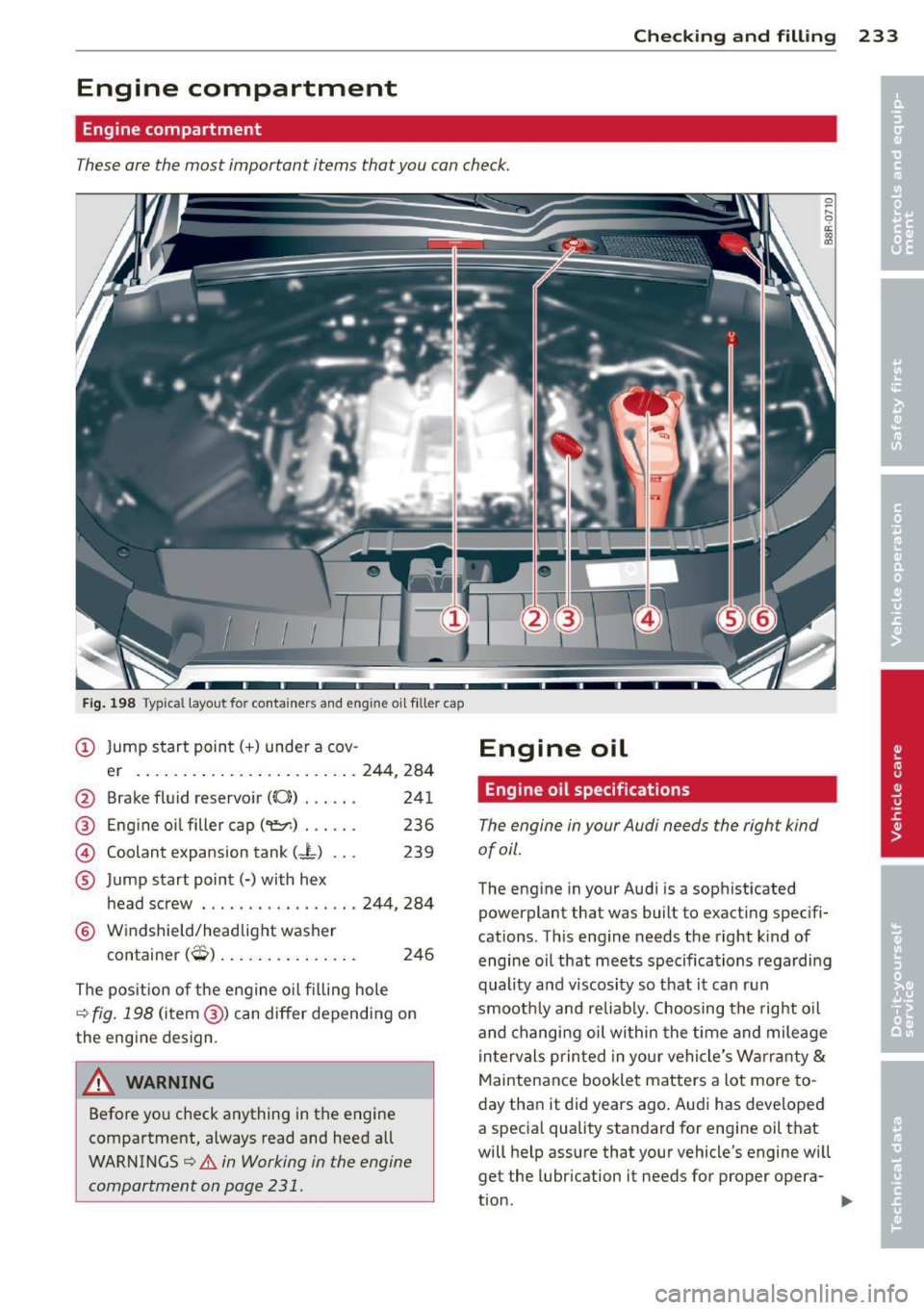
Engine compartment
These are the most important items that you can check.
Fig. 198 Typical layout for contain ers and engine oil filler cap
(D Jump start point( +) under a cov -
er .. .. .. .. .............. .. 244, 284
@ Brake fluid reservoir ((0)) . . . . . . 241
@ Eng ine oil filler cap ("t=:?1) . . . . . . 236
@ Coolant expansion tank (J-) . . . 239
® Jump start point(-) with hex
head screw ..... .......... ..
244, 284
® Windshield/headlight washer
container
(0) . . . . . . . . . . . . . . . 246
The pos ition of the engine o il filling hole
¢ fig. 198 (item @) can differ depending on
the engine design.
A WARNING
-
Before you check anything in the engine
compartment, always read and heed all
WARNINGS ¢&.
in Working in the engine
compartment on page 231.
Engine oil
Engine oil specifications
The engine in your Audi needs the right kind
of oil.
The engine in your Audi is a sophisticated
powerplant that was built to exacting specifi
cations. This eng ine needs the right k ind of
engine oil that meets specifications regarding
quality and viscosity so that it can run
smooth ly and reliab ly. Choosing the right oil
and changing oil within the time and mileage
intervals printed in your vehicle's Warranty
&
Maintenance booklet matters a lot more to
day than it did years ago . Audi has developed
a specia l quality standard for engine oil that
will help assure that your vehicle's engine will
get the lubrication it needs for proper opera-
tion. .,..
Page 237 of 316
names etc.) that conform to Audi oi l standard
VW 502 00 (vehicles with gasoline engine) or
VW 507 00 (vehicles with diesel engine).
C hang ing th e engin e oil
The engine oil and oi l filter must be changed
according to the m ileage (kilomete rs) and
time inte rva ls specified in yo ur vehicle's War
ranty
& Maintenance booklet. Do not exceed
these intervals -harmful deposits from old
engine oil can reduce engine performance and
can lead to expensive eng ine repairs.
Changing the o il at the recommended inter
va ls is so very important because the lubricat
ing properties of oi l decrease gradually during
norma l vehicle use . If you are not sure when
you have your oi l changed, ask your author
ized Audi Service Advisor.
Under some circ umstances the engine oi l
should even be changed more frequently .
Change o il more often if you drive mostly
short distances, operate the vehicle in dusty
areas or mostly under stop-and -go traffic con
d itions, or when you use your veh icle where
temperatures stay below freezing point for l ong periods.
Detergent addit ives in the o il w ill make fresh
oil look dark after the eng ine has been run
n ing for a short time. This is norma l and is not
a reason to change the o il mo re often than
r ecommended.
Damage or ma lf u nction s du e to lac k of
ma intenance
It is essential that you change your oil at the
recommended interva ls using only engine oil
that complies with Audi oil standard
VW 502 00 (vehicles with gasoline engine) or
VW S07 00 (veh icles with diese l engi ne). Yo ur
L im ited New Vehicle Warra nty does not cover
damage or ma lfunctions due to failure to fol
l ow recommended maintenance and use re
quirements as set forth in the A udi Owner's
Manual and Warranty
& Maintenance book let.
Your dealer will have to deny warranty cover age un less you present to the dea ler proof in
the form of Service or Repa ir Orders that a ll
Checking and fillin g 235
scheduled maintenance was performed in a
timely manner.
· Engine oil consumption
The engine in your vehicle depends on an ade
quate amount of oil to lubricate and cool all
of its moving parts.
In order to prov ide effective lubrication and
cooling o f inte rna l engine components, all in
ternal combustion engines consume a certain
amount of oil. Oil consumpt ion varies from
engine to engine and may change sign ificantly
over the life of the engine. Typically, engines
with a spec ified break-in period (see
Q page 205) consume more oil during the
break-in pe riod than they consume after o il
consump tion has stabilized.
Under normal cond itions, the rate of oi l con
sumption depends on the quality and viscos ity
of the oil, the RP M (revolut ions per minute) at
which the engine is operated, the ambient
tempe rature a nd road conditions. Furt her fac
tors are the amount of oil dilut ion from wa ter
condensation or fue l residue and the oxida
tion level of the oi l. As any engine is subject to
wear as mi leage builds up, the oil consump
tion may increase over time until replacement
of worn components may become necessary.
With a ll these variab les coming into p lay, no
standard rate of oil consumpt ion can be es
tablished or spec ified. There is no alternative
to regular and frequent check ing of the o il lev
el, see
Not e.
If the yellow engine oil level warning symbo l
in the instrument cluster
II lights up, you
shou ld check the oil leve l as soon as possib le
¢ page 236 . Top off the oil at your earliest
convenience
~ page 236.
&_ WARNING
Before you chec k anything in the engine
compa rtmen t, always read and heed al l
WARNI NGS
Q .&. in Working in the engine
compartment on page 231 .
•
•
Page 238 of 316
236 Checking and filling
(D Note
Driving with an insufficient oi l level is like
ly to ca use seve re damage to the eng ine.
@ Tips
- The oil pressure warning display. is
not an indicator of the oil level. Do not
rely on it. Instead , check the oil level in
your engine at regular intervals, pref
erably each t ime you refuel, and always
before going on a long trip .
-If you have the impression your engine
consumes excessive amo unts of oi l, we
r ecommend that yo u consult an author
i zed Audi dealer to have the cause of
you r concern p rope rly diag nosed. Keep in
mi nd t hat t he ac curat e measure ment of
oi l co nsu mp tion re q uires grea t care and
may ta ke some time. A n author ize d Audi
dea ler has inst ructions about how to
measure oil consum ptio n accurately.
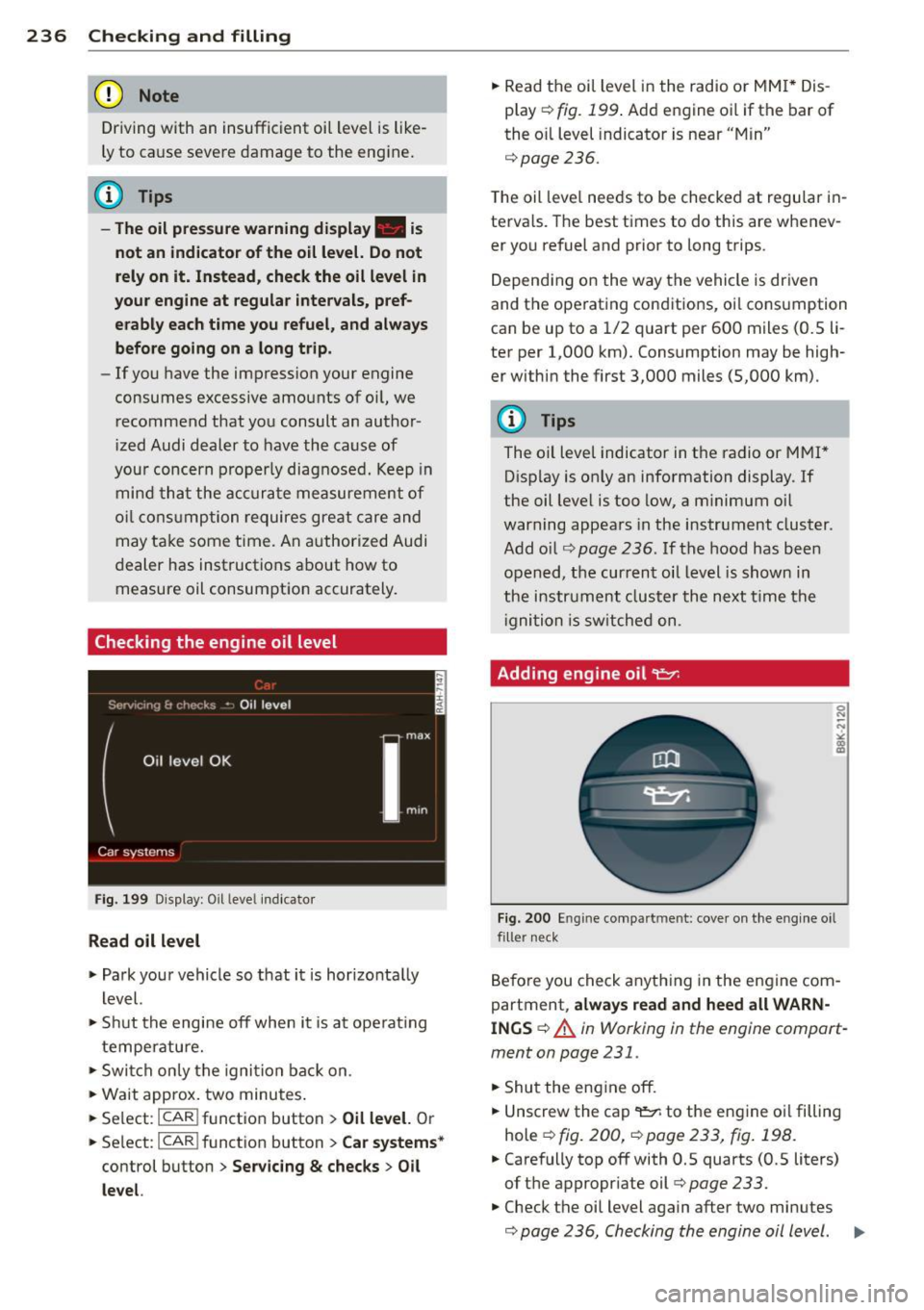
Checking the engine oil level
Fig . 199 Di splay: O il leve l in dica tor
Read oil level
.. Park you r vehicle so that i t is hor izo nta lly
l evel.
.. Shu t the engine off when i t is at ope ra ti ng
temperature .
.. Swi tch on ly th e igni tion bac k on .
.. Wa it approx. two minutes .
.. Se lect :
I CAR ! funct io n button > Oil level. Or
.. Se lect :
ICAR ! function button> Car systems*
control button > Servicing & checks > Oil
level.
.. Read the oil level in the radio or MM I* Dis
p lay
r=> fig. 199 . Add engine o il if the bar of
the o il level indicato r is near "Mi n"
r=>page236.
The oil leve l needs to be checked at regu lar i n
terva ls. The best times to do this are whenev
er you refuel and prio r to long trips .
D epend in g on the w ay the vehicle is driven
and the ope rat ing cond itio ns, oi l cons umption
can be up to a 1/2 quart per 60 0 miles (O.S li
ter per 1,000 km). Consumption may be high
er withi n the first 3,000 miles (5,000 km).
(!} Tips
The oil leve l indicator in t he radio or M MI*
D isplay is on ly an information display . If
the oil leve l is too low, a m inimum o il
war ning appea rs in the instrument cluster.
A dd oil ¢
page 236. If the hood has bee n
opened , the cur ren t oi l level is shown in
t he i nstr ume nt cl uster the next t ime t he
i gni tion is sw itche d on.
Adding engine oil 't:::r.
Fig. 2 00 Eng ine co mpa rtm ent : cove r on t he e ng in e o il
f il le r ne ck
B efo re you check anyth ing in the en gine com
partment ,
always read and heed all WARN
INGS
¢ A in Working in the engine compart
ment on page 231 .
.. Shu t the eng ine off .
.. Unscrew the cap
9::7; to the eng ine o il filling
hole ¢
fig. 200, r=> page 233, fig . 198 .
.. Carefully top off with 0.5 quarts (0.5 liters)
of t he appropr iate oil¢
page 233.
.. Check the oi l level again after two minutes
¢ page 2 36 , Checking the engine oil l evel. II>
Page 239 of 316
~ Top off the oil, if necessary.
~ Screw the cap back on the filling hole.
A WARNING
- While topping off, the oil must not come in contact with hot engine parts - fire
hazard!
- The oil filler cap must be properly se cured to prevent oil from being sprayed
on the hot engine and exhaust system
when the engine is running - fire hazard!
- If your skin has come in contact with the
engine oil, you must subsequently
cleanse it thoroughly .
(D Note
-Check the oil level using the radio or the
MM!*. If the message
Please reduce oil
level
appears, contact your authorized
Audi dealer or other qualified workshop
to have excess oil extracted if necessary.
-Audi does not recommend the use of oil
additives. They may damage the engine
and adversely affect your New Vehicle
Warranty.
@ For the sake of the environment
- Under no circumstances can the oil come
in contact with the sewage network or
the soil.
- Observe and follow legal regulations
when disposing of empty oil containers.
Changing the engine oil
We recommend that have your oil changed by
an authorized Audi dealer or a qualified serv
ice station .
Before you check anything in the engine com
partment,
always read and heed all WARN
INGS
c::> .&. in Working in the engine compart
ment on page 231.
The engine oil must be changed according to
the intervals specified in your Warranty
&
Maintenance booklet. This is very important
because the lubricating properties of oil di
minish gradually during normal vehicle use.
Checking and filling 237
Under some circumstances the engine oil
should be changed more frequently. Change
oil more often if you drive mostly short dis
tances, operate the vehicle in dusty areas or
under predominantly stop-and-go traffic con
dition s, or have your vehicle where tempera
tures remain below freezing for extended pe
riods.
Detergent addi tives in the oil will make fresh
oil look dark after the engine has been run
ning for a short time . This is normal and is not
a reason to change the oil more often than recommended.
Because of the problem of proper disposal,
along with the special tools and necessary ex
pertise required, we strongly recommend that
you have your oil changed by an authorized
Audi dealer or a qualified service station.
If you choose to change your oil yourself ,
please note the following important informa
tion:
A WARNING
To reduce the risk of personal injury if you
must change the engine oil in your vehicle
yourself:
- Wear eye protection.
- To reduce the risk of burns from hot en-
gine oil, let the engine cool down to the
touch.
- When removing the oil drain plug with
your fingers, stay as far away as possible.
Always keep your forearm parallel to the
ground to help prevent hot oil from run ning down your arm.
- Drain the oil into a container designed
for this purpose, one large enough to
hold at least the total amount of oil in
your engine.
- Engine oil is poisonous. Keep it well out
of the reach of children.
- Continuous contact with used engine oil
is harmful to your skin. Always protect
your skin by washing oil
off thoroughly
with soap and water.
•
•
Page 240 of 316
238 Check ing and filling
Never mix oil additives with your engine
oil. These additives can damage your en
gine and adversely affect your Audi Limit
ed New Vehicle Warranty.
@) For the sake of the environment
- Before changing your oi l, f irst make sure
you know where you can properly dispose of the used o il.
- Always dispose of used engine oil proper
l y. Do not dump it on garden so il, wood
ed areas, into open streams or down
sewage dra ins.
- Recycle used engine oil by taking it to a
used engine oil collection facility in your
area, or contact a service station .
Engine cooling system
Coolant
The engine coolant performs two functions: it
keeps the engine from overheating and it pro tects the engine from freezing in the winter.
The cooling system is sea led and generally re
q ui res little attention .
The cooling system has been filled at the fac
tory with a pe rmanent coolant which does not
need to be changed. The coolant consists of a
mixture o f spec ia lly condi tioned water and the
manufacturer's glycol -basedcoolant addi -
tive G l3 antifreeze with anticorrosion addi
tives (50% for USA models ; 60% for Canadian
models). This mixture both assures the neces
sary frost protection and protects metal com
ponents in the engine's cooling system from
corrosion and scaling . It also raises the boil
i ng po int of the coo lant .
Do not red uce the concentration of the coo l
ant in the summer by adding plain water.
The
proportion of coolant add iti ve mu st be at
least 50 % but not more than 60 %
to main
tain antifreeze protection and cooling efficie n
cy.
If t he coolant frost protect io n is too low,
the coo lant cou ld freeze and damage the veh i
cle heating and engine cooling system. F
or year -ro und driving, antifreeze is added a t
the factory for temperatures down to :
- -31°F(-35° C)USA
- -40°F ( -40°C) Canada.
If you must add coolant, use a mixture of wa
ter and coolant additive . Mix ing the coo lant
additive with distilled water is recommended .
.&, WARNING
--
Before you c hec k anyth ing in the engine
compartment, a lways read and heed a ll
WAR NIN GS~ .&.
in Working in the engine
compor tment on page 231 .
(J;) Note
-Before winter sets in, have the coo lant
checked to see if the coolant additive in
yo ur vehicle is sufficient to meet the cli
mate condi tions . This is especia lly impor
tant if you live in a region where the win
ter is extreme ly co ld . If necessary, in
crease the p roportion of coo lant add itive
to 60%.
- When adding coolant additive to yo ur
cooling system, remember :
- W e r ecommend using o nly coola nt ad
d itive G l2++ or Gl3 for your veh icle.
T his coolan t additive is av ail ab le a t au
thor ized Audi dealers. O ther types of
antifreeze can significant ly reduce cor
rosion protection . The resulti ng cor ro
sion can cause a loss o f coolant and se
rious engine damage.
- Do not add any type of rad iator leak seal
ant to your vehicle 's eng ine coolant.
Add ing radiato r repair flu id may adverse
ly affect the function and performance of
your cooling system and co uld resu lt in
damage not cover ed by yo ur New Ve hicle
Limited Warranty.