ECU AUDI Q5 2014 User Guide
[x] Cancel search | Manufacturer: AUDI, Model Year: 2014, Model line: Q5, Model: AUDI Q5 2014Pages: 316, PDF Size: 78.41 MB
Page 101 of 316
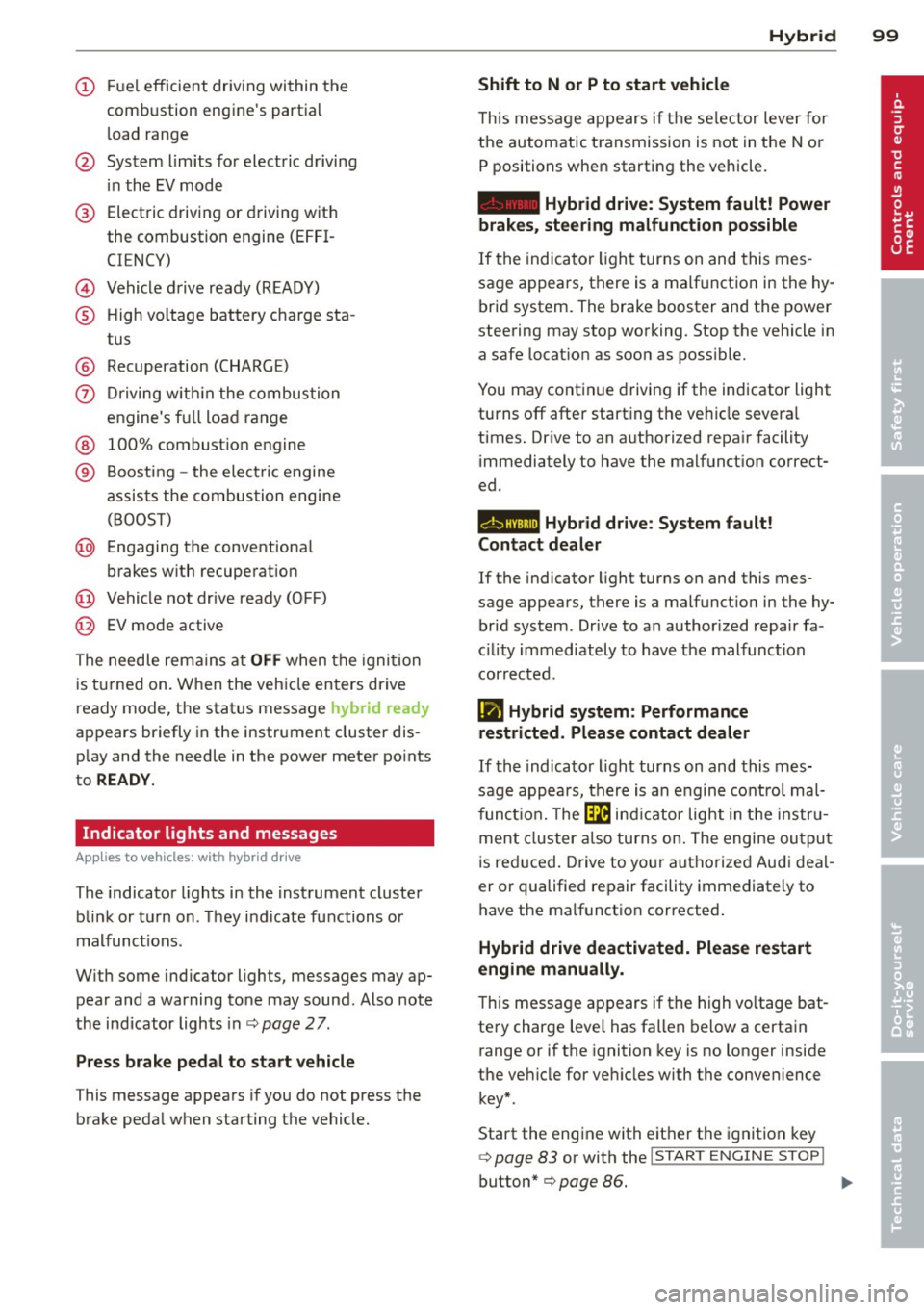
(!) Fuel efficient driv ing within the
comb ustion engine's partia l
l oad range
@ System limits fo r electric d riving
i n the EV mode
® Elect ric driving or d riving w it h
the combustion engine (EFFI -
CI ENCY)
© Vehicle d rive ready (READY)
® H igh vo ltage bat tery c ha rge sta -
tus
® Recuperation (CHARGE)
0 Dr iving w it hi n the combus tion
engine's fu ll loa d range
® 100% combust io n engine
® Boost ing -the elect ric e ngine
assists the combus tion engine
( B OOST)
@ Engaging the conventiona l
brakes w ith recuperat ion
@ Vehicle not drive ready ( OFF)
@ EV mode active
The needle rema ins at
OFF when the igni tion
is tur ned on. W hen the veh icle en ters drive
ready mode, t he stat us message
hybrid ready
ap pears briefly in the instrument cluster dis
p lay and the needle in the power meter po ints
to
READY .
Indicator lights and messages
Applies to vehicles: with hybrid drive
The indicator lights in the instrument cluste r
b link or t urn on . Th ey i ndicate fu nctions o r
malfunct ions .
W ith some ind icator lights, messages may ap
pear and a warning tone may sound. Also note
the indicator lights in c::,;,
pag e 27.
Press brake pedal to start vehicle
This message appea rs if you do not press the
brake peda l when starting the vehicle.
Hybrid 99
Shift to N or P to start vehicle
T his mess age appears if the se lector lever for
the automatic t ransmission is not in t he N or
P positions when starting the vehicle.
- Hybrid drive: System fault! Power
brakes, steering malfunction possible
I f the indica tor ligh t turns on and this mes
sage a ppears, t here is a ma lf u nction in the hy
bri d system. The brake booster and the power
steering may stop working. Stop the vehicle i n
a safe l ocat io n as soo n as poss ible.
You may cont in ue dr iving if the indicator light
turns
off afte r start ing the ve hicle severa l
times. Dr ive to an a uthorized repa ir facility
immediately to have the malfunct ion correct
ed .
EHithjj,j Hybrid drive : Sy stem fault!
Contact dealer
If the indicator light turns on and this mes
sage appears , there is a malfunct ion in the hy
br id system . Drive to a n author ized repair fa
c ili ty immediat ely to hav e th e m alfunc tion
corrected.
Ill Hybrid system: Performance
restricted. Please contact dealer
If th e i ndica to r light turns on and this mes
sag e appea rs, there is an engine contro l ma l
f unct io n .
The @B indi cator light in t he instr u
m ent cluster also tur ns on. The engine ou tput
i s re duced. Drive to yo ur autho rize d Au di dea l
er or qualifie d repair facility immediately to
have the malfunct io n corrected .
Hybrid drive deactivated. Please restart
engine manually.
Th is message ap pears if the high vo ltage bat
te ry charge leve l has fallen below a certa in
range or if the ignition key is no longer inside
the ve hicle for ve hicles with the convenience
key *.
Start the eng ine with e it h er the ignitio n key
¢page 83 or with the !STAR T EN GINE STOPI
button* c::> page 86.
Page 103 of 316
-Offroad mode and hill descent assist must
not be turned on
c::> page 198.
The combust ion eng ine tu rns on and inter
rupts
the enhanced electric d rive mode when
the vehicle is accelerated. The gray indicator
light
l:!I also turns on in the disp lay. The en
hanced electric drive mode resumes automati
cally once acceleration stops.
The enhanced e lectric drive mode is
deactivat
ed
if at least one of the following conditions is
met :
- Th e ign ition is turned off.
- Th e
1.:1"1 button is pressed again.
- The high voltage battery charge level is low .
- The veh icle speed is higher than approxi -
mately 62 mph (100 km/h).
- The
S selector lever position or tiptronic
mode is selected .
- Offroad mode or hill descent assist is
switched on .
T he
ld" I button must be pressed to reactivate
it .
Start-Stop function
The combustion engine is operated on ly as
needed. Generally, the combustion engine
turns off when the vehicle is stationary and
the high voltage battery powers the electrical
vehicle systems.
The purpose of automatica lly shutting the
combustion engine off in hybrid drive mode is
to save fuel. All of the important veh icle sys
tems, such as steering, brakes and the A/C
system, cont inue to remain active. In some
cases, systems may require the combustion
engine to cont inue running when the vehicle
is stationary. When dr iv ing in congested traf
fic for long per iods of time, the combustion
engine w ill cycle on when the vehicle is sta
tionary to keep the high voltage battery
charged.
Gliding
I f the gas pedal is not pressed and the D posi
tion is selected, the combustion engine re-
Hybrid 101
mains turned off up to speeds of approxi
mately 99 mph ( 160 km/h) . Driving conserva
tive ly like this can reduce fuel consumption .
Energy recovery (recuperation)
When braking, the elect ric motor will act as a
generator creating e lectric energy that is then
stored in the high voltage battery. This also
occurs when the ve hicle is coasting or driving
downhi ll. The combustion engine is automati
cally turned off in this case.
The vehicle is braked with the electric motor
by applying ear ly and even pressure to the
brakes and using short pedal movements
¢ page 98, fig. 107 @. By doing this, a large
amount of the kinetic energy is recovered and may be stored as electric energy in the high
voltage battery. During heavy braking, the
convent ional brakes are also act ivated
c::> page 98, fig. 107 @.
The energy recovery is shown in the MMI dis
play
c::> page 104 .
Automatic start of the combustion engine
Various operating conditions cause the com
bust ion engine to start automat ically :
- The high voltage battery charge leve l is low.
- The temperature of the comb ustion engine
is low.
- The temperature of the catalyt ic converter is
low .
- The power output needed for the A/C sys-
t em is high.
- The vehicle speed is hig h.
- The vehicle acceleration is high.
- The inclin e is steep.
- High charge level for the high voltage bat-
tery when coasting. In th is case, the h igh
voltage battery cannot absorb any mo re en
ergy and so the electric motor cannot slow
down the veh icle. The combustion engine
tu rns on (engine brake). In this situation the
h igh voltage battery will show a Ma x charge.
Page 104 of 316
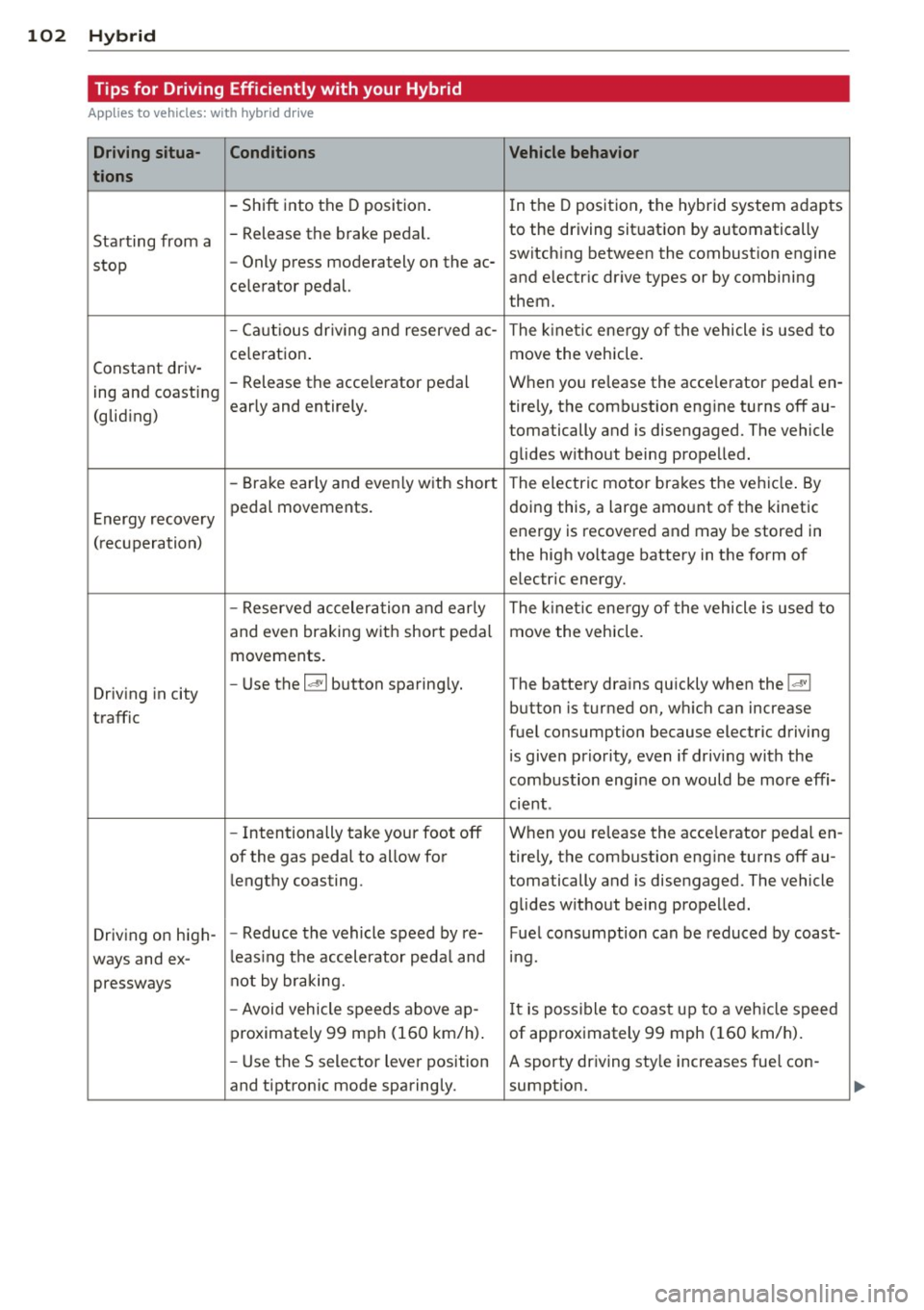
102 Hybrid Tips for Driving Efficiently with your Hybrid
Applies to vehicles: with hybrid drive
Driving situa-
Conditions Vehicle behavior
tions
-Shift into the D position.
In the D position, the hybrid system adapts
Starting from a -
Release the brake pedal. to the driving situation by automatically
stop -
Only press moderately on the ac- switching between the combustion engine
and electric drive types or by combining
celerator pedal.
them.
- Ca utious dr iv ing and reserved ac-
The kinetic energy of the vehicle is used to
ce leration . move the vehicle.
Constant driv-
ing and coasting -
Release the acce lerator pedal When you release the acce lerator pedal en-
early and entirely. ti rely, the combustion engine turns off au-
(gliding)
tomatically and is disengaged. The vehicle
glides without being propelled.
- Brake early and even ly with short The electric motor brakes the vehicle. By
Energy recovery pedal movements.
doing this
, a large amount of the kinetic
energy is recovered and may be stored in
( recuperation)
the high voltage battery in the form of
electric energy.
- Reserved acceleration and early The kinetic energy of the vehicle is used to
and even braking w ith short pedal move the vehicle.
movements .
Driving in city -
Use the
la• I button sparing ly. The battery drains quickly when the laVI
button is turned on, which can increase
traffic
fuel consumption because electric driving
is given priority, even if driving with the
combustion engine on would be more effi-
cient .
- Intentionally take your foot off When you release the acce lerator pedal en-
of the gas pedal to allow for ti rely, the combustion engine turns off au-
lengthy coasting . tomatically and is disengaged. The vehicle
glides without being propelled.
Driv ing on high- -
Reduce the vehicle speed by re-Fuel consumption can be reduced by coast-
ways and ex- l
eas ing the accelerator peda l and mg.
pressways not by braking.
- Avoid vehicle speeds above ajp -
It is possible to coast up to a veh icle speed
proximately 99 mph (160 km/h) . of approximately 99 mph (160 km/h).
- Use the S selector lever position A sporty driving style increases fuel con -
and tiptronic mode sparingly. sumption.
Page 105 of 316

Hybrid 103
Driving situa- Conditions Vehicle behavior
tions
- Do not run the combustion en- The temperature of the comb ust ion eng ine
gine wh ile the vehicle is parked to rises very slowly and the fuel consumption
warm t he engine . increases considerably.
- Use the rear w indow/exterior This conserves the energy in the h igh vo lt-
Driv ing in cold mirro
r defroster and the seat heat- age battery so that it is ava ilab le to run the
weather i
ng sparingly. vehicl e in elect ric mode .
- Park the vehicle in a ga rage over-
This reduces exposure of the hig h voltage
night.
Energy flow display
Applies to vehicles: with hybrid drive
Fig. 10 9 Instrument cluster: e nergy flow disp lay
The energy flow of the hybrid system is shown
i n the instrument cluster display and in the
M MI disp lay. The image is animated in the
MMI display.
Image in the instrument cluster display
.,. Press the !RESET I button in the w indshield
wipe r lever repeated ly until the e ne rgy flow
display
c::> fig . 109 appears .
Component Color
@Combustion engine orange
gray
@ Props haft green
orange
green-o range
g ray battery to co
ld temperatures . The required
temperature range for the hig h voltage
battery will then be reached more quick ly
after you start driving.
Fi g. 1 10 MMI d isp lay: energy flow display
Image in the MMI display
.,. Sele ct: i ME NUI fu nct ion button> Hybrid
contro l button r=;, fig . 110.
Meaning
The combustio n engine is runni ng
The combust io n engine is off
Electric driving/ recuperating
D riving w ith th e combust io n engine
Driving with the combustio n engine and electric
motor (boost)
Vehi cle s ta ti onary/rolling in the N sele ctor lever
p osition
Page 106 of 316
104 Hybrid
Component Color
® High voltage battery green
green (animated
in MMI)
gray
(§) Movement arrow g
reen
orange
green-orange
@ Movement arrow green
@ Tips
The Energy flow dis play will not shown in
the MMI display when the reverse gear is engaged, due to safety reasons.
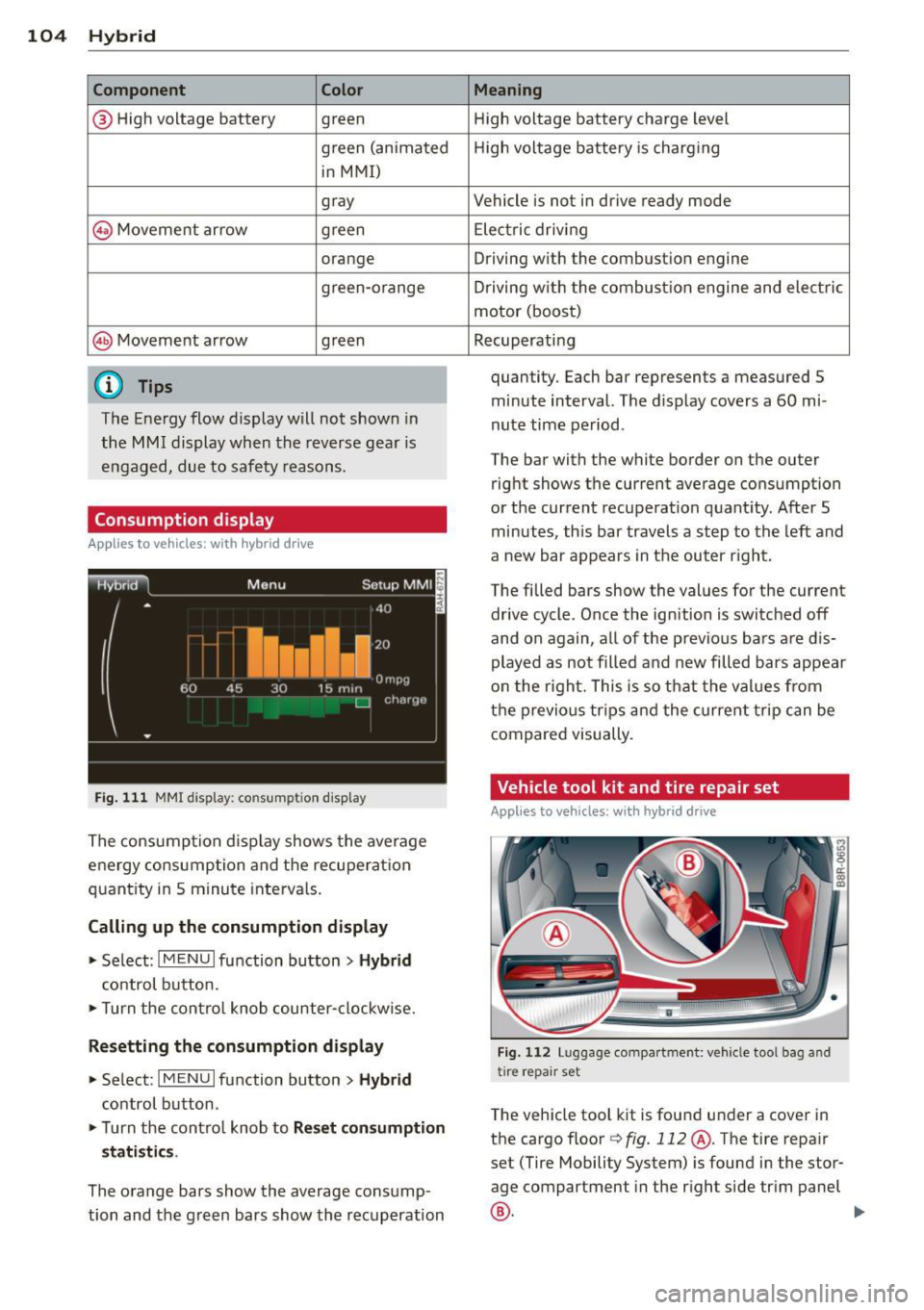
Consumption display
Ap plies to vehicles: with hybri d drive
Fig. 111 MMI display: consumpt io n disp lay
The consumpt ion d isplay shows the average
energy consumption and the recuperation
quantity in 5 minute interva ls.
Calling up th e co nsumpti on displa y
• Se lect : I MENU I function button> Hybrid
control button.
• Turn the cont ro l knob counter-clockw ise.
R esetting the c onsumption displ ay
• Se lect : IM ENU I function button > Hybr id
control button.
• Turn the cont ro l knob to
R es et con sumpt ion
s tati sti cs.
The orange bars show the average consump
tion and the green bars show the recuperation
Meaning
High voltage battery charge level
High voltage battery is charging
Vehicle is not in drive ready mode
E lectric driving
Driving with the combustion engine
Driving w ith the combust ion engine and electric
motor (boost)
Recuperating
quantity. Each bar represents a measured 5
minute interval. The display covers a 60 mi
nute time period.
The bar with the white border on the outer
right shows the current average consumption
or the current recuperation quant ity . After 5
minutes, this bar travels a step to the left and
a new bar appears in the outer r ight.
The filled bars show the values for the current
drive cycle . Once the ignition is switched off
and on again, all of the previous bars a re d is
played as not filled and new filled bars appear
on the right. This is so that the values from
the p revious trips and the current trip can be
compared visually.
Vehicle tool kit and tire repair set
Appl ies to v ehicles: wi th hybrid drive
Fig. 112 Lu ggage compa rtment: vehicle tool bag and
tire repair set
The vehicle tool kit is found under a cover in
the cargo floor Qfig .
112 @. The tire repair
set (Tire Mobility System) is found in the stor
age compartment in the right side trim panel
®· ~
Page 116 of 316

114 Audi adaptive cruise control and bra king guard
- Always remember t hat t he radar sens or
fo r the b raking guard wo rks only within
defined detection and range limits that
may preve nt the proper detection of oth
er v eh icles.
- The radar senso r's fu nction and range
can be reduced by rain, s now a nd heavy
spray. Mo ving v ehicle s up a head may not
b e pr omptly dete cte d or may not be de
te cte d at al l.
- Reflective surfaces in cl udi ng c ras h ba rri
ers or t unnel ent ran ces may impair the
f unc tion of the r ad ar se nso r.
(D Tips
- You can cance l th e braking tha t is initiat
ed by the system by braking you rs e lf, by
a cce lerati ng noticeab ly o r by swerving.
- Bra king guard er ror messages
¢pag e
114.
- Keep in mi nd that braking gua rd can
brake u nexpect edly . Always secure any
ca rgo or objects that you are tr ansport
i ng to reduce the risk of d amage or in
ju ry.
Settings in the radio/MM!*
Applies to vehicles: with Audi adaptive cruise control
• Se lect : ICAR !f u nct ion button> Audi braking
guard .
Or
• Se lect : ~I C-A-R~ I funct ion button >
Car systems*
control button > Driver assist > Audi brak
ing guard .
System -
Switch bra kin g g uard On and Off .
When you sw itch the ignition on, the message
Brak ing guard: Off appears if the system is
switched off .
Early warning -The d istance and approach
warn ings in the disp lay can be switched
On /
Off .
(D Tips
-Your settings are automatica lly sto red
and ass igned to the remote control key
being used at the t imes t he settings are
made¢ page
36.
- If you restric t the E SC, the br aking gua rd
also sw itc hes itself off~ page
198.
-Switch braking guar d off when you a re
loading the vehicle onto a veh icle car rier,
train, s hip o r othe r type of t ransporta
tion. This can prevent undesired warn
ings from the braking gua rd system.
Messages
Applies to vehicles: with Aud i adaptive cruise control
Braking guard : Off
T his dr iver mess age a ppears if t he system is
tu rned off via the radio/MM I*. Ot herw ise, if
t h e system is turned off, the information ap
pears every t ime shortly after the start of the
trip.
T he driver messa ge a lso appears if the system
is not available due to a malfunct io n or if the
ESC is not switched on¢ page
198. If th is is
t h e case, the system w ill not p rov ide warnings
about a poss ible collision.
Braking guard : Activated
T h is dr iver mess age appears if sharp b rake
pressure was applie d due to a n acu te warning.
•••
Three white dots appear if a sett ing cannot be
selected w ith the operating lever . For exam
ple, this happens if you wa nt to raise/low er
the speed even thoug h there was no previous
l y saved speed.
ACC: Sensor blocked
This message appears if the sensor v iew is ob
structed, for examp le by leaves, snow, heavy
sp ray or d irt . Clean the sensor¢ page
107,
fig .
113.
ACC: Unav ailable
The driver mess age appe ars if, for ex ample,
the b rake tempera ture is too high . The adap
tive cr uise contro l is temporar ily u nava ila ble .
A chime sounds as a reminder.
ACC: Not available
Page 128 of 316
126 Automatic transmission
8_ WARNING
-Unintended vehicle movement can cause
serious injury .
- Never leave your vehicle with the engine
running while in gear. If you must leave
your vehicle when the engine is running,
activate the parking brake and move the
selector lever to P.
- Power is still transmitted to the wheels
when the engine is running at idle. To
prevent the vehicle from "creeping", you
must keep your foot on the brake when
the engine is running and the selector lever is in D/S or R or "tiptronic" mode is
selected.
- Do not press the accelerator pedal when
changing the selector lever position
while the vehicle is stationary and the
engine is running.
- Never shift into
R or P while driving.
- Before driving down a steep slope, re-
duce your speed and shift into a lower
gear with "tiptronic".
- Do not ride the brakes or press the brake
pedal too often or too long when driving
down a hill. Constant braking causes the
brakes to overheat and substantially re
duces braking performance, increases
braking distance or causes complete fail
ure of the brake system .
- To preven t the vehicle from rolling back
when stopping on inclines, always hold it
in place with the brake pedal or parking
brake.
- Never hold the vehicle on an incline with
a slipping clutch . The clutch opens auto
matically when it becomes too hot from
the overload. An indicator lamp
[O] illu
minates and a driver message appears
<=:> page 128when the clutch is overload
ed.
- If the engine must remain running, never
have any driving position engaged when
checking under the hood. Make sure the
selector lever has securely engaged and
is locked in P with the parking brake set
r:::> page 231 . Otherwise, any increase in engine speed may set the vehicle in mo
tion, even with the parking brake ap
plied.
(D Note
- When stopping on an incline , do not try
to hold the vehicle in place by pressing
the accelerator pedal while a driving gear is selected. This can cause the transmis
sion to overheat and can damage it. Acti
vate the parking brake or press the brake pedal to prevent the vehicle from rolling .
- Allowing the vehicle to roll when the en
gine is stopped and the selector lever is
in N will damage the transmission be
cause it is not lubricated under those cir
cumstances.
@ Tips
For safety reasons, the parking brake is re
leased automatically only when the driv
er's safety belt is engaged in the buckle.
Hill descent control
The hill descent control system assists the
driver when driving down declines.
Hill descent control is activated when these
lector lever is in D /S and you press the brake
pedal. The transmission automatically selects
a gear that is suitable for the incline. Hill de
scent control tries to maintain the speed ach
ieved at the time of braking, within physical
and technical limitations. It may still be nec
essary to adjust the speed with the brakes .
Hill descent control switches off once the de
cline levels out or you press the accelerator
pedal.
When the speed is set in the cruise control
system
r:::> page 95, hill descent control is also
activated.
A WARNING
-
Hill descent control cannot overcome
physical limitations, so it may not be able
to maintain a constant speed under all
Page 137 of 316
Homelink
Universal remote
control
Description
Applies to vehicles: with Home link
The HomeLink universal remote control can
be programmed with the remote control for
devices that are already present.
With Home Link, you can control devices such
as the garage door, security systems, house
lights , etc. comfortably from the inside of you
vehicle.
Homelink makes it possible for you to rep lace
three different remote controls from dev ices
in your home with one universal remote. This
feature works for most garage door and exte
rior door motor signals. Programming the in
dividual remote control for your remote con
trol takes place near the center of the radiator
grille. There is a control module attached at
this location .
A one-time programming of the sensor must be performed before you are able to use sys
tems with Homelink. If the system does not activate after performing the one-time pro
gramming, check whether the system uses a rolling code¢
page 138 for vehicles without
the MMI*.
& WARNING
-
- Never use the Homelink transmitter
with any garage door opener that does
have not the safety stop and reverse fea
ture as requ ired by federa l safety stand
ards. This includes any garage door open
er model manufactured before April 1,
1982.
-A garage door opener which cannot de
tect an object, signaling the door to stop
and reverse does not meet current feder
al safety standards . Using a garage door
opener without these features increases
risk of serious injury or death.
Homelink 135
- For safety reasons never release the
parking brake or start the engine while
anyone is standing in front of the vehicle .
- A garage door or an estate gate may
sometimes be set in motion when the
Homelink remote control is being pro
grammed. If the device is repeatedly ac
tivated, th is can overstrain motor and
damage its electrical components - an
overheated mo to r i s a fire hazard!
- To avoid possib le injuries or property
damage, please always make abso lutely
certa in that no persons or objects are lo
cated in the range of motion of any
equipment being operated.
(0 Tips
- If you would like more information on
Homelink, where to purchase the Home
Link compat ible products, or would like
to purchase the Home Link Home Light
ing Package, please call toll-free :
1-800-355-3515.
-For Declaration of Compliance to United
States FCC and Industry Canada regula
tions
¢ page 296.
-For security reasons, we recommend that
you clear the programmed buttons be
fore selling the vehicle.
Operation
App lies to vehicles : with Homeli nk
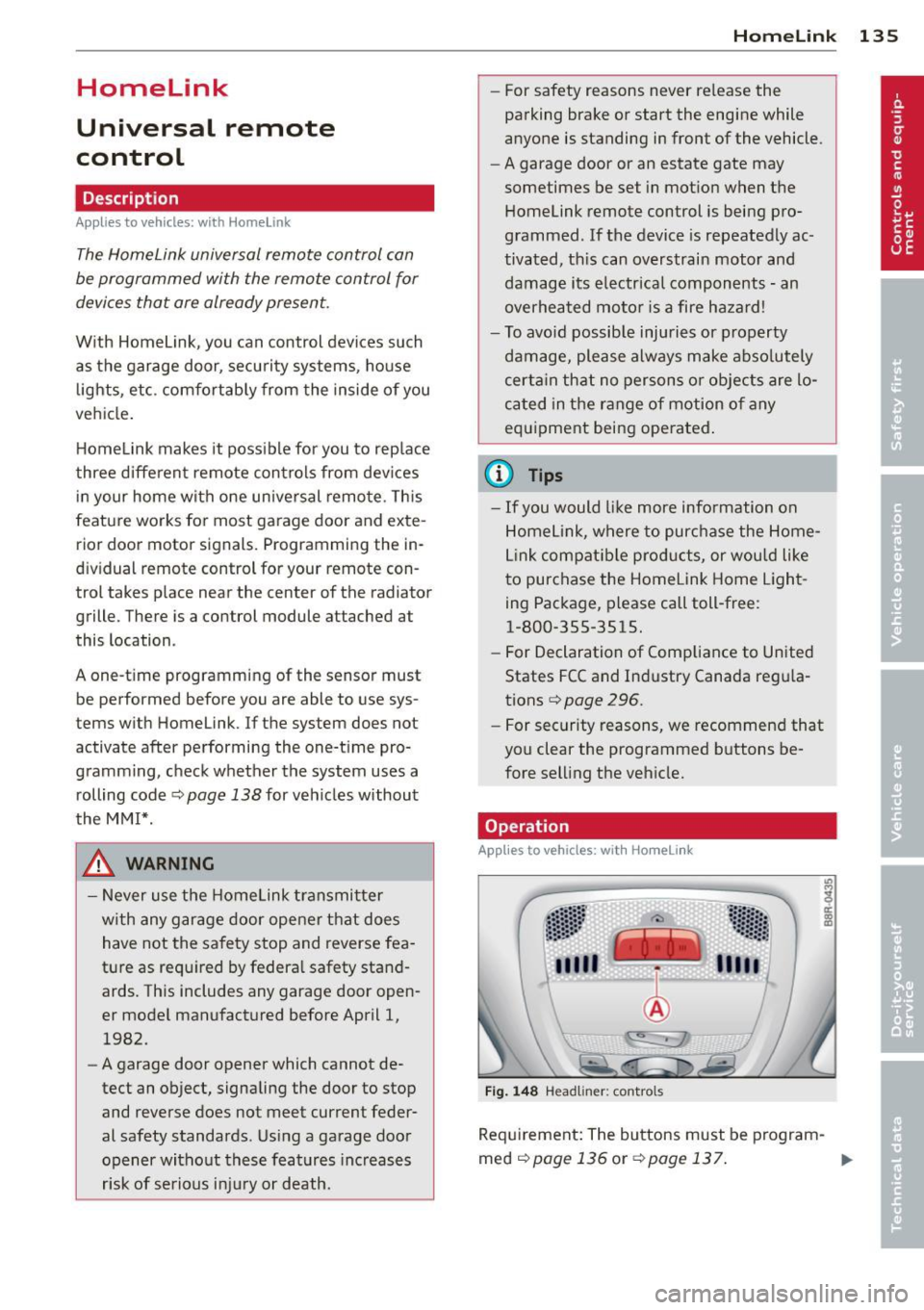
Fig. 148 Headl iner: controls
Req uirement: The buttons must be program-
med
<:!)page 136 or ¢page 137. ..,_
Page 141 of 316
Driving Safely
General notes
Safe driving habits
Please remember -safety first!
This chapter contains important information,
tips, instructions and warnings that you need
to read and observe for your own safety, the
safety of your passengers and others . We have
summarized here what you need to know
about safety belts, airbags, child restraints as
well as child safety. Your safety is for us
priori
ty number 1.
Always observe the information
and warnings in this section - for your own
safety as well as that of your passengers.
The information in this section applies to all
model versions of your vehicle . Some of the
features described in this sections may be
standard equipment on some models, or may
be optional equipment on others. If you are
not sure, ask your authorized Audi dealer.
A WARNING
- Always make sure that you follow the in
structions and heed the WARNINGS in
this Manual. It is in your interest and in
the interest of your passengers.
- Always keep the complete Owner's Liter
ature in your Audi when you lend or sell
your vehicle so that this important infor
mation will always be available to the
driver and passengers.
- Always keep the Owner's literature handy
so that you can find it easily if you have
questions.
Safety equipment
The safety features are part of the occupant
restraint system and work together to help
reduce the risk of injury in a wide variety of
accident situations .
Your safety and the safety of your passengers
should not be left to chance. Advances in
technology have made a variety of features
available to help reduce the risk of injury in an
Driving Safely 139
accident. The following is a list of just a few of
the safety features in your Audi :
- sophisticated safety belts for driver and all
passenger seating positions,
- belt force limiters for the front seats,
- belt pretensioners for the seats,
- belt height adjustment for the front seats,
- head restraints for each seating position,
- front airbags,
- side airbags in the front seats and outer rear
seats*,
- side curtain airbags,
- special LATCH anchorages for child re-
straints,
- adjustable steering column.
These individual safety features, can work to gether as a system to help protect you and
your passengers in a wide range of accidents.
These features cannot work as a system if
they are not always correctly adjusted and cor
rectly used.
Safety is everybody's responsibility!
Important things to do before driving
Safety is everybody 's job! Vehicle and occu
pant safety always depends on the informed
and careful driver.
For your safety and the safety of your passen
gers,
before driving always:
.,. Make sure that all lights and signals are op
erating correctly .
.,. Make sure that the tire pressure is correct .
.,. Make sure that all windows are clean and af
ford good visibility to the outside .
.,. Secure all luggage and other items carefully
qpage 76.
.,. Make sure that nothing can interfere with
the pedals.
.,. Adjust front seat, head restraint and mirrors
correctly for your height .
.,. Instruct passengers to adjust the head re
straints according to their height .
.,. Make sure to use the right child restraint
correctly to protect children ¢
page 178,
and~~~-~
•
•
Page 144 of 316

142 Driving Safely
unfolds with great force in the blink of
an eye .
- Always make sure that there are at least
10 inches (25 cm) between the front
passenger's breastbone and the instru
ment panel.
- Each passenger must always sit on a seat of their own and properly fasten and
wear the safety belt belonging to that
seat.
- Before driving, always adjust the front
passenger seat and head restraint prop
erly .
- Always keep your feet on the floor in
front of the seat. Never rest them on the
seat, instrument panel, out of the win
dow, etc. The airbag system and safety
belt will not be able to protect you prop
erly and can even increase the risk of in
jury in a crash.
- Never drive with the backrest reclined or
tilted far back! The farther the backrests
are tilted back, the greater the risk of in
jury due to incorrect positioning of the
safety belt and improper seating posi
tion.
- Children must always ride in child safety
seats
c::> page 178. Special precautions
apply when installing a child safety seat
on the front passenger seat
c::> page 15 7 .
Proper seating positions for passengers
in rear seats
Rear seat passengers must sit upright with
both feet on the floor consistent with their
physical size and be properly restrained whenever the vehicle is in use .
To reduce the risk of injury caused by an incor
rect seating position in the event of a sudden
braking maneuver or an accident, your pas
sengers on the rear bench seat must always
observe the following :
.. If there is a passenger on the rear center
seating pos ition, slide the center head re
straint upward at least to the next notch
c::> page 65.
.. Make sure that the seatback is securely
latched in the upright position
c::> page 67.
.. Keep both feet flat in the footwell in front of
the rear seat .
.. Fasten and wear safety belts properly
c::>page 152.
.. Make sure that children are always properly
restrained in a child restraint that is appro
priate for their size and age
c::> page 178.
_& WARNING
Passengers who are improperly seated on
the rear seat can be seriously injured in a
crash .
- Each passenger must always sit on a seat
of their own and properly fasten and
wear the safety belt belonging to that seat .
- Safety belts only
offer maximum protec
tion when the seatback is securely latch
ed in the upright position and the safety
belts are properly positioned on the
body. By not sitting upright, a rear seat
passenger increases the risk of personal
injury from improperly positioned safety
belts!
- Always adjust the head restraint properly
so that it can give maximum protection.
Proper adjustment of head restraints
-
Correctly adjusted head restraints are an im
portant part of your vehicle's occupant re
straint system and can help to reduce the risk
of injuries in accident situations.
Fig. 152 H ead restra int: vi ew ed from the front
The head restraints must be correctly adjust-
ed to achieve the best protection. .,.