ECU AUDI Q5 2014 Owner's Guide
[x] Cancel search | Manufacturer: AUDI, Model Year: 2014, Model line: Q5, Model: AUDI Q5 2014Pages: 316, PDF Size: 78.41 MB
Page 189 of 316
~ Secure unused safety belts on the rear seat
¢page 183.
Children up to at least 8 years old (over 40
lbs. or 18 kg) are best protected in child safe
ty seats designed for their age and weight. Ex perts say that the skeletal structure, particu
larly the pelvis, of these children is not fully
developed, and they must not use the vehicle
safety belts without a suitable child restraint .
It is usually best to put these children in ap
propriate booster seats. Be sure the booster
seat meets all applicable safety standards .
Booster seats raise the seating position of the
child and reposition both the lap and shoulder
parts of the safety belt so that they pass
across the child 's body in the right places. The
routing of the belt over the child's body is very
important for the child's protection, whether
or not a booster seat is used . Children age 12
and under must always ride in the rear seat.
Children who are at least 4
ft . 9 in. (57 in
ches/1.45 meters) tall can generally use the
vehicle's three point lap and shoulder belts .
Never use the lap belt portion of the vehicle's
safety belt alone to restrain any child, regard
less of how big the child is. Always remember
that children do not have the pronounced pel
vic structure required for the proper function
of lap belt portion of the vehicle's three point
lap and shoulder belts. The child's safety ab
solutely requires that a lap belt portion of the
safety belt be fastened snugly and as low as
possible around the pelvis. Never let the lap
belt portion of the safety belt pass over the
child's stomach or abdomen.
In a crash, airbags must inflate within a blink
of an eye and with considerable force. In order
to do its job, the airbag needs room to inflate
so that it will be there to protect the occupant
as the occupant moves forward into the air bag.
A vehicle occupant who is out of position and
too close to the airbag gets in the way of an inflating airbag. When an occupant is too
close, he or she will be struck violently and
Child Safety 187
will receive serious or possibly even fatal in
jury.
In order for the airbag to offer protection, it is
important that all vehicle occupants, especial
ly any children, who must be in the front seat
because of exceptional circumstances, be
properly restrained and as far away from the
airbag as possible . By keeping room between
the child's body and the front of the passen
ger compartment, the airbag can inflate com
pletely and provide supplemental protection
in certain frontal collisions .
_&. WARNING
Not using a booster seat, using the boos
ter seat improperly, incorrectly installing a booster seat or using the vehicle safety
belt improperly increases the risk of seri
ous personal injury and death in a collision
or other emergency situation. To help re
duce the risk of serious personal injury
and/or death:
- The shoulder belt must lie as close to the
center of the child's collar bone as possi
ble and must lie flat and snug on the up
per body . It must never lie across the
throat or neck . The lap belt must lie
across the pelvis and never across the
stomach or abdomen. Make sure the belt lies flat and snug. Pull on the belt to
tighten if necessary.
- Failure to properly route safety belts
over a child's body will cause severe inju
ries in an accident or other emergency
situation
¢page 149.
- The rear side of the child safety seat
should be positioned as close as possible
to the backrest on the vehicle seat. Ad
just or remove the rear seat head re straint if it is difficult to install the child
seat with the head restraint in place
¢ page 65. Install the head restraint
again immediately once the child seat is
removed . Driving without head restraints
or with head restraints that are not prop
erly adjusted increases the risk of serious
-
or fatal neck injury dramatically. ~
•
•
Page 190 of 316
188 Child Saf ety
- Childre n on the front seat of any car,
even w ith Advanced A irbags, can be seri
ous ly injured or even killed when an a ir
bag inflates .
- Never let a child stand or knee l on any
seat, for examp le the front seat.
- Never let a child ride in the cargo area of your vehicle .
- Always remember that a ch ild lean ing
forward, sitt ing s ideways or out of posi
t ion in any way during an acc ident can be
st ruck by a deploying airbag . This will re
sult in serious personal injury o r dea th .
- If you must install a booster seat on the
front passenger seat because of excep
t io nal circumstances the
PASSENGER
AIR BAG OFF
light must come on and
stay on, whenever the igni tion is sw itch
ed on.
- If the
PASSENGER AIR BAG OFF ligh t
doe s not come on and stay on, perform
the chec ks described
¢ page 168, Moni
toring the Advanced Airbag System.
- T ake the child rest rain t off th e fron t pas
senger seat and install it properly at one
of the rea r seat positions if the
PASSEN
GER AIR BAG OFF
light does not stay on
whenever the ignition is switched on.
- Always read and heed all WAR NIN GS
whenever using a child restrained in ave
hicle is being used¢
page 149 , Safety
belts,¢ page 157, Airbag system
and
¢ page 178, Important things to know.
Installing a child safety
seat
Securing a child safety seat using a
safety belt
Safety bel ts for the rear sea ts and the front
passenger can be locked with the conver tible
locking retractor to properly secure child
safety seats .
The safety belts emergency locking retractors
for the rear seats safety belts and for the
front passenge r's seat safety belt have a co n
ve rtible locking retracto r fo r child restra ints . T
he safety belt m ust be locked so that be lt
web bing cannot unree l. The retractor can be
activated to lock the sa fety belt and prevent
the safety belt webbing from loosening up
duri ng norma l dr iving . A chi ld safety seat can
o n ly be prope rly insta lled when t he safety belt
i s loc ked so that the ch ild and child safety
sea t w ill stay in place .
Always remember: Even tho ugh your vehicle is
equipped with an Advanced Airbag system , all
c h ildren, especially thos e 12 years and young
er, sho uld alw ays r ide in the back seat prope r
l y restra ined fo r the ir age and size.
_& WARNING
Im prop erly ins talled ch ild safety sea ts in
crease the risk o f serious pe rsonal injury
and death in a co llision.
- Always make s ure that the sa fe ty bel t re
trac to r i s loc ked w hen insta lling a child
safety seat . An un locke d safety belt re
tracto r cannot hold the child safety seat
in place dur ing no rma l driving o r in a
crash.
- Always buckle the child sa fety seat firmly
in place even if a ch ild is not sitt ing in it .
A loose child safety seat can fly around du ring a s udden stop or in a collision .
- Always make sure that the rear seat
backrest to wh ic h the center rear safety
be lt is attached is securely latched when
eve r the rea r center saf ety belt is being
used to secure a c hild restr aint.
- If the backrest is not securely la tched,
the child and the child res traint will be
throw n forward togethe r with t he back
rest and will strike part s of t he vehi cle
interior. The child can be seriously in
jured or killed.
- Never insta ll re ar-f acing child s afety
seats or in fant ca rrie rs on the front pas
sen ger seat . A child will be serious ly in
jured and can be killed when the passen ge r airbag in flates.
- The inflating air bag will h it the c hild
safety seat or infant carrier with great
force and will smash the child safety seat ..,.
Page 192 of 316
190 Child Safety
-A tight tether strap on a rearward-facing
child restraint attached to the front pas
senger seat can put too much pressure on the weight-mat in the seat and regis
ter a heavier weight in the Advanced Air
bag System . The heavier weight regis
tered can make the system work as
though an adult were on the seat and de
ploy the Advanced Airbag when it must
be suppressed causing serious or even
fatal injury to the child.
- Make sure that the
PASSENGER AIR BAG
OFF
light comes on and stays on all the
time whenever the ignition is switched
on.
- If the
PASSENGER AIR BAG OFF light
does not come on and stay on, immedi
ately install the rear-facing child safety
seat in a rear seating position and have
the airbag system inspected by your Audi dealer.
Activating the convertible locking
retractor
Use the convertible locking retractor to se
cure a child restraint.
Always heed the child safety seat manufactur
er's instructions when installing a child re
straint in your vehicle . To activate the conver
tible locking retractor:
• Place the child restraint on a seat, prefera
bly on the rear seat.
• Slowly pull the belt
all the way out.
• Route it around or through the child re
straint belt path¢,& .
• Push the child safety seat down with your
full weight to get the safety belt really tight.
• Insert the belt tongue into the buckle for
that seating position.
• Guide the safety belt back into the retractor
until the belt lies flat and snug on the child
safety seat .
• You should hear a "clicking " noise as the
belt winds back into the inertia reel. Test the
convertible locking retractor by pulling on
the belt. You should no longer be able to pull the belt out of the retractor.
The con
vertible locking retractor is now activated.
• Make sure that the red release button is fac
ing away from the child restraint so that it
can be unbuckled quickly.
• Pull on the belt to make sure the safety belt
is properly tight and fastened so that the
seat cannot move forward or sideways more
than one inch
(2.5 cm).
_&. WARNING
-
Using the wrong child restraint or an im
properly installed child restraint can cause
serious personal injury or death in a crash.
- Always make sure that the safety belt re-
tractor is locked when installing a child
safety seat. An unlocked safety belt re
tractor cannot hold the child safety seat
in place during normal driving or in a
crash.
- Always buckle the child safety seat firmly in place even if a child is not sitting in it.
A loose child safety seat can fly around
during a sudden stop or in a crash.
- Always make sure the seat backrest to
which the child restraint is installed is in
an upright position and securely latched
into place and cannot fold forward . Oth
erwise, the seatback with the child safety
seat attached to it could fly forward in
the event of an accident or other emer
gency situation.
- Always read and heed all WARNINGS
whenever using a child restrained in ave
hicle is being used
~page 178. Special
precautions apply when installing a child
safety seat on the front passenger seat
¢ page 158, Child restraints on the front
seat -some important things to know .
Page 194 of 316
192 Child Safety
-Always follow the instructions provided
by the manufacturer of the child re
straint you intend to install in your vehi
cle.
- Never install a child restraint without a
properly attached top tether strap if the
child restraint manufacturer's instruc
tions require the top tether strap to be
used.
- Improper use of child restraint LATCH
lower anchorage points can lead to injury
in a collision. The LATCH lower anchorage
points are designed to withstand only
those loads imposed by correctly fitted
child restraints.
- Never mount two child restraint systems
on one LATCH lower anchorage point.
- Never secure or attach any luggage or
other item to the LATCH lower anchorag
es .
(j) Tips
-In Canada, the terms "top tether" with
"lowe r universal anchorages" (or "lower
universal anchorage bars") are used to
describe the system.
- In other countries, the term "ISOFIX" is
used to describe the lower anchorages.
Location
Fig. 178 Schematic overview: LATCH a nch orage point
locations
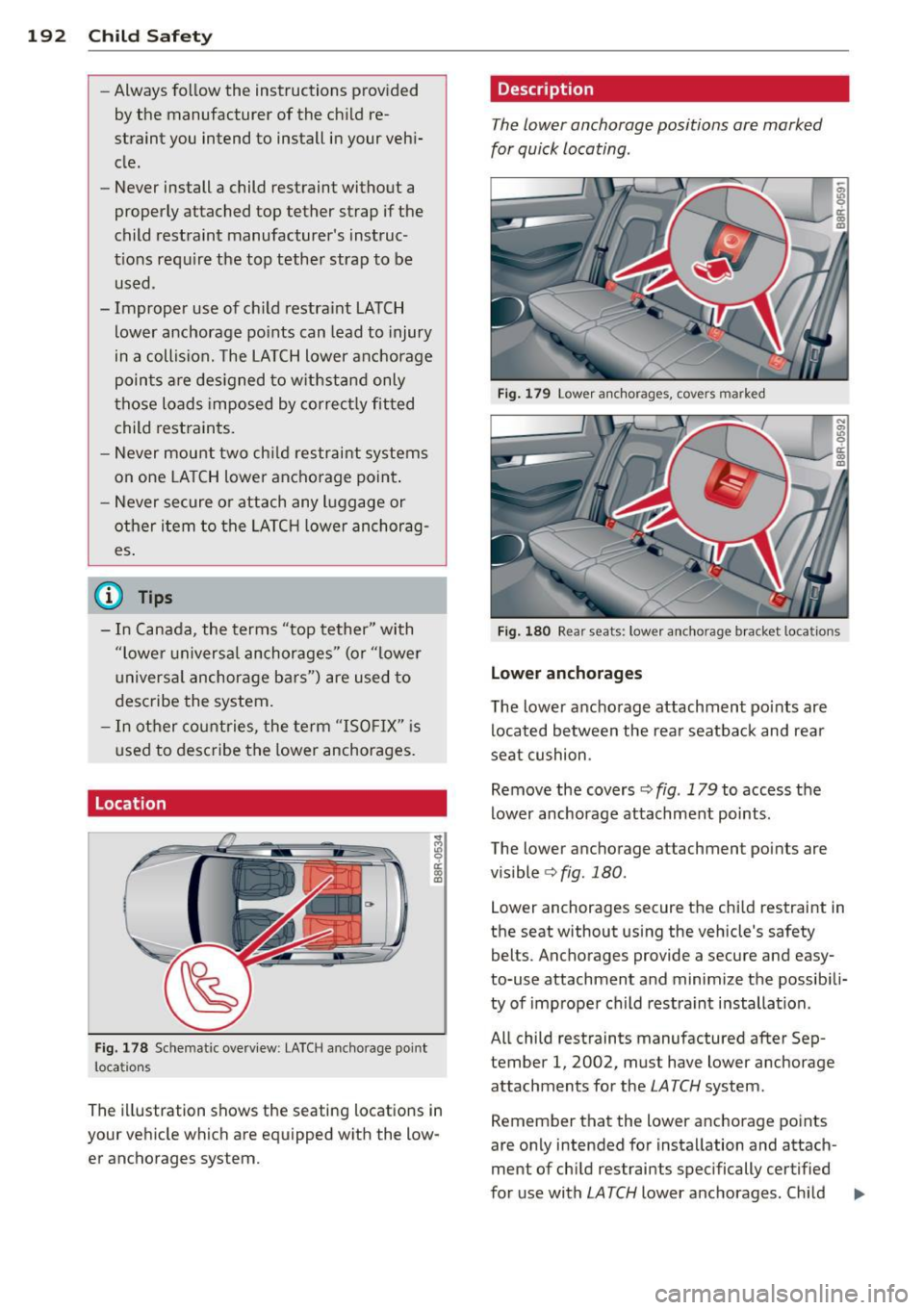
The illustration shows the seating locations in
your vehicle which are equipped with the low
er anchorages system.
Description
The lower anchorage positions are marked
for quick locating.
Fig. 179 Lower anchorages, covers marked
Fig. 180 Rear seats: lower anc horage bracket locations
Lower anchorages
The lower anchorage attachment points are
located between the rear seatback and rear
seat cushion.
Remove the covers ¢
fig. 179 to access the
lower anchorage attachment points.
The lower anchorage attachment points are
visible <=>
fig. 180 .
Lower anchorages secure the chi ld restraint in
the seat without using the vehicle's safety
belts. Anchorages provide a secure and easy
to-use attachment and minimize the possibili
ty of improper child restraint installation .
All child restraints manufactured after Sep
tember 1, 2002, must have lower anchorage
attachments for the
LATCH system.
Remember that the lower anchorage points
are only intended for installation and attach
ment of child restraints specifically certified
for use with
LATCH lower anchorages. Child ..,_
Page 195 of 316
restraints that are not equipped with the low
er anchorage attachments can still be instal
led in compliance with the ch ild restra int
manufacturer's instructions on using vehicle
safety belts.
A WARNING
Improper use of LATCH lower anchorages
can cause serious personal injury in an ac
cident.
-Always carefully follow the ch ild re
straints manufacturer's inst ruct ions for
proper installation of the child restra int
and proper use of the lowe r anchorages
or safe ty belts in your vehicle.
- Never secure o r attach any luggage or
other items to the
LATCH lower ancho
rages.
- Always read and heed the important in
formation about ch ild restra ints in this
chapter and WARNINGS
~ page 178,
Child Safety.
Installing a child restraint with LATCH
lower anchorages
Whenever you install a child restraint always
follow the child restraint manufacturer's in
structions.
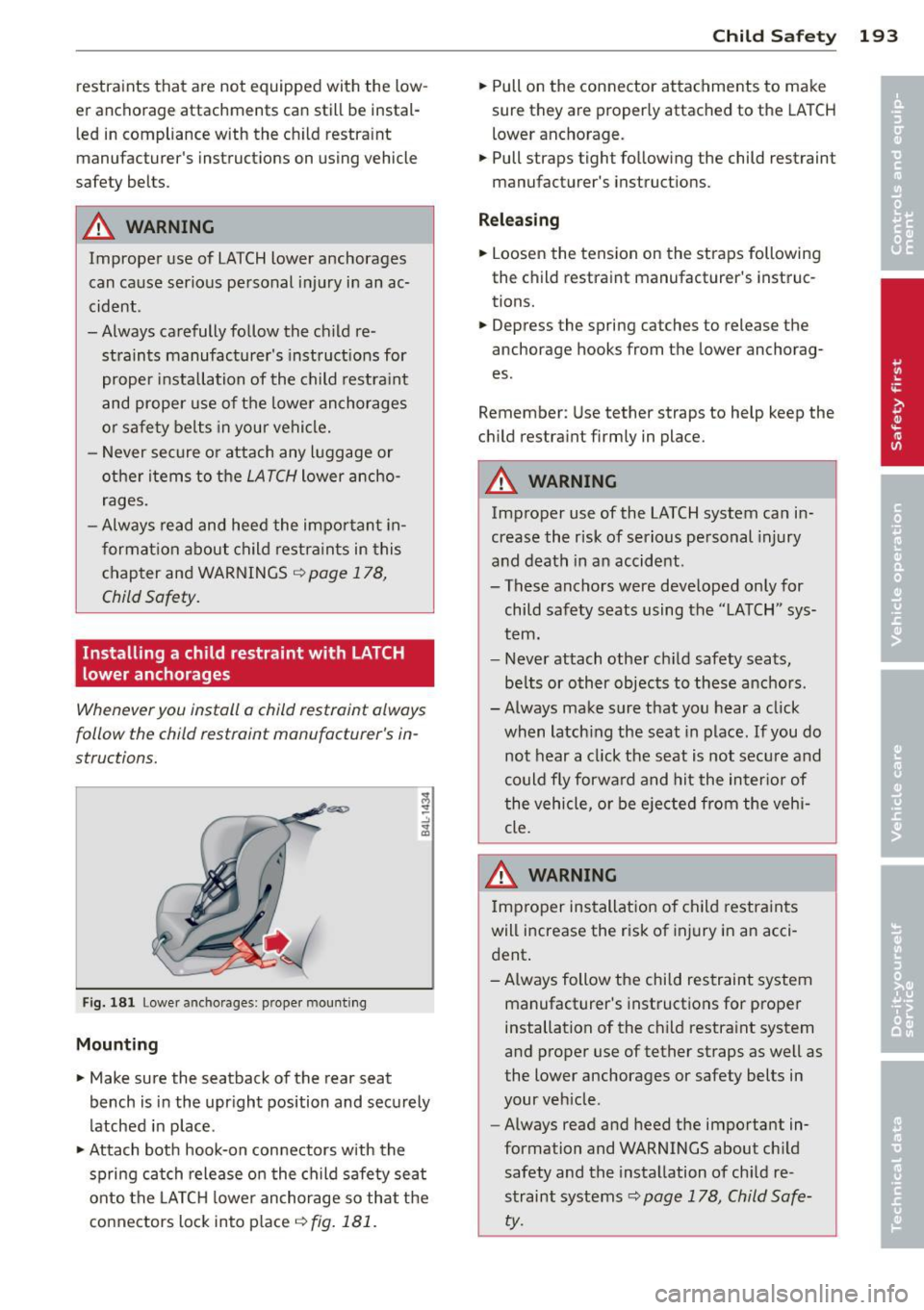
F ig. 181 Lower ancho rages: proper mount ing
Mounting
~ Make sure the seatback of the rear seat
bench is in the upr ight position and securely
latched in place.
~ Attach bot h hook-on connectors with the
spring catch release o n the child safety seat
onto the LATC H lower anchorage so that the
connectors lock into place~
fig. 181.
Child S afety 193
~Pullon the connector attachments to make
sure they are properly attached to the LATCH
lower anchorage.
~ Pull straps tight follow ing the child restraint
manufacturer's instructions.
R ele a sing
~ Loosen the tension on the straps following
the child restraint manufacturer's instruc
tions.
~ Depress the spring catches to release the
anchorage hooks from the lower anchorag
es .
Remember: Use tether straps to help keep the
ch ild restraint firmly in place.
A WARNING
Improper use of the LATCH system ca n in
crease the r isk of serious personal injury
and death in an accident.
- These anchors were developed only for
child safety seats using the "LATCH" sys
tem.
- Never attach other ch ild safety seats,
be lts or other objects to these anchors.
- Always make sure that you hear a click when latch ing the seat in place. If you do
not hear a click the seat is not secu re and
could fly forwa rd and hit the inter ior of
the vehicle, or be e jected from the vehi
cle.
A WARNING
Improper installat ion of child restraints
will i ncrease the risk of injury in an acci
dent .
- A lways follow the child restraint system
manufacturer's instructions for proper
installation of the ch ild restra int system
and proper use of tether straps as well as
the lower anchorages or safety belts in
your veh icle.
-Always read and heed the important in
formation and WARNINGS about child
safety and the instal lation of ch ild re
straint systems~
page 178, Child Safe
ty.
-
Page 196 of 316
194 Child Safe ty
Tether anchors and tether straps
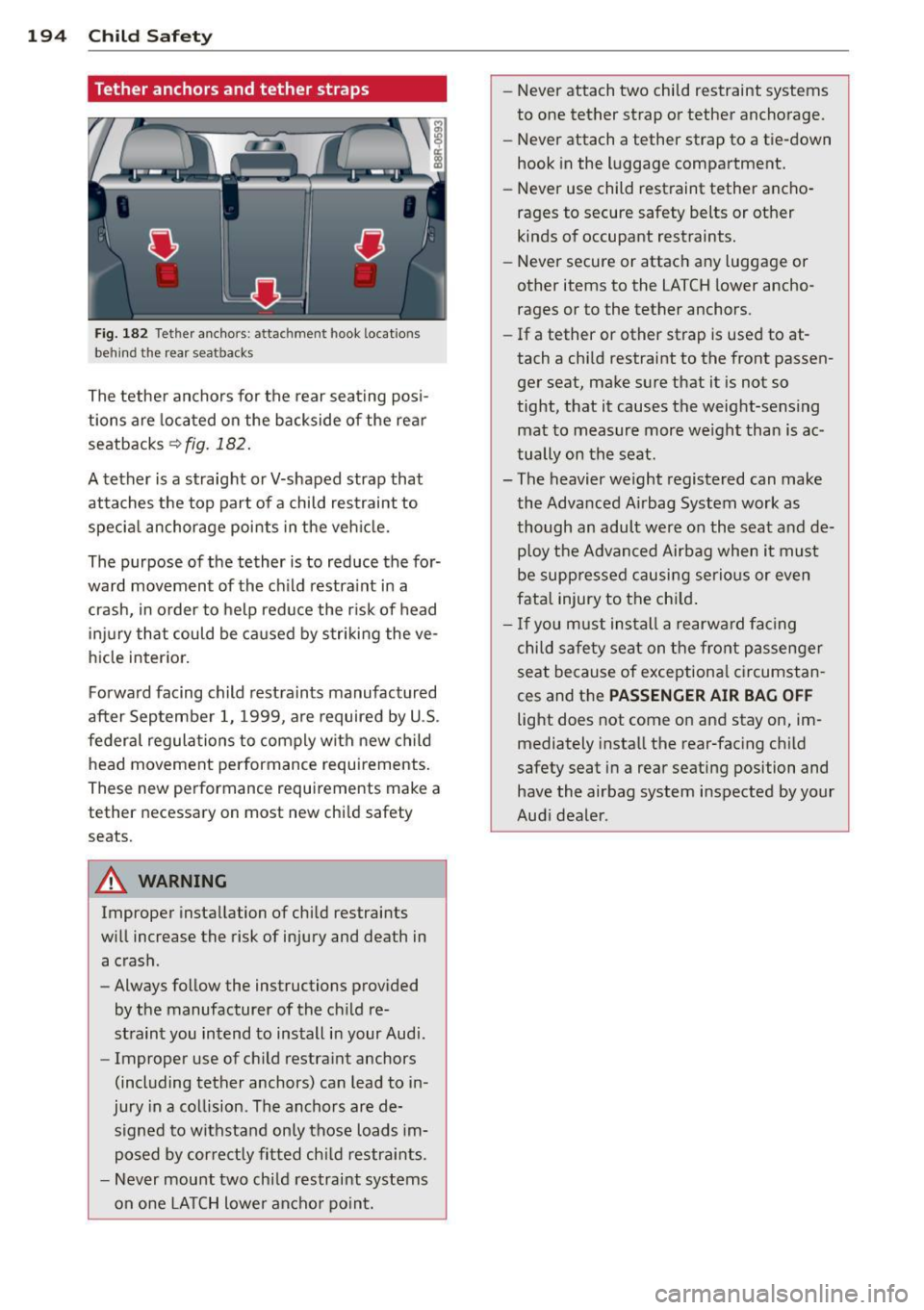
Fig. 182 Tethe r ancho rs: attachment hook locatio ns
behind the rea r sea tbacks
The tether anchors for the rear seating posi
tions are located on the backside of the rea r
seatbacks
~ fig. 182.
A tether is a straight or V-shaped strap that
attaches the top part of a child restraint to
specia l anchorage points in the veh icle.
The purpose of the tether is to reduce the for·
ward movement of the ch ild restra int in a
crash, in order to help reduce the r isk of head
in ju ry that could be ca used by striking the ve
hicle interior.
Forward facing child restra ints manufactured
after September 1, 1999, are required by U .S .
federal regulations to comply with new child
head movement performance requirements.
These new performance requ irements make a
tether necessary on most new chi ld safety
seats.
A WARNING
Improper insta llation of chi ld restraints
w ill increase the risk of injury and death in
a crash.
- Always follow the instructions prov ided
by the manufacturer of the ch ild re
stra int you intend to install in your Audi.
- Improper use of c hild restra int anchors
(including tether anchors) can lead to in ·
jury in a co llision. Th e anchors are de·
sign ed to withstand only those loads im
posed by cor rect ly fi tted ch ild restraints.
- Never mou nt two chi ld restraint systems
on one LA TCH lower anchor po int. -
Never attach two child restraint systems
to one tether strap or tether anchorage .
- Never attach a tether strap to a tie-down
hook in the luggage compartment.
- Never use child restraint tether ancho
rages to secure safety belts or other
kinds of occupant restraints.
- Never secure or attac h any luggage or
other items to the LATCH lower ancho
rages or to the tether anchors.
- If a tether or other strap is used to at
tach a chi ld restraint to the front passen
ger seat, make sure that it is not so
tight, that it causes the weight-sensing mat to measure more we ight than is ac
tually on the seat.
- The heavier weight registered can make the Advanced Airbag System work as
though an adult were o n the seat and de·
p loy the Advanced Airbag when it mus t
be supp ressed causi ng serio us or even
fatal injury to the ch ild .
- If you must ins tall a rearw ard fa cing
c h ild safe ty seat on the fro nt passenger
seat because of exceptiona l circumstan
ces and the
PASSENGER AIR BAG OFF
light does not come on and stay on , im
mediately insta ll the rear-fac ing child
safety seat in a rear seating position and have the airbag system inspected by your
Aud i deale r.
Page 212 of 316
210 Driving o ff road
Driving off road
Driving in difficult road
conditions and offroad
General information
The operation of the E lectronic Stabilization
Control (ESC) is expanded for operation away
from paved roads. In situations where slip or a
d ifferential locking function is required, the
offroad mode can be activated
c::;, page 197.
Your Audi also has permanent all -wheel drive
in addit ion.
However, your Aud i is not a pure offroad vehi
cle . It was not built for driving under extreme
conditions , e.g . for trips that are in the nature
of an expedition .
D riv e only on roads and off road sections
which match the design of your vehicle and
your abil ities a s a driver . Never take ri sks!
Before driving offro ad
- Check the engine oi l level, tire press ure,
coolant leve l, and the fluid level in the w ind
shield washer reservo ir.
- Stow luggage items and other objects in the
l uggage compartment, and secure them
against slid ing around .
After driving offroad
- After trips offroad, remove any twigs and other foreign objects from the grill, the un
derbody and the wheels. Pay specia l atten
t ion to fore ign ob jects (stones) which have
become lodged in the tire tread.
- Clean the body and the vehicle unders ide,
and inspect the veh icle for possible damage.
- Clean dirty w indows, headlamp lenses, rear
li ghts, and license plates .
- Perform a brake check (part icu larly after
trave lling through water) .
A WARNING
- Drive especially attentively and plan
ahead in difficult road conditions and
w hen offroad . Excess ive speed or incor-
-
rect mane uvers can cause injuries and
damage to the vehicle.
- Always adapt your speed and driving
style to road, offroad, traff ic, and weath
er cond itions. Drive especially slowly off
road when your v iew is restricted.
- Please be aware that in offroad mode,
particularly on a smooth and slippery
road , the whee ls may have an increased
tendency to sp in and the vehicle may
b reak away- dange r of skiddi ng!
- Stability is limited in the offroad mode .
® For the sake of the environment
Avoid damage to the environment and re
spect nature.
(D Tips
Only drive w here it is permitte d and stay
on marked roads and paths.
Explanation of some technical terms
The following data refer to ideal cond it ions .
Depend ing on veh icle load and ground condi
t ions and the environment, the numbers may
vary. It is the d river 's responsib ility to d ecide
whethe r a ve hicl e can overcome a spe cific s it
u ati on
c::;, ,&. .
Gradient angle
The number of meters in alt itude ga ined over
a di sta nce of 109 .4 yards or 100 mete rs
(grade) a re given as a pe rcentage o r degrees .
Info rmation abou t the gra dien t the veh icle
c an climb under i ts own power (depends in
part on t he road surfa ce and engine power).
Maximum pe rm itted gra de : 3 1
°
Lateral angle (slope of vehicle)
Ind icates the angle up to which the vehicle
can be d riven diagona lly or a cross the fall line
o n a s lope wi tho ut the vehicle tip ping over
s ideways (depends on center of gravity) . Maxi -
mum pe rmitted lateral angle: 25°
Ill-
Page 215 of 316
Trailer towing Driving with a trailer
General information
Your Audi was designed primarily for passen
ger transportation .
If you plan to tow a trailer, please remember
that the additional load will affect durability,
economy and performance .
T railer towing not only places more stress on
the vehicle, it also calls for more concentra
tion from the driver.
For this reason, always follow the operating
and driving instructions provided and use
common sense.
Technical requirements
Trailer hitch
Use a weight-carrying hitch conforming to the
gross trailer weight. The hitch must be suita
ble for your vehicle and trailer and must be
mounted securely on the vehicle's chassis at a
technically sound location. Use only a trailer
hitch with a removable ball mount. Always
check with the trailer hitch manufacturer to
make sure that you are using the correct
hitch.
Do not use a bumper hitch.
T he hitch must be installed in such a way that
it does not interfere with the impact-absorb
ing bumper system. No modifications should
be made to the vehicle exhaust and brake sys
tems . From time to time, check that all hitch
mounting bolts remain securely fastened.
When you are not towing a trailer, remove the
trailer hitch ball mount. This prevents the
hitch from causing damage should your vehi
cle be struck from behind
¢ &. .
Trailer brakes
If your trailer is equipped with a braking sys
tem, check to be sure that it conforms to all
regulations .
Trailer towing 213
The trailer hydraulic brake system must not be
directly connected to the vehicle's hydraulic
brake system
¢ &. .
Safety chains
Always use safety chains between your vehicle
and the trailer.
Trailer lights
Trailer lights must meet all regulations . Be
sure to check with your authorized Audi dealer
for correct wiring, switches, and relays.
Mirrors
If you are unable to see the traffic behind you
using the regular outside mirrors, then you
must install extended mirrors.
It is important
that you always have clear vision to the rear .
.8, WARNING
- If a trailer has electrical brakes please
note that these brakes are not activated
by the factory-fitted control unit -risk of
accident!
- After removing the trailer hitch, do not
store it in your vehicle. In case of sudden
braking, the hitch could fly forward and
injure you or your passengers.
- Never install a "weight distributing" or
"load equalizing" trailer hitch on your ve
hicle. The vehicle was not designed for
these kinds of trailer hitches . The hitch
attachment can fail, causing the trailer
to tear loose from the vehicle .
- The Gross Vehicle Weight Rating for your
vehicle, found on the safety compliance
label on the driver's side B-pillar, must
never be exceeded under any circumstan
ces. Exceeding the Gross Vehicle Weight
Rating of your vehicle is likely to damage
your vehicle, and such damage will not
be covered by your Limited New Vehicle
Warranty. Exceeding the Gross Vehicle
Weight Rating will also change the per
formance and handling characteristics of
your vehicle, which could cause a crash resulting in serious injury or death.
-
•
•
Page 216 of 316
214 Trailer towing
Operating instructions
6"
i ~
I 1,2 ..
{ ~
~
,,
-
2
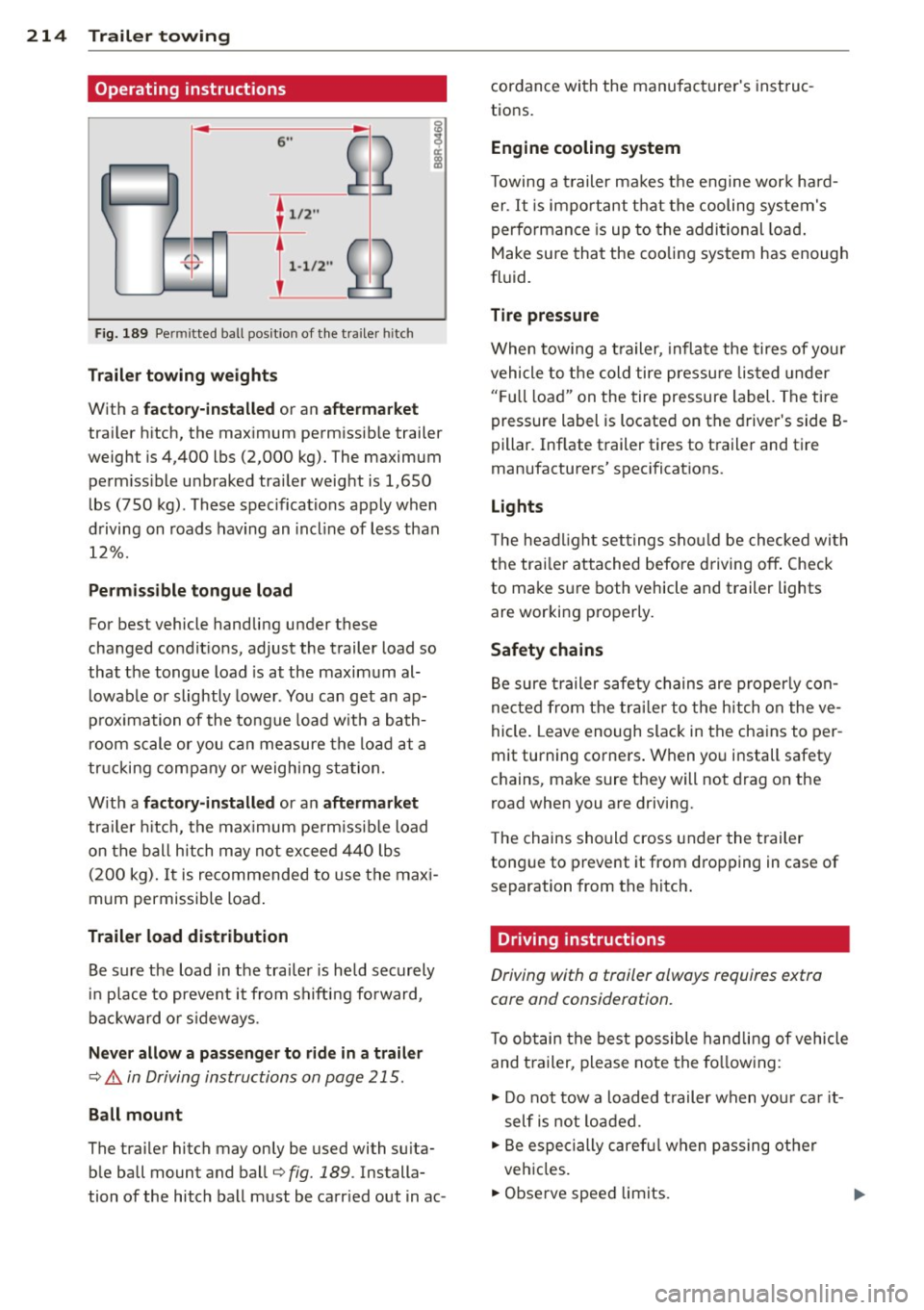
Fig. 189 Pe rmi tted ball posit ion of the tra iler h itch
T ra ile r tow ing weight s
With a factor y-insta lled or an afte rm arket
trailer h itch, the max imum permissib le trailer
weight is 4,400 lbs (2,000 kg). The maximum perm iss ible unbraked trailer weight is 1,650
lbs (750 kg). These spec ifications apply when
driving on roads hav ing an incl ine of less than
12%.
P erm is s ible tongue load
For best vehicle handling under these
changed condit ions, adjust the trailer load so
that the tongue load is at the maximum al
l owable or slightly lower . You can get an ap
p rox imation of the tongue load w ith a bath
room scale or you can measure the load at a
tr ucking company or weighing sta tion.
W ith a
fact ory -in stall ed or an aftermarket
trailer h itch, the max imum pe rm issible load
on the ball hitch may not exceed 440 lbs (200 kg).
It is recommended to use the maxi
mum permissible load .
Trailer lo ad distribut ion
Be sure the load in the trai ler is held securely
in place to prevent it from shifting fo rward,
backward or s ideways.
N eve r allow a p assenger to rid e in a trail er
¢ .&. in Driving instructions on page 215.
Ball mount
The trailer hitch may only be used with su ita
ble ball mount and ball¢
fig. 189. Installa
tion of the hitch ball must be carr ied out in ac- cordance with the manufacturer's instruc
tions.
Eng ine cooling system
T owing a t railer makes the engine work hard
er . It is important that the cooling system's
performance is up to the additional load .
Make sure that the cooling system has enough
fluid.
Tire pressur e
When towing a trailer, inflate the tires of your
vehicle to the cold tire pressu re listed under
" F u ll load" on the tire pressure label. The tire
pressure label is located on the driver's side B·
pillar. Inflate trailer tires to trailer and tire
manufacturers' spec ificat ions.
Lights
T he headlight settings shou ld be checked wi th
the trai ler attached before driving off . Check
to make sure both vehicle and trailer lights
are working properly.
Safety chains
Be sure trailer safety chains are properly con
nected from the tra iler to the hitch on the ve
hicle . Leave enough slack in the chains to per
mit turning corners . When you install safety
chains, make sure they will not drag on the
road when you are driving.
T he chains should cross under the trailer
tongue to prevent it from dropping in case of separation from the hitch .
Driving instructions
Driving with a trailer always requires extra
core and consideration.
T o obtain the best possible handling of vehicle
and t railer, please note the fo llowing :
.,. Do not tow a loaded t railer when you r ca r it
self is not loaded .
.. Be especially caref ul when passing ot her
vehicles.
.. Observe speed limits.
Page 233 of 316
Checking and filling Engine hood
Releasing the engine hood
The engine hood is released from inside the
vehicle .
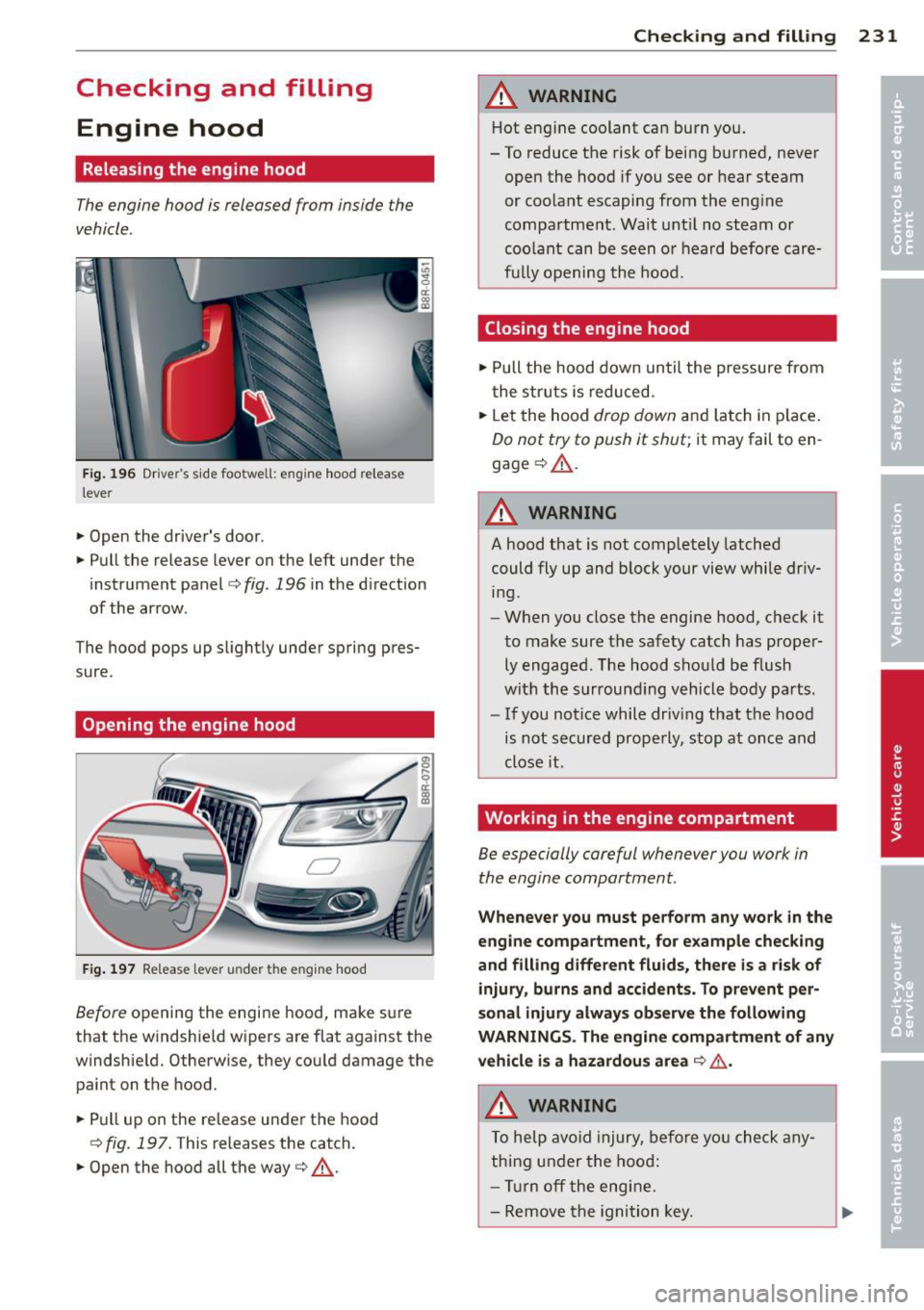
Fig. 196 Dr iver's side footwell: engin e hood release
lever
"' Open the driver's door .
"' Pull the release lever on the left under the
instrument panel
i=> fig. 196 in the d irection
of the arrow .
The hood pops up slightly under spring pres
sure.
Opening the engine hood
F ig . 197 Release lever under the engine hood
Before opening the engine hood, make sure
that the windshield wipers are flat against the
windshie ld. Otherwise, they could damage the
paint on the hood.
"' Pull up on the release under the hood
r::!> fig . 197 . This releases the catch.
"' Open the hood all the way
i=> .&,.
Checkin g and fillin g 231
A WARNING
Hot engine coolant can burn you.
- To reduce the risk of being burned, never
open the hood if you see or hear steam
or coolant escaping from the eng ine
compartment . Wait unt il no steam or
coolant can be seen or heard before care
fu lly opening the hood.
Closing the engine hood
"' Pull the hood down until the pressure from
the struts is reduced.
"' Let the hood
drop down and latch in p lace.
Do not try to push it shut; it may fail to en
gage
c;, .&, .
A WARNING
--
A hood that is not completely latched
could fly up and block your view while dr iv
ing.
- When you close the engine hood, check it
to make sure the safety catch has proper
ly engaged. The hood should be flush
with the surround ing vehicle body parts.
- If you notice while driv ing that the hood
is not secured properly, stop at once and
close it .
Working in the engine compartment
Be especially careful whenever you work in
the engine compartment.
Whenever yo u must pe rform any w ork in the
e n g ine com pa rt ment, for e xample ch ecki ng
and filling different fluids, th ere is a risk of
injury , burn s and accid ent s. T o pr eve nt per
so nal injury alwa ys obs erve the foll owing
WARNINGS . The en gine c ompa rtment of an y
vehicl e is a hazardou s are a
c;, Lh,.
A WARNING ~
To help avoid injury, be fo re you check any
thing under the hood:
- Turn off the engine.
- Remove the ignition key.