flat tire AUDI Q5 2014 Owner's Manual
[x] Cancel search | Manufacturer: AUDI, Model Year: 2014, Model line: Q5, Model: AUDI Q5 2014Pages: 316, PDF Size: 78.41 MB
Page 266 of 316
264 Tire s and wheel s
driving a few yards and correct if neces
sary. Follow the instructions from the
snow cha in manufacturer when doing so.
(D Tips
Where snow chains are mandatory oncer
tain roads, this normally also applies to
veh icles with all-wheel dr ive .
Wheel bolts
Wheel bolts must always be tightened to the
correct torque.
The design of whee l bolts is matched to the
factory insta lled rims . If different rims are fit
ted, the correct wheel bolts with the right l ength and correctly shaped bolt heads must
be used. This ensures that wheels are f itted
securely and that the brake system functions
correctly .
In certain circumstances, you may not use
wheel bolts from a different vehicle -even if it
is the same model
¢ page 295.
.&_ WARNING
Improperly tig htened or maintained wheel
bolts can become loose ca using loss of
cont ro l, a co llision and serious p ersona l in
Jury.
- Always keep the wheel bolts and the
threads in t he wheel hubs clea n so the
wheel bolts can tu rn easily and be prop
erly tigh tened.
- N ever grease or oil the wheel bo lts and
the threads in the wheel h ubs. They can
become loose w hile d riving if greased or
oiled, even if tightened to the specified
torq ue.
- Only use wheel bolts that be long to the
rim being installed.
- N ever use different whee ls bolts on your
vehicle.
- Always mai nta in the co rrec t tighte ning
tor que fo r the wheel bo lts to reduce the
risk of a wheel loss . If the tightening tor
que of the wheel bo lts is too low, they
can loosen and come out when the veh i- cle is moving.
If the tightening torque is
too high, the wheel bolts and threads
can be damaged and the wheel can be
come loose.
(D Note
The specified torque for the whee l bolts is
105 ft lb (140 Nm) with a to lerance of
± 7,4 ft lb(± 10 Nm). Torque wheel bolts
diagonally . After changing a wheel, the
torque must be checked as soon as poss i
ble with a to rque wrench -preferab ly by an
a uthorized Aud i dea le r or qualified wor k
shop.
Low aspect ratio tires
Your A udi is factory -eq uipped w it h low aspect
ratio tires. These tires have been thoroughly
tested and been se lected specifically for your
model for their superb performance, road fee l
and handling under a variety of driving condi
t ions . Ask your authorized Audi dealer for
more details .
The low aspect ratio of these tires is ind icated
by a numeral of
55 or less in the tire's s ize
designation . The numeral represents the ratio
of the tire's sidewall height in relation to its
t read width exp ressed in percentage. Conven
tiona l tires have a he ight/w idth rat io of 60 or
more.
Th e performanc e of low-a spect-ratio tire s is
pa rticularly sensi tive to improp er inflation
pre ssure. It i s ther efor e important that low
a spe ct ratio tir es are inflated to the spe cified
pre ssure and that the inflation pre ssure i s
regula rly checked and mainta ined. Tire pre s
sure s should be checked at lea st once a
month and al way s befo re a long trip
¢ page 2 53, Checking tire pressure.
What you can do to a void tire and rim
damage
Low aspect ratio tires can be damaged more
easily by impact w ith potholes, curbs, gul lies
or ridges on the road, particularly if the tire is
underinflated . ..,.
Page 267 of 316
In o rder to minimize the occurrence o f impact
damage to the tires of your vehicle, we recom mend that you observe the following precau
tions :
- Always maintain recommended inflation
pressures. Check your tire pressure every
2,000 miles (3,000 km) and add a ir if neces
sary.
- Drive carefu lly on roads with potholes, deep
gullies or ridges. The impact from driving
through or over such obstacles can damage
your tires. Impact with a curb may also cause damage to your tires .
- After any impact, immediately inspect your
tires or have them inspected by the nearest
authorized Aud i dealer . Replace a damaged
t ire as soon as poss ible .
- In spect your t ires every 2,000 miles (3,000
km) for damage and wear . Damage is not al
ways easy to see. Damage can lead to loss of
air and unde rinflation, wh ic h could eventu
ally cause ti re fail ure.
If yo u be lieve that a
ti re may have been damaged , replace the
tire as soon as possible.
- These tires may wear more quick ly than oth
ers.
- Please a lso remembe r that, whi le these t ires
deliver respons ive handling, they may ride
less comfortably and make more noise than
other c hoices.
Reduced p erformance in winter /cold
s ea son condit ion s
All ti res are designed for certain purposes .
The low aspect ratio, ultra hig h performance
tires originally installed on your veh icle are in
tended for max imum dry and wet road per
formance and handling . They are not suitable
for cold, snowy or icy weather cond it ions . If
you dr ive under those circumstances, you
should equip your vehicle with all-season or
winter tires, whi ch offe r better traction under
those cond it ions . We suggest you use the rec
ommended snow or all -season tires specified
for your ve hicle, or their equiva lent .
Refe r to ~
page 262 for mo re deta iled info r
mat io n regarding w in ter t ires.
Tire s an d wheel s 265
Tire pressure
monitoring system
ill General notes
App lies to vehicles : wi th tire p ress ure mo nito rin g system
Each tire, incl uding the spare (if provided),
shou ld be checked monthly when co ld and in
flated to the inflation pressure recommended
by the veh icle manufacturer on the veh icle
placard or tire inflation pressure label. (If your
vehicle has tires of a d ifferent size than the
s iz e indicated on the vehicle placard or tire in
flat io n pressu re labe l, you shou ld dete rmine
the p roper t ire inflation p ress ure fo r those
t i r es).
As an added safety feature, your veh icle has
been equipped with a tire pressure monitoring
system ( TPMS) that illum inates a low ti re
pressure te lltale whe n one or more o f your
ti res is significant ly under -inflated . According
ly, when the low tire pressure te lltale i llumi
nates, you shou ld stop and check your tires as
soon as possib le, and inflate them to the
proper pressure. Driving on a sign ificantly un
der- inflated t ire causes the tire to overheat
and can lead to tire fa ilure . Under-inflation al
so reduces fuel effic iency and tire tread life,
and may affect the vehicle 's hand ling and
stopp ing abil ity.
Please note that the TPMS is not a subst itute
fo r proper tire ma intenanc e, and it is the d riv
er's respo nsibility to maintain co rrect tire
pressure, even if under-inflation has not
reached the leve l to tr igger illum inat ion of the
T PMS low ti re p ressu re tellta le .
You r vehicle has also been equipped with a
T PMS ma lf u nction indicator to ind icate w hen
the sys tem is not operating prope rly . T he
T PMS ma lfunction indicator is combined w ith
the low tire pressure te lltale. When the sys
tem detects a malfunction, the telltale wi ll
flash for approximate ly one min ute and then
rema in con tinuously i llum inated . T hi s se
quence will continue upon subsequent vehicle
start-ups as long as the malfunct ion exists . ..,.
•
•
Page 268 of 316
266 Tire s and wheels
When the malfunction indicator is illuminat
ed, the system may not be able to detect or
signal low t ire pressure as intended. TPMS
malfunctions may occur for a variety of rea
sons, including the installation of replace
ment or alternate tires or wheels on the vehi
cle that prevent the TPMS from funct ioning
properly . Always check the TPMS malfunct ion
tellta le after replacing one or more t ires or
wheels on your veh icle to ensure that the re
p lacement or a lternate tires and wheels allow
the TPMS to continue to function properly.
Tire pressure indicator appears
Applies to vehicles: with tire pressure monitoring system
The tire pressure indicator in the instrument
cluster informs you if the tire pressure is too
low or if there is a system malfunction.
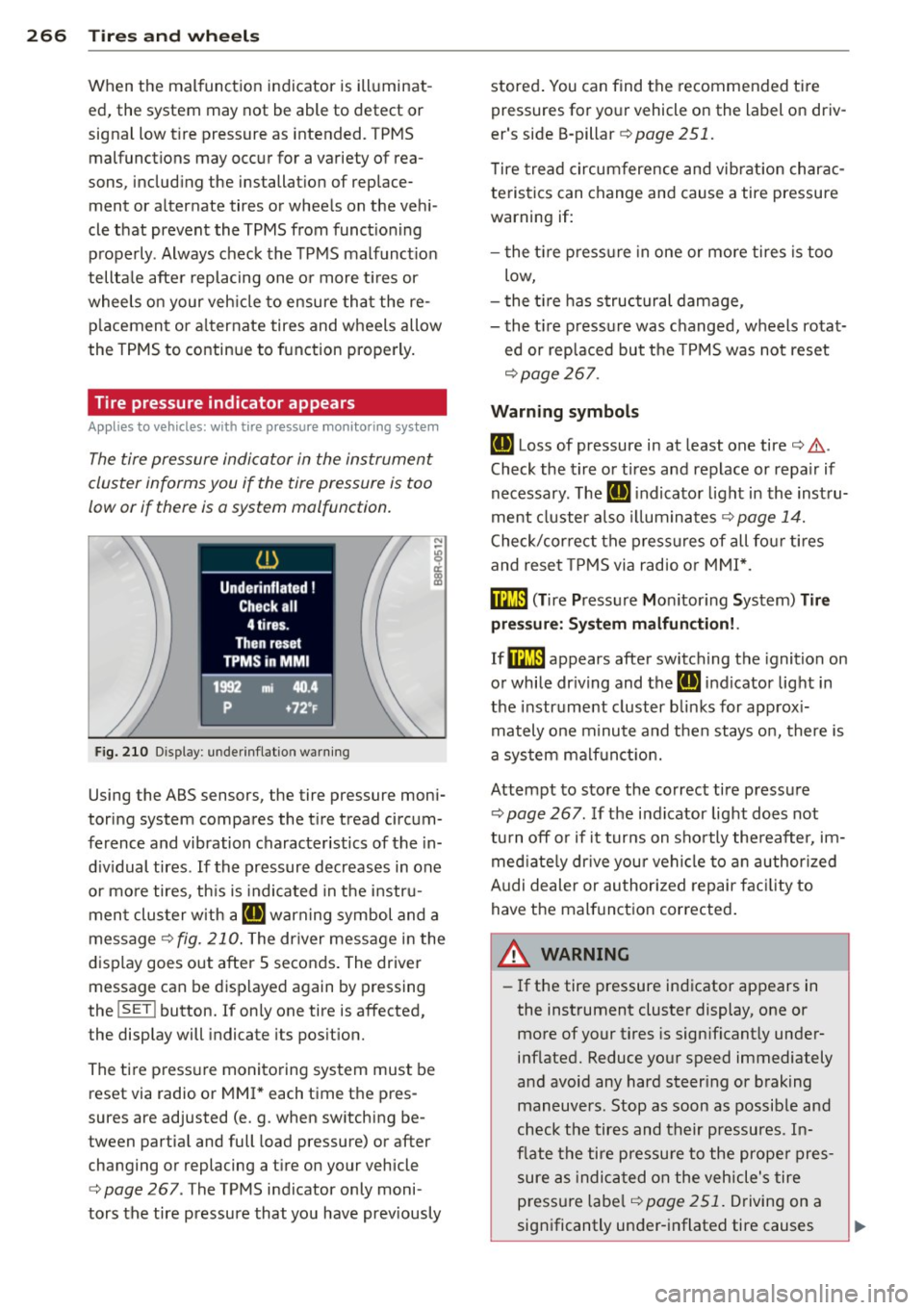
N
I
Fig. 210 Display: underinflation warning
Using the ABS sensors, the tire pressure moni
toring system compares the tire tread circum
ference and vibration characteristics of the in
dividual tires. If the pressure decreases in one
or more tires, th is is indicated in the instru
ment cluster w ith a
IE warning symbol and a
message
¢fig . 210. The dr iver message in the
display goes out after 5 seconds. The driver
message can be displayed again by pressing
the
! SET ! button. If on ly one tire is affected,
the display will indicate its position.
The tire pressure monitoring system must be
reset via radio or MMI * each time the pres
sures are adjusted (e. g . when switching be
tween partia l and full load pressure) or after
changing or replacing a tire on your vehicle
¢
page 267. The TPMS indicator only moni
tors the tire pressure that you have prev iously stored
. You can find the recommended tire
pressures for your vehicle on the label on driv
er's side B-pillar ¢
page 251.
Tire tread circumference and vibration charac
teristics can change and cause a tire pressure
warning if:
- the tir e pressure in one or more tires is too
low,
- the tir e has structural damage,
- the tir e pressure was changed, wheels rotat-
ed or replaced but the TPMS was not reset
¢page 267.
Warning symbols
IE Loss of pressure in at least one tire¢ .&..
Check the tire or tires and replace or repa ir if
necessary. The
IE indicato r light in the inst ru
ment cluster als o illuminates
¢ page 14.
Check/correct the pressures of all four tires
and reset TPMS via radio or MMI*.
ffim (T ire Pressure Mon itor ing System) Tire
pressure: System malfunction!.
If@m appears after switching the ignition on
or while dr iving and the
IE indicator light in
the instrume nt cluster blink s for app rox i
mately one minute and then stays on, there is
a system malfunction.
Attempt to store the correct tire pressure
¢
page 267 . If the indicator light does not
tu rn
off or if it turns on shortly thereafter, im
mediately drive you r vehicle to an authorized
A udi dealer or authorized repair facility to
have the malfunction corrected.
A WARNING
=
- If the tire pressure indicator appears in
the instrument cluster display, one or
more of your tires is sign ificant ly under
inflated. Reduce your speed immediately
and avoid any hard steer ing or braking
maneuvers. Stop as soon as possible and
check the tires and their pressures. In
flate the tire pressure to the proper pres
sure as ind icated on the vehicle's tire
p ressu re lab el¢
page 251. Driving on a
significantly under-inflated tire causes
Page 269 of 316
the tire to overheat and can lead to tire
failure. Under-inflation also is likely to
impair the vehicle's handling and stop
ping ability .
- The driver is responsible for maintaining
the correct tire pressures. You must
check the tire pressures regularly.
- Under certain conditions (such as a spor
ty driving style, winter conditions or un paved roads), the pressure monitor indi
cator may be delayed.
-Ask your authorized Audi dealer if run flat tires may be used on your vehicle .
Your vehicle registration becomes invalid if you use these tires when not permit
ted. Damage to your vehicle or accidents
could also result.
@ Tips
- The tire pressure monitoring system
stops working when there is an ESC/ABS
malfunction.
- Using snow chains may result in a system
malfunction.
- The tire pressure monitoring system on
your Audi was developed using tires with the "AO" or "RO" identification on the
tire sidewall¢
page 258. We recom
mend using these tires.
Reset tire pressure monitoring system
Applies to vehicles: with tire pressure monitoring system
If the tire pressure is adjusted, wheels are ro
tated or changed, the TPMS must be reset via
radio or MMI* .
.,. Before resetting the TPMS, the current pres
sures of all four tires must correspond to
the specified values. Adjust the tire pressure and reset the pressure in the tire pressure
monitoring system according to the load
you are carrying
¢ page 251 .
.. Turn on the ignition .
.,. Select :
I CARI function button > Tire pressure
monitoring
> Store now . Or
.,. Select: I CARI function button > Car systems*
control button > Servicing & checks > Tire
pressure monitoring
> Store tire pressures.
Tires and wheels 267
(D Tips
Do not store the tire pressure if there are
snow chains on the tire.
•
•
Page 270 of 316
268 What do I do now?
What do I do now?
Jack, tools and
inflatable spare tire
Onboard tool kit and vehicle jack
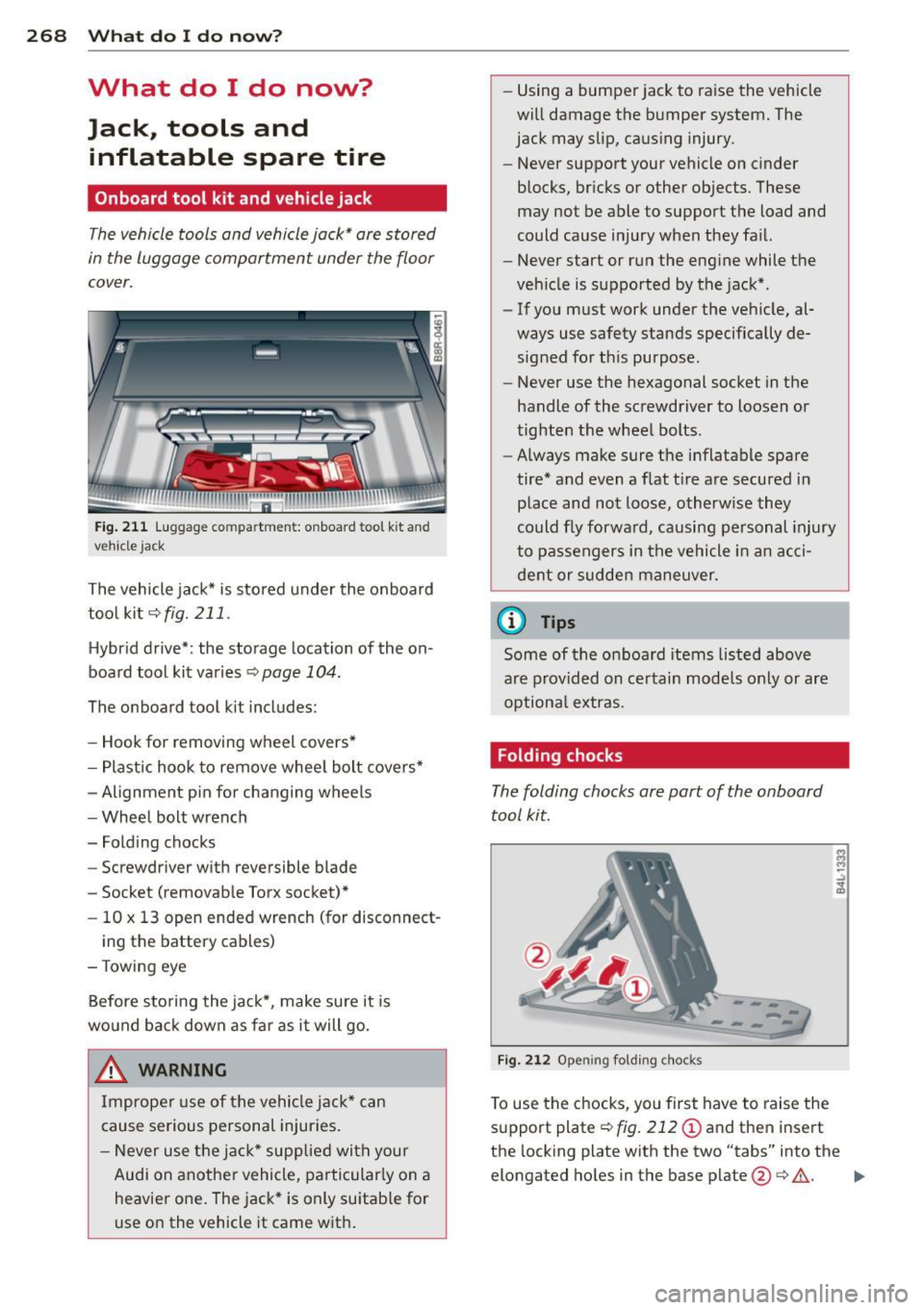
The vehicle tools and vehicle jack* are stored
in the luggage compartment under the floor
cover.
Fig . 211 Luggage compartment: on board tool kit and
vehicle jack
The vehicle jack* is stored under the on board
tool kit¢
fig. 211.
Hybrid drive*: the storage location of the on
board tool kit varies
¢ page 104.
The onboard tool kit includes:
- Hook for removing wheel covers*
- Plastic hook to remove whee l bolt covers*
- Alignment p in for changing wheels
- Wheel bolt wrench
- Folding chocks
- Screwdriver with reversible blade
- Socket (removable Torx socket)*
- 10 x 13 open ended wrench (for disconnect-
ing the battery cables)
-Towing eye
Before storing the jack*, make sure it is
wound back down as far as it will go.
& WARNING
Improper use of the vehicle jack* can
cause serious personal injuries.
- Never use the jack* supplied with your
Audi on another vehicle, particularly on a
heavier one . The jack* is only suitab le for
use on the vehicle it came with . -
Using a bumper jack to raise the vehicle
will damage the bumper system. The
jack may slip, causing injury.
- Never support your vehicle on cinder
blocks, bricks or other objects. These
may not be able to support the load and
could cause injury when they fa il.
- Never start or run the engine while the
veh icle is supported by the jack*.
- If you must work under the vehicle, al
ways use safety stands specifically de
signed for this purpose.
- Never use the hexagonal socket in the
handle of the screwdriver to loosen or
tighten the wheel bolts.
- Always make sure the inflatable spare
tire* and even a flat t ire are secured in
place and not loose, otherw ise they
could fly forward, causing personal injury
to passengers in the vehicle in an acci
dent or sudden maneuver.
@ Tips
Some of the on board items listed above
are provided on certain models only or are
optiona l extras.
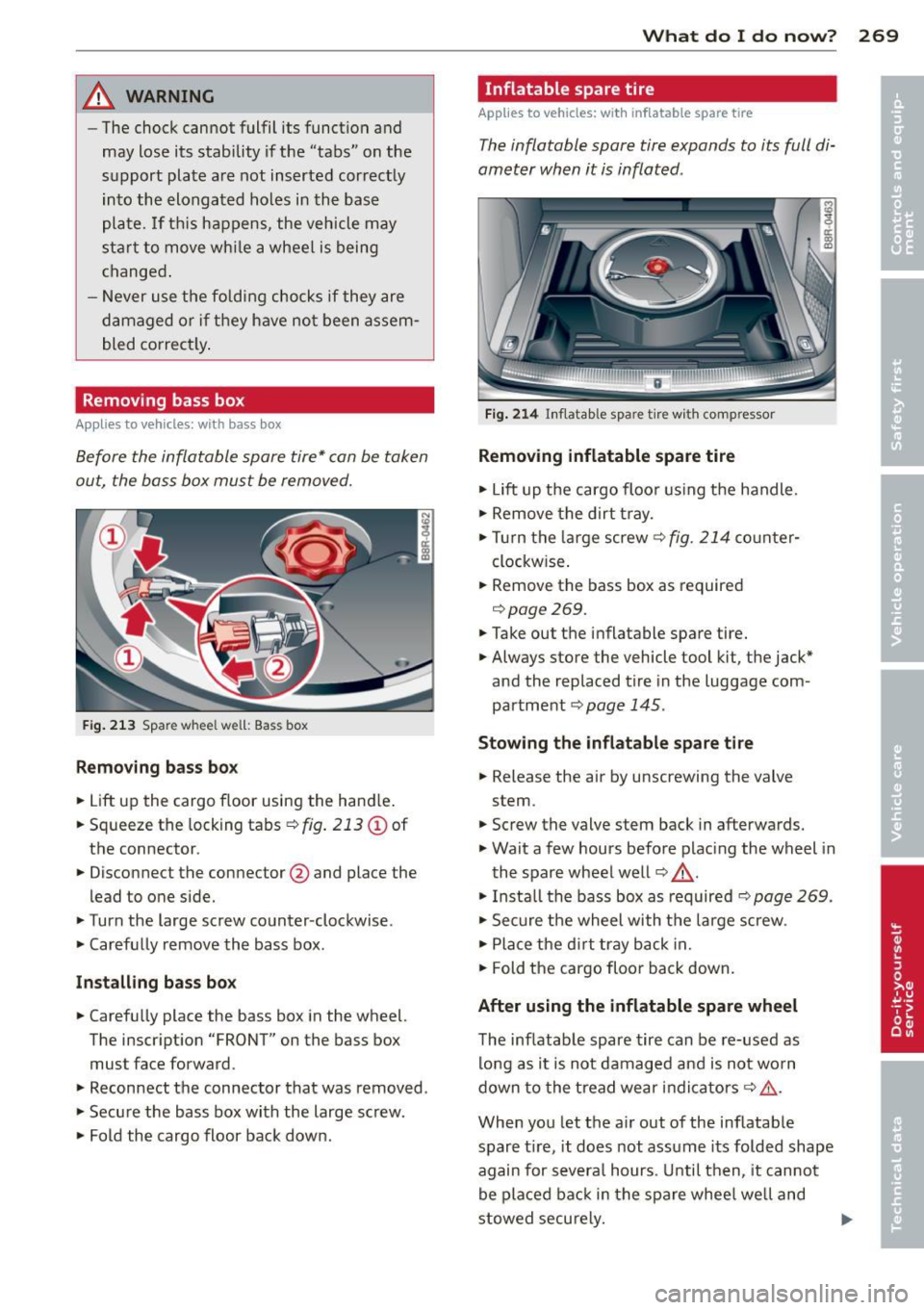
Folding chocks
The folding chocks are part of the on board
tool kit.
Fi g. 2 12 Open ing folding choc ks
To use the chocks, you first have to raise the
support plate¢
fig . 212 (D and then insert
the locking plate with the two "tabs" into the
elongated holes in the base plate @¢& .
Ill>
Page 271 of 316
_& WARNING
-The chock cannot fulfil its funct ion and
may lose its stability if the "tabs" on the
support plate are not inserted cor rectly
into the elongated holes in the base
pla te. If th is happens, the vehicle may
st ar t to move whi le a wheel is being
changed .
- Never use the folding chocks if they are
damaged or i f th ey have not been assem
bled correct ly .
Removing bass box
Applies to vehicles: with bass box
Before the inflatable spare tire* can be taken
out, the bass box must
be removed.
Fig . 2 13 Spare w hee l well : Bas s box
Removing bas s bo x
.,. Lift up the cargo floor using the hand le .
.,. Sq ueeze the locking tabs
c:!;> fig . 213 (D of
the connector.
.,. Disconnect the connector @and place the
lead to one side.
.,. Turn the large screw counter -clockwise .
.,. Carefu lly remove the bass box .
Install ing bas s bo x
.,. Carefu lly place the bass box in the wheel.
The inscr ipt ion "FRONT" on the bass box
must face forward .
.,. Reconnect the connector that was removed .
.,. Secure the bass box with the large screw.
.,. Fold the cargo floor back down.
What do I d o now ? 269
Inflatable spare tire
Applies to vehicles: with inflatable spare tire
The inflatable spare tire expands to its full di
ameter when it is inflated.
Fi g. 21 4 In flatable spa re t ire w it h comp ressor
Removing inflatable spare tire
.,. Lift up the cargo floo r using t he handle .
.,. Remove the dirt t ray .
.,. Turn the large screw
c:!;> fig. 214 co unter
clockw ise .
.,. Remove the bass box as required
c:!;> page 269 .
.,. Take out the inflatable spare tire .
.,. Always store the vehicle tool kit, the jack*
and the replaced tire in the luggage com
partment
c:!;> page 145.
Stowing the inflatabl e spare t ire
.,. Release the air by unscrewing the valve
stem .
.,. Screw the valve stem back in afterwards .
.,. Wait a few hours befo re placing the wheel in
the spare wheel well
c:!;> .,&. .
"'Insta ll the bass box as required c:!;> page 269 .
.,. Secure the wheel with t he la rge screw .
.,. Place the d irt tr ay back in .
.,. Fold the cargo floor back down.
After using the inflatable spare wheel
T he inflatab le spare tire can be re-used as
l ong as it is not damaged and is not wo rn
down to the t read wea r indica tors
c:!;> ,& .
When you let the a ir out of the inflatab le
spare t ire , it does not assume its folded shape
again for s evera l hours . U nti l then , it canno t
be pla ced ba ck in the spare whee l we ll and
stowed secure ly.
Page 272 of 316
2 70 What do I do now?
A WARNING
-Never use the spare tire if it is damaged
or if it is worn down to the tread wear in
dicators.
- If the inflatable spare tire is more than 6
years old, use it only in an emergency
and with extreme caution and careful
driving.
- The inflatable spare tire is intended only
for temporary and short-term use. It
should be replaced as soon as possible
with the normal wheel and tire.
- The tire pressure value for the inflatable
spare tire is located on the driver's side
8-pillar
¢ page 251, fig. 206.
- Maximum permissible speed is SO mph
(80 km/h).
- Avoid full-throttle acceleration, heavy
braking, and fast cornering .
- When the air is let out of the inflatable
spare wheel, it does not assume its fold
ed shape for several hours. Until then, it
cannot be placed back in the spare wheel
well and stowed securely.
- Never drive with more than one inflata
ble spare tire.
- For technical reasons, the use of tire
chains on the inflatable spare tire is not
permitted .
If it is necessary to drive with
tire chains, the inflatable spare wheel
must be mounted on the front axle in the
event of a flat in a rear tire. The newly
available front wheel must then be in
stalled in place of the rear wheel with
the flat tire. Installing the tire chain be
fore mounting the wheel and tire is rec
ommended.
- Loose items in the passenger compart
ment can cause serious personal injury
during hard braking or in an accident.
Never store the inflatable spare tire or
jack* and tools in the passenger com
partment.
Q) Note
- The inflatable spare tire has been devel
oped specifically for this vehicle model.
It must not be exchanged or used for
other vehicle models. Similarly, inflata
ble tires from other vehicle models must
not be used.
- Normal summer or winter tires must not
be installed on the inflatable tire rim.
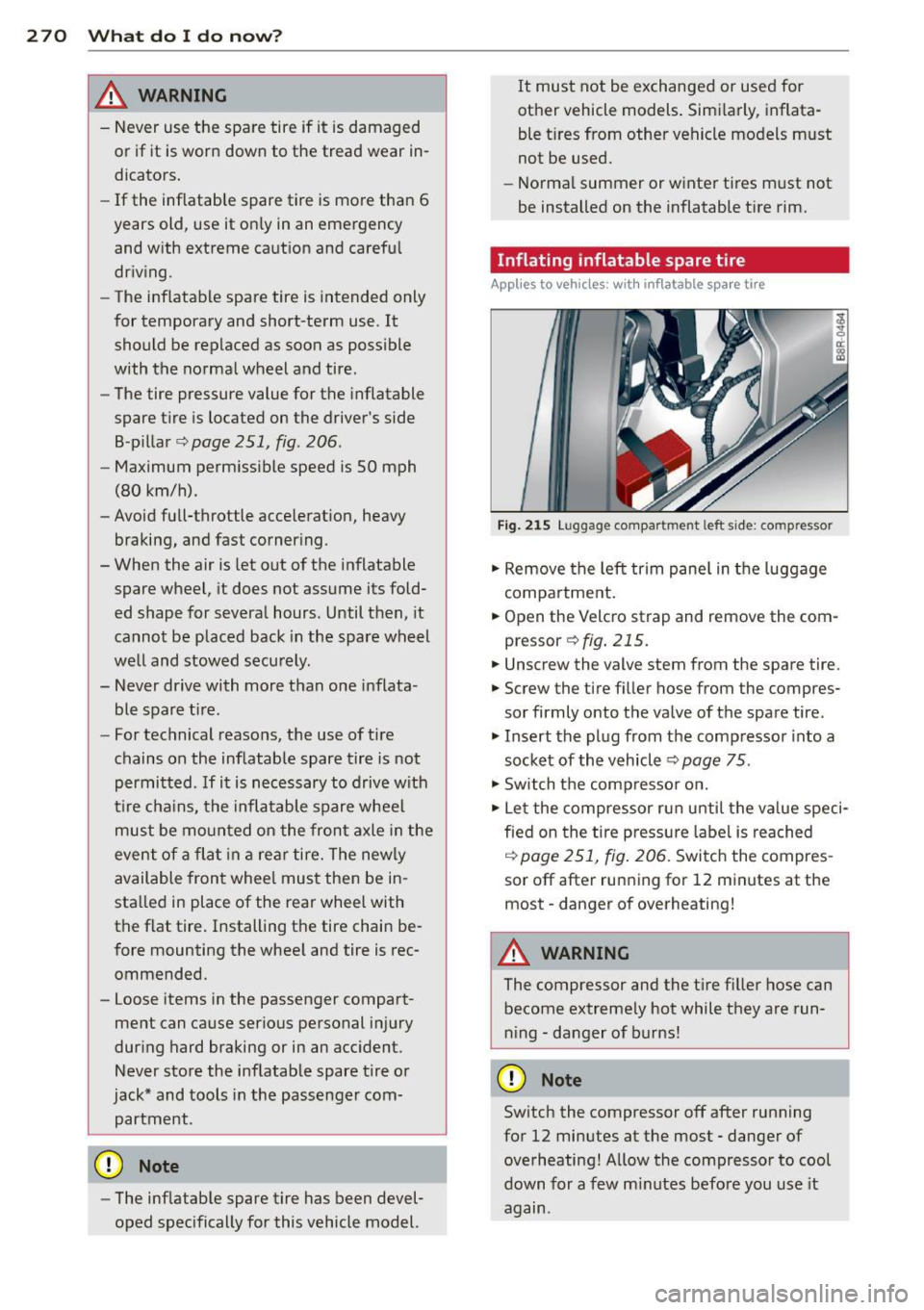
Inflating inflatable spare tire
Applies to vehicles : wit h in flatable spa re tire
Fig. 215 L u ggage compartment left side : compressor
.,. Remove the left trim panel in the luggage
compartment.
.,. Open the Velcro strap and remove the com
pressor ¢
fig. 215.
.,. Unscrew the valve stem from the spare tire.
.,. Screw the tire filler hose from the compres
sor firmly onto the valve of the spare tire .
.., Insert the plug from the compressor into a
socket of the vehicle
r=;, page 75 .
.., Switch the compressor on.
.., Let the compressor run until the value speci
fied on the tire pressure label is reached
r=;, page 251, fig. 206. Switch the compres
sor off after running for 12 minutes at the
most -danger of overheating!
A WARNING
= The compressor and the tire filler hose can
become extremely hot while they are run
ning -danger of burns!
(D Note
Switch the compressor off after running
for 12 minutes at the most -danger of
overheating! Allow the compressor to cool
down for a few minutes before you use it
again .
Page 273 of 316
Tire repair
General information and safety
precautions
Appl ies to vehicles: with tire repair kit
The tire r epair is only m eant for tempo rary
use.
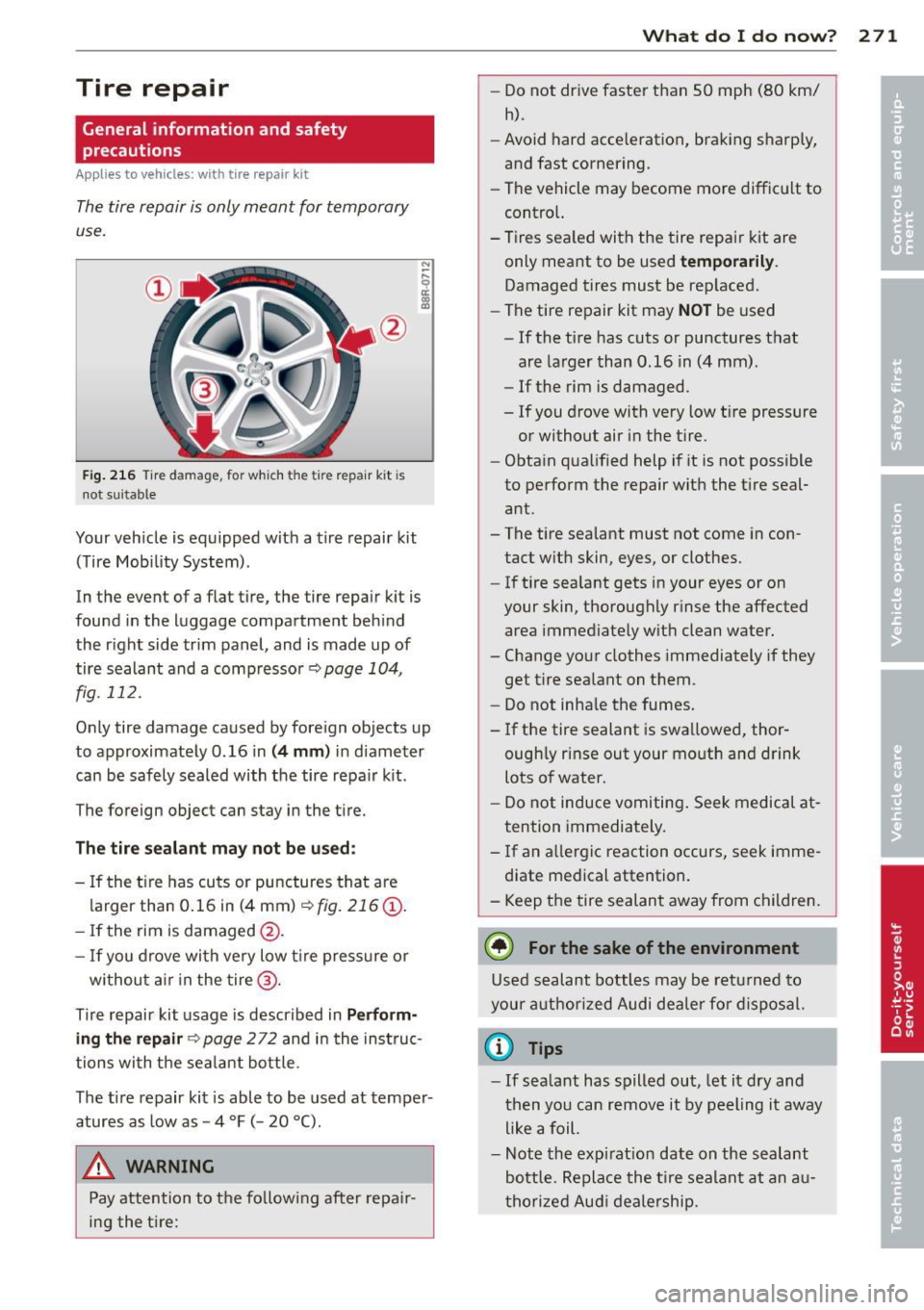
Fi g. 2 16 Tire damage, fo r which the tire repair kit is
not su itab le
Your veh icle is equipped with a tir e repair kit
(Tire Mob ility System) .
In the event of a flat tire, the tire repair kit is
found in the luggage compartment behind
the right side trim panel, and is made up of
tire sealant and a comp resso r
Q page 104,
fig. 112.
Only tire damage caused by fore ign objects up
to approximately 0.16 in
( 4 mm) in diameter
can be safely sealed with the tire repa ir k it .
The foreign object can stay in the t ire.
Th e tire sealant may not b e us ed :
- If the t ire has cuts or punctures that are
larger than 0 .16 in (4 mm)
Qfig. 216@.
-If the rim is damaged @.
-If you drove wi th very low t ire press ure o r
without a ir in the tire @.
Tire repair kit usage is descr ibed in
Perform
in g th e repair
Q page 2 72 and in the inst ruc
tions wi th the sea lant bottle.
The tire repair kit is able to be used at temper
atures as low as -4
°F ( -20 °().
A WARNING
Pay attention to t he fo llowing after repa ir
ing the t ire:
What do I d o now ? 271
-Do not dr ive faster than SO mph (80 km/
h).
- Avoid hard acce leration, braking s harply,
and fast cornering.
- The vehicle may become more diffic ult to
contro l.
- Tires sea led with the tire repai r kit are
only meant to be used
temporar ily .
Damaged tires must be rep laced .
- The tire repair kit may
NOT be used
- If the ti re has cuts or punctures that
are la rger than 0.16 in (4 mm).
- If the rim is damaged.
- If you drove with very low t ire pressure
or without air i n the tire.
- Obta in qua lified help if it is not poss ible
to perform the repair with the t ire seal
ant.
- The tire sea lant must not come in con
tact with skin, eyes, or clothes.
- If tire sea lant gets in your eyes or on
your skin, thoroughly rinse the affected
area immed iately w ith clean water .
- Change yo ur clothes immediately if they
get t ire sea lant on t hem.
- Do not inha le the fumes.
- If t he tire sealant is swa llowed, thor -
ough ly rinse out your mouth and drink
lots o f water.
- Do not induce vomiting . Seek medical at
tention immediately.
- If an a llergic reaction occurs , seek imme
diate medical attention.
- Keep the tire sealant away from children.
@ For the sake of the environment
Used sealant bottles may be retu rned to
your auth orized Audi dea le r for disposa l.
@ Tips
- If
sea lant has spilled out, let it dry and
then yo u can remove it by peeling it away
like a foil.
- Note the expi rat ion date on the sealant
bott le. Re pla ce the t ire sealant at an a u
t horize d Au di dealership.
Page 274 of 316
272 What do I do now ?
Performing the repair
App lies to vehicles: with tire repair kit
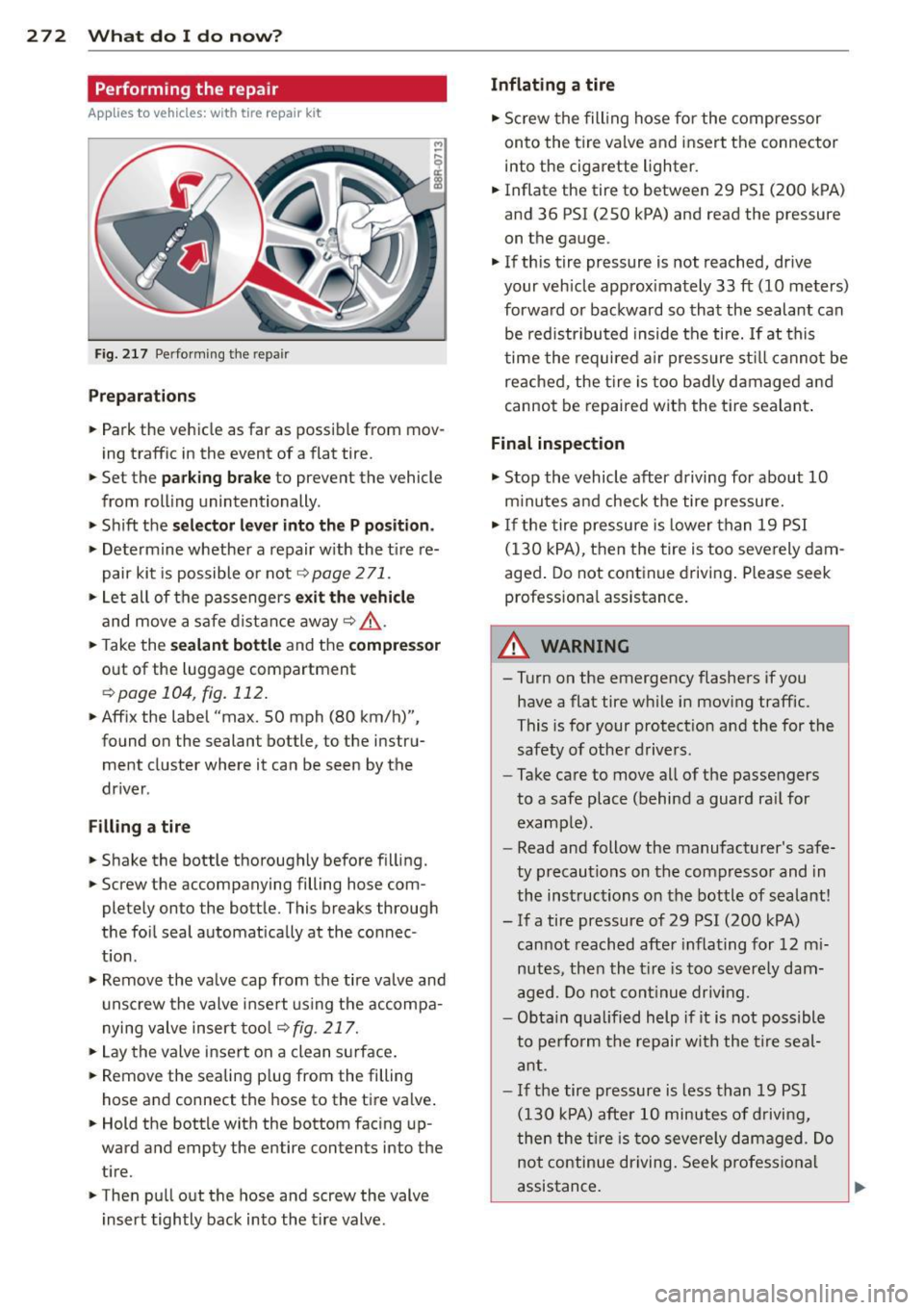
Fig. 217 Perform ing the rep air
Pre parati ons
.. Park the vehicle as far as possible from mov
ing traffic in the event of a flat tire.
.. Set the
parki ng brake to prevent the vehicle
from roll ing unintentionally .
.. Shift the
se lec tor le ver in to th e P po siti on.
.. Determine whethe r a repair w ith the tire re
pair kit is possible or not
¢ page 271.
.. Let all of the passengers ex it th e vehicle
and move a safe distance away ¢& .
.. Take the
sealant bottle and the compre ssor
out of the luggage compartment
¢ page 104, fig. 112.
.. Affix the label "max. 50 mph (80 km/h)",
found on the sealant bottle, to the instru
ment cluster where it can be seen by the
dr iver .
Fill ing a tire
.. Shake the bottle thoroughly before f il li ng.
.. Screw the accompanying filling hose com-
pletely onto the bottle. This breaks through
the foi l seal automatically at the connec
t ion.
.. Remove the valve cap from the tire va lve and
uns crew the valve inse rt using the accompa
nying valve insert too l¢
fig . 217.
.. Lay the valve insert on a clean s urface .
.. Remove the sealing p lug from the filling
hose and connect the hose to the tire va lve .
.. Hold the bottle with the bottom fac ing up
ward and empty the entire contents into the
tire.
.. Then pu ll out the hose and screw the valve
i nsert tightly back into the tire valve .
Inflating a tire
.. Screw the fill ing hose for the compressor
onto the tire valve and insert the connector
into the cigarette lighter .
.. Inflate the tire to between 29 PSI (200 kPA)
and 36 PSI (250 kPA) and read the pressure
on the gauge .
.. If this tire pressure is not reached, dr ive
your veh icle approximately 33 ft ( 10 meters)
forward or backward so that the sealant can be red istr ibuted inside the tire.
If at this
time the requi red a ir pressure st ill cannot be
reached , the tire is too badly damaged and
cannot be repaired with the tire sealant .
Final inspection
.. Stop the vehicle after driving for about 10
m inutes and check the tire pressure .
.. If the tire pressure is lower than 19 PSI
( 1 30 kPA), then the tire is too seve rely dam
aged. Do not continue driving . Please seek
professiona l assistance.
A WARNING
--
- Turn on the emergency flashers if you
have a flat tire while in moving traffic .
This is for your protect ion and the for the
safety of other drivers.
- Take care to move all of the passengers
to a safe place (behind a guard ra il for
example) .
- Read and follow the manufacturer's safe
ty precautions on the compressor and in
the instructions on the bottle of sealant!
- If a tire pressure of 29 PSI (200 kPA) cannot reached after inflating for 12 m i
nutes, then the t ire is too severe ly dam
aged. Do not cont inue driving.
- Obta in qualified help if it is not possible
to pe rform the repair w ith the tire seal
a nt .
- I f the tire pressure is less than 19 PSI
(130 kPA) afte r 10 minutes of d riving,
then the t ire is too severely damaged . Do
not continue dr iving. Seek p rofess ional
assistance .
Page 275 of 316
(D Note
Special care is required if you are repairing
the tire on a steep incline.
@ Tips
-Do not operate the compressor for more
than 12 minutes continuously, otherwise it can overheat. Once the compressor has
cooled, you can continue to use it.
- If sealant has spilled out, let it dry and
then you can remove it by peeling it away
like a foil.
- Remember to obtain a new bottle of
sealant from your authorized Audi dealer
after repairing a tire. After this, the func
tionality of the tire repair set is restored.
- Obey all laws.
Changing a wheel
Before changing a wheel
Observe the following precautions for your
own and your passenger's safety when chang
ing a wheel.
.,. After you experience a tire failure, pull the
car well away from moving traffic and try to
reach
level ground before you stop¢_& .
.. All passengers should
leave the car and
move to a safe location (for instance, behind
the guardrail) ¢
_&.
.. Engage the parking brake to prevent your
vehicle from rolling unintentionally¢_&.
.. Move
selector lever to position P ¢ _& .
.,. If you are tow ing a trai ler: unhitch the trail
er from your vehicle.
.,. Block the diagonally opposite wheel with
the folding chocks or other objects.
.. Take the
jack* and the inflatable spare tire*
out of the luggage compartment
¢page 268.
A WARNING
You or your passengers could be injured
while changing a wheel if you do not fol
low these safety precautions:
-
What do I do now? 273
- If you have a flat tire, move a safe dis
tance off the road. Turn off the engine,
turn the emergency flashers on and use
other warning devices to alert other mo
torists.
- Make sure that passengers wait in a safe
place away from the vehicle and well
away from the road and traffic.
- To help prevent the vehicle from moving
suddenly and possibly slipping off the
jack*, always fully set the parking brake
and block the wheel diagonally opposite
the wheel being changed with the fold
ing chocks or other objects. When one
front wheel is lifted off the ground, plac
ing the Automatic Transmission in P
(Park) will
not prevent the vehicle from
moving.
- Before you change a wheel, be sure the
ground is level and firm. If necessary,
use a sturdy board under the jack*.
- Always store the vehicle tool kit, the
jack* and the replaced tire in the luggage
compartment
¢page 145.
Changing a wheel
When you change a wheel, follow the se
quence described below step-by-step and in
exactly that order.
1. Remov e the decorative wheel cover*. For
more details see also
¢ page 274, Deco
rative wheel covers
or ¢ page 2 7 4,
Wheels with wheel bolt cops .
2. Loosen the wheel bolts¢ page 2 75 .
3. Locate the proper mounting point for the
jack* and align the jack* below that point
¢ page 275.
4. Lift the car with the jack* ¢ page 2 75 .
S. Remove the wheel with the flat tire and
then install the
inflatable spare tire*
¢page 276.
6. Tighten all wheel bolts lightly.
7.
Lower the vehicle with the jack*.
8. Use the wheel bolt wrench and
firmly
tighten all wheel bolts¢ page 2 75.
9. Replace the decorative wheel cover*.
•
•