battery AUDI Q5 2014 Owner's Guide
[x] Cancel search | Manufacturer: AUDI, Model Year: 2014, Model line: Q5, Model: AUDI Q5 2014Pages: 316, PDF Size: 78.41 MB
Page 244 of 316
242 Checking and filling
@ For the sake of the environment
Be cause of the problem of proper disposa l
of brake flu id as we ll as the special tools
req uired and the necessary expert ise, we
recommend that you have the b rake fluid
changed by your author ized Audi dealer.
Battery
General information
Unde r normal operating conditions, the bat
tery in your A udi does not need any mainte
nance. With
high outside temperatures or
long daily dr ives we recommend that you have
the elect ro lyte level checked by an authorized
Aud i dea ler o r qualified workshop . The elec
trolyte leve l sho uld a lso be c hecked each t ime
the battery is c harged ¢
page 244.
Have the battery checked when you take your
ve hicle in for service . Yo u are well adv ised to
replace a bat tery that is older tha n 5 yea rs .
W ith certa in types of a irbag deployment, t he
battery is d isconnected from the vehicle elec
tr ica l system fo r safety reasons ¢
& in Re
pair, core and disposal of the airbags on
page 171.
Hybr id d rive *: you can find important i nforma
tion about the high voltage battery under
¢ page 97.
Disconnecting the battery terminals
Some veh icle functions (power w indow regu
lators, for example) are lost if the battery ter
minals a re discon nected. These functions have
to be re learned after the ba tte ry term inals a re
connect ed aga in. To prevent this , the battery
should only be d isconnected from the vehicle
e lec tric al sys te m whe n absolu tely necessa ry
for rep airs.
Vehicles not driven for long periods
If yo u do not dr ive you r vehicle over a pe riod
of severa l days or w eeks, ele ct rical com po
n e nt s are gr adually cu t ba ck o r swi tched off .
T his redu ce s energy consu mp tion and mai n- ta
ins s tart ing c apability over a longer pe riod
¢ page 203.
Take i nto consi deratio n that whe n you unl ock
yo ur vehicle, some conven ien ce f un ctions ,
s u ch as the inte rior ligh ts or the powe r sea t
adjustment, may not be availab le. T he con
venience functions will be avai lab le aga in
when you tu rn on the ign ition and start t he
engine.
Winter operation
Du ring the winte r mon ths, bat tery ca pac ity
tends to dec rease as tem peratures drop . This
is beca use more power is a lso consumed wh ile
starting, and the headlights, rear wi ndow de
fogger, etc ., are used more often.
Avoid unnecessary powe r consum ption, pa r
t icu lar ly in city traffic or when traveling only
sho rt distances. Let your authori zed Aud i
dealer check the capacity of the vehicle bat
te ry before winter sets in ¢
page 244. A well
c h arged battery will not on ly preven t starti ng
problems when the wea ther is cold, but w ill
also last lo nger.
Working on the battery
Be especially careful when working on or near
the ba ttery.
The battery is located in the luggage compart
me nt under the floor . B efo re you c hec k any
t hi ng in the luggage compartmen t,
read and
heed all WARNINGS
¢ & -
Hybrid dr ive* : yo u can find impo rtant informa
t io n about the h igh vol tage ba tte ry unde r
¢page 97 .
Always heed the safety warnings , when work
ing on the v ehicle ba tte ry or the vehicle e lec
t rical sys tem to preven t inju ry .
Page 245 of 316
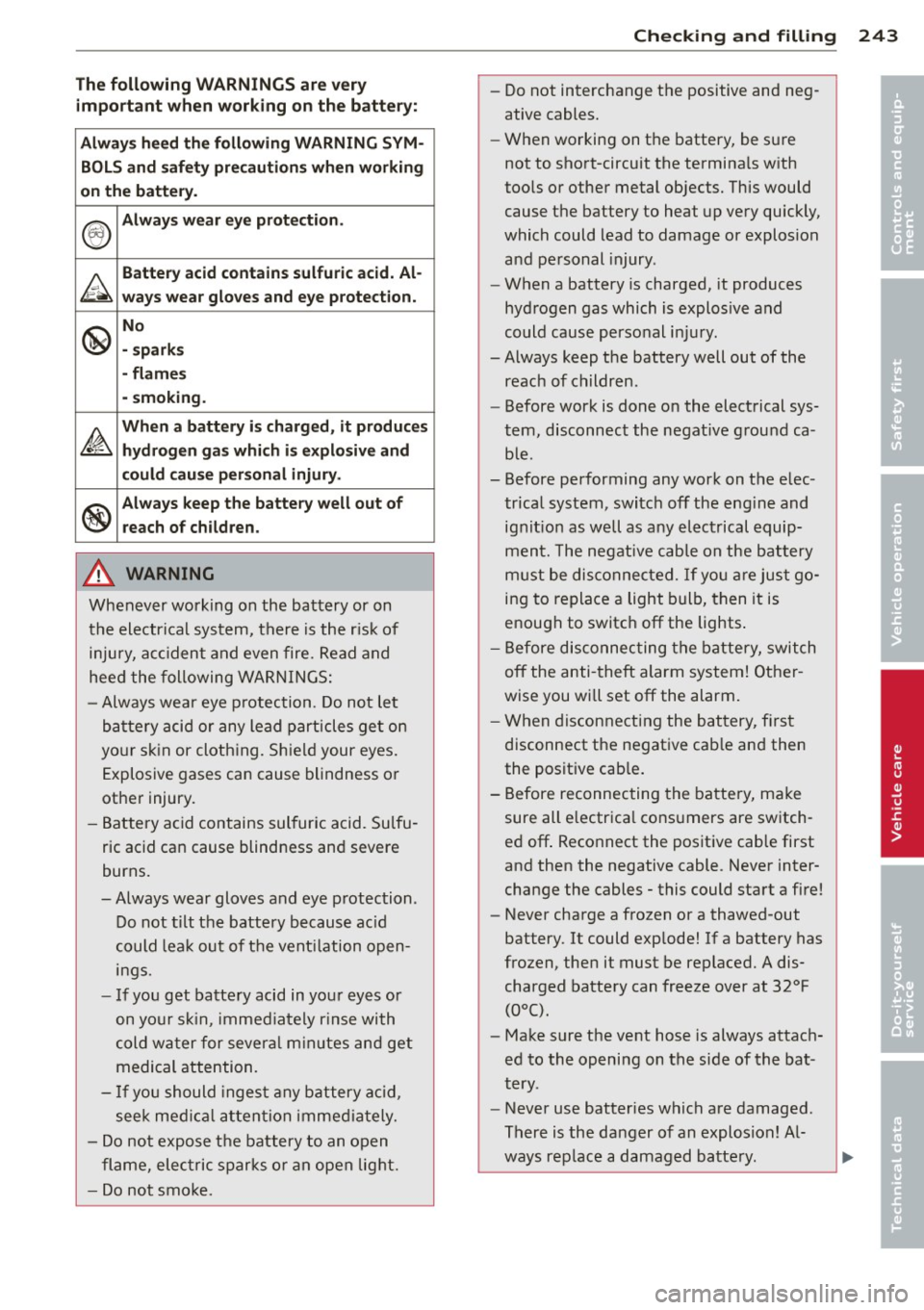
The following WARNINGS ar e ver y
impo rtant when working on the batt ery:
Always heed th e fo llowin g WARN ING SYM ·
BOLS and saf ety pre caution s wh en working
on the batt ery.
®
Alw ay s w ear e ye prot ection .
&
Battery aci d contain s sulfuri c acid. Al-
w ays we ar g lo ve s and e ye protect ion.
@
No
• spark s
- fl ame s
• smokin g.
A
When a battery is charged , it produces
h y drogen gas whi ch i s ex plo sive and
could cause personal injury.
®
Al ways k eep the batte ry well out of
re ac h of children.
A WARNING
Whenever working on the battery or on
the electrical system, there is the r isk of
injury, ac cident and even fire. Read and
heed the following WARNINGS:
- Always wear eye protec tion. Do not let
battery acid or any lead particles ge t on
yo ur sk in or cloth ing. Sh ield your eyes.
Explosive gases can cause blindness o r
other injury.
- Battery acid contains sul furic acid. Sulfu
ric acid can cause blindness and severe
burns.
- Always wear gloves and eye p rotection.
Do not tilt the battery because ac id
could lea k out of the vent ilation open
ings.
- If you get batte ry acid in you r eyes or
on your sk in, immed iately r inse with
cold water for severa l m in utes and get
medical attention.
- I f you should inges t any battery acid,
see k med ica l attention immediately.
- Do not expose the battery to an open
flame, elec tric sparks o r an open light.
- Do not smoke.
-
Checkin g and fillin g 243
-Do not interchange the positive and neg
ative cables.
- When working on the battery, be sure
not to short-circuit the termina ls w ith
too ls or other metal objects. This would
cause the battery to heat up very quickly,
which could lead to damage or explosion and personal injury.
- When a battery is charged, it produces
hyd rogen gas which is explos ive and
could cause personal in jury.
- Always keep the battery well out of the
reach of children.
- Before work is done on the electrical sys
tem, disconnect the negat ive g round ca
b le.
- Before performing any work on the e lec
trical system, switch off the eng ine and
ignit ion as well as any electrical equip
ment. The negative cable on the battery
m ust be disconnected. If yo u are just go
ing to replace a light bulb, then it is
enough to switch off the lights .
- Before disconnec ting the battery, switch
off the anti -theft alarm system! Other
wise you wi ll set off the alarm.
- When d isconnecting the battery, first
disconnect the negative cab le and then
the positive cab le .
- Before reconnecting the batte ry, make
sure all e lectrica l consumers are sw itch
ed off . Reconnect the positive cable first
and then the negative cable. Never inter
change the cables -this could start a fire!
- Never charge a frozen or a thawed-out
battery. It could exp lode! If a battery has
frozen, then it must be replaced. A dis
charged battery can freeze over at 32°F
(QO().
- Make sure the vent hose is always attach
ed to the opening on the side of the bat
tery.
- Never use batteries which are damaged.
There is the danger of an explosion! Al
ways rep lace a damaged batte ry .
•
•
Page 246 of 316

244 Checking and filling
A WARNING
California Proposition 65 Warning:
- Battery posts, terminals and related ac
cessories contain lead and lead com
pounds, chemicals known to the State of
California to cause cancer and reproduc
tive problems. Wash hands after han
dling.
(D Note
- Do not disconnect the vehicle battery
when the ignition is switched on or when
the engine is running, otherwise, you will
damage electronic components in the
electrical system.
- If your vehicle is going to stand for a
long period of time without being driven,
protect the battery from "freezing ", oth
erwise it will be damaged and will then have to be replaced .
Battery charging
Starting the engine requires a well charged
battery.
Fig. 203 E ng ine compar tment: Connectors for charger
a nd jumper cab les
Always read and heed all WARNINGS below
¢
.&. and ¢ .&. in Working on the battery on
page 243.
• Hybrid drive*: read the important informa
tion concerning a dead high voltage battery
under
¢page 105.
•Turnoff the ignition and all electrical con
sumers.
• Make sure the area is well ventilated when
you charge the battery. •
Open the engin e hood ¢
page 231.
• Remove th e cover (D by pressing on the ar
row
¢fig. 203.
• Open the cover @on the positive terminal.
• Connect the charger co nnectors according to
the instructions to the
jump start bolts .
(Bolts under the cover = "pos itive", Bolts
with hex head= "negative ").
• Only now plug the mains lead for the charg
ing equipment into the wall outlet and turn
it on¢ .&_.
• Make sure the charging rate is not over
30 amps/14.8 Volt.
• When the battery is fully charged: T urn the
charg ing equipment off and remove the
mains lead from the wall outlet.
• Now remove the clamps for the charging
equipment.
• Close the cover @on the positive terminal
and re-install the cover
(D.
• Close the hood¢ page 231.
A discharged battery can freeze at tempera
tures of only 32 °F (0 °C). Allow a frozen bat
tery to thaw completely before attempting to
charge it¢.&.. However, we recommend not
using a thawed battery again because the bat
tery casing can be cracked due to ice forma
tion and can leak battery acid.
Battery charging (Maximum charging rate
of 30 amps/14.8 Volt)
When charging at low voltages (e.g. with a
trickle charger), the battery cables do not
have to be disconnected first. The battery
caps should
not be opened when charging a
battery.
It is not necessary to remove the battery from
the luggage compartment.
Fast charging the battery (charging rate
above 14.8 Volts)
For technical reasons do not use a battery
c h arger that uses voltage greater than 14.8
Volts to charge your vehicle's battery.
A WARNING
--
Charging a battery can be dangerous. ~
Page 247 of 316
-Always follow the operating instructions
provided by the battery charger manu
facturer when charging your battery.
- Never charge a frozen battery.
It may ex
plode because of gas trapped in the ice.
Allow a frozen battery to thaw out first.
- Do not reuse batteries which were fro
zen. The battery housing may have
cracked and weakened when the battery
froze.
- Charge the battery in a well ventilated
area. Keep away from open flame or elec
trical spark. Do not smoke . Hydrogen gas
generated by the battery is explosive.
- To reduce the danger of explosion, never
connect or disconnect charger cables
while the charger is operating.
- Fast charging a battery is dangerous and
should only be attempted by a compe
tent technician with the proper equip
ment.
- Battery acid that may spill during charg
ing should be washed off with a solution
of warm water and baking soda to neu
tralize the acid.
(D Note
Never use a fast charger as a booster to
start the engine. This will seriously dam
age sensitive electronic components, such
as control units, relays, radio, etc., as well
as the battery charger.
Battery replacement
The new battery must have the same specifi
cations and dimensions as the original equip
ment battery.
Intelligent energy management in your vehi
cle is responsible for distributing the electri
cal energy throughout your vehicle
¢ page 203. The intelligent energy manage
ment system will keep the engine battery
charged better then vehicles without this sys
tem . To make sure the additional electrical en
ergy is available once again after you have
changed the battery, we recommend that you
Checking and filling 245
install batteries of the same type and manu
facture only (the same as those installed at
the time your vehicle was delivered). Specifi cations are listed on the battery housing . Your
authorized dealer must code the battery in
the energy management system to enable you
to use the energy management functions cor
rectly after replacing the battery .
If it is not possible to use a battery of this
type , the new battery must have the same ca
pacity, voltage (12 volts), amperage, con
struction and plug sealing .
When installing the battery, make sure the ig nition and all electrical consumers are turned
off .
(D Note
-Make sure the ventilation hose on the
side of the battery is connected, other
wise fumes or battery acid can leak out .
- Vehicles with the Start-Stop-System* are
equipped with a special cycle-proof AGM
battery. Installing a different type of
battery can cause problems in the vehi
cle electrical system. When replacing the
vehicle battery, always install one with
the same specifications as the original
battery.
@ For the sake of the environment
Because of the problem of proper disposal
of a battery, we recommend your author
ized Audi dealer change the battery for
you. Batteries contain sulfuric acid and
lead and must always be disposed of prop
erly in compliance with all environmental
regulations. Disposing of vehicle batteries
improperly is very dangerous to the envi
ronment. •
•
Page 251 of 316
Groove
means the space between two adjacent tread
ribs.
Load rating (code)
means the maximum load that a tire is rated
to carry for a given inflation pressure. You
may not find this information on all tires be
cause it is no t req uired by law.
Maximum load rating
means the load rating for a t ire at the max i
mum permissible inflation pressure for that
tire.
Maximum loaded vehicle weight
means the sum of:
(a) Curb weight
(b) Accessory weight
(c) Vehicle capacity weight, and
(d) Production options weight
Maximum (permissible) inflation pressure
means the maximum cold inflation pressure
to which a tire may be inflated. Also called "maximum inflation pressure."
Normal occupant weight
means 150 lbs. (68 kilograms) times the
number of occupants seated in the vehicle up
to the total seating capacity of your vehicle.
Occupant distribution
means distribution of occupants in a vehicle.
Outer diameter
means the overa ll diamete r of an inflated new
tire.
Overall width
means the linear distance between the exteri
ors of the sidewalls of an inflated tire, includ
in g elevations due to labeling, decorations, or
protective bands or ribs.
Ply
means a layer of rubber-coated parallel cords.
Tires and wheels 249
Production options weight
means the combined weight of those installed
regular production options we ighing over 5
lbs. (2.3 kg) in excess of those standard items
which they replace, not previously considered
in curb weight or accessory weight, including
heavy duty brakes, ride levelers, roof rack,
heavy duty battery, and spec ial tr im .
Radial ply tire
means a pneumatic tire in which the ply cords
that extend to the beads are laid at substan
tia lly 90 degrees to the center line of the
tread .
Recommended inflation pressure
see ¢ page 248, Cold tire inflation pressure.
Reinforced tire
means a t ire design to operate at higher loads
and at h igher inflation pressures than the cor
re sp onding standard tire. Reinforced tires
may be identified as "XL", "xl", "EXTRA LOAD",
or "RF" on the sidewa ll.
Rim
means a metal support for a tire or a t ire and
tube assembly upon which the tire beads are
seated.
Rim diameter
means nom inal diameter of the bead seat. If
you change your wheel s ize, you will have to
purchase new tires to match the new rim di
ameter.
Rim size designation
means r im diameter and width .
Rim width
means nominal distance between rim flanges .
Sidewall
means that portion of a tire between the
tread and bead.
•
•
Page 270 of 316
268 What do I do now?
What do I do now?
Jack, tools and
inflatable spare tire
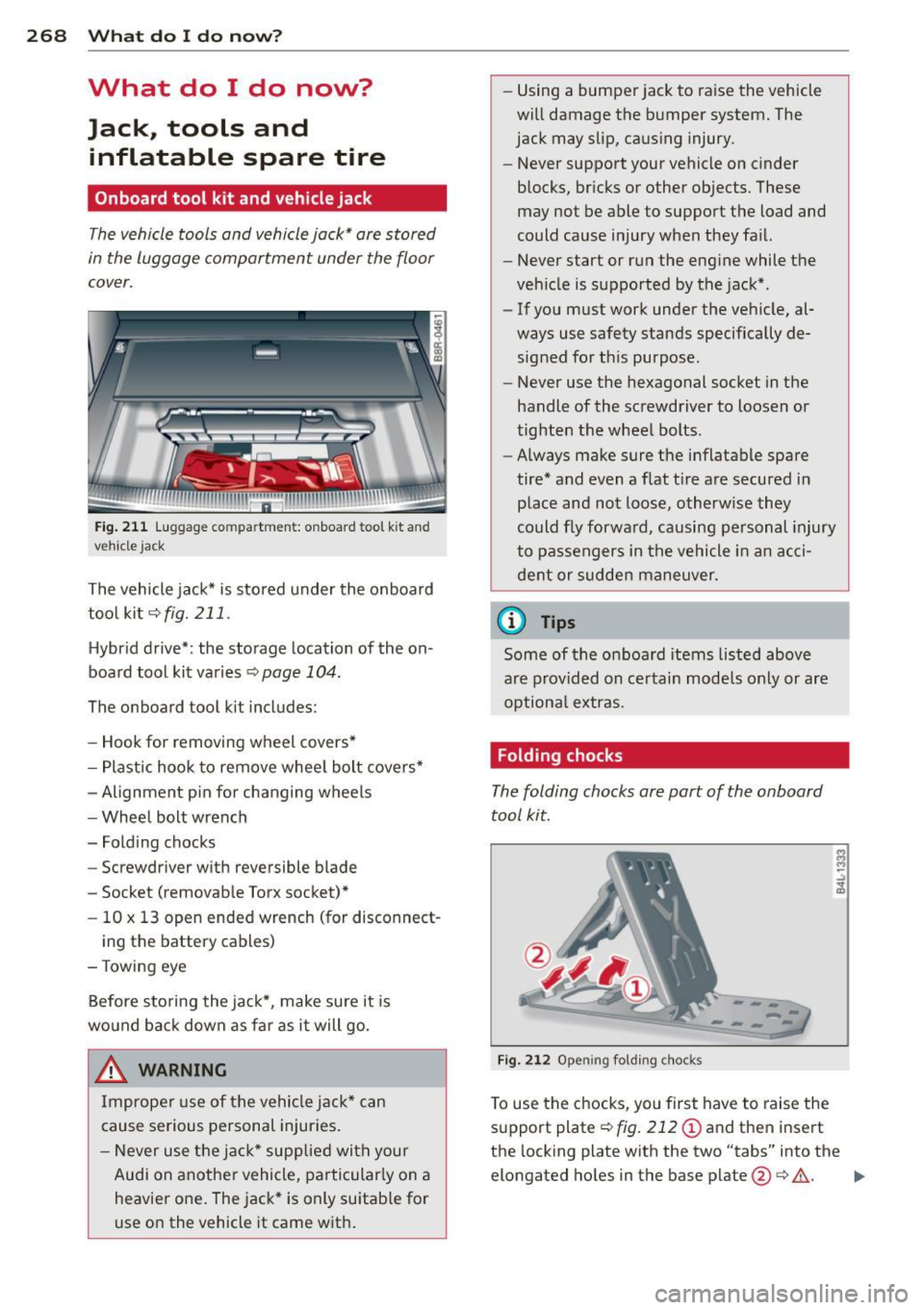
Onboard tool kit and vehicle jack
The vehicle tools and vehicle jack* are stored
in the luggage compartment under the floor
cover.
Fig . 211 Luggage compartment: on board tool kit and
vehicle jack
The vehicle jack* is stored under the on board
tool kit¢
fig. 211.
Hybrid drive*: the storage location of the on
board tool kit varies
¢ page 104.
The onboard tool kit includes:
- Hook for removing wheel covers*
- Plastic hook to remove whee l bolt covers*
- Alignment p in for changing wheels
- Wheel bolt wrench
- Folding chocks
- Screwdriver with reversible blade
- Socket (removable Torx socket)*
- 10 x 13 open ended wrench (for disconnect-
ing the battery cables)
-Towing eye
Before storing the jack*, make sure it is
wound back down as far as it will go.
& WARNING
Improper use of the vehicle jack* can
cause serious personal injuries.
- Never use the jack* supplied with your
Audi on another vehicle, particularly on a
heavier one . The jack* is only suitab le for
use on the vehicle it came with . -
Using a bumper jack to raise the vehicle
will damage the bumper system. The
jack may slip, causing injury.
- Never support your vehicle on cinder
blocks, bricks or other objects. These
may not be able to support the load and
could cause injury when they fa il.
- Never start or run the engine while the
veh icle is supported by the jack*.
- If you must work under the vehicle, al
ways use safety stands specifically de
signed for this purpose.
- Never use the hexagonal socket in the
handle of the screwdriver to loosen or
tighten the wheel bolts.
- Always make sure the inflatable spare
tire* and even a flat t ire are secured in
place and not loose, otherw ise they
could fly forward, causing personal injury
to passengers in the vehicle in an acci
dent or sudden maneuver.
@ Tips
Some of the on board items listed above
are provided on certain models only or are
optiona l extras.
Folding chocks
The folding chocks are part of the on board
tool kit.
Fi g. 2 12 Open ing folding choc ks
To use the chocks, you first have to raise the
support plate¢
fig . 212 (D and then insert
the locking plate with the two "tabs" into the
elongated holes in the base plate @¢& .
Ill>
Page 282 of 316
280 Fuses and bulbs
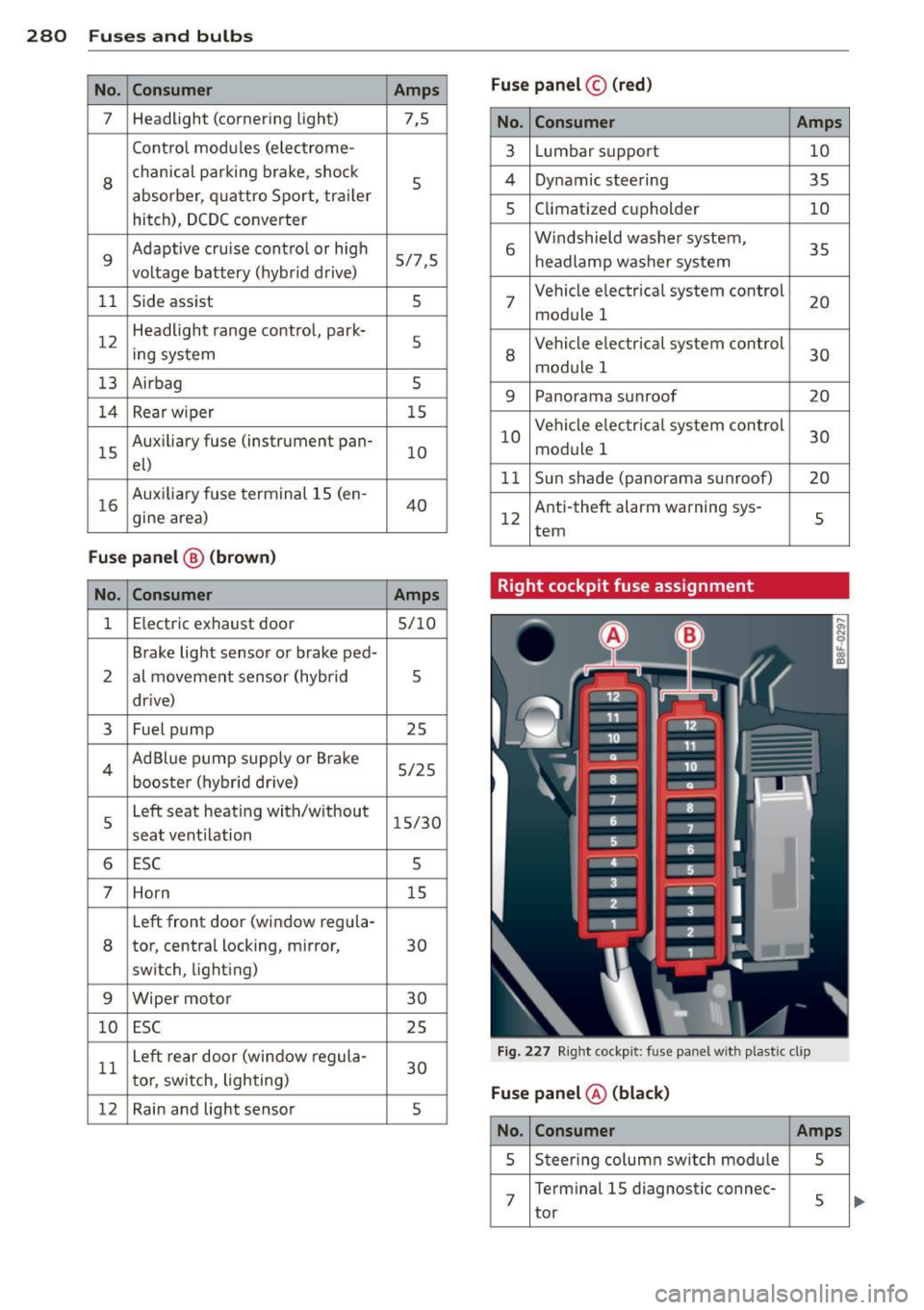
No. Consumer Amps Fuse panel
© (red )
7 Headlight (corner
ing light)
7,5 No. Consumer Amps
Contro l modu les (e lec trome-
3 Lum bar s upport 10
8
chanic al par king br ake, sho ck
5
absorber, q uatt ro Spor t, tra ile r
hitch), DCDC converter 4
Dynamic stee ring
35
5 Climat ized cu pholder 10
9
Adaptive cruise contro l or hig h
5/7,5
vo ltage battery (hybr id d rive) 6
W indshield w asher system,
35
h eadlamp washer sys tem
1 1 Side ass ist 5
7 Vehicle e
lectrical system control
20
module 1
12 H
eadlight range contro l, par k·
5
ing sys tem
8
Ve hicle e lec tric al syste m control
30
mod ule 1
13 Airbag
5
9 Panorama sunroof
20
1 4 Rear wiper 15
1 5 Aux
iliary fuse (instrument pan·
10
el)
16
Auxi liary fuse term inal 15 (en -
40
gine area) 10
Vehicle e
lectrica l system control
30
module 1
1 1 Sun shade (panorama s unroof) 20
1 2 Anti-theft alarm warning sys·
s
tern
Fuse panel
@ (brown)
No. Consumer Amps Right cockpit fuse assignment
1 Electric exhaust door
5/10
Brake lig ht sensor o r brake ped·
2 al movem ent s ensor (hybrid 5
dr ive)
3 Fuel pump 25
4 AdBl
ue p ump supp ly o r Br ake
5/25
booste r (hybr id drive)
5 Left seat heati
ng wit h/w ithout
15/30
seat vent ilation
6 ESC 5
7 Horn 15
Left front door (window regula ·
8 tor, central locking, m irror,
30
sw itch, light ing)
9 Wipe r moto r 30
10 ESC 25
11 Le
ft r ear do or (win dow regul a-
30
t o r, sw itch, lighting)
12 Rain and light se
nso r
5
Fig. 22 7 Right cockp it: fuse panel wit h plast ic clip
Fuse panel ® (black)
No. Consumer Amps
5 Steering column sw itch mod ule s
7
Terminal 15 diagnostic connec·
tor
5
Page 283 of 316
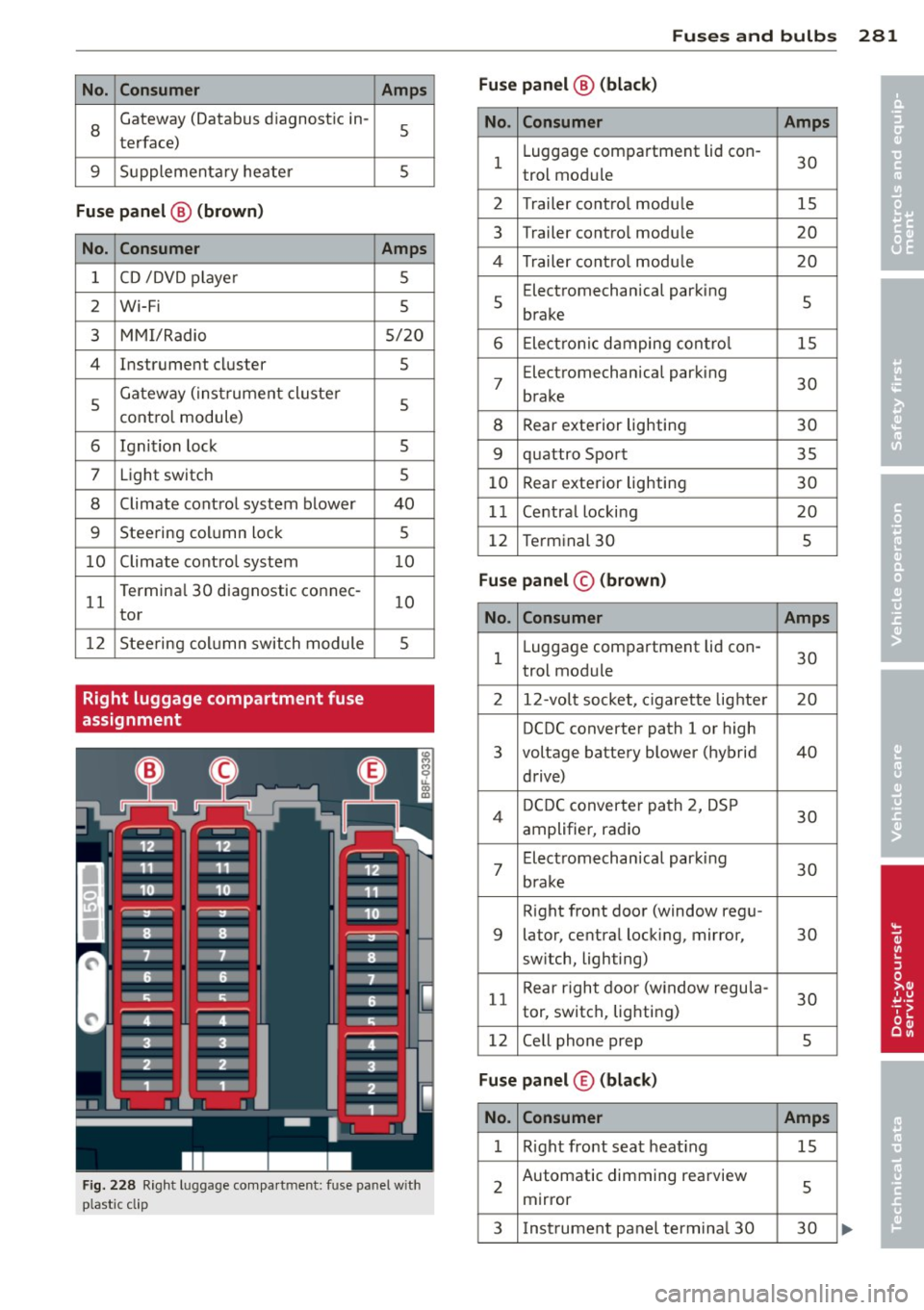
No. Consumer
8
Gateway (Databus d iagnostic in-
terface)
9 Supplementary heater
Fuse p anel @ (b rown )
N o. Con sumer
1 CD /DVD player
2 Wi-Fi
3 MMI/Radio
4 Instrument cluster
5 Gateway
(instrument cluster
cont rol module)
6 Ignition lock
7 Light switch
8 Climate control system blower
9 Steering column lock
10 Climate contro l system
11 T
erminal 30 diagnostic connec-
tor
12 Steering column switch module
Right luggage compartment fuse
assignment Amps
5
5
Amps
5
5
5/20
5
5
5 5
40
5
10
1 0
5
Fig. 228 Right luggage compa rtment: fuse panel w ith
ptastic cl ip
Fu ses and bulb s 281
Fus e panel@ (bla ck)
•
N o. Consumer Amps •
1 Luggage
compartment lid con-
30
trol module
2 Trailer contro l modu le 15
3 Trailer contro
l modu le
20
4 Trailer cont ro l modu le 20
5 Electromechanical
parking
5
brake
6 Electronic damping contro l 15
7
Electromechanical parking
30
brake
8 Rear exterior lighting
30
9 quattro Sport
35
10 Rear
exterior lighting
30
1 1 Centra l locking 20
12 Terminal 30 5
Fuse pan el© (brown )
No . Consumer Amps
1 Luggage compartment lid con-
30
trol module
2 12-vo lt socket, c igarette lighte r 20
DCDC converter path 1 or high
3 voltage
battery blower (hybrid 40
drive)
4 D
CDC converter path 2, DSP
30
amplifier, radio
7
Electromechan ical parking
30
brake
Right front door (window regu-
9 lator, central locking, mirror,
30
switch, lighting)
11 Rear
right door (window regu la-
30
tor, switch, lighting)
12 Cell phone prep
5
Fuse panel ® (bla ck )
No. Consumer Amps
1 Right front seat heat ing 15
2 Automatic dimming
rearview
5
mirror
3 Instrument panel termina l 30 30
Page 284 of 316
282 Fuses and bulb s
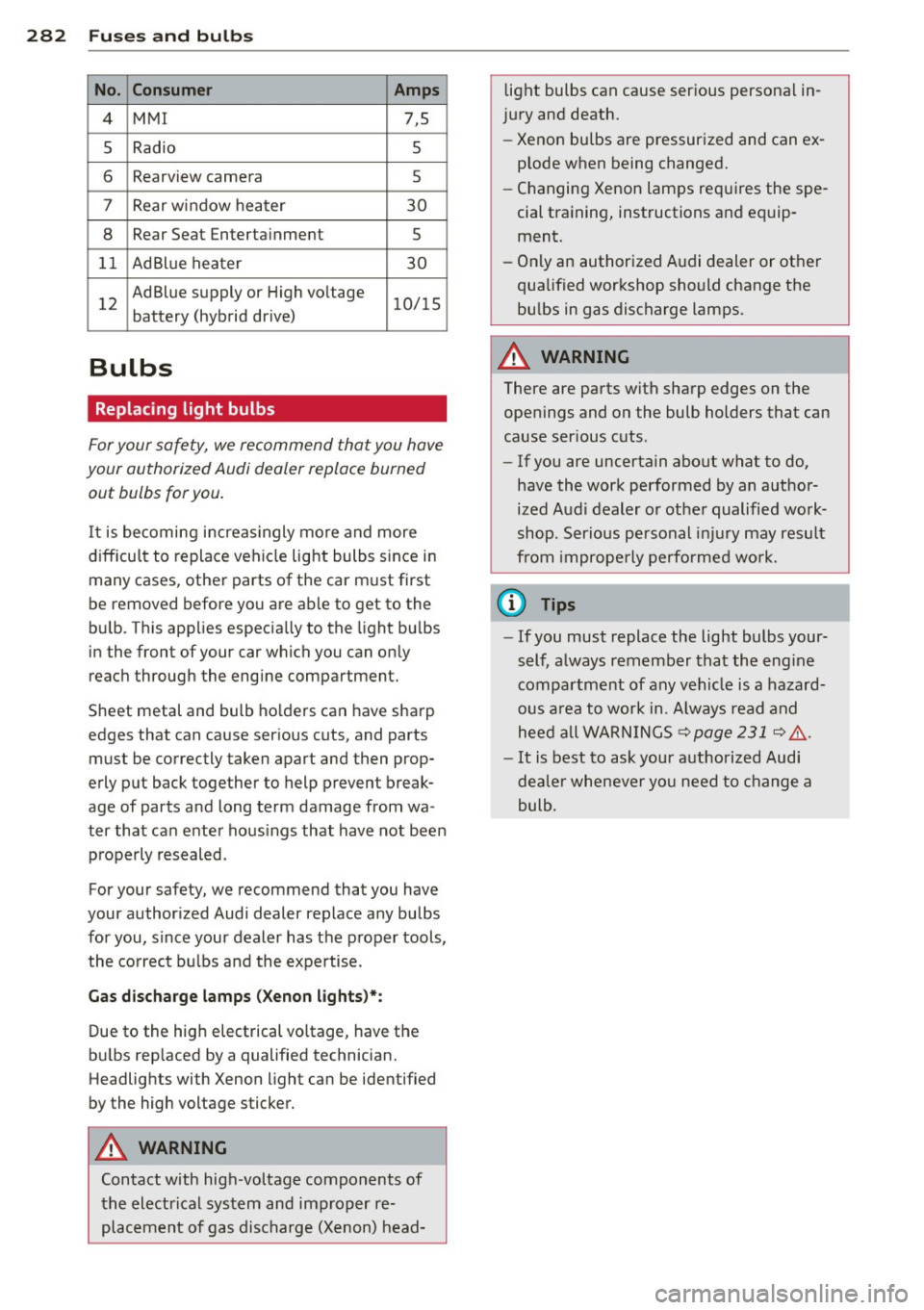
No. Consumer Amps
4 MMI 7,5
5
Radio 5
6 Rearview camera 5
7
Rear w indow heater 30
8 Rear Seat Enterta inment s
1 1 AdBlue hea ter 30
1 2
Ad Blue supply or High vo ltage 1 0/ 15
battery (hybrid dr ive)
Bulbs
Replacing light bulbs
F or your safety, we recommend that you have
your authorized Audi dealer replace burned
out bulbs for you.
It is becoming i ncreas ingly mo re and more
d iff icu lt to replace vehi cle lig ht bulbs s ince in
many cases, other parts of the car m ust first
be removed before yo u are ab le to get to the
bu lb. Th is app lies especia lly to the light bu lbs
in the front of your car which you can on ly
reac h throug h the engine compartment.
Sheet metal and bulb ho lde rs can have sharp
edges that can cause ser ious cuts, and parts
must be correctly taken apart and then prop·
erly put back together t o help prevent break
age of par ts a nd long term damage from wa
ter that ca n ente r hous ings that have not been
p roperly resealed.
For your safety, we recommend that you have
your author ized Audi dealer replace a ny bulbs
for you, since your dealer has the p roper tools,
the co rrect bu lbs and the expertise.
Gas d ischarge lamps (Xenon lights )*:
Due to the hig h electrical vo ltage, have the
bu lbs rep laced by a qualified technician.
Headlig hts with Xenon light can be identified
by the high voltage sticker.
A WARNING
Contact with high-voltage components of
t he electrical system and improper re
pl acement of gas dis charge (Xenon) head- light bulbs can cause ser
ious personal in·
j u ry and death.
- Xenon bulbs are pressur ized and can ex
plode when being changed.
- Changing Xenon lamps re quires the spe
cial tra ining, instructions and equip
ment.
- Only an auth orized A udi dealer or other
qualified wor kshop should change the
bu lbs in gas discharge lamps.
A WARNING
There are parts with sharp edges on the
openings and on the bulb holders that can
cause ser ious c uts.
- If you are uncertain about what to do,
have the work performed by an a uthor
ized Audi dealer or othe r qualified wo rk·
shop. Serious personal in jury may resul t
fr om imprope rly performed wo rk.
(D Tips
- If you must replace the light bulbs your ·
self, a lways remember tha t the eng ine
compar tment of any vehi cle is a hazard
ous area to work in. A lways read a nd
hee d all WARNI NGS
~page 231 ~ & .
-It is best to ask your authorized Audi
de aler whenever yo u need to c hange a
bulb .
-
Page 285 of 316
Emergency situations
General
This chapter i s intended for trained emer
gency crews and working personnel who have the necessary tools and equipment to
perform these operations.
Starting by pushing or
towing
(D Note
Vehicles with an automatic tran smission
cannot be started by pu shing or towing .
Starting with jumper
cables
If necessary, the engine can be started by
connecting it to the battery of another vehi
cle.
If the engine sho uld fail to start because of a
discha rged o r weak battery, the battery can be
connected to the battery o f
another vehicle,
using a
pair of jumper cables to start the en
g ine.
Jumper cables
Use only jumper cables of sufficiently la rge
c ross section to carry the starter c urrent safe
l y. Refer to the man ufacturer's specifications.
Use o nly jumper cables with
insulated te rm i
na l clamps w hich are d istinctly mar ked:
plus (+) cable in mos t cases co lore d red
minus (-) cab le
in most cases colored black .
A WARNING
Batterie s contai n elec tricity, ac id, an d gas.
Any of these c an cause ve ry ser io us or fatal
injury. Foll ow the instr uctions bel ow fo r
safe han dling of your veh icle's b attery .
- Alw ays s hield you r eye s and avoid lean
ing over the bat te ry whenever p ossib le.
- A dis ch arged b attery c an free ze at te m
pera tures ju st be low 3 2 °F ( 0 °C ). Befo re
Emergency situations 283
connecting a jumpe r cab le, you must
thaw the fr ozen battery c omp lete ly, ot h
erwise it could explode.
- Do not allow battery acid to contact eyes
or skin. Fl ush any contacted area with
wate r immediately.
- Improper use of a booster battery to start a vehicle may cause an explosion.
- Vehicle batter ies genera te exp losive gas
es. Keep spar ks, flame and lighted c iga
rettes away from batte ries.
- Do not try to jump start any ve hicle w ith
a low ac id leve l in the battery.
- The vo ltage of the booste r batte ry m ust
a lso have a 12-Vol t rating. T he capacity
(Ah) of the booster battery sho uld not be
lowe r tha n that of the discharged bat
tery . U se of batte rie s of d iffe ren t voltage
or substan tially diffe rent "Ah" rat ing
may c au se a n exp losion and persona l in
JU ry.
- N ever cha rge a fro zen batte ry. Gas tr ap
pe d in t he ice may c ause an explosion.
- Never cha rge or use a batte ry tha t h as
been fr ozen. T he battery case may have
be weakened.
- Us e of b atter ies of differe nt voltage or
sub stant ia lly diff eren t ca pa city (Ah) ra t
i ng may c ause an ex plosion an d injury .
Th e capac ity (Ah) of the booster bat tery
should not be lower than that of the dis
charged batte ry .
- Before you chec k any thing in the engine
compa rtment, always read and hee d all
WARNINGS
¢page 231.
(D Note
-App lyin g a higher vo ltage booster ba t
t ery w ill cause expens ive damage to se n
sit ive e lectronic com ponents, such as
cont ro l units, relays, rad io, etc.
- The re must be no electrical contact be
tween the vehicles as ot herwise c urrent
co uld a lready start to f low as soon as the
p o sit ive(+) term inals a re connected. ..,. •
•