ESP AUDI Q5 2014 Repair Manual
[x] Cancel search | Manufacturer: AUDI, Model Year: 2014, Model line: Q5, Model: AUDI Q5 2014Pages: 316, PDF Size: 78.41 MB
Page 219 of 316
Vehicle care and clean ing
General information
Regular, proper care helps to maintain your
vehicle 's value. It can also be a requirement
when submitting warranty claims for corro
sion damage and paint defects on the body .
The required cleaning and care products can
be obtained from your authorized Audi dealer
or a qualified workshop . Read and follow the
instructions for use on the packaging.
A WARNING
-Us ing clean ing and care products incor
rectly can be dangerous to your hea lth.
- Always store cleaning and care products
out of reach of children to reduce the risk
of poisoning.
@) For the sake of the environment
-Preferably use environmentally-friendly
products when buying cleaning agents.
- Do not d ispose of leftover cleaning and
care products with household trash .
Car washes
-
The longer that deposits such as insects, bird
droppings, tree sap or road salt remain on the
vehicle, the more the surface can be dam aged. High temperatures such as those
caused by sunlight increase the corrosive ef
fect.
Before washing, wet heavy deposits w ith plen
ty of water.
Also, wash the underside of your vehicle once road salt stops be ing used for the season.
Pressure washers
When washing your vehicles with a pressure
washer, always follow the operating instruc
tions provided w ith the pressure washer . Th is
is especially important in regard to the pres
sure and spraying distance. Do not aim the
spray directly at seals on side w indows, doors,
Vehicle care and cleaning 217
the hood, the rear lid or the sunroof* or at
tires, rubber hoses, insulating material, sen sors* or camera lenses* . Keep a distance of at
least 16 inches (40 cm).
Do not remove snow and ice with a pressure
washer.
Never use rotary nozzles or high pressure noz
zles.
The water temperature must not be above
140 °F (60 °C) .
Automatic car washes
Spray off the vehicle before washing.
Make sure that the windows and roof* are
closed and the windshield wipers are
off. Fol
low instructions from the car wash operator,
especially if there are accessories attached to
your vehicle.
If possible, use car washes that do not have
brushes .
Washing by hand
Clean the vehicle starting from the top and
working down using a soft sponge or cleaning
brush. Use solvent-free cleaning products.
Washing vehicles with matte finish paint
by hand
To avoid damaging the paint when washing,
first remove dust and large particles from
your vehicle. Insects, grease spots and finger prints are best removed with a special cleaner
for matte finish paint.
Apply the product using a microfiber cloth. To
avoid damaging the paint surface, do not use
too much pressure .
Rinse the vehicle thoroughly with water. Then
clean using a neutral shampoo and a soft mi
crof iber cloth.
Rinse the vehicle thoroughly again and let it
air dry . Remove any water residue using a
shammy.
Stubborn deposits such as bi rd droppings or
tree sap are best removed with plenty of wa-
ter and a microfiber cloth.
Ill-
•
•
Page 221 of 316
Vehicle care and cleaning 219
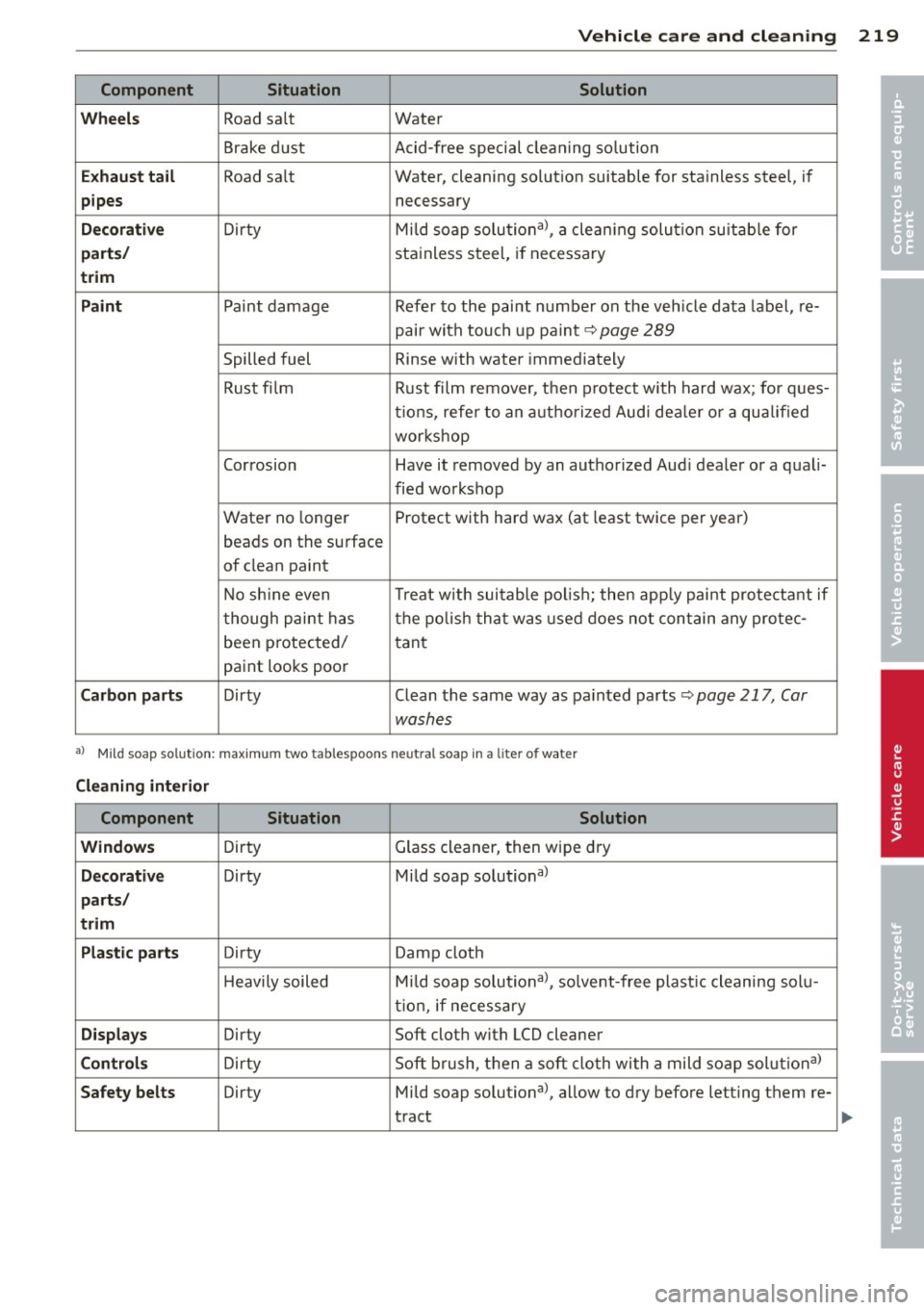
Component Situation Solution
Wheels
Road sa lt Water
Brake dust Acid-free special cleaning solution
Exhaust tail Road salt Water, cleaning solut ion suitable for stainless steel, if
pipes necessary
Decorative Dirty Mild soap
solutional, a cleaning solution suitab le for
parts/ stainless steel, if necessary
trim
Paint
Paint damage Refer to the paint number on the veh icle data label, re-
pair with touch up paint~
page 289
Spilled fuel R inse with water immediately
Rust fi lm Rust film1 remover, then protect with hard wax; for ques-
tions, refer to an authorized Audi dealer or a qualified
workshop
Corrosion Have it removed by an aut horized Audi dealer or a quali-
fied workshop
Water no longer Protect with hard wax (at least twice per year)
beads on th e surface
of clean paint
No shine even Treat
with suitable polish; then apply paint protectant if
though paint has the polish that was used does not contain any protec-
been protected/
tant
paint looks poor
Carbon parts Dirty Clean the same way as pa inted parts ~ page 217, Car
wash es
al Mild soap sol utio n: maximum two tablespoons neutral soap in a lite r of water
Cleaning interior
Component Situation Solution
Windows
D irty Glass
cleaner, then wipe dry
Decorative Dirty Mild soap solutional
parts/
trim
Plastic parts
Dirty Damp cloth
H eavily soiled Mild soap solutional, solvent-free plast ic cleaning solu-
tion, if neces sary
Displays Dirty Soft cloth with LCD cleaner
Controls Dirty Soft
bru5,h, then a soft cloth with a mild soap solut ional
Safety belts Dirty Mild soap solutional, allow to dry befo re letting them re-
tract
•
•
Page 222 of 316
220 Vehicle care and cleaning
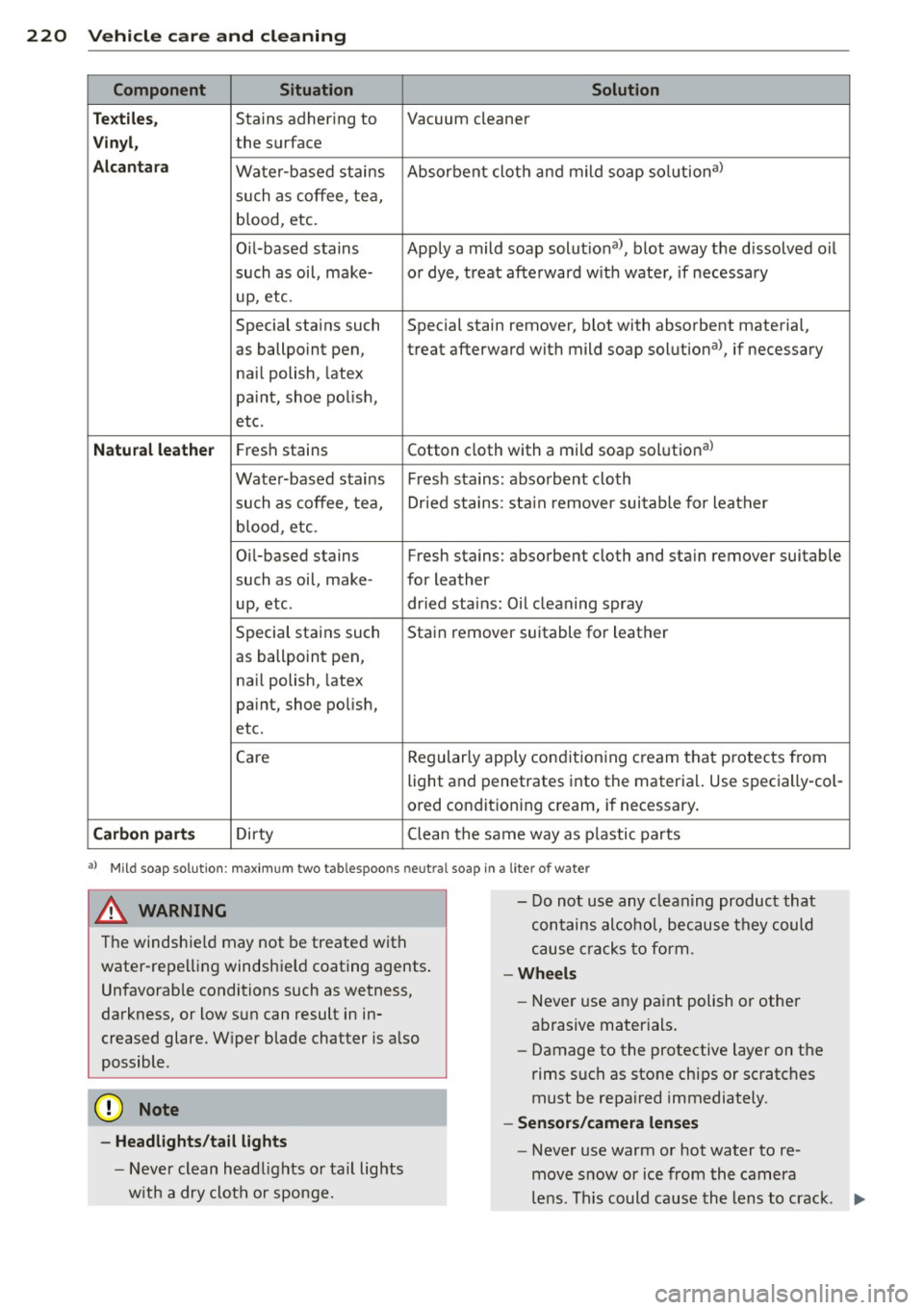
Component Situation Solution
T ex tile s,
Stains adhering to Vacuum cleaner
Vin yl, the surface
Alcan ta ra Water -based stains Absorbent cloth and mild soap solutiona>
such as coffee, tea,
blood, etc.
O il-based stains Apply a mild soap solutiona>, blot away the d issolved oil
such as oil, make- or dye, treat afte rward w ith water, if necessary
up, etc.
Special stains such Special stain remover, b lot with absorbent material,
as ballpoint pen, treat afterward with mild soap solutiona>, if necessary
na il polish, latex
pa int, shoe po lish,
etc.
Natu ral leather Fresh stains Cotton cloth with a mild soap solutiona>
Wate r-based stains Fresh s tains: absorbent cloth
such as coffee, tea, Dr ied stains: sta in remover sui table for leather
blood, etc.
Oi l-based stains Fresh stains: absorbent cloth and sta in remover suitable
such as oil, make- for leather
up, etc. dried stains: Oil cleaning spray
Special stains such Stain remover suitable for leather
as ballpo int pen,
na il polish, latex
pa int, shoe polish,
etc.
Care Regular
ly apply condit ion ing c ream that protec ts from
light a nd penetrates into the materia l. Use specially-col-
ored conditioning cream, if necessary.
Carbon part s Dirty Clean tlhe same way as plastic parts
a) Mi ld soap solut ion : maximum two tablespoons neut ra l soap in a lite r of wate r
& WARNING
The windshie ld may not be treated with
water -repe lling windshield coating agents .
Unfavorab le conditions such as wetness,
darkness, or low sun can result in in
creased glare. W iper blade chatter is a lso
possible .
(V Note
-Headlights /tail lights
- Never clean headlights or tail lights
w it h a dry cloth or sponge. -
Do not us e any cleaning product that
contains alcohol, because they could
cause cracks to form.
-Wheels
- Never use any paint polish or other
abrasive mater ials.
- Damage to the protective layer on the
rims such as stone chips or scratc hes
must be repa ired immediately.
- Sensor s/camera lenses
- Never use warm or hot water to re-
move snow or ice from the camera
le ns. Th is could cause th e lens to crack . ""
Page 225 of 316

-Anti-knock index must be 87 AKI or higher.
- Blend must contain not more than 15%
MTBE.
Seasonally adjusted gasoline
Many gasoline grades are blended to perform
especially well for winter or summer driving. During seasonal change-over, we suggest that
you fill up at busy gas stat ions where the sea
sonal adjustment is more likely to be made in
time.
(D Note
- Fuels containing a high percentage of
ethanol such as ESO and E85 may only
be used in veh icles with flex ible fuel* en
gines. Using high ethano l fuel in vehicles
not equipped with flexib le fue l* engines
can cause severe engine damage .
- Methanol fuels which do not meet these
requirements may cause corrosion and
damage to plastic and rubber compo
nents in the fuel system.
- Do not use fuels that fail to meet the
specified criteria in this chapter.
- If you are unable to determine whether
or not a particular fuel blend meets the
specifications, ask your service station or
its fuel supplier.
- Do not use fuel for which the contents
cannot be identified.
- Fuel system damage and performance
problems resulting from the use of fuels
different from those specified are not
the respons ibility of Audi and are not
covered under the New Veh icle or the
Emission Control System Warranties.
- If you experience a loss of fuel economy
or driveability and performance prob
l ems due to the use of one of these fuel
blends, we recommend that you switch
to unblended fuel.
Fuel supply and filling your fuel tank 223
Ethanol fuel (Bio-ethanol)
Applies to veh icles: w it h flex ible fue l en gin e
You can recognize vehicles with a flexible fuel
engine by looking at the label on the inside of
the fuel filler flap .
Vehicles with flexible fuel engines may be op
erated with bio -ethanol fuels such as E85
(85% ethanol and 15% gasoline) or with un
leaded gasoline (91 AKI/ROZ 95) . T he vehicle
may also be operated with a mixture of these
fuels.
Your fuel consumption will increase when us
ing bio-ethanol fue ls due to the lower amount
of energy contained per unit volume in etha
nol.
Warming up the flexible fuel engine in
low temperatures
Due to the chemical composition of b io-etha
nol, a certain amount of fuel ends up in the
engine oil when driving short distances in ve ry
low temperatures. This fuel evaporates again
when the engine is warmed up.
D Please warm up engine.
If the driver message appears in the instru
ment cluster disp lay, drive with a warm en
gine to reduce the oil level.
(D Note
- Never fill with methanol or with a higher
percentage of b io-ethanol than 85%
(E85). A h igher percentage of bio-etha
nol in the fuel can cause damage to the
engine or to the fue l system.
- If you use only E85, it is recommended
to fill the fue l tank complete ly w ith un
leaded premium grade gaso line every
5,000 miles.
- If you experience starting, rough id le or
hesitation driveability problems, fill the
fuel tank comp letely with unleaded pre
mium grade gasoline and dr ive it nor
mally until the gasoline is used. See your
authorized Audi dealer if the problem
pers ists.
•
•
Page 228 of 316
226 Fuel suppl y and filli ng your fu el t ank
enter the exhaust system and damage the
catalytic converter.
Refuelling
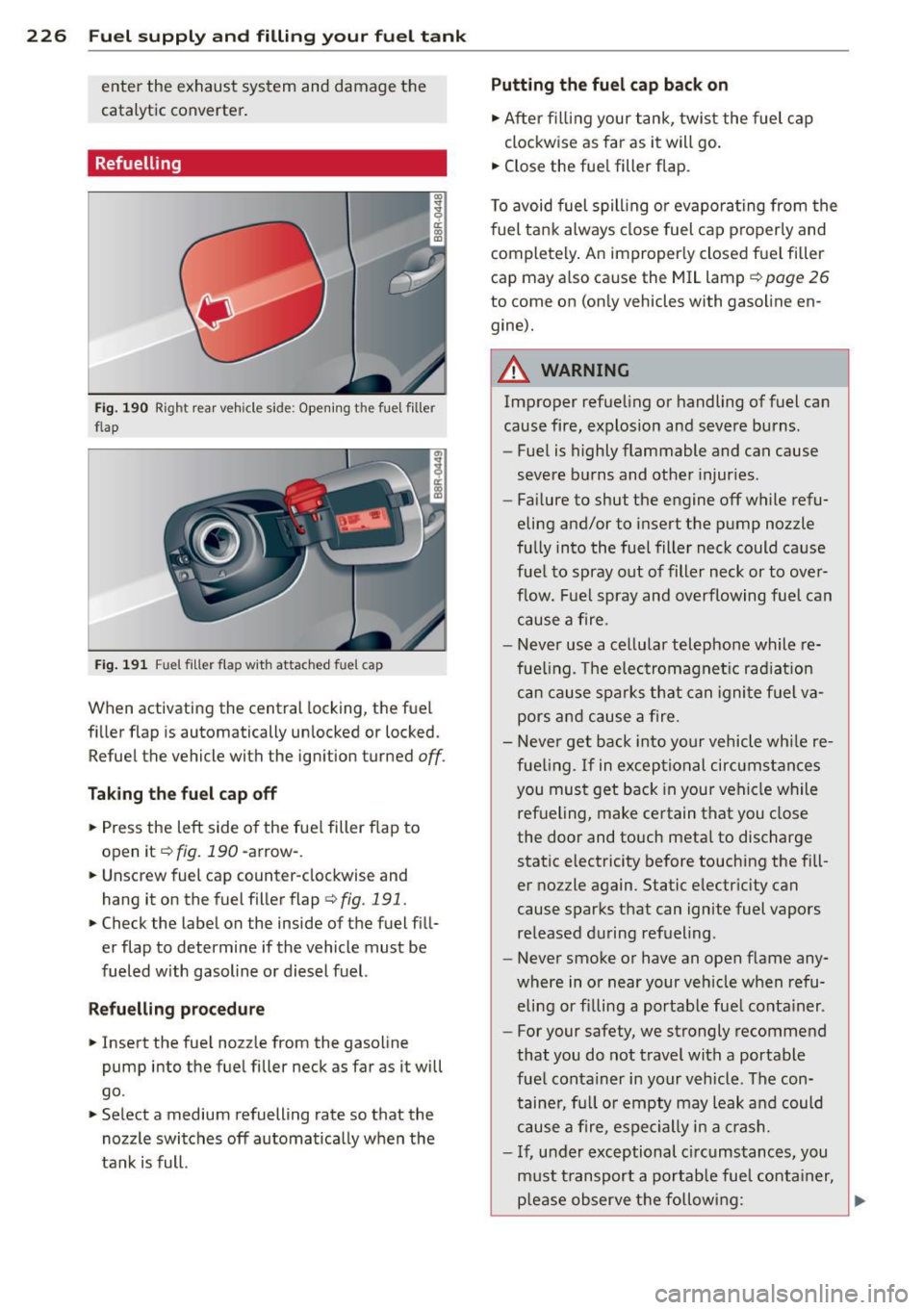
Fig. 190 Righ t rear ve hicle si de: Opening t he fuel filler
fl ap
Fig . 191 Fu el filler fla p w ith attached fuel cap
When activating the central locking, the fuel
filler flap is automatically unlocked or locked.
Refuel the vehicle with the ign ition turned
off .
Tak ing th e fu el cap off
• Press the Left side of the fue l filler flap to
open it ¢
fig. 190 -arrow-.
.. Unscrew fuel cap counter-clockwise and
hang it on the fuel filler flap ¢
fig. 191.
.. Check the Label on the inside of the fuel fill
er flap to determine if the vehicle must be
fueled with gasoline or diesel fuel.
Ref uelling pr ocedu re
.. Insert the fue l no zzle from the gasoline
pump into the fuel filler neck as far as it will
go .
.. Select a medium refuelling rate so that the
nozzle switches off automatically when the
tan k is full .
Putting the fu el cap b ack o n
• After f illing your tank, twist the fuel cap
clockwise as far as it will go .
.. Close the fue l filler flap.
T o avoid fuel spill ing o r evaporating from the
fuel tank always close fuel cap p roperly and
completely . An improperly closed fuel filler
cap may a lso ca use the
MIL Lamp ¢ page 26
to come on (on ly vehicles with gasoline en
gine).
A WARNING
-Improper refueling or handling of fuel can
cause fire, explosion and severe burns .
- Fuel is highly flammable and can cause
severe bu rns and other injur ies.
- Failure to shut the engine off while refu
eling and/or to insert the pump nozzle
fully into the fuel filler neck could cause
fuel to spray out of filler neck or to over
flow. Fue l spray and overflowing fuel can
cause a fire .
- Never use a cellular telephone while re
fue ling. The electromagnet ic rad iat ion
can cause spa rks that can ignite f uel va
pors and cause a fire .
- Never get back into your vehicle whi le re
fue ling.
If in exceptional circ umstances
you must get back in your vehicle while
refueling, make certain that you close
the door and touch metal to discharge
static e lectricity before touching the fill
er nozzle again . Static e lectr icity can
cause sparks that can ignite fuel vapors
released du ring refueling .
- Never smoke or have an open flame any
where in or near your vehicle when refu eling or filling a portable fuel conta iner.
- For your safety, we strongly recommend
that you do not travel with a portable
fuel conta iner in your vehicle . The con
tainer, fu ll o r empty may leak and could
cause a fire, especially i n a c rash.
- If , under exceptional c ircumstances, you
must transport a portab le fuel conta iner,
p lease observe the following: .,.
Page 233 of 316
Checking and filling Engine hood
Releasing the engine hood
The engine hood is released from inside the
vehicle .
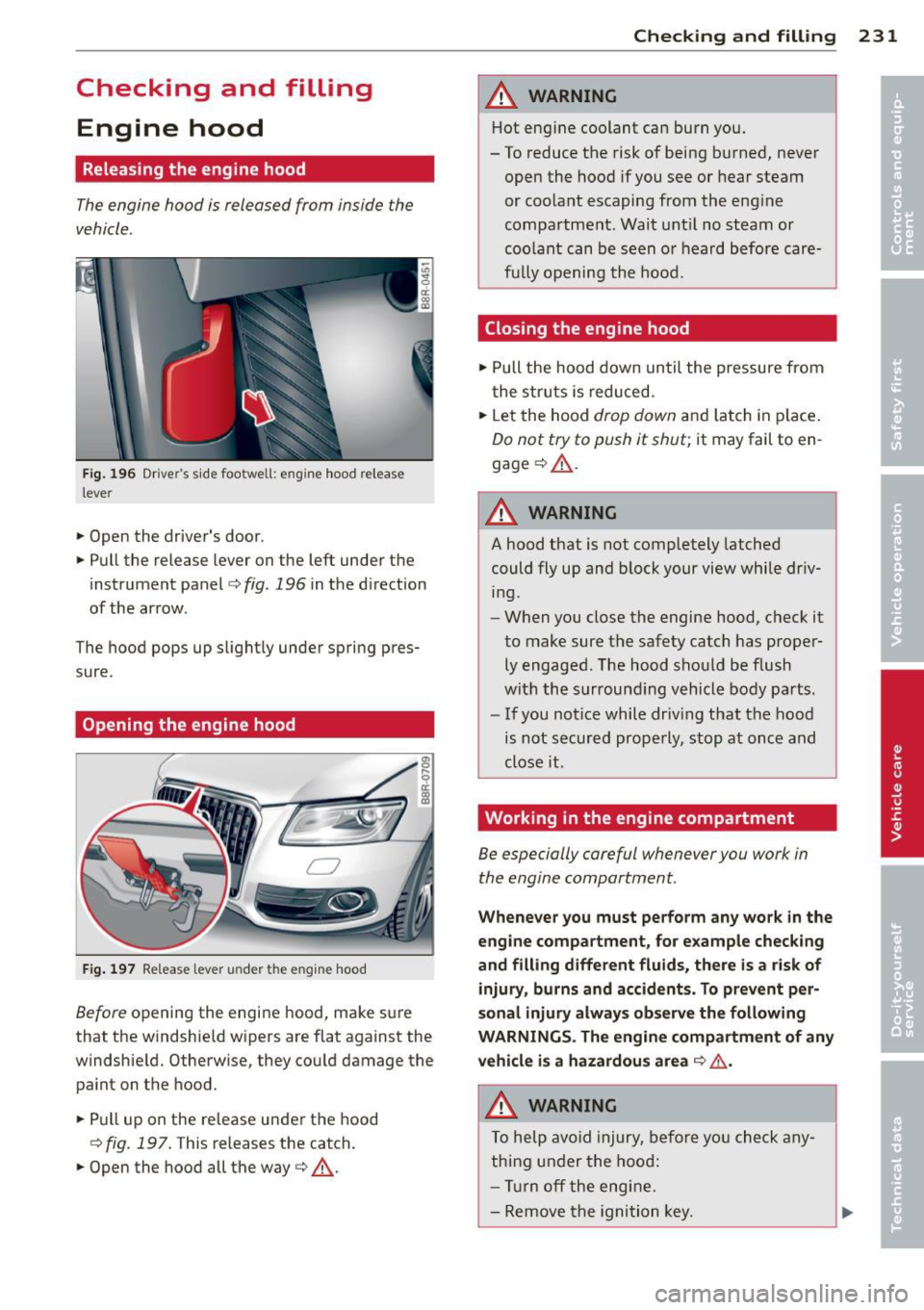
Fig. 196 Dr iver's side footwell: engin e hood release
lever
"' Open the driver's door .
"' Pull the release lever on the left under the
instrument panel
i=> fig. 196 in the d irection
of the arrow .
The hood pops up slightly under spring pres
sure.
Opening the engine hood
F ig . 197 Release lever under the engine hood
Before opening the engine hood, make sure
that the windshield wipers are flat against the
windshie ld. Otherwise, they could damage the
paint on the hood.
"' Pull up on the release under the hood
r::!> fig . 197 . This releases the catch.
"' Open the hood all the way
i=> .&,.
Checkin g and fillin g 231
A WARNING
Hot engine coolant can burn you.
- To reduce the risk of being burned, never
open the hood if you see or hear steam
or coolant escaping from the eng ine
compartment . Wait unt il no steam or
coolant can be seen or heard before care
fu lly opening the hood.
Closing the engine hood
"' Pull the hood down until the pressure from
the struts is reduced.
"' Let the hood
drop down and latch in p lace.
Do not try to push it shut; it may fail to en
gage
c;, .&, .
A WARNING
--
A hood that is not completely latched
could fly up and block your view while dr iv
ing.
- When you close the engine hood, check it
to make sure the safety catch has proper
ly engaged. The hood should be flush
with the surround ing vehicle body parts.
- If you notice while driv ing that the hood
is not secured properly, stop at once and
close it .
Working in the engine compartment
Be especially careful whenever you work in
the engine compartment.
Whenever yo u must pe rform any w ork in the
e n g ine com pa rt ment, for e xample ch ecki ng
and filling different fluids, th ere is a risk of
injury , burn s and accid ent s. T o pr eve nt per
so nal injury alwa ys obs erve the foll owing
WARNINGS . The en gine c ompa rtment of an y
vehicl e is a hazardou s are a
c;, Lh,.
A WARNING ~
To help avoid injury, be fo re you check any
thing under the hood:
- Turn off the engine.
- Remove the ignition key.
Page 240 of 316
238 Check ing and filling
Never mix oil additives with your engine
oil. These additives can damage your en
gine and adversely affect your Audi Limit
ed New Vehicle Warranty.
@) For the sake of the environment
- Before changing your oi l, f irst make sure
you know where you can properly dispose of the used o il.
- Always dispose of used engine oil proper
l y. Do not dump it on garden so il, wood
ed areas, into open streams or down
sewage dra ins.
- Recycle used engine oil by taking it to a
used engine oil collection facility in your
area, or contact a service station .
Engine cooling system
Coolant
The engine coolant performs two functions: it
keeps the engine from overheating and it pro tects the engine from freezing in the winter.
The cooling system is sea led and generally re
q ui res little attention .
The cooling system has been filled at the fac
tory with a pe rmanent coolant which does not
need to be changed. The coolant consists of a
mixture o f spec ia lly condi tioned water and the
manufacturer's glycol -basedcoolant addi -
tive G l3 antifreeze with anticorrosion addi
tives (50% for USA models ; 60% for Canadian
models). This mixture both assures the neces
sary frost protection and protects metal com
ponents in the engine's cooling system from
corrosion and scaling . It also raises the boil
i ng po int of the coo lant .
Do not red uce the concentration of the coo l
ant in the summer by adding plain water.
The
proportion of coolant add iti ve mu st be at
least 50 % but not more than 60 %
to main
tain antifreeze protection and cooling efficie n
cy.
If t he coolant frost protect io n is too low,
the coo lant cou ld freeze and damage the veh i
cle heating and engine cooling system. F
or year -ro und driving, antifreeze is added a t
the factory for temperatures down to :
- -31°F(-35° C)USA
- -40°F ( -40°C) Canada.
If you must add coolant, use a mixture of wa
ter and coolant additive . Mix ing the coo lant
additive with distilled water is recommended .
.&, WARNING
--
Before you c hec k anyth ing in the engine
compartment, a lways read and heed a ll
WAR NIN GS~ .&.
in Working in the engine
compor tment on page 231 .
(J;) Note
-Before winter sets in, have the coo lant
checked to see if the coolant additive in
yo ur vehicle is sufficient to meet the cli
mate condi tions . This is especia lly impor
tant if you live in a region where the win
ter is extreme ly co ld . If necessary, in
crease the p roportion of coo lant add itive
to 60%.
- When adding coolant additive to yo ur
cooling system, remember :
- W e r ecommend using o nly coola nt ad
d itive G l2++ or Gl3 for your veh icle.
T his coolan t additive is av ail ab le a t au
thor ized Audi dealers. O ther types of
antifreeze can significant ly reduce cor
rosion protection . The resulti ng cor ro
sion can cause a loss o f coolant and se
rious engine damage.
- Do not add any type of rad iator leak seal
ant to your vehicle 's eng ine coolant.
Add ing radiato r repair flu id may adverse
ly affect the function and performance of
your cooling system and co uld resu lt in
damage not cover ed by yo ur New Ve hicle
Limited Warranty.
Page 244 of 316
242 Checking and filling
@ For the sake of the environment
Be cause of the problem of proper disposa l
of brake flu id as we ll as the special tools
req uired and the necessary expert ise, we
recommend that you have the b rake fluid
changed by your author ized Audi dealer.
Battery
General information
Unde r normal operating conditions, the bat
tery in your A udi does not need any mainte
nance. With
high outside temperatures or
long daily dr ives we recommend that you have
the elect ro lyte level checked by an authorized
Aud i dea ler o r qualified workshop . The elec
trolyte leve l sho uld a lso be c hecked each t ime
the battery is c harged ¢
page 244.
Have the battery checked when you take your
ve hicle in for service . Yo u are well adv ised to
replace a bat tery that is older tha n 5 yea rs .
W ith certa in types of a irbag deployment, t he
battery is d isconnected from the vehicle elec
tr ica l system fo r safety reasons ¢
& in Re
pair, core and disposal of the airbags on
page 171.
Hybr id d rive *: you can find important i nforma
tion about the high voltage battery under
¢ page 97.
Disconnecting the battery terminals
Some veh icle functions (power w indow regu
lators, for example) are lost if the battery ter
minals a re discon nected. These functions have
to be re learned after the ba tte ry term inals a re
connect ed aga in. To prevent this , the battery
should only be d isconnected from the vehicle
e lec tric al sys te m whe n absolu tely necessa ry
for rep airs.
Vehicles not driven for long periods
If yo u do not dr ive you r vehicle over a pe riod
of severa l days or w eeks, ele ct rical com po
n e nt s are gr adually cu t ba ck o r swi tched off .
T his redu ce s energy consu mp tion and mai n- ta
ins s tart ing c apability over a longer pe riod
¢ page 203.
Take i nto consi deratio n that whe n you unl ock
yo ur vehicle, some conven ien ce f un ctions ,
s u ch as the inte rior ligh ts or the powe r sea t
adjustment, may not be availab le. T he con
venience functions will be avai lab le aga in
when you tu rn on the ign ition and start t he
engine.
Winter operation
Du ring the winte r mon ths, bat tery ca pac ity
tends to dec rease as tem peratures drop . This
is beca use more power is a lso consumed wh ile
starting, and the headlights, rear wi ndow de
fogger, etc ., are used more often.
Avoid unnecessary powe r consum ption, pa r
t icu lar ly in city traffic or when traveling only
sho rt distances. Let your authori zed Aud i
dealer check the capacity of the vehicle bat
te ry before winter sets in ¢
page 244. A well
c h arged battery will not on ly preven t starti ng
problems when the wea ther is cold, but w ill
also last lo nger.
Working on the battery
Be especially careful when working on or near
the ba ttery.
The battery is located in the luggage compart
me nt under the floor . B efo re you c hec k any
t hi ng in the luggage compartmen t,
read and
heed all WARNINGS
¢ & -
Hybrid dr ive* : yo u can find impo rtant informa
t io n about the h igh vol tage ba tte ry unde r
¢page 97 .
Always heed the safety warnings , when work
ing on the v ehicle ba tte ry or the vehicle e lec
t rical sys tem to preven t inju ry .
Page 247 of 316
-Always follow the operating instructions
provided by the battery charger manu
facturer when charging your battery.
- Never charge a frozen battery.
It may ex
plode because of gas trapped in the ice.
Allow a frozen battery to thaw out first.
- Do not reuse batteries which were fro
zen. The battery housing may have
cracked and weakened when the battery
froze.
- Charge the battery in a well ventilated
area. Keep away from open flame or elec
trical spark. Do not smoke . Hydrogen gas
generated by the battery is explosive.
- To reduce the danger of explosion, never
connect or disconnect charger cables
while the charger is operating.
- Fast charging a battery is dangerous and
should only be attempted by a compe
tent technician with the proper equip
ment.
- Battery acid that may spill during charg
ing should be washed off with a solution
of warm water and baking soda to neu
tralize the acid.
(D Note
Never use a fast charger as a booster to
start the engine. This will seriously dam
age sensitive electronic components, such
as control units, relays, radio, etc., as well
as the battery charger.
Battery replacement
The new battery must have the same specifi
cations and dimensions as the original equip
ment battery.
Intelligent energy management in your vehi
cle is responsible for distributing the electri
cal energy throughout your vehicle
¢ page 203. The intelligent energy manage
ment system will keep the engine battery
charged better then vehicles without this sys
tem . To make sure the additional electrical en
ergy is available once again after you have
changed the battery, we recommend that you
Checking and filling 245
install batteries of the same type and manu
facture only (the same as those installed at
the time your vehicle was delivered). Specifi cations are listed on the battery housing . Your
authorized dealer must code the battery in
the energy management system to enable you
to use the energy management functions cor
rectly after replacing the battery .
If it is not possible to use a battery of this
type , the new battery must have the same ca
pacity, voltage (12 volts), amperage, con
struction and plug sealing .
When installing the battery, make sure the ig nition and all electrical consumers are turned
off .
(D Note
-Make sure the ventilation hose on the
side of the battery is connected, other
wise fumes or battery acid can leak out .
- Vehicles with the Start-Stop-System* are
equipped with a special cycle-proof AGM
battery. Installing a different type of
battery can cause problems in the vehi
cle electrical system. When replacing the
vehicle battery, always install one with
the same specifications as the original
battery.
@ For the sake of the environment
Because of the problem of proper disposal
of a battery, we recommend your author
ized Audi dealer change the battery for
you. Batteries contain sulfuric acid and
lead and must always be disposed of prop
erly in compliance with all environmental
regulations. Disposing of vehicle batteries
improperly is very dangerous to the envi
ronment. •
•
Page 249 of 316
Tires and wheels
Tires
General notes
Tires may be the least appreciated and most
abused parts of a motor vehicle .
Tires may be the least appreciated and most
abused parts of a motor vehicle . Tires are,
however, one of the most important parts of a
vehicle, particularly considering the compara
tively small patch of rubber on each tire that
assures that a ll- important contact between
you, your vehicle and the road.
Maintaining the correct tire pressure, mak ing
sure that your vehicle and its tires do not have
to carry mo re weight than they can safely han
d le, avoiding damage from road hazards and
r eg ularly inspect ing t ires for damage i nclud
ing cuts, slashes irregu la r wear and ove rall
condition are the most important things that
you can do to he lp avoid sudden tire failure in
cluding tread separat ion and blowouts.
A voidin g damage
If you have to d rive over a curb or similar ob
stacle, drive very slow ly and as close as possi
b le at a right angle to the curb.
A lways keep chemicals includ ing grease, o il ,
gasoline and brake fluid off the t ires .
I nspect the t ires regularly for damage (cuts,
cracks or b listers, etc.). Remove any fo reign
bod ies embedde d in the treads.
Storing tires Mark tires when you remove them to indicate
the direction of rotation . T his ensures you to
be ab le to mount them correctly when you re
i nstall them .
When removed, the wheels or t ires should be
sto red in a cool, d ry and preferably dark place .
Store tires in a vertical pos ition if they are not
mounted on rims, in a horizontal pos it ion if
they are mounted on rims .
Tires an d wheel s 24 7
New tires
New ti res have to be broken in¢& .
The tread depth of new t ires may vary, accord
ing to the type a nd make of t ire and the tread
patte rn.
H idden damage
Damage to tires and r ims is ofte n not readily
visible . If you notice unusual v ib rat ion or the
vehicle pulls to one s ide, th is may ind icate
that one of the t ires has been damaged . T he
ti res m ust be chec ked immed iate ly by an au
thorized Audi dea le r or q ua lified wor kshop .
Unidirectional tires
A un idirectional tire can be identified by ar
rows on the sidewa ll, that po int in the direc
tion the t ire is designed to rotate. You mus t
f ol low the specified di rection o f rotation . T his
is necessary so that these tires can develop
their optimum characteristics regarding grip, road noise, wear and hydrop laning resistance.
For more information
¢ page 277.
A WARNING
New tires or t ires that are o ld, worn or
damaged cannot provide maximum con
trol and braking ability .
-
-New tires tend to be slippery and must
also be b roken-in. To reduce the risk of
losing control, a collision and serious
pe rsonal injuries, drive w it h special care
for the first 350 miles (560 km).
- Driving with worn or damaged tires can
lead to loss of control, sudden tire fail
ure, including a blowout and sudden de
fl ation, cras hes and se riou s personal in
juries . Have worn or damaged t ires re
placed immediate ly.
- Ti res age even if they are not being used
and can fai l sudden ly, especially at hig h
speeds. Tires that are more than 6 years
old can only be used in an emergency
and then w ith special care and at low
speed.
•
•