brake AUDI Q5 2014 Manual PDF
[x] Cancel search | Manufacturer: AUDI, Model Year: 2014, Model line: Q5, Model: AUDI Q5 2014Pages: 316, PDF Size: 78.41 MB
Page 263 of 316
-All four wheels must be fitted with radial
tires of the same type, size (rolling cir
cumference) and the same tread pattern .
Driving with different tires reduces vehi
cle handling and can lead to a loss of
control.
- If the spare tire is not the same as the
tires that are mounted on the vehicle -
for example with winter tires -only use
the spare tire for a short period of time and drive with extra care. Refit the nor
mal road wheel as soon as safely possi
ble.
- Never drive faster than the maximum
speed for which the tires on your vehicle
are rated because tires that are driven
faster than their rated speed can fail
suddenly.
- Overloading tires cause heat build-up,
sudden tire failure, including a blowout
and sudden deflation and loss of control.
- Temperature grades apply to tires that
are properly inflated and not over or un
derinflated .
- For technical reasons it is not always
possible to use wheels from other
vehicles -in some cases not even wheels
from the same vehicle model.
- If you install wheel trim discs on the ve
hicle wheels, make sure that the air flow
to the brakes is not blocked. Reduced air
flow to the brakes can them to overheat,
increasing stopping distances and caus
ing a collision.
- Run flat tires may only be used on
vehicles that were equipped with them at the factory. The vehicle must have a
chassis designed for run flat tires. Incor
rect use of run flat tires can lead to vehi
cle damage or accidents. Check with an
authorized Audi dealer or tire specialist
to see if your vehicle can be equipped
with run flat tires. If run flat tires are
used, they must be installed on all four
wheels . Mixing tire types is not permit
ted.
Tires and wheels 261
@ Note
- For technical reasons, it is not generally
possible to use the wheel rims from oth
er vehicles. This can hold true for wheels
of the same vehicle type.
- If the spare tire is different from the
tires that you have mounted on your ve
hicle (for example winter tires or wide
profile tires), then use the spare tire for a
short period of time only and drive with
extra care. Replace the flat tire with the
tire matching the others on your vehicle
as soon as possible.
- Never drive without the valve stem cap .
The valves could get damaged.
(® For the sake of the environment
Dispose of old tires in accordance with the
local requirements.
Uniform tire quality grading
- Tread wear
- Traction AA A B C
- Temperature ABC
Quality grades can be found where applicable
on the tire side wall between tread shoulder
and maximum section width
¢ page 258,
fig. 209.
For example: Tread wear 200, Traction AA,
Temperature A.
All passenger car tires must conform to Feder
al Safety Requirements in addition to these
grades.
Tread wear
The tread wear grade is a comparative rating
based on the wear rate of the tire when tested
under controlled conditions on a specified
government test course.
For example, a tire graded 1S0 would wear
one and one half (1 1/2) times as well on the
government course as a tire graded 100. •
•
Page 266 of 316
264 Tire s and wheel s
driving a few yards and correct if neces
sary. Follow the instructions from the
snow cha in manufacturer when doing so.
(D Tips
Where snow chains are mandatory oncer
tain roads, this normally also applies to
veh icles with all-wheel dr ive .
Wheel bolts
Wheel bolts must always be tightened to the
correct torque.
The design of whee l bolts is matched to the
factory insta lled rims . If different rims are fit
ted, the correct wheel bolts with the right l ength and correctly shaped bolt heads must
be used. This ensures that wheels are f itted
securely and that the brake system functions
correctly .
In certain circumstances, you may not use
wheel bolts from a different vehicle -even if it
is the same model
¢ page 295.
.&_ WARNING
Improperly tig htened or maintained wheel
bolts can become loose ca using loss of
cont ro l, a co llision and serious p ersona l in
Jury.
- Always keep the wheel bolts and the
threads in t he wheel hubs clea n so the
wheel bolts can tu rn easily and be prop
erly tigh tened.
- N ever grease or oil the wheel bo lts and
the threads in the wheel h ubs. They can
become loose w hile d riving if greased or
oiled, even if tightened to the specified
torq ue.
- Only use wheel bolts that be long to the
rim being installed.
- N ever use different whee ls bolts on your
vehicle.
- Always mai nta in the co rrec t tighte ning
tor que fo r the wheel bo lts to reduce the
risk of a wheel loss . If the tightening tor
que of the wheel bo lts is too low, they
can loosen and come out when the veh i- cle is moving.
If the tightening torque is
too high, the wheel bolts and threads
can be damaged and the wheel can be
come loose.
(D Note
The specified torque for the whee l bolts is
105 ft lb (140 Nm) with a to lerance of
± 7,4 ft lb(± 10 Nm). Torque wheel bolts
diagonally . After changing a wheel, the
torque must be checked as soon as poss i
ble with a to rque wrench -preferab ly by an
a uthorized Aud i dea le r or qualified wor k
shop.
Low aspect ratio tires
Your A udi is factory -eq uipped w it h low aspect
ratio tires. These tires have been thoroughly
tested and been se lected specifically for your
model for their superb performance, road fee l
and handling under a variety of driving condi
t ions . Ask your authorized Audi dealer for
more details .
The low aspect ratio of these tires is ind icated
by a numeral of
55 or less in the tire's s ize
designation . The numeral represents the ratio
of the tire's sidewall height in relation to its
t read width exp ressed in percentage. Conven
tiona l tires have a he ight/w idth rat io of 60 or
more.
Th e performanc e of low-a spect-ratio tire s is
pa rticularly sensi tive to improp er inflation
pre ssure. It i s ther efor e important that low
a spe ct ratio tir es are inflated to the spe cified
pre ssure and that the inflation pre ssure i s
regula rly checked and mainta ined. Tire pre s
sure s should be checked at lea st once a
month and al way s befo re a long trip
¢ page 2 53, Checking tire pressure.
What you can do to a void tire and rim
damage
Low aspect ratio tires can be damaged more
easily by impact w ith potholes, curbs, gul lies
or ridges on the road, particularly if the tire is
underinflated . ..,.
Page 274 of 316
272 What do I do now ?
Performing the repair
App lies to vehicles: with tire repair kit
Fig. 217 Perform ing the rep air
Pre parati ons
.. Park the vehicle as far as possible from mov
ing traffic in the event of a flat tire.
.. Set the
parki ng brake to prevent the vehicle
from roll ing unintentionally .
.. Shift the
se lec tor le ver in to th e P po siti on.
.. Determine whethe r a repair w ith the tire re
pair kit is possible or not
¢ page 271.
.. Let all of the passengers ex it th e vehicle
and move a safe distance away ¢& .
.. Take the
sealant bottle and the compre ssor
out of the luggage compartment
¢ page 104, fig. 112.
.. Affix the label "max. 50 mph (80 km/h)",
found on the sealant bottle, to the instru
ment cluster where it can be seen by the
dr iver .
Fill ing a tire
.. Shake the bottle thoroughly before f il li ng.
.. Screw the accompanying filling hose com-
pletely onto the bottle. This breaks through
the foi l seal automatically at the connec
t ion.
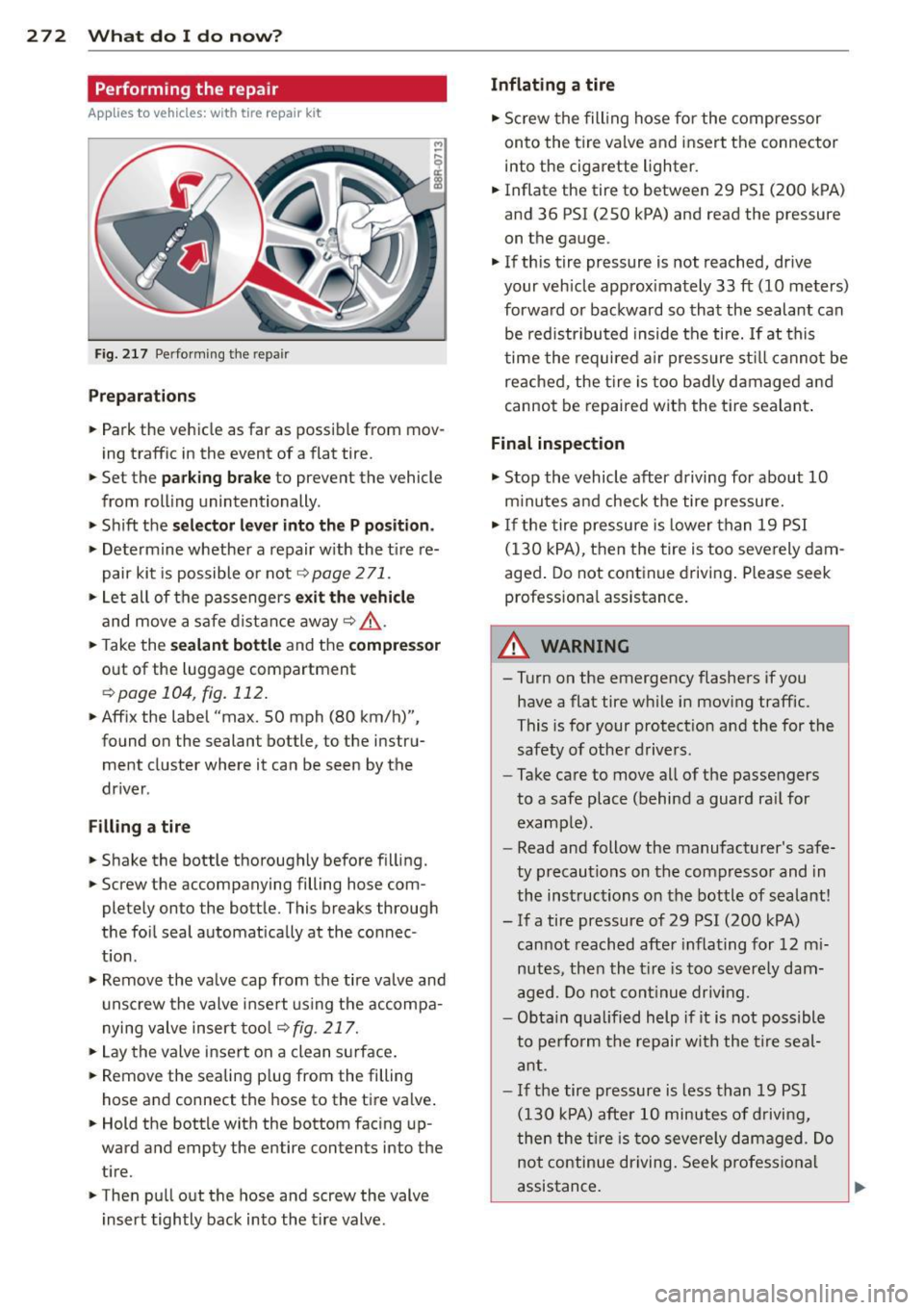
.. Remove the valve cap from the tire va lve and
uns crew the valve inse rt using the accompa
nying valve insert too l¢
fig . 217.
.. Lay the valve insert on a clean s urface .
.. Remove the sealing p lug from the filling
hose and connect the hose to the tire va lve .
.. Hold the bottle with the bottom fac ing up
ward and empty the entire contents into the
tire.
.. Then pu ll out the hose and screw the valve
i nsert tightly back into the tire valve .
Inflating a tire
.. Screw the fill ing hose for the compressor
onto the tire valve and insert the connector
into the cigarette lighter .
.. Inflate the tire to between 29 PSI (200 kPA)
and 36 PSI (250 kPA) and read the pressure
on the gauge .
.. If this tire pressure is not reached, dr ive
your veh icle approximately 33 ft ( 10 meters)
forward or backward so that the sealant can be red istr ibuted inside the tire.
If at this
time the requi red a ir pressure st ill cannot be
reached , the tire is too badly damaged and
cannot be repaired with the tire sealant .
Final inspection
.. Stop the vehicle after driving for about 10
m inutes and check the tire pressure .
.. If the tire pressure is lower than 19 PSI
( 1 30 kPA), then the tire is too seve rely dam
aged. Do not continue driving . Please seek
professiona l assistance.
A WARNING
--
- Turn on the emergency flashers if you
have a flat tire while in moving traffic .
This is for your protect ion and the for the
safety of other drivers.
- Take care to move all of the passengers
to a safe place (behind a guard ra il for
example) .
- Read and follow the manufacturer's safe
ty precautions on the compressor and in
the instructions on the bottle of sealant!
- If a tire pressure of 29 PSI (200 kPA) cannot reached after inflating for 12 m i
nutes, then the t ire is too severe ly dam
aged. Do not cont inue driving.
- Obta in qualified help if it is not possible
to pe rform the repair w ith the tire seal
a nt .
- I f the tire pressure is less than 19 PSI
(130 kPA) afte r 10 minutes of d riving,
then the t ire is too severely damaged . Do
not continue dr iving. Seek p rofess ional
assistance .
Page 275 of 316
(D Note
Special care is required if you are repairing
the tire on a steep incline.
@ Tips
-Do not operate the compressor for more
than 12 minutes continuously, otherwise it can overheat. Once the compressor has
cooled, you can continue to use it.
- If sealant has spilled out, let it dry and
then you can remove it by peeling it away
like a foil.
- Remember to obtain a new bottle of
sealant from your authorized Audi dealer
after repairing a tire. After this, the func
tionality of the tire repair set is restored.
- Obey all laws.
Changing a wheel
Before changing a wheel
Observe the following precautions for your
own and your passenger's safety when chang
ing a wheel.
.,. After you experience a tire failure, pull the
car well away from moving traffic and try to
reach
level ground before you stop¢_& .
.. All passengers should
leave the car and
move to a safe location (for instance, behind
the guardrail) ¢
_&.
.. Engage the parking brake to prevent your
vehicle from rolling unintentionally¢_&.
.. Move
selector lever to position P ¢ _& .
.,. If you are tow ing a trai ler: unhitch the trail
er from your vehicle.
.,. Block the diagonally opposite wheel with
the folding chocks or other objects.
.. Take the
jack* and the inflatable spare tire*
out of the luggage compartment
¢page 268.
A WARNING
You or your passengers could be injured
while changing a wheel if you do not fol
low these safety precautions:
-
What do I do now? 273
- If you have a flat tire, move a safe dis
tance off the road. Turn off the engine,
turn the emergency flashers on and use
other warning devices to alert other mo
torists.
- Make sure that passengers wait in a safe
place away from the vehicle and well
away from the road and traffic.
- To help prevent the vehicle from moving
suddenly and possibly slipping off the
jack*, always fully set the parking brake
and block the wheel diagonally opposite
the wheel being changed with the fold
ing chocks or other objects. When one
front wheel is lifted off the ground, plac
ing the Automatic Transmission in P
(Park) will
not prevent the vehicle from
moving.
- Before you change a wheel, be sure the
ground is level and firm. If necessary,
use a sturdy board under the jack*.
- Always store the vehicle tool kit, the
jack* and the replaced tire in the luggage
compartment
¢page 145.
Changing a wheel
When you change a wheel, follow the se
quence described below step-by-step and in
exactly that order.
1. Remov e the decorative wheel cover*. For
more details see also
¢ page 274, Deco
rative wheel covers
or ¢ page 2 7 4,
Wheels with wheel bolt cops .
2. Loosen the wheel bolts¢ page 2 75 .
3. Locate the proper mounting point for the
jack* and align the jack* below that point
¢ page 275.
4. Lift the car with the jack* ¢ page 2 75 .
S. Remove the wheel with the flat tire and
then install the
inflatable spare tire*
¢page 276.
6. Tighten all wheel bolts lightly.
7.
Lower the vehicle with the jack*.
8. Use the wheel bolt wrench and
firmly
tighten all wheel bolts¢ page 2 75.
9. Replace the decorative wheel cover*.
•
•
Page 277 of 316
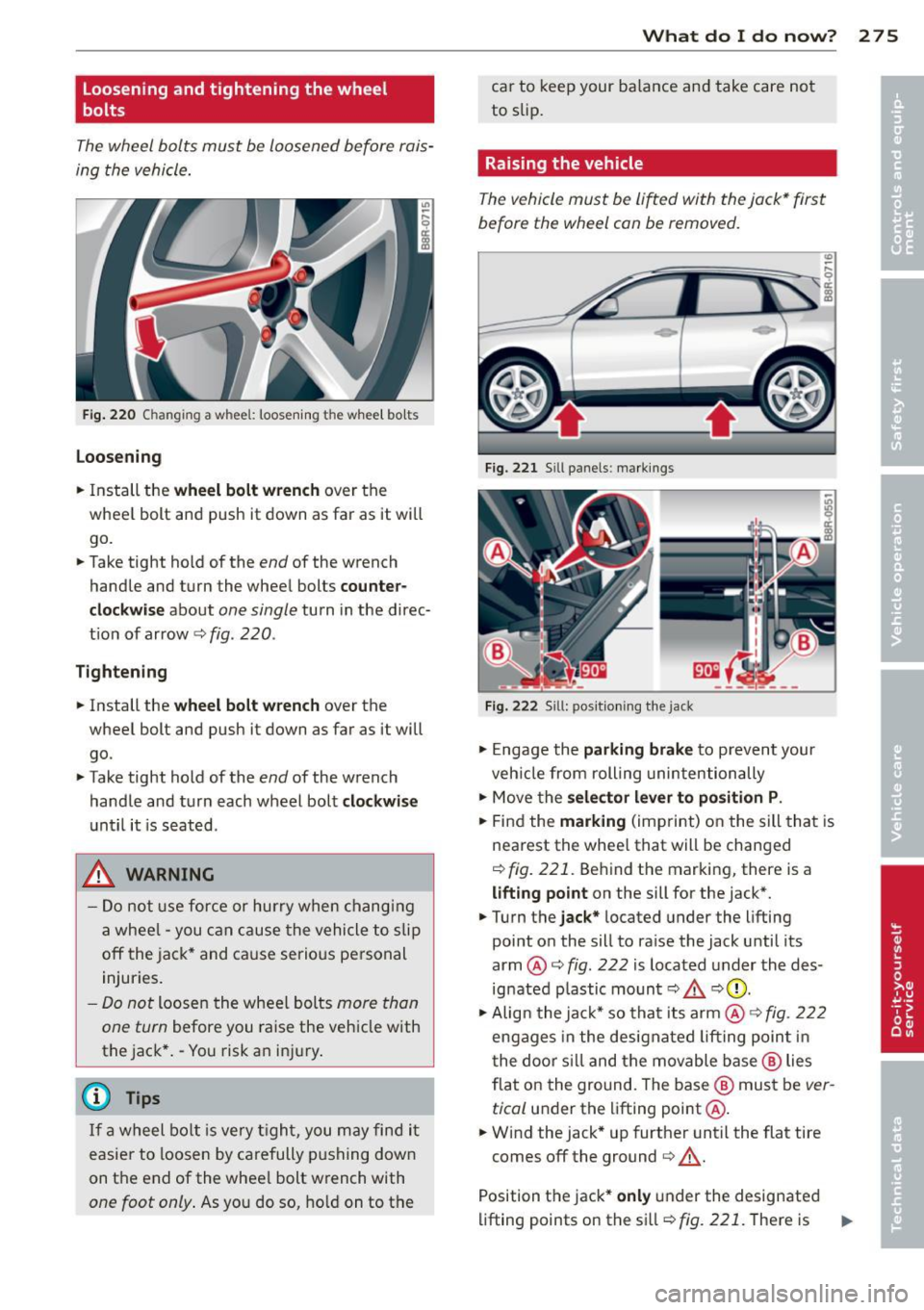
Loosening and tightening the wheel
bolt s
The wheel bolts must be loosened before rais
ing the vehicle.
Fig . 220 Changing a wheel: loosening the whee l bo lts
Loosening
.. Install the wheel bolt wrench over the
wheel bolt and push it down as far as it will
go .
.. Take tight hold of the
end of the wrench
handle and turn the wheel bolts
counter
clockwise
about one single turn in the direc
t ion of arrow c::>
fig. 220.
Tightening
.. Install the wheel bolt wrench over the
wheel bolt and push it down as far as it will go.
.. Take tight hold of the
end of the wrench
handle and turn each wheel bolt
clockwise
until it is seated .
.&, WARNING
-Do not use force or hurry when changing
a whee l -you can cause the vehicle to slip
off the jack* and cause serious personal
injuries.
- Do not loosen the wheel bolts more than
one turn
before you raise the veh icle with
the jack*. -You risk an injury .
(D Tips
If a wheel bolt is very tight, you may find it
easier to loosen by carefully pushing down
on the end of the whee l bolt wrench with
one foot only . As you do so, hold on to the
What do I do now? 275
car to keep your ba lance and take care not
to slip.
Raising the vehicle
The vehicle must be lifted with the jock* first
before the wheel con be removed.
Fig . 221 Sill panels : marking s
Fig. 222 Sill: positio ning the jack
.,. Engage the parking brake to prevent your
vehicle from rolling unintentionally
.. Move the
selector lever to position P .
.. Find the marking (imprint) on the s ill that is
nearest the whee l that will be changed
c::>fig . 221. Behind the marking, there is a
lifting point on the sill for the jack*.
.. Turn the
jack* located under the lifting
point on the sill to raise the jack until its
arm @c::>
fig. 222 is located under the des
ignated p lastic mount c::>
& c::>0.
.,. Align the jack* so that its arm@
c::> fig. 222
engages in the designated lifting point in
the door s ill and the movable base® lies
flat on the ground. The base@ must be
ver
tical
under the lifting point@.
.. Wind the jack* up further until the flat tire
comes off the ground
c::> & .
Position the jack* only under the designated
lifting points on the s ill
c::>fig. 221. There is ll-
Page 279 of 316
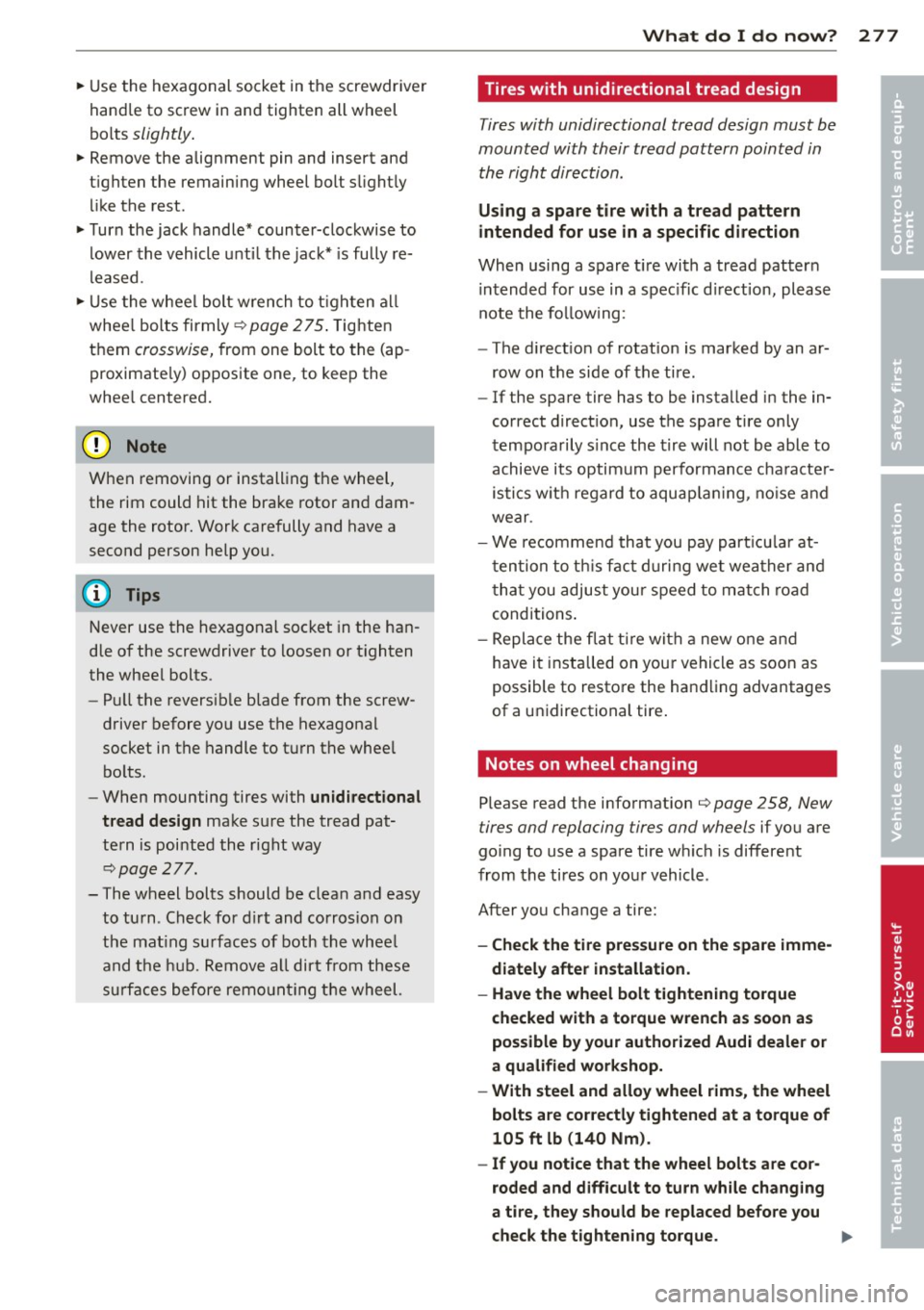
~ Use the hexagonal socket in the screwdriver
handle to screw in and tighten all wheel
bo lts
slightly .
~ Remove the alig nment pin and insert and
t igh ten the remaining wheel bolt s light ly
Like t he rest.
~ Turn th e jack handle* counter-clockwise to
l ower the vehicle unti l the jack* is fully re
leased .
~ Use the whee l bolt w rench to t ighten a ll
whee l bolts firmly <=>
page 2 75. Tighten
them
crosswise, from one bolt to the (ap
proximate ly) opposite one, to keep the
whee l centered.
Q;) Note
When removing or installing the wheel,
the rim could hit the brake rotor and dam
age the rotor. Work carefully and have a
second person help you.
(D} Tips
Never use the hexagonal socket in the han
dle of the screwdriver to loosen or tighten
the wheel bolts .
- Pull the reversib le b lade from the screw
driver before yo u use the hexagonal
socket in the handle to t urn the whee l
bo lts .
- When mounting tires with
unid irectional
tread design
make sure the tread pat
te rn is poi nted the right way
<=> page 2 77.
- The wheel bolts should be clea n and easy
to tu rn . Check for d irt and corrosion on
the mat ing s urfaces of both the wheel
and the hub. Remove a ll dirt from these
su rfaces before remo unting the wheel.
What do I do now? 277
Tires with unidirectional tread design
Tires with unidirectional tread design must be
mounted with their tread pattern pointed in the right direction .
Using a spa re tire with a tread pattern
intended for use in a specific direction
When using a spare t ire wi th a tread pat ter n
intended for use in a spec ific d irect ion, please
note the fo llowing :
- The d irect io n of rotation is marked by an ar
row on t he side of the ti re .
- If the spare tire has to be insta lled in the in
correct d irect ion, use the spare tire only
temporarily s ince the t ire will not be able to
achieve its optimum performance cha racte r
is tic s w it h regard to aquap la ni ng, no ise and
wear .
- We recommend that you pay part icu lar at
t en tion to th is f act d uring we t wea ther and
t ha t you adjus t you r speed to m atch r oad
conditions .
- Repla ce the fl at t ire wi th a new o ne and
have i t installed on your vehicle as soo n as
possible to resto re the han dling advantages
of a u nidirectional tire .
Notes on wheel changing
Please read the information¢ page 258, New
tires and replacing tires and wheels
if yo u a re
go ing to use a spare tire w hich is different
from the tires on yo ur vehicle .
After you change a tire:
- Check the tire pre ssure on the spare imme
diately after installation.
- Have the wheel bolt tightening torque
checked with a torque wrench as soon a s
possible by your authorized Audi dealer or
a qualified workshop.
- With steel and alloy wheel rims , the wheel
bolts are cor re ctly tightened at a torque of
105 ft lb (140 Nm).
- If you notice that the wheel bolts are cor
roded and diff icult to turn while changing
a tire, they should be replaced before you
check the t ightening torque. .,,.
•
•
Page 282 of 316
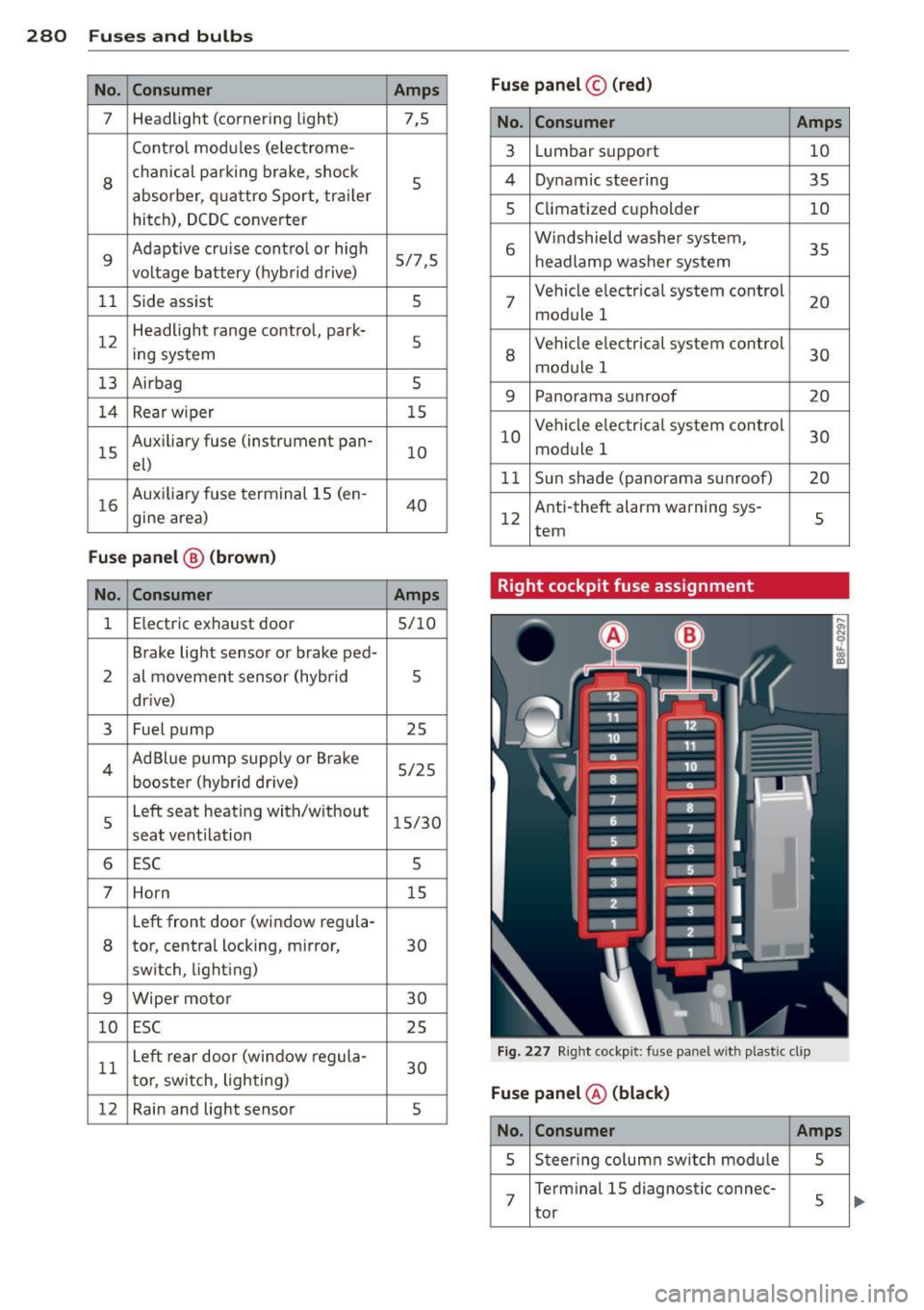
280 Fuses and bulbs
No. Consumer Amps Fuse panel
© (red )
7 Headlight (corner
ing light)
7,5 No. Consumer Amps
Contro l modu les (e lec trome-
3 Lum bar s upport 10
8
chanic al par king br ake, sho ck
5
absorber, q uatt ro Spor t, tra ile r
hitch), DCDC converter 4
Dynamic stee ring
35
5 Climat ized cu pholder 10
9
Adaptive cruise contro l or hig h
5/7,5
vo ltage battery (hybr id d rive) 6
W indshield w asher system,
35
h eadlamp washer sys tem
1 1 Side ass ist 5
7 Vehicle e
lectrical system control
20
module 1
12 H
eadlight range contro l, par k·
5
ing sys tem
8
Ve hicle e lec tric al syste m control
30
mod ule 1
13 Airbag
5
9 Panorama sunroof
20
1 4 Rear wiper 15
1 5 Aux
iliary fuse (instrument pan·
10
el)
16
Auxi liary fuse term inal 15 (en -
40
gine area) 10
Vehicle e
lectrica l system control
30
module 1
1 1 Sun shade (panorama s unroof) 20
1 2 Anti-theft alarm warning sys·
s
tern
Fuse panel
@ (brown)
No. Consumer Amps Right cockpit fuse assignment
1 Electric exhaust door
5/10
Brake lig ht sensor o r brake ped·
2 al movem ent s ensor (hybrid 5
dr ive)
3 Fuel pump 25
4 AdBl
ue p ump supp ly o r Br ake
5/25
booste r (hybr id drive)
5 Left seat heati
ng wit h/w ithout
15/30
seat vent ilation
6 ESC 5
7 Horn 15
Left front door (window regula ·
8 tor, central locking, m irror,
30
sw itch, light ing)
9 Wipe r moto r 30
10 ESC 25
11 Le
ft r ear do or (win dow regul a-
30
t o r, sw itch, lighting)
12 Rain and light se
nso r
5
Fig. 22 7 Right cockp it: fuse panel wit h plast ic clip
Fuse panel ® (black)
No. Consumer Amps
5 Steering column sw itch mod ule s
7
Terminal 15 diagnostic connec·
tor
5
Page 283 of 316
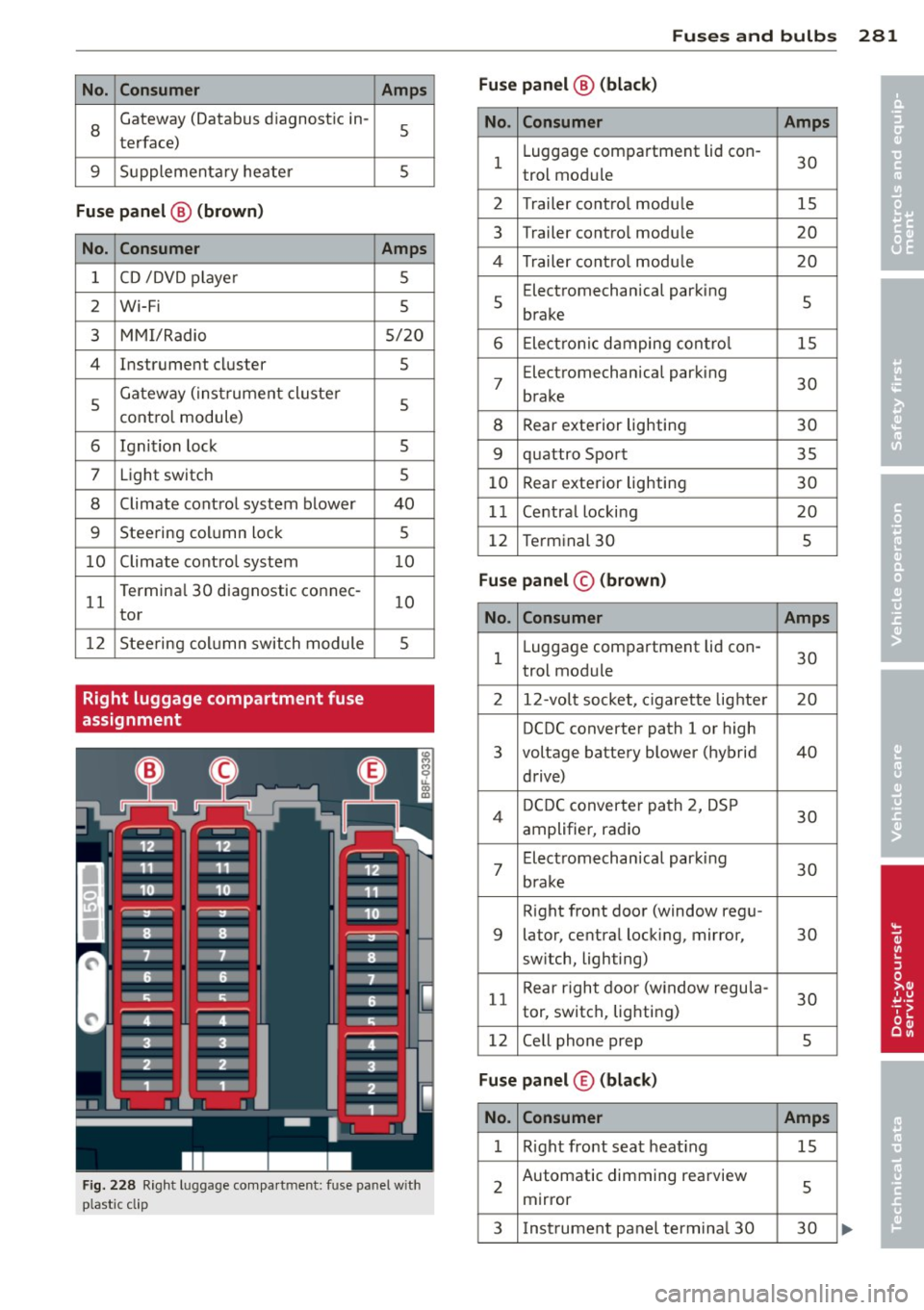
No. Consumer
8
Gateway (Databus d iagnostic in-
terface)
9 Supplementary heater
Fuse p anel @ (b rown )
N o. Con sumer
1 CD /DVD player
2 Wi-Fi
3 MMI/Radio
4 Instrument cluster
5 Gateway
(instrument cluster
cont rol module)
6 Ignition lock
7 Light switch
8 Climate control system blower
9 Steering column lock
10 Climate contro l system
11 T
erminal 30 diagnostic connec-
tor
12 Steering column switch module
Right luggage compartment fuse
assignment Amps
5
5
Amps
5
5
5/20
5
5
5 5
40
5
10
1 0
5
Fig. 228 Right luggage compa rtment: fuse panel w ith
ptastic cl ip
Fu ses and bulb s 281
Fus e panel@ (bla ck)
•
N o. Consumer Amps •
1 Luggage
compartment lid con-
30
trol module
2 Trailer contro l modu le 15
3 Trailer contro
l modu le
20
4 Trailer cont ro l modu le 20
5 Electromechanical
parking
5
brake
6 Electronic damping contro l 15
7
Electromechanical parking
30
brake
8 Rear exterior lighting
30
9 quattro Sport
35
10 Rear
exterior lighting
30
1 1 Centra l locking 20
12 Terminal 30 5
Fuse pan el© (brown )
No . Consumer Amps
1 Luggage compartment lid con-
30
trol module
2 12-vo lt socket, c igarette lighte r 20
DCDC converter path 1 or high
3 voltage
battery blower (hybrid 40
drive)
4 D
CDC converter path 2, DSP
30
amplifier, radio
7
Electromechan ical parking
30
brake
Right front door (window regu-
9 lator, central locking, mirror,
30
switch, lighting)
11 Rear
right door (window regu la-
30
tor, switch, lighting)
12 Cell phone prep
5
Fuse panel ® (bla ck )
No. Consumer Amps
1 Right front seat heat ing 15
2 Automatic dimming
rearview
5
mirror
3 Instrument panel termina l 30 30
Page 286 of 316
284 Emergency situations
@ Tips
-The discharged battery must be properly
connected to the vehicle's electrical sys
tem. When jump starting or charging the
battery, never connect the negative
ground cable to the battery negative
post because the battery manager sys
tem must be able to detect the battery's
state of charge . Always connect the neg
ative ground cable to the negative
ground post of the battery manager con
trol unit.
Use of jumper cables
Make sure to connect the jumper coble
clomps in exactly the order described below!
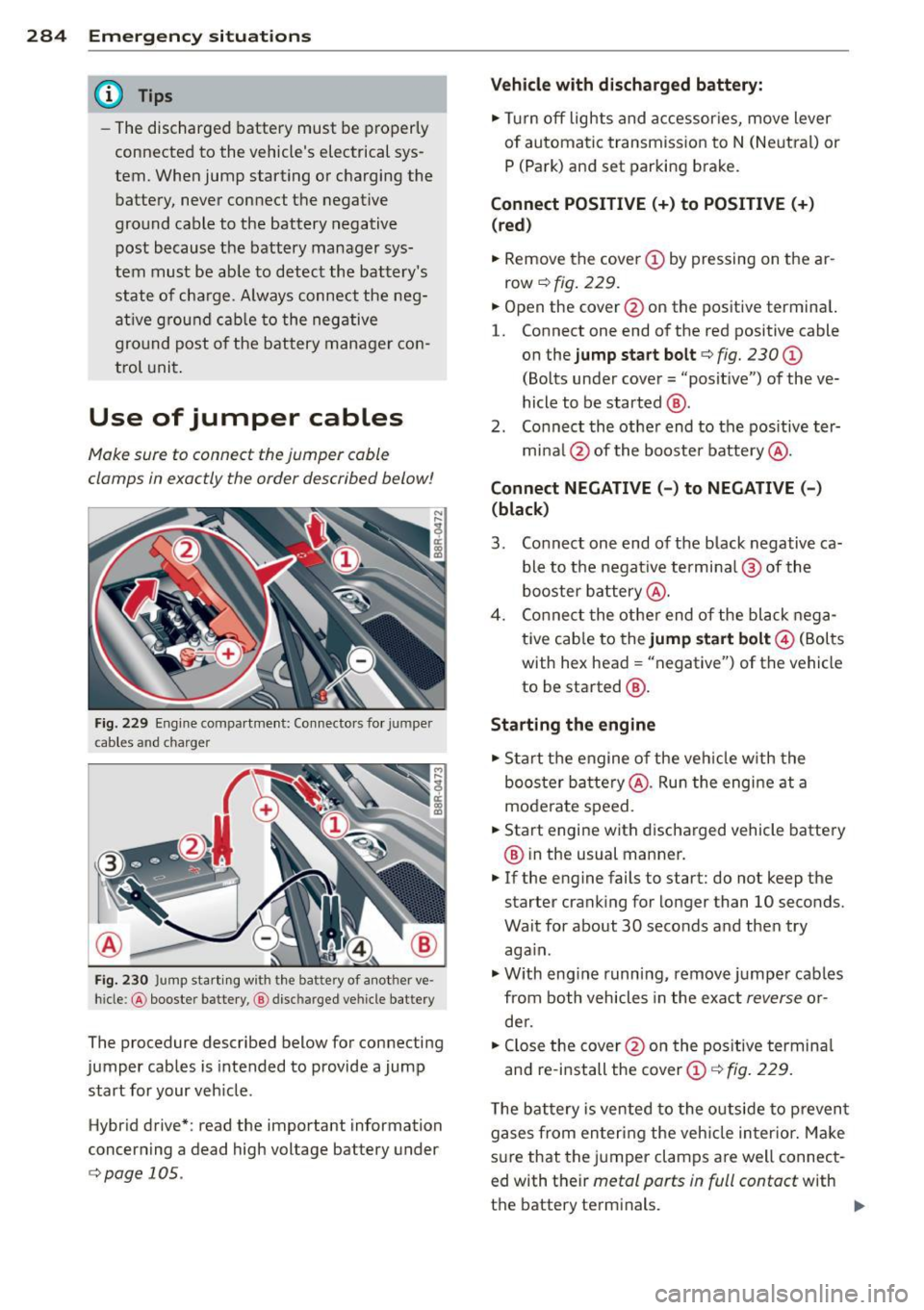
Fig . 229 Engine co mpartment: Conne cto rs fo r jum per
c ables a nd charger
Fig. 230 Ju m p sta rt in g w it h the bat te ry of anot her ve
h icle : @ booster battery ,@ disc harged vehicle battery
The procedure described below for connecting
jumper cables is intended to provide a jump
start for your veh icle .
Hybrid drive*: read the important information
concerning a dead high voltage battery under
c:;, poge 105.
Vehicle with discharged battery:
"Turn off lights and accessor ies, move lever
of automatic transmission
to N (Neutra l) or
P (Park) and set parking brake.
Connect POSITIVE(+) to POSITIVE(+)
(red)
.. Remove the cover CD by pressing on the ar
row
c:;, fig. 229 .
.. Open the cover @on the positive terminal.
l. Connect one end of the red positive cable
on the
jump start bolt c:;, fig. 230 CD
(Bolts under cover= "positive") of the ve
hicle to be started @.
2. Connect the other end to the positive ter-
minal @of the booster battery@.
Connect NEGATIVE( -) to NEGATIVE( -)
(black)
3 . Connect one end of the black negative ca
ble to the negat ive termina l@ of the
booster battery @.
4. Connect the other end of the black nega
tive cab le to the
jump start bolt@ (Bolts
with hex head= "negative") of the vehicle
to be started @.
Starting the engine
"Start the engine of the veh icle w ith the
booster battery@. Run the engine at a
moderate speed .
.. Start engine with discharged vehicle battery
@ in the usual manner .
.. If the engine fails to start: do not keep the
starter cranking for longer than 10 seconds.
Wait for about 30 seconds and then try aga in.
" With engine running, remove jumper cables
from both vehicles in the exact
reverse or·
de r.
" Close the cover @on the positive terminal
and re-install the cover
CD c:;, fig. 229.
The battery is vented to the outside to prevent
gases from entering the vehicle inter ior. Make
sure that the jumper clamps are well connect
ed with their
metal ports in full contact with
the battery terminals.
Page 287 of 316
& WARNING
To avoid serious personal injury and dam
age to the vehicle, heed all warnings and
instructions of the jumper cable manufac
turer. If in doubt, call for road serv ice.
- Jumper cables must be long enough so
that the vehicles do not touch.
- When connecting jumper cables, make
sure that they cannot get caught in any
moving parts in the engine compart
ment.
- Do not bend over the batteries -danger
of chemical burns!
- The battery ce ll locking screws must be
t ightened securely .
- Before you check anything in the engine
compartment, always read and heed all
WARNINGS
~ page 231.
{[) Note
Improper hook-up of jumper cables can ru
in the generator.
- Always connect POSITIVE(+) to POSI
TIVE(+), and NEGATIVE(-) to NEGATIVE
(-) ground post of the battery manager
control unit.
- Check that all screw plugs on the battery
ce lls are screwed in firmly .
If not, tighten
plugs prior to connecting clamp on nega
tive battery terminal.
- Please note that the procedure for con
necting a jumper cable as described
above applies spec ifically to the case of
your vehicle be ing jump started. When
you are giving a jump start to another ve
hicle, do
not connect the negative(-) ca
ble to the negative(-) terminal on the
discharged battery©
c::> fig. 230. In
stead, securely connect the negative(-)
cable to either a solid metal component
that is firmly bolted to the engine block
or to the engine block itself. If the bat
tery that is being charged does not vent
to the outside, escaping battery gas
could ignite and explode!
-
Emergency situations 285
Emergency towing
with commercial tow
truck
General hints
Your Audi requires special handling for tow
ing.
T he following information is to be used by
commercial tow truck operators who know
how to operate their equipment safely.
- Never tow your Audi, towing will cause
damage to the engine and transmission.
- Never wrap the safety chains or winch ca
ble s around the brake lines .
- To prevent unnecessary damage, your Audi
must be transported with a flat bed truck.
- To load the vehicle on to the flat bed , use
the towing loop found in the vehicle tools
and attach to the front or rear anchorage
i::>page 286 and ~page 286.
A WARNING
A vehicle being towed is not safe for pas
sengers. Never allow anyone to ride in a
vehicle be ing towed, for any reason.
-
•
•