check engine light AUDI Q5 2015 User Guide
[x] Cancel search | Manufacturer: AUDI, Model Year: 2015, Model line: Q5, Model: AUDI Q5 2015Pages: 302, PDF Size: 75.01 MB
Page 207 of 302
M N
co
a:
co
,...., \!) Ll"I
N Ll"I ,....,
Operating instructions
6"
~
a
2
. 1/2"
'
-{ I} 1-1/2"
-
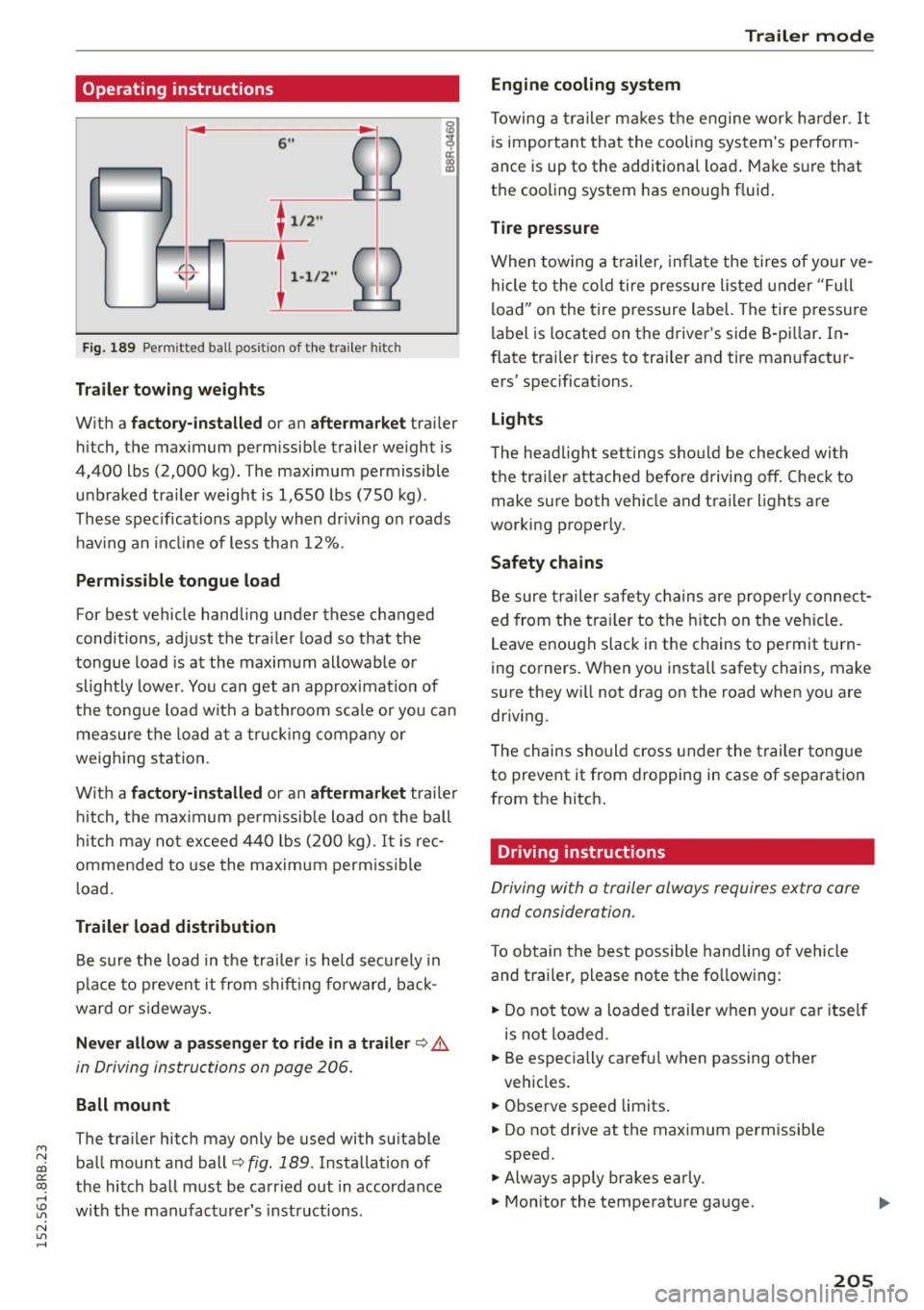
Fig. 189 Pe rmi tted ba ll pos it ion of the trailer hitc h
Trailer towing weights
With a factory-installed or an aftermarket trailer
hitch, the maximum permissible trailer weight is
4,400 lbs (2,000 kg) . T he maximum permissible
unbraked trailer weight is 1,650 lbs (750 kg) .
These specifications apply when dr iv ing on roads
having an inclin e of less than 12%.
Permissible tongue load
For best vehicle handling under these changed
conditions, adjust the traile r load so that the
tongue load is at the maximum allowable or
slightly lower. You can get an approximat ion of
the tongue load w ith a bathroom scale or you can
measure the load at a trucking company or
weighing station.
With a
factory-installed or an aftermarket trailer
hitch, the maximum permissible load on the ball
hitch may not exceed 440 lbs (200 kg). It is rec
ommended to use the maximum permissible
l oad.
Trailer load distribution
Be sure the load in the tra iler is held securely in
place to prevent it from shifting forward, back
ward or sideways .
Never allow a passenger to ride in a trailer c::> .&.
in Driving instructions on page 206.
Ball mount
The trailer hitch may only be used with suitable
ball mount and ball
c::> fig. 189 . Installation of
the hitch ball must be carr ied out in accordance
with the manufacturer's instructions .
Trailer mode
Engine cooling system
Towing a trailer makes the engine work harder . It
is important that the cooling system's perform
ance is up to the additional load . Make s ure that
the cooling system has enough fluid .
Tire pressure
When towing a trailer, inflate the tires of your ve
hicle to the cold tire pressure listed under "Full
load" on the tire pressure label. The tire pressure
label is located on the driver's side B·pillar. In·
flate trailer tires to trailer and tire manufactur
ers' specifications.
Lights
T he headlight settings sho uld be checked with
the trai ler attached before driving off. Check to
make sure both vehicle and trailer lights are
working properly.
Safety chains
Be sure trailer safety chains are properly connect
ed from the trailer to the hitch on the vehicle.
Leave enough slack in the chains to permit turn
ing corners. When you install safety chains, make
sure they w ill not drag on the road when you are
driving.
The chains should cross under the trailer tongue
to prevent it from dropping in case of separation
from the hitch.
Driving instructions
Driving with o trailer always requires extra core
and consideration .
To obtain the best possible handling of vehicle
and trailer, please note the fo llowing :
.. Do not tow a loaded trailer when your car itse lf
is not loaded.
.. Be especially careful when passing other
vehicles .
.. Observe speed lim its .
.. Do not drive at the maximum permissible
speed.
.. Always apply brakes early .
.. Mon itor the temperature gauge .
205
Page 223 of 302
M N
Checking and Filling Hood
Releasing the engine hood
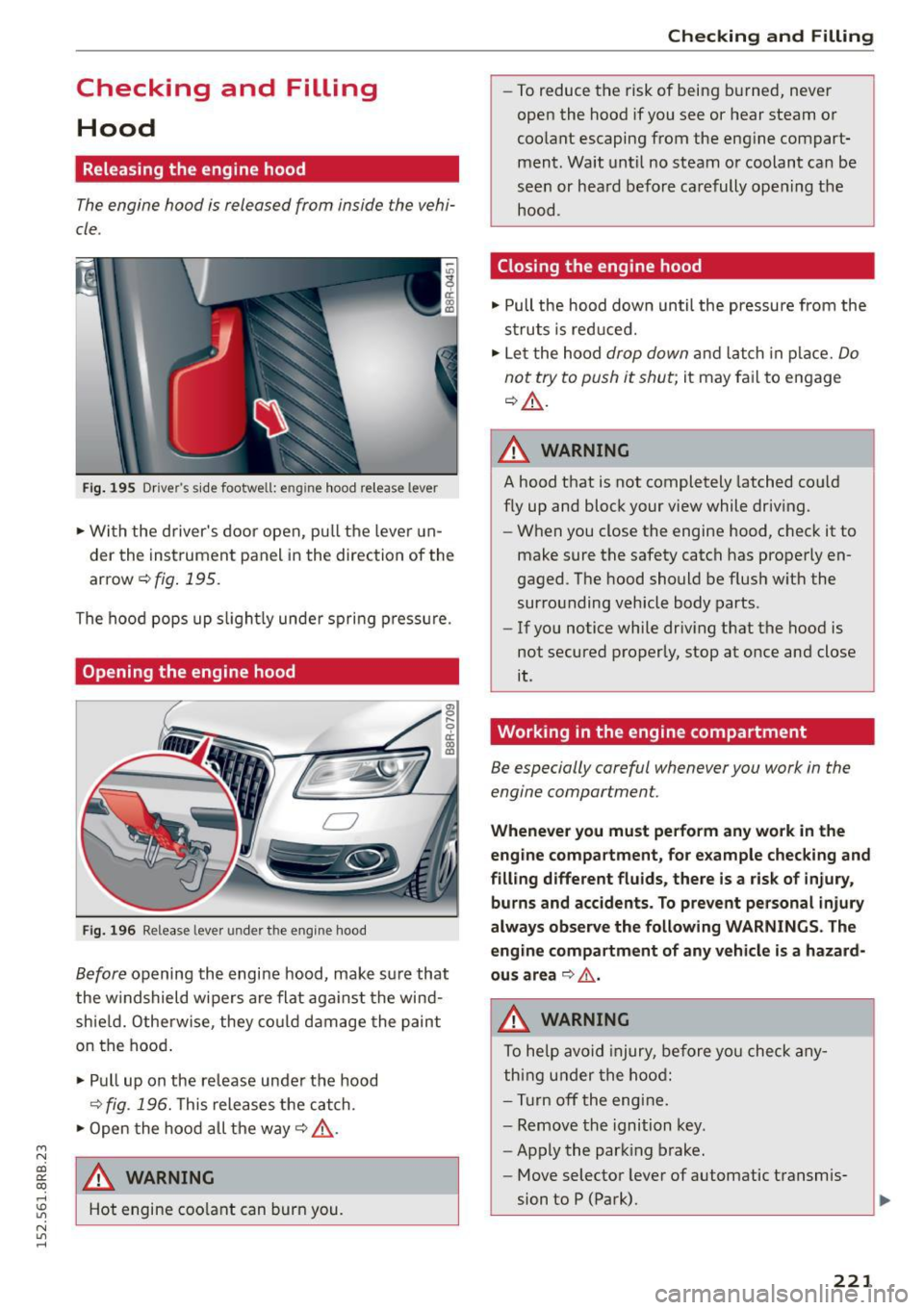
The engine hood is released from inside the vehi
cle .
Fig . 195 Drive r's side footwe ll: e ng ine hood re lease lever
"' Wi th the driver's door open, pu ll the leve r un
der the instrument panel in the direction of the
arrow
c::> fig . 195.
The hood pops up s light ly under spri ng press ure.
Opening the engine hood
Fig. 196 Relea se leve r un der the eng ine hood
Before opening the engine hood, make su re that
the w indshield wipers are flat aga inst the wind
shield. Otherwise, they could damage the paint
on the hood .
"' Pull up on the release under the hood
c:> fig . 196. This releases the catch.
"' Open the hood all the way
c::> A.
~ _&. WARNING
rl
:5: Hot engine coo lant can burn you.
N l/1 rl
Ch eck in g and Fillin g
-To reduce the risk of being burned, never
open the hood if you see or hear steam or
coolant escaping from the eng ine compart
ment. Wait until no steam or coolant can be
seen or heard before carefully opening the hood.
Closing the engine hood
"' Pull the hood down until the pressu re from the
struts is reduced.
"' Le t the hood
drop down and latch in p lace. Do
not try to push it shut;
it may fa il to engage
c::> A .
A WARNING
-
A hood that is not completely latched cou ld
fly up and block your view while driv ing.
-
- When you close the engine hood, check it to
make sure the safety catch has properly en
gaged . The hood should be flush with the
surrounding vehicle body parts .
- If you notice while driv ing that the hood is
not secured properly, stop at once and close
it .
Working in the engine compartment
Be especially careful whenever you work in the
engine compartment.
Wheneve r you must pe rfo rm an y wo rk in the
eng ine comp artment , for e xample chec king and
fi lling differen t fluids , ther e is a ri sk of i nju ry,
bu rn s and acci den ts. To p re ve nt pe rsonal injur y
al way s ob serve the follo wing WARN INGS . The
e ngi ne compartm ent of an y ve hicle is a haza rd
ou s area
~ ,&..
A WARNING
To help avoid injury, before you check any
thing under the hood:
- Turn off the eng ine.
- Remove the ignition key.
- Apply the parking brake.
-
- Move selector lever of automatic transmis-
sion to P (Park).
221
Page 225 of 302
M N
co ~ co
rl I.O
"' N
"' rl
Checking and Filling
Engine compartment
Engine compartment
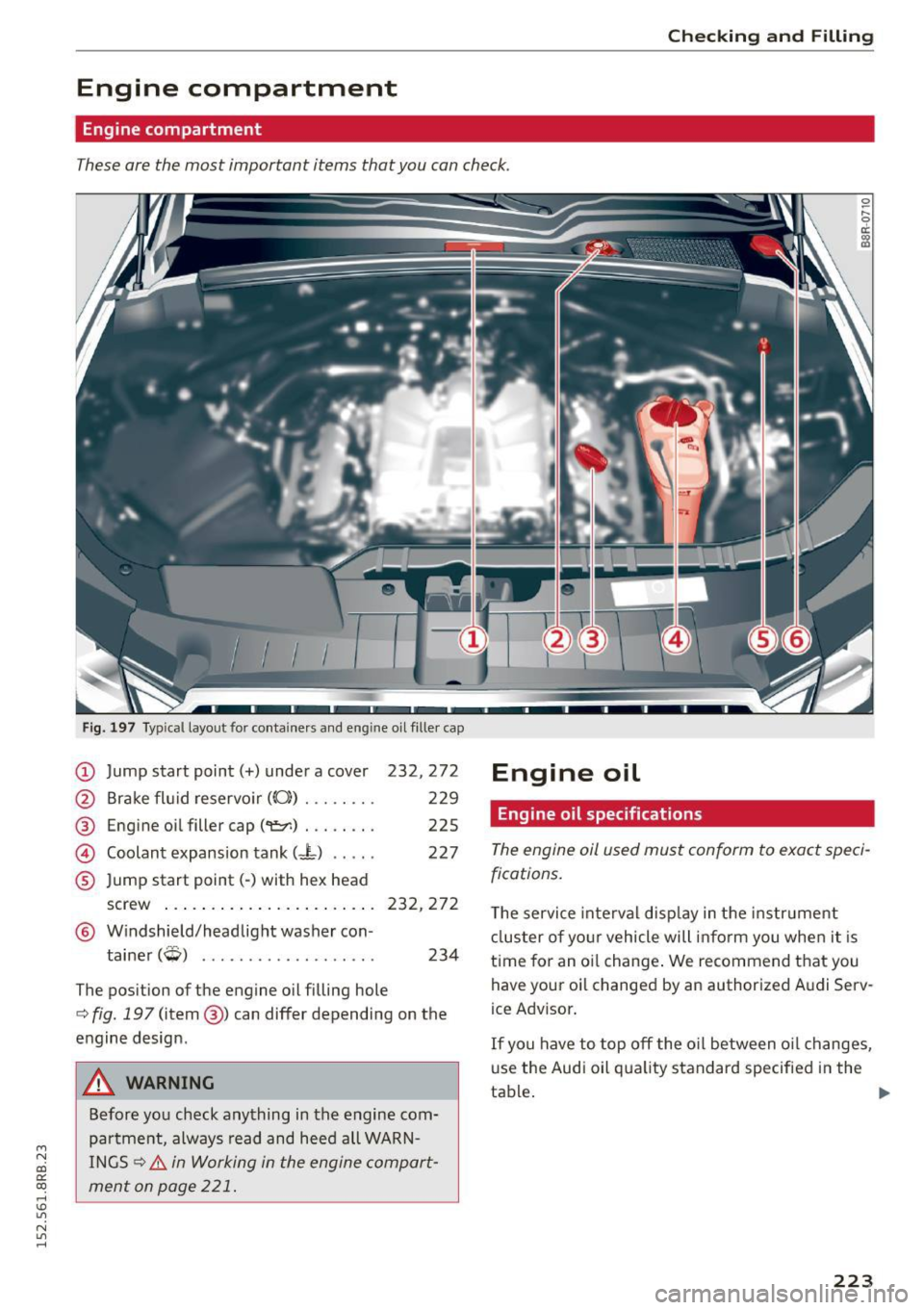
These are the mos t important item s that you can check .
Fig. 197 Typical layou t fo r container s and e ngine oil filler ca p
(D Jump start point(+) under a cover 23 2, 272
@ Brake fluid reservoir (0) . . . . . . . . 229
@ Engine oil filler cap(~) . . . . . . . . 225
@ Coolant expansion tank (- L) . . . . . 227
® Jump start point(-) w ith hex head
s crew . . . . . . . . . . . . . . . . . . . . . . . 232, 272
@ Windshield/headlight washer con -
tainer
(Q) . . . . . . . . . . . . . . . . . . . 234
T he po sit ion of the engine oil filling hole
c:> fig. 197 (item @) can differ depending on the
engine design .
A WARNING
Before you check anything in the engine com
partment, always read and heed all WARN
INGS
c:> &. in Working in the engine compart
ment on page 221.
Engine oil
Engine oil specifications
The engine oil used must conform to exact sp eci
f ications.
T he service interval disp lay in the instrument
cluster of your vehicle will inform you when it is
time for an oi l chang e. We recommend that you
hav e your oil chang ed by an authori zed A udi Serv
ic e Advi sor .
If you have to top off the oil between oil changes,
use the Audi oil qua lity standa rd specified in the
tab~ .
~
223
Page 226 of 302
Checking and F ill in g
Audi oil quality standard
Gas oline VW 502 00 or
engi ne
vw 504 00
Die sel
vw 50 7 00
e n g in e
Using the proper engine o il is important for the
functionality and serv ice life of the engine. Your
engine was facto ry-filled with a high-qua lity oil
which can usually be used throughout the entire
year.
(D Note
Your Limited New Vehicle Warranty does not
cover damage or malfunctions due to failure
to follow recommended maintenance and use
requirements as set forth in the Audi Owner's Manual and Warranty
& Ma intenance booklet.
- Use only a high qua lity eng ine oil that ex-
pressly complies w ith the Audi o il quality
standard specified for your vehicle's engine.
Using any other oil can cause serious engine
damage.
- Do not mix any lubricants or other additives
into the engine oil. Doing so can cause en
gine damage.
(D Tips
If you need to add oil and there is none availa
ble that meets the Audi o il quality standard
your eng ine requires, you may add a total of
no more than 0.5 quart/liter of a h igh-quality
"synthe tic"oil that meets the followi ng speci
fications.
- Vehicles with gasoli ne engine: AC EA A3 o r
API SM wi th a viscosity g rade of SAE OW-30,
SA E SW-30 or SAE SW-40 .
- Vehicles wi th d iesel engine: AC EA C3 o r
API CF wi th a v iscosi ty grade of SA E OW-30
or SAE SW-30.
- Fo r more information abo ut eng ine oil t hat
has been approved for your vehicle, please
contact eithe r your a uthorized Audi dea le r
or A udi Customer Relations at
1 (800) 822-2834 or visit our web site at
www.aud iusa.com or www .aud icanada.ca.
224
· Eng ine oil consumption
The engine in your vehicle depends on an ade
quate amount of oil to lubricate and cool all of
its moving parts.
In order to prov ide effective lubrication and coo l
i ng of internal engine components, all internal
combust ion engines consume a certa in amount
of oil. Oil consumpt ion va ries from engine to en
gine and may change sig nificantly over the life of
the engine. Typically, eng ines wi th a specified
break -in period (see¢
page 198) consume mo re
o il during t he b reak-in period than they co nsume
after oil consumption has stabilized .
Un der normal cond itions, the rate o f oi l con
sumption depends on the q uality and viscos ity o f
the oil, the RPM (revolutions per min ute) at
which the engine is operated, the ambient tem perature and road condit ions. Further factors are
the amount of o il dilution from water condensa
tion or fuel residue and the ox idat ion leve l of the
o il. As any engine is subject to wear as mileage
builds up, the oil consumption may inc rease over
time unt il rep lacement of worn compone nts may
become necessary.
With a ll these variab les coming into p lay, no
standard rate of oil consumpt ion can be estab
li shed or spec ified. There is no alte rnative to reg
u lar and frequent checking of the oil leve l, see
Note .
If the yellow engine oil leve l warning symbo l in
the i nstrument cluster
II lights up, you should
c h ec k t he o il level as soon as poss ible
cf> page 2 25. Top off the oil at your ear liest con
venience
r:!> page 225.
A WARNING
Before you check anything in the engine com
partment, always read and heed a ll WARN
INGS¢ .&.
in Working in the engine compart
ment on page 221.
(D Note
Driving wit h an insufficient oi l level is likely to
cause severe damage to the engine.
liJJ,
Page 230 of 302

Checking and Filling
"'Park your vehicle on a level surface.
"'Turn off the ignition.
"'Read the engine coolant level from the coolant
expansion tank
c:> fig . 200, <=> page 223,
fig. 197. With a cold engine, the coolant level
should be between the "MIN" and "MAX" mark
ings . When the engine is warm, the level may
be slightly above the "MAX" marking .
The location of the coolant expansion tank can be
seen in the engine compartment illustration
<=> page 223 .
To obtain an accurate reading, the engine must
be switched off.
The expansion tank in your vehicle is equipped
with an electric coolant level sensor.
When the coolant level is too low, the warning
light in the Auto-Check System
c::> page 29 will
blink until you add coolant and the level has been
restored to normal. Even though there is an elec
tric coolant level sensor, we still recommend you
check the coolant level from time to time .
Coolant loss
Coolant loss may indicate a leak in the cooling
system. In the event of coolant loss, the cooling
system should be inspected immediately by your
authorized Audi dealer. It is not enough merely
to add coolant .
In a
sealed system, losses can occur only if the
boiling point of the coolant is exceeded as a re
sult of overheating.
0 Note
Do not add any type of radiator leak sealant
to your vehicle's engine coolant . Adding radia
tor repair fluid may adversely affect the func
tion and performance of your cooling system
and could result in damage not covered by
your New Vehicle Limited Warranty .
Adding coolant
Be very careful when adding engine coolant.
Before you check anything in the engine compart
ment,
always read and heed all WARNINGS
228
c::> A in Working in the engine compartment on
page
221.
Requirement: There must be a residual amount
of coolant in the expansion tank
<=>(i) .
"'Turn off the engine.
"' Let the engine cool down.
"' Place a thick rag over the coolant expansion
tank
c::> page 22 7, fig. 200 and carefully turn
the cap counter-clockwise
c::> .&, .
"'Add coolant mixed in the correct ratio
c::> page 22 7, Coolant up to the MAX marking.
"'Make sure that the fluid level remains stable.
Add more coolant if necessary .
"'Twist the cap on again
tightly.
Replacement engine coolant must conform to ex
act specifications
c::> page 22 7, Coolant.
We recommend using only coolant additive Gl2+
+, Gl3
or in an emergency Gl2+. Do not use a
different additive. In an emergency use plain wa
ter until you can get the correct additive and can
restore the correct ratio. This should be done as
soon as possible.
If you have lost a considerable amount of cool
ant, then you should add cold antifree ze and cold
water only when the engine is cold.
Always use
new engine coolant when refilling.
Do not fill coolant above the "MAX" mark. Excess
coolant will be forced out through the pressure
relief valve in the cap when the engine becomes
hot.
A WARNING
- The cooling system is under pressure and
can get very hot. Reduce the risk of scalding
from hot coolant by following these steps.
- Turn off the engine and allow it to cool
down.
- Protect your face, hands and arms from
escaping fluid and steam by covering the
cap with a large, thick rag.
- Turn the cap slowly and very carefully in a
counter-clockwise direction while applying
light, downward pressure on the top of
the cap.
ll-
Page 231 of 302
M N
co ~ co
rl I.O
"' N
"' rl
-To avoid being burned, do not spi ll anti
freeze or coolant on the exhaust system or hot engine parts. Under certain condi
tions, the ethylene glycol in engine cool ant can catch fire.
- Antifreeze is poisonous. Always store anti
freeze in its original conta iner and well out
of the reach of ch ildren .
-If you drain the coolant, it must be caught
and safely stored in a proper container
clearly marked "poison" .
(D Note
-Do not add coolant if the expansion tank is
empty . Air could enter the cooling system
and damage the eng ine .
If this is the case,
do not continue driving. Seek profess ional
ass istance.
- Coolant pollutes the env ironment and could
cause an eng ine fire . Excess coolant will be
fo rced out through the pressure relief valve
i n the cap when the eng ine becomes hot.
- If, i n an emergency , only water can be add
ed, the correct ratio between wa ter and an
tifreeze
~ page 22 7 must be restored as
soon as possib le .
@) For the sake of the environment
Drained coolant should not be reused. Always
dispose o f used coolant while observ ing all
environmental regulations .
Radiator fan
The radiator fan switches on automatically by it
self.
The radiator fan is driven by the engine via the V
be lt . The viscous clu tch regulates the speed of
the fan ac cording to the temperature of the cool
ant.
An auxiliary e lectr ic rad iator fan* switches on and
off depend ing on coolant temperat ure and othe r
veh icle operating conditions.
Afte r you switch the engine off, the auxiliary fan
can continue runn ing for up to 10 minutes -even
Ch eck in g and Fillin g
with the ignition off . It can even switch on again
later by itself¢& , if
- the temperatu re of the engine coo lant rises due
to the heat build- up from the engine in the en
gine compartment, or
- the engine compartment heats up because the
veh icle is parked in intense sun light .
A WARNING
-To reduce the risk of persona l injury never
touch the radiator fan .
- The auxiliary electric fan is temperature con trolled and can switch on suddenly even
when the engine is not running.
- The a uxiliary radiator fan sw itches on auto
matica lly when the engine coolant reaches a
certain temperature and will continue to run
until the coolant temperature drops.
Brake fluid
Checking brake fluid level
The brake fluid level can be checked with a quick
glance .
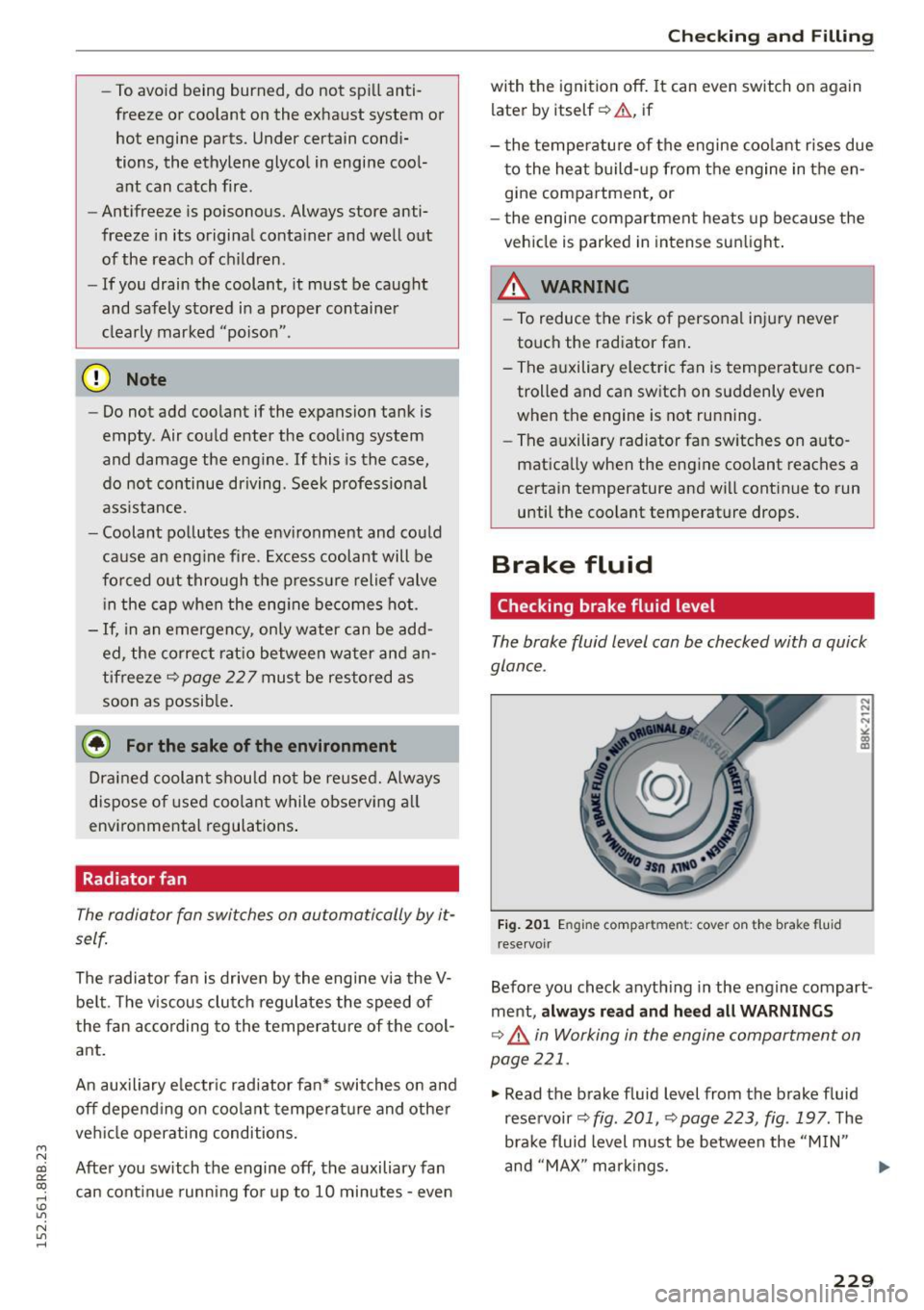
Fig. 201 Engine compar tment : cov er on th e bra ke fluid
r e servoir
Before you check anyth ing in the engine compart
ment,
al way s read and h eed all WARNIN GS
¢ _.& in Working in the engine compartment on
page 221 .
.,. Read the brake fluid level from the b rake fluid
reservoir ¢
fig. 201, ¢ page 223, fig . 197 . The
brake fluid level must be between the
"MIN "
and "MAX " markings.
229
Page 232 of 302
Checking and F ill in g
The brake fluid reservoir is located at the rear
partition of the engine compartment on t he left
side ¢
page 223.
The fl uid level may drop slightly after some time
due to the automatic adjustment of the brake
pads. This is not cause for alarm.
If the b ra ke fluid level fal ls considerably below
the "MIN" mark, the brake warn ing/indicator
light (U.S. models:
1111 , Canadian models: . )
will come on¢
page 18 and ¢ page 28 . Do not
continue to operate the vehicle . The complete
brake system shou ld be thoroughly checked by an
author ized Audi dealer or qualif ied workshop and
the cause corrected. If the brake fluid level is too low, the brake warning/indicator light will illum i
nate. Contact an authorized Aud i dealer
immedi
a tel y.
Changing brake fluid
Have the brake fluid changed by an experienced technician.
Brake flu id abso rbs moisture from the a ir . If the
water content in the brake fluid is too high, cor rosion in the b rake system may result after a pe ri
od of time. The boiling point of the bra ke fluid
will also decrease conside rably and decrease
b ra ki ng per fo rmance .
Therefore, th e brake flu id must be changed
ev ery
tw o years .
Always use new b rake fluid w hich con
forms to Fede ra l Motor Vehicle Standa rd " FMVSS
1 16 DOT 4".
The brake fluid rese rvoir can be difficult to reach,
therefo re, we recommend that yo u have the
b rake fluid changed by your authori zed
Audi
dealer .
Your dealer has the cor rect too ls, the
right brake f luid and the know -how to do t his for
you.
A WARNING
- Brake fluid is po isonous. It must be stored
only in the closed orig inal container out of
the reach of children!
- Brake fai lure can result from old or inappro
pr iate brake fluid . Observe these precau
t ions:
230
- Use only brake fluid that meets SAE spec i
ficat io n
J 1703 and conforms to Federal
Motor Vehicle Sta ndard 116 . Always check
with your aut horized Aud i dea ler to make
su re you are using the correct brake fl uid .
The co rrect type of brake f lu id is also ind i
cated on t he b rake fluid reservoir.
- The brake fl uid must be new. Heavy use of
the b rakes can cause a vapor lock if the
brake fluid is left in t he system too long.
This can se riou sly affec t the efficiency of
the b rakes as well as yo ur sa fety. This
could result in an acc ident .
(D Note
Bra ke fluid will damage the pai nt of you r vehi
cle.
@ For the sake of the environment
B ecause of the prob lem of prope r disposal of
b rake fluid as well as the spe cial tools re
q ui red and the necessary ex pert ise, we rec
ommend that you have the brake f lu id
cha nged by yo ur autho rize d Aud i dea le r.
Battery
General information
U nder normal operat ing conditions , the battery
i n you r Aud i does not need any maintenance.
With
high outside tem pera tures or long d aily
drives we recommend that you have the e lectro
l yte level checked by an a utho rized Audi dea le r or
qualified workshop. The electrolyte leve l should
a lso be checked each time the battery is charged
¢ page 232.
Have the battery checked when yo u take your ve
hicle in for service. You a re well advised to re
place a battery that is older than 5 years.
With cer tain types of airbag deployment, t he bat
tery is disconnected from the vehicle elect rical
system for safety reasons
Q &. in Repair, care
and disposal of the airbags on page 165.
Hybrid drive *: yo u can find important information
abo ut the high voltage battery under ¢
page 98 . ..,.
Page 233 of 302
M N
co
a:
co
,...., \!) 1.1'1
N 1.1'1 ,....,
Disconnecting the battery terminals
Some vehicle functions (power window regula
tors , for example) are lost if the battery termi
nals are disconnected. These functions have to be
re learned after th e battery terminals are con
nected again. To prevent this, the batte ry should
only be disconnected from the ve hicle electrical
system when absolutely necessary for repairs.
Vehicles not driven for long periods
If you do not drive your vehicle over a period of
several days or weeks, e lectrica l components are
gradually cut back or switched off. This reduces
energy consumption and maintains starting ca pability over a longer period
c:> page 196.
Take into consideration that when you un lock
your veh icle, some convenience functions, such
as the interior lights or the power seat adjust
ment, may not be available . The convenience
functions will be ava ilable again when you turn
on the ignition and start the engine.
Winter operation
During the winter months, battery capacity tends
to decrease as temperatures drop. This is because
more power is also consumed while starting, and
the headlights, rear window defogger, etc ., are
used more often.
Avoid unnecessary power consumption, part icu
larly in city traffic or when traveling only short
d istances . Let your authorized Aud i dealer check
the capacity of the vehicle battery before w inter
sets in
c:> page 232. A well charged battery will
not only prevent s tarting problems when the
weather is cold, but will also last longer.
Working on the battery
Be especially careful when working on or near
the battery.
The battery is located in the luggage compart
ment under the floor. Before you check anything
in the lug gage compartment,
read and heed all
WARNINGS
c:> ,&. .
Hybr id drive*: you can find important informat ion
about the high vo ltage battery u nder
c:> page 98.
Checking and Filling
Always heed the safety warnings, when working
on the vehicle battery or the vehicle e lectrica l
system to prevent injury.
The following WARNINGS are very important
when working on the battery :
Always heed the following WARNING SYM·
BOLS and safety precautions when working on
the battery.
®
Always wear eye protection.
~
Battery acid contains sulfuric acid. Al·
ways wear gloves and eye protection.
@
No
· sparks
· flames
· smoking.
~
When a battery is charged, it produces
hydrogen gas which is explosive and
could cause personal injury.
®
Always keep the battery well out of reach
of children.
A WARNING
= -Whenever working on the battery or on the
e lectrica l system, there is the risk of injury,
accident and even fire . Read and heed the fol
lo w ing WARNINGS:
- Always wear eye protection. Do not let bat
tery acid or any lead particles get on your
skin or clothing. Shield yo ur eyes. Exp losive
gases can cause blindness or other injury.
- Battery acid contains sulfuric acid. Sulfuric
acid can cause blindness and severe burns .
- Always wear g loves and eye protection. Do
not tilt the battery because acid could leak
out of the ventilation openings.
-If you get battery acid in your eyes or on
your skin, immed iately r ins e with cold wa
ter for several minutes and get medical at
tent ion.
- If you should ingest any battery acid, seek
med ical attention immediate ly .
- Do not expose the battery to an open flame,
elec tric sparks or an open light.
- Do not smoke.
~
231
Page 234 of 302
Checking and Filling
-Do not interchange the positive and nega
tive cables .
- When working on the battery, be sure not to
short-circuit the terminals with tools or oth
er metal objects. This would cause the bat
tery to heat up very quickly, which could
lead to damage or explosion and personal
injury .
- When a battery is charged, it produces hy
drogen gas which is explosive and could
cause personal injury.
- Always keep the battery well out of the
reach of children .
- Before work is done on the electrical sys
tem, disconnect the negative ground cable .
- Before performing any work on the electri
cal system, switch off the engine and igni
tion as well as any electrical equipment. The
negative cable on the battery must be dis
connected. If you are just going to replace a
light bulb, then it is enough to switch off
the lights.
- Before disconnecting the battery, switch off
the anti-theft alarm system! Otherwise you
will set off the alarm.
- When disconnecting the battery, first dis
connect the negative cable and then the
positive cable.
- Before reconnecting the battery, make sure
all electrical consumers are switched off. Re
connect the positive cable first and then the
negative cable . Never interchange the ca
bles -this could start a fire!
- Never charge a frozen or a thawed-out bat
tery. It could explode! If a battery has fro
z en, then it must be replaced . A discharged
battery can freeze over at 32°F (O°C).
- Make sure the vent hose is always attached
to the opening on the side of the battery .
- Never use batteries which are damaged.
There is the danger of an explosion! Always
replace a damaged battery.
A WARNING
California Proposition 65 Warning:
- Battery posts, terminals and related acces
sories contain lead and lead compounds,
232
chemicals known to the State of California
to cause cancer and reproductive problems.
Wash hands after handling.
(D Note
- Do not disconnect the vehicle battery when
the ignition is switched on or when the en
gine is running, otherwise , you will damage
electronic components in the electrical sys
tem .
- If your vehicle is going to stand for a long
period of time without being driven, protect
the battery from "freezing", otherwise it
will be damaged and will then have to be re placed.
Battery charging
Starting the engine requires a well charged battery .
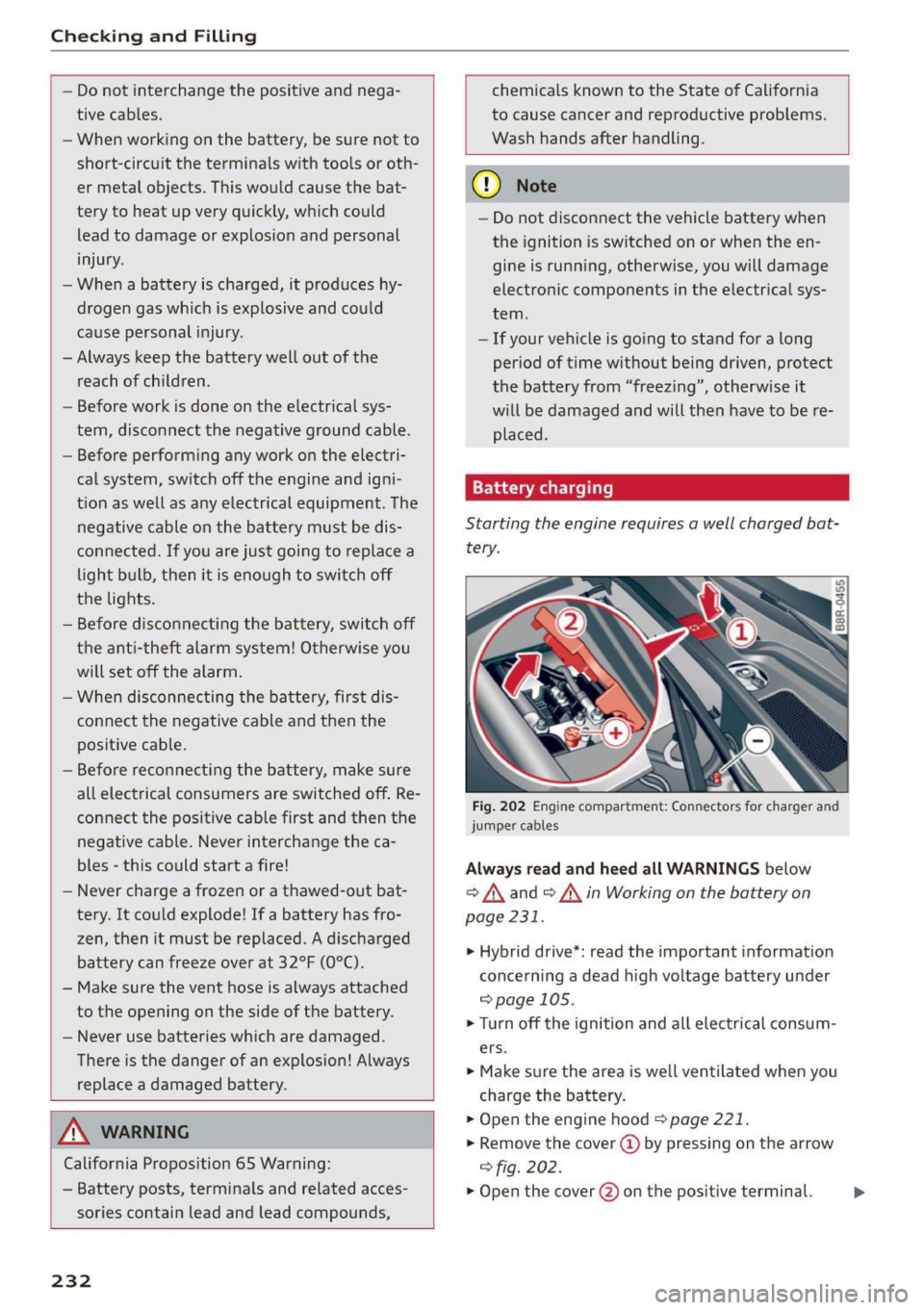
Fig. 202 Engin e compar tment : Co nnec tors fo r char ger and
jumper cables
Always read and heed all WARNINGS below
¢ .&. and
¢.&. in Working on the battery on
page 231 .
.. Hybrid drive*: read the important information
concerning a dead high voltage battery under
¢ page 105.
.. Turn off the ignition and all electrical consum
ers.
.. Make sure the area is well ventilated when you
charge the battery .
.. Open the engine hood
¢ page 221.
.. Remove the cover(!) by pressing on the arrow
¢fig. 202 .
.. Open the cover @on the positive terminal. .,.
Page 236 of 302
Checking and F ill in g
management system to enable you to use the en
ergy management functions correctly after re p lacing the battery .
If i t is not poss ible to use a battery of this type,
the new battery must have the same capacity,
voltage (12 vo lts), amperage, construction and
p lug sealing .
When insta lling the ba ttery, make sure the igni
tion and all electrical consumers are t urned
off .
(D Note
- M ake sure the ven tilat ion hose on the side
of the ba tte ry is co nne cte d, o therw ise
fumes o r batte ry acid can lea k out .
- Vehicles wi th the Start-Stop-System* are
equipped with a special cycle-proof AG M
b attery. Installing a different type of bat
tery can cause prob lems in the vehicle elec
trica l system. When replacing the vehicle
battery, always install one with the same
spec ificat ions as the or iginal battery.
@ For the sake of the environment
Because of the problem of proper disposa l of
a battery, we recommend your author ized
Aud i dea ler change the battery for you. Bat
teries conta in su lfuric ac id and lead and must
always be disposed of properly in compliance
w it h all environmental reg ulations. Disposing
of vehicle batte ries imprope rly is very dange r
ous to the e nvironme nt.
Windshield/headlight
washer container
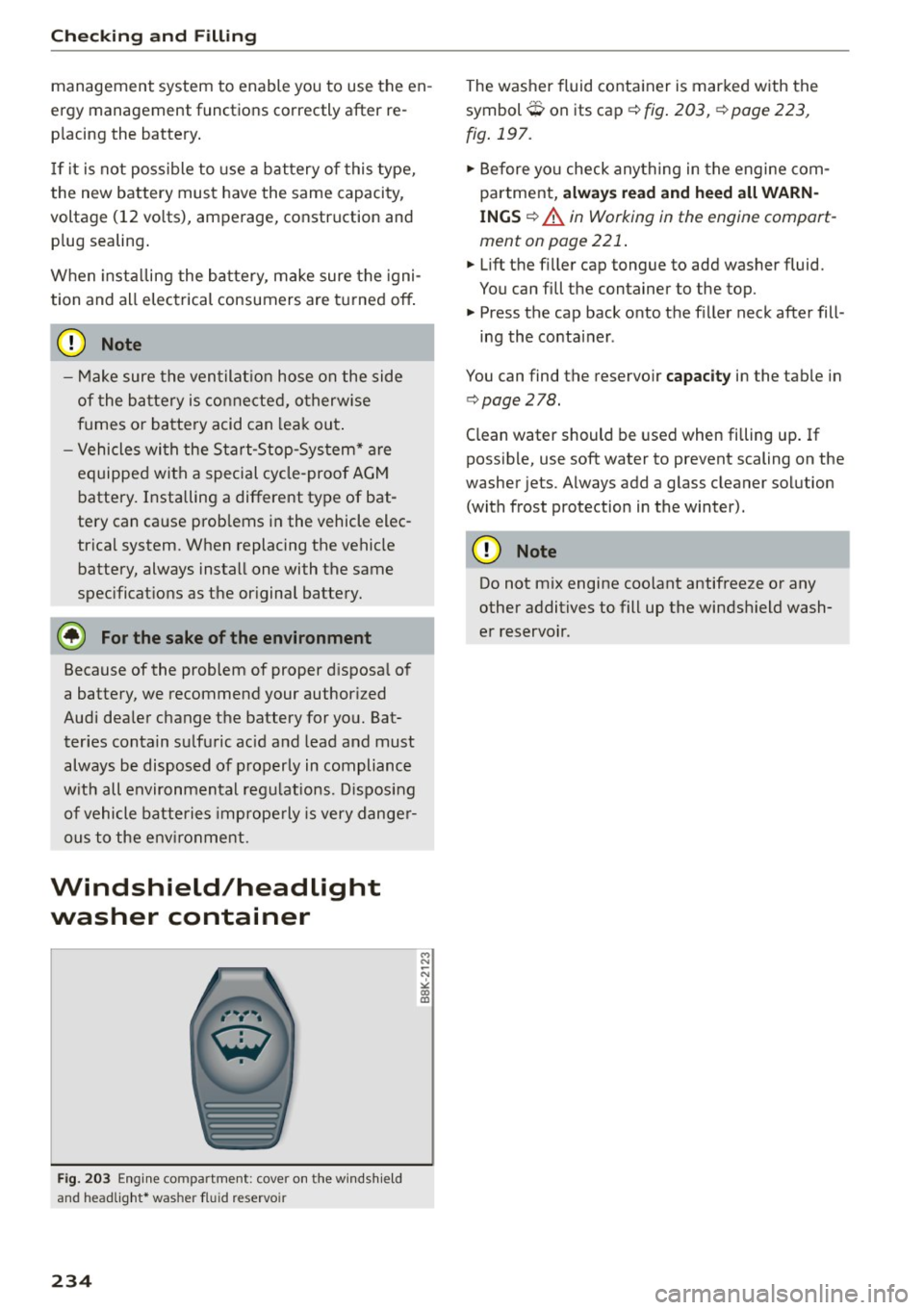
F ig . 20 3 En gin e compart ment: cover o n the w inds hield
and headlig ht* w ash er flui d reservo ir
234
M N
-N
>< a, al
The washer fluid conta iner is mar ked w ith the
symbol
O on its cap ¢ fig . 203, ¢page 223,
fig . 197 .
.. Before yo u check any thing in the engine com
partment,
always re ad and heed all WARN
INGS ¢ A in Working in the engine compart
ment on page 221 .
.. Lift the f iller cap tongue to add washer fluid.
You can fill the container to the top.
.. Press the cap back o nto the f iller neck afte r fill -
ing the conta iner.
You can find the reservo ir
capacity in the table in
<=> page 2 78.
Clean water should be used when fi lling up . If
possib le, use soft water to prevent scaling on the
washer jets . Always add a g lass cleaner solution
(with frost protection in the winter).
(D Note
Do not mix engine coolant antifreeze o r any
other additives to fill up the winds hield wash
e r reservo ir .