fuel cap AUDI Q5 2015 User Guide
[x] Cancel search | Manufacturer: AUDI, Model Year: 2015, Model line: Q5, Model: AUDI Q5 2015Pages: 302, PDF Size: 75.01 MB
Page 224 of 302
Checking and Filling
-Always let the engine cool down. Hot com
ponents will burn skin on contact .
- To reduce the risk of being burned, never
open the hood if you see or hear steam or
coolant escaping from the engine compart
ment . Wait until no steam or coolant can be
seen or heard before carefully opening the
hood.
- Keep children away from the engine com
partment .
- Never spill fluids on hot engine compo
nents . They can cause a fire .
- Never touch the radiator fan. The auxiliary
electric fan is temperature controlled and
can switch on suddenly.
- Never open the coolant reservoir cap when
the engine is still warm. The coolant system
is pressurized and hot coolant could spray
out .
- Protect your face, hands and arm from steam or hot engine coolant by placing a
thick rag over the cap when you open the coolant reservoir .
- Do not remove the engine cover under any
circumstances. This increases the risk of
burns.
- If work on the fuel system or the electrical
system is necessary :
- Always disconnect the battery.
- Never smoke or work near heaters or open
flames . Fluids in the engine compartment
could start a fire.
- Keep an approved fire extinguisher imme
diately available.
- To avoid electrical shock and personal injury
while the engine is running or being started, never touch:
- Ignition cables
- Other components of the high voltage
electronic ignition system.
- If you must perform a check or repair with
the engine running:
- First, fully apply the parking brake , move
selector lever of automatic transmission
to P (Park).
222
- Always use extreme caution to prevent
clothing, jewelry, or long hair from getting
caught in the radiator fan, V-belts or other
moving parts, or from contacting hot
parts . Tie back hair before starting, and do
not wear clothing that will hang or droop
into the engine.
- Minimize exposure to emission and chemi
cal hazards
~ ,&. .
&, WARNING
California Proposition 65 Warning:
- Engine exhaust , some of its constituents,
and certain vehicle components contain or
emit chemicals known to the State of Cali
fornia to cause cancer and birth defects and
reproductive harm. In addition, certain flu
ids contained in vehicles and certain prod
ucts of component wear contain or emit
chemicals known to the State of California
to cause cancer and birth defects or other
reproductive harm.
- Battery posts, terminals and related acces sories contain lead and lead compounds,
chemicals known to the State of California
to cause cancer and reproductive harms .
Wash hands after handling .
('.!) Note
When adding fluids, always make sure that
they are poured into the proper container or
filler opening, otherwise serious damage to
vehicle systems will occur.
@ For the sake of the environment
To detect leaks in time, inspect the vehicle
floor pan from underneath regularly. If you
see spots from oil or other vehicle fluids, have
your vehicle inspected by an authorized Audi dealer.
Page 227 of 302
M N
co ~ co
rl I.O
"' N
"' rl
@ Tips
-The oil pressure warning display. is not
an indicator of the oil level. Do not rely on
it. Instead, check the oil level in your en
gine at regular intervals, preferably each
time you refuel , and always before going
on a long trip .
-If you have the impression your engine con
sumes excess ive amounts of o il, we recom
m end th at you cons ult an a uthorized Aud i
deal er to have th e cau se of yo ur co nc ern
p ro perly di ag no se d . Keep i n mi nd th at the
a ccurate meas ureme nt o f oil c onsu mpti on
r equires great care and m ay ta ke some time.
An a uthorized Audi dea ler has i nstr uctions
abo ut how to meas ure o il cons umption ac
curate ly.
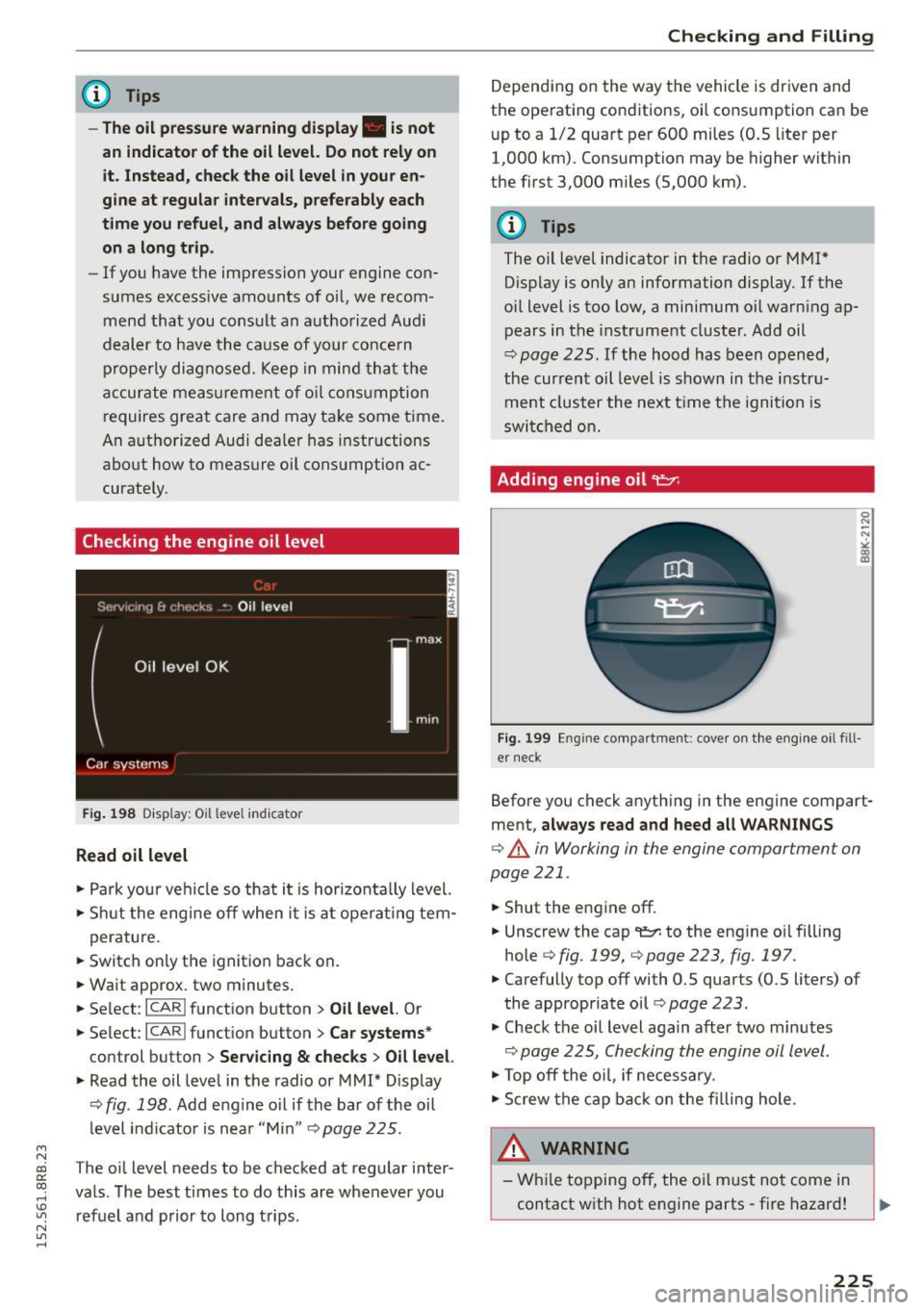
Checking the engine oil level
F ig. 19 8 Disp lay: O il level indicator
Read oil level
.. Pa rk your vehicle so that i t is hor izont ally level.
.. Shu t the engine off when i t is at oper ating te m-
perature.
.. Switc h on ly the ignition back on.
.. Wa it approx. two minutes .
.. Se lect:
I CARI funct ion button > Oil level. Or
.. Select:
ICARI funct ion button> Car systems *
control button > Servicing & checks > Oil level.
.. Read the oil leve l in the radio or MMI* Display
¢ fig . 198. Add e ng in e oil if the bar of the oil
l evel i ndicator is nea r "M in"
9page 225.
The oil level needs to be c hec ked at regular inter
va ls. The best t im es to do this are whenever you
ref uel and prior to long t rips.
Checking and Filling
D epend ing on the way t he vehicle is dr iven and
the ope rat ing cond itions, oil consumption ca n be
u p to a 1/2 quart pe r 600 miles (0 .5 liter per
1,000 km). Consumption may be higher within
the fi rst 3,000 mi les (5,000 km).
(D Tips
The oil leve l indicator in t he ra dio or MMI*
D isp lay is only an information display. If t he
o il level is too low , a minimum oi l warn ing ap
p ears in the instrume nt cl uster. Add oil
¢ page 225. If the hood has been o pen ed,
t h e cur ren t oil leve l is shown in t he instru
m ent cl uster the n ext tim e the ig niti on i s
sw itch ed on.
Adding engine oil
Fig . 199
Engine compa rtment: cove r on th e e ng in e oi l fill
er neck
Befo re you check a nyth ing in the engine compart
ment ,
always read and heed all WARNINGS
¢ & in Working in the engine compartment on
page 221 .
.. Shut the eng ine off .
.. Unscrew the cap
'l!:7-to the eng ine o il filling
hole
¢ fig. 199, 9page223, fig.197 .
.. Carefully top off with 0.5 quarts (0.5 liters) of
the appropriate oil ¢
page 223 .
.. Check t he oil level aga in after two m inutes
<:> page 225, Checking th e e ngin e oil l eve l.
.. Top off the o il, if necess ary .
.. Scr ew the cap back on the filling hole.
& WARNING
-
- W hile to p pin g off , the o il m ust not come in
contact w ith hot e ngine parts - fire hazar d!
225
Page 240 of 302
Wheels
Bead
means the part of the tire that is
made of steel wires, wrapped or
reinforced by ply cords and that is
shaped to fit the rim .
Bead separation
means a breakdown of the bond
between components in the bead.
Cord
means the strands form ing the
plies in the tire.
Cold tire inflation pressure
means the tire pressure recom
mended by the vehicle manufac
turer for a tire of a designated
size that has not been driven for
more than a coup le of miles (kilo
meters) at low speeds in the three
hour period before the tire pres
sure is measured or adjusted .
Curb weight
means the weight of a motor ve
hicle with standard equipment in
cluding the maximum capacity of
fuel, oi l, and coolant , air condi
tioning and additional weight of optional equipment.
E x tra load tire
means a tire des igned to operate
at higher loads and at higher in-
238
flation pressures than the corre
sponding standard tire . Extra load
tires may be identified as "XL",
"xl", "EXTRA LOAD", or "RF" on
the sidewall.
G ross A xle Weight Rating
("GAWR ")
means the load-carrying capacity
of a single axle system , measured
at the tire-ground interfaces .
Gross Vehicle Weight Rating
( "GVWR" )
means the max imum total loaded
weight of the vehicle .
Groove
means the space between two ad
jacent tread ribs .
Load rating (code )
means the max imum load that a
tire is rated to carry for a given in
flation pressure . You may not find
this information on all tires be cause it is not required by law.
Ma ximum load rating
means the load rating for a tire at
the maximum permissible infla
tion pressure for that tire .
Maximum loaded vehicle
w eight
means the sum of: ...
Page 248 of 302
Wheels
and follow the important
safety precautions in
c::> page 247, Tires and vehicle
load limits.
-The tire must flex more if the
tire pressure is too low or if
the vehicle speed or load are
too high. This heats the tire up
too much. This increases the
risk of an accident because it
can cause the tire to burst and
result in loss of vehicle con
trol.
-Incorrect tire pressure increas
es tire wear and has a negative
effect on driving and braking
Tire pressure table
Please note that the information
contained in the following table
was correct at the time of print
ing, and the information is sub
ject to change. If there are differ
ences between this information
and the tire pressures specified
on the label on the driver's side 8-pillar, always follow the specifica
tion on the 8-pillar label
c::> page 245, fig. 206.
246
behavior, which increases the
risk of an accident.
(D Note
Replace lost valve caps to re
duce the risk of damage to the
tire valves.
@ For the sake of the environment
Tire pressure that is too low in
creases fuel consumption.
(D Tips
Audi recommends using the
tire pressure specified for a nor
mal load
c::> table on page 247
or for a full load when the vehi
cle is partially loaded.
Make sure that the tire designa
tion on your tire matches the des ignation on the tire pressure label
and the tire pressure table.
The following table lists recom
mended tire pressures in cold
tires according to the load and the size of the tires installed. .,.
Page 280 of 302

Technical data
Gross Axle Weight Rating
The Gross Axle Weight Rating is the maximum
load that can be applied at each axle of the vehi
cle ¢& .
Vehicle capacity weight
The vehicle capacity we ight (max. load) is listed
on the driver's side 8 -p ill ar.
_& WARNING
- T he actual Gross Axle Weight Rating at the
front and rear axles should not exceed the
permissible weights, and their combination
must not exceed the Gross Vehicle Weight
Rating.
Dimensions
Length in (mm)
Width in (mm)
Width (across mirrors) in (mm)
Height (unloaded)al in (mm) -
Exceeding permissible weight ratings can
result in veh icle damage, acc idents and per
sonal injury.
(D Note
- The vehicle capacity weight figures apply
when the load is distributed evenly in the
vehicle (passengers and luggage). When
transporting a heavy load in the luggage
compartment, carry the load as near to the
rear axle as possible so that the vehicle's
hand ling is not impaired.
- Do not exceed the maximum permissible
axle loads or the maximum gross veh icle
we ight. Always remember that the vehicle's
hand ling will be affected by the extra load.
T herefore, adjust your speed accordingly.
- Always observe local regulations .
QS/QS hybrid SQS
182.6 (4639) 183 .0 (4647)
74.7 (1898) 75 .2 (1911)
82.2 (2089) 82 .2 (2089)
65 .2 (1655) 65.3 (1658)
al T h e he ight of t he ve hicl e depends on the tires and the su spens ion.
When driving up steep ramps, on rough roads,
over curbs, etc. it is important to remember that
some parts of your vehicle, such as spo ilers or ex- haust system components, may be close
to the
ground . Be careful not to damage them.
Capacities
QS/SQS QS hybrid
Fuel tank: total capacity gal (liters) approx. 19.8 (75) approx. 19.0 (72)
Windshield and headlight* quarts (liters) approx.
4.9 (4.6) approx. 4.9 (4.6)
washer fluid container
278
Page 292 of 302
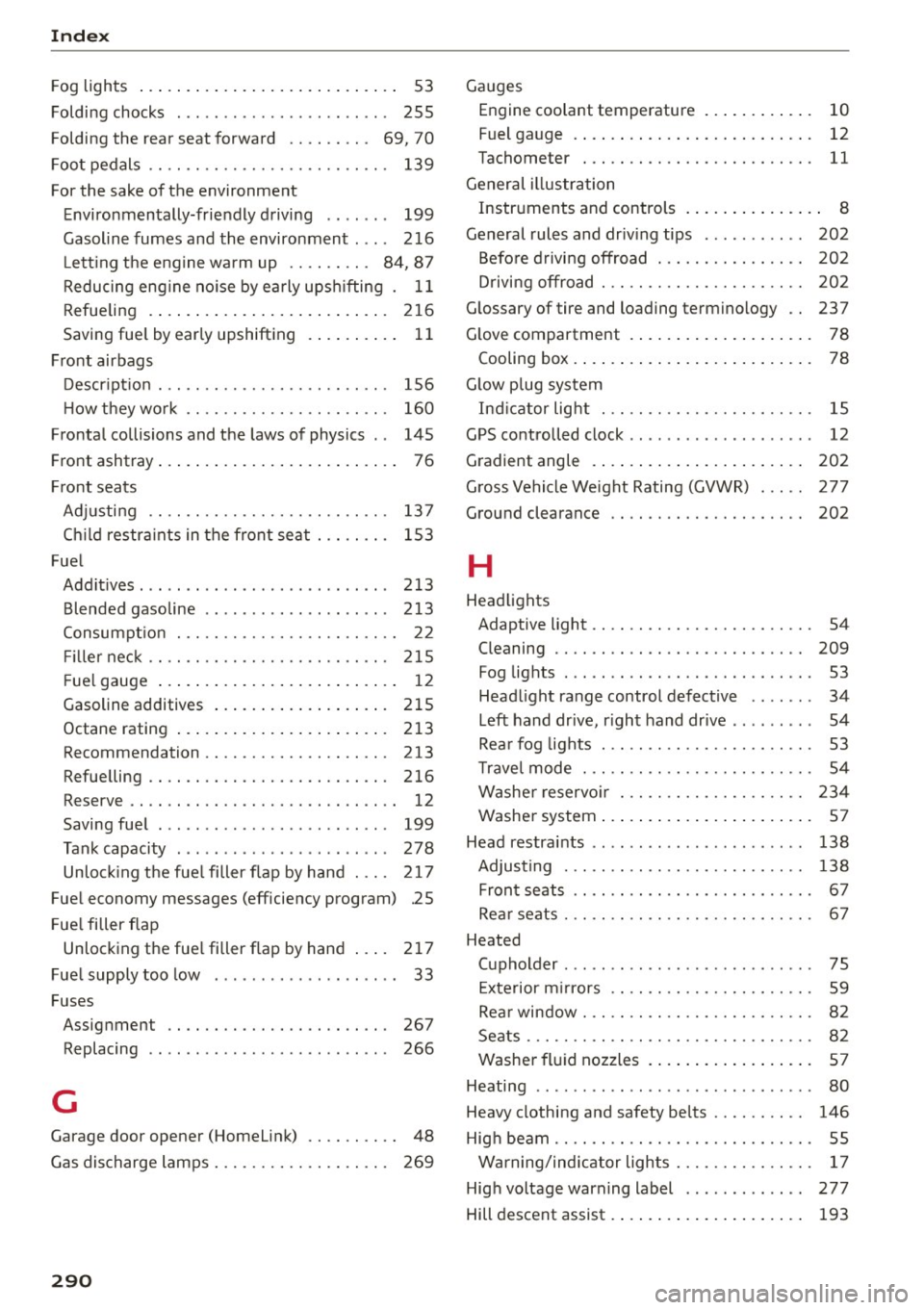
Index
Fog lights . . . . . . . . . . . . . . . . . . . . . . . . . . . . 53
Folding chocks . . . . . . . . . . . . . . . . . . . . . . . 255
Folding the rear seat forward . . . . . . . . . 69, 70
F oot pedals . . . . . . . . . . . . . . . . . . . . . . . . . . 139
For the sake of the environment
Environmentally-friendly driving . . . . . . . 199
Gasoline fumes and the environment . . . . 216
L ett ing the engine warm up . . . . . . . . . 84, 87
Reducing engine noise by early upsh ifting . 11
Refueling . . . . . . . . . . . . . . . . . . . . . . . . . . 216
Saving fue l by early upshifting . . . . . . . . . . 11
Front airbags Description . . . . . . . . . . . . . . . . . . . . . . . . . 156
H ow they work . . . . . . . . . . . . . . . . . . . . . . 160
Frontal collisions and the laws of physics . . 145
Fr ont ashtray . . . . . . . . . . . . . . . . . . . . . . . . . . 76
Front seats
Adjusting . . . . . . . . . . . . . . . . . . . . . . . . . . 137
Ch ild restra ints in the front seat . . . . . . . . 153
Fuel Addit ives ....... .......... ...... ... . 213
Blended gasoline . . . . . . . . . . . . . . . . . . . . 213
Consumpt ion . . . . . . . . . . . . . . . . . . . . . . . . 22
Fill er neck . . . . . . . . . . . . . . . . . . . . . . . . . . 215
F ue l gauge . . . . . . . . . . . . . . . . . . . . . . . . . . 12
Gasoline additives . . . . . . . . . . . . . . . . . . . 215
Octane rating . . . . . . . . . . . . . . . . . . . . . . . 213
Recommendation............... .. ... 213
Refuelling .. .. .... ........... .. .. ... 216
Reserve . . . . . . . . . . . . . . . . . . . . . . . . . . . . . 12
Saving fuel . . . . . . . . . . . . . . . . . . . . . . . . . 199
Tank capacity . . . . . . . . . . . . . . . . . . . . . . . 278
Unloc king the fue l filler flap by hand . . . . 217
Fue l economy messages (efficiency program) .25
F ue l filler flap
Unlocking the fuel filler flap by hand . . . . 217
Fue l supply too low . . . . . . . . . . . . . . . . . . . . 33
Fuses Assignment . . . . . . . . . . . . . . . . . . . . . . . . 267
Replacing . . . . . . . . . . . . . . . . . . . . . . . . . . 266
G
Garage door opener (Homelink) . . . . . . . . . . 48
Gas discharge lamps . . . . . . . . . . . . . . . . . . . 269
290
Gauges
Engine coolant temperature . . . . . . . . . . . . 10
Fuel gauge . . . . . . . . . . . . . . . . . . . . . . . . . . 12
Tachometer . . . . . . . . . . . . . . . . . . . . . . . . . 11
General illu stration
Instruments and controls . . . . . . . . . . . . . . . 8
General rules and driv ing tips . . . . . . . . . . . 202
Before driving offroad . . . . . . . . . . . . . . . . 202
Driving offroad . . . . . . . . . . . . . . . . . . . . . . 202
Glossary of tire and loading terminology .. 237
Glove compartment . . . . . . . . . . . . . . . . . . . . 78
Cooling box . . . . . . . . . . . . . . . . . . . . . . . . . . 78
Glow plug system
Indicator light . . . . . . . . . . . . . . . . . . . . . . . 15
GPS controlled clock .................. . .
Gradient angle ...... .. ........... .. . .
Gross Vehicle Weight Rating (GVWR) ... . .
Ground clearance
H
Head lights 12
202
277
202
Adaptive light . . . . . . . . . . . . . . . . . . . . . . . . 54
Cleaning . . . . . . . . . . . . . . . . . . . . . . . . . . . 209
Fog lights . . . . . . . . . . . . . . . . . . . . . . . . . . . 53
Headlight range control defective . . . . . . . 34
Left hand drive, r ight hand drive . . . . . . . . . 54
Rear fog lights . . . . . . . . . . . . . . . . . . . . . . . 53
T rave l mode . . . . . . . . . . . . . . . . . . . . . . . . . 54
Washer reservo ir . . . . . . . . . . . . . . . . . . . . 234
Washer system . . . . . . . . . . . . . . . . . . . . . . . 57
H d . ea restra ints . . . . . . . . . . . . . . . . . . . . . . . 138
Ad .
t· JUS mg . . . . . . . . . . . . . . . . . . . . . . . . . . 138
Front seats . . . . . . . . . . . . . . . . . . . . . . . . . . 67
Rear seats . . . . . . . . . . . . . . . . . . . . . . . . . . . 67
Heated (upholder . . . . . . . . . . . . . . . . . . . . . . . . . . . 75
Ex terior mirrors . . . . . . . . . . . . . . . . . . . . . . 59
Rear window . . . . . . . . . . . . . . . . . . . . . . . . . 82
Seats . . . . . . . . . . . . . . . . . . . . . . . . . . . . . . . 82
Washer fluid nozzles . . . . . . . . . . . . . . . . . . 57
Heating . . . . . . . . . . . . . . . . . . . . . . . . . . . . . . 80
Heavy clothing and safety belts . . . . . . . . . . 146
High beam . . . . . . . . . . . . . . . . . . . . . . . . . . . . 5S
Warning/indicator lights . . . . . . . . . . . . . . . 17
High voltage warn ing label . . . . . . . . . . . . . 277
Hill descent assist . . . . . . . . . . . . . . . . . . . . . 193