ECU AUDI Q5 2015 Owner's Manual
[x] Cancel search | Manufacturer: AUDI, Model Year: 2015, Model line: Q5, Model: AUDI Q5 2015Pages: 302, PDF Size: 75.01 MB
Page 137 of 302
M N
co
a:
co
Driving safety
Basics
Safe driving habits
Please remember -safety first!
This chapter contains important information,
tips, instructions and warnings that you need to
read and observe for your own safety, the safety
of your passengers and others . We have summar
ized here what you need to know about safety
belts, airbags , chi ld restraints as well as child
safety. Your safety is for us
priority number 1. Al
ways observe the informat ion and warn ings in
this section - for your own safety as well as that
of your passengers .
The information in this section app lies to all
model ve rsions of your vehicle . Some of the fea
tures described in this sections may be standard
equipment on some models, or may be optional
eq uipment on others .
If you are not sure, ask
your authorized Audi dealer.
A WARNING
- Always make sure that you follow the in
struct ions and heed the WARNINGS in this
Manual. It is in your interest and in the in
terest of your passengers.
- Always keep the complete Owne r's Litera
ture in your Aud i when you lend or sell your
vehicle so that this important info rmation
will always be ava ilable to the driver and
passenge rs.
-
- Always keep the Owner's literature handy so
that you can find it easily if you have ques
tions.
Safety equipment
The safety features are part of the occupant re
straint system and work together to help reduce the risk of injury in a wide variety of accident sit
uations.
Your safety and the safety of your passenge rs
should not be left to chance. Advances in tec h-
; nology have made a var iety of fea tures available
~ to help reduce the r isk o f injury in an accident. ,....,
Dr ivin g sa fet y
The following is a list of just a few of the sa fety
features in your A udi:
- sophisticated s afety be lts fo r drive r and a ll pas-
senger seat ing pos itions,
- be lt fo rce limi ters for the front seats,
- belt pretensioners for the seats,
- be lt he ight adjustment for the front seats,
- head restra ints for each seating posit ion,
- front airbags,
- side airbags in the front seats and outer rear
seats *,
- side curtain airbags,
- specia l LATCH anchorages for child rest raints,
- adjustab le steering colum n.
These ind iv idual safety features, can work to
gether as a system to help protect you and your
passengers in a w ide range of accidents . T hese
features cannot work as a system if they are not always cor rect ly adjusted and co rrectly used.
S afet y is ev erybod y's re sponsibil it y !
Important things to do before driving
Safety is everybody 's job! Vehicle and occupant
safety always depends on the informed and care
ful driver .
For your safety and the safety of your passen
gers,
before driv ing alway s:
.,. Make s ure that all lights and signals are operat
ing correctly .
.,. Make sure that the tire pressure is correct .
.,. Make sure that all windows are clean and afford
good vis ibility to the outs ide .
.,. Secure all luggage and other items carefully
Q page 77 .
.,. Ma ke s ure that nothing can inte rfere wi th the
peda ls .
.,. Adjust front seat, head restraint and mirrors
correctly for your height.
.,. Instruct passengers to adjust the head re
straints according to the ir height.
.,. Make sure to use the r ight child restraint cor
rectly to protect ch ildren
Q page 172, Child
safety.
1 3 5
Page 140 of 302
Driving safety
-Always keep your feet on the floor in front
of the seat. Never rest them on the seat, in
strument panel, out of the window, etc. The airbag system and safety belt will not be
able to protect you properly and can even in
crease the risk of injury in a crash .
- Never drive with the backrest reclined or tilted far back! The farther the backrests are
tilted back, the greater the risk of injury due
to incorrect positioning of the safety belt
and improper seating position.
- Children must always ride in child safety
seats r=;,
page 172. Spec ial precautions ap
ply when installing a child safety seat on the
front passenger seat r=;,
page 152.
Proper seating positions for passengers in
rear seats
Rear seat passengers must sit upright with both
feet on the floor consistent with their physical
size and be properly restrained whenever the ve hicle is in use.
To reduce the risk of injury caused by an incorrect
seating position in the event of a sudden braking
maneuver or an accident, your passengers on the
rear bench seat must always observe the follow
ing:
~ If there is a passenger on the rear center seat
ing position, slide the center head restraint up
ward at least to the next notch r=;,
page 67.
~ Make sure that the seatback is securely latched
in the upright position
r:=:>page 69 .
~ Keep both feet flat in the footwell in front of
the rear seat.
~ Fasten and wear safety belts properly
r:=:> page 147.
~ Make sure that children are always properly re
strained in a child restraint that is appropriate
for their size and age r=;,
page 172.
A WARNING
Passengers who are improperly seated on the
rear seat can be seriously injured in a crash.
- Each passenger must always sit on a seat of their own and properly fasten and wear the
safety belt belonging to that seat.
138
- Safety belts only offer maximum protection
when the seatback is securely latched in the
upright position and the safety belts are properly positioned on the body. By not sit
ting upright, a rear seat passenger increases
the risk of personal injury from improperly
positioned safety belts!
- Always adjust the head restraint properly so
that it can give maximum protection.
Proper adjustment of head restraints
Correctly adjusted head restraints are an impor
tant part of your vehicle's occupant restraint sys
tem and can help to reduce the risk of injuries in
accident situations.
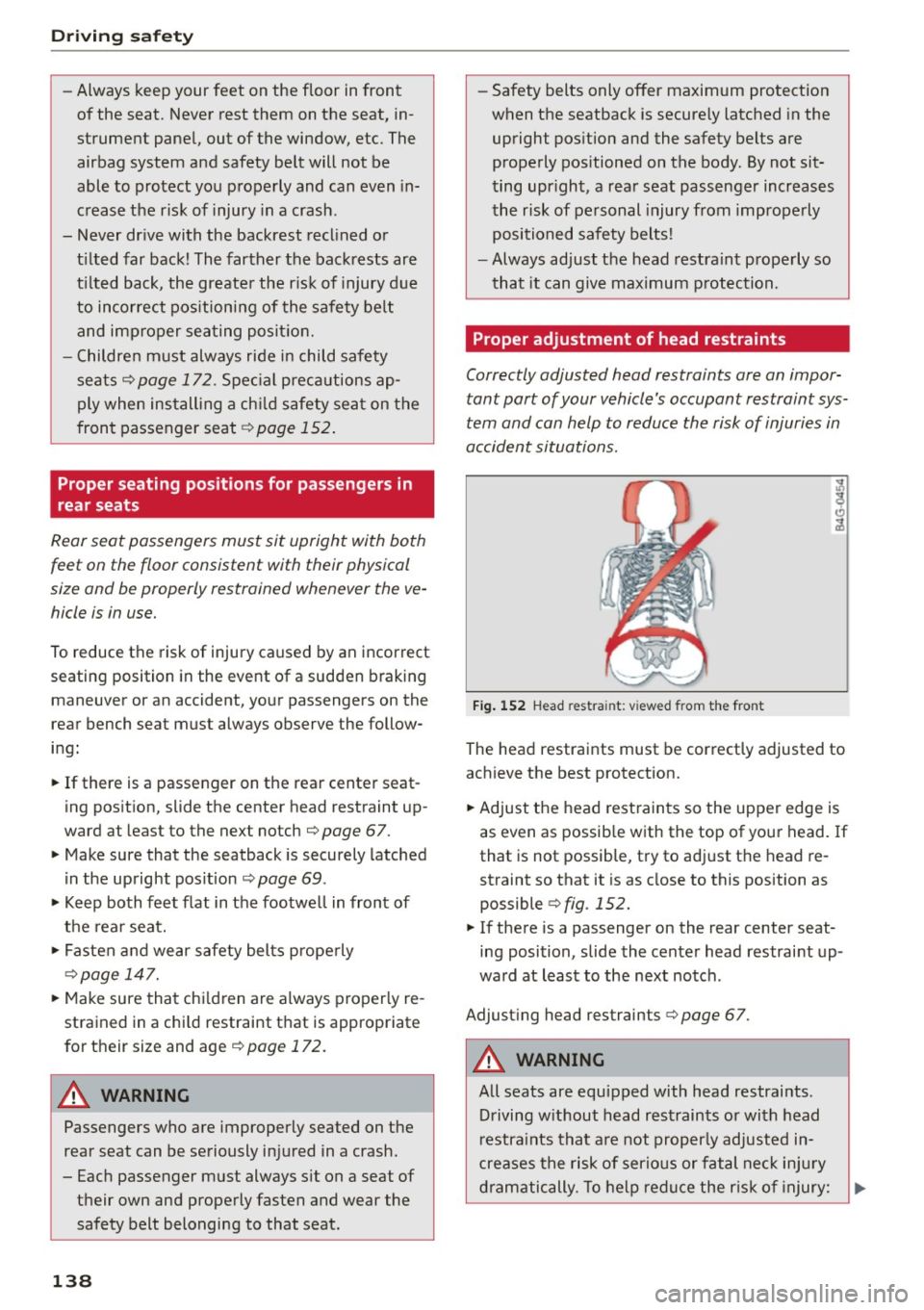
Fig. 152 Head rest ra in t: v iewed from the fro nt
The head restraints must be correctly adjusted to
achieve the best protection.
~ Adjust the head restraints so the upper edge is
as even as possible with the top of your head. If
that is not possible, try to adjust the head re
straint so that it is as close to this position as
possible r=;,
fig. 152.
~ If there is a passenger on the rear center seat
ing position, slide the center head restraint up
ward at least to the next notch .
Adjus ting head restraints r=;,
page 67.
A WARNING
All seats are equipped with head restraints.
Driving without head restraints or with head
restraints that are not properly adjusted in
creases the risk of serious or fatal neck injury
-
dramatically. To help reduce the risk of injury: ~
Page 141 of 302
M N
co
a:
co
,...., \!) 1.1"1
N 1.1"1 ,....,
-Always drive with the head restraints in
place and properly adjusted.
- Every person in the vehicle must have a
properly ad justed head restraint.
- Always make sure each person in the vehicle
properly adjusts their head restraint. Adjust
the head restraints so the upper edge is as even as possib le w ith the top of your head.
If that is not possib le, try to adjust the head
restraint so that it is as close to this position
as possib le.
- Never attempt to adjust head restraint
wh ile driving. If you have driven off and
must adjust the dr iver headrest for any rea
son, fi rst stop the veh icle safely before at
tempting to ad just the head restraint.
- Children must always be properly restrai ned
in a ch ild restraint that is appropria te fo r
their age and si ze
qpoge 172.
Examples of improper seating positions
The occupant restraint system con only reduce
the risk of injury if vehicle occupants ore properly
seated.
I mproper seat ing posit ions can ca use serious in
jury o r death . Safety be lts ca n only work when
they are prope rly positioned on t he body. Im
proper sea ting pos it ions reduce the effect iveness
of safety belts and wi ll even increase the risk of
in ju ry and death by moving the safety belt to cr it
i cal areas of the body. Improper seating positions
also increase the risk of serious injury and death
when an airbag deploys a nd strikes an occupant
who is not i n the proper seating position . A driver
i s responsible for the safety of all vehicle occu
pants and especia lly for children . Therefo re :
.. Never allow anyone to ass ume an incorrect
seat ing pos ition when the veh icle is being used
¢ ,&. .
The follow ing bulletins list only some sample po
sitions that will increase the risk of ser ious injury
and death. Our hope is that these examples will
make you more aware of seat ing pos itions that
are dangerous.
Dr ivin g s afet y
Therefore , whenever the vehicle is moving :
-never stand up in the vehicle
- never stand on the seats
- never kneel on the seats
- never ride w ith the seatback reclined
- never lie down on the rear seat
- never lean up against the instrument panel
- never sit on the edge of the seat
- neve r sit sideways
- neve r lean out t he window
- neve r put your feet out the window
- never put your feet on the instrument panel
- never rest your feet on the seat cush ion or back
of the seat
- never ride in the footwell
- never ride in the ca rgo a rea
A WARNING
Imp roper seating posit ions increase the risk
of ser ious personal in jury and death whenever
a veh icle is being used.
-Always make sure that all vehicle occupants stay in a proper seating position and are
properly restrained whenever the vehicle is
be ing used.
Pedal area
Pedals
The pedals must always be free to move and
must never be interfered with by a floor mot or
any other object .
Make sure that a ll peda ls move free ly without in
te rfe ren ce and t hat no thing prevents them from
re tu rning to t he ir o riginal posi tions.
Only use floor mats t hat leave the pedal a rea free
and can be secured with floor mat fastene rs.
If a brake circuit fa ils, increased brake pedal trav
el is required to bring the veh icle to a full stop .
A WARNING
-
Pedals that cannot move free ly can cause loss
of vehicle co ntrol and increase the risk of ser i-
ous injury.
~
1 39
Page 142 of 302
Driving safety
-Never place any objects in the driver's foot
well. An object could get into the pedal area
and interfere with pedal function . In case of
sudden braking or an accident, you would not be able to brake or accelerate!
- Always make sure that nothing can fall or
move into the driver 's footwell.
Floor mats on the driver side
Always use floor mots that con be securely at
t ached to the floor mo t fas teners and do no t in
terfere with the free movement of the pedals .
• Make su re that the floor mats are properly se
cured and cannot move and interfere with the pedals
c> _&. .
Use only floor mats that leave the pedal area un
obstructed and that are firmly secured so that
they cannot slip out of position. You can obtain
suitable floor mats from your authorized Audi
dealer .
Floor mat fasteners are installed in your Audi.
Floor mats used in your vehicle must be attached
to these fasteners. Properly securing the floor mats will prevent them from sliding into posi
tions that could interfere with the pedals or im
pair safe operation of your vehicle in other ways.
A WARNING
Pedals that cannot move freely can result in a
loss of vehicle control and increase the risk of
serious personal injury.
- Always make sure that floor mats are prop
erly secured .
- Never place or install floor mats or other
floor coverings in the vehicle that cannot be
properly secured in place to prevent them
from slipping and inte rfering w ith the ped
als or the ability to control the vehicle .
- Never place or install floor mats or other
floor coverings on top of already installed
floor mats. Additional floor mats and other
coverings will reduce the size of the pedal
area and interfere with the pedals .
- Always properly reinstall and secure floor
mats that have been taken out for cleaning.
140
-Always make sure that objects cannot fall
into the driver footwell while the vehicle is
moving. Objects can become trapped under
the brake pedal and accelerator pedal caus
ing a loss of vehicle control.
Storing cargo correctly
Loading the luggage compartment
All luggage and other objects must be properly stowed and secured in the luggage comport
ment.
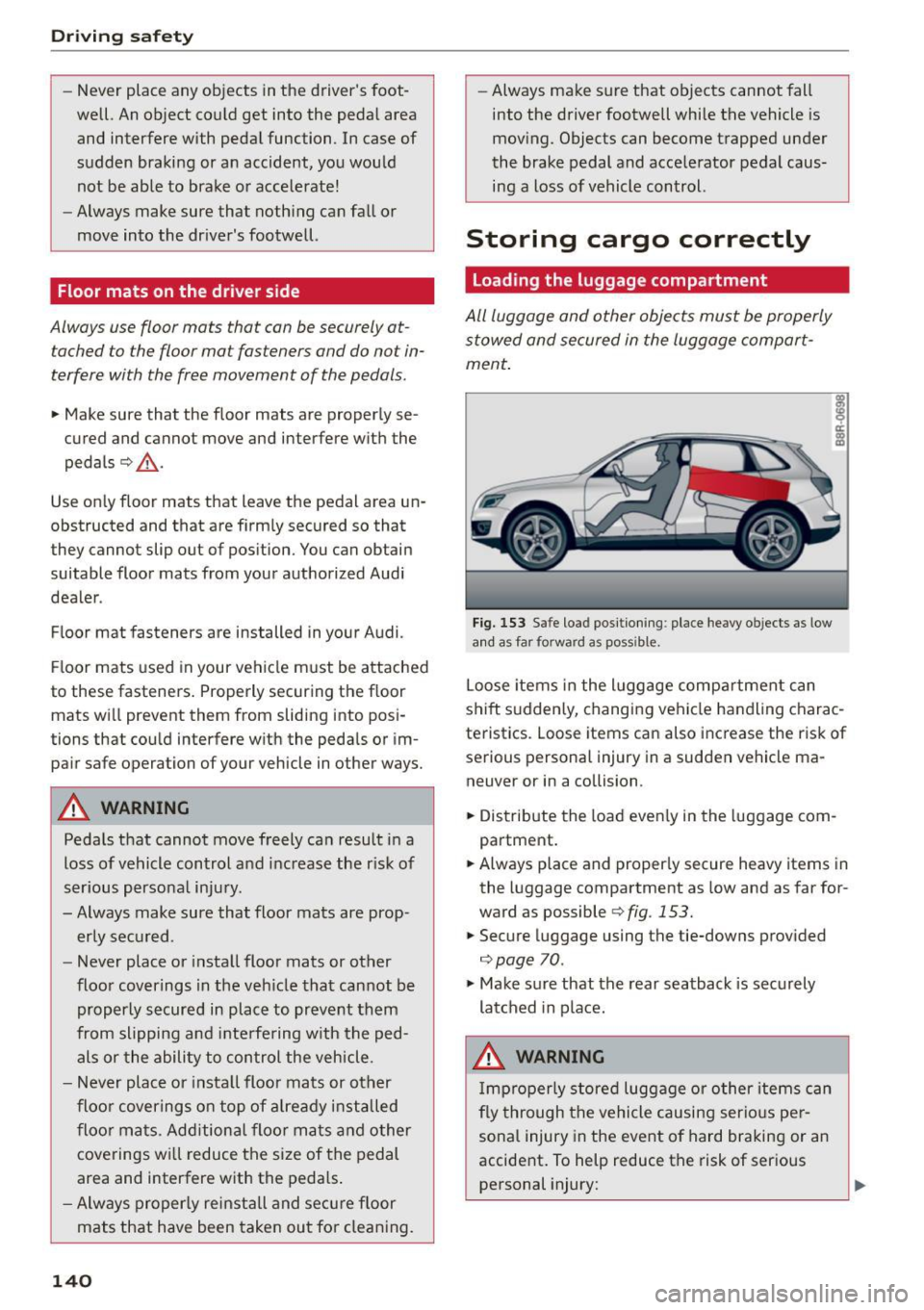
Fig. 153 Safe loa d positioning : place heavy o bjects as low
and as far fo rwa rd as poss ib le.
Loose items in the luggage compartment can
shift suddenly, changing vehicle handling charac
teristics . Loose items can also increase the risk of
serious personal injury in a sudden vehicle ma neuver or in a collision .
• Distribute the load evenly in the luggage com
partment.
• Always place and properly secure heavy items in
the luggage compartment as low and as far for
ward as possible
c> fig . 153.
• Secure luggage using the tie-downs provided
c>poge 70.
• Make sure that the rear seatback is securely
latched in place.
A WARNING
Improperly stored luggage or other items can
fly through the vehicle causing serious per
sonal injury in the event of hard braking or an
accident. To help reduce the risk of serious personal injury: ..,.
Page 143 of 302
M N
co
a:
co
,...., \!) 1.1'1
N 1.1'1 ,....,
-Always put objects, for examp le, luggage or
other heavy items in the luggage c ompart
ment.
- Always secure objects in the luggage com
partment us ing the tie-down eye lets and
suitable straps.
A WARNING
Heavy loads will influence the way your vehi
cle handles. To help reduce the risk of a loss
of control leading to ser ious personal injury:
- Always keep in m ind when transporting
heavy objects, that a change in the center of
gravity can also cause changes in vehicle
hand ling:
- Always distribute the load as even ly as
possible.
- Place heavy objects as far forward in the
luggage compartment as possible.
- Never exceed the G ross Ax le Weight Rating
or the Gross Vehicle Weight Rating specified
on the safety compliance sticker on the left
doo r jamb. Exceeding permissible weight
standards can cause the vehicle to s lide and
hand le different ly.
- Please observe information on safe driving
r=>page 135.
A WARNING
To help prevent poisonous exhaust gas from
being drawn into the vehicle, always keep the
rear lid closed while driv ing.
- Never transport objects larger than those
fitt ing completely into the luggage a rea be
cause the rea r lid cannot be fully closed .
- If you absolutely must drive w ith the rear lid
open, observe the following notes to reduce
the risk of poisoning:
- Close a ll windows,
- Close the Panoramic sliding sunroof*,
- Open al l air outlets in the instrument pan-
el,
- Sw itch off the air recircu lation,
- Set the fresh ai r fan to the h ighest speed.
Dr ivin g s afet y
A WARNING
Always make sure that the doors, all windows,
the Panoramic sliding sunroof * and the rear
lid are securely closed and locked to reduce
the r is k of injury when the vehicle is not being
used.
- After closing the rear lid, always make sure
that it is p roperly closed and locked.
- Never leave your vehicle unattended espe
cially with the rea r lid left open . A child
could crawl into the ve hicle through the lug
g age compartmen t and clo se the re ar lid be
coming trapped and unable to get out. Be
ing trapped in a vehicle can lead to serious
pe rsonal injury .
- Never let children play in or around the vehi
cle.
- Never let passengers ride in the luggage
compa rtment . Vehicle occupants must al
ways be properly restrained in one of the ve
hicle's seating positions.
(D Tips
- Air circul ation helps to reduce window fog
ging . Stale ai r escapes to the outs ide
through vents in the t rim panel. Be sure to
keep these slots free and open.
- The tire pressure m ust correspond to the
load. The tire pressure is shown on the tire
pressure label. The t ire p ress ure label is lo
cated on the dr iver's side B-pillar. The tire
pressure label lists the recommended cold
t ire inflation pressures fo r the veh icle at its
maximum ca pac ity weight and the tires that
we re on your vehicle at the t ime it was man
ufac tured. For recommended tire pressures
for normal load condi tions, please see chap
ter
r=> page 246.
Tie-downs
The luggage compar tment is equipped wi th four
tie-downs to se cure luggage and other items .
Use the t ie-downs to secu re your cargo prope rly
r=> page 140, Loading the luggage compar tment. lliJ,
141
Page 144 of 302
Driving safet y
In a collision, the laws of phys ics mean that even
sma ller items that are loose in the vehicle wi ll
become heavy miss iles that can cause serious in
jury. Items in the vehicle possess energy which vary with vehicle speed and the weight of the item . Vehicle speed is the most significant factor .
For examp le, in a frontal coll is ion at a speed of
30 mph (48 km/h), the forces acting on a 10-lb (5 kg) object are about 20 t imes the normal
weight of the item . This means that the we ight
of the item would suddenly be about
200 lbs. (90 kg) . You can imagine the injuries
that a 200 lbs. (90 kg) item flying free ly through
the passenger compartment could ca use in a co l
lision like this .
A WARNING
Weak, damaged or improper straps used to
secure items to tie-downs can fa il during hard
bra king or in a collision and cause serious per
sonal injury.
- Always use suitable mounting straps and
properly secure items to the tie-downs in
the luggage compartment to help prevent
items from shifting or flying forward as dan
gerous missiles.
- When the rear seat backrest is fo lded down ,
always use suitable mounting straps and
properly secure items to the tie-downs in
the luggage compartment to help prevent
item s from flying forwa rd as dangerous mis
siles into the passenger comp art ment.
- Never attac h a child safety seat tether strap
to a tie-down.
Reporting Safety Defects
Applicable to U.S.A.
If y ou b eliev e that y our vehicl e
has a defe ct which could caus e a
cr ash or could cause injury or
d eath , you should immediately in
form the National Highw ay Tr affi c
Saf ety Admini stration (NHTSA) in
142
a d dition t o notif ying Audi of
Am eri ca, Inc .
If NHTSA r ecei ves similar com
plaint s, it may open an inve stiga
tion , and if it finds that a safety
defect s ex ists in a group of
v ehicles, it may order a recall and
remedy camp aign. How ever,
NHTSA cannot become in vol ved in
indi vidual pr oblems between you ,
your dealer, or Audi of America ,
Inc.
T o conta ct the NHTSA, you m ay
e ither call:
Tel.: 1-888-32 7-4 236 (TTY :
1-800-4 24-9 153) or
1-800-424-9393
or you ma y write to:
NHT SA
U .S . De part ment of Tran sp ort a
tion 1200 Ne w Jer sey A ve ., S. E.
W est Building
W ashington , D C 2 0590
You can also obtain other infor
mation about motor vehicle saf e
t y from:
http: / /www .s af ercar.g ov
Page 149 of 302
M N
co ~ ex:, rl I.O
"' N
"' rl
A WARNING
Not wearing safety belts or wearing them im
properly increases the risk of serious personal
injury and death. Safety belts can work only
when used correctly .
- Always fasten your safety belts correctly be
fore driving off and make sure al l passen
gers are correctly restrained.
- For maximum protection, safety belts must
always be pos itioned properly on the body.
- Never strap more than one person, includ
ing small ch ildren, into any belt.
- Never place a safety belt over a child sitting
on your lap.
- Always keep feet in the footwell in front of
the seat while the vehicle is being driven.
- Never let any person ride with their feet on
the instrument panel or sticking out the
window or on the seat.
- Never remove a safety belt while the vehicle
is moving . Doing so will increase your risk of
being injured or killed.
- Never wear belts twisted.
- Never wear belts over rigid or breakable ob-
jects in or on your clothing, such as eye
glasses, pens, keys, etc., as these may cause
injury.
- Never allow safety belts to become dam
aged by being caught in door or seat hard
ware.
- Do not wear the shoulder part of the belt
under your arm or otherwise out of position.
- Several layers of heavy clothing may inter
fere with correct positioning of belts and re duce the overall effectiveness of the system.
- Always keep belt buckles free of anything
that may prevent the buckle from latching
securely.
- Never use comfort clips or devices that cre
ate slack in the shoulder be lt. However, spe
cial clips may be required for the proper use
of some child restraint systems.
- Torn or frayed safety belts can tear, and
damaged belt hardware can break in an acc i
dent. Inspect belts regularly. If webb ing,
bind ings, buckles, or retracto rs are dam-
Safety belts
aged, have belts replaced by an authorized
Audi dealer or qualified workshop.
- Safety belts that have been worn and loaded
in an accident must be replaced with the
correct replacement safety belt by an au
thorized Audi dealer. Replacement may be
necessary even if damage cannot be clearly
seen. Anchorages that were loaded must al
so be inspected.
- Never remove, modify, d isassemble, o r try
to repair the safety belts yourself.
-Always keep the belts clean. Dirty belts may not work properly and can impair the func
tion of the inertia reel~
table Internal
cleaning on page 210.
Safety belts
Fastening safety belts
Safety first -everybody buckle up!
Fig. 160 Belt buck le and tongue on the d rive r's seat
To provide maximum protection, safety belts
must always be positioned correctly on the wear
er's body.
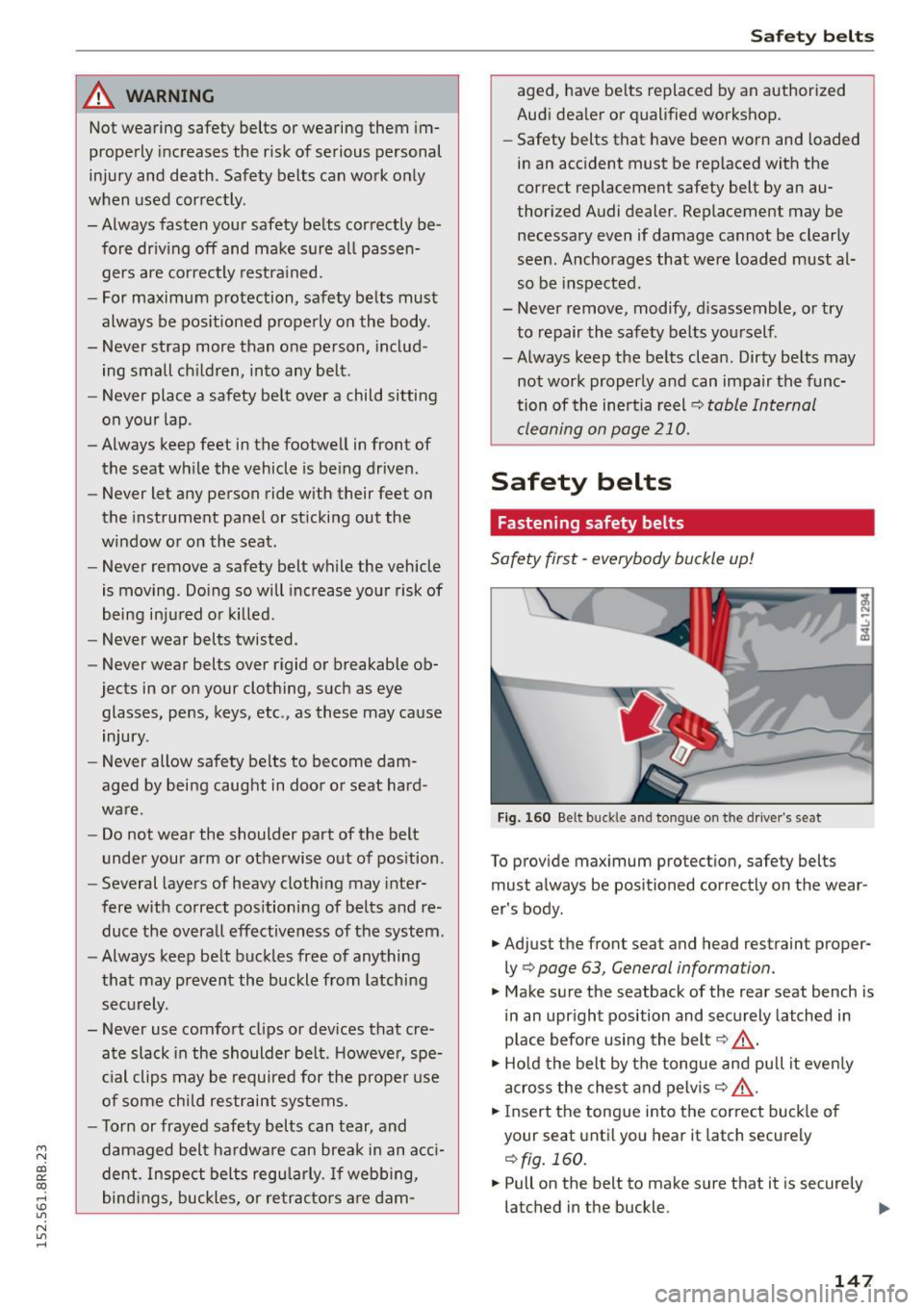
.. Adjust the front seat and head restraint proper
ly
q page 63, General information.
.. Make sure the seatback of the rear seat bench is
in an upright position and securely latched in
place before using the belt
q .&, .
.. Ho ld the belt by the tongue and pull it even ly
across the chest and pelvis ¢.&_ .
.. Insert the tongue into the correct buckle of
your seat until you hear it latch securely
q fig. 160.
.. Pull on the belt to make sure that it is securely
latched in the buckle.
Ill>
147
Page 150 of 302
Safety belts
Autom atic safet y belt retractors
Every safety belt is eq uipped w ith an automatic
be lt retractor on the shou lder belt. This feature
locks the belt when the be lt is pulled o ut fast,
during hard brak ing and in an accident . The belt
may also lock when you drive up or down a steep
hill or through a sharp curve. During normal driv
ing the belt lets you move freely.
S afety belt pre te n sioners
The safety be lts are equipped with a belt preten
sioner that helps to t ighten the safety belt and
remove s lack when the pretensioner is activated .
The function of the pretensioner is monitored by
a warning light
r:::') page 16.
Swi tchable lo cking feature
Every safety belt except the one on the driver
seat is equipped w ith a switchable locking fea
ture that
must be used when the safety belt is
used to attach a child safety seat. Be sure to read
the important informat ion about th is feature
r=;, page 181 .
.&_ WARNING
Improperly positioned safety belts can cause
ser ious injury in an accident¢
page 148,
Safe ty belt position.
- Safety belts offer optimum protection only
when the seatback is upright and belts are
properly positioned on the body.
- Always make sure that the rea r seat back
rest to which t he center rear safety belt is
attached is securely latched whenever the
rear center safety belt is being used . If the
backrest is not securely latched, the passen
ger will move forward with the backrest dur
ing sudden braking, in a sudden maneuver
and especially in a crash.
- Never attach the safety belt to the buck le
for another seat. Attaching the belt to the
wrong buckle will reduce safety be lt effec
t iveness and can cause serious persona l in
jury .
- A passenger who is not properly restrained
can be se riously in ju red by the safety belt it
self when it moves from the stronger parts
148
of the body into critical areas like the abdo
men.
- Always lock the convertible locking retractor
when you are secur ing a child safety seat in
the vehicle
r=;, page 183.
Safety belt position
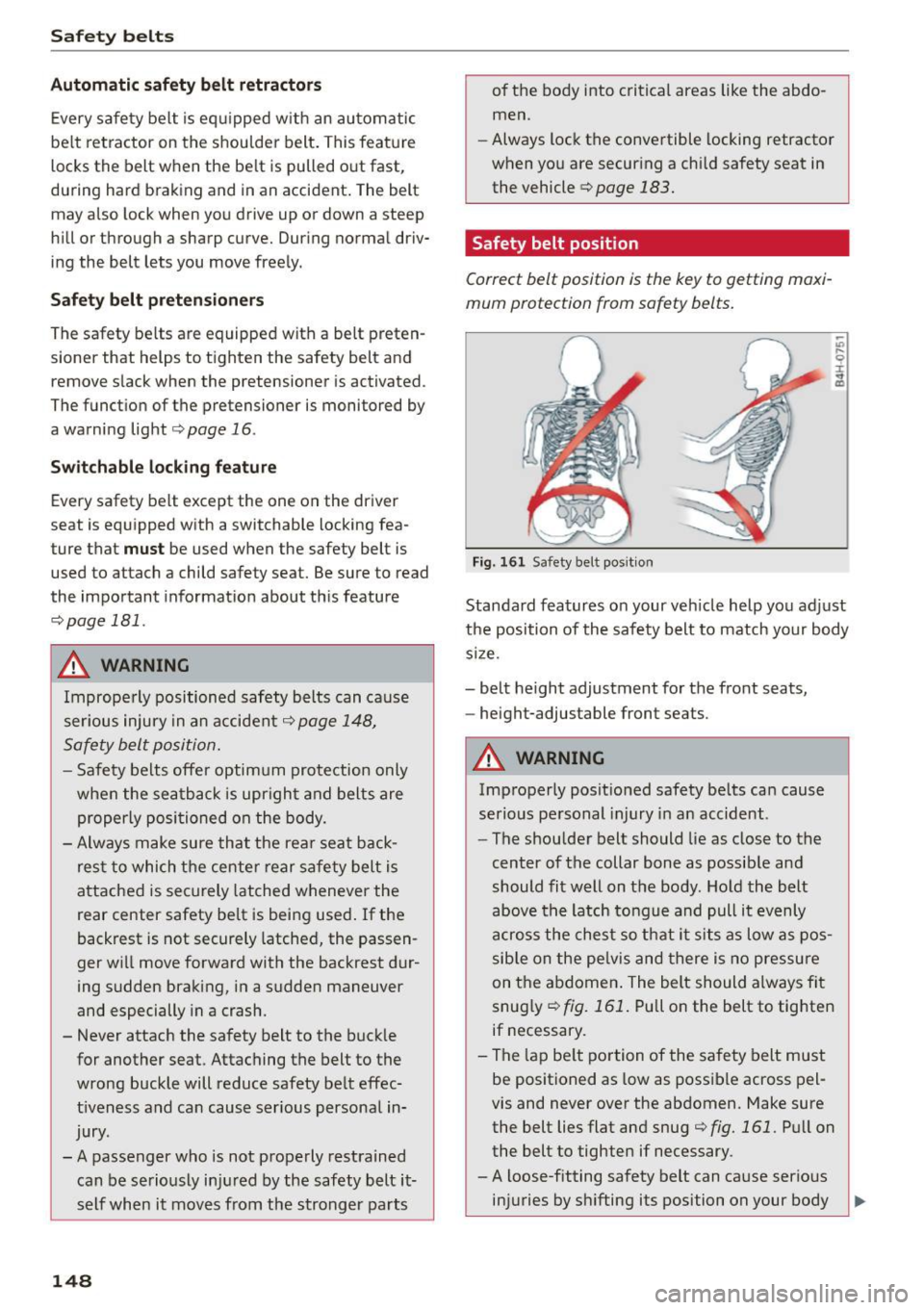
Correct belt position is the key to getting maxi
mum protection from safety belts .
Fig. 161 Safety belt posit ion
-"' .... 9 I ... a,
Standard features o n your veh icle help you adjust
the position of the safety belt to match your body
s ize .
- belt he ight adjustment fo r the front seats,
- height-adjustable front seats.
.&_ WARNING
Imp roperly posit ioned safety be lts can cause
serious pe rsonal injury i n an accident.
- The shou lder belt should lie as close to the
center of the collar bone as possib le and
should fit well on the body . Ho ld the belt
above the latch to ngue and pull it evenly
across the chest so that it sit s as low as pos
sib le on the pe lvis and there is no pressure
on the abdomen . The belt should always fit
snug ly ¢
fig. 161. Pull on the belt to tighten
if necessary.
- The lap be lt po rtion of the safety belt must
be positioned as low as possi ble across pel
vis and never over the abdomen. Make sure
the belt lies flat and snug
¢fig. 161. Pull on
the belt to tighten if necessary.
- A loose-fitting safety belt can ca use serious
in juries by sh ifting its position on your body
~
Page 151 of 302
M N
co ~ co
rl I.O
"' N
"' rl
from the strong bones to more vulnerable,
soft tissue and cause serious injury.
- Always read and heed all WARNINGS and
other important information
i::> page 146 .
Pregnant women must also be correctly
restrained
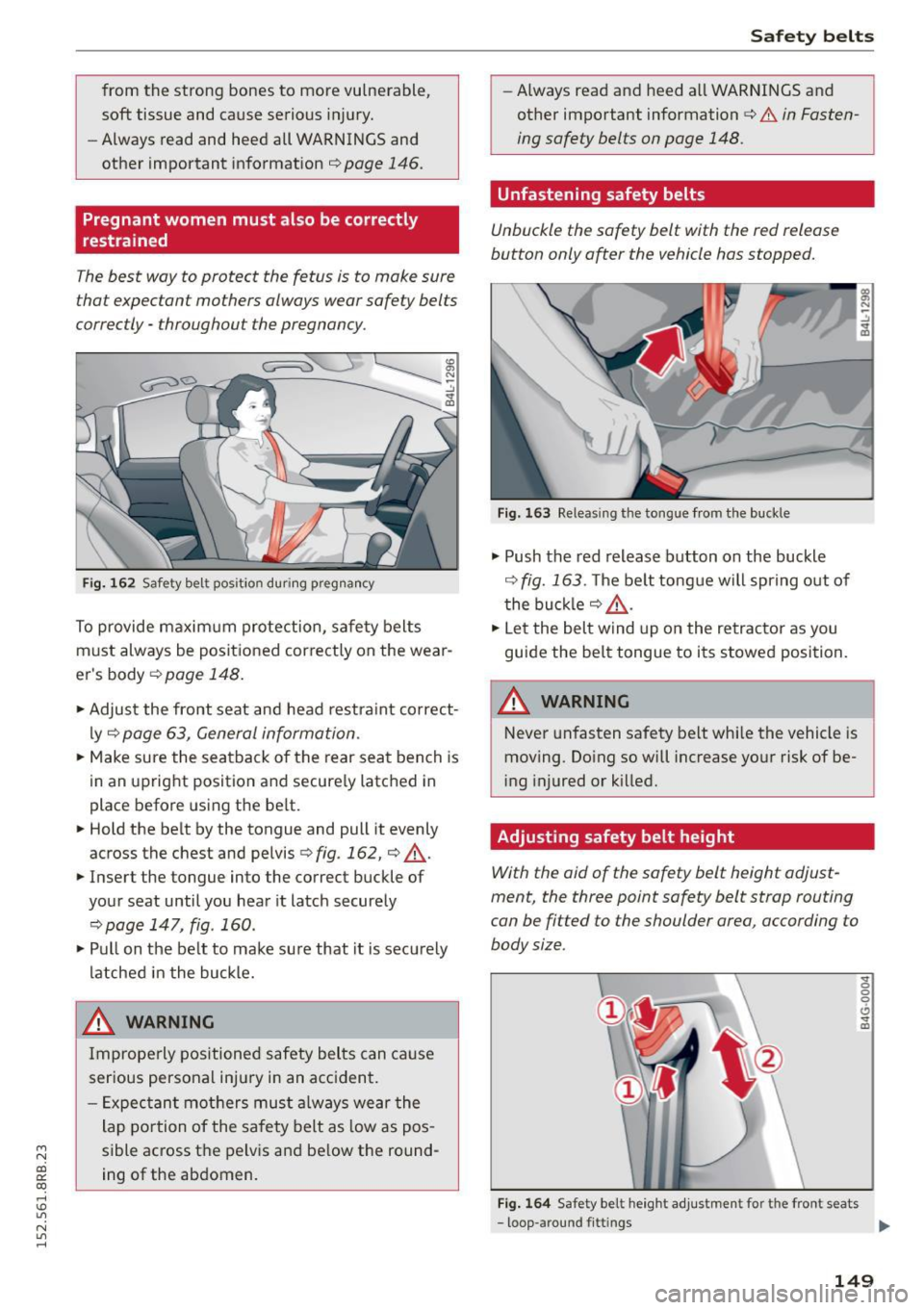
The best way to protect the fetus is to make sure
that expectant mothers always wear safety belts
correctly -throughout the pregnancy .
Fig. 162 Safety belt position during preg nancy
To provide maximum protection, safety belts
must always be positioned correct ly on the wear
er's body
i::> page 148.
• Adjust the front seat and head restraint correct
ly
c:> page 63, General information .
• Make sure the seatback of the rear seat bench is
in an upright position and secure ly latched in
place before using the be lt.
• Hold the belt by the tongue and pull it evenly
across the chest and pelvis
c:> fig . 162, c:> &_ .
• Insert the tongue into the correct buckle of
your seat until you hear it latch securely
i=:>page 147 , fig . 160 .
•Pullon the belt to make sure that it is securely
latched in the buckle.
_& WARNING ,..__
Improperly positioned safety belts can cause
serious personal injury in an accident.
- Expectant mothers must always wear the
lap portion of the safety belt as low as pos
sible across the pelvis and below the round
ing of the abdomen.
Safety belts
-Always read and heed all WARNINGS and
other important information
c:> & in Fasten
ing safety belts on page 148 .
Unfastening safety belts
Unbuckle the safety belt with the red release
button only a~er the vehicle has stopped.
Fig. 163 Releas ing the tongue from the buck le
.,. Push the red release button on the buckle
i=:> fig. 163. The belt tongue will spring out of
the buckle
i::> &_.
• Let the belt wind up on the retractor as you
guide the belt tongue to its stowed position.
_& WARNING
Never unfasten safety belt while the vehicle is
moving . Do ing so will increase your risk of be
i ng injured or killed.
Adjusting safety belt height
With the aid of the safety belt height adjust
ment, the three point safety belt strap routing
can be fitted to the shoulder area, according to
body size .
Fig. 164 Safety belt height adjustmen t fo r the front seats
... 0 0
0
6 ... a,
- loop-around fittings ..,.
149
Page 177 of 302
M N
co
a:
co
,...., \!) 1.1'1
N 1.1'1 ,....,
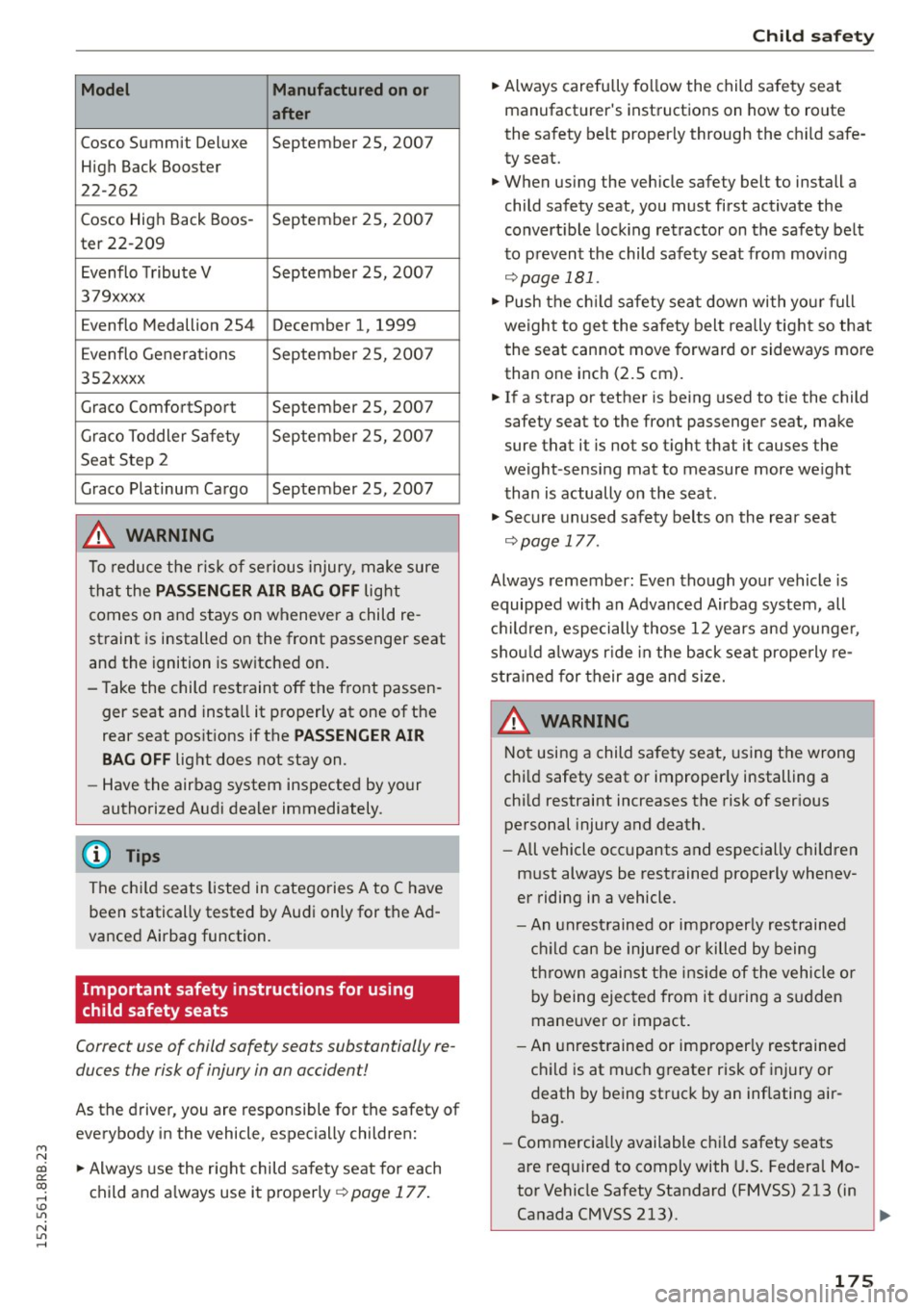
Model Manufactured on or
a fter
Cosco Summit Deluxe September 25, 2007
High Back Booster
22-262
Cosco High Back Boos -September 25, 2007
ter 22-209
Evenflo Tribute V September 25, 2007
379xxxx
Evenflo Medallion 254 December 1, 1999
Evenflo Generations September 25, 2007
3S2xxxx
Graco ComfortSport September 25, 2007
Graco Toddler Safety September 25, 2007
Seat Step 2
Graco Platinum Cargo September 25, 2007
.&, WARNING
To reduce the risk of serious injury, make sure
that the
PASS ENGER AIR BAG OFF light
comes on and stays on whenever a child re
straint is installed on the front passenger seat
and the ignition is switched on.
- Take the child restraint off the front passen ger seat and install it properly at one of the
rear seat positions if the
PASSENGER AIR
BA G OFF
light does not stay on.
- Have the airbag system inspected by your
authorized Audi dealer immediately.
(D Tips
The ch ild seats listed in categories A to C have
been statically tested by Audi on ly for the Ad
vanced Airbag function.
Important safety instructions for using
child safety seats
Correct use of child safety seats substantially re
duces the risk of injury in an accident!
As the driver, you are responsible for the safety of
everybody in the vehicle, especially children:
.,. Always use the right child safe ty seat for each
child and a lways use it properly ¢
page 177.
Child sa fety
.,. Always carefully follow the child safety seat
manufacturer's instructio ns on how to route
the safety belt properly through the child safe
ty seat.
.,. When using the vehicle safety belt to install a
child safety seat, you must first activate the
convert ible lock ing retractor on the safety belt
to prevent the child safety seat from mov ing
r::) page 181 .
.,. Push the ch ild safety sea t down with yo ur full
weight to get the safety belt rea lly tight so that
the seat cannot move forward or sideways more
than one inch (2.5 cm).
.,. If a strap or tether is being used to tie the child
safety seat to the front passenger seat, make
sure that it is not so tight that it causes the
weight -sensing mat to measure more we ight
than is actually on the seat .
.,. Secure unused safety belts on the rear seat
r::) page 177 .
Always remember : Even though your vehicle is
equipped with an Advanced Airbag system, all
c hi ld ren, especially those 12 years and younge r,
shou ld a lways r ide in the back seat prope rly re
stra ined for their age and size.
A WARNING
=
Not using a child sa fety seat, us ing the wrong
chi ld safety seat or improperly installing a
chi ld restraint increases the risk of serious
personal injury and death.
- All vehicle occ upants and especially children
must always be restrained properly whenev
er riding in a vehicle .
- An unrest rained or improperly restrained
ch ild can be injured or killed by being
thrown against the ins ide of the vehicle o r
b y being ejected from it du ring a s udden
maneuver or impact.
- An unrestrained or improperly res trained
child is at much greater risk of injury or
death by being struck by an inflating air
bag.
- Commercia lly available child safety seats
are req uired to comply with U.S. Federa l Mo
tor Vehicle Safety Standard (FMVSS) 213 (in
Canada CMVSS 213). .,_
175