door lock AUDI Q5 2015 Owner's Manual
[x] Cancel search | Manufacturer: AUDI, Model Year: 2015, Model line: Q5, Model: AUDI Q5 2015Pages: 302, PDF Size: 75.01 MB
Page 91 of 302
transmission is not in the P or N position . The en
gine can only be started with the se lecto r in
these posit ions.
l!,JI Is the key in the vehicle ?
This message appears in a veh icle w ith Conven
i en ce key* if the mas ter key is removed from the
ve hicl e with the eng ine running.
If th e maste r
key is no longer in the vehicle, you c annot sw itch
on the i gnition after s topping the engine and you
also ca nnot start the engine again . Moreover, you
cannot lock the veh icle from the o utside with the
key .
Shift to P otherwi se vehicle can roll awa y. Doors
do not lock if lever is not in P.
This mes sage appea rs for sa fe ty rea sons a long
w ith a w arning s ignal.
It ap pears if the se lector
l ever fo r the automatic t ransmission is not in the
P posit ion when switching
off the ignition. Move
the selector lever to the P posit ion, otherwise the
ve hicle is not secured aga inst ro lling away. You
also ca nnot lock the vehicle using the locking
button* on the door ha ndle or using the remote
key .
Turn off ignition before leav ing car
This message appears i f the driver's door is
opened while the ignition is switched on. Always
sw itch
off the ign ition if yo u are leaving the vehi
cle . See a lso
c;, page 93.
Turn off ignition before leaving car . Batter y is
discharging
This mes sage appea rs if the driver's door is
opened while the igni tion is sw itched on . Always
switch
off the ignition if yo u are leaving the vehi
cle. See a lso
c;, page 93.
Shift to P and turn off ignition, oth erwise ve hi
cle can roll away
This m essage appears if the driv er's door is
ope ned while the igni tion is sw itched on and t he
se lec to r lever i s not in t he P po siti on. Shift these
l ec to r l ever in to the P pos ition and switch
off t he
~ ignit ion when yo u exit the vehicle . Otherwise the
co ~ ve hicle co uld roll. See also c;, page 93.
rl
:5: Convenien ce key defec tive! Use ignition lock
N l/1 rl
D riv ing
This message appears if the engine m ust be
started or stopped using the ignition key and not
the
I START ENGINE STOPi* button.
Electromechanical
parking brake
Operation
The electromechanical parking brake replaces
the hand brake.
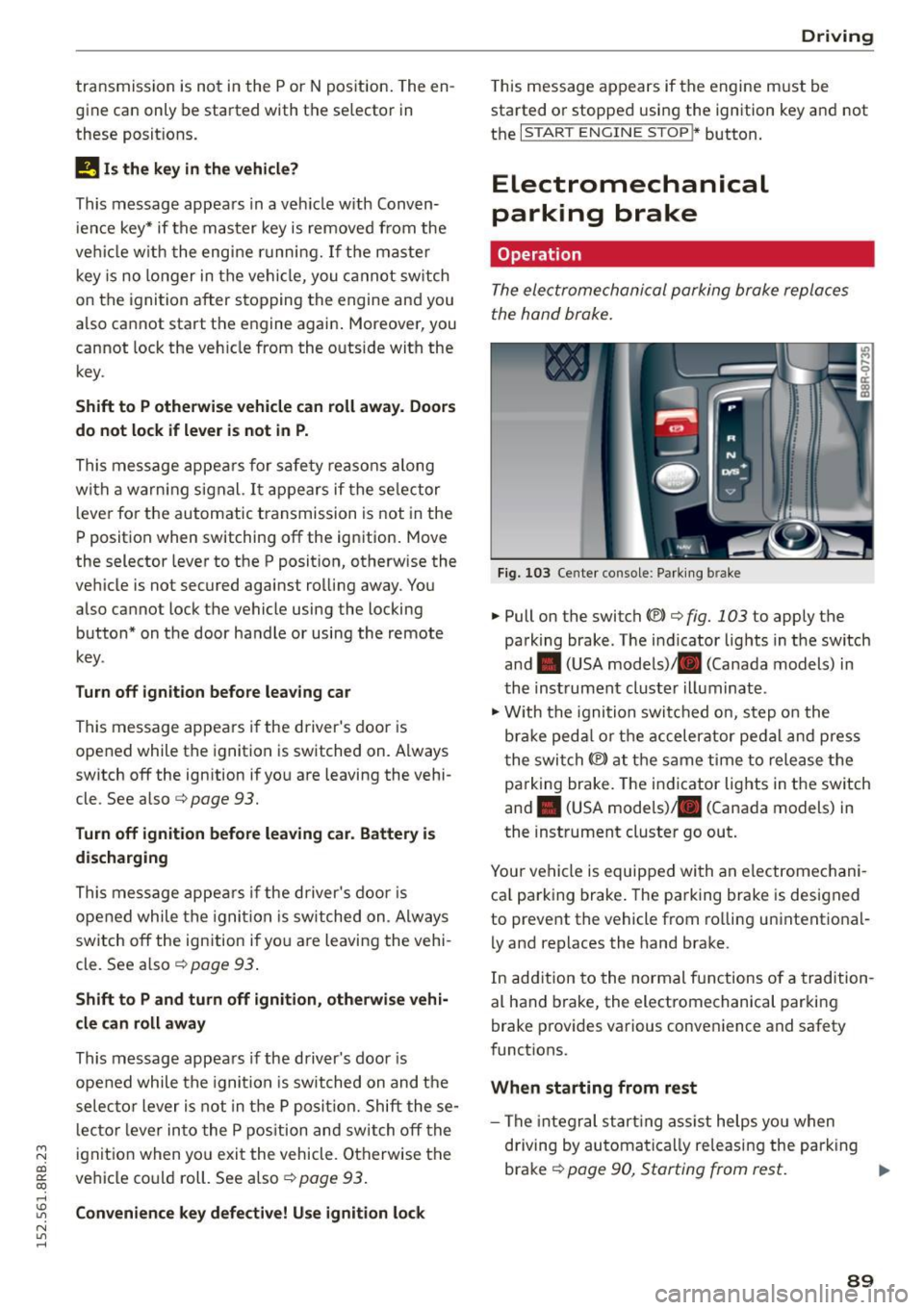
Fig . 103 Ce nte r console : Parki ng b rake
.,. Pull on the switch «el) c:;, fig. 103 to apply the
parking brake . The i ndicator lig hts in the switch
and . (USA models) . (Canada models) in
th e inst rument cluste r illuminat e.
.,. With the ignition swi tch ed on, step o n the
b rak e ped al or t he ac celer ato r pe dal an d pre ss
t he swi tch
(®) at the same time to release the
pa rking brake. The ind icator lights in the switch
and . (USA mode ls) . (Canada models) in
the inst rument cluste r go out.
Your vehicle is equipped with an electromechani ca l park ing brake . The pa rking brake is designed
to prevent the vehicle from ro lling u nintent io na l
l y and replaces the hand brake .
In add ition to the normal f unctions of a tradition
al hand brake, the electromechanical parki ng
brake prov ides various conve nience and safety
funct ions.
When starting from rest
- The integr al st art ing ass ist helps yo u when
d riving by automa tica lly re leasi ng the par king
brake
c:;, page 90, Starting from rest. IJo-
89
Page 92 of 302
Driving
- When starting on inclines, the sta rting assist
prevents the vehicle from unintentionally roll
i ng back . T he braking force of the parking brake
is not released unt il sufficient driving force has
been built up at the wheels.
Em ergency brake function
An emergency bra ke ensures that the vehicle can
be slowed down even if the normal brakes fa il
c::> page 91, Emergency broking .
A WARNING
-
If a drive range is engaged with the vehicle
stationary and the engine running, you must
in no instance accelerate careless ly. Otherwise
t he vehicle will start to move immed iate ly -
r isk of an accident.
(1) Tips
- If the parking brake is applied with the igni
tion switched off, the indicator lights in the
swi tch and . (USA
models) ;II (Cana-
da models) in t he instrument cluster wil l go
out after a certa in period of time.
- Occasiona l noises when th e par king b rake is
applied and released are normal and are not
a cau se for co nce rn.
- When the ve hicle is par ked, the parking
b rake goes t hro ugh a se lf-test cycle a t regu
lar in tervals . Any associa ted noises are no r
mal.
Parking
~ Press the brake peda l to stop the vehicle.
~ Pu ll the switch c::> page 89 , fig . 103 to set the
parking brake.
~ Move the selecto r lever to P .
~ Turn the eng ine off c::> ,&. .
~ When on incl ines or declines, turn the steer ing
whee l so that the vehicle w ill roll into the curb
if it beg ins to move.
A WARNING
- W hen you leave your veh icle -even if only
br ie fly -always remove the igni tion key. This
applies part icu larly when children remain in
90
-
the vehicle. Ot herwise the ch ild ren could
start the engine, release the parking b rake
or operate electrical equ ipment (e.g . power
w indows) . There is the risk of an accident.
- W hen the veh icle is locked, no one -part icu
larly not chi ldren shou ld remain in the ve hi
cle. Locked doors make it more d ifficult for
emerge ncy wor kers to get into the ve hicle -
putting lives at risk .
Starting from rest
The starting assist function ensures that the
parking broke is released automatically upon
starting.
Stopping and applying parking brake
~ Pull the sw itch to app ly the parking brake.
Starting and automatically releasing the
parking brake
~ When you sta rt to drive as us ual, the parking
brake is automatically released and yo ur vehicle
beg ins to move.
When stopping at a traffic signa l or stopping in
c ity t raffic on vehicles with an a utomat ic trans
mission, the parking brake ca n be applied. The
vehicle does not have to be he ld with the foot
brake . The park ing brake e liminates the tendency
to c reep with a d rive ra nge engaged . As soon as
you d rive off as usua l, the par king b rake is re
l eased a utomat ic all y and the vehi cle starts to
move .
Starting on slopes
When sta rting on inclines, the starting assist pre
vents the vehicle from unintentionally ro lling
ba ck. The braking for ce of t he parking b ra ke is
not released until sufficient dr iv ing force has
been built up a t the wheels.
(D Tips
Fo r safety reaso ns, the p arking bra ke is re
l e ased auto m atically only w hen t he d river 's
s a fe ty be lt is engaged in t he b uckle .
Page 95 of 302
M N
co ~ co
rl I.O
"' N
"' rl
General information
Applies to vehicles: with Start-Stop-System
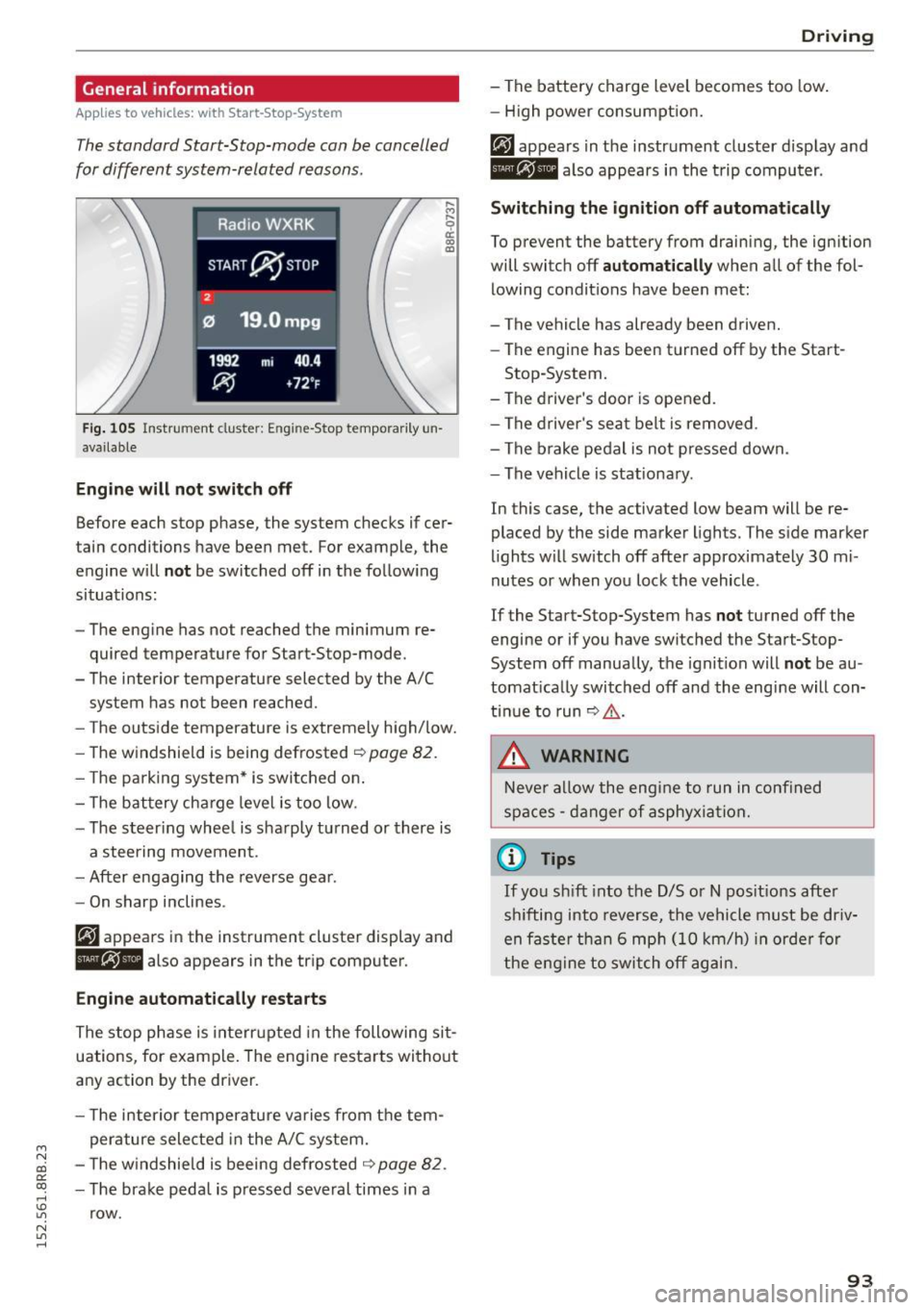
The standard Start-Stop-mode can be cancelled
for different system-related reasons.
Fig . 105 Instrument cluster: E ngin e-Stop tempo rarily un
available
Engine will not switch off
.... M
9 cc IX) ID
Before each stop phase, the system checks if cer
tain conditions have been met. For example, the
engine will
not be switched off in the following
situations:
- The engine has not reached the minimum re
quired temperature for Start-Stop-mode.
- The interior temperature selected by the A/C system has not been reached.
- The outside temperature is extremely high/low.
- The windshield is being defrosted ~
page 82.
-The park ing system* is switched on .
- The battery cha rge level is too low.
- The steer ing whee l is sharply turned or there is
a steering movement.
- After engaging the reverse gear.
Engine automatically restarts
The stop phase is interrupted in the following sit
uations, for example. The engine restarts without
any action by the driver.
- The interior temperature varies from the tem
perature selected in the A/C system.
- The windshield is beeing defrosted
~ page 82.
-The brake pedal is pressed several times in a
row.
Driving
- The battery charge level becomes too low.
Switching the ignition off automatically
To prevent the battery from draining, the ignition
will switch off
automatically when all of the fol
lowing condit ions have been met:
- The vehicle has already been driven.
- The engine has been turned off by the Start-
Stop-System.
- The driver's door is opened.
- The driver's seat belt is removed .
- The brake pedal is not pressed down.
- The vehicle is stationary .
In this case, the activated low beam will be re
placed by the side marker lights. The side marker
lights will switch off after approximately 30 mi
nutes or when you lock the vehicle .
If the Start-Stop-System has
not turned off the
engine or if you have switched the Start-Stop
System off manually, the ignition will
not be au
tomatically switched off and the engine will con
tinue to run~,&. .
A WARNING
Never allow the engine to run in confined
spaces - danger of asphyxiation.
(D Tips
-
If you shift into the D/S or N positions after
sh ifting into reverse, the vehicle must be driv
en faster than 6 mph (10 km/h) in orde r for
the engine to switch off again.
93
Page 127 of 302
M N
co
a:
co
,...., \!) 1.1"1
N 1.1"1 ,....,
(Neutral) for more than approximately 1 second,
without the brake pedal being pressed.
Release button
The release button on the selector lever prevents
the lever from be ing acc identally shifted into cer
tain positions. Pressing this button deactivates
the selector lever lock . Depending on the direc
tion of the shift, the se lector lever locks at differ
ent positions. The positions are highlighted in
the illustration¢
fig. 135.
Ignition key safety interlock
The key cannot be removed from the igni tion un
l ess the se lector lever is in the P park position .
When the ignition key is removed, the selector
l ever will be locked in the P position.
Driving the automatic transmission
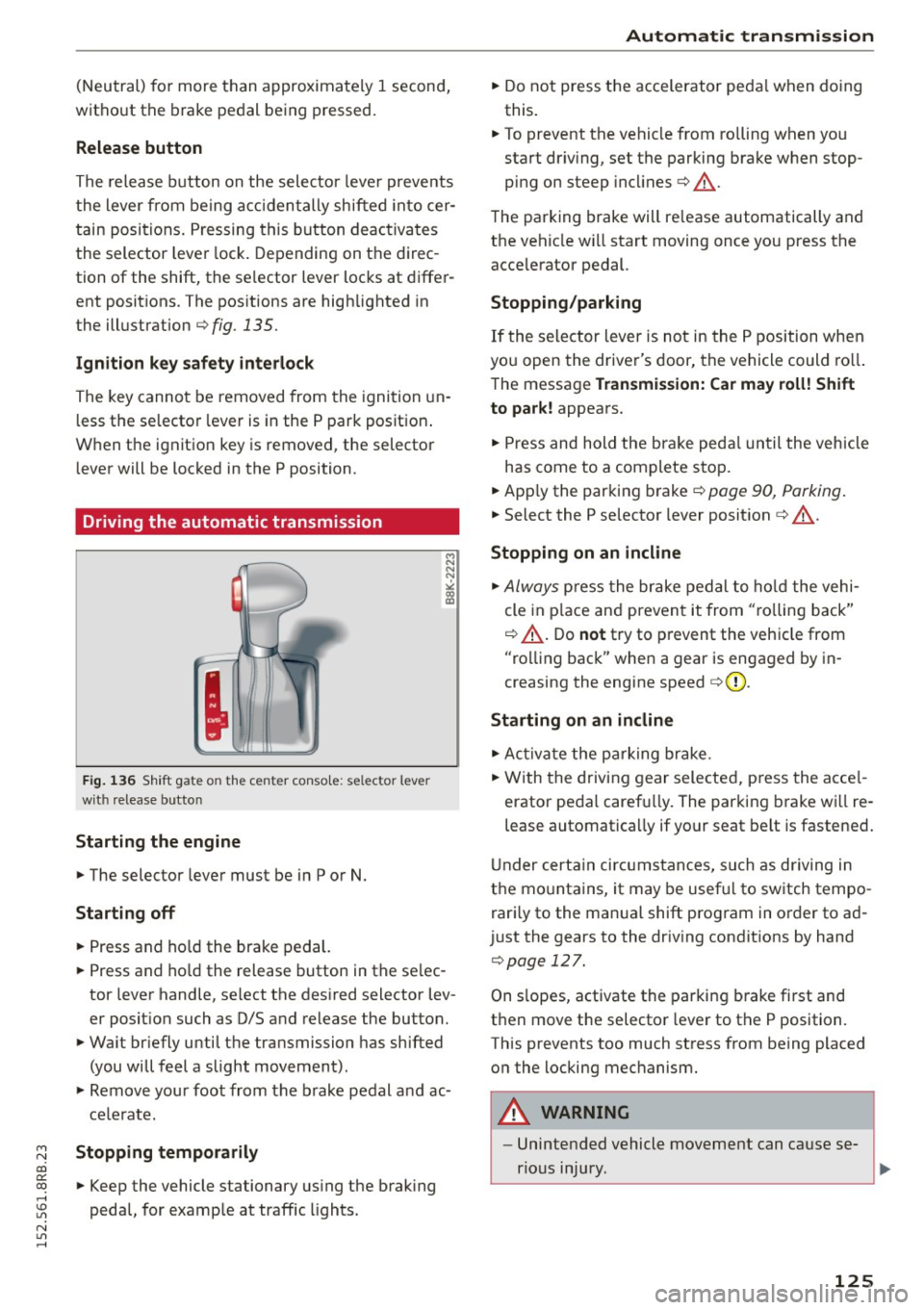
Fig. 136 Shift gate on the center conso le: selector lever
with release button
Starting the engine
.,. The selector lever must be in P or N.
Starting off
.,. Press and hold the brake pedal.
.,. Press and ho ld the release button in the se lec
tor lever handle, select the desired selector lev
er position such as D/S and release the button.
.,. Wait br iefly until the transmission has shifted
(you will feel a slight movement).
.,. Remove your foot from the brake pedal and ac
celerate.
Stopping temporarily
.,. Keep the vehicle stationary using the brak ing
pedal, for example at traffic lights.
Automatic transmission
.,. Do not press the accelerator peda l when doing
this.
.,. To prevent the vehicle from rolling when you
start dr iv ing, set the parking brake when stop
ping on steep incl ines¢ &_.
The parking brake will re lease automatically and
the vehicle wi ll start moving once you press the
acce lerator pedal.
Stopping/parking
If the selector lever is not in the P position when
you open the driver's door, the vehicle could roll.
The message
Transmission: Car may roll! Shift
to park!
appears.
.,. Press and hold the brake pedal until the vehicle
has come to a complete stop.
.,. App ly the parking brake¢
page 90, Parking .
.,. Select the P se lector lever position ¢ &_ .
Stopping on an incline
.,. Always press the brake pedal to hold the vehi
cle in place and prevent it from "ro lling back"
¢ &_ . Do
not try to prevent the vehicle from
"rolling back" when a gear is engaged by in
creasing the engine speed
c> (D .
Starting on an incline
.,. Activate the parking brake .
.,. With the driving gear selected, press the acce l
erator pedal carefu lly. The parking brake wi ll re
lease automatically if your seat belt is fastened.
Under certain circumstances, such as driving in
the mountains, it may be usefu l to switch tempo
rari ly to the manual shift program in order to ad
just the gears to the driving conditions by hand
¢page 127 .
On s lopes, activate the parking brake first and
then move the selector lever to the P position .
This prevents too much stress from being placed on the locking mechanism .
A WARNING ,_
-Unintended vehicle movement can cause se-
rious injury.
~
125
Page 143 of 302
M N
co
a:
co
,...., \!) 1.1'1
N 1.1'1 ,....,
-Always put objects, for examp le, luggage or
other heavy items in the luggage c ompart
ment.
- Always secure objects in the luggage com
partment us ing the tie-down eye lets and
suitable straps.
A WARNING
Heavy loads will influence the way your vehi
cle handles. To help reduce the risk of a loss
of control leading to ser ious personal injury:
- Always keep in m ind when transporting
heavy objects, that a change in the center of
gravity can also cause changes in vehicle
hand ling:
- Always distribute the load as even ly as
possible.
- Place heavy objects as far forward in the
luggage compartment as possible.
- Never exceed the G ross Ax le Weight Rating
or the Gross Vehicle Weight Rating specified
on the safety compliance sticker on the left
doo r jamb. Exceeding permissible weight
standards can cause the vehicle to s lide and
hand le different ly.
- Please observe information on safe driving
r=>page 135.
A WARNING
To help prevent poisonous exhaust gas from
being drawn into the vehicle, always keep the
rear lid closed while driv ing.
- Never transport objects larger than those
fitt ing completely into the luggage a rea be
cause the rea r lid cannot be fully closed .
- If you absolutely must drive w ith the rear lid
open, observe the following notes to reduce
the risk of poisoning:
- Close a ll windows,
- Close the Panoramic sliding sunroof*,
- Open al l air outlets in the instrument pan-
el,
- Sw itch off the air recircu lation,
- Set the fresh ai r fan to the h ighest speed.
Dr ivin g s afet y
A WARNING
Always make sure that the doors, all windows,
the Panoramic sliding sunroof * and the rear
lid are securely closed and locked to reduce
the r is k of injury when the vehicle is not being
used.
- After closing the rear lid, always make sure
that it is p roperly closed and locked.
- Never leave your vehicle unattended espe
cially with the rea r lid left open . A child
could crawl into the ve hicle through the lug
g age compartmen t and clo se the re ar lid be
coming trapped and unable to get out. Be
ing trapped in a vehicle can lead to serious
pe rsonal injury .
- Never let children play in or around the vehi
cle.
- Never let passengers ride in the luggage
compa rtment . Vehicle occupants must al
ways be properly restrained in one of the ve
hicle's seating positions.
(D Tips
- Air circul ation helps to reduce window fog
ging . Stale ai r escapes to the outs ide
through vents in the t rim panel. Be sure to
keep these slots free and open.
- The tire pressure m ust correspond to the
load. The tire pressure is shown on the tire
pressure label. The t ire p ress ure label is lo
cated on the dr iver's side B-pillar. The tire
pressure label lists the recommended cold
t ire inflation pressures fo r the veh icle at its
maximum ca pac ity weight and the tires that
we re on your vehicle at the t ime it was man
ufac tured. For recommended tire pressures
for normal load condi tions, please see chap
ter
r=> page 246.
Tie-downs
The luggage compar tment is equipped wi th four
tie-downs to se cure luggage and other items .
Use the t ie-downs to secu re your cargo prope rly
r=> page 140, Loading the luggage compar tment. lliJ,
141
Page 180 of 302
Child safety
seats support t he baby 's back, neck and head in a
crash
r=> fig . 174.
The airbag on the passenger side makes the fron t
seat a potentially dange rous place for a ch ild to
ride. The front seat is not the safest place for a
child in a fo rward-facing child seat. It is a very
dangerous p lace for an infant or a larger chi ld in
a rearward-facing seat .
_&. WARNING
Not using a child safety seat , using the wrong
child safety seat o r imp roperly insta lling a
child restraint inc reases the r isk of serious
personal in ju ry and death in a crash .
- Never install rea r-facing ch ild safety seats or
infant carriers on the front passenger seat -
even w ith an Advanced Ai rbag System. A
c hild will be serio us ly injured and c an be kil
led whe n the infl ating airbag hits the child
sa fe ty seat or infant carrier w ith great force
and smashes the c hild safety seat and c hild
against the bac krest, center armrest, door
or roof
r=> page 153, Child restraints on the
front seat -some important things to
know .
-Always insta ll rear-facing child safety seats
o r infant ca rr iers on the rear seat.
- Never install a rear-facing child restraint in the forward-facing direction. Such restra ints
are designed for the specia l needs of infants
and very small children and cannot protect
them prope rly if the seat is forward-fac ing .
- If you must install a rearward facing child safety seat on the front pass enge r seat be
ca use of exceptional c ircumstanc es and t he
PASSENGER AIR BAG OFF light does not
c ome on an d st ay on, immedi ate ly ins tall
t h e rear-facing c hild safety sea t in a rea r
seat ing position and have the airbag system
inspected by your Audi dealer.
- Alw ays read and hee d all WARN INGS when
ever using a child restrained in a vehicle is
being used
c::> page 144 , Safety belts,
c::> page 152, Airbag system
and
c::> page 172, Important information.
178
Convertible child safety seats
Properly used convertible child safety seats can
help protect toddlers and children over age one
who weigh between 20 and 40 lbs. (9 and 18 kg)
in a cra sh .
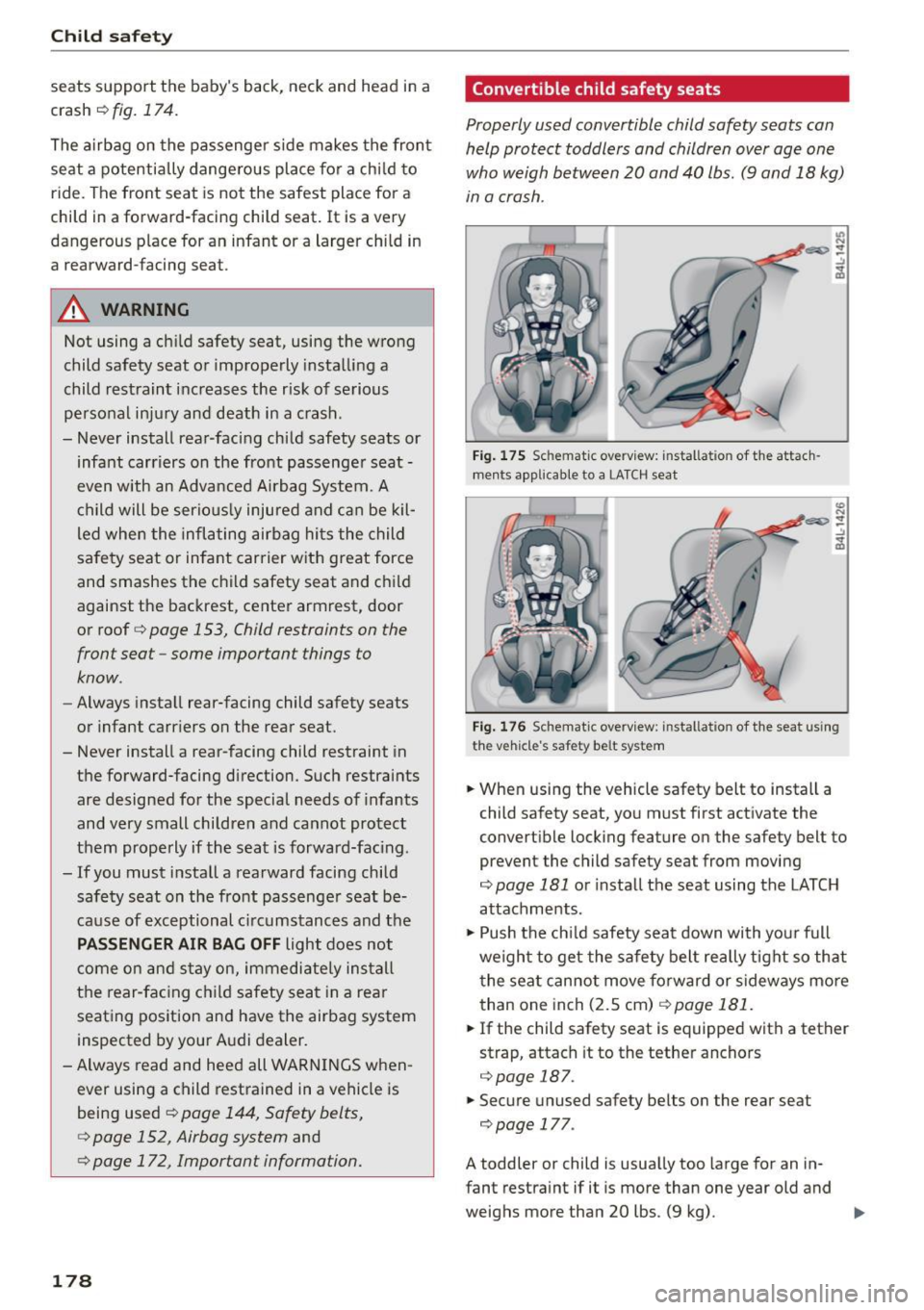
Fi g. 175 Sc hem at ic ove rv iew: instal la ti on of t he attach
m ents applicable to a LA T CH seat
Fi g. 1 76 Schemat ic ove rv iew : in stal lat io n of th e seat usin g
the v ehicl e's sa fet y bel t system
.. When using the vehicle safety belt to install a
child sa fety seat, you must first activate the
convertible locking feature on the safety belt to
prevent the child safety seat from moving
r=> page 181 or i nsta ll the seat using the LATC H
attachments.
.,. Push the ch ild safety seat down with you r full
weigh t to get the safe ty belt rea lly tight so that
t he sea t ca nnot move forward or sideways mo re
than one inch (2.5 cm)
r=> page 181.
.. If the child safety seat is equipped with a tether
strap, attach it to the tether anchors
c::> page 187.
.. Secure unused safety belts on the rear seat
r=> page 177 .
A toddler or child is usua lly too large for an in
fant restra int if it is more than one year old and
weighs more than 20 lbs . (9 kg) .
IJJ,,
Page 184 of 302
Child safety
A WARNING
Improperly installed child safety seats in
crease the risk of serious personal injury and
death in a collision.
- Always make sure that the safety belt re
tractor is locked when installing a child safe
ty seat . An unlocked safety belt retractor
cannot hold the child safety seat in place
during normal driving or in a crash.
- Always buckle the child safety seat firmly in
place even if a child is not sitting in it. A
loose child safety seat can fly around during
a sudden stop or in a collision.
- Always make sure that the rear seat back
rest to which the center rear safety belt is
attached is securely latched whenever the
rear center safety belt is being used to se
cure a child restraint.
- If the backrest is not securely latched, the
child and the child restraint will be thrown
forward together with the backrest and will
strike parts of the vehicle interior. The child
can be seriously injured or killed.
- Never install rear-facing child safety seats or
infant carriers on the front passenger seat.
A child will be seriously injured and can be
killed when the passenger airbag inflates .
- The inflating airbag will hit the child safety
seat or infant carrier with great force and
will smash the child safety seat and child
against the backrest, center armrest, door
or roof.
-Always install rear-facing child safety seats
or infant carriers on the rear seat.
- Forward-facing child safety seats or infant
carriers installed on the front passenger's
seat may interfere with the deployment of
the airbag and cause serious injury to the
child.
- It is safer to install a forward-facing child
safety seat on the rear seat.
- Always read and heed all WARNINGS when
ever using a child restrained in a vehicle is
being used
~page 172. Special precautions
apply when installing a child safety seat on
the front passenger seat~
page 153, Child
182
restraints on the front seat -some impor
tant things to know.
A WARNING
Always take special precautions if you must
install a forward or rearward-facing child re
straint on the front passenger's seat in excep
tional situations:
- Whenever a forward or rearward-facing
child restraint is installed on the front pas
senger seat, the
PASSENGER AIR BAG OFF
light must come on and stay on whenever
the ignition is switched on.
- If the PASSENGER AIR BAG OFF light does
not come on and stay on, perform the
checks described
~ page 162, Monitoring
the Advanced Airbag System.
-Take the child restraint off the front passen
ger seat and install it properly at one of the
rear seat positions if the
PASSENGER AIR
BAG OFF
light does not stay on whenever
the ignition is switched on.
- Improper installation of child restraints can
reduce their effectiveness or even prevent
them from providing any protection.
- An improperly installed child restraint can
interfere with the airbag as it deploys and
seriously injure or even kill the child .
- Always carefully follow the manufacturer's
instructions provided with the child safety
seat or carrier.
- Never place additional items on the seat
that can increase the total weight registered
by the weight-sensing mat and can cause in
jury in a crash.
A WARNING
Forward-facing child restraints:
-Always make sure the forward-facing seat
has been designed and certified by its man
ufacturer for use on a front seat with a pas
senger front and side airbag.
- Never put the forward-facing child restraint
up, against or very near the instrument pan
el.
-
.__ ________________ __J ...
Page 185 of 302
M N
co
a:
co
,...., \!) 1.1'1
N 1.1'1 ,....,
-Always move the passenger seat into its
rearmost position in the seat's fore and aft
adjustment range, as far away from the air
bag as possible before installing the for
ward-facing child restraint. The backrest must be adjusted to an upright position.
- Make sure that the
PASSENGER AIR BAG
OFF
light comes on and stays on all the time
whenever the ignition is switched on.
A WARNING
Rearward-facing child restraints:
-A child in a rearward-facing child safety seat
installed on the front passenger seat will be
seriously injured and can be killed if the
front airbag inflates - even with an Ad
vanced Airbag System.
- The inflating airbag will hit the child safety
seat or infant carrier with great force and
will smash the child safety seat and child
against the backrest, center armrest, door
or roof.
- Always be especially careful if you must in
stall a rearward facing child safety seat on
the front passenger seat in exceptional cir cumstances.
- A tight tether strap on a rearward-facing
child restraint attached to the front passen
ger seat can put too much pressure on the
weight-mat in the seat and register a heavi er weight in the Advanced Airbag System.
The heavier weight registered can make the
system work as though an adult were on the
seat and deploy the Advanced Airbag when
it must be suppressed causing serious or
even fatal injury to the child.
- Make sure that the
PASSENGER AIR BAG
OFF
light comes on and stays on all the time
whenever the ignition is switched on.
- If the
PASSENGER AIR BAG OFF light does
not come on and stay on, immediately in
stall the rear-facing child safety seat in a
rear seating position and have the airbag
system inspected by your Audi dealer.
Child safety
Activating the convertible locking retractor
Use the convertible locking retractor to secure a
child restraint .
Always heed the child safety seat manufacturer's
instructions when installing a child restraint in
your vehicle . To activate the convertible locking
retractor:
.. Place the child restraint on a sea t, preferably on
the rear seat.
.. Slowly pull the belt all the way out.
.. Route it around or through the child restraint
belt path
~ . & .
.. Push the child safety seat down with your full
weight to get the safety belt really tight.
.. Insert the belt tongue into the buckle for that
seating position.
.. Guide the safety belt back into the retractor un
til the belt lies flat and snug on the child safety
seat .
.. You should hear a "clicking" noise as the belt
winds back into the inertia reel. Test the con
vertible locking retractor by pulling on the belt .
You should no longer be able to pull the belt
out of the retractor. The convertible locking re
tractor is now activated .
.. Make sure that the red release button is facing
away from the child restraint so that it can be
unbuckled quickly.
.. Pull on the belt to make sure the safety belt is
properly tight and fastened so that the seat
cannot move forward or sideways more than
one inch (2 .5 cm) .
A WARNING
Using the wrong child restraint or an improp
erly installed child restraint can cause serious
personal injury or death in a crash .
- Always make sure that the safety belt re
tractor is locked when installing a child safe
ty seat. An unlocked safety belt retractor
cannot hold the child safety seat in place
during normal driving or in a crash.
- Always buckle the child safety seat firmly in place even if a child is not sitting in it. A
loose child safety seat can fly around during
a sudden stop or in a crash. ..,.
183
Page 218 of 302
Fuel and R efue lin g
_& WARNING
Under normal operating conditions, never car
ry additional fuel containers in your car. Gas
canisters and other containers used to trans
port fuel can be dangerous. Such containers,
full or empty, may leak and could cause a fire
in a collision. If you must transport fuel to
use for your lawn mower, snow blower, etc.,
be very careful and a lways observe loca l and
state laws rega rding the use, transportation
and sto rage of such fuel containers. Make cer
tain the container meets industry standards
(ANSI/ASTM F852 -86) .
(D Note
Never d rive you r vehicle unt il the fuel tank is
comp letely empty. The irreg ular supply of
fue l can cause m isfiring. Gasoline cou ld enter
the exhaust system and damage the catalytic
converter.
Refuelling
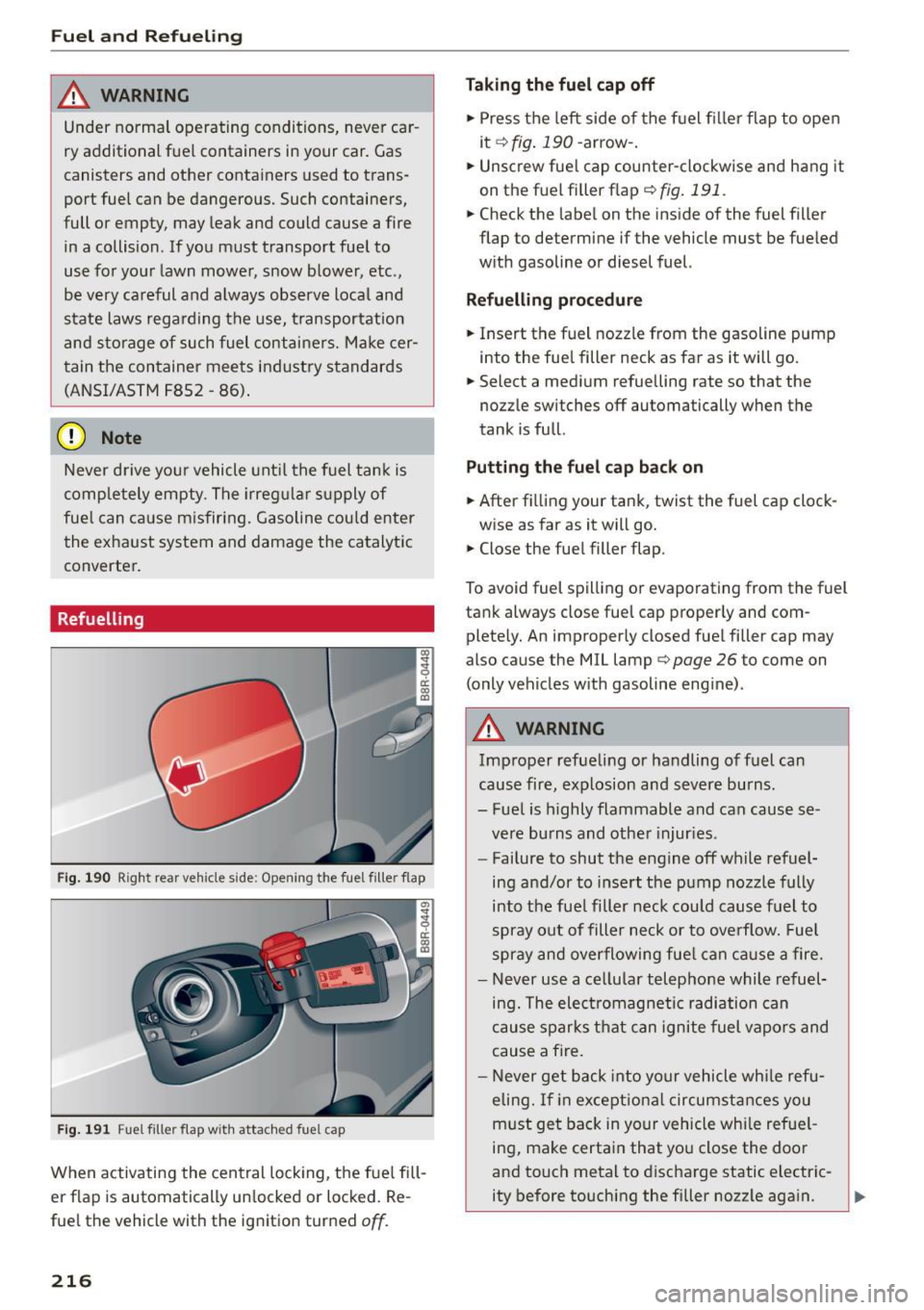
Fig . 190 Right rear vehicle s ide: Opening the fuel fill er flap
Fi g. 191 Fuel filler flap with attached fuel cap
When activating the central lock ing, the fue l fill
er flap is automatically un locked or locked. Re
fue l the vehicle with the ignition turned
off.
216
Tak ing the fu el cap off
.. Press the left side of the fuel fi ller flap to open
it
¢ fig . 190 -arrow-.
.. Unscrew fue l cap counter-clockwise and hang it
on the fuel filler f lap
c;, fig. 191.
.. Check the label on the inside of the fuel filler
flap to determine if the vehicle must be fueled
w ith gasoline or diesel fuel.
Re fuelling proce dure
.. Insert the fuel nozzle from the gasoline pump
into the fue l filler neck as far as it will go.
.. Select a medium refuelling rate so that the
nozzle switches off automatically when the
tank is full.
Putting t he fu el cap b ack on
.. After f illing your tank, twist the fuel cap clock-
wise as far as it will go.
.. Close the fuel filler flap.
To avoid fuel spilling or evaporating from the fuel
tank always close fue l cap proper ly and com
plete ly. An improper ly closed fue l filler cap may
also cause the MIL lamp
c;, page 26 to come on
(only vehicles w ith gasoline eng ine) .
_& WARNING
Imp roper refueling or handling of fuel can
cause fire, explosion and severe burns.
- Fue l is highly flammable and can cause se
vere burns and other injur ies.
-
- Failure to shut the engine off while refuel
ing and/or to insert the pump nozzle fully
into the fue l filler neck could cause fuel to
spray out of filler neck or to overflow. Fue l
spray and overflowing fue l can cause a fire.
- Never use a ce llular telephone while refuel
ing. The electromagnetic radiation can
cause sparks that can ignite fuel vapors and
cause a fire.
- Never get back into your vehicle wh ile refu
eling. If in except iona l circumstances you
m ust get back in your vehicle whi le refue l
ing, make certain that yo u close the door
and touch metal to discharge static electric-
ity before touching the filler nozz le aga in.
IJJ,,,
Page 221 of 302
M N
co ~ co
rl I.O
"' N
"' rl
Filling AdBlue
Applies to vehicles: with selective catalytic reductio n
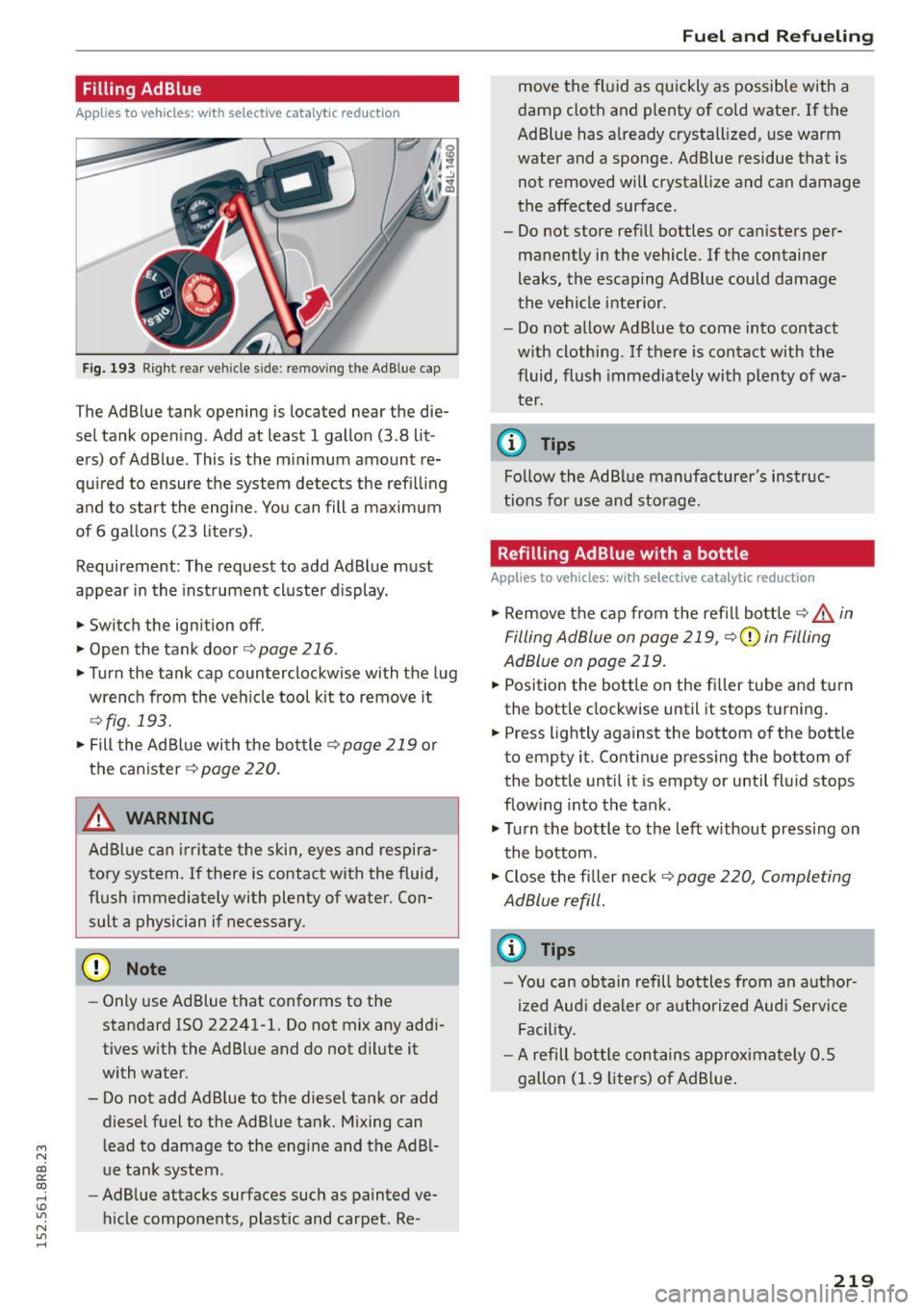
Fig. 193 Right rear vehicle s ide: remov ing the Ad Blue cap
The Ad Blue tank opening is located near the die
sel tank opening . Add at least 1 gallon (3 .8 lit
ers) of AdBlue. This is the m inimum amount re
qu ired to ensure the system detects the ref illing
and to start the eng ine. You can fill a maximum
of 6 ga llons (23 l iters).
Requirement: The request to add Ad Blue must
appear in the instrument cluster display.
.,. Switch the ign ition off.
.,. Open the tank door¢
page 216 .
.,. Turn the tank cap counterclockwise with the lug
wrench from the veh icle tool kit to remove it
9fig. 193.
.,. Fill the Ad Blue with the bottle¢ page 219 or
the canister
¢ page 220.
A WARNING
Ad Blue can irritate the skin, eyes and respira
tory system. If there is contact with the fluid,
flush immediately with plenty of water. Con sult a physician if necessary.
CI) Note
- Only use Ad Blue that conforms to the
standard ISO 22241-1. Do not mix any addi
tives with the AdBlue and do not dilute it
with water.
- Do not add Ad Blue to the diesel tank or add
diesel fuel to the Ad Blue tank. Mixing can
lead to damage to the eng ine and the Ad B l
ue tank system.
- AdBlue attacks surfaces such as painted ve
hicle components, plastic and carpet. Re-
Fuel and Refueling
move the fluid as quickly as possible with a
damp cloth and plenty of cold water. If the
Ad Blue has already crystall ized, use warm
water and a sponge. Ad Blue residue that is
not removed will crystallize and can damage
the affected surface.
- Do not store refill bottles or can isters per
manently in the vehicle. If the container
leaks, the escaping AdBlue could damage
the vehicle interior.
- Do not allow Ad Blue to come into contact
with clothing. If there is contact w ith the
fluid, flush immediately with plenty of wa
ter .
@ Tips
Follow the AdBlue manufacturer's instruc
tions for use and storage.
Refilling Ad Blue w ith a bottle
Applies to vehicles: with selective catalytic reduction
.,. Remove the cap from the ref ill bott le 9 _& in
Filling AdBlue on page
219, ¢(Din Filling
AdBlue on page
219 .
.,. Posit ion the bottle on the filler tube and t urn
the bottle clockwise until it stops turning.
.,. Press lightly against the bottom of the bottle
to empty it . Continue pressing the bottom of
the bottle until it is empty or until fluid stops
flow ing into the tank.
.,. Turn the bottle to the left without pressing on
the bottom.
.,. Close the filler neck
9 page 220, Completing
AdBlue refill.
{i) Tips
- You can ob tain refill bottles from an author
ized Aud i deale r or authorized Audi Service
Facility.
- A refill bottle contains approximately 0 .5
gallon (1.9 liters) of AdBlue.
219