ignition AUDI Q5 2015 Repair Manual
[x] Cancel search | Manufacturer: AUDI, Model Year: 2015, Model line: Q5, Model: AUDI Q5 2015Pages: 302, PDF Size: 75.01 MB
Page 164 of 302
Airb ag syst em
-Never place or attach accessories or other
objects (such as cupholders, telephone
brackets, large, heavy or bulky objects) on
the doors, over or near the area marked "AIRBAG" on the steer ing wheel, instru
ment pane l, seat backrests or between
those areas and yourself. These obje cts
could cause injury in a crash, e specially
when the airbags inflate.
- Never recline the front passenger's seat to
transport objec ts . Items can also move into
t h e area of the side airbag or the front air
bag dur ing braking or in a sudden maneu·
ver. Objects near the airbags can become
projectiles and cause injury, part icularly
when the seat is reclined.
A WARNING
The f ine dust created when a irbags dep loy can
cause breathing problems for people with a
history of asthma or other breathing condi
tions .
- To reduce the r isk of breathing problems,
those w ith asthma or other resp iratory con
ditions should g et fr esh air r ight away by
get ting out of the vehicle o r opening w in
dows or door s.
- If you are in a col lision in w hich a irbags de
p loy, wash your hand s and fa ce wi th mild
soap and water before eating.
- Be caref ul not to get the dus t into you r eyes,
or into any cuts or s cratches.
- If the residue should get into you r eyes,
flush them with water.
Monitoring the
Advanced Airbag System
Airbag monitoring indicator light
Two separa te indicators monitor the function of
the Advanced Airbag System: the airbag moni
toring indicator light and the
PASSENGER AIR
BAG OFF
light.
The Advanced Airbag System (including the elec· tronic control unit, sensor circuits and system
w iri ng) is monitored cont inuous ly to make sure
that it is funct ion ing properly whenever the ign i·
162
tion is on . Each time you t urn on the ignit ion, the
airbag monitoring indicator light
II wi ll come on
for a few seconds (self diagnostics).
The sy stem must be inspected when th e
indicat or light
fB :
-does not come on when the ignition is sw itched
on,
- does not go out a few seconds after you have
switched on t he ignit ion, or
- comes on wh ile driving.
If an airbag system malfunction is detected, t he
i ndic ator light will fi rst s tart flashing to catch the
dr iver's at ten tion and the n st ay on con tinuo usly
to serve as a constant reminder to have the sys
tem inspected immediately .
If a malfu nction occurs that turns the front air
bag on the passenge r side off, the
PASSENGER
AIR BAG OFF
light will come on and stay on
whenever the ignit ion is on .
A WARNING
An airbag system that is not functioning prop
erly cannot provide supplemental protection in a frontal crash.
- If the airbag ind icator light
c> page 16
comes when the vehicle is being used, have
the system inspected immediately by your
author ized Audi dealer .
It is possible that
the airbag will inflate when it is not sup·
posed to, or will not inflate when i t should.
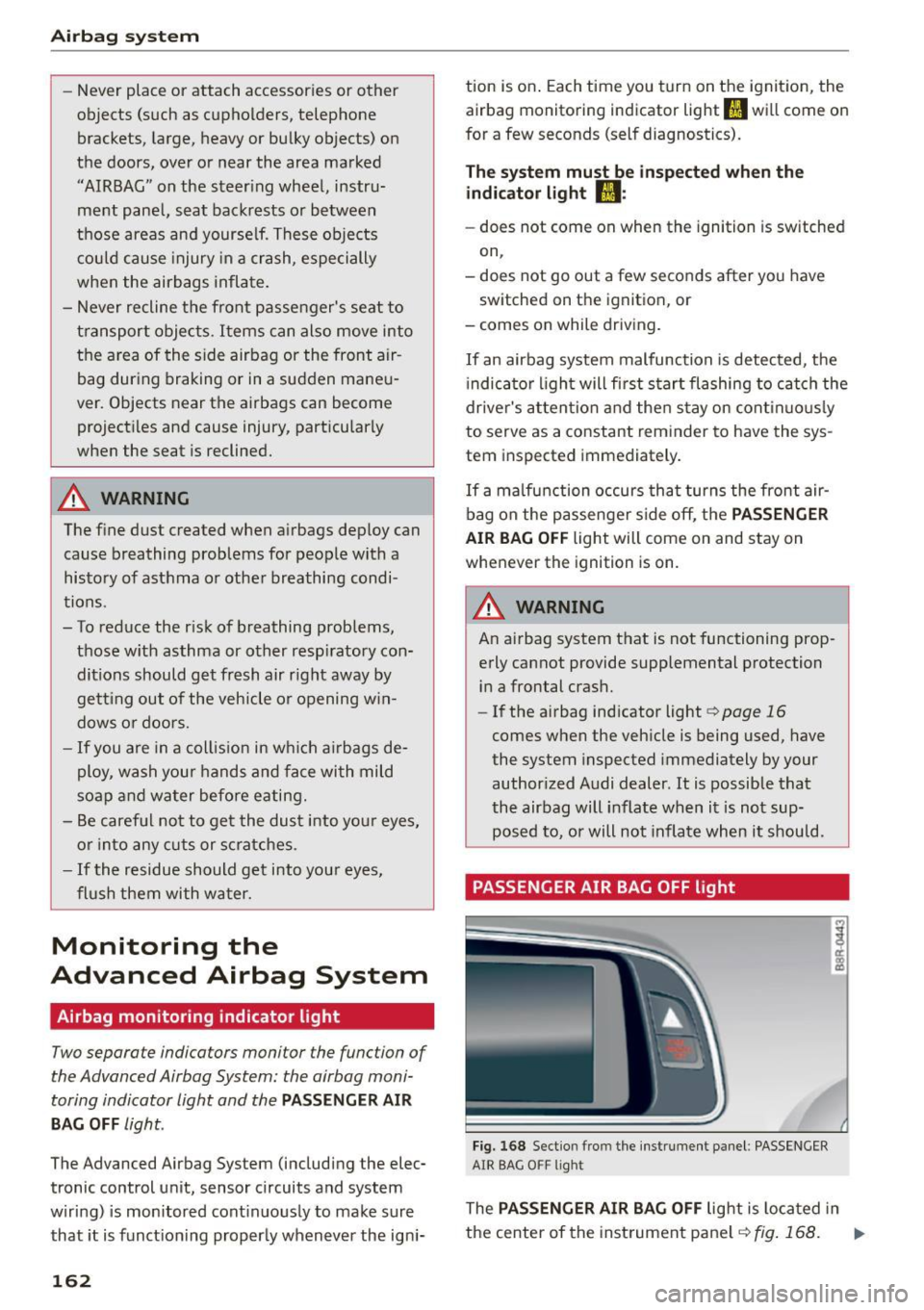
PASSENGER AIR BAG OFF light
Fig. 168 Sec tion fro m t he in strument panel: PASSENGER
AIR BAG O FF ligh t
The PASSENGER AIR BAG OFF light is loca ted in
the center of the inst rument panel
c> fig . 168. ..,.
Page 165 of 302
M N
co
a:
co
,...., \!) 1.1'1
N 1.1'1 ,....,
The PASSENGER AIR BAG OFF light will come on
and stay on to tell you when the front Advanced
Airbag on the passenger side has been t urned
off
by the electron ic control unit. Each time you turn
on the ignition, the
P A SSEN GER AIR BAG OFF
light will flash for a few seconds and:
- wi ll stay on if the front passenger seat is not
occupied,
- will stay on if there is a small child or child re
straint on the front passenger seat,
- wi ll go out if the front passenger seat is occ u
pied by an adult as registered by the weight
sensing mat .
The
PASSENGER AIR BAG OFF light mu st co me
on and st a y on
if the ignition is on and
- a ca r bed has been insta lled on the front seat ,
o r
- a rearward-fac ing c hild restraint has been in
stalled on the front passenger seat, or
- a fo rward-facing child restraint has been insta l
led on the front passenger seat, or
- the weight registered on the front passenger
seat is equal to o r less than the comb ined
weight of a typica l 1 yea r-old restrained in one
of the rear -facing or forwa rd-facing infant re
straints listed in Federal Motor Vehicle Safety
Standard 208 with which the Advanced Airbag
System in your vehicle was certified .
I f the front passenger seat is not occupied, the
fro nt airbag will not deploy, and the
PASSENGER
AIR BAG OFF
light will stay on. Never install a
rearward-facing chi ld restraint on the front pas
senger seat, the safest place for a child in any
kind of child restraint is at one of the seating po
sitions on the rear seat
¢ page 153, Child re
straints on the front seat -some important
things to know
and ¢ page 172, Child safety.
If the PA SSENGER AI R BAG OFF light comes on
when one of the condit ions listed above is met,
be sure to check the light regularly to make cer
tain that the
PASSENGER AIR BAG OFF light
stays on cont inuous ly whenever the ignition is
on.
If the PA SSENGER AIR BAG OFF light does
not appea r and not stay on a ll the time , stop as
soon as it is safe to do so and
Airbag syste m
- reactivate the system by t urning the ignition off
and then turning it on again;
- remove and reins tall the child restra int . Make
sure that the child restraint is properly installed
and that the safety belt for the front passenger
seat has been correct ly routed around the chi ld
restraint as described in the c hild restraint
manufacturer's instruc tions;
- make sure that the convertible locking feature
on the safety belt for the front passenger seat
has been activated and that the safety belt has
been pulled tight . T he belt must not be loose or
have loops of s lack so that the sensor below the
safety belt lat ch on the seat can do its job
~ page 181.
-make sure that things that may increase the
weight of the ch ild and c hild safety seat a re not
be ing transpo rted on the fro nt passenge r seat;
- make sure t hat the safety belt tension sensor is
not b locked. Shake the safety belt lat ch on the
front passenge r seatback and forth;
- I f a strap or tet he r is be ing used to tie the child
safety sea t to the front passenge r seat, make
sure that it is not so t ight that it causes the
weight -sensing mat to measure more weight
than is actually on the seat .
If the PASSENGER AIR BAG OFF light still d oes
not come on
and does not stay on continuously
(when the ignition is switched on),
- t ake the child rest raint
off the front passenge r
seat and instal l it properly at one of the rea r
seat pos itions. Have the a irbag system inspec t
ed by your authorized Audi dealer immediately .
- move the child to a rear seat posi tion and make
sure that the child is properly rest ra ined in a
child restraint that is appropr iate for its size
and age .
T he
PASSENGER AIR BAG OFF light sho uld NO T
come on when the ignit ion is on and an adult is
s itting in a proper seating position on the front
pass enger seat. If the
PASSENGER AIR BAG OFF
li ght comes on and stays on or flashes for about
5 seconds while dr iv ing, unde r these circumstan
ces, make sure that :
- the adult on t he front passenger seat is proper-
ly seated on the center of the seat cushion w ith ..,_
163
Page 172 of 302

Airbag system
The airbag system is not a substitute for your
safety belt. Rather, it is part of the overall occu
pant restraint system in your vehicle . Always re
member that the airbag system can only help to
protect you if you are wearing your safety belt
and wearing it prope rly. This is another reason
why you should always wear your safety belts, not just because the law requires you to do so
~ page 144, General information.
It is important to remember that while the side
curta in a irbag system is designed to help reduce
the likelihood of serious injuries, other injuries,
for example, swelling, bruising, and minor abra
sions can also be associated with these airbags.
Remember too, these airbags wi ll dep loy only
once and only in certain kinds of accidents -your
safety belts are always there to offer protection.
The side curtain airbag system basically
consists of:
-The electronic control modu le and externa l side
impact sensors
- The side curtain airbags above the front and
rear side w indows
- The airbag indicator light in the instrumen t
panel
The airbag system is monitored electron ically to
make certa in it is f uncti oning properly at all
times. Each time you turn on the ignition, the air
bag system indicator light wi ll come on for a few
seconds (self diagnostics).
The side curtain airbag is not activated:
-if the ignit ion is tu rned off,
- in s ide collisions when the acceleration meas-
ured by the sensor is too low,
- in rear-end collisions.
A WARNING
-Safety belts and the ai rbag system will on ly
provide protection when occupants are in
the proper sea ting position
~ page 63, Gen
eral information .
-If the airbag indicato r ligh t ~page 16
comes when the vehicle is being used, have
the system inspected immediate ly by your
authorized Aud i dealer. It is possible that
170
the airbag will inflate when it is not sup
posed to, or will not inflate when it should.
How side curtain airbags work
Side curtain airbags can work together with side
airbags to help reduce the risk of head and upper
torso injuries for occupants who ore properly re
strained.
Fig. 172 Illustration of principle: Inflated side curtain air
bags on the left side
The side curtain airbags inflate between the oc
cupant and the windows on the side of the vehi
cle that is struck in a side collision
~ fig. 172.
N 0
s ri: (X) m
When the system is triggered, the side curta in
airbag is filled with propellant gas and breaks
through a seam above the front and rear side
windows identified by the AIRBAG label. In order
to help provide this additional protection, the
side curtain airbag must inflate within the blink
of an eye at very high speed and with great force .
The side curtain airbag could injure you if your
seat ing position is not proper or upright or if
i tems are located in the area where the supple
mental sid e curtain airbag inflates. This applies
especially to chi ld ren
~ page 172.
Although they are not a soft pillow, side curtain
a irbags can "cush ion" the impact and in this way
they can help to reduce the risk of injury to the
head and the upper pa rt of the body.
A fine dust may develop when the airbag deploys.
This is quite normal and does not mean there is a
fire in the vehicle.
Page 175 of 302
M N
co
a:
co
,...., \!) ..,.,
N ..,., ,....,
exceptional circumstances and the
PASSENGER AIR BAG OFF light does not
come on and stay on, immediately install
the rear-facing child safety seat in a rear
seating position and have the airbag system
inspected immediately by your Audi dealer .
A WARNING
If, in exceptional circumstances, you must in
stall a forward-facing child restraint on the
front passenger's seat:
- Always make sure the forward-facing seat
has been designed and certified by its man
ufacturer for use on a front seat with a pas
senger front and side airbag.
- Always follow the manufacturer's instruc
tions provided with the child safety seat or
carrier.
- Always move the passenger seat into its
rearmost position in the seat's fore and aft
adjustment range, as far away from the air
bag as possible before installing the child
restraint. The backrest must be adjusted to
an upright position.
- Always make sure that the
PASSENGER AIR
BAG OFF
light comes on and stays on all the
time whenever the ignition is switched on.
(D Tips
Always replace child restraints that were in
stalled in a vehicle during a crash. Damage to
a child restraint that is not visible could cause
it to fail in another collision situation.
Advanced front airbag system and children
Your vehicle is equipped with a front "Advanced
Airbag System " in compliance with United States
Federal Motor Vehicle Safety Standard (FMVSS)
208 as applicable at the time your vehicle was
manufactured.
The Advanced Airbag system in your vehicle has
been certified to meet the "low-risk" require
ments for 3- and 6-year old children on the pas
senger side and small adults on the driver side.
The low risk deployment criteria are intended to
reduce the risk of injury through interaction with
Child safety
the airbag that can occur, for example, by being
too close to the steering wheel and instrument
panel when the airbag inflates. In addition, the
system has been certified to comply with the "suppression" requirements of the Safety Stand
ard, to turn off the front airbag for infants up to 12 months who are restrained on the front pas
senger seat in child restraints that are listed in
the Standard.
Even though your vehicle is equipped with an Ad
vanced Airbag system, all children, especially
those 12 years and younger, should always ride in
the back seat properly restrained for their age
and size . The airbag on the passenger side makes
the front seat a potentially dangerous place for a child to ride. The front seat is not the safest place
for a child in a forward-facing child safety seat. It can be a very dangerous place for an infant or a
larger child in a rearward-facing seat.
Advanced Airbags and the weight-sensing mat in the front seat
The Advanced Airbag System in your vehicle de
tects the presence of an infant or child in a child
restraint on the front passenger seat using the
weight-sensing mat in the seat cushion and the
sensor below the safety belt latch on the front
passenger seat that measures the tension on the
safety belt .
The weight-sensing mat measures total weight of
the child and the child safety seat and a child blanket on the front passenger seat. The weight
on the front passenger seat is related to the de
sign of the child restraint and its "footprint", the
size and shape of the bottom of the child re straint as it sits on the seat . The weight of a child
restraint and its "footprint" vary for different
kinds of child restraints and for the different
models of the same kind of child restraint offered
by child restraint manufacturers.
The weight ranges for the individual types, makes
and models of child restraints that the NHTSA
has specified in the Safety Standard together
with the weight ranges of typical infants and typ
ical 1 year-old child have been stored in the con
trol unit of the Advanced Airbag System. When a
1iJ11-
173
Page 177 of 302
M N
co
a:
co
,...., \!) 1.1'1
N 1.1'1 ,....,
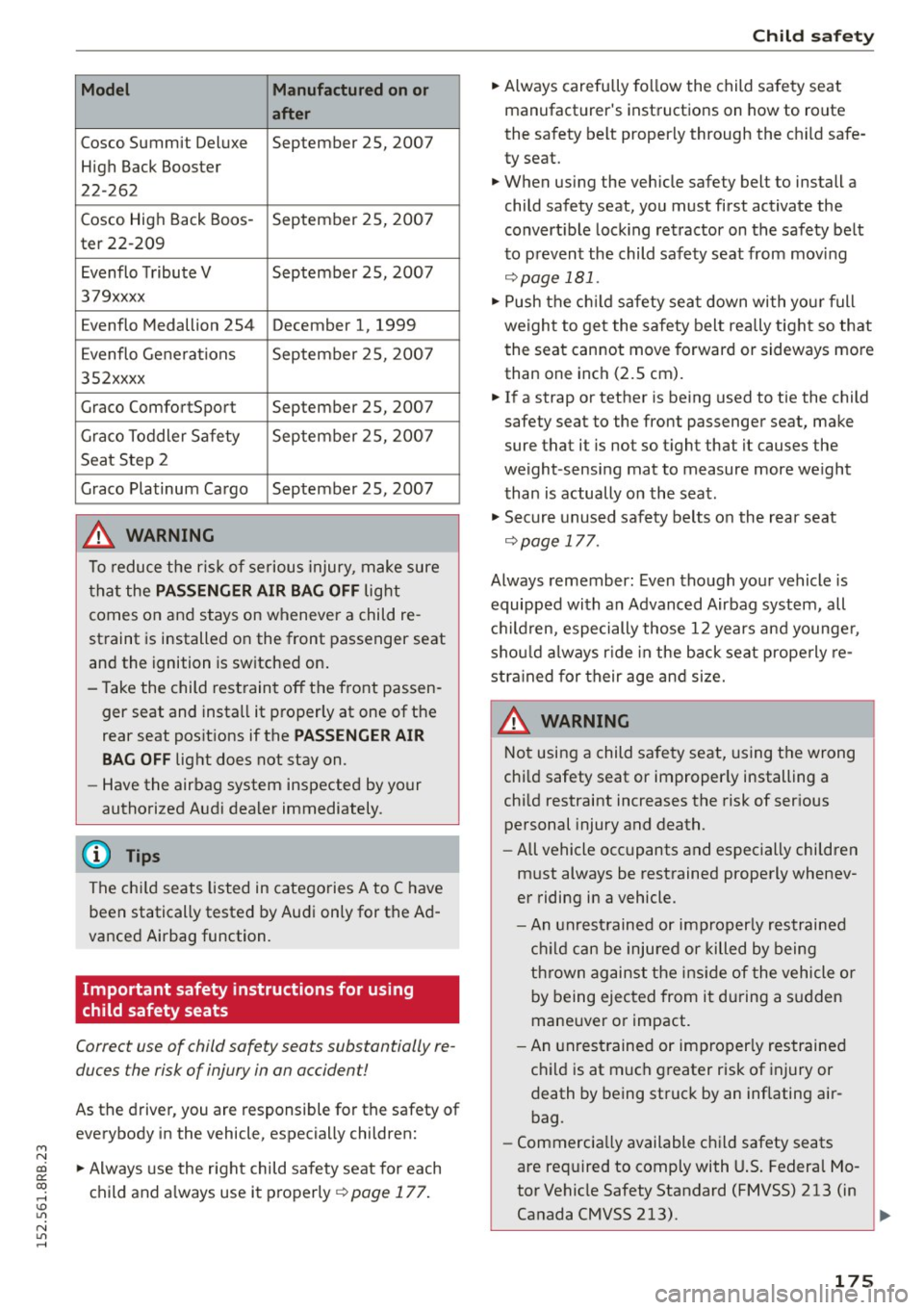
Model Manufactured on or
a fter
Cosco Summit Deluxe September 25, 2007
High Back Booster
22-262
Cosco High Back Boos -September 25, 2007
ter 22-209
Evenflo Tribute V September 25, 2007
379xxxx
Evenflo Medallion 254 December 1, 1999
Evenflo Generations September 25, 2007
3S2xxxx
Graco ComfortSport September 25, 2007
Graco Toddler Safety September 25, 2007
Seat Step 2
Graco Platinum Cargo September 25, 2007
.&, WARNING
To reduce the risk of serious injury, make sure
that the
PASS ENGER AIR BAG OFF light
comes on and stays on whenever a child re
straint is installed on the front passenger seat
and the ignition is switched on.
- Take the child restraint off the front passen ger seat and install it properly at one of the
rear seat positions if the
PASSENGER AIR
BA G OFF
light does not stay on.
- Have the airbag system inspected by your
authorized Audi dealer immediately.
(D Tips
The ch ild seats listed in categories A to C have
been statically tested by Audi on ly for the Ad
vanced Airbag function.
Important safety instructions for using
child safety seats
Correct use of child safety seats substantially re
duces the risk of injury in an accident!
As the driver, you are responsible for the safety of
everybody in the vehicle, especially children:
.,. Always use the right child safe ty seat for each
child and a lways use it properly ¢
page 177.
Child sa fety
.,. Always carefully follow the child safety seat
manufacturer's instructio ns on how to route
the safety belt properly through the child safe
ty seat.
.,. When using the vehicle safety belt to install a
child safety seat, you must first activate the
convert ible lock ing retractor on the safety belt
to prevent the child safety seat from mov ing
r::) page 181 .
.,. Push the ch ild safety sea t down with yo ur full
weight to get the safety belt rea lly tight so that
the seat cannot move forward or sideways more
than one inch (2.5 cm).
.,. If a strap or tether is being used to tie the child
safety seat to the front passenger seat, make
sure that it is not so tight that it causes the
weight -sensing mat to measure more we ight
than is actually on the seat .
.,. Secure unused safety belts on the rear seat
r::) page 177 .
Always remember : Even though your vehicle is
equipped with an Advanced Airbag system, all
c hi ld ren, especially those 12 years and younge r,
shou ld a lways r ide in the back seat prope rly re
stra ined for their age and size.
A WARNING
=
Not using a child sa fety seat, us ing the wrong
chi ld safety seat or improperly installing a
chi ld restraint increases the risk of serious
personal injury and death.
- All vehicle occ upants and especially children
must always be restrained properly whenev
er riding in a vehicle .
- An unrest rained or improperly restrained
ch ild can be injured or killed by being
thrown against the ins ide of the vehicle o r
b y being ejected from it du ring a s udden
maneuver or impact.
- An unrestrained or improperly res trained
child is at much greater risk of injury or
death by being struck by an inflating air
bag.
- Commercia lly available child safety seats
are req uired to comply with U.S. Federa l Mo
tor Vehicle Safety Standard (FMVSS) 213 (in
Canada CMVSS 213). .,_
175
Page 181 of 302
M N
co
a:
co
,...., \!) 1.1'1
N 1.1'1 ,....,
Toddlers and children who are older than one
year up to about 4 years old and weigh more than
20 lbs. (9 kg) up to 40 lbs. (18 kg) must always
be properly restrained in a child safety seat certi
fied for their si ze and weight¢
fig. 175 and
¢fig. 176 .
The airbag on the passenger side makes the front
seat a potentially dangerous place for a child to ride . The front seat is not the safest place for a
child in a forward-facing child safety seat. It is a
very dangerous place for an infant or a larger
child in a rearward-facing seat.
.8, WARNING
Not using a child safety seat, using the wrong
child safety seat or improperly installing a
child restraint increases the risk of serious
personal injury and death in a collision or oth
er emergency situation.
- Children on the front seat of any car, even
with Advanced Airbags, can be seriously in
jured or even killed when an airbag inflates. A child in a rearward-facing child safety seat
installed on the front passenger seat will be
seriously injured and can be killed if the
front airbag inflates -even with an Ad·
vanced Airbag System .
- The inflating airbag will hit the child safety seat or infant carrier with great force and
will smash the child safety seat and child against the backrest, center armrest, door
or roof.
- Always install rear-facing child safety seats
on the rear seat.
- If you must install a rearward facing child
safety seat on the front passenger seat be
cause of exceptional circumstances and the
PASSENGER AIR BAG OFF light does not
come on and stay on, immediately install
the rear-facing child safety seat in a rear
seating position and have the airbag system inspected by your Audi dealer.
- The rear side of the child safety seat should
be positioned as close as possible to the
backrest on the vehicle seat. Adjust or re
move the rear seat head restraint if it is dif
ficult to install the child seat with the head
Child safety
restraint in place ¢page 67. Install the
head restraint again immediately once the
child seat is removed. Driving without head restraints or with head restraints that are
not properly adjusted increases the risk of
serious or fatal neck injury dramatically.
- Always read and heed all WARNINGS when
ever using a child restrained in a vehicle is
being used¢
page 144, Safety belts,
¢ page 152, Airbag system
and
¢ page 172, Important information.
.8, WARNING
If exceptional circumstances require the use
of a forward-facing child restraint on the front
passenger's seat, the child's safety and well
being require that the following special pre
cautions be taken:
- Make sure the forward-facing seat has been
designed and certified by its manufacturer
for use on a front seat with a passenger
front and side airbag .
- Always follow the manufacturer's instruc
tions provided with the child safety seat or
infant carrier.
-Always move the front passenger seat into the rearmost position of the passenger seat's fore and aft adjustment range, and as
far away from the airbag as possible before installing the child restraint.
- Always make sure that nothing prevents the
front passenger's seat from being moved to the rearmost position in its fore and aft ad
justment range.
- Always make sure the backrest is in an up
right position.
- Make sure that the
PASSENGER AIR BAG
OFF
light comes on and stays on all the time
whenever the ignition is switched on.
- If the light does not stay on, perform the
checks ¢
page 162, Monitoring the Ad
vanced Airbag System.
- Take the child restraint off the front passen
ger seat and install it properly at one of the
rear seat positions if the
PASSENGER AIR
BAG OFF
light does not stay on whenever
the ignition is switched on.
179
Page 184 of 302
Child safety
A WARNING
Improperly installed child safety seats in
crease the risk of serious personal injury and
death in a collision.
- Always make sure that the safety belt re
tractor is locked when installing a child safe
ty seat . An unlocked safety belt retractor
cannot hold the child safety seat in place
during normal driving or in a crash.
- Always buckle the child safety seat firmly in
place even if a child is not sitting in it. A
loose child safety seat can fly around during
a sudden stop or in a collision.
- Always make sure that the rear seat back
rest to which the center rear safety belt is
attached is securely latched whenever the
rear center safety belt is being used to se
cure a child restraint.
- If the backrest is not securely latched, the
child and the child restraint will be thrown
forward together with the backrest and will
strike parts of the vehicle interior. The child
can be seriously injured or killed.
- Never install rear-facing child safety seats or
infant carriers on the front passenger seat.
A child will be seriously injured and can be
killed when the passenger airbag inflates .
- The inflating airbag will hit the child safety
seat or infant carrier with great force and
will smash the child safety seat and child
against the backrest, center armrest, door
or roof.
-Always install rear-facing child safety seats
or infant carriers on the rear seat.
- Forward-facing child safety seats or infant
carriers installed on the front passenger's
seat may interfere with the deployment of
the airbag and cause serious injury to the
child.
- It is safer to install a forward-facing child
safety seat on the rear seat.
- Always read and heed all WARNINGS when
ever using a child restrained in a vehicle is
being used
~page 172. Special precautions
apply when installing a child safety seat on
the front passenger seat~
page 153, Child
182
restraints on the front seat -some impor
tant things to know.
A WARNING
Always take special precautions if you must
install a forward or rearward-facing child re
straint on the front passenger's seat in excep
tional situations:
- Whenever a forward or rearward-facing
child restraint is installed on the front pas
senger seat, the
PASSENGER AIR BAG OFF
light must come on and stay on whenever
the ignition is switched on.
- If the PASSENGER AIR BAG OFF light does
not come on and stay on, perform the
checks described
~ page 162, Monitoring
the Advanced Airbag System.
-Take the child restraint off the front passen
ger seat and install it properly at one of the
rear seat positions if the
PASSENGER AIR
BAG OFF
light does not stay on whenever
the ignition is switched on.
- Improper installation of child restraints can
reduce their effectiveness or even prevent
them from providing any protection.
- An improperly installed child restraint can
interfere with the airbag as it deploys and
seriously injure or even kill the child .
- Always carefully follow the manufacturer's
instructions provided with the child safety
seat or carrier.
- Never place additional items on the seat
that can increase the total weight registered
by the weight-sensing mat and can cause in
jury in a crash.
A WARNING
Forward-facing child restraints:
-Always make sure the forward-facing seat
has been designed and certified by its man
ufacturer for use on a front seat with a pas
senger front and side airbag.
- Never put the forward-facing child restraint
up, against or very near the instrument pan
el.
-
.__ ________________ __J ...
Page 185 of 302
M N
co
a:
co
,...., \!) 1.1'1
N 1.1'1 ,....,
-Always move the passenger seat into its
rearmost position in the seat's fore and aft
adjustment range, as far away from the air
bag as possible before installing the for
ward-facing child restraint. The backrest must be adjusted to an upright position.
- Make sure that the
PASSENGER AIR BAG
OFF
light comes on and stays on all the time
whenever the ignition is switched on.
A WARNING
Rearward-facing child restraints:
-A child in a rearward-facing child safety seat
installed on the front passenger seat will be
seriously injured and can be killed if the
front airbag inflates - even with an Ad
vanced Airbag System.
- The inflating airbag will hit the child safety
seat or infant carrier with great force and
will smash the child safety seat and child
against the backrest, center armrest, door
or roof.
- Always be especially careful if you must in
stall a rearward facing child safety seat on
the front passenger seat in exceptional cir cumstances.
- A tight tether strap on a rearward-facing
child restraint attached to the front passen
ger seat can put too much pressure on the
weight-mat in the seat and register a heavi er weight in the Advanced Airbag System.
The heavier weight registered can make the
system work as though an adult were on the
seat and deploy the Advanced Airbag when
it must be suppressed causing serious or
even fatal injury to the child.
- Make sure that the
PASSENGER AIR BAG
OFF
light comes on and stays on all the time
whenever the ignition is switched on.
- If the
PASSENGER AIR BAG OFF light does
not come on and stay on, immediately in
stall the rear-facing child safety seat in a
rear seating position and have the airbag
system inspected by your Audi dealer.
Child safety
Activating the convertible locking retractor
Use the convertible locking retractor to secure a
child restraint .
Always heed the child safety seat manufacturer's
instructions when installing a child restraint in
your vehicle . To activate the convertible locking
retractor:
.. Place the child restraint on a sea t, preferably on
the rear seat.
.. Slowly pull the belt all the way out.
.. Route it around or through the child restraint
belt path
~ . & .
.. Push the child safety seat down with your full
weight to get the safety belt really tight.
.. Insert the belt tongue into the buckle for that
seating position.
.. Guide the safety belt back into the retractor un
til the belt lies flat and snug on the child safety
seat .
.. You should hear a "clicking" noise as the belt
winds back into the inertia reel. Test the con
vertible locking retractor by pulling on the belt .
You should no longer be able to pull the belt
out of the retractor. The convertible locking re
tractor is now activated .
.. Make sure that the red release button is facing
away from the child restraint so that it can be
unbuckled quickly.
.. Pull on the belt to make sure the safety belt is
properly tight and fastened so that the seat
cannot move forward or sideways more than
one inch (2 .5 cm) .
A WARNING
Using the wrong child restraint or an improp
erly installed child restraint can cause serious
personal injury or death in a crash .
- Always make sure that the safety belt re
tractor is locked when installing a child safe
ty seat. An unlocked safety belt retractor
cannot hold the child safety seat in place
during normal driving or in a crash.
- Always buckle the child safety seat firmly in place even if a child is not sitting in it. A
loose child safety seat can fly around during
a sudden stop or in a crash. ..,.
183
Page 210 of 302

Care and cleaning
Care and cleaning
General information
Regular, proper care he lps to maintain your vehi
cle's value.
It can also be a requirement when
submitting warranty claims for corrosion damage
and paint defects on the body.
The necessary care products can be obtained
from your authorized Audi dealer . Read and fol
low the instructions for use on the packaging.
A WARNING
-Using cleaning and care products incorrectly
can be dangerous to your health.
- Always store cleaning and care products out of reach of children to reduce the risk of poi
soning .
@ For the sake of the environment
-Preferably use environmentally-friendly
products when buying cleaning agents.
- Do not dispose of leftover cleaning and care
products with household trash .
Car washes
The longer that deposits such as insects, bird
droppings, tree sap or road sa lt remain on the ve
hicle, the more the surface can be damaged. High
temperatures such as those caused by sunlight
increase the damaging effect .
Before washing, rinse off heavy deposits with
plenty of water.
Stubborn deposits such as bird droppings or tree
sap are best removed with plenty of water and a
microfiber cloth .
Also, wash the underside of your vehicle once
road salt stops being used for the season.
Pressure washers
When washing your veh icles with a pressure
washer, always follow the operating instructions
p rovided with the pressure washer. This is espe
cially important in regard to the pressure and
spraying distance. Do not aim the spray direct ly
at seals on side windows, doors, the hood, the
208
rear lid or the sunroof* or at tires, rubber hoses,
insulating material, sensors* or camera lenses*.
Keep a distance of at least 16 inches (40 cm).
Do not remove snow and ice with a pressure
washer.
Never use rotary nozzles or high pressure noz
zles.
The water temperature must not be above 140 °F
(60 °().
Automatic car washes
Spray off the vehicle before washing.
Make sure that the windows and roof* are closed
and the windshie ld wipers are off . Follow instruc
tions from the car wash operator, especially if
there are accessories attached to your vehicle.
If possible, use car washes that do not have
brushes.
Washing by hand
Clean the veh icle starting from the top and work
i ng down using a soft sponge or cleaning b rush .
Use solvent-free cleaning products.
Washing vehicles with matte finish paint by
hand
To avoid damaging the paint when washing, first
remove dust and large particles from your vehi
cle. Insects, grease spots and fingerprints are
best removed with a special cleaner for matte
finish paint .
Apply the product using a microfiber cloth . To
avoid damaging the paint surface, do not use too
much pressure.
Rinse the vehicle thoroughly with water. Then
clean using a neutra l shampoo and a soft micro
fiber cloth .
Rinse the vehicl e thoroughly again and let it air
dry. Remove any water residue using a shammy.
A WARNING
-
- Only wash the vehicle when the ignition is
off and fo llow the instruct ions from the car
Page 215 of 302
M N
co
a:
co
,...., \!) 1.1'1
N 1.1'1 ,....,
Fuel and Refueling
Fuel
Gasoline
Applies to vehicles: with gasoline engine
Using the right fuel helps keep the environment
clean and prevents engine damage .
Fuel recommendation
The fuel recommended for your vehicle is unlead
ed premium
grade gasoline. Audi recommends
using TOP TIER Detergent Gasoline with a mini
mum octane rating of 91 AKI (95 RON). For more
information on TOP T IER Detergent Gasoline ,
please go to the official website
(www.toptiergas.com).
The recommended gasoline octane rating for
your engine can also be found on a label located
on the inside of the fuel filler flap. This rating
may be specified as AKI or RON .
Your vehicle may also be operated using unlead
ed regular gasoline with a minimum octane rat
ing of 87 AKl/91 RON . However , using 87 AKl/91
RON octane fue l wi ll slight ly reduce engine per
formance.
Use unleaded gasoline only. Unleaded gasoline
is available throughout the USA, Canada, and in
most European countries. We recommend that
you do not take your vehicle to areas or countries
where unleaded gasoline may not be available.
For more informat ion on refueling your vehicle,
see
~ page 215.
Octane rating
Octane rating indicates a gasoline's ability to re
sist engine damaging "knock" caused by prema
ture ignition and detonation . Therefore, buying
the correct grade of gasoline is very important to
help prevent possible engine damage and a loss
of eng ine performance.
Gasoline most commonly used in the United
States and Canada has the following octane rat
ings that can usually be found on the filler pump:
- Prem ium Grade : 91- 96 AKI
Fuel and Refueling
- Regular Grade: 87 -90 AKI
Ex planation of the abbreviations:
AKI =
Anti Knock Index = (R +M)/2 = (RON+MON)/
2
RON= Research Octane Number
MON = Motor Octane Number.
(D Note
- Do not use any fuel w ith octane ratings low
er than 87 AKI or 91 RON otherwise expen
sive engine damage wi ll occur.
- Do
not us e leaded gasoline. The use of lead
ed gasoline will severely damage your veh i
cle's catalytic converter and its ability to
contro l exha ust emissions.
Blended gasoline
App lies to vehicles: wit h gasoli ne e ngi ne
Use of gasoline containing alcohol or MTBE
(methyl tertiary butyl ether)
You may use unleaded gasoline blended with al
cohol or MTBE (commonly referred to as oxygen
ates) if the blended mixture meets the following
criteria:
Blend of gasoline methanol (wood alcohol or
methyl alcohol)
-Anti -knock index must be 87 AKI or higher.
- Blend must contain no more than 3% metha-
nol.
- Blend must contain more than 2% co-solvents.
Blend of gasoline and ethanol (grain alcohol or
ethyl alcohol)
- Anti-knock index must be 87 AKI or higher.
- Blend must not contain more than 15% etha-
nol.
- Vehicles w ith flexible fuel* engine: blend must
not contain more than 85% ethanol.
Blend of gasoline and MTBE
-Anti-knock index must be 87 AKI or higher.
- Blend must contain not more than 15% MTBE.
Seasonally adjusted gasoline ..,.
213