ignition AUDI Q5 2015 Workshop Manual
[x] Cancel search | Manufacturer: AUDI, Model Year: 2015, Model line: Q5, Model: AUDI Q5 2015Pages: 302, PDF Size: 75.01 MB
Page 102 of 302
Hybrid
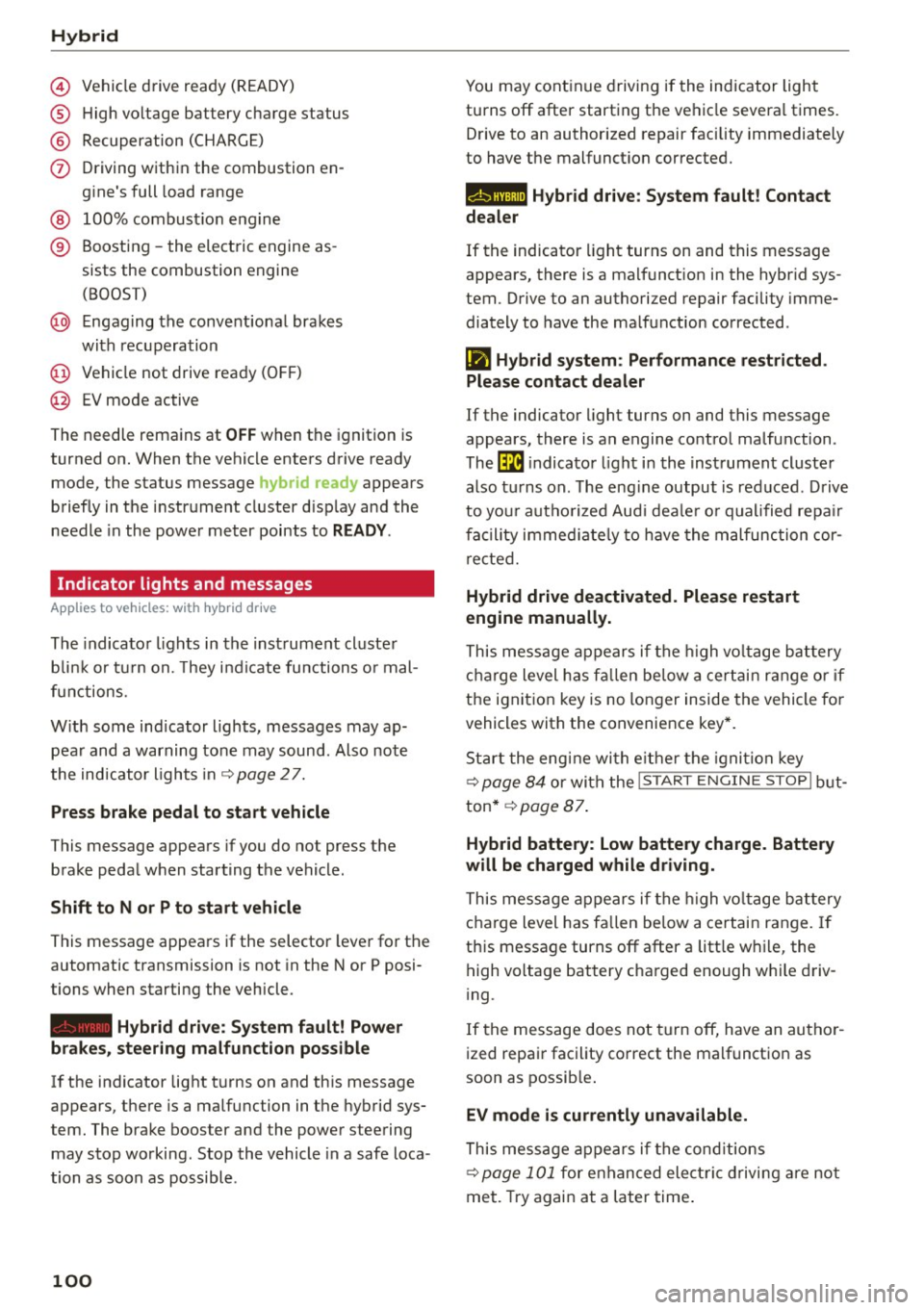
© Vehicle drive ready (READY)
® High voltage battery charge status
® Recuperation (CHARGE)
(f) Driving within the combustion en
gine's full load range
@ 100% combust ion engine
® Boosting -the electric engine as
sists the combustion engine (BOOST)
@ Engaging the convent ional brakes
with recuperation
@ Vehicle not drive ready (OFF)
@ EV mode active
The needle remains at
OFF when the ignition is
turned on. When the vehicle enters drive ready mode, the status message
hybrid ready appears
briefly in the instrument cluster d isplay and the
needle in the power meter points to
READY .
Indicator lights and messages
Applies to vehicles: with hybrid drive
The indicator lights in the instrument cluster
b lin k or tu rn on. They i ndicate functions o r mal
functions.
W ith some ind icator lights, messages may ap
pear and a warning tone may sound. Also note
the indicator l ights in ¢
page 2 7.
Press brake pedal to start vehicle
This message appears if you do not press the
brake pedal when starting the vehicle.
Shift to N or P to start vehicle
This message appears if the selector lever for the
automatic transmission is not in the Nor P posi
tions when starting the vehicle .
-Hybrid drive: System fault! Power
brakes, steering malfunction pos sible
lfthe indicator light turns on and this message
appears, there is a malfunction in the hybrid sys
tem. The brake booster and the power steering
may stop working. Stop the vehicle in a safe loca
tion as soon as possible.
100
You may continue driving if the indicator light
turns off after starting the vehicle severa l times.
Drive to an authorized repair facility immediately
to have the malfunct ion corrected.
Q/ij:@ ,j rlybrid drive: System fault! Contact
dealer
If the indicator light turns on and this message
appears, there is a malfunct ion in the hybr id sys
tem. Drive to an authorized repair facility imme
diately to have the ma lfunction corrected.
Ill Hybrid system : Performance restricted .
Please contact dealer
If the indicator light turns on and this message
appears, there is an engine control malfunction .
The
ffa i ndicator light in the instrument cluster
also t urns on. The eng ine output is red uced . Drive
to you r autho rized Aud i deale r o r qualified repair
facility immediate ly to have the malfunction cor
rected.
Hybrid drive deactivated. Please restart
engine manually.
This message appears if the high volta ge battery
charge level has fallen be low a certain range or if
the ignition key is no longer inside the vehicle fo r
vehicles with the convenience key*.
Start the engine with e ither the ignition key
¢
page 84 or with the !S TAR T EN GINE STOPI but
ton* ¢
page 87.
Hybrid battery: Low battery charge. Battery
will be charged while driving.
This message appears if the high volta ge battery
charge level has fa llen below a certain range. If
this message turns off after a litt le while, the
high voltage battery charged enough w hile driv
i ng .
If the message does not turn off, have an autho r
ized repair facility correct the malfunct ion as
soon as possible.
EV mode is currently unavailable.
This message appears if the cond itions
¢ page 101 for enhanced elect ric driving are not
met. Try again at a later time.
Page 103 of 302
M N
co
a:
co
,...., \!) 1.1"1
N 1.1"1 ,....,
Hybrid functions and operating modes
Appl ies to vehicles: with hybri d drive
Fig. 111 Center console: av bu tton
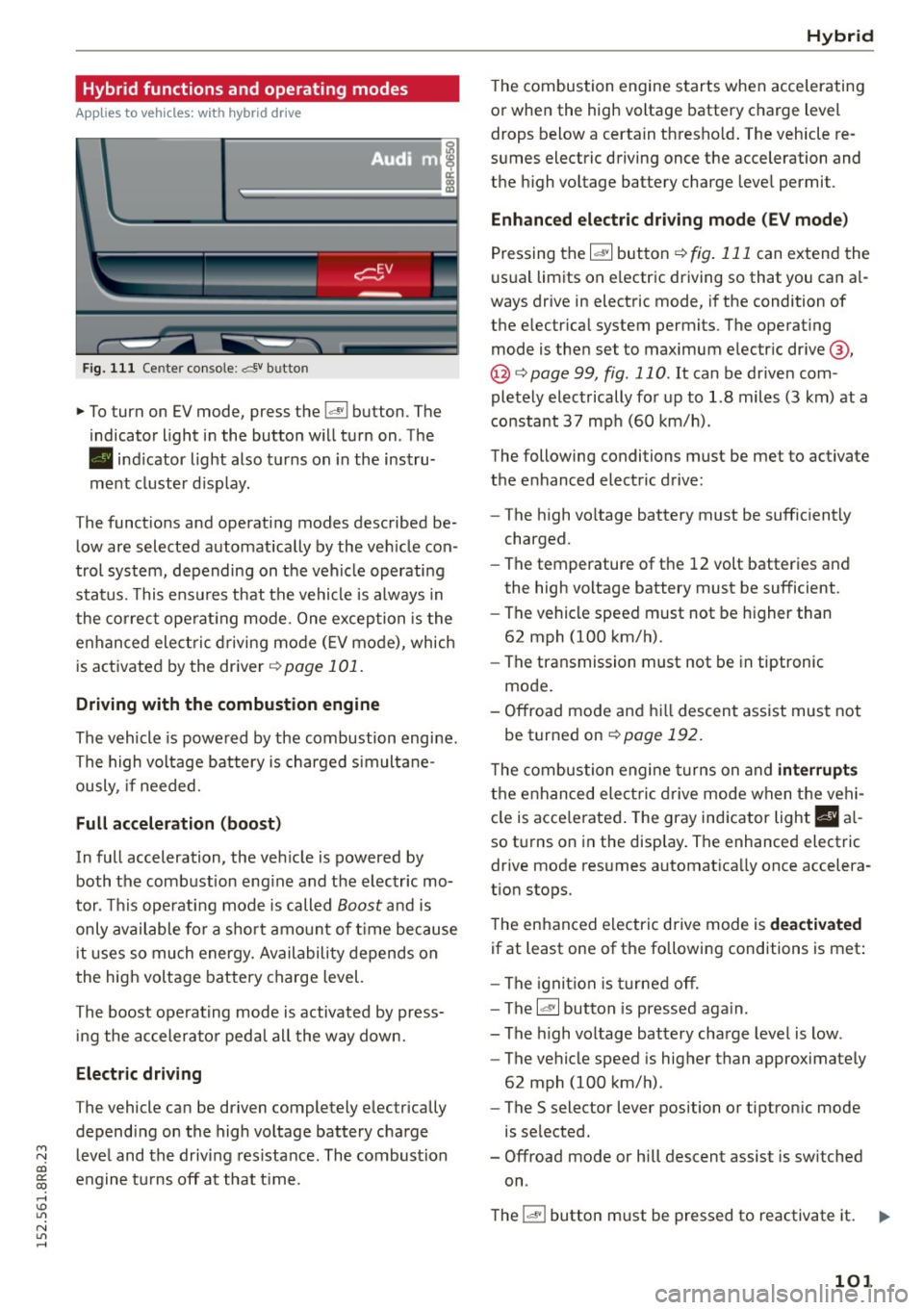
.,. To turn on EV mode, press the l.,,;v l button. The
indicator light in the button will turn on. The
• indicator light also turns on in the instru
ment cluster display.
The functions and operating modes described be
low are selected automatically by the veh icle con
trol system, depending on the vehicle operating
status. This ensures that the vehicle is always in
the correct operating mode. One exception is the
enhanced elect ric driving mode
(E V mode), which
is activated by the driver ¢
page 101.
Driving with the combustion engine
The vehicle is powered by the combustion engine.
The high voltage battery is charged simultane
ously, if needed.
Full acceleration (boost)
In full acceleration, the vehicle is powered by
both the combustion eng ine and the electric mo
tor . This operating mode is called
Boost and is
only available for a short amount of time because
i t uses so much energy. Availability depends on
the high voltage battery charge level.
The boost operating mode is activated by press in g the accelerator peda l all the way down.
Electric driving
The vehicle can be driven completely electrically
depending on the high voltage battery charge
level and the driving res istance . The combustion
engine turns off at that t ime .
Hybrid
The combustion engine starts when accelerating
or when the high voltage battery charge level drops below a certain thresho ld. The vehicle re
sumes electric driving once the acceleration and
the high voltage battery charge level permit .
Enhanced electric driving mode (EV mode)
Pressing the 1~· 1 button r::!> fig. 111 can extend the
usual limits on e lectric driving so that you can a l
ways drive in electric mode, if the condition of
the electrical system permits. The operating
mode is then set to maximum electric drive @,
@ <:!> page 99, fig . 110. It can be driven com
pletely electrically for up to 1.8 miles (3 km) at a
constant
37 mph (60 km/h).
The following conditions must be met to activate
the enhanced electric drive:
- The high voltage battery must be sufficiently
charged.
- The temperature of the
12 volt batteries and
the high voltage battery must be sufficient.
- The vehicle speed must not be higher than
62 mph (100 km/h).
- The transmission must not be in tiptronic
mode.
- Offroad mode and hill descent assist must not
be turned on
r::!;>page 192.
T he combustion engine turns on and interrupt s
the enhanced ele ctric drive mode when the vehi
cle is acce lerated. The gray ind icator light
I§ a l
so turns on in the display. The enhanced electric
drive mode resumes automatica lly once accelera
tion stops.
The enhanced electric drive mode is
deactivated
if at least one of the following conditions is met :
- The ignition is turned off.
- The
l~ ·I button is pressed aga in.
- The high voltage battery charge level is low .
- The vehicle speed is higher than approximately
62 mph (100 km/h) .
- The
S selector lever position or tiptronic mode
is selected.
- Offroad mode or hill descent assist is switched
on .
The
l "'-'' I button must be pressed to reactivate it. 1iJ11-
101
Page 107 of 302
M N
co ~ co
rl I.O
"' N
"' rl
@ Tips
The Energy flow display will not shown in the
MMI display when the reverse gear is engag-
ed, due to safety reasons.
Consumption display
App lies to vehicles: with hybri d dr ive
Fig. 114 MMI display: consumptio n dis play
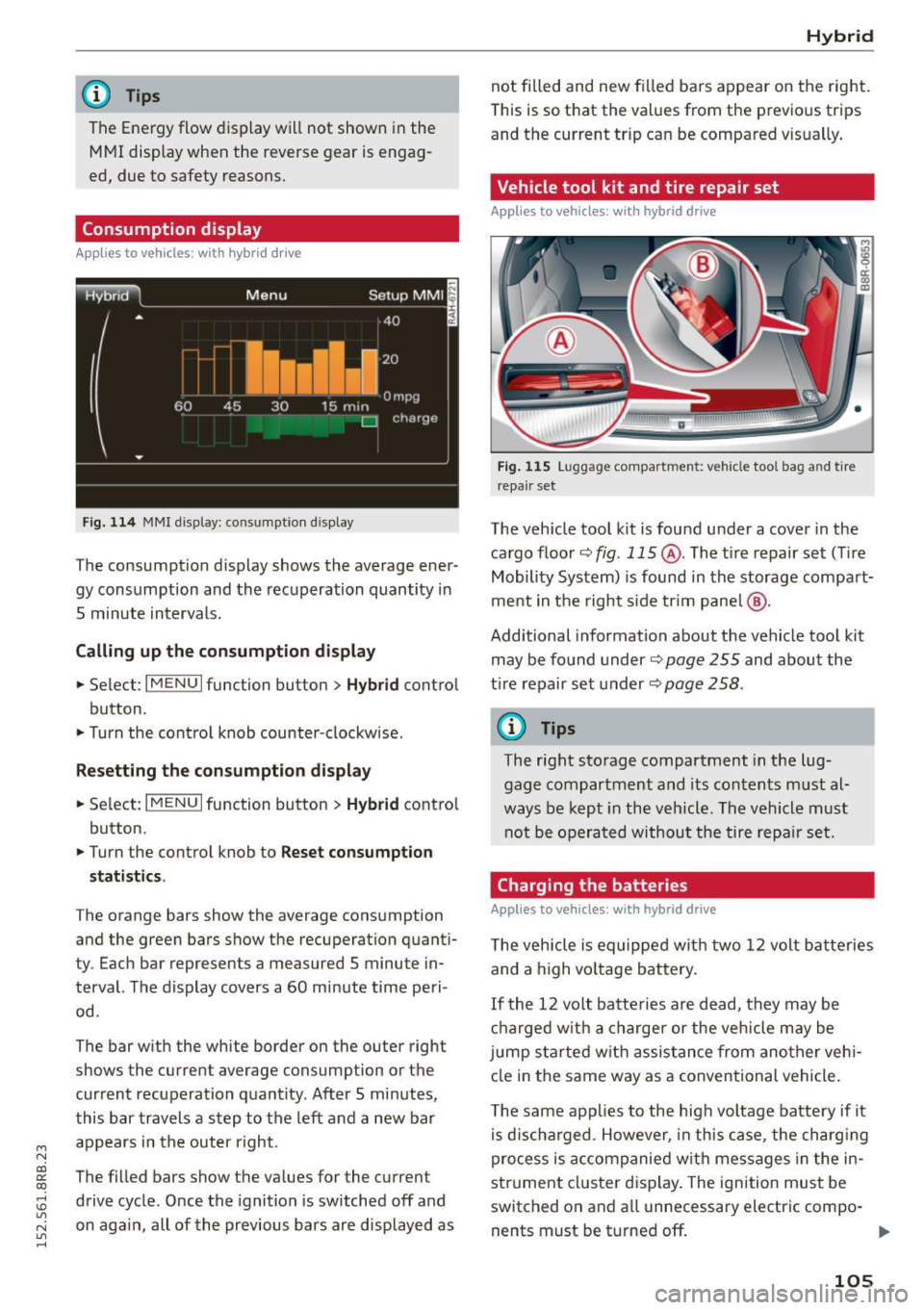
The consumption display shows the average ener
gy consumption and the recuperation quantity in
5 minute intervals.
Calling up the consumption display
... Select : I MENU I function button> Hybrid control
button .
... Turn the control knob counter-clockwise .
Resetting the consumption display
... Select: I MENU I function button > Hybrid contro l
button .
... Turn the control knob to
Reset consumpt ion
statistics .
The orange bars show the average consumption
and the green bars show the recuperation quanti
ty. Each bar represents a measured
5 minute in
terval. The display covers a
60 minute time peri
od .
The bar with the white border on the outer right
shows the current average consumption or the
current recuperation quantity. After 5 minutes,
this bar travels a step to the left and a new bar
appears in the outer right.
The filled bars show the values for the current
drive cycle . Once the ignition is switched off and
on again, all of the previous bars are displayed as
Hybrid
not filled and new filled bars appear on the right.
This is so that the values from the previous trips
and the current tr ip can be compared vis ually .
Vehicle tool kit and tire repair set
Applies to vehicles: wit h hybrid drive
Fig. 115 Luggage compart ment: vehicle tool bag an d tir e
r epa ir set
The veh icle tool kit is found under a cover in the
cargo floor
~ fig . 115 @. The t i re repair set (Ti re
Mobility System) is found in the storage compart
ment in the right s ide trim pane l@ .
Additional information about the vehicle tool kit
may be found under~
page 255 and about the
t ir e repair set under ~
page 258 .
@ Tips
The right storage compartment in the lug
gage compartment and its contents must al
ways be kept in the vehicle. The vehicle must
not be operated without the tire repair set.
Charging the batteries
Applies to vehicles: wit h hybrid drive
The vehicle is equipped with two 12 volt batteries
and a high vo ltage battery.
If the
12 volt batteries are dead, they may be
charged with a charger or the vehicle may be
j u mp started with assistance from another veh i
cle in the same way as a conventional vehicle .
The same applies to the high voltage battery if it
is d ischarged . However, in this case, the charging
process is accompanied w ith messages in the in
strument cluster display. The ignition must be
switched on and a ll unnecessary electric compo -
nents must be turned off.
ll>
105
Page 108 of 302
Hybrid
The connections in the engine compartment are
used for both charging and jump starting
¢ pag e 232 or ¢ page 271.
Vehicl e not r eady to start. S ee owne r's
m anu al
This message appears if the h igh voltage battery
charge leve l is too low. The vehicle can no longer
be started with its own power. The high voltage
battery must be charged with a charger or the ve
h icle must be jump started with the aid of anoth
er vehicle .
After the connecting the charger or jumper ca bles, the ign it ion must be turned off for approxi
mately two minutes and then turned on again .
After no more than one minute, one of the fol lowing indicator lights turns on in the instrument
cluste r display .
B Charging battery. Plea se wait ...
If the indicator light turns on and this message
appears, the high voltage battery is charging or
the vehicle is be ing jump started w ith assistance
from another vehicle .
If the 12 volt batter ies are dead , the - indi
cator light turns on . The charging procedure
takes longer in this case because the 12 volt bat
ter ies are charged first . T he p rocedure goes fast
er with the ig nition sw itched off.
Vehicle ready to st art.
This message appears if the charg ing procedure
was successful. The vehicle may be started aga in.
B atter y could n ot be ch arged en ough to st ar t
v eh icle.
This message appears if the charg ing procedure
was not successful or it was interrupted . This
may happen if the charger or the battery in the
veh icle that is assist ing is too weak. If the veh icle
can not be started, see a n author ized repair fac il i
ty for ass istance.
(D Tips
- The charger shou ld deliver a current of at
l east 30 A. Otherw ise charging t he h igh
voltage battery w il l take considerab ly Lon-
106
ger . A cu rrent between 50 A and 70 A is ide
al.
- T he veh icle that is assist ing shou ld be some
what within the same veh icle class when
jump starting a vehicle. A smaller vehicle's
battery may be drained.
- After approximately 30 minutes , the charg
ing procedure ends because the ignition is
automatically turned off. If you wo uld like
to cont inue to charge the battery, turn the
ignition on again .
Vehicle transport
Applies to vehicles : with hybrid drive
The following contains information you should
know abou t transporting your vehicle.
The lithium ion battery (SANYO 72 UF 121 285)
i nsta lled in your vehicle has passed test 38 .3 in
accordance with UN handbook tes ts and criteria.
T he vehicle may be transported w ith the battery
i nstalled as conventional class 9 hazardous mate
ria ls without addit ional official consent for air
and sea transpo rtation (cu rrent law !CAO-TI and
IMDG-Code 01.01.2012).
Page 126 of 302
Automatic transmission
brake before and while moving the lever to D/S
out of N.
A WARNING
Read and follow all WARNINGS c:> &_in Driv
ing the automatic transmission on
page 125.
(D Note
Coasting downhill with the transmission in N
and the engine not running will result in dam
age to the automatic transmission and possi
bly the catalytic converter .
{!) Tips
-On vehicles with Audi drive select*, you can
adjust the sporty shift characteristics in the
Dynamic driving mode.Swill appear in the
instrument cluster display instead of D .
- If you accidentally select N while driving,
take your foot off the accelerator pedal im·
mediately and wa it for the engine to slow
down to idle before select ing D/S .
- Hybrid drive* : if the
1~1 button c:> page 101
is pressed while in sport mode S, the trans
mission switches automatically to the nor·
mal mode D.
- If there is a power failure, the selector lever
will not
move out of the P pos ition. The
emergency release can be used if this hap
pens
c:> page 128.
124
.
Automatic Shift Lock (ASL)
T he Automatic Shift Lock safeguards you against
occidentally shifting into a forward or the re· verse gear and causing the vehicle to move unin
tentionally.
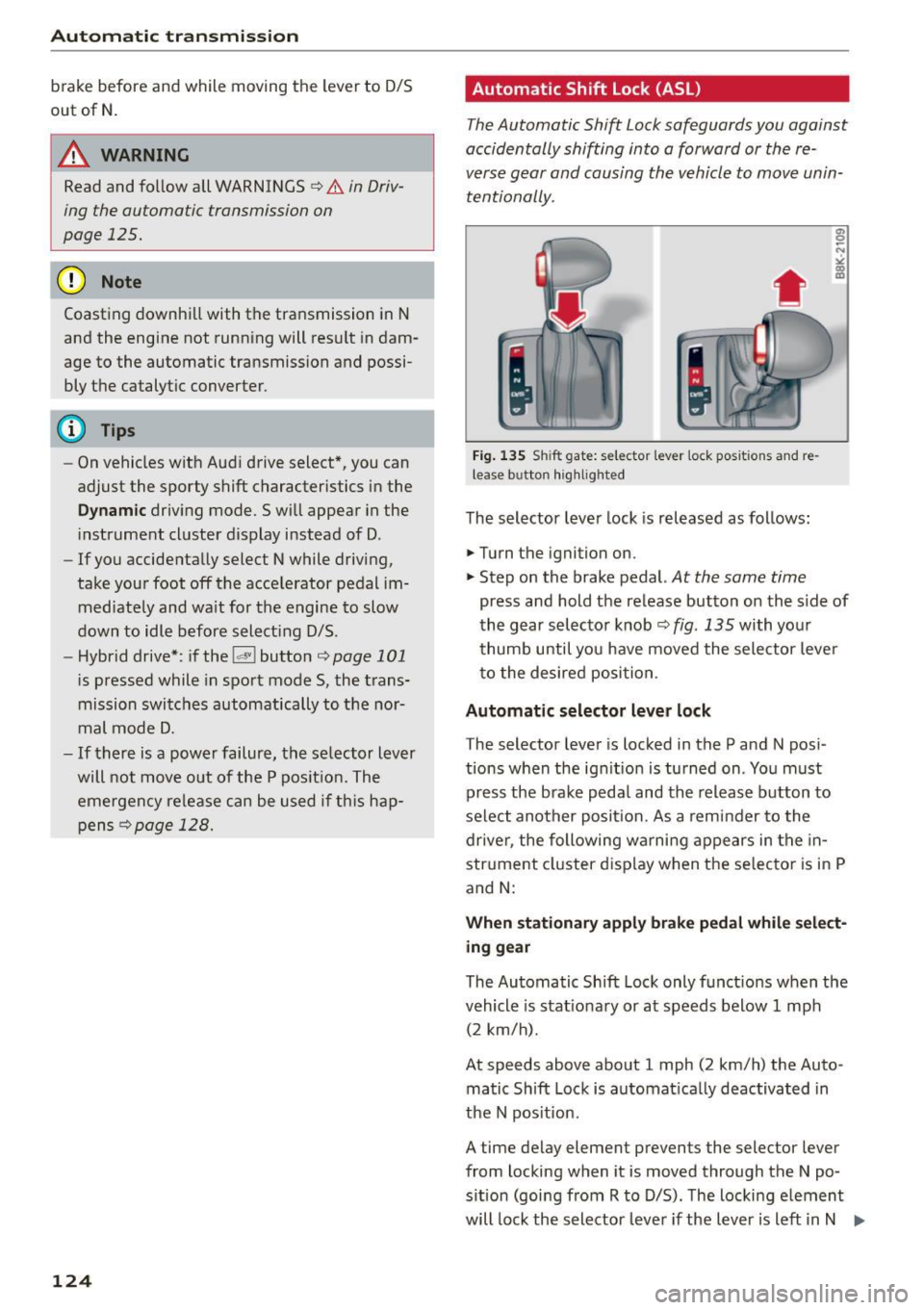
' Fig. 135 S hi ft gate: selector lever lock posit ions and re
lease b utton highlighted
The selector lever lock is released as fol lows:
.,. Turn the ignition on.
.,. Step on the brake pedal.
At the some time
press and hold the release button on the side of
the gear selector knob
c:> fig. 135 with your
thumb until you have moved the selector lever
to the desired position.
Automatic selector lever lock
The selector lever is locked in the P and N pos i
tions when the ignit ion is turned on. You must
press the brake peda l and the release button to
select another position. As a reminder to the
driver, the following warni ng appears in the in
str ument cluster display when the selector is in P
and
N:
When stationary apply brake pedal while select
ing gear
The Automatic Shift Lock only funct ions when the
vehicle is stat ionary or at speeds below 1 mph
(2 km/h).
At speeds
above about 1 mph (2 km/h) the Auto
matic Shift Lock is automat ica lly deactivated in
the N pos ition.
A time delay element prevents the selector lever
from locking when it is
moved through the N po
s ition (going from R to D/S) . The locking e lement
will lock the selector lever if the lever is left in N .,..
Page 127 of 302
M N
co
a:
co
,...., \!) 1.1"1
N 1.1"1 ,....,
(Neutral) for more than approximately 1 second,
without the brake pedal being pressed.
Release button
The release button on the selector lever prevents
the lever from be ing acc identally shifted into cer
tain positions. Pressing this button deactivates
the selector lever lock . Depending on the direc
tion of the shift, the se lector lever locks at differ
ent positions. The positions are highlighted in
the illustration¢
fig. 135.
Ignition key safety interlock
The key cannot be removed from the igni tion un
l ess the se lector lever is in the P park position .
When the ignition key is removed, the selector
l ever will be locked in the P position.
Driving the automatic transmission
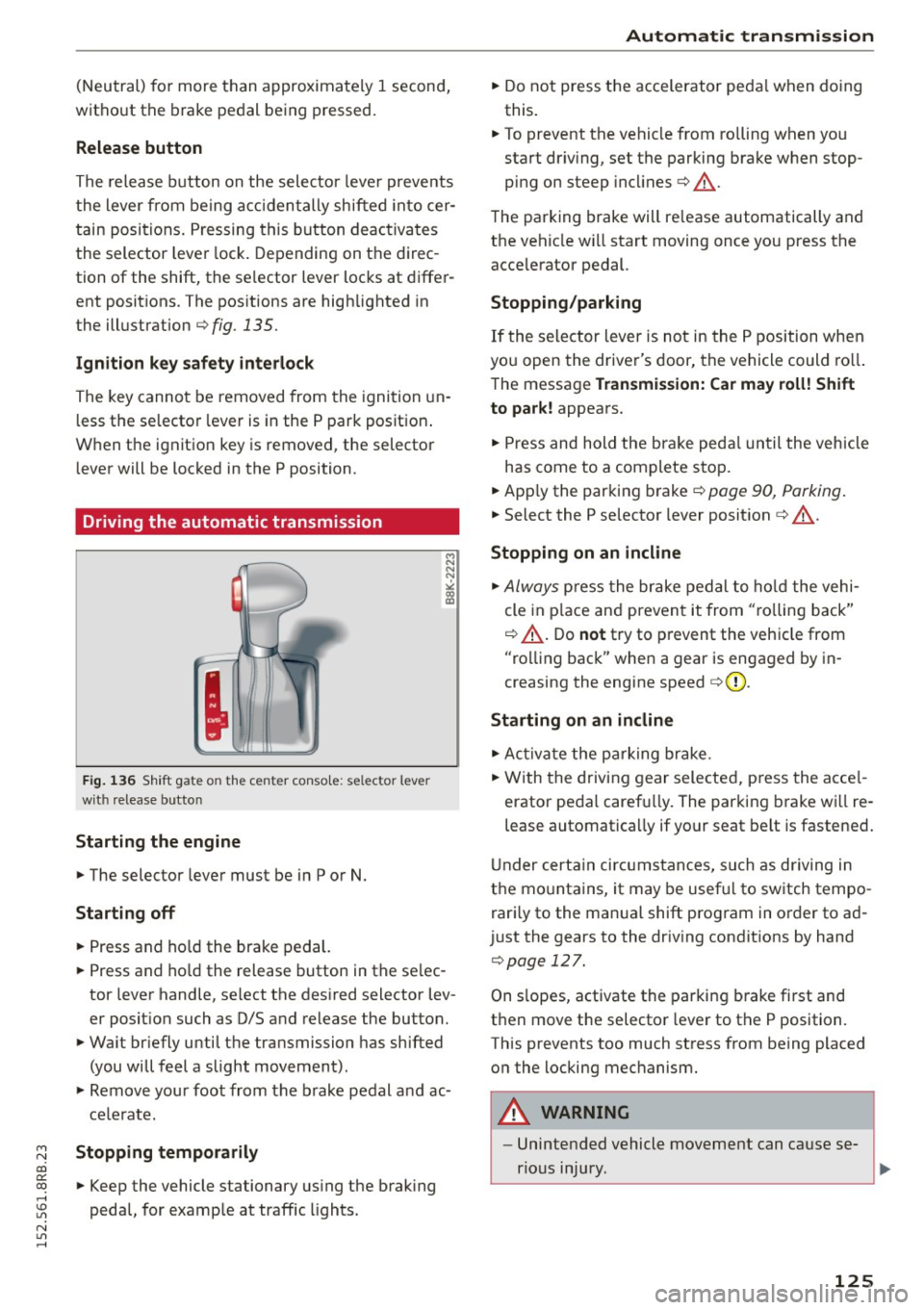
Fig. 136 Shift gate on the center conso le: selector lever
with release button
Starting the engine
.,. The selector lever must be in P or N.
Starting off
.,. Press and hold the brake pedal.
.,. Press and ho ld the release button in the se lec
tor lever handle, select the desired selector lev
er position such as D/S and release the button.
.,. Wait br iefly until the transmission has shifted
(you will feel a slight movement).
.,. Remove your foot from the brake pedal and ac
celerate.
Stopping temporarily
.,. Keep the vehicle stationary using the brak ing
pedal, for example at traffic lights.
Automatic transmission
.,. Do not press the accelerator peda l when doing
this.
.,. To prevent the vehicle from rolling when you
start dr iv ing, set the parking brake when stop
ping on steep incl ines¢ &_.
The parking brake will re lease automatically and
the vehicle wi ll start moving once you press the
acce lerator pedal.
Stopping/parking
If the selector lever is not in the P position when
you open the driver's door, the vehicle could roll.
The message
Transmission: Car may roll! Shift
to park!
appears.
.,. Press and hold the brake pedal until the vehicle
has come to a complete stop.
.,. App ly the parking brake¢
page 90, Parking .
.,. Select the P se lector lever position ¢ &_ .
Stopping on an incline
.,. Always press the brake pedal to hold the vehi
cle in place and prevent it from "ro lling back"
¢ &_ . Do
not try to prevent the vehicle from
"rolling back" when a gear is engaged by in
creasing the engine speed
c> (D .
Starting on an incline
.,. Activate the parking brake .
.,. With the driving gear selected, press the acce l
erator pedal carefu lly. The parking brake wi ll re
lease automatically if your seat belt is fastened.
Under certain circumstances, such as driving in
the mountains, it may be usefu l to switch tempo
rari ly to the manual shift program in order to ad
just the gears to the driving conditions by hand
¢page 127 .
On s lopes, activate the parking brake first and
then move the selector lever to the P position .
This prevents too much stress from being placed on the locking mechanism .
A WARNING ,_
-Unintended vehicle movement can cause se-
rious injury.
~
125
Page 136 of 302
Parkin g system
mirror or a corner of yo ur vehicle does not col
lide with any obstacles. This can damage to
your vehicle.
(D Tips
The left or right orientation lines and sur faces
wi ll be displayed, depending on the turn sig
nal being used .
Adjusting the display
and warning tones
A pp lies to veh icles: w ith Audi park ing system p lus w ith rear
view ca mera
The display and warning tones can be adjusted in
the MMI.
~ Select: I CARI function button > Pa rking system .
Or
~ Select: ICARI funct ion button > Car s ystem s*
control button> Driver ass ist > Par king aid .
D is pl ay
- Off -when the parking system is switched on,
only audib le signals are given .
-On -when the parking system is switched on,
either the visual disp lay or the picture from the
rearview camera is disp layed.
Warning tones
- Front volum e -
front sensor volume
- Front frequency -front sensor frequency
-Rea r volume -rear sensor volume
-Rear fre quenc y -rear sensor frequency
- In -ca r entertainment fader /M usic volume
w hile pa rking -
when the parking system is
switched on, the volume of the active audio
source is lowered.
The newly adjusted value is briefly heard from
the signal generator.
(D Tips
- The warning tones can also be adjusted d i
rectly by the visual display or the picture
from the rearview camera. Simply press the
S ett ing s control button.
- Changed settings are activated when park
i ng system is switched on again .
134
-The settings are automatica lly stored and
assigned to the remote contro l key .
Trailer hitch
App lies to vehicles : wi th Audi parking sys te m plus wi th rea r
v iew camera a nd t railer hitch
For vehicles with a factory installed trailer hitch,
o r a trai ler h itch installed accord ing to factory
spec ifications, the parking sys tem rear sensors
do not come on whenever you shift into reverse
gear or when you press the
P" 1A switch. Remem
ber, there is no warning for distances to the rear.
The front sensors remain activated . The visua l
display switches to the trailer towing mode. The
picture from the rearv iew camera w ill not show
the or ientat ion lines nor the blue surfaces.
If you insta ll a hitch yourse lf, this function may
not work.
Error messages
App lies to vehicles: wi th Audi parking sys te m plus with rea r·
v iew camera
There is an error in the system if the LED on the
PwA switch is b linking and you hear a continuous
a larm for a few seconds after switching on the
parking system or when the parking system is al
ready act ivated. Have your authori zed Audi dealer
correct the error.
(D Tips
If the error is not corrected before you switch
off the ignition, when you switch on the park i ng system again, the LED in the
Pw.o. sw itch
will blink.
Page 156 of 302
Airbag system
safety seat. It can be a very dangerous place for
an infant or a child in a rearward-facing seat.
The Advanced Airbag System in your veh icle has
been ce rtified to comp ly w ith the Requirements
of United States Federal Motor Vehicle Safety
Standard 208 as applicable at the time your vehi
cle was manufactured.
The Standard requires the front airbag on the
passenger side to be turned off ("suppressed") if
a child up to about one year of age restrained in
one of the rear-fac ing or forward-facing infant re
straints listed in Federal Motor Vehicle Safety
Standard 208 w ith which the Advanced A irbag
System in your vehicle was certified has been in
stalled on the front passenger seat. Fo r a listing
of the ch ild restraints that were used to certify
comp liance with the US Safety Standard
¢page 174.
The PASSENGER AIR BAG OFF light in the instru
ment panel tells you when the front Advanced
Ai rbag on the passenger side has been turned off
by the electron ic control unit.
E ach t ime you turn on the ignition, the
PASSEN
GER AIR BAG OFF light will come on for a few
seconds and:
- will stay on if the front passenger seat is not
occupied,
- will stay on if there is a small child or child re
stra int on the front passenger seat,
- will go off if the front passenger seat is occu
pied by an adult as registered by the weight
sensing mat¢
page 162, Monitoring the Ad
vanced Airbag System.
The PASSENGER AIR BAG OFF light comes on
when the control un it detects a total weight on
the front passenger seat that requ ires the front
ai rbag to be turned off.
If the tota l weight on the front passenger seat is
more than that of a typical 1 year -old child but
less than the we ight of a small adult, the front
ai rbag on the passenger side can deploy (the
PASSENGER AIR BAG OFF light does not come
on). If the
PASSENGER AIR BAG OFF light does
not come on, the front airbag on the passenger
side has not been turned off by the electronic
154
control unit and can dep loy if the control unit
senses an impact that meets the conditions stor
ed in its memory .
For example, the airbag may deploy if:
-a small ch ild that is heavier than a typical 1
year-old chi ld is on the front passenger seat (re
ga rdl ess of whethe r the child is in one of the
child safe ty seats listed¢
page 174), or
- a child who has outgrow n chi ld restraints is on
the front passenger seat .
If the front passenger airbag is turned off, the
PASSENGER AIR BAG OFF light comes on in the
instr ument cluster and stays on.
The front airbag on the passenger side may
not
deploy (the PASSENGER AIR BAG OFF light does
not illuminate and stay lit) even if a sma ll adult
o r teenager, or a passenger who is not sitt ing up
r ight w ith their back against a non-reclined back
rest with their feet on the vehicle floor in front of
the seat is on the front passenger seat
¢ page 136, Proper seating position for the driv
er .
If the front passenger airbag deploys, the Federal
Standard requires the airbag to meet the "low
risk" deployment criteria to reduce the risk of in
ju ry through interaction with the airbag. "Low
risk" deployment occurs in those crashes that
take place at lower decelerations as defined in
the electronic control unit ¢
page 162, PASSEN
GER AIR BAG OFF light .
Always remember, a child safety seat or infant
carr ier installed on the front seat may be struck
and knocked out of position by the rapidly inflat
i ng passenger's airbag in a frontal collision . The
airbag could greatly reduce the effectiveness of
the child restraint and even seriously injure the
child during inflation.
For th is reason, and because the back seat is the
safest place for children - when prope rly restra in
ed accord ing to their age and size -we strong ly
recommend that children always sit in the back
seat ¢
page 172, Child safety. ..,.
Page 157 of 302
M N
co
a:
co
,...., \!) 1.1'1
N 1.1'1 ,....,
A WARNING ,~
A child in a rearward-facing child safety seat
installed on the front passenger seat will be
seriously injured and can be killed if the front
airbag inflates - even with an Advanced Airbag
System.
- The inflating airbag will hit the child safety
seat or infant carrier with great force and
will smash the child safety seat and child
against the backrest, center armrest, door
or roof.
- Always install rear-facing child safety seats
on the rear seat.
- If you must install a rearward facing child
safety seat on the front passenger seat be
cause of exceptional circumstances and the
PASSENGER AIR BAG OFF light does not
come on and stay on, immediately install
the rear-facing child safety seat in a rear
seating position and have the airbag system inspected by your authorized Audi dealer.
- Forward-facing child safety seats installed
on the front passenger's seat may interfere
with the deployment of the airbag and cause serious personal injury to the child .
A WARNING
If, in exceptional circumstances, you must in
stall a forward-facing child restraint on the
front passenger's seat:
-Always make sure the forward-facing seat
has been designed and certified by its man
ufacturer for use on a front seat with a pas
senger front and side airbag.
- Never put the forward-facing child restraint
up against or very near the instrument pan
el.
- Always move the passenger seat into its
rearmost position in the seat's fore and aft
adjustment range, as far away from the air
bag as possible before installing the for
ward-facing child restraint. The backrest must be adjusted to an upright position.
- Make sure that the
PASSENGER AIR BAG
OFF
light comes on and stays on all the time
whenever the ignition is switched on.
Airbag system
A WARNING
To reduce the risk of serious injury, make sure
that the
PASSENGER AIR BAG OFF light will
be displayed whenever a child restraint is in
stalled on the front passenger seat and the ignition is switched on .
- If the
PASSENGER AIR BAG OFF light does
not stay on, perform the checks described
~ page 162, Monitoring the Advanced Air
bag System.
- Take the child restraint off the front passen
ger seat and install it properly at one of the
rear seat positions if the
PASSENGER AIR
BAG OFF
light does not stay on.
- Have the airbag system inspected by your
authorized Audi dealer immediately.
-Always carefully follow instructions from
child restraint manufacturers when instal
ling child restraints.
A WARNING
If, in exceptional circumstances, you must in
stall a forward or rearward-facing child re
straint on the front passenger's seat:
- Improper installation of child restraints can
reduce their effectiveness or even prevent
them from providing any protection.
- An improperly installed child restraint can
interfere with the airbag as it deploys and
seriously injure or even kill the child -even
with an Advanced Airbag System.
-Always carefully follow the manufacturer's
instructions provided with the child safety
seat or carrier.
- Never place additional items on the seat that can increase the total weight registered by the weight-sensing mat and can cause in
jury in a crash.
155
Page 160 of 302
Airbag syste m
-a small adu lt or teenager is on the front pas
senger seat
- a passenger who is not sitting upright with
their back against a non -reclined backrest with
their feet on the vehicle floor in front of the
seat is on the front passenger seat.
I f the front passenger airbag deploys, the Federal
Standard req uires the airbag to meet the " low
risk" deployment criteria to help reduce the risk
of injury through interaction with the airbag .
"Low risk" deployment occurs in those crashes
that take place at lower decelerations as defined in the electron ic control unit . ¢ page
162
Alw ays re member: Even though your vehicle is
equ ipped w ith Advanced Airbags, the safest place
for children is properly restrained on the back
seat . Please be sure to read the important infor
mat ion in the sections that follow and be sure to
heed a ll of the WARNINGS.
_& WARNING
To reduce the ris k of injury when an airbag in
fla tes, always wear safety belts proper ly.
- If you are unrestrained, leaning fo rward, s it
t ing s ideways or out of position in any way,
your risk of injury is much higher .
- You w ill also receive serious inju ries and
could even be killed if you are up against the
airbag or too close to it when it inflates -
even with an Advanced Airbag ¢page
152.
_& WARNING
A child in a rearward-facing child safety seat
installed on the front passenger seat will be
ser iously injured and can be killed if the front
airbag inflates - even w ith an Advanced Airbag
System.
- Although the Advanced Airbag System in
your vehicle is designed to turn off the front
airbag when a rearward -facing child re
straint has been installed on the front pas
senger seat, nobody can absolutely guaran
tee that deployment is impossible in al l con
ceivable s ituations that may happen dur ing
the usef ul life o f your vehicle .
- The inflating a irbag w il l hit the child safety
seat or infant carrier wi th great force and
158
w ill smash the child safety seat and child
aga inst the backrest, center armrest, door,
or roof.
- Always install rearward-facing chi ld re
straints in the back seat.
- If you must insta ll a rearward fac ing ch ild
safety seat on the front passenger seat be
cause of exceptional circumstances and the
PAS SENGER AIR BAG OFF light does not
come on and stay on, immediately install
the rear-facing child safety seat in a rear
seating position and have the airbag system
inspected by your au thorized Aud i dealer .
_& WARNING
If, in exceptiona l circumstances, you must in
stall a forwa rd-facing child restra int on the
front passenger's seat:
- Always ma ke sure the forward-facing sea t
has been des igned and certif ied by its man
ufacturer for use on a front seat with a pas
senger front and s ide a irbag .
- Never p ut the fo rward-facing child restraint
up against or very near the instrument pan
el.
-Always move the passenger seat into its
rearmost position in the seat's fore and aft
ad justment range, as far away from the a ir
bag as poss ible, before insta lling the for
ward-facing child restraint. The backrest
must be adjusted to an upr ight position .
- Make sure that the
PASSENGER AIR BAG
OFF
li ght comes on and stays on all the time
whenever the ign it ion is switched on.
Advanced Airbag System components
The front passenger seat in your vehicle has a lot
of ve ry impo rtant parts of the Advanced A irbag
System in it. These pa rts include the we ight
sensing mat, senso rs, w iring, bracke ts, and more.
The function of the system in the front passenge r
seat is checked by the e lectronic control unit
when the ignition is on. The control unit mon itors
the Advanced Airbag System and turns the airbag i ndicator light on when a malfunct io n in the sys
tem components is detected. The function of the
a irbag indicator light is described in greate r