warning AUDI Q5 2016 Owners Manual
[x] Cancel search | Manufacturer: AUDI, Model Year: 2016, Model line: Q5, Model: AUDI Q5 2016Pages: 300, PDF Size: 75.02 MB
Page 189 of 300
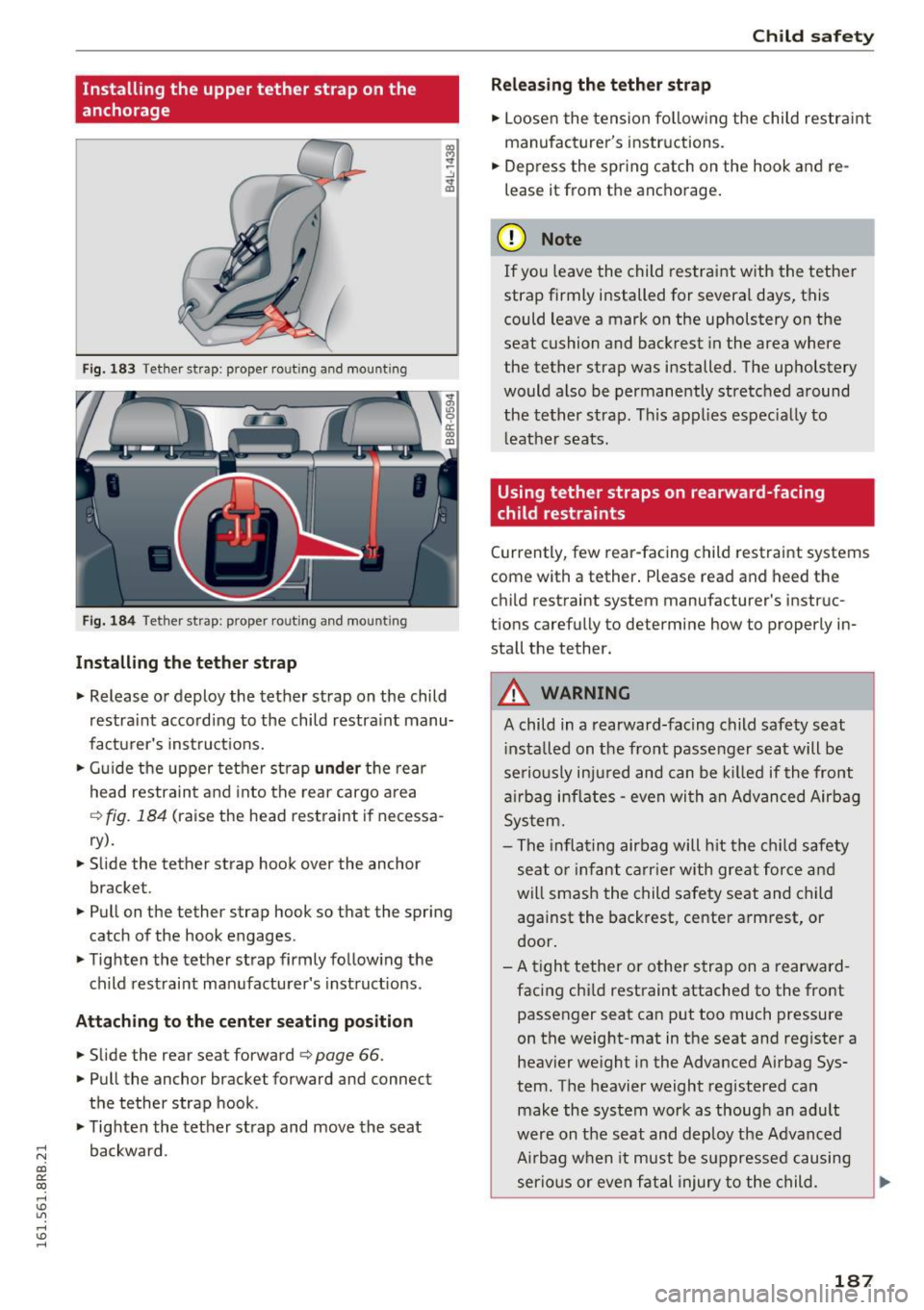
Installing the upper tether strap on the
anchorage
Fig. 183 Tether strap: proper rout ing and mount ing
Fig. 184 Tether strap: proper ro utin g and mo untin g
Inst all ing th e teth er str ap
.,. Release or deploy the tether strap on the child
restra int according to the child restra int manu
factu rer's instruct ions.
.,. Gu ide the upper tether st rap
und er the rear
head restra int and into the rear cargo a rea
¢ fig. 184 (raise the head restraint if necessa
ry) .
.,. Slide the tether strap hook over the anchor
bracket .
.,. Pull on the tether strap hook so that the spring
catch of the hook engages.
.,. Tighten the tether strap firmly follow ing the
child restraint manufacturer's instruct ions.
Atta ching to the center seating p osition
.,. Slide the rear seat forward c> page 66.
.,. Pull the anchor bracket forward and connect
the tether strap hook .
.,. Tighten the tether strap and move the seat
;::: backward .
co ~ CX)
rl I.Cl U"I
rl I.Cl rl
Child sa fety
R elea sing the teth er str ap
.,. Loosen the tension following the child restra int
manufacturer's instructions .
.,. Depress the spring catch on the hook and re
lease it from the anchorage.
(D Note
If you leave the child restraint with the tether
strap firmly installed for several days, this
could leave a mark on the upholstery on the
seat cushion and backrest in the area where
the tether strap was installed . The upholstery
would also be permanently stretched around
the tether strap . T his applies espec ially to
l eather seats.
'
Using tether straps on rearward-facing
child restraints
Currently, few rear-facing child restraint systems
come with a tether . Please read and heed the
child restraint system manufacturer's instruc
tions carefully to determine how to properly in
stall the tether.
_&. WARNING ~
A child in a rearward-facing child safety seat i nsta lled on the front passenger seat will be
se riously inju red and can be ki lled if the front
a ir bag inflates - even wi th an Advanced Airbag
Sys tem.
- The inflating airbag will h it the ch ild safety
seat o r infant carr ier with great force and
will smash the child safety seat and child against the backrest, cente r armrest, or
door .
- A t ight tether or other strap on a rearward
facing chi ld restraint attached to the front
passenger seat can put too much pressure
on the weight-mat in the seat and register a
heavier weight in the Advanced Airbag Sys
tem. The heavier weight registered can
make the system work as thoug h an adu lt
were on the seat and deploy the Advanced Ai rbag when it must be suppressed causing
serio us or eve n fatal injury to the child. .,..
18 7
Page 192 of 300
Intelligent Technology
shared, please see your contract with the
wireless te lecommunications provider and the
"About Aud i connect" tab in your vehicle's
MMI*:
I MENU ! button > Audi connect > About
Audi connect .
Electronic Stabilization
Control (ESC)
Description
The Electroni c Stab ili z at ion Control (ESC) re infor
ces driver safety. It reduces the r isk of slipping
and improves driving stability. ESC detects crit i
cal s ituations suc h as the vehicle overstee ring
and understeering o r the wheels sp inning. The
ve hicl e is stab ilized by applying the b rakes o r re
ducing e ngine torque . Once t he ESC is acti ve , the
i n dicator light
m bli nks in the instrument cl us
ter.
The fo llow ing sys tems a re integrated in the ESC:
Anti-lock b rake system (ABS)
ABS preve nts the wheels from lock ing up when
b raking . The veh icle can sti ll be steered even dur
i n g ha rd brak ing . Apply steady press ure to the
b rake pedal. Do no t pump t he pedal. A pulsing in
the brake pedal indicates tha t the system i s help
i n g you to br ake the vehicle .
Brake assist system
The brake assist system can decrease brak ing dis
tance . It increases brak ing power when the d river
p resses the brake pedal q uic kl y in eme rgency si t
uations . You m ust press and hold t he b rake pedal
until the situa tion is over. In vehi cles w it h ad ap
tive cruise contro l* , the brake assist system is
mo re sensit ive if the distance detected to the ve
h icle ahead is too small.
Anti -slip regulation (ASR)
A SR re duces eng ine power when the drive w heels
begin to spin and adapts the force to the roa d
conditions. This makes it easie r to sta rt, acceler
ate and drive up hi lls.
190
Electronic differential lock (EDL)
The EDL brakes wheels that are spi nning and
transfers the drive power to the other w heels .
This function is not ava ilable at higher speeds.
I n ext reme cases , ED L automat ica lly swi tches off
to help keep the b rake on the bra ke d whee l from
overheating . EDL will sw itch on again automa ti
ca lly w hen conditions have returned to normal.
Steering recommendation
The ESC he lps to stabilize the vehicle by cha ng ing
t h e s teer ing torque .
On vehicles with dynam ic steering*, ESC helps
stab il ize the steer ing in crit ica l sit uat ions .
Selective wheel torque control
Selective wheel torque cont rol is used when d riv
i ng o n curves. The front whee l on the inside of
the curve or both wheels on the i nside of the
curve are braked selectively as needed . Th is al
l ows mo re prec ise driving in c urves . The applica
ble sys tem may not a ctivate w hen d riv in g in we t
o r snowy cond it ions.
_8. WARNING
- The ESC and i ts integ ra ted systems cannot
overcome the laws of physics . This is espe
cially important on slippery or wet roads. If
the systems begin act ing to stab ilize your
veh icle, you should immediately change
your speed to matc h the road and traffic
conditions. Do no t let the increased safe ty
provided by t hese systems tempt yo u to
t ake risks. Doing so will i ncreas e th e risk of
a loss of vehicle con trol, collisi on and se ri
ou s person al injur ies .
- Always a dap t your spee d to road , traffic and
weather condi tions. The risk of los ing con
t rol of the vehicle in cr eases w hen driving
t oo f ast, es pecially throu gh curves and on
slippe ry or wet roads, and when driving too
close to ve hicles up ahea d. The ESC and its
integ rated systems cannot always prevent
col lisions - there is still a risk of accidents!
- Always accelerate w ith special ca re on even,
smooth surfaces s uch as those that are wet
o r covered with ice and snow. The drive .,..
Page 193 of 300
..... N
co ~ CX)
..... I.Cl U"I
.... I.Cl .....
wheels can spin even with these ass istance
systems that cannot always he lp to reduce
the risk of loss of vehicle control.
@ Tips
-ABS and AS R on ly work correctly when a ll
fo ur whee ls are e quipped w ith ide ntical
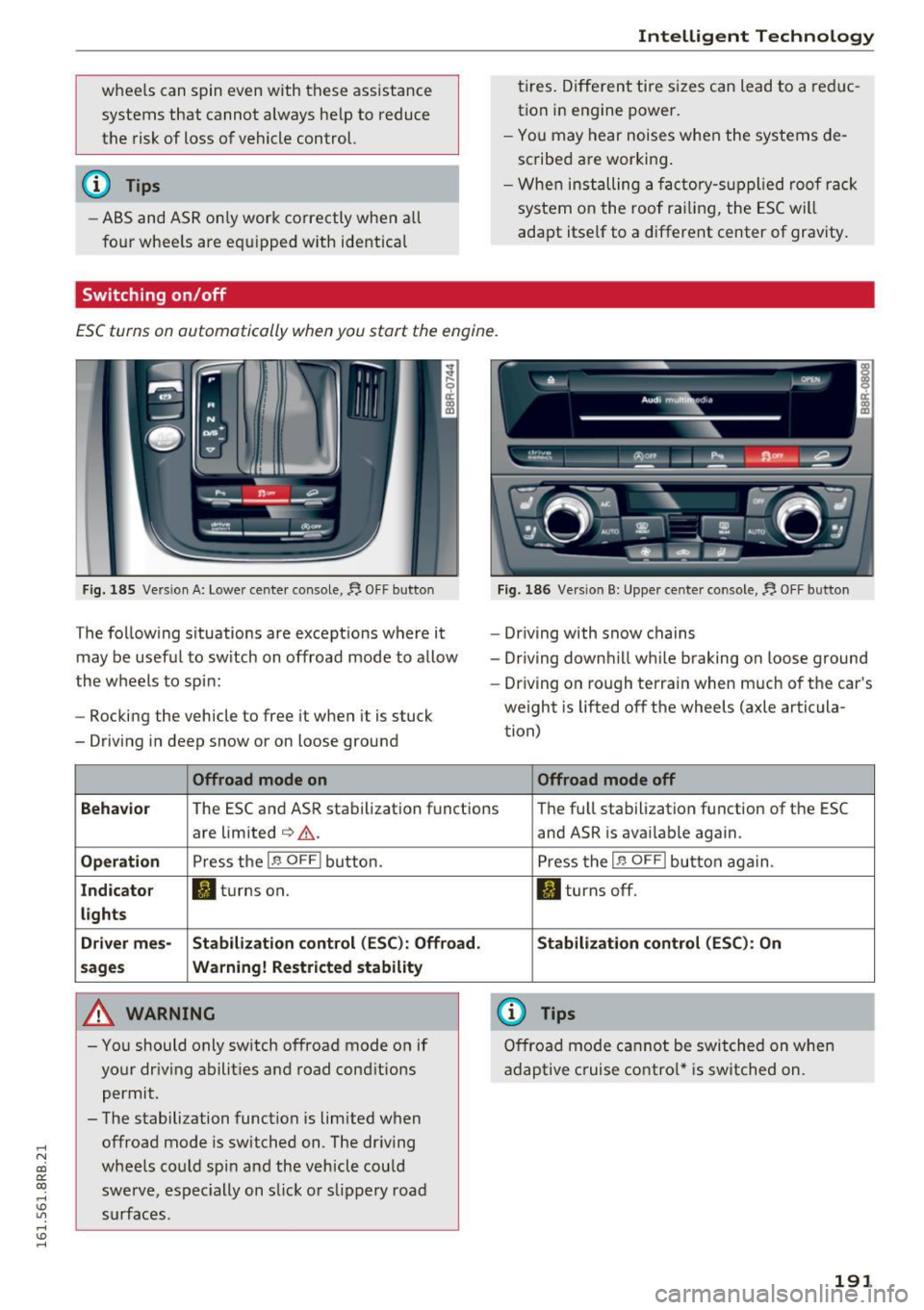
Switching on /off
Intelligent Technology
tires. Diff eren t tire s izes can lead to a red uc
tion i n engine po wer .
- You may hear noises when t he sy stems de
scribe d are workin g.
- Whe n in sta lling a facto ry-s up plied roo f ra ck
system o n the roof r ailing , the ESC wi ll
adapt itself to a different center of gravity .
ESC turns on automatically when you start the engine.
Fig . 18 5 Versio n A: Lowe r cente r conso le,~ OFF b utto n
The follow ing s ituations are except ions where it
may be usef ul to sw itch on offroad mode to allow
the wheels to spi n:
- Rocking the vehicle to free it when it is stuck
- Driv ing in deep snow or on loose ground
Offroad mode on
~ Q:)01_1 _ --.!'3.- -ft.
- Driving with snow chains
- Dr iving down hill wh ile braking on loose ground
- Dr iving on ro ugh te rra in when m uch of the car's
weight is lifted off the wheels (axle articula
tion)
Offroad mode off
Behavio r
The ESC and AS R stabilization f unctions Th
e fu ll sta bilization f unction of the ESC
a re limited
c:> &. .
Operation Press the 1.$ OFF I button.
Indicator II turns on.
lights
Driver mes- Stabilization
control (ESC): Offroad.
sages Wa rning! Restricted stability
A WARNING
- You should only sw itch o ffroad mode o n if
yo ur dr iv ing abilit ies a nd road cond it io ns
permit.
- The stabilization function is limited when offroa d mode is switched on. The dr iv ing
wheels co uld spi n and th e vehicle cou ld
swerve, es pec ially on s lick o r sli ppery roa d
s ur fac es. and ASR
is avai lab le again.
P ress t he
1.$ OFFI button aga in.
II turns off.
Stabilization control (ESC ): On
(D Tips
Offro ad mode ca nno t be switche d on whe n
adaptive c ruise co ntro l* is switched on.
191
Page 194 of 300
Intelligent Technology
Hill descent assist
The hill descent assist makes it possible to drive
down an incline at a constant speed .
~~,·~ ('l)ofF ___ P..1 --- fl~ IIL..~
---
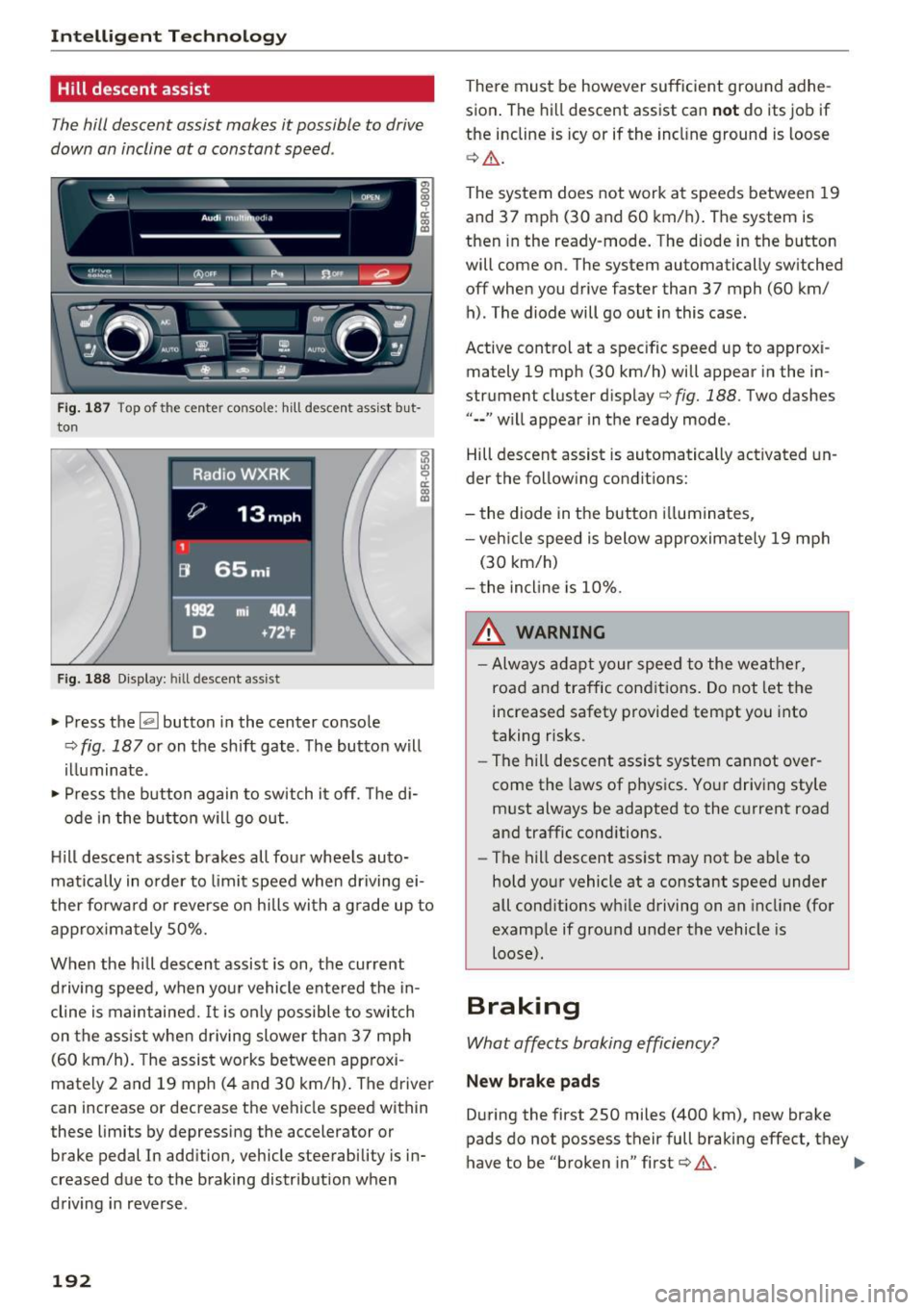
Fig. 187 Top of the center conso le: hill descent assist but
ton
Fig. 188 Display: hill descent assist
.. Press the~ button in the center console
¢ fig . 187 or on the shift gate . The button will
illuminate .
" Press the button again to switch it off. The di-
ode in the button will go out .
Hill descent ass ist brakes all four wheels auto
matically in order to limit speed when driving ei
ther forwa rd o r reverse on hills with a grad e up to
approximately 50%.
When the hill descent assist is on, the current
driving speed, when your vehicle entered the in
cline is maintained.
It is only possible to switch
on the assist when driving slower than 37 mph
(60 km/h). The assist works between app roxi
mately 2 and 19 mph (4 and 30 km/h) . The driver
can increase or decrease the vehicle speed within
these limits by depressing the accelerator or
brake pedal In addition, vehicle steerability is in
creased due to the braking distribution when
driving in reverse .
192
There must be however sufficient ground adhe
sion . The hill descent assist can
not do its job if
the incline is icy or if the incl ine ground is loose
¢ &.
The system does not work at speeds between 19
and 37 mph (30 and 60 km/h). The system is
then in the ready-mode. The diode in the button
will come on . The system automatically sw itched
off when you drive faster than 37 mph (60 km/ h) . The diode will go out in this case .
Active control at a specific speed up to approxi
mately 19 mph (30 km/h) will appear in the in
strument cluster display
c:> fig. 188 . Two dashes
" •• " w ill appear in the ready mode .
Hill descent assist is automatically activated un
der the following conditions:
- the diode in the button illuminates,
- veh icle speed is below approximately 19 mph
(30 km/h)
- the incline is 10%.
& WARNING
-Always adapt your speed to the weather,
road and traffic cond itions. Do not let the
increased safety provided tempt you into
taking risks.
-
-The hill descent assist system cannot over
come the laws of phys ics. Your driving style
must always be adapted to the current road
and traffic conditions.
- The hill descent assist may not be ab le to
hold your vehicle at a constant speed under
all cond itions wh ile driving on an incline (for
example if ground under the vehicle is
loose).
Braking
What affects braking efficiency?
New brake pads
Du ring the first 2 50 miles (400 km), new brake
pads do not possess their full braking effect, they
have to be "broken in" first
c:> &. ..,_
Page 195 of 300
,....,
N
co
er::
co
,....,
The brakes on today 's au tomobiles a re still s ub
ject to wea r, depend ing la rgely on ope rating con
ditions and driving habits¢.&. . On vehicles that
ar e e ither driv en most ly in stop-and -go city traf
f ic or are driven ha rd, the brake pads should be
checked by your authorized Aud i dealer more of
ten than specified in the
Warranty & Mainte
n ance boo klet .
Failure to have your brake pads
inspected can resu lt in reduced brake perform
ance.
On steep slopes, you should use the braking ef
fect of the eng ine . This way, you prevent unnec
essary wear on the brake system . If you must use
your b rakes , do not ho ld the brakes down con tin
uously. Pump t he b rakes at intervals.
Operating noise
Noises may occur when braking depend ing on the
speed , braking force and outs ide cond itions such
as tempe rature and humidity .
Effect of water and road sa lt
In certain situations, for example a fter driving
t hrough water, in heavy ra in , after overnight con
densat ion or after washing your car, the braking
effect can be reduced by moisture or ice on the
b rake rotors and b rake pads . T he brakes must be
d ried first w ith a few careful b rake applica tions.
At highe r speeds and with the windsh ie ld w ipers
turned on, the bra ke pads press aga inst the brake
rotors for a short amount of time . Thi s occ urs at
r egular intervals wit hout the d river noticing and
p rovides for be tter br ak e response time u nder
wet conditions.
The eff ectiv eness of the brakes can be reduced
when the vehi cle is dr iven on a salt-covered road
and the brakes are not used. L ikewise, you clean
off acc umu la ted salt coat ing from b rake discs
and pads with a few ca utious applications of the
b rake ¢.&. .
Corrosion
There may be a tende ncy for d irt to b uild up on
the brake pads an d cor ros io n t o fo rm on the discs
if the ca r is not driven regular ly or only fo r sho rt
trips with little use of the brakes .
Intelligent Technology
If
the brakes are not used frequent ly, or i f co rro
sio n has formed on the discs , it is advisable to
clean off the pads and discs by braking firmly a
few times from a moderately high speed ¢ .&, .
Faults in the brake system
If you shou ld notice a sudden inc rease in brake
peda l travel, t hen one of t he two brake circ uits
may have fai led ¢
&..
Low brake fluid level
Malfunctions ca n occur i n the b rake system if the
br ak e fluid level is too low . T he brake f lu id leve l
is moni tored elect ronically .
Brake booster
The brake booster increases the press ure that
yo u generate with the b rake peda l.
It only oper
ates while the eng ine is r unning or w it h t he igni
tio n sw itched on (hybr id drive*) ¢.&, .
Brake lining wear status
Brake lining wear may be chec ked by visual in
spect io n of t he condition of the brake pads
t hr ough the openings in the wheel.
If necessary,
t h e wheel may be removed fo r th is i nspe ction
¢ page 259, Replacing wheels .
.&_ WARNING
--
-New brake pads don't have the bes t stop
p ing power an d m ust be " broken-in" d uring
the initial 250 miles (400 km). You can compensate for this by pressing the brake
pedal more firmly. This also applies later
when new pads are insta lled.
- You sho uld perform braking maneuvers for
the purpose of cleaning t he brake system
only if road condit io n s pe rmit . O ther road
users m ust not be put at r is k - you may
cause an accident!
- Before descending a steep g rade, reduce
speed and sh ift transmission into a lower
gea r or l ower dr iv ing ra nge. Do not r ide the
b rakes or hold the ped al down too long or
too often. This co uld cause t he b rakes to ge t
hot and dimi nish braking eff ic ien cy .
- Do no t "ride the br akes" by res ting you r foot
on the pedal when you do no t intend to ...,
193
Page 197 of 300
,....,
N
co
er::
co
,....,
variab ly to the front and rear axle.
It works to
gether with selective wheel torque control, which
ac tivates when driving through curves
¢page 190.
The all-wheel drive concept is designed for high
engine power. Your ve hicle is exceptionally pow
erful and has excellent driving characterist ics
both under norma l dr iving condit ions and on
snow and ice. Always read and follow safety pre
cautions ¢.&. .
Winter tires
When driving in the w inter, your vehicle with a ll
wheel drive has an advantage, even with regular
tires. In winter road conditions it may be adv isa
b le to mount w inter t ires (or all-season tires) for
i mproved driveab ility and brak ing : these tires
must be mounted on
all four wheel s. See a lso
¢ page 249, Winter tires.
Tire chains
Where tire chains are manda tory on certain
roads, this normally also applies to vehicles w ith
a ll-wheel drive¢ page 249 , Snow chains.
Replacing wheel s/tires
Veh icles with all -whee l dr ive must always have
tires of the same s ize. A lso avo id tires with differ
ent tread depths . For detai ls see page
¢ page 241, New tires or wheels.
A WARNING
Always adjust you r driving to road and t raff ic
conditions. Do not let the extra safety affo rd
ed by all-wheel drive te mpt you into tak ing
extra risks.
- Alt hough the all-whee l dr ive is very effec
t ive, always remember th at br akin g ca pac ity
is limited by tire traction. Yo u should t here
fore not d rive at excess ive speeds on icy or
slippery road surfaces.
- On wet road surfaces, be caref ul not to drive
too fast because the front wheels co uld be
gin to slide on top of the water (a quaplan
ing). If this shou ld occu r, you w ill have no
warning from a sudden increase in eng ine
speed as with a front -whee l dr ive vehicle.
Intellig ent Technology
Always d rive at speeds which are suited to
the road conditions -risk of c rash.
Energy management
Starting ability is optimized
E nergy management controls the distribution of
electrical energy and thus optimizes the availa
bility of electrical energy for starting the engine .
If a vehicle with a conventional energy system is
not dr iven fo r a long pe riod of time, the ba ttery is
discharged by id ling curre nt cons umers (e.g. im
mobili ze r). In ce rtain circumstances i t can resu lt
i n t he re being insuffi cient energy av ailabl e to
st ar t the eng ine.
Intellige nt ene rgy manageme nt in yo ur vehicle
hand les the d ist ribution of electrical e nergy.
St art ing abil ity is m arkedly improved and the life
of the ba ttery is ex tende d.
Bas ica lly, energy management co nsists of
bat
tery diagnosis , idling current management
and
dynami c energy management .
Battery diagnosis
Battery d iagnosis continuously determ ines the
state of the battery . Sensors de termine battery
vo ltage, battery curren t and batte ry tempera
tu re . This determines t he cur rent state of c harge
and the power of t he ba ttery.
Idling current management
Idli ng cur rent management reduces energy con
s u mption wh ile the vehicle is standing . With the
ignition switched off , it contro ls the energy sup
ply to the vario us elec trical componen ts. Data
fr om b attery diagnosis is co nsidere d.
Depend ing on the ba tte ry's s ta te of charge, indi
v idual consumers are gradually turned off to pre
ven t ex cess ive disc ha rge of t he battery and thus
m ain ta in starting c ap abili ty.
Dynamic energy management
While the vehicle is being driven, dynam ic e nergy
manageme nt dis trib utes the energy generated
according to the needs of the ind ividual compo-
nents.
It regula tes consu mption, so that more ..,.
195
Page 199 of 300
,....,
N
co
er::
co
,....,
environment
Breaking in
New engine
The engine needs to be run-in during the first
1,000 miles (1,500 km).
For the first 600 miles (1 ,000 kilometer s):
"' Do not use full throttle .
"' Do not drive at engine speeds that are more
than 2/3 of the max imum permitted RPM .
From 600 to 1,000 miles (1 ,000 to 1 ,500
kilometers):
"' Speeds can gradually be increased to the maxi
mum pe rm issib le road or engine speed .
During and after break-in pe riod
"' Do not rev the engine up to high speeds when it
is cold. This applies whether the transmission is
in N (Neutral) or in gear .
After the break-in period
"'Do not exceed maximum engine speed under
any c ircumstances.
"'U pshift into the next higher gear
before reach
ing the red area at the end of the tachometer
sca le
c=>page 10.
During the first few hours of driving, the eng ine's
internal friction is higher than later when all the
mov ing parts have been broken in . How well this
b reak-in process is done depends to a considera
b le exte nt on the way the veh icle is d rive n during
t he first 1,000 miles (1,500 kilometers).
(D Note
Extremely high eng ine s peeds a re au toma ti
cally reduced. However, t hese rpm limits are
programme d for a n engine well run-i n, not a
n ew engine.
@) For the sake of the environment
D o not dr ive with u nnecessari ly high eng in e
spee ds -up sh ifting ea rly saves fuel, reduces
n oise and pr otects the envi ronme nt.
Driving and the envir onment
New tires
If your vehicle is runn ing on new tires, d rive very
car efu lly fo r the firs t 35 0 miles (500 kilometers)
a ft er fit ting.
WARNING
New tires tend to be slippe ry and must a lso
be "bro ken-in". Be sure to remembe r th is dur
i ng the fi rst 350 m iles (500 kilometers).
Brake gent ly. Avoid following closely behind
other vehicles or other s ituations that m ight
r equire sudden, hard b raking.
Catalytic converter
Applies to vehicles: wit h gasoli ne e ngi ne
It is very important that your emission control
system (catalytic converter) is functioning prop
erly to ensure that your vehicle is running in an
environmen tally sound manner.
"' Always use lead-free gasoli ne c> page 212,
Gasoline .
"' Never run t he tank down all the way to empty.
"'N ever put too much mo to r oil in yo ur eng ine
c=> page 2 24, Adding engine oil 'l:::r. .
"' Never try to push- or tow-start your veh icle.
T he cat alyt ic co nverter is an efficie nt "cle an-up"
device built into the exhau st sys tem o f the ve hi
cl e. T he catalyt ic converte r burns many of the
po llutants in the exhaust gas before they are re
l eased into the atmosphere.
T he ex clusive use of u nleaded fuel is critic ally im
por tant fo r the life o f the catalytic converte r and
prope r fu nct ion ing of the engine.
A WARNING
=
The temperat ure o f the exhaust system is
hi gh, both when driv ing and after stopping
the eng ine.
-
- Never touch the exhaus t tail pipes once they
have become hot. This cou ld res ult in burns.
- Do not park or operate the vehicle in a reas
where the hot exhaust system may come in
contact w ith dry g rass, brush, fuel sp ill o r
other mate rial wh ich can ca use a fire.
197
Page 200 of 300
Driving and th e en vironm ent
- Do not apply additional undercoating or
rustproofing on or near the exhaust mani
fold, exhaust pipes, catalytic converter or heat sh ields . During dr iv ing, the substance
used for undercoating could overheat and
cause a fire .
{U) Note
-Be aware that just one tank filling with
leaded fuel will already seriously degrade
the performance of the catalytic co nverter .
- Do not exceed the correct engine oil level
c:>page224 .
-Do not drive until the fuel tank becomes
completely empty . The engine could mis
fire. Unburned fuel could also get into the
exhaust system and this could cause the
catalytic converte r to overheat.
- Do not turn off the ignition while the vehicle
. . 1s moving.
- Do not continue to operate your vehicle un
der these cond itions, as otherwise fuel can
r each the catalytic converte r. This could re
su lt in overheating of the converter, requir
i ng its replacement .
- To assure efficient operation of the Emis
s ion Control System:
- Have your vehicle maintained properly and in accordance with the service recommen
dations in your Warranty
& Maintenance
booklet .
- Lack of proper maintenance as well as im
proper use of the vehicle will impair the
function of the em ission control system
and could lead to damage.
@ For the sake of the environment
Even when the Emission Control System is op
erat ing properly, the exhaust gas can have a
sulfur-like exhaust gas smell under some op
erat ing states . This depends on the su lfur
content of the fuel be ing used. Using a differ
ent brand of fue l may he lp, or filling the tank
with lead-free super grade gasoline.
198
Diesel particulate filter
Applies to vehicles: with diesel engine
The diese l particulate filter filters near ly all of
the soot particles out of th e exhaust. The filter
cleans itself automat ically under normal d riving
conditions. If the filter cannot clean itself (for ex
ample, because you are only driving shor t distan
ces), the filter becomes clogged with soot and
the
II symbol for the diesel part iculate filter il
luminates
c:> page 34 .
&_ WARNING
-Do not park your vehicle over flammable
materials such as grass or leaves because
the high temperature of the diesel particu
late filter could start a fire.
-
- Do not apply an underbody protectant in the
exhaust system area or a fire could start.
Avoid damaging the
vehicle
When you are driving on poor roads, or over
curbs, steep ramps, etc., make certain that low
lying parts such as spoilers and exhaust system
parts do no t bottom out and ge t damaged.
This is espec ially true for vehicles with low-s lung
chassis (sports chassis)* and fully loaded
vehicles.
Economical and environ
mentally-friendly driving
General
Your personal style of driving will determine the
economy of your vehicle, as well as exhaust and
noise levels.
Fuel economy, environmental impact, and wear
on your engine, brakes and tires largely depend
on three factors:
- your personal driving style
- operating conditions
- technical limitations
If you anticipate what you need to do next and
drive economically, you can easily cu t your fuel
Page 203 of 300
,....,
N
co
er::
co
,....,
conditions and off-road
General information
The operation of the Electronic Stabilization Con
trol (ESC) is expanded for operation away from paved roads. In situations where slip or a differ
ential locking fun ction is required , the offroad
mode can be activated ¢
page 190. Your Audi al
so has permanent all-wheel drive in addition .
However, your Audi is not a pure offroad vehicle.
It was not built for driving under extreme condi
tions, e.g. for tr ips that are in the nature of an
expedition .
Drive only on roads and offroad sections which
match the design of your vehicle and your abili
ties as a driver. Never take risks!
Before driving offroad
-Check the engine oi l level, tire pressure, coo l
ant level, and the fluid level in the windshield
washer reservo ir.
- Stow luggage items and other objects in the
luggage compartment, and secure them
against sliding around.
After driving offroad
-After trips offroad, remove any twigs and other
foreign objects from the gri ll, the underbody
and the wheels. Pay special attention to foreign
objects (stones) which have become lodged in
the tire tread.
- Clean the body and the vehicle underside, and
inspect the vehicle for possible damage.
- Clean dirty windows, headlamp lenses, rear
lights, and license plates.
- Perform a brake check (particularly after travel
ling through water).
A WARNING
-Drive especially attentively and plan ahead
in difficult road condit ions and when off
road. Excessive speed or incorrect maneu
vers can cause injuries and damage to the
vehicle .
Offroad driving
-Always adapt your speed and driving style to
road, offroad, traffic, and weather condi
tions. Drive especially slowly offroad when
your view is restricted.
- Please be aware that in offroad mode, par
ticularly on a smooth and slippery road, the
wheels may have an increased tendency to spin and the vehicle may break away - dan
ger of skidd ing!
- Stability is lim ited in the offroad mode .
@) For the sake of the environment
Avoid damage to the environment and re
spect nature.
(D Tips
Only drive where it is permitted and stay on
marked roads and paths.
Explanation of some technical terms
The following data refer to ideal conditions. De
pending on vehicle load and ground conditions
and the environment, the numbers may vary. It is
the driver's responsibility to decide whether ave
hicle can overcome a specific s ituation
¢ ,&. .
Gradient angle
The number of meters in altitude gained over a
distance of 109.4 yards or 100 meters (grade)
are given as a percentage or degrees. Informa
t ion about the gradient the vehicle can cl imb un
der its own power (depends in part on the road
s ur face and eng ine power). Maximum permitted
grade: 31
°
Ground clearance
The distance between the road surface and the
lowest point of the vehicle underbody. Ground
clearance 7.9 in (200 mm)
_& WARNING
-
Exceeding the stated maximum figures can
result in severe injuries or vehicle damage.
- All the information was gathered on level,
firm and non-slippery road surfaces, and un-
der dry weather conditions.
~
201
Page 204 of 300
Offroad dri ving
- Ideal conditions do not prevai l offroad . Nev
er utilize the maximum readings to their
fullest, always leave a safety reserve.
Driving tips
On poor rood ond offroad, there is always only
one motto: Plan ahead and drive slowly!
Pl ease observe the following when driv ing away
from paved roads:
.,. Drive only on roads and off road sections which
ma tch the des ign of your vehicle and yo ur abili
ties as a driver . Neve r take risks!
... Drive slowly and p lan ahead!
... Take into consideratio n the
ground clearan ce
of your veh icle.
.,. Activate the
offro ad mode Q page 190 as need
ed .
.,. Use the
hill desc ent a ssis t Q page 192 when
driv ing down steep sections on hills .
Unpaved roads and offroad
Drive s low ly on unfam iliar roads and unknown
offroad sections, and look out for unexpected ob
stacles (e .g. potholes, rocks, tree stumps, etc .) .
To prevent the veh icle from bottoming and avoid
damage to the underbody, you should d rive
stra ight across severe bumps in the ground with
only one side of the vehicle so that only two of
your wheels cross the b umps.
Drive briskly through sandy or marshy offroad
sections and do not stop , if at all possible .
Driving through water
Note the following to avoid vehicle damage when
driving throug h water, fo r example on flooded
roads:
- T he wate r must no t be any higher than the bot-
tom of the vehicle body .
- Do no t drive fas ter than wa lking spee d.
Driving on a slope
If you ever find yo urself not able to cl imb a s lope,
do not try to turn around, d rive back down in
re
verse .
Otherw ise, you run the risk of tipping over.
202 If the vehicle thre
atens to tip o ver when dr iving
across a slope, you must immediately stee r
downhill in the direction of the slope.
Do no t pa rk you r vehi cle on steep s lopes or
grades .
To reduce the risk of tipping over, drive on slopes
i n the d irect io n of the downwa rd slope (fa ll line) -
not cros swi se .
& WARNING
After driving thro ugh water, mud, slush, etc.,
the brakes may be slow to take effect beca use
of wet brake rotors and pads. Dry the brakes
f irst by braking carefu lly to restore the full
braking effect .
(D Note
- Vehicle components such as the engine,
transmiss ion, suspension or electrical sys
tem can be seve rely damaged by driving
throug h water.
-Always switch off the Start-Stop-System *
when driving through water Qpage 93.
(D Tips
-Check the de pth of the water before driving
through it.
- Do not stop the vehicle, drive in reverse or
switch the engine of f whe n driving through
water.
- Keep in mind that oncom ing vehicles may
create waves that raise the water level and
make it too deep fo r your vehicle to drive
t h roug h safe ly.
-Avoid driv ing through salt water beca use it
can cause corrosion.