warning AUDI Q5 2016 Owners Manual
[x] Cancel search | Manufacturer: AUDI, Model Year: 2016, Model line: Q5, Model: AUDI Q5 2016Pages: 300, PDF Size: 75.02 MB
Page 244 of 300
Wheels
different tire speeds. For this rea
son, in case of emergency, only
use a spare tire* that is the same
circumference as the regular
tires.
,&. WARNING -
-Only use tire/rim combina tions and suitable wheel bolts
that have been approved by
Audi. Otherwise, damage to
the vehicle and an accident could result.
-For technical reasons, it is not possible to use tires from oth
er vehicles - in some cases,
you cannot even use tires from the same vehicle model.
-Make sure that the tires you select have enough clearance
to the vehicle . Replacement
tires should not be chosen simply based on the nominal
size, because t ires with a dif
ferent construction can differ
greatly even if they are the
same size. If there is not
enough clearance, the tires or
the vehicle can be damaged and this can reduce driving
safety and increase the risk of
an accident.
242
-Only use tires that are more
than 6 years old when abso
lutely necessary and drive
carefully when doing so .
-Do not use run-flat tires on your vehicle. Using them when not permitted can Lead to ve
hicle damage or accidents.
- If you install wheel covers on
the vehicle, make sure they al
low enough air circulation to
cool the brake system. If they
do not, this could increase the
risk of an accident.
Tire wear/damage
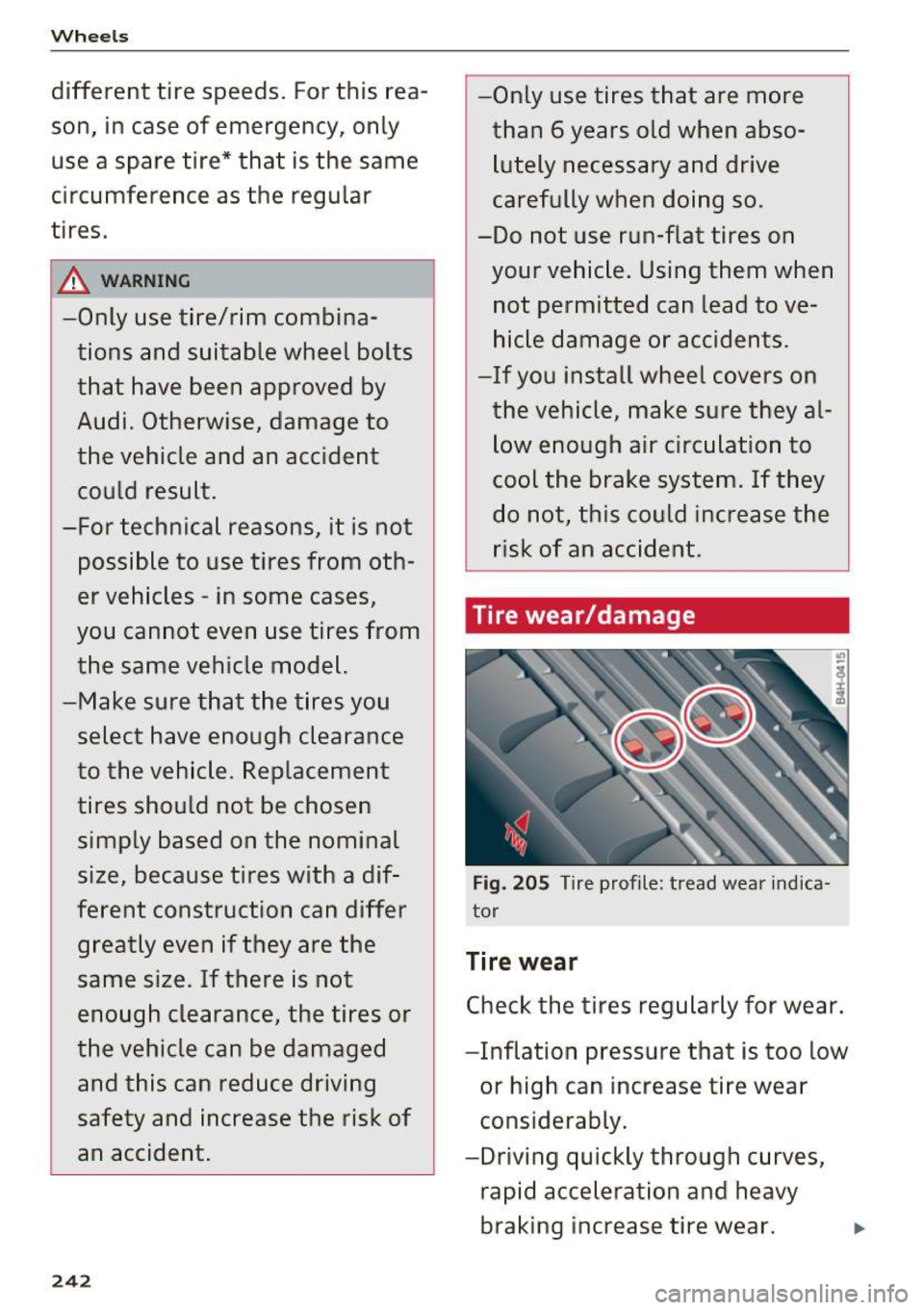
Fig. 205 Tire profile: tread wear ind ica
tor
Tire wear
Check the tires regularly for wear.
- Inflation pressure that is too Low
or high can increase tire wear
considerably.
-Driving quickly through curves, rapid acceleration and heavy
braking increase tire wear. ..
Page 245 of 300
Wheels
-Have an authorized Audi dealer wear evenly. To rotate wheels, in-
or authorized Audi Service Facili- stall the wheels from the rear
ty check the wheel alignment if axle on the front axle and vice
there is unusual wear. versa. This will allow the tires to
-Have the wheels rebalanced if an have approximately the same
imbalance is causing noticeable length of service life.
vibration in the steering wheel. For unidirectional tires, make
If you do not, the tires and other sure the tires are installed accord-
vehicle components could wear ing to the running direction indi-
more quickly. cated on the tire sidewall
Treadwear indicator ¢page 263.
Original equipment tires contain Hidden damage
treadwear indicators in the tread
Damage to tires and rims can of-
pattern, which are bars that are ten occur in locations that are
1/16 inch (1 .6 mm) high and are
hidden. Unusual vibrations in the
spaced evenly around the tire per- vehicle or pulling to one side
may
pendicular to the running di rec-indicate that there is tire damage.
tion ¢
fig. 205. The letters "TWI"
Reduce your speed immediately .
or triangles on the tire sidewall Check the tires for damage. If no
indicate the location of the tread- damage is visible from the out-
wear indicators. side, drive slowly and carefully to
The tires have reached the mini- the nearest authorized Audi deal-
mum tread depth
l) when they er or authorized Audi Service Fa-
have worn down to the treadwear cility to have the vehicle inspect-
indicators . Replace the tires with ed.
new ones¢ &.
& WARNING
-
Wheel rotation Tread that has worn too low or
Rotating the wheels regularly is different tread depths on the
recommended to ensure the tires tires can reduce driving safety
.
..
.... N a:i er ~ ... l) Obey any applicable regu lat ions in your '° "? .... country . '° ...
243
Page 247 of 300
A WARNING
Always adapt the tire pressure
to your driving style and vehicle load.
-Overloading can lead to loss of
vehicle control and increase the risk of an accident. Read
and follow the important safe
ty precautions in¢
page 246,
Tires and vehicle load limits.
-The tire must flex more if the
tire pressure is too low or if
the vehicle speed or load are
too high. This heats the tire up
too much. This increases the risk of an accident because it
can cause the tire to burst and result in loss of vehicle con
trol.
-Incorrect tire pressure in creases tire wear and has a
Tire pressure table
Please note that the information
contained in the following table
was correct at the time of print
ing, and the information is sub
ject to change. If there are differ
ences between this information
and the tire pressures specified
on the label on the driver's side B pillar, always follow the specifica-
Wheels
negative effect on driving and
braking behavior, which in
creases the risk of an accident.
Replace lost valve caps to re
duce the risk of damage to the
tire valves.
@ For the sake of the environment
Tire pressure that is too low in
creases fuel consumption.
(1) Tips
Audi recommends using the
tire pressure specified for a normal load ¢
table on
page 246
or for a full load
when the vehicle is partially
loaded.
tion on the B-pillar label
¢ page 244, fig. 206.
Make sure that the tire designa
tion on your tire matches the des ignation on the tire pressure label
and the tire pressure table.
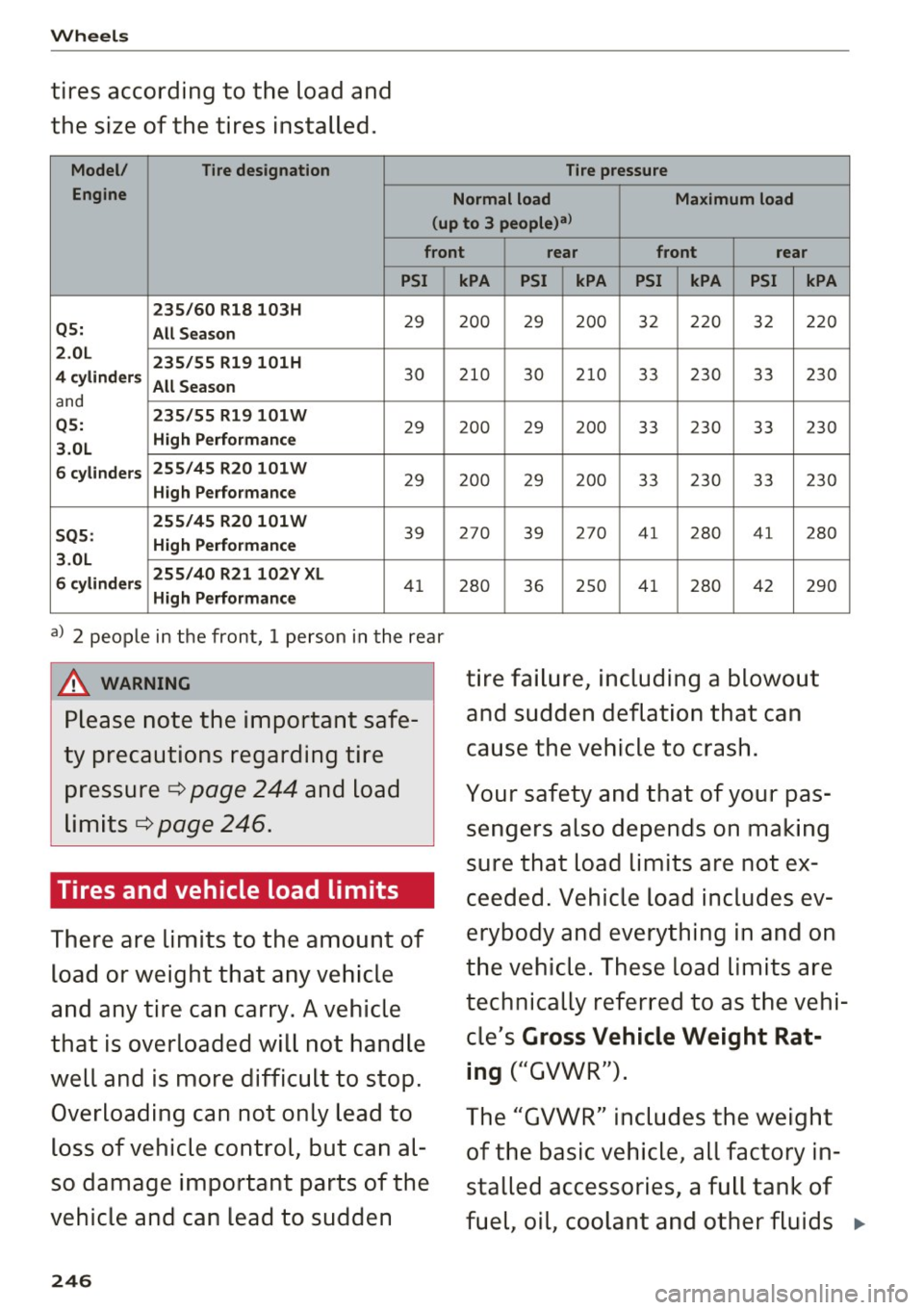
The following table lists recom mended tire pressures in cold
245
Page 248 of 300
Wheels
tires according to the load and
the size of the tires installed.
Model/ Tire designation
Engine Tire pressure
Normal load Maximum load
(up to 3 people)al
front rear front rear
PSI
235/60 Rl8 103H
29 Q5:
All Season
2 .0L
235/55 R19 101H
4 cylinders All Season
30
and
Q5: 235/55 R19101W 29 High Performance
3.0L
6 cylinders 255/45
R20 101W
29 High Performance
255/45 R20 101W
39 SQ5: High Performance
3.0L
6 cylinders 255/40
R21102Y XL
41 High Performance
a) 2 people in the front, 1 person in the rear
A WARNING
Please note the important safe
ty precautions regarding tire pressure ¢
page 244 and load
limits ¢
page 246.
Tires and vehicle load limits
There are limits to the amount of
load or weight that any vehicle
and any tire can carry. A vehicle
that is overloaded will not handle
well and is more difficult to stop.
Overloading can not only lead to
loss of vehicle control, but can al
so damage important parts of the
vehicle and can lead to sudden
246
kPA PSI kPA PSI kPA PSI kPA
200 29 200 32 220 32 220
210
30 210 33 230 33 230
2 00 29 2 00 33 2 30 33 230
200 29 200 33 230 33 230
27 0
39 27
0 41 2 80 41 2 80
280 36 250 4 1 280 42 290
tire failure, including a blowout
and sudden deflation that can
cause the vehicle to crash.
Your safety and that of your pas
sengers also depends on making
sure that load limits are not ex
ceeded. Vehicle load includes ev
erybody and everything in and on
the vehicle. These load limits are
technically referred to as the vehi
cle's
Gross Vehicle Weight Rat
ing
("GVWR").
The "GVWR" includes the weight
of the basic vehicle, all factory in
stalled accessories, a full tank of
fuel, oil, coolant and other fluids ..,.
Page 251 of 300
,....,
N
co
er::
co
,....,
disassemble them ¢.&. .
A WARNING
Wheel bolts that are tightened or repaired in
correctly can become loose and result in loss
of vehicle control, which increases the risk of
an acc ident. For the correct tightening specifi
cation, refer to ¢
page 260, After changing a
wheel .
- Always keep the wheel bolts and the
threads in the wheel hub clean and free of grease.
- Only use wheel bolts that fit the rim .
- Always have damaged r ims repa ired by an
authorized Audi dealer o r autho rized Aud i
Service Facility . Never repair or d isassemble
rims yourself, because this increases the risk
of an accident.
Winter tires
W inte r ti res s ignificantly improve the vehicle's
h andling when driving in win ter condit ions . Be
cause of the ir constr uction (width, compound,
tread pattern), summer tires provide less trac
tion on ice and snow .
"'U se winter t ires on all fo ur wheels .
.. Only use winter t ires that are approve d for your
v ehicl e.
"' Please note that the maximum permitted
speed may be lower with winter tires¢.&_ . An
authorized Aud i dealer or au thori zed Aud i Serv
ice Fac ility can inform you about the maximum
permitted speed fo r your tires .
"' Check the tire press ure after installing wheels
¢page 244.
The effectiveness of winter tires is reduced great
l y when the tread is worn down to a depth of
0 .1 57 inch (4 mm). The character ist ics of winter
tires a lso de crease great ly as the tire ages, re
ga rdless of the remain ing tread.
WARNING
- Never drive faster than the maxim um per
mitted speed for your t ires. This cou ld cause
the tires to heat up too much. Th is increases
Wh eel s
the risk of an accident because it can cause
the t ire to burst.
- Always adapt your driving to the road and
traffic cond itions . Drive carefully and reduce
your speed on icy or slippery roads . Even
winter t ires can lose tract io n on black ice.
@ For the sake of the environment
Reinsta ll summer tires at the app ropr iate
time, beca use they prov ide better handling
when roads are free of snow and ice. Summer
tires cause less road no ise, tire wear and fue l
consumpt io n.
(D Tips
You can also use all season tires instead of
winter tires. Please note that in some coun
tries where winter tires are required, on ly
winter tires w ith the
& symbo l may be per
mitted .
Snow chains
Snow chains improve traction in the snow.
"'On ly install snow chains on the rear wheels.
"' Check and correct the seating of the snow
chains if necessary after drivi ng a few feet. Fol
low the instructions from the manufacturer .
"' Note the maximum pe rmitted spe ed wh en dr iv
ing w it h snow cha ins. Do not excee d 30 mph
( SO km/h) .
S now c ha ins not o nly improve the
driving in win
te r road condit io ns, but also the
braking.
Use of snow chains is only permitted w ith certa in
r im/tire comb inat ions due to technical reasons .
Check with an author ized Audi dealer or author
ized Audi Service Facility to see if you may use
snow chains.
U se
fine-mesh snow chains . They must not add
more than 0 .53 inch (13 .5 mm) in heig ht, incl ud
ing the cha in lock.
You m ust remove the chai ns when driving on
r oads t hat are
free of snow . When roads are free
of snow, snow chai ns can impa ir han dling and .,.
249
Page 252 of 300
Wheels
damage the ti res, and the chains w ill quickly be
destroyed .
A WARNING
Using incorrect snow chains or insta lling snow
chains incorrectly can result in loss of vehicle
control, which increases the risk of an acc i
dent .
(D Note
Snow chains can damage the rims/wheel cov
ers * if the chains come into d irect contact
w ith them. Remove the wheel covers* first .
Use coated snow chains.
(D Tips
When using snow cha ins, it may be useful to
sw itch the off road mode on
<=> page 191.
Low aspect ratio tires
Your Aud i is factory -equipped with low aspect ra
tio tires. These t ires have been tho roughly tested
a nd been se lected specifically fo r yo ur model fo r
thei r supe rb per fo rman ce , road feel and handling
un der a va riety of d riving conditions . As k yo ur au
thor ized Audi dealer for mo re details .
T he low aspect ratio of these t ires is in dicated by
a nume ral of
55 or less in the tire's size desig na
tion . The numera l rep resents the rat io o f th e
tire's sidewall he ight in relat ion to its tread width
expressed in pe rcentage. Conventional tires have
a height/w idt h rat io o f 60 o r more .
The performance of low-aspect -ra tio tires i s par
ticularly sensitive to improper inflation pres
sure . It is therefore important that low aspect
ratio tires are inflated to the specified pressure
and that the inflation pressure is regularly
checked and maintained . Tire pressures should
be checked at least once a month and always
before a long trip <=>
page 244.
What you can do to avoid tire and rim
damage
Low aspect rat io tires can be damaged more easi
ly by impact with potholes, cu rbs, gullies or
250
ridges on the road, particularly if the tire is un
derinflated.
I n orde r to mi nimize the occur rence o f imp act
dam age to the tires o f yo ur vehicle, we recom
mend that you observe the following preca u
tions:
- Always m aintain reco mmende d in fla tion pres
sures. Check yo ur tir e pressure eve ry 2,0 00
m iles (3,00 0 km) and add air if necessary .
- Dr ive c arefully on ro ads w ith potholes, deep
gu llies o r ridges . The impact from dr iving
through or over such obstacles can damage
your tires. Impact with a curb may a lso ca use
damage to your t ires.
- After any impact, immediate ly inspect you r
tires or have them inspected by the nearest au
thorized Aud i dealer. Replace a damaged tire as
soon as possible.
- Inspect your tires every 2,000 m iles (3,000 km)
for damage and wear . Damage is not always
easy to see . Damage can lead to loss of a ir and
unde rinflation, w hich could event ua lly cause
tire fa ilure . If you believe that a tire may have
be en damaged, replace the tire as soon as pos
sible .
- These tires may wear mo re quickly than o thers .
- Please also remember that, while these tires delive r responsive hand ling, they may ride less
comfortab ly and make mo re noise than o ther
choi ces.
Reduced performance in winter/cold season
conditions
A ll tires are des igned for certain purposes. The
l ow aspect ratio, ultra h igh performance tires
o rigin ally ins talle d on your veh icle are inten ded
for m aximum dry and wet road per forma nce and
handling . They a re not suitable for co ld, snowy or
i cy weather conditions . If you drive under those
c ir cumstances, you should equip yo ur vehicle
with all-season o r winter tires, which offer better
tract ion under t hose conditions. We suggest you
u se the recommended s now or all-season tires
spec ified for your vehicle, o r the ir equiva lent .
Refer to<=>
page 249 for more detailed informa
tion regard ing winter tires.
Page 253 of 300
,....,
N
co
er::
co
,....,
- T read wear
- Traction AA A B C
- Temperature ABC
Qua lity grades can be found where applicable on
the tire side wall between tread shoulder and
maximum sect ion w idth
c:> page 234, fig. 204.
For example: Tread wear 200 , Traction AA, Tem
perature
A .
All passenge r ca r tires m ust conform to Federal
Safety Requirements in add ition to these grades .
Tread wear
The tread wear grade is a comparat ive rating
based on the wear rate of the t ire when tested
under cont ro lled conditions o n a specified gov
e rnment test course.
For example, a t ire graded
1 50 would wear one
and one ha lf
( 1 1/2) times as well on the gove rn
men t course as a tire g raded
100.
The relative performance of t ires depends upo n
the actual conditions of their use, howeve r, and
may depart significant ly from the norm due to
va ria tions in driving ha bits, serv ice practices and
d ifferences in road cha racteristics and climate .
Traction
The traction grades, from highest to lowest, are
AA, A, B and
C. T hose grades represent the t ire's
ab il ity to stop on wet pavement as meas ured un
de r contro lled condi tions on specified gove rn
ment tes t sur faces of asphalt and conc re te. A tire
mar ked C may have poor traction performance
c:> &. .
Temperature
The temperature grades are A (t he hi ghest), B ,
a nd C, represent ing the tire's resis tan ce to t he
generation o f heat and its ability to diss ipate
h eat when tested unde r contro lled conditions on
a specified indoor laboratory test whee l.
Sus ta ined hig h temper ature c an cause t he mate
r ial of the ti re to degenerate and red uce tire life,
and excessive temperatu re can lea d to sud den
tire fai lure
c:> &..
Wh eel s
The grade C cor responds to a level of perform
ance which all passenger car tires must meet un
der the Federal Motor Vehicle Safety Standa rd
No.
109 . Grades Band A represent higher levels
of pe rformance on the laboratory test wheel than
the minimum req uired by law .
A WARNING ,-
The tractio n grade assigned to this tire is
based on st raight-a head braking traction
t es ts, and does no t include acceler ation, co r
n eri ng, hy dropla ning or pe ak tra ction charac
terist ics.
A WARNING ,.,___
The tempera ture grade for this tire is estab
lished for a tire that is properly inflated and
not overloaded . Excessive speed, underinfla
tion, or excessive loading, either separate ly or
i n comb inat ion, can cause heat bu ildup and
possib le tire fai lure.
A WARNING
-
Temperature g rades apply to tires that are
p roperly inflated a nd not over o r under inflat
ed.
Tire pressure monitoring system
ill General notes
App lies to vehicles: wi th tire pressure mo nito rin g syste m
-
Each tire, including the spare (if provided),
should be checked monthly whe n cold and inflat
ed to the inflat io n pressure recommended by the
vehicle manufacturer on the veh icle placard or
t ir e infla tion p ressure la be l. (If your ve hicle has
t ir es of a different size than t he si ze ind ic a ted on
the vehi cle placar d or tire in flat ion press ure la
bel, you sho uld dete rmine the proper tire infla
t ion press ure for those tires) .
As an ad ded s afety feat ure, yo ur vehicle has been
equipped with a tire press ure mon itor ing system
( T PMS) t hat illuminates a low tire pressure tell
ta le when one or mo re of your tires is signif icant -
ly under-inf lated. According ly, when the low t ire
pressure telltale i llum inates, you shou ld stop and.,.
251
Page 255 of 300
,....,
N
co
er::
co
,....,
store the pressure again in the Infotainment sys
tem
¢ page 253.
mm (T ire Pressure Monitoring System) Tire
pressu re: S ys tem malfunction !. If m:m
appears
after switching the ignition on or whi le driving
and the
all indicator light in the instrument clus
ter blinks for approximate ly one minute and then
stays on, there is system malfunction. Try to
store the correct tire pressures¢
page 253. If
the ind icator light does not turn off or turns on
again after a short period of time, drive to an au
thor ized Audi dealer or authorized Audi Se rvice
F ac ility immediately to have the malfunction cor
rected .
& WARNING ,___ -
- If the tire pressure indicator appears in the
display, reduce your speed immed iate ly and
avoid any hard steering or braking maneu
vers. Stop as soon as possib le and check the
t ires and their pressure.
- The driver is responsib le for maintaining the
correct tire pressure. You must check the
t ire pressure regu larly.
- Under certa in conditions (such as a sporty
driv ing style, winter cond itions or unpaved
roads), the tire p ressure monitoring system
indicator may be delayed.
(D Tips
- The t ire pressure monitoring system can al
so stop work ing when there is an ESC mal
funct ion.
- Using snow chains may result in a system
malfunction.
- The Tire Pressure Mon itoring System in your
Audi was calibrated with "Audi Orig inal
Equ ipment tires"¢
page 241. We recom
mend that you use these tires .
Wheel s
Storing tire pressures
App lies to vehicles : wi th tire pressure monitor ing syste m
If the tire pressure changes or a tire is replaced,
it must be confirmed in the Infotainment sys
tem .
.,.. Make sure before storing t hat the t ire pressures
of all four tires meet the specified values and
are adapted to the load
¢ page 244.
.,.. Switch on the ign ition.
.,.. Select: the
I CAR ! funct io n key> Tire Press ure
Monitoring Sy stem > Store now .
Or
.,.. Sele ct: the
I CAR I funct ion but ton > Car S ys
tem s*
control b utton > Servicing & check s >
Tire pressure mon itoring > Sto re tire pre ssures
> Yes , store now .
(D Tips
Do not store the tire pressures if snow chains
are installed.
253
Page 256 of 300
Emerg ency assis ta nce
Emergency assistance
Vehicle jack, vehicle tool kit and collapsible spare
tire
Onboard tool kit and vehicle jack
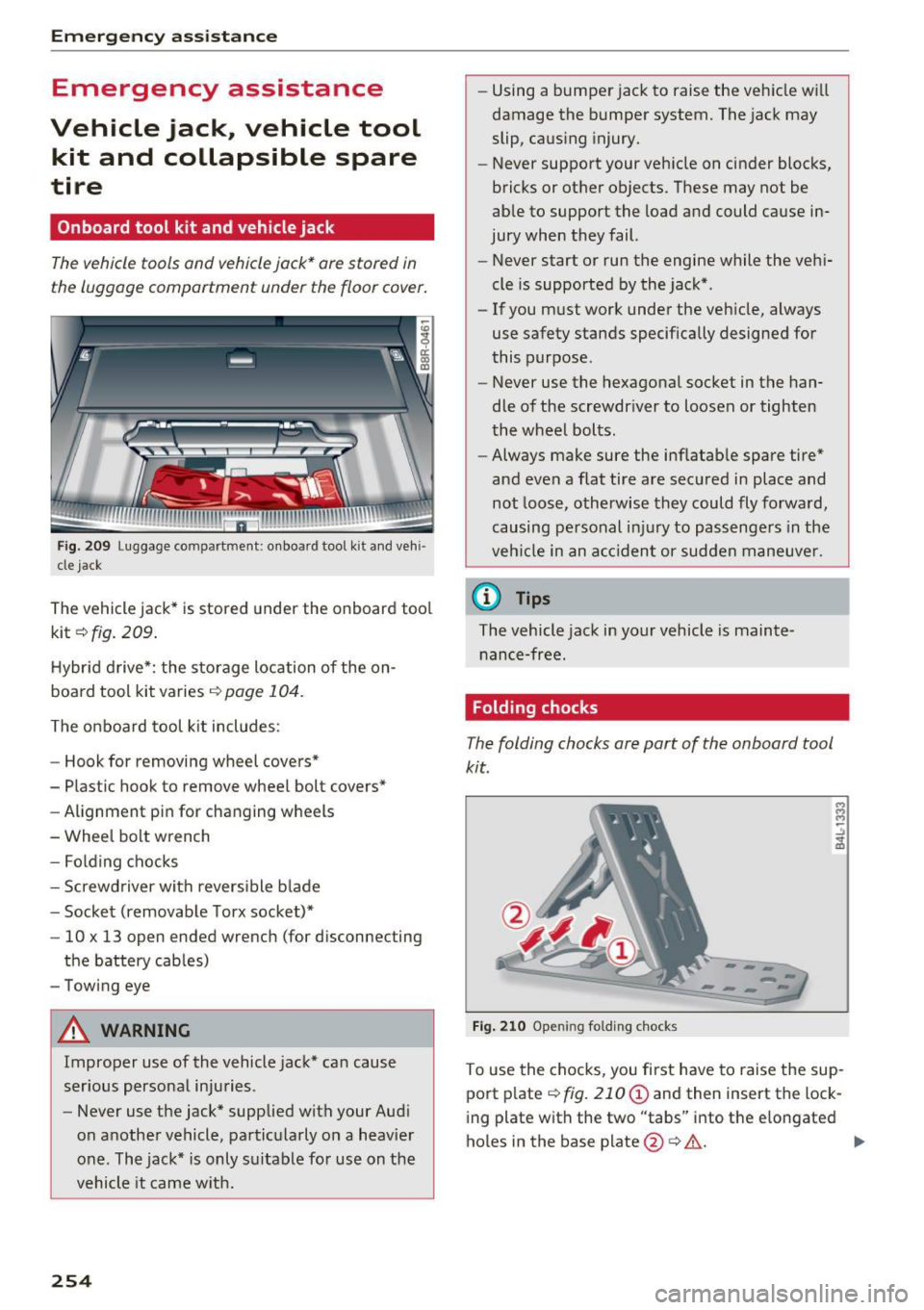
The vehicle tools and vehicle jock* ore stored in
the luggage comportment under the floor cover.
Fig. 209 Luggage compartment: on board tool kit and vehi
cle jack
The vehicle jack* is stored under the onboard tool
kit ¢ fig. 209.
Hybr id d rive*: the storage location of the on
board tool kit varies ¢ page 104.
The onboard tool k it includes:
- Hook for removing wheel covers*
- Plastic hook to
remove wheel bolt covers*
-Alignment pin for changing wheels
- Wheel bolt wrench
- Folding chocks
- Screwdriver with revers ible blade
- Socket (removable Torx socket)*
- 10 x 13 open ended wrench (for disconnecting
the battery cables)
- Towing eye
A WARNING
Improper use of the vehicle jack* can cause
ser ious personal injuries.
- Never use the jack* supplied with your Aud i
on another vehicle, particularly on a heavier
one. The jack* is only su itable for use on the
vehicle it came w ith.
254 -
Using a bumper jack to raise the vehicle will
damage the bumper system. The jack may
slip, caus ing injury.
- Never support your vehicle on cinder blocks,
bricks or other objects. These may not be
able to support the load and could cause in
jury when they fail.
- Never start or run the engine while the vehi
cle is supported by the jack* .
- If you must work under the vehicle, always
use safety stands specifically designed for
this purpose .
- Never use the hexagonal socket in the han
dle of the screwdr iver to loosen or tighten
the wheel bolts .
- Always make sure the inflatable spare tire*
and
even a flat tire are secu red in place and
not loose, otherwise they could fly forward,
causing personal inj ury to passenge rs in the
vehi cle in an a cc ident or sudden maneuve r.
@ Tips
The vehicle jack in your vehicle is mainte
nance-free.
Folding chocks
The folding chocks ore port of the on board tool
kit .
---
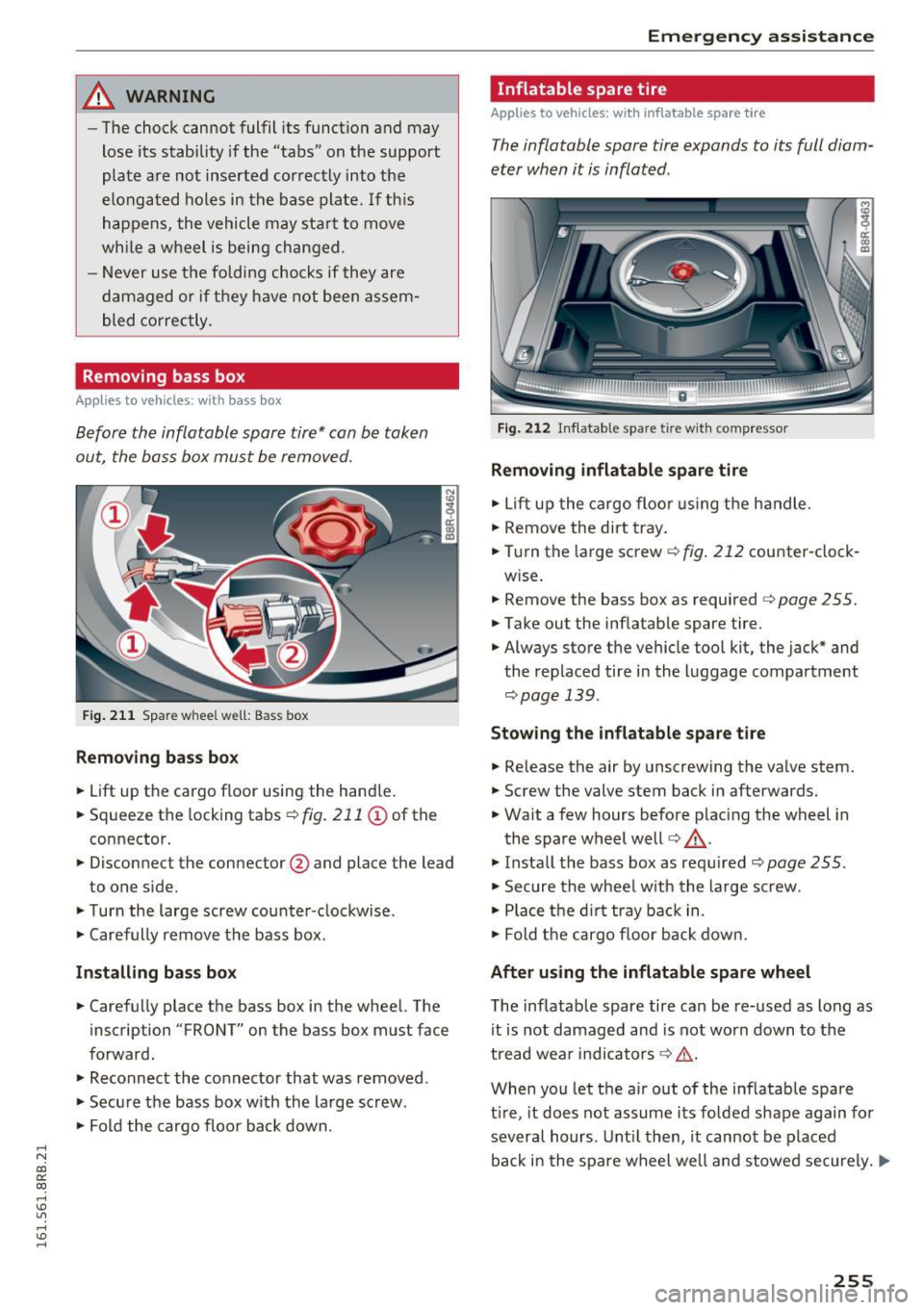
Fig . 210 Open ing fo lding chocks
To use the chocks, you fi rst have to raise the sup
port plate
¢ fig. 210 (D and then insert the lock
ing plate with the two "tabs" into the elongated
holes in the base plate
@ c> &.. .,,_
Page 257 of 300
..... N
co ~ CX)
..... I.Cl U"I
..... I.Cl .....
_& WARNING
-The chock cannot fulfil its function and may
lose its stability if the "tabs" on the support
plate a re not inserted correctly into the
elongated holes in the base plate. If th is
happens, the vehicle may sta rt to move
wh ile a wheel is being changed.
- Never use the fold ing chocks if they are
damaged or if they have not been assem
bled co rrectly.
Removing bass box
Appl ies to vehicles : wit h bass box
Before the inflatable spare tire* can be token
out, the bass box must be removed.
Fig . 21 1 Spare w heel well: Bass box
Removing ba ss box
"Lift up the cargo floor using the hand le .
" Squeeze the locking tabs
c:> fig . 211 (D of the
connector.
" Disconnect the connector @and place the lead
to one s ide.
"T urn the large screw counter -clockwise .
" Carefully remove t he bass box .
Installing bas s bo x
"Carefully place the bass box in the whee l. The
inscription "FRONT" on the bass box must face
forward.
" Reconnect the co nnector that was removed.
" Secu re the bass box w ith the la rge screw .
" Fold the cargo floo r bac k down.
Em ergen cy a ssis tanc e
Inflatable spare tire
Applies to vehicles: w ith inflatable spare tire
The inflatable spare tire expands to its full diam
eter when it is inflated .
Fig. 212 In flatable spare tire wit h comp ressor
Removing inflatabl e spare tire
"Lift up the cargo floo r us ing the handle.
" Remove the dirt tray .
" Turn the large screw <=:>
fig. 212 counter -clock-
w ise .
" Remove the bass box as required<=:>
page 255.
"Take out the inflatab le spare tire.
" Always store the vehicle too l kit, the jack* and
the replaced tire in the luggage compartment
<=:> page 139.
Stowing the inflatable spare t ire
.. Release the air by unscrewing the valve stem.
" Screw the valve stem back in afterwards.
" Wa it a few hours before plac ing the wheel in
the spare wheel well<=:>,& .
" Insta ll the bass box as required <=:>
page 255 .
" Secure the whee l w ith the la rge sc rew.
" Place t he d irt tray back in .
" Fold t he c argo floor back down .
After using the inflatable spare wheel
The inflatable spare tire can be re-used as long as
it is not damaged and is not worn down to the
tread wea r indicators
c:> .&, .
When you let the a ir out of the inf latab le spare
t ir e, it does not assume its folded shape again for
severa l hours . Unt il then, it cannot be placed
back i n the spare wheel well and stowed securely.
IJI>
255