battery AUDI Q5 2016 Owner's Manual
[x] Cancel search | Manufacturer: AUDI, Model Year: 2016, Model line: Q5, Model: AUDI Q5 2016Pages: 300, PDF Size: 75.02 MB
Page 107 of 300
.... N
co
er::
co
....
used for both charging and jump starting
¢ page 231 or¢ page 2 70.
Vehicle not ready to start. See owner's
manual
This message appears if the high voltage battery
charge level is too low. The vehicle can no longer
be started with its own power. The high voltage
battery must be charged with a charger or the ve
hicle must be jump started with the a id of anoth
er vehicle.
After the connecting the charger or jumper ca bles, the ignition must be turned off for approxi
mately two minutes and then turned on again.
After no more than one m inute, one of the fol
l owing indicator lights turns on in the instrument
cluster display .
B Charging battery. Please wait ...
If the indicator light turns on and this message
appears, the high voltage battery is charging or
the vehicle is be ing jump started with assistance
from another veh icle .
If the 12 volt batteries are dead, the -indi
cator light turns on . The charging procedure
takes longer in this case because the 12 volt bat
ter ies a re charged first. The procedure goes fast
er with the ignit ion switched off.
Vehicle ready to start.
This message appears if the charging procedure
was successful. The vehicle may be started again .
Battery could not be charged enough to start
vehicle.
This message appears if the charging procedure
was not successful or it was interrupted. This
may happen if the charger or the battery in the
veh icle that is assist ing is too weak. If the ve hicle
cannot be started, see an authorized repair facili
ty for ass istance.
(D Tips
- The charger should deliver a current of at
l east 30 A. Otherwise charging the high
voltage battery will take considerably Ion-
Hybrid
ger . A current between 50 A and 70 A is ide
al.
- The vehicle that is assisting should be some
what within the same vehicle class when
jump starting a vehicle. A smaller vehicle's
battery may be drained.
- After approximately 30 minutes, the charg
ing procedure ends because the ignition is
automatically turned off. If you wou ld like
to cont inue to charge the battery, turn the
ign ition on again .
Vehicle transport
App lies to vehicles: wit h hybrid drive
The following contains information you should
know about transporting your vehicle.
The lithium ion battery (SANYO 72 UF 121 285)
installed in your vehicle has passed test 38.3 in
accordance with UN handbook tests and criter ia.
The vehicle may be transported with the battery
installed as conventional class 9 hazardous mate
rials without addit ional officia l consent for a ir
and sea transportation (current law ICAO- TI and
IMDG-Code 01.01.2012).
105
Page 120 of 300
Audi side assist
(D Tips
-Si de assist is not active w hile you are mak
i ng t he a dju stment .
- You r settings are automatic ally store d an d
assi gned to t he remote co ntrol key being
u sed.
Driver messages
A ppl ies to ve hicles: w ith Audi side assis t
If side ass ist switches off by itself, the LED in the
button turns off a nd a message will appear in the
i n str ument cluster d isp lay :
Audi side assist unavailable: Sensors blocked
The rada r senso rs ' vision is affected. Do not cove r
the area in front of the sensors with b ike wheels,
stickers , dirt or other objects. Clean the area in
front of the sensors, if necessary
c> page 116 ,
fig. 130.
Audi side assist: Currently unavailable
Side assist cannot be switched on tempo rar ily be
cause there is a malfunction (for example, the
battery charge level may be t oo low).
Audi side assist: System fault!
The system cannot guarantee that it wi ll detect
ve hicl es co rrectly and it is switc hed off. The sen
sors have been d isp laced or are fa ulty. Have the
system checked by an a uthorized Audi dealer or
author ized Audi Se rvice Facility soon.
Audi side assist: Unavailable when towing
Side assist sw itches off automati ca lly w hen a fac
to ry -installed trailer hitch is connected to t he
electrical connector on the trailer. The re is no
gua rantee the system w ill sw itch off whe n using
a retrofitted tra ile r hitc h. Do not use side assist
when towing a trailer.
118
Page 129 of 300
..... N
co ~ CX)
..... I.Cl U"I
..... I.Cl ..... The transmission temperature has increased sig
nificantly due to the sporty driving manner. Drive
in a less sporty manner until the temperature re
turns to the normal range and the indicator light
switches of .
rm Transmission malfunction: You can continue
driving
There is a system malfunct ion in the transmis
sion. You may continue driving. Drive to your au
thorized Audi dealer or qualified repair facility
soon to have the malfunction corrected.
rm Transmission malfunction: Limited driving
functionality
There is a system malfunction in the transmis
sion . T he transmission is sw itching to emergency
mode. This mode only shifts into certain gears or
will no longer shift at all. The engine may stall.
Drive to your authorized Audi dea ler or qualified
repair facility immediately to have the malfunc
tion corrected .
rm Transmission malfunction: Stop vehicle and
shift to park.
Do not continue driving. Select the P selector lev
e r position and see your a uthorized Aud i dea ler
or qualified repair facility for assistance .
(D Note
If the transmission switches to emergency
mode, you sho uld take the vehicl e to an au
thorized Audi dealership as soon as possible
to have the condition corrected.
Automatic transmission
Selector lever emergency release
If the vehicle 's power supply fails, the selector
lever can be released in an emergency .
Fig. 139 Front center conso le: Removing the ashtray insert
Fig. 140 Selector lever emergency release
.,. To access the emergency re lease mechanism,
remove the ashtray insert@ using the release
switch @Qfig.139.
.,. Loosen and remove the cap in the ashtray
mount
Q fig. 140.
.,. You now have access to a pin . Using a screw
driver or sim ilar object, press the pin down and
hold it in that position .
.,. Now press the release button and move these-
lector lever to the N position.
The selector lever can only be moved from the P
pos ition if the key is in the lock and the ignition is
switched on. If the power supply fails (for exam
ple, the battery is discharged) and the vehicle
must be pushed or towed, move the selector lev
er to the N position f irst using the emergency re
lease .
127
Page 166 of 300
Airbag system
(D Tips
If the weight-sensing mat in the front passen
ger seat detects an empty seat, the front air
bag on the passenger side will be turned off,
and
PASSENGER AIR BAG OFF will stay on.
Repair , care and disposal of the airbags
Parts of the airbag system are installed at many
different places on your Audi. Installing , remov
ing, servicing or repairing a part in an area of the
vehicle can damage a part of an airbag system and prevent that system from working properly in a collision.
There are some important things you have to
know to make sure that the effectiveness of the
system will not be impaired and that discarded
components do not cause injury or pollute the
environment.
A WARNING
Improper care, servicing and repair proce
dures can increase the risk of personal injury
and death by preventing an airbag from de
ploying when needed or deploying an airbag
unexpectedly:
-
- Never cover, obstruct, or change the steer
ing wheel horn pad or airbag cover or the in
strument panel or modify them in any way .
- Never attach any objects such as cupholders
or telephone mountings to the surfaces cov
ering the airbag units.
- For cleaning the horn pad or instrument panel, use only a soft, dry cloth or one mois
tened with plain water. Solvents or cleaners could damage the airbag cover or change
the stiffness or strength of the material so
that the airbag cannot deploy and protect properly.
- Never repair, adjust , or change any parts of
the airbag system.
- All work on the steering wheel, instrument
panel, front seats or electrical system (in
cluding the installation of audio equipment,
cellular telephones and CB radios, etc.)
must be performed by a qualified technician
164
who has the training and special equipment necessary.
- For any work on the airbag system, we
strongly recommend that you see your au
thorized Audi dealer or qualified workshop .
- Never modify the front bumper or parts of
the vehicle body.
- Always make sure that the side airbag can
inflate without interference:
- Never install seat covers or replacement
upholstery over the front seatbacks that
have not been specifically approved by
Audi .
- Never use additional seat cushions that
cover the areas where the side airbags in
flate.
- Damage to the original seat covers or to
the seam in the area of the side airbag
module must always be repaired immedi
ately by an authorized Audi dealer .
- The airbag system can be activated only
once . After an airbag has inflated, it must
be replaced by an authorized Audi dealer or
qualified technician who has the technical
information, training and special equipment
necessary.
- The airbag system can be deployed only
once . After an airbag has been deployed, it
must be replaced with new replacement
parts designed and approved especially for
your Audi model version. Replacement of complete airbag systems or airbag compo
nents must be performed by qualified work
shops only. Make sure that any airbag serv
ice action is entered in your Audi Warranty
& Maintenance booklet under AIRBAG RE
PLACEMENT RECORD.
- In accidents when an airbag is deployed, the
vehicle battery separates the alternator and
the starter from the vehicle electrical sys
tem for safety reasons with a pyrotechnic
circuit interrupter.
- Work on the pyrotechnic circuit interrupt
er must only be performed by a qualified
dealer - risk of an accident!
- If the vehicle or the circuit interrupter is
scrapped, all applicable safety precautions
must be followed.
llll-
Page 197 of 300
,....,
N
co
er::
co
,....,
variab ly to the front and rear axle.
It works to
gether with selective wheel torque control, which
ac tivates when driving through curves
¢page 190.
The all-wheel drive concept is designed for high
engine power. Your ve hicle is exceptionally pow
erful and has excellent driving characterist ics
both under norma l dr iving condit ions and on
snow and ice. Always read and follow safety pre
cautions ¢.&. .
Winter tires
When driving in the w inter, your vehicle with a ll
wheel drive has an advantage, even with regular
tires. In winter road conditions it may be adv isa
b le to mount w inter t ires (or all-season tires) for
i mproved driveab ility and brak ing : these tires
must be mounted on
all four wheel s. See a lso
¢ page 249, Winter tires.
Tire chains
Where tire chains are manda tory on certain
roads, this normally also applies to vehicles w ith
a ll-wheel drive¢ page 249 , Snow chains.
Replacing wheel s/tires
Veh icles with all -whee l dr ive must always have
tires of the same s ize. A lso avo id tires with differ
ent tread depths . For detai ls see page
¢ page 241, New tires or wheels.
A WARNING
Always adjust you r driving to road and t raff ic
conditions. Do not let the extra safety affo rd
ed by all-wheel drive te mpt you into tak ing
extra risks.
- Alt hough the all-whee l dr ive is very effec
t ive, always remember th at br akin g ca pac ity
is limited by tire traction. Yo u should t here
fore not d rive at excess ive speeds on icy or
slippery road surfaces.
- On wet road surfaces, be caref ul not to drive
too fast because the front wheels co uld be
gin to slide on top of the water (a quaplan
ing). If this shou ld occu r, you w ill have no
warning from a sudden increase in eng ine
speed as with a front -whee l dr ive vehicle.
Intellig ent Technology
Always d rive at speeds which are suited to
the road conditions -risk of c rash.
Energy management
Starting ability is optimized
E nergy management controls the distribution of
electrical energy and thus optimizes the availa
bility of electrical energy for starting the engine .
If a vehicle with a conventional energy system is
not dr iven fo r a long pe riod of time, the ba ttery is
discharged by id ling curre nt cons umers (e.g. im
mobili ze r). In ce rtain circumstances i t can resu lt
i n t he re being insuffi cient energy av ailabl e to
st ar t the eng ine.
Intellige nt ene rgy manageme nt in yo ur vehicle
hand les the d ist ribution of electrical e nergy.
St art ing abil ity is m arkedly improved and the life
of the ba ttery is ex tende d.
Bas ica lly, energy management co nsists of
bat
tery diagnosis , idling current management
and
dynami c energy management .
Battery diagnosis
Battery d iagnosis continuously determ ines the
state of the battery . Sensors de termine battery
vo ltage, battery curren t and batte ry tempera
tu re . This determines t he cur rent state of c harge
and the power of t he ba ttery.
Idling current management
Idli ng cur rent management reduces energy con
s u mption wh ile the vehicle is standing . With the
ignition switched off , it contro ls the energy sup
ply to the vario us elec trical componen ts. Data
fr om b attery diagnosis is co nsidere d.
Depend ing on the ba tte ry's s ta te of charge, indi
v idual consumers are gradually turned off to pre
ven t ex cess ive disc ha rge of t he battery and thus
m ain ta in starting c ap abili ty.
Dynamic energy management
While the vehicle is being driven, dynam ic e nergy
manageme nt dis trib utes the energy generated
according to the needs of the ind ividual compo-
nents.
It regula tes consu mption, so that more ..,.
195
Page 198 of 300
Intelligent Technology
electrical energy is not being used than is being
generated and ensures an optimal state of
charge for the battery.
(D Tips
- But even energy management cannot neg ate the limits of physics . Consider that the
power and life of a battery are limited.
- If starting ability is threatened, the indica
tor light (•) appears
r=:; page 33.
What you should know
The highest priority is given to maintaining start
ing capability.
The battery is severely taxed in short-distance
driving, in city traffic and during the cold time of
year. Abundant electrical energy is required, but only a little is generated. It is also critical if the
engine is not running and electrical components
are turned on. In this instance energy is being
consumed but none is being generated.
It is in precisely these situations that you will no
tice energy management actively regulating the
distribution of energy .
Vehicle stands for an extended period
If you do not drive your vehicle over a period of
several days or weeks, electrical components are
gradually cut back or switched off. This reduces
energy consumption and maintains starting ca pability over a longer period. Some of the con
venience functions may not operate, such as the interior lights or the power seat adjustment . The
convenience functions will be available again
when you switch on the ignition and start the en
gine.
With the engine turned off
If you listen to the radio, for example, with the
engine turned off or use other MMI" functions,
the battery is being discharged .
If starting capability is jeopardized due to energy
consumption, a message appears in the radio or MMI* display . The message indicates that the
system will be switched off automat ical ly in a
196
moment. If you wish to continue using the func
tions, you have to start the engine .
With the engine running
Although electrical energy is generated when the
vehicle is being driven, the battery can become
discharged. This happens mostly when little en
ergy is being generated and a great deal con
sumed and the battery's state of charge is not
optimal.
To bring the energy balance back into equilibri
um, consumers which require especially large
amounts of energy are temporarily cut back or
switched off. Heating systems in particular re
quire a great deal of energy. If you notice, for ex
ample, that the heated seats* or the heated rear
window are not heating, they have been tempo
rarily cut back or switched off . These systems will
be available again as soon as the energy balance
has been restored.
You will also notice that engine idle speed has
been increased slightly . This is normal and not a
cause for concern. By increasing engine idle
speed the additional energy required is generat
ed and the battery is charged.
Page 213 of 300
,....,
N
co
er::
co
,....,
one direction and not back and forth.
- Never remove snow or ice from door win
dows and mirrors using warm or hot water
because this could cause cracks to form.
- To avoid damage to the rear window de
fogger, do not apply any stickers on the
heating wires on the inside of the window.
- Decorative parts/trim
- Never use chrome care or cleaning prod-
ucts.
-Paint
- To reduce the risk of scratches, the vehicle
must be free of dirt and dust before pol
ishing or waxing.
- To prevent paint damage, do not polish or
wax the vehicle in direct sunlight.
- To reduce the risk of paint damage, do not
polish away rust spots.
- Remove cosmetics and sunscreen immedi
ately- these could damage the paint.
-Displays
-To avoid scratches, do not use dry cleaning
methods on displays.
-Controls
- Make sure that no fluids enter the con-
trols, because this could cause damage.
- Safety belts
- Do not remove the safety belts to clean
them.
- Never clean safety belts or their compo
nents chemically or with corrosive fluids
or solvents and never allow sharp objects
to come into contact with the safety belts.
This could cause damage to the belt web
bing.
- If there is damage to the webbing, the
connections, the retractors or the buckles,
have them replaced by an authorized Audi
dealer or authorized Audi Service Facility.
- Textiles/artificial leather/ Alcantara
- Never treat artificial leather/ Alcantara
with leather care products, solvents, floor
polish, shoe polish, spot remove or similar
products.
- Have a specialist remove stubborn stains
to prevent damage.
Care and cleaning
-Never use steam cleaners, brushes, hard
sponges, etc. when cleaning.
- Do not turn on the seat heating* to dry the
seat.
- Objects with sharp edges such as zippers,
rivets on clothing or belts can cause dam
age to the surface.
- Open hook and loop fasteners, for exam
ple on clothing, can damage seat covers.
Make sure hook and loop fasteners are
closed.
- Natural leather
- Never treat leather with solvents, floor
polish, shoe polish, spot remover or simi
lar products.
- Objects with sharp edges such as zippers, rivets on clothing or belts can cause dam
age to the surface.
- Never use steam cleaners, brushes, hard
sponges, etc. when cleaning.
- Do not turn on the seat heating* to dry the
seat.
- To help prevent the leather from fading,
do not leave the vehicle in direct sunlight
for long periods of time. If leaving the ve
hicle parked for long periods of time, you
should cover the leather to protect it from
direct sunlight.
(D Tips
-Insects are easier to remove from paint that
has been freshly waxed.
- Regular waxing can prevent rust spots from
forming.
Placing your vehicle out
of service
If you would like to take your vehicle out of serv
ice for a longer time, contact your authorized
Audi dealer or authorized Audi Service Facility.
They will advise you of important measures, such
as corros ion protection, maintenance and stor
age procedures . Also follow the information
about the battery ¢
page 229.
211
Page 223 of 300
,....,
N
co
er::
co
,....,
ponents will burn skin on contact .
- To reduce the risk of being burned, never
open the hood if you see or hear steam or
coolant escaping from the engine compart
ment. Wait until no steam or coolant can be
seen or heard before carefully opening the
hood.
- Keep children away from the engine com
partment .
- Never spill fluids on hot engine compo
nents. They can cause a fire .
- Never touch the radiator fan. The auxiliary
electric fan is temperature controlled and
can switch on suddenly.
- Never open the coolant reservoir cap when
the engine is still warm. The coolant system
is pressurized and hot coolant could spray
out .
- Protect your face, hands and arm from
steam or hot engine coolant by placing a
thick rag over the cap when you open the
coolant reservoir .
- Do not remove the engine cover under any
circumstances. This increases the risk of
burns.
- If work on the fuel system or the electrical
system is necessary:
- Always disconnect the battery.
- Never smoke or work near heaters or open
flames. Fluids in the engine compartment
could start a fire.
- Keep an approved fire extinguisher imme
diately available.
- To avoid electrical shock and personal injury
while the engine is running or being started, never touch:
- Ignition cables
- Other components of the high voltage
electronic ignition system .
- If you must perform a check or repair with
the engine running:
- First, fully apply the parking brake, move
selector lever of automatic transmission
to P (Park).
Checking and Filling
-Always use extreme caution to prevent
clothing, jewelry, or long hair from get
ting caught in the radiator fan, V-belts or
other moving parts, or from contacting hot parts. Tie back hair before starting,
and do not wear clothing that will hang or
droop into the engine.
- Minimize exposure to emission and chemi
cal hazards
~ .&, .
A WARNING
California Proposition 65 Warning:
- Engine exhaust , some of its constituents,
and certain vehicle components contain or
emit chemicals known to the State of Cali
fornia to cause cancer and birth defects and
reproductive harm. In addition, certain flu
ids contained in vehicles and certain prod
ucts of component wear contain or emit
chemicals known to the State of California
to cause cancer and birth defects or other
reproductive harm.
- Battery posts, terminals and related acces
sories contain lead and lead compounds,
chemicals known to the State of California
to cause cancer and reproductive harms .
Wash hands after handling .
(I) Note
When adding fluids, always make sure that
they are poured into the proper container or
filler opening, otherwise serious damage to
vehicle systems will occur.
@) For the sake of the environment
To detect leaks in time, inspect the vehicle
floor pan from underneath regularly . If you
see spots from oil or other vehicle fluids, have
your vehicle inspected by an authorized Audi dealer.
221
Page 231 of 300
,....,
N
co
er::
co
,....,
partition of the engine compartment on the left
side ¢
page 222.
The fl uid level may drop slightly after some time
due to the automatic adjustment of the brake
pads . This is not cause for alarm.
I f the b rake fl uid level fa lls
considerably be low
the "MIN" mark, the brake wa rning/ind icator
light (U .S. mode ls:
1111 , Canadian models:.)
will come on¢
page 18 and ¢ page 28 . Do not
continue to operate the vehicle. The complete brake system should be thoroughly checked by an
author ized Audi dealer or qualified workshop and
the cause corrected . If the brake fluid level is too
low, the brake warning/ind icator light will illumi
nate. Contact an authorized Audi dealer
immedi
a te ly.
Changing brake fluid
Have the brake fluid changed by an experienced technician.
Brake fluid absorbs mo isture from the air. If the
water conte nt in the brake fluid is too h igh, cor
ros ion in the brake system may resu lt after ape
riod of time. The boiling poi nt of the brake flu id
will also dec rease cons iderably and decrease
braking pe rformance.
Therefore, the b rake fluid must be changed
e ve ry
two year s.
Always use new b rake fluid wh ich con
forms to Fede ral Motor Veh icle St andard "FMVSS
116 DOT 4".
The brake fluid reservoir can be diff icult to reach,
therefore, we re commend that yo u have the
b rake fl uid changed by yo ur autho rized
Audi
deal er.
Your dealer has the cor rect too ls, the
right brake fluid and the know -how to do this for
you.
A WARNING
- Brake fluid is poisonous. It must be stored
only in the closed original container out of
the reach of chi ldren!
- B rake failure can resu lt from old or inappro
pr iate brake flu id. Observe these precau
t io ns:
Ch eck ing and Filling
-Use only brake fluid that meets SAE speci
ficat ion
J 1703 and conforms to Federal
Motor Vehicle Standard 116. Always check
with your authorized Aud i dealer to make
sure you are us ing the correct brake fluid .
The co rrect type of brake flu id is also i ndi
cated on the b rake fluid reservoir.
- The brake flu id must be new. Heavy use of
the b rakes can cause a vapo r lock if the
bra ke fluid is left in the system too long.
T his can se riously affe ct the efficiency of
t h e b rakes as we ll as you r safety . This
could resu lt in an accident.
(D Note
B rake flu id will damage the paint of your ve h i
cle.
@) For the sake of the environment
Because of the p roblem of proper d isposa l of
brake fluid as well as the spec ial too ls re
q uire d and the necessary expertise, we rec
ommend that yo u have the bra ke fluid
c hanged by yo ur authorize d Au di dealer.
Battery
General information
Under normal ope rat ing condit ions, the batte ry
in you r A udi does not need any mainte nance.
Wi th
high o utside temperatures or long daily
drives we recommend that yo u have the elec tro
lyte level checked by an authorized A udi dealer or
qualified workshop . The electro lyte level should
also be checked each time the battery is charged
~ page 231.
Have the batte ry checked when you take your ve
hicle in for service. You are we ll advised to re
place a battery that is older than S years.
Wi th certain types of airbag deployment, the
battery is d isconnected from the veh icle electri
ca l system for safety reasons¢.&.
in Repair, care
and disposal of the airbags on page 164.
Hyb rid dr ive *: yo u can find impo rtant informat ion
about the high voltage battery under ¢
page 97. .,.
229
Page 232 of 300
Checking and Filling
Disconnecting the battery terminals
Some vehicle functions (power window regula
tors, for example) are lost if the battery termi
na ls are disconnected. These functions have to be
relearned after the battery terminals are con
nected again. To prevent this, the battery should
only be disconnected from the vehicle e lectrical
system when absolutely necessary for repairs.
Vehicles not driven for long periods
If you do not drive your vehicle over a period of
several days or weeks, electrical components are
gradually cut back or sw itched off. This reduces
energy consumption and ma intains starting ca
pab ility over a longer period
c::> page 195 .
Take into consideration that when you unlock
your veh icle, some convenience functions, such
as the interior lights or the power seat adjust
ment, may not be available. The convenience
functions will be available again when you turn
on the ignition and start the engine.
Winter operation
During the winter months, battery capacity tends
to decrease as temperatures drop. This is be
cause more power is also consumed while start
ing, and the head lights, rear window defogger,
etc., are used more often.
Avoid unnecessary power consumption, particu
larly in city traffic or when traveling only short
d istances . Let your authorized Audi dealer check
the capacity of the vehicle battery befo re winter
sets inc::>
page 231. A well cha rged battery w ill
not only preven t starting problems when the
weather is cold, but will also last longer.
Working on the battery
Be especially careful when working on or near
the battery.
The batte ry is located in the luggage compart
ment under the floor. Before you check anything
in the luggage compartment,
read and heed all
WARNINGS
c::> & .
Hybr id drive*: you can find important information
about the high volta ge battery unde r
c::> page 97.
230
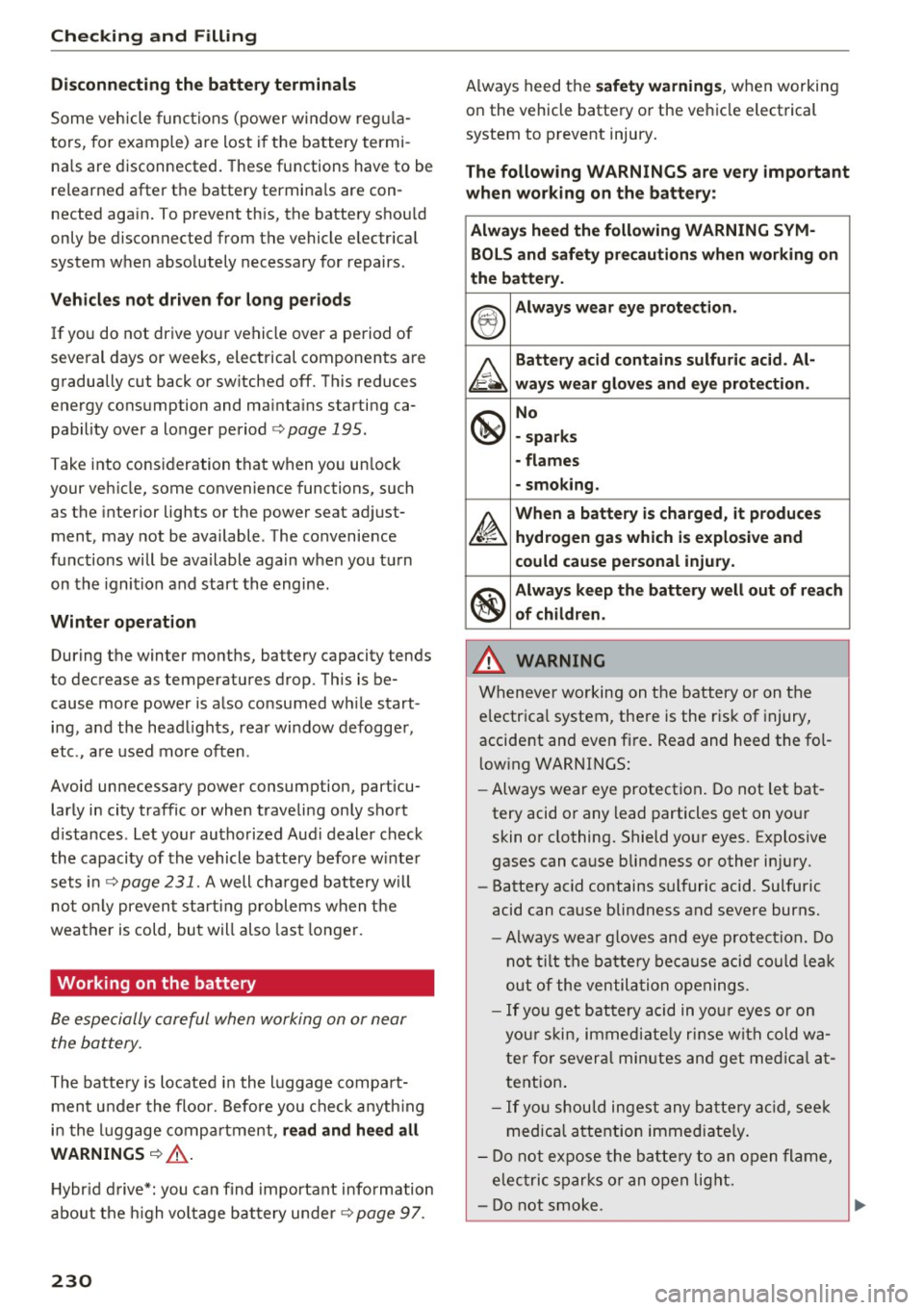
Always heed the safety warnings , when working
on the vehicle battery or the vehicle electrical system to prevent injury.
The following WARNINGS are very important
when working on the battery :
Always heed the following WARNING SYM· BOLS and safety precautions when working on
the battery .
®
Always wear eye protection .
A
Battery acid contains sulfuric acid. Al-
ways wear gloves and eye protection .
@
No
• sparks
• flames
- smoking.
~
When a battery is charged, it produces
hydrogen gas which is explosive and
could cause personal injury.
®
Always keep the battery well out of reach
of children .
.b WARNING
-
Whenever working on the battery or on the
e lectrica l system, there is the risk of injury,
accident and even fire. Read and heed the fol
lowing WARNINGS:
- Always wear eye protection . Do not let bat
tery acid or any lead particles get on your
skin or clothing. Shield your eyes. Explosive
gases can cause blindness or other injury.
- Battery acid contains sulfuric acid. Sulfuric
acid can cause blindness and severe burns.
-A lways wear glo ves and eye protection. Do
not tilt the battery because acid could leak
out of the ventilation openings.
- If you get battery acid in yo ur eyes or on
you r skin, immediate ly rinse with cold wa
ter for several minutes and get medical at
tention .
- If you should ingest any battery acid , seek
medical attention immediate ly.
- Do not expose the battery to an open flame,
elec tric sparks or an open light.
- Do not smoke.
~