instrument cluster AUDI Q5 2016 Owner's Guide
[x] Cancel search | Manufacturer: AUDI, Model Year: 2016, Model line: Q5, Model: AUDI Q5 2016Pages: 300, PDF Size: 75.02 MB
Page 124 of 300
Automatic transmissio n
Automatic transmission
tiptronic
Introduction
The automat ic transmission is controlled e lec
tron ically . The transmission upshifts or down
shifts automatically depending on wh ich dr ive
p rogram is selected. The powe r is transferred by
a torque converter .
When a
moderate driving style is used, the
transmission se lects the most economical d riving
mode .
It will then change up early and de lay the
downshifts to give better fuel economy .
The transm ission switches to a spo rty mode afte r
a kick-down or when the drive r uses a
sport y
d riv ing sty le
charac ter ized by quick accelerator
pedal movements, heavy acce leration, frequent
changes in speed and traveling at the maximum
speed.
If desired, the dr iver can a lso select the gears
manually ( tiptronic mod e) ¢ page 126.
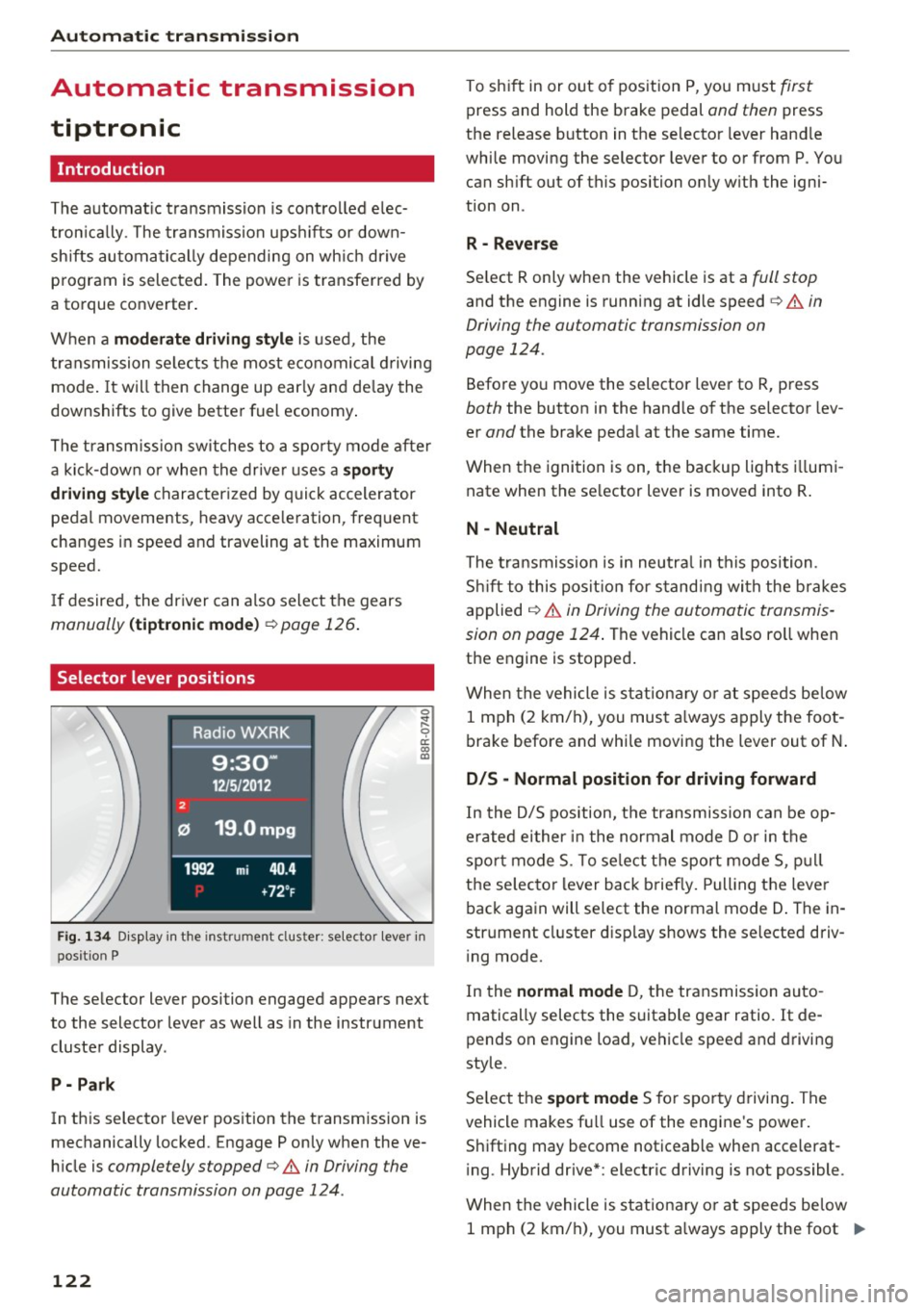
Selector lever positions
0 ;:t 0 ct CX) a,
Fig. 1 34 Disp lay in the instrument cl uster: selector lever in
position P
The selector lever position engaged appears next
to the selector lever as well as in the instrument
cluster display .
P -Pa rk
In this selector lever position the transmission is
mechanically locked. Engage P only when the ve
h icle is
completely stopped¢.& in Driving the
automatic transmission on page 124 .
122
To shift in or out of pos ition P, you m ust first
press and hold the brake pedal and then press
the release button in the selector lever hand le
while moving the selector lever to or from P. You can sh ift out of this position on ly w ith the igni
tion on .
R -Reve rse
Se lect R only when the vehicle is at a full stop
and the engine is running at idle speed c> .& in
Driving the automatic transmission on
page 124.
Befo re yo u move the selector lever to R, press
both the button in the hand le of the se lector lev
er
and the brake peda l at the same time.
When the ignition is on, the backup lights i llumi
nate when the se lector lever is moved into R .
N -Neutral
The t ra nsmission is in neutra l in this position .
S hi ft to this pos it ion for s tand ing wi th the brakes
applied
¢ .&. in Driving the automatic transmis
sion on page 124 .
The vehicle can also ro ll when
the engine is stopped .
When the vehicle is stationa ry o r at speeds be low
1 mph (2 km/h), you must a lways apply the foot
brake before and whi le moving the lever out of N .
D/S -Normal position for driving forward
In the D/5 position, the transmission can be op
erated either in the normal mode Dor in the
spo rt mode 5. To se lect the sport mode 5, p ull
t h e se lecto r lever back briefly. Pulling the leve r
back again will select the normal mode D . The in
strument cluster d isplay shows the se lected driv
i ng mode.
In the
normal mode D, t he transmission auto
matically selects the suitable gear ratio . It de
pends on engine load, vehicle speed and d riving
style.
Se lect t he
sport mode 5 for sporty drivi ng . The
vehicle makes fu ll use of the engine 's power.
Shifting may become noticeable when accelerat
i ng . Hybrid drive* : electric driving is not possible .
When the vehicle is stationary o r at speeds be low
1 mph (2 km/h), you must a lways apply the foot ..,.
Page 128 of 300
Automatic transmission
Manual shift program
Using the manual shift program you can man
ually select gears .
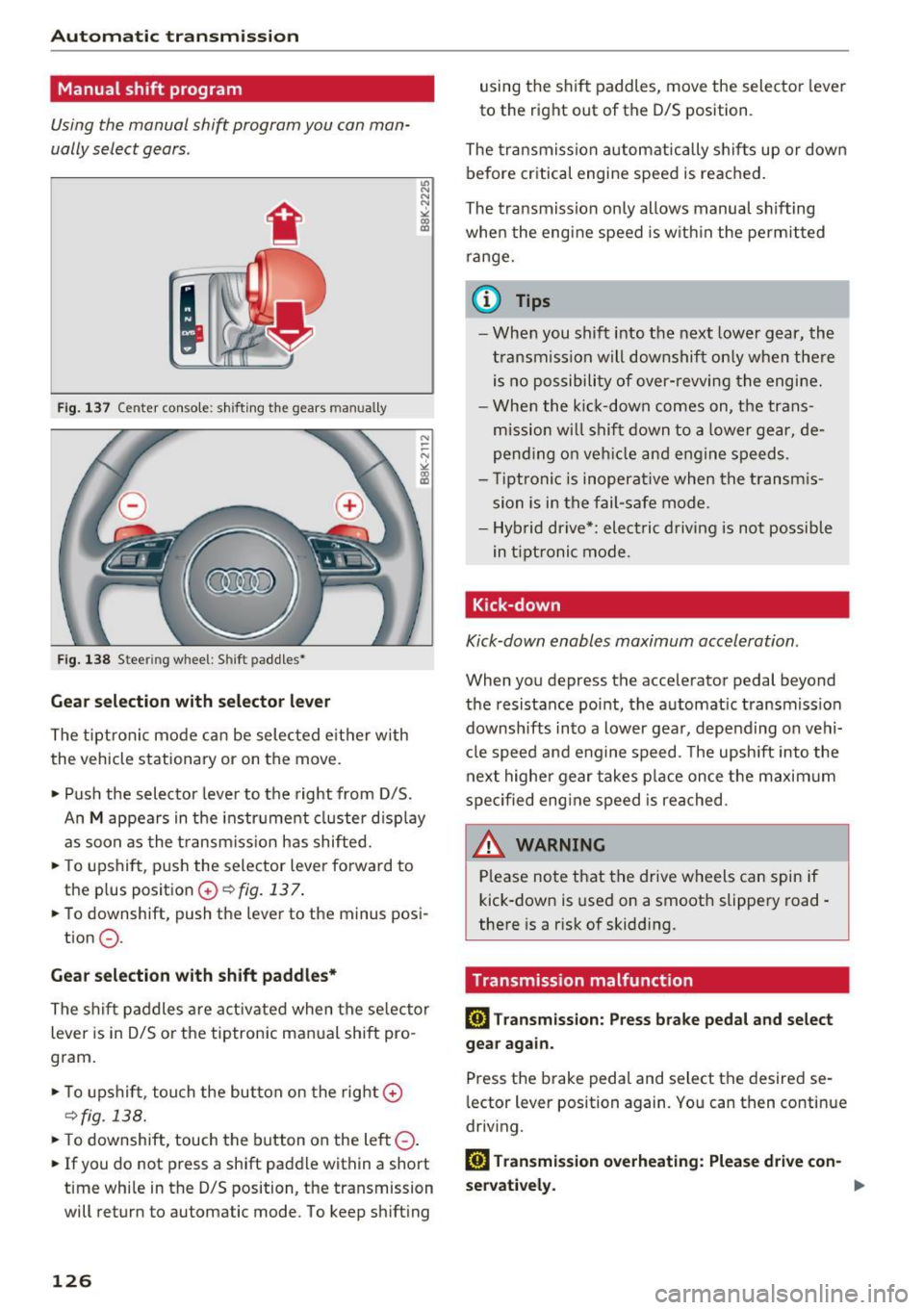
Fig. 137 Center console: shifting the gears man ually
Fig. 138 Stee rin g whee l: S hift paddles •
Gear selection with selector lever
The tiptronic mode can be selected eith er with
the vehicle stationary or on the
move.
• Push the selector lever to the right from D/S.
u, N
N
N
" ll1
An M appears in the instrument cluster displa y
as soon as the transmission has shifted.
• To upshift, push the selector lever forward to
the plus position
G) ¢ fig. 137 .
• To downshift, push the lever to the minus posi-
tion
0 .
Gear selection with shift paddles*
The shift paddles are activated when the selector
lever is in D/S or the tiptronic manual shift pro
gram.
• To upshift , touch the button on the right
G)
¢fig. 138.
• To downshift, touch the button on the left 0-
• If you do not press a shift paddle within a short
time while in the D/S position, the transmission
will return to automatic mode. To keep shifting
126
using the shift paddles, move the selector lever
to the right out of the D/S position .
The transmissron automatically shifts up or down
before critical engine speed is reached.
The transmission only allows manual shifting
when the engine speed is within the permit ted
range.
(D Tips
- When you shift into the next lower gear, the
t ransm ission will downshift only when there
is no possibili ty of
over-revving the engine.
- When the kick-down comes on, the trans
mission will shift down to a lower gear, de
pending on vehicle and engine speeds.
- Tiptr onic is inoperat ive when the transmis
sion is in the fail-safe mode.
- Hybrid drive*: elect ric driving is not possible
in t iptronic mode .
Kick-down
Kick-down enables maximum acceleration .
When you depress the accelerator pedal beyond
the resistance point, the automat ic transmission
downshifts into a lower gear, depending on vehi
cle speed and engine speed. T he upsh ift into the
next higher gear takes place once the maximum
specified eng ine speed is reached.
A.::!!. ARNING
-Please note that the drive wheels can spin if
kick-down is used on a smooth slippery road -
there is a risk of skidd ing.
Transmission malfunction
ml Transmission: Press brake pedal and select
gear again.
Press the brake pedal and select the desired se
lector lever position again. You can then continue
driving.
ml Transmission overheating: Please drive con-
servatively . .,,.
Page 145 of 300
..... N
co
er::
co
.....
General information
Always wear safety belts!
Wearing safety belts correctly saves lives!
This chapter explains why safety belts are neces
sary, how they work and how to adjust and wear
them correctly. "' Read all the information that follows and heed
all of the instructions and WARNINGS.
A WARNING
Not wearing safety belts or wearing them im
properly increases the risk of serious personal
injury and death.
- Safety belts are the single most effective
means available to reduce the risk of serious
injury and death in automobile accidents.
For your protection and that of your passen
gers, always correctly wear safety belts
when the vehicle is moving.
- Pregnant women, injured, o r physically im
paired persons must also use safety belts.
Like all vehicle occupants, they are more
likely to be seriously injured if they do not
wear safety belts. The best way to protect a
fetus is to protect the mother -throughout
the entire pregnancy.
Number of seats
Your Audi has a total of five seating positions:
two in the front and three in the rear. Each seat ing position has a safety belt.
A WARNING
Not wearing safety belts or wearing them im
properly increases the risk of serious personal
injury and death.
- Never strap more than one person, includ
ing small children, into any belt.
It is espe
cially dangerous to place a safety belt over a
child sitting on your lap.
- Never let mo re people ride in the vehicle
than there are safety belts available .
Safety belts
-Be sure everyone riding in the vehicle is
properly restrained with a separate safety
belt or child restraint.
Safety belt warning light
Your vehicle has a warning system for the driver
and (on USA models only) front seat passenger
to remind you about the importance of buckling
up .
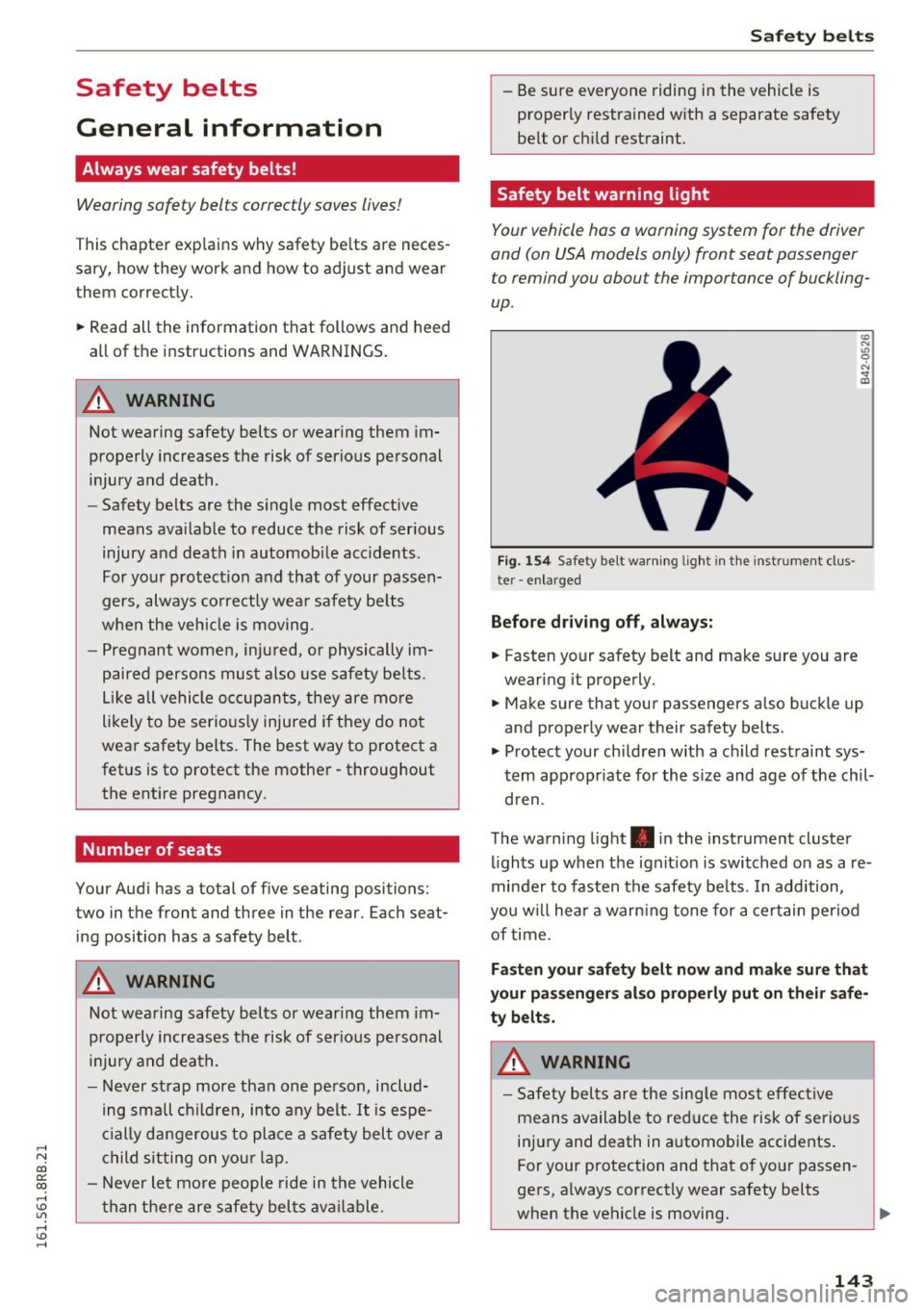
Fig. 154 Safety belt warning light in the instrument clus
te r -enlarged
Before driving off, always:
.. Fasten your safety belt and make sure you are
wearing it properly.
.,, N
"' 0 ..:, ., m
"' Make sure that your passengers also buckle up
and properly wear their safety belts.
"' Protect your children with a ch ild restraint sys
tem appropr iate for the size and age of the chil
dren .
The warning light . in the instrument cluster
lights up when the ignit ion is switched on as a re
minder to fasten the safety be lts. In addition,
you w ill hear a warn ing tone for a certain period
of time.
Fasten your safety belt now and make sure that
your passengers also properly put on their safe
ty belts.
A WARNING
-
-Safety belts are the single most effective
means available to reduce the risk of serious
injury and death in automobile accidents .
For your protection and that of your passen
gers, a lways correctly wear safety belts
when the vehicle is moving.
143
Page 160 of 300
Airbag syste m
greater detail below. Because the front passen
ger seat contains important parts of the Ad
vanced Airbag System, you must take care to pre
vent it from being damaged. Damage to the seat m ay prevent the Advanced Airbag for the front
passenger seat from doing its job in a crash .
The front Advanced Airba g Sy stem con sists
of the follo wing :
-Crash sensors in the front of the vehicle that
measure vehicle acceleration/deceleration to
provide information to the Advanced Airbag
System about the seve rity of the crash .
- An electronic control un it, with integrated
crash sensors for front and side impacts . The
contro l unit "decides " whethe r to fire the front
airbags based on the information received from
the crash sensors. The control unit a lso "de
cides" whether the safety be lt pretensioners
shou ld be activated.
- An Advanced Airbag with gas generator and
contro l valve for the driver ins ide the steering
whee l hub .
- An Advanced Airbag with gas generator and
contro l valve inside the instrument pane l for
the front passenger .
- A weight -sensing mat under the upho lstery
padding of the front passenger seat cushion
that measures th e total weight on the seat . T he
information registered is sent continuously to
the e lec tronic control unit to regu la te dep loy
ment of the front Advanced A irbag on the pas
senger side .
- An airbag monitoring system and indica tor
l ight in the instrument cluster
c> page 161 .
-A sensor in each front sea t registers the dis
tance between the respective seat and the
steering wheel or instrument panel. The infor mation reg istered is sent continuous ly to the
electronic control u nit to regulate deployment
of the front Advanced A irbags.
- T he
PASSEN GE R AIR B AG OFF light comes on
and stays on in the center of the inst rument
pane l
c> page 161 , fig . 168 and tells you when
the front Advan ced Airbag on the passenger
side has been turned off .
- A sensor below the safety belt la tch fo r the
front seat passenger to meas ure the tension on
158
the safety belt. The tension on the safety belt
and the weight reg istered by the weight-sens
ing mat help the contro l unit "decide" whether
the front airbag for the front passenger seat
should be turned
off or not c> page 152, Child
restraints on the front seat -some important
things to know .
-A sensor in the safety belt latch for the driver
and for the front seat passenger that senses
whether that safety belt is latched or not and
transmits this information to the e lectronic
cont rol u nit.
_&. WARNING
Damage to the fron t passenge r seat can pre
vent the front airbag from work ing properly .
- Improper repair or disassembly of the front
passenger and driver seat will prevent the
Advanced Airbag System from f unctioning
proper ly.
- Repairs to the front passenger seat mus t be
performed by qualified and proper ly trained
wo rkshop personne l.
- Never remove the front passenger or driver
seat from the vehicle.
- Never remove the upholstery from the front
passenger seat.
- Never d isassemble or remove pa rts from the
seat o r disconnect wi res from it.
- Never carry sharp objects in your pocke ts or
place them on the seat. If the weight-sens
ing mat in the passenger seat is p unctured
it cannot work proper ly.
- Never carry things on your lap or carry ob jects on the passenger seat. Such items can increase the weight reg istered by the
weight-sensing mat and send the wrong in
formation to the airbag control unit.
- Never store items under the front passenger
seat . Parts of the Advanced Airbag System
under the passenger seat could be dam
aged, preventing them and the airbag sys
tem from working properly .
- Never p lace seat covers or replacement up
holstery that have not been specifically ap
proved by Audi on the front seats.
- Seat covers can prevent the Advanced A ir
bag System from recognizing child
Page 165 of 300
,....,
N
co
er::
co
,....,
ly seated on the center of the seat cushion with
his or her back up against the backrest and the
backrest is not reclined
9 page 135 , Correc t
passenger seating positions,
- the adult is not taking weight off the seat by
holding on to the passenger assis t handle
above the front passenger door or suppor ting
their weight on the armrest,
- the safety bel t is being properly worn and that
there is not a lot of slack in the safety belt web
bing,
- accessory seat covers or cushions or other
things that may cause an incorrect reading or
impression on the weight-sensing mat under
the upholstery of the seat have been removed
from the front passenger seat,
- a safety belt extender has not been left in the
safety belt latch for the front passenger seat.
In addition to the
PASSENGER AIR BAG OFF
light in the center of the instrument panel, the
message
PASSENGER AIR BAG OFF or PASSEN
GER AIR BAG ON
will briefly appear in the instru
ment cluster display . This is to inform the driver
of the current front passenger airbag status.
Important safety instructions on
monitoring the Advanced Airbag System
A WARNING
An airbag system that is not functioning prop erly cannot provide supplemental protection
in a frontal crash .
- If the airbag indicator light
9 page 16
comes when the vehicle is being used, have
the system inspected immediately by your
authorized Audi dealer. It is possible that
the airbag will inflate when it is not sup
posed to, or will not inflate when it should.
A WARNING
If the front airbag inflates, a child without a
child restraint, in a rearward-facing child safe
ty seat or in a forward-facing child restraint
that has not been properly installed will be
seriously injured and can be killed.
Airbag system
-Even though your vehicle is equipped with
an Advanced Airbag System, make certain
that all children, especially 12 years and
younger, always ride on the back seat prop erly restrained for their age and size .
- Always install forward or rear-facing child
safety seats on the rear seat -even with an
Advanced Airbag System .
- If you must install a rearward-facing child
safety seat on the front passenger seat be
cause of exceptional circumstances and the
PASSENGER AIR BAG OFF light does not
appear and stay on, immediately install the
rear-facing child safety seat in a rear seating
position and have the airbag system in
spected by your authorized Audi dealer.
-A tight tether or other strap on a rearward
facing child restraint attached to the front passenger seat can put too much pressure
on the weight-sensing mat in the seat and
register more weight than is actually on the
seat . The heavier weight registered can
make the system work as though an adult
were on the seat and deploy the Advanced
Airbag when it must be suppressed causing
serious or even fatal injury to the child.
- If, in exceptional circumstances, you must
install a forward-facing child restraint on
the front passenger seat, always move the
seat into its rearmost position in the seat's
fore and aft adjustment range, as far away
from the airbag as possible. The backrest must be adjusted to an upright position .
Make sure that the
PASSENGER AIR BAG
OFF
light comes on and stays on all the time
whenever the ignition is switched on.
A WARNING
-- If the PASSENGER AIR BAG OFF light does
not go out when an adult is sitting on the
front passenger seat after taking the steps
described above, make sure the adult is
properly seated and restrained at one of the rear seating positions.
- Have the airbag system inspected by your
authorized Audi dealer before transporting
anyone on the front passenger seat.
163
Page 207 of 300
,....,
N
co
er::
co
,....,
Towing a loaded trailer with an empty car res ults
in a high ly unstable distribution of weight. If this
cannot be avoided, drive at very low speeds only
to avoid the risk of losing steering control.
A "balanced" rig is eas ier to operate and control.
This means that the tow vehicle should be loaded
to the extent possible and permissible, while
keeping the trailer as light as possible under the
circumstances. Whenever possible, transfer
some cargo to the luggage compartment of the
tow vehicle while observ ing tongue load require
ments and vehicle loading considerat ions.
Speed
The higher the speed, the more difficult it be
comes for the driver to contro l the rig. Do not
drive at the maximum permiss ible speed . Reduce
your speed even more if load, weather or wind
conditions are unfavorable - part icularly when
going downhill.
Reduce veh icle speed
immediately if the tra iler
shows the slightest sign of swaying .
Do not try
to stop the swaying by accelerating.
Observe speed lim its . In some areas, speeds for
veh icles towing trai lers are lower than for regular
veh icles.
Always apply brakes early. When driving down
h ill , shift into a lower gear to use the engine
braking effect to slow the veh icle. Use of the
brakes alone can cause them to overheat and fa il.
Coolant temperature
The coolant temperature gauge r=;, page 10 must
be observed carefully . If the needle moves close
to the upper end of the scale, reduce speed im mediately and/or turn off the air conditioner.
If the coolant temperature warning light in the
instrument cluster starts flashing., pull off
the road, stop and let the engine
idle for about
two minutes to prevent heat build-up.
A WARNING
Anyone not properly restrained in a moving
vehicle is at a much greater risk in an acci-
-
Trailer mode
dent. Never let anyone ride in your car who is
not properly wear ing the restraints provided
by Aud i.
Trailer mode notes
Important to know
Your vehicle handles differently when towing a
t railer because o f the additional weight and dif
ferent weight distribution. Safety, performance
and economy will greatly depend on how carefu l
ly you load your trai ler and operate your rig.
Before you actually tow your trailer, practice
tu rning, stopping and backing up in an area away
from traffic. Keep practicing until you have be
come comp lete ly familiar w ith the way your vehi
cle-tra iler combination behaves and responds.
Backing up is difficu lt and requires practice.
Backing up with a t railer generally requires steer
ing action opposite to that when backing up your
vehicle without a trailer.
Maintain a greater distance between your vehicle
and the one in front of you . You will need more
room to stop. To compensate for the trailer, you
will need a larger than normal turning radius.
When passing, remember that you cannot accel
erate as fast as you normally would because of
the added load. Make sure you have enough room
to pass. After passing, allow p lenty of room for
your trailer before c hanging lanes again.
Avoid jerky starts, sharp turns or rapid lane
changes.
(D Tips
- Do not tow a trailer during the break-in peri
od of your veh icle.
- If you tow a trailer, your Audi may requ ire
more frequent maintenance due to the ex
tra load
r=;, page 280.
205
Page 219 of 300
..... N
co
er::
co
.....
¢ fig. 192. Now you can open the fuel fi ller flap
as usual.
Selective catalytic reduction (AdBlue)
General information
Applies to vehicles: with selective catalyt ic reduction
In vehicles with se lective cata lytic reduction, a
urea solution (Ad B lue) is injected into the ex
haust system before a nitrogen ox ide catalytic
converter to reduce nitrogen emissions.
The AdBlue is carried in a separate tank in the ve
hicle. The Ad Blue usage accounts for approxi
mately 0.5% to 2.5% of the diesel fuel that is
used.
When a message about refilling the Ad B lue ap
pears in the instr ument cluster disp lay, you must
refill the Ad Blue yourself or have it refilled by an
author ized Audi dealer or author ized Audi Service
Facility
¢ page 218.
(l) Tips
-The display indicates the distance remain ing
that can be driven
¢page 217. If the AdBl
ue tank is complete ly empty, the engine w ill
not sta rt again after the ignition is sw itched
off.
- Ad Blue is req uired by law to operate this ve
hicle.
Messages in the instrument cluster display
App lies to vehicles: with selective catalyt ic reduction
The display indicates if the Ad Blue level is low or
if there is a system malfunction .
AdBlue level low
You will be informed if the AdBlue in the tank
d rops below a certa in leve l.
AdBlue f) 1500 mi (2400 km) Refill Ad Bl-
ue. See owner 's manual
This message appea rs when there is only eno ugh
Ad B lue left to drive the distan ce indi cated in the
instr ument cluster . Fil l the Ad B lue.
Fuel and R efueling
AdBlue /9 600 mi (1000 km) Refill Ad Blue!
No restart in 600 mi (1000 km )! See owner's
manual
T h is mess age appears when there is on ly enough
Ad B lue left to dr ive the distance indicated in the
instrument cluster. Fill the AdBl ue . Otherwise
t h e engine will not start again if yo u stop it once
the d istance ind icated has been driven.
Refill AdBlue! No re
start! See owner 's manual
Th is message appears when t he Ad B lue tank is
empty. Fill the AdBlue. Otherwise you wi ll not be
able to start the engine again once you stop i t.
T he Ad Blue must be refilled when the amount in
t h e tank has reache d the m inimum leve l
¢ page 218, Filling AdBlue.
Incorrect filling/system malfunct ion
A message appea rs if the Ad Blue tank was fi lled
with a flu id other tha n Ad Blue and the system
has detected tha t the tank was filled incorrectly,
o r i f the re is a system ma lfu nction.
Ad Blue,/' 600 mi (1000 km) Ad Blue:
Fault ! No restart in 600 mi (1000 km )! See
own er' s manual
This message appears when it is on ly possible to
drive the distance indicated in the instrument
cluster . Dr ive to the nea res t author ized Audi
dealer or authori zed A udi Se rvi ce Fac ility to have
the malfunc tion cor rected. Otherw ise the eng ine
will not sta rt aga in if you stop it once the dis
tance indicated has been driven .
AdBlue: Sy stem
fault . No restart! See owner 's manual
This message appears if the system has detected
that the tank was fi lled incor rect ly or that there
is a ma lf u nct ion. Drive immed iate ly to the near
e st au thor ized A udi dealer or au thori ze d Audi
Se rvice Facility to h ave the ma lf u nction correct
ed. Otherwise you wi ll not be able to start the en
gine again once yo u stop it.
217
Page 220 of 300
Fuel and R efue li ng
Filling AdBlue
Applies to veh icles: w ith selective cata ly ti c reduction
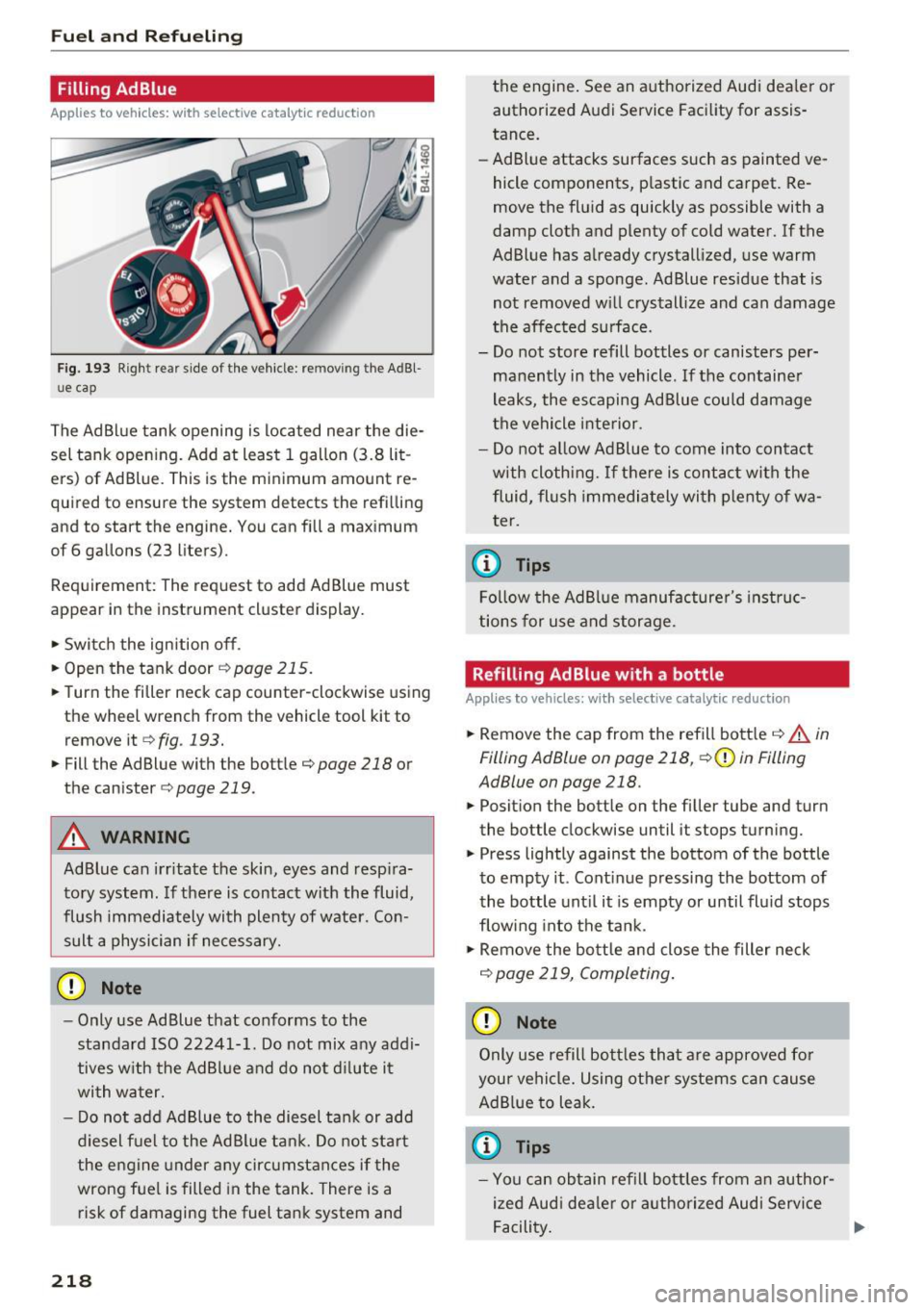
Fig. 193 Right rear side of the vehicle: removing the AdBl
ue cap
The Ad Blue tank opening is located near the die
sel tank opening. Add at least 1 gallon (3.8 lit
ers) of Ad Blue. This is the minimum amount re
quired to ensure the system detects the refilling
and to start the engine. You can fill a maximum
of 6 gallons (23 liters).
Requirement: The request to add Ad Blue must
appear in the instrument cluster display.
• Switch the ignition off.
• Open the tank door
r::!) page 215.
• Turn the filler neck cap counter-clockwise using
the wheel wrench from the vehicle tool kit to
remove it
¢ fig . 193.
• Fill the Ad Blue with the bottle¢ page 218 or
the canister ¢
page 219.
A WARNING
AdBlue can irr itate the skin, eyes and resp ira
tory system. If there is contact with the fluid,
flush immediately with plenty of water. Con sult a physician if necessary.
CD Note
- Only use Ad Blue that conforms to the
standard ISO 22241-1. Do not mix any addi
tives w ith the AdBl ue and do not d ilute it
wi th water.
- Do not add Ad Blue to the diesel ta nk or add
diesel f uel to the AdBlue tan k. Do not start
the engine under any circumstances if the
wrong fue l is filled in the tank. There is a
risk of damaging the fuel tank system and
218
the engine . See an authorized Audi dea le r or
authorized Audi Service Facility for assis
tance.
- Ad Blue attacks surfaces such as painted ve
hicle components, p lastic and carpet. Re
move the fluid as quickly as possible with a
damp cloth and plenty of cold water. If the
AdBlue has a lready crystall ized, use warm
water and a sponge. Ad Blue residue that is
not removed w ill crystall ize and can damage
t he affected s urface.
- Do not store refill bottles or canisters per
manently in the vehicle. If the container
leaks, the escaping Ad Blue could damage
the vehicle inte rior.
- Do not allow Ad Blue to come into contact
with cloth ing. If t here is contac t w ith the
fluid, flush immediately wi th plenty of wa
ter.
(0 Tips
Fo llow the AdBlue manufacture r's instruc
tions for use and storage.
Refilling Ad Blue w ith a bottle
App lies to vehicles : wi th selec tive cata lyt ic reduct ion
• Remove the cap from the refill bott le ¢ &. in
Filling AdBlue on page 218,
¢ 0 in Filling
AdBlue on page 218.
• Posit ion the bottle on the filler tube and turn
the bottle clockwise until it stops turning.
• Press lightly against the bottom of the bottle
to empty it . Cont inue pressing the bottom of
the bottle unt il it is empty or until fluid stops
flowing into the tank.
• Remove the bottle and close the filler neck
¢ page 219, Completing .
CD Note
Only use refill bott les tha t are approved for
you r vehicle. Using other systems can cause
Ad B lue to leak.
(0 Tips
- You can obtain refill bottles from an author
ized Audi dea le r or authorized Audi Service
Facility.
Page 224 of 300
Checking and Filling
Engine compartment
Engine compartment
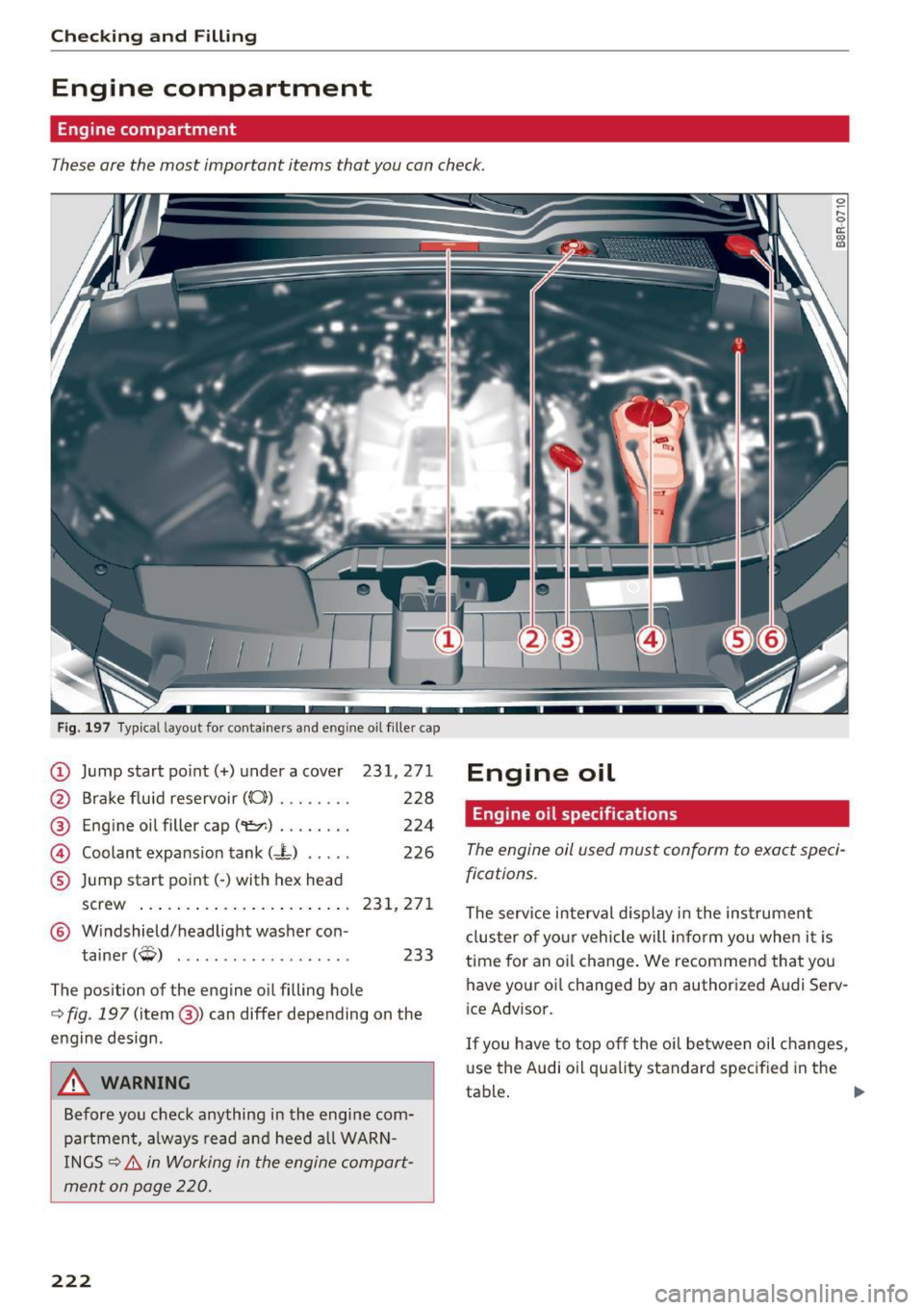
These are the most important items that you can check.
Fig. 197 Typical layout for con tainers and eng ine oil filler cap
® Eng ine oil filler cap ("1::7':) ........ 224
© Coolant expansion tank (- L) ..... 226
® Jump start point(-) with hex head
screw
. .. .. .... .............. 231,271
® Windshield/headlight washer con-
tainer
(Q) ................... 233
The position of the engine oil filling hole
¢ fig. 197 (item @) can differ depending on the
engine design .
A WARNING
Before you check anything in the engine com
partment, always read and heed all WARN
INGS ¢.&.
in Working in the engine compart
ment on page 220.
222
Engine oil
Engine oil specifications
~ r--0 d::
"' t0
The engine oil used must conform to exact speci
fications.
The serv ice interval display in the instrument
cluster of your vehicle will inform you when it is
time for an oi l chang e. We recommend that you
have your oi l changed by an authorized Audi Serv
i ce Advisor.
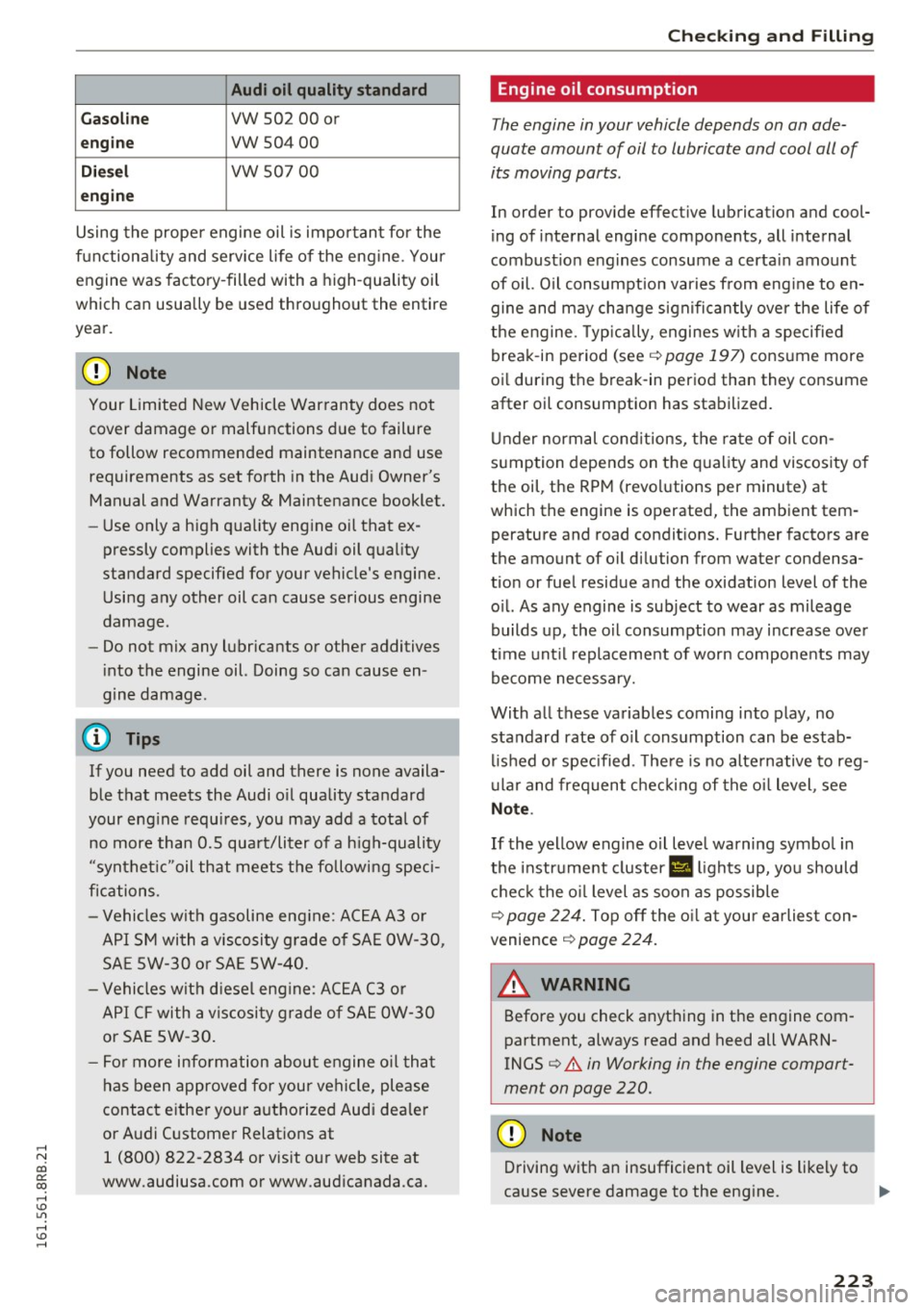
If you have to top off the oil between oil changes,
us e the Audi oil quality standard specified in the
ta ble.
~
Page 225 of 300
Audi oil quality standard
Gas oline
VW 502 00 or
engi ne vw 504 00
Die sel vw 507 00
en gin e
Using the prope r engine oil is important for the
functiona lity and service life of the eng ine. Your
engine was factory-filled with a high -quality oil
which can usually be used throughout the entire
year.
@ Note
Your Limited New Vehicle Warranty does not
cover damage or malfunctions due to failure
to follow recommended maintenance and use
requirements as set forth in the Audi Owner's Manual and Warranty
& Maintenance booklet.
- Use only a high quality eng ine oil that ex-
pressly complies with the Aud i oil quality
standard specified for your vehicle's engine.
Using any other oil can cause serious engine
damage .
- Do not mix any lubricants or other additives
into the engine oil. Doing so can cause en
gine damage.
(D Tips
If you need to add oil and there is none availa
ble that meets the Audi o il quality standard
your eng ine requ ires, you may add a total of
no more than 0.5 quart/liter of a h igh-quality
"synthet ic"oil that meets the followi ng speci
fications.
- Vehicles with gasoline eng ine: AC EA A3 o r
API SM wi th a viscosity g rade of SA E OW-30,
SAE SW-30 or SAE SW-40.
- Vehicles wit h diesel eng ine: ACEA C3 o r
API CF with a v iscosi ty grade of SA E OW-30
or SA E SW -30.
- Fo r more information abou t engine o il that
has been approved for your vehi cle, please
contact either you r a utho rized Audi dea ler
or A udi Customer Relations at
~ 1 (800) 822-2834 or visit our web site at co
g:; www.audiusa.com or www.aud icanada.ca.
Ch eck ing and Filling
Engine oil consumption
The engine in your vehicle depends on on ade
quate amount of oil to lubricate and cool oil of
its moving ports.
In order to provide effect ive lubrication and cool
i ng of internal engine components, all internal
combust ion eng ines consume a certa in amount
of oil. Oil consumption varies from eng ine to en
gine and may change s ign ificantly ove r the life of
the engine. Typ ica lly, engines w ith a specified
break-in period (see
¢ page 197) consume more
oi l during the break -in period than they consume
after oil consumption has stabilized.
Under normal cond itions, the rate of oil con
sumption depends on the q uality and viscosity o f
the oil, the RPM (revol utions per minute) at
which the engine is operated, the ambient tem
perature and road condit ions. Further factors are
the amount of oil dilution from water condensa
tion or fuel residue and the oxidation level of the o il. As any engine is subject to wear as mileage
builds up, the oil consumption may increase over
time unt il replacement of worn components may
become necessary.
With all these variables coming into play, no standard rate of o il consumption can be estab
li shed or spec ified . T he re is no alte rnative to reg
u la r and frequent checking of the oi l level , see
Note .
If the yellow engine o il leve l warning symbo l in
the instrument cluster
II lights up, yo u should
c h eck the o il level as soon as possible
¢ page 224. Top off the o il at your earlies t con
venience
¢ page 224.
A WARNING
--=-
Before you check anything in the engine com-
partment, always read and heed all WARN
INGS
¢ &. in Working in the engine comport
ment on page 220.
(D Note
Driving wit h an insufficient oil level is likely to
cause severe damage to the eng ine. ..,.
223