engine oil AUDI Q5 2017 User Guide
[x] Cancel search | Manufacturer: AUDI, Model Year: 2017, Model line: Q5, Model: AUDI Q5 2017Pages: 296, PDF Size: 74.43 MB
Page 199 of 296
CD
CD
.... N ,-... N .... 0 0 C<'. 00
It is normal for the oil consumption of a new en
gine to reach its lowest value after a certain mile
age has been driven .
You must drive your vehicle abo ut 3,000 miles
(5,000 k ilometers) before you can proper ly as
sess oi l cons umption.
This a lso applies to fuel consumption and engine
ou tput.
(y Note
- Have your vehicle maintained properly and
in accordan ce with the servi ce recommend a
tions in yo ur Warranty
& Ma intenance book
l et. Lack of proper maintenance as well as
i mproper use of the vehicle will impair the
funct ion of the emission control system and
could lead to damage.
- Do not alter or remove any component of
the Em ission Control System unless ap
proved by the manufacturer.
- Do not a lter or remove any device, such as
heat shie lds, sw itches, ignition wires,
valves, which are designed to protect your
vehicle's Em ission Control System and other
i mportant vehicle components .
Fewer short trips
Fuel consumption will always be relatively high
on short trips .
.. Try to avoid driving short distances with a cold
engine.
The engine and catalyt ic converter have to reach
their optimal
ope rating temperature to reduce
fuel consumption and noxious emissions effec
t ively .
Just after starting, a co ld engine in a mid-size car
only achieves a fuel economy of 6-8 miles per
ga llon (30-40 l/100 km). After about a half a
mile, fuel economy cl imbs to 12 mpg (20 l/100
km). After about
2 .5 miles (4 km), the engine is
at its proper operating temperature and fuel
economy has reac hed a norma l level. So you can
see that you sho uld avo id short t rips w henever
possib le.
Driving and the envir onment
The out side tempe rature is a lso crit ica l in this re
gard . Your car consumes more fuel in the winter
than in the summer .
197
Page 212 of 296
Fuel and R efu eli ng
Many gasoline grades are b lended to perform es
pecia lly we ll for winter or summer driving. Dur
ing seasonal change-over, we suggest that you
fill up at busy gas stations where the seasonal
adjustment is more likely to be made in time.
@) Note
-Fuels containing a high percentage of etha
nol such as ESO and E85 may only be used in
vehicles with flexible fuel* engines. Using high ethanol fuel in vehicles not equipped
with flexible fuel* engines can cause severe
engine damage.
- Methanol fuels which do not meet these re quirements may cause corros io n and dam
age to plast ic and rubber components in the
fuel system.
- Do not use fuels that fail to meet the spec i
fied c riter ia in this chapter.
- If you a re unable to determine whether or
not a particular fuel blend meets the spec i
ficat ions, ask your service station or its fuel
supplier.
- Do not use fuel for wh ich the contents can
not be identified.
- Fuel system damage and performance p rob
l ems result ing from the use of fue ls diffe r
ent from those specified are not the respon
s ibility of Audi and are not covered under
the New Vehicle or the Emission Control
System Warranties .
- If you experience a loss of fue l economy o r
driveability and performance prob lems due
to the use of one of these fuel b lends, we
recommend that you switch to unblended
fuel.
Ethanol fuel (Bio -ethanol)
Ap plies to: vehicl es w ith flex ible fuel engine
You con recognize vehicles with a flexible fuel
engine by looking at the label on the inside of
the fuel filler flop.
Vehicles with flexible f uel engines may be oper
ated w ith bio-ethanol fuels such as E85 (85%
ethanol and 15% gasoline) or with unleaded gas
oline (91 AKI/ROZ 95). The vehicle may also be
operated with a mixture of these fuels .
210
Your fuel consumpt ion wi ll increase when using
bio-ethano l fue ls due to the lower amount of en
ergy contained per un it vo lume in ethanol.
Warming up th e fle xible fuel engine in low
temperatures
Due to the chemical composition of bio-ethanol ,
a certain amount of fuel ends up in the engine o il
when driving short distances in very low temper
atures. This fuel evaporates again when the en
gine is warmed up .
II Please warm up engine .
If the driver message appears in the instr ument
cluster disp lay, drive with a warm engine to re
duce the oil leve l.
(D Note
- N ever fill with methano l o r with a h igher
percentage of bio -e thanol than 85% (E85).
A highe r percentage of bio-ethanol in the
fuel can cause damage to the engine or to
the fuel system.
- If you use on ly E85, it is recommended to
fill the fue l tank comp lete ly with unleaded
premium grade gasoline every 5,000 mi les.
- If you experience starting, rough id le or hes
itat ion driveab ility prob lems, f ill the fuel
tank comp lete ly with unleaded prem ium
grade gaso line and drive it no rma lly until
the gaso line is used. See your author ized
Audi dealer if the prob lem pers ists.
- Inform your authorized Audi dealer that you
are operat ing or have operated the vehicle
with E85.
- Read and follow the informat ion and tips
about gasoline~
page 209.
(D Tips
It may take longer to start the engine when
the outs ide temperature is ve ry cold . If possi
ble, use winterized fue l if tempe ratu res are
below free zing .
Page 213 of 296
CD
CD
.... N ,-... N .... 0 0 C<'. 00
Gasoline additives
Applies to: vehicles with gasoline engine
A major concern among many auto manufactur
ers is carbon deposit build-up caused by the type
of gasoline you use.
Although gasoline grades differ from one manu
facturer to another, they have certain things in
common. All gasoline grades contain substances
that can cause deposits to collect on vital engine parts, such as fuel injectors and intake valves . Al
though most gasolin e brands include additives to
keep engine and fuel systems clean, they are not
equally effe ctive.
Audi recommends using TOP TIER Detergent Gas
oline. For more information on TOP TIER Deter
gent Gasoline , please go to the official website
(www.toptiergas.com).
After an extended period of using inadequate
fuels, built-up carbon depos its can rob your en
gine of peak performance.
CD Note
- Damage or malfunction due to poor fuel
quality is not covered by the Audi New Vehi
cle Limited Warranty .
- Do not add aftermarket fuel additive prod
ucts to your fuel tank.
Diesel fuel
Applies to: veh icles with diesel eng ine
Always use ULSD (Ultra Low Sulfur Diesel) No. 2.
The ULSD No . 2 meets the ASTM 0975.
Diesel fuel with concentrations of biodiesel high
er than S % such as 811,820 or 8100 are strictly prohibited.
Service station fuel pumps are labeled with the
correct fuel information for easy recognition by
the user. If the diesel fuel pump is not labeled
ask the station operator what fuel is being dis
pensed before filling up your vehicle .
ULSD No . 2 may not be available outside the USA
and Canada. Be sure to check before traveling to
other countries.
Fuel and Refueling
ULSD No. 2 can become thicker in very cold tem
peratures, and this can impair the engine 's start
ing and running. Depending on the season, gas
stations provide ULSD No.
2 that flows better in
cold temperatures so tha t you can continue oper
ating your vehicle as usual.
CD Note
- Your vehicle's diesel engine was designed
soley for use with ULSD No.
2. Therefore,
never use gasoline, heating oil, other fuels
or flow improvers . These contain substances
that will severely damage the fuel system
and the engine. Such damage will not be
covered by your New Vehicle Limited War
ranty.
- If you put any amount of incorrect fuel in
the fuel tank, do not start the engine under
any circumstances. Immediately contact the
nearest authorized Audi dealer or author
ized Audi Service Facility for assistance.
These fuels contain substances that can se
verely damage the fuel system and the en gine if the engine is started .
Refueling
Fuel filler neck
The fuel filler neck is located on the right rear
side panel behind the fuel filler flap.
If the power locking system should fail, you can
still open the flap manually -for detailed instruc
tions see
¢ page 213.
You can find the fuel tank capacity of your vehicle
in
¢ page 273.
The label on the inside of the fuel filler flap tells
you the correct fuel for your vehicle. For more in
format ion about fuel specificat ions, see
¢ page 209.
Your vehicle fuel tank has an on-board refuelling
vapor recovery system. This feature helps to pre
vent fuel vapors from escaping from the tank and polluting the environment while you refuel your
vehicle. In order to fill the tank properly while
protecting the environment, please follow this
refueling procedure carefully.
211
Page 220 of 296
Checking and Filling
-Always let the engine cool down. Hot com
ponents will burn skin on contact .
- To reduce the risk of being burned, never
open the hood if you see or hear steam or
coolant escaping from the engine compart
ment. Wait until no steam or coolant can be
seen or heard before carefully opening the
hood.
- Keep children away from the engine com
partment.
- Never spill fluids on hot engine compo
nents . They can cause a fire.
- Never touch the radiator fan. The auxiliary
electric fan is temperature controlled and
can switch on suddenly.
- Never open the coolant reservoir cap when
the engine is still warm. The coolant system
is pressurized and hot coolant could spray
out .
- Protect your face, hands and arm from steam or hot engine coolant by placing a
thick rag over the cap when you open the coolant reservoir.
- Do not remove the engine cover under any
circumstances . This increases the risk of
burns.
- If work on the fuel system or the electrical
system is necessary:
- Always disconnect the battery.
- Never smoke or work near heaters or open flames. Fluids in the engine compartment
could start a fire.
- Keep an approved fire extinguisher imme
diately available.
- To avoid electrical shock and personal injury
while the engine is running or being started, never touch:
- Ignition cables
- Other components of the high voltage
electronic ignition system .
- If you must perform a check or repair with
the engine running:
- First, fully apply the parking brake, move
selector lever of automatic transmission
to P (Park).
218
- Always use extreme caution to prevent
clothing, jewelry, or long hair from get
ting caught in the radiator fan, V-belts or
other moving parts, or from contacting hot parts . Tie back hair before starting,
and do not wear clothing that will hang or
droop into the engine.
- Minimize exposure to emission and chemi
cal hazards
~ &.
&, WARNING
California Proposition 65 Warning:
- Engine exhaust, some of its constituents,
and certain vehicle components contain or
emit chemicals known to the State of Cali
fornia to cause cancer and birth defects and
reproductive harm. In addition, certain flu
ids contained in vehicles and certain prod
ucts of component wear contain or em it
chemicals known to the State of California
to cause cancer and birth defects or other
reproductive harm .
- Battery posts, terminals and related acces sories contain lead and lead compounds,
chemicals known to the State of California
to cause cancer and reproductive harms .
Wash hands after handling.
('.!) Note
When adding fluids, always make sure that
they are poured into the proper container or
filler opening, otherwise serious damage to
vehicle systems will occur.
@ For the sake of the environment
To detect leaks in time, inspect the vehicle
floor pan from underneath regularly . If you
see spots from oil or other vehicle fluids, have
your vehicle inspected by an authorized Audi dealer.
Page 221 of 296
a,
a,
..... N r-N ..... 0 0
0:
co
Checking and Filling
Engine compartment
Engine compartment
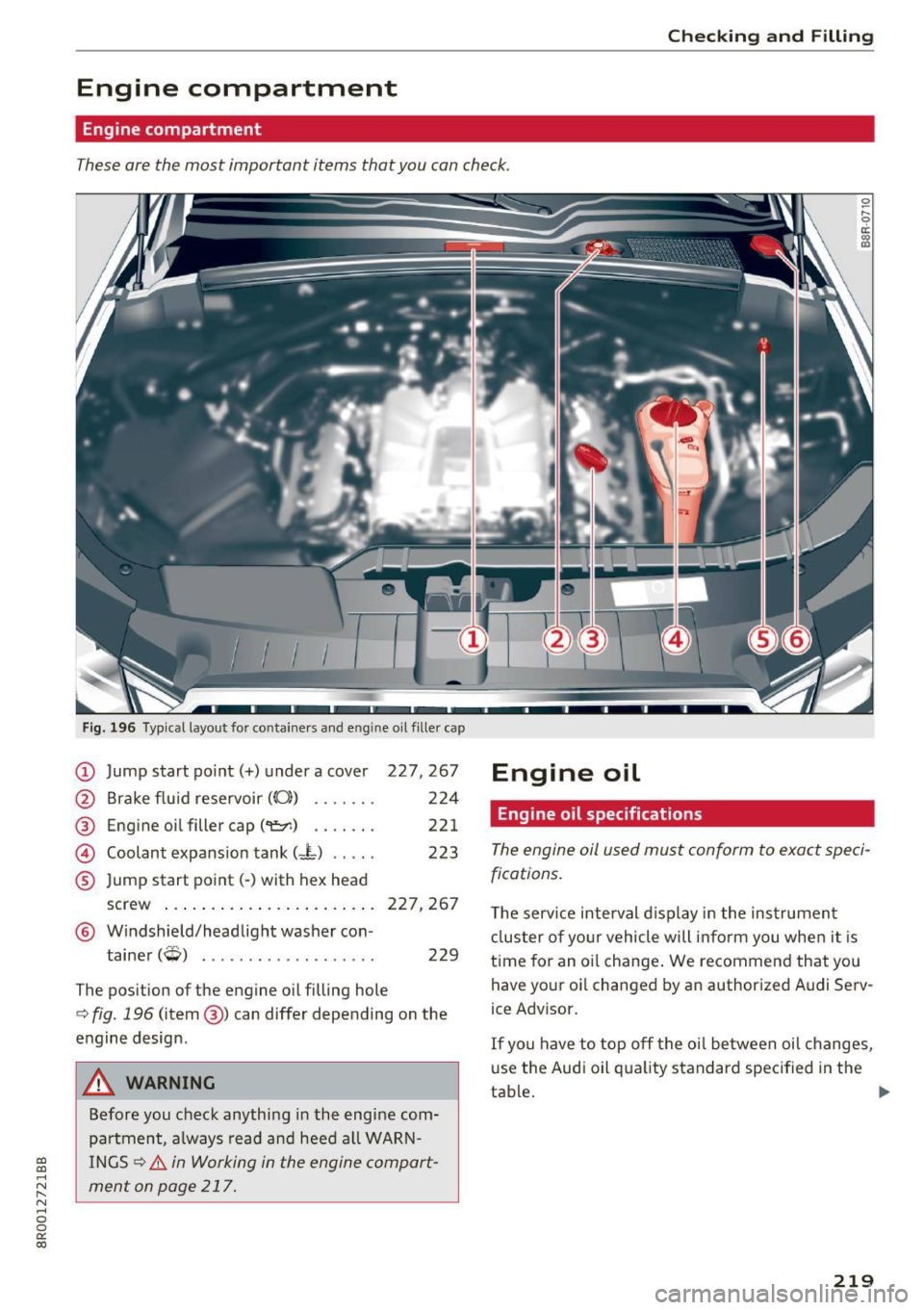
These are the most important items that you can check.
Fig. 196 Typical layout for containers and e ngin e oil fille r cap
(D Jump start po int(+) under a cover 227,267
@ Brake fluid reservoir (CO)) . . . . . . . 224
@ Engine oil filler cap(~) . . . . . . . 221
@ Coolant expansion tank (- L) . . . . . 223
® Jump start point( -) with hex head
screw . . . . . . . . . . . . . . . . . . . . . . . 227, 267
@ Windshield/headlight washer con -
tainer
(W) . . . . . . . . . . . . . . . . . . . 229
The position of the engine oil filling hole
c:> fig. 196 (item@) can differ depending on the
engine design .
A WARNING
Before you check anything in the engine com
partment, always read and heed a ll WARN
INGS
c:> &. in Working in the engine compart
ment on page 217.
Engine oil
Engine oil specifications
The engine oil used must conform to exact speci
fications.
T he serv ice interval display in the instrument
cluster of your vehicle will inform you when it is
time for an oi l change . We recommend that you
have your oi l changed by an authorized Audi Serv
ice Advisor.
If you have to top off the oil between oil changes,
use the Audi oil quality standard specified in the
tab~ .
~
219
Page 222 of 296
Check ing and F illing
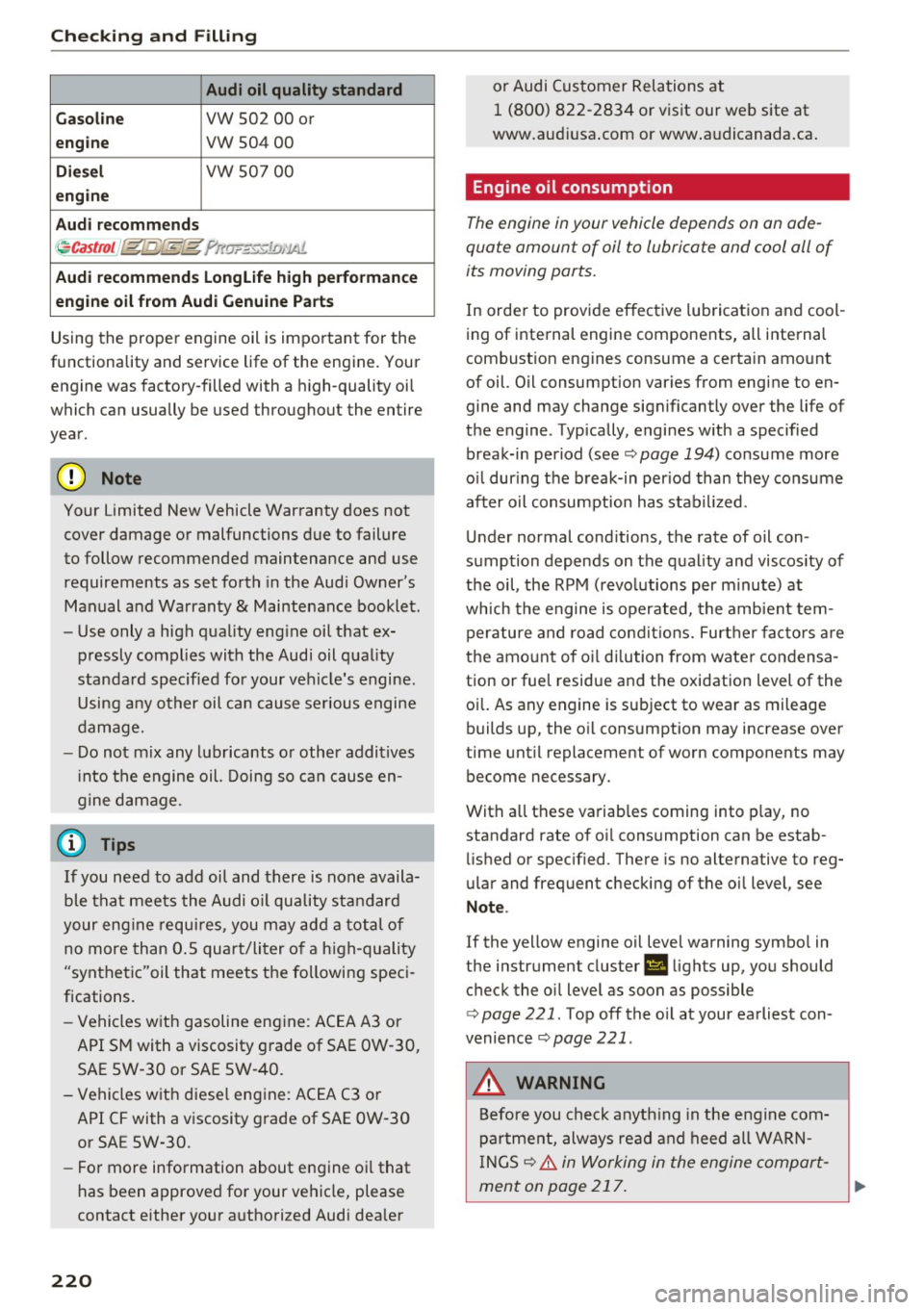
Audi oil quality standard
Gas olin e
VW 502 00 or
engi ne vw 50400
Di esel vw 50 7 00
eng in e
Au di r ecomm ends
~ castroL //gJB,'flt@t Frti:rr.:;-...1"JDl'1Al.
Au di r ecommend s Longlif e high perf ormance
engi ne oil from A udi Genuine Part s
Using the proper engine oil is important for the
functionality and service life of the eng ine. Your
engine was factory-filled with a high-quality oil
which can usually be used throughout the entire
year.
{tD Note
Your Limited New Vehicle Warranty does not
cover damage or malfunctions due to failure
to follow recommended maintenance and use
requirements as set forth in the Audi Owner's
Manual and Warranty
& Maintenance booklet.
- Use only a high quality eng ine oil that ex-
pressly complies wi th the Audi oil quality
standard specified for your vehicle's engine.
Using any other oil can cause serious engine
damage.
- Do not mix any lub ricants or other additives
i nto the engine oil. Doing so can cause en
g ine damage.
@ Tips
If you need to add oil and there is none availa
ble tha t meets the Audi o il quality standard
your eng ine requi res, you may add a tota l of
no more than 0 .5 quart/li ter of a h igh-quality
"synthetic"oil that meets the fo llowing speci
fications.
- Vehicles with gasoline eng ine: ACEA A3 or
API SM with a viscosity grade of SAE OW-30,
SAE 5W-30 or SAE 5W-40.
- Vehicles w it h diese l engine: ACEA C3 o r
API CF with a viscosity grade of SAE OW-30
or SAE 5W-30.
- For more information about engine oi l that
has been approved for your ve hicle, please
contact either your authorized Audi dea ler
220
or Audi Customer Relations at
1 (800) 822-2834 or visit our web site at
www.aud iusa .com or www .a udicanada .ca.
Engine oil consumption
The engine in your vehicle depends on an ade
quate amount of oil to lubricate and cool all of
its moving parts.
In order to provide effective lub rication and cool
ing of internal engine components, all internal
combust ion engines consume a certa in amount
of oil. Oil consumption var ies from engine to en
gine and may change significantly over the life of
the engine . Typically, engines w ith a specified
break-in period (see
c::;,page 194) consume more
o il dur ing the break-in per iod than they consume
after o il consumption has stabi lized .
Under normal cond itions, the rate of oil con
sumption depends on t he quality and viscos ity of
the oil, the RPM (revolutions per m inute) at
wh ich the engine is operated, the ambient tem
perature and road condit ions. Furthe r facto rs a re
t h e amount of o il d ilution from water condensa
tion or fue l residue and the oxidation level of the
oi l. As any engine is subject to wear as mileage
builds up, the oil consumption may increase over
time unt il replacement of worn components may
become necessary.
With a ll these variab les coming into p lay, no
standard rate of oi l consumption can be estab
li shed or spec ified . There is no alternative to reg
ular and frequent checking of the oi l level, see
Note .
If the yellow engine oil level warning symbo l in
the instrument cluster
Ill lights up, you should
check the o il level as soon as possible
<=:> page 221 . Top off the o il at your earliest con
venience
c::;, page 221 .
&. WARNING
Before you check anything in the engine com
partment, always read and heed all WARN
I NGS
<=:> .&. in Wor king in the engine compart-
ment on page 217. ..,
Page 223 of 296
CD
CD
.... N ,-... N .... 0 0 C<'. 00
(D Note
Driving with an insufficient oil leve l is likely to
cause severe damage to the engine .
@ Tips
-The oil pressure warning display. is not
an indicator of the oil level. Do not rely on
it. Instead , check the oil level in your en
gine at regular intervals, preferably each
time you refuel, and always before going
on a long trip.
- If yo u have the impression your engine con
sumes excessive amounts of oil, we recom
men d that you cons ult an autho riz ed Au di
dealer to hav e the ca use of your conce rn
properly diagnosed. Keep in mind that the
a ccu ra te measurement of oil consump tion
r equi re s gre at care and m ay ta ke some
time. An a uthorized Audi de aler has instr uc
tions about how to measure oil consump
tion acc urately.
Checking the engine oil level
Read oil level
"' Park your vehicle so that it is hor izonta lly level.
"' Shu t the engine off when it is at operat ing tem-
perature.
"' Switch only the ignition back on .
"' Wai t approx. two mi nutes .
"' Se lect:
I CARI funct ion button > Oil lev el. Or
"' Se le ct:
ICARI f u n ct ion butto n> Car sy stem s*
contro l button > Servicing & checks > Oil level.
"' Read the oil level in the r adio or M MI* Disp lay.
Add engine oil if the ba r of the o il level indica
tor is near "Min"
¢ page 221.
The o il level needs to be c heck ed at reg ular i nter
va ls. The bes t times to do this are w henever you
refuel and pr io r to long trips .
D epending on t he way t he ve hicle is dr iven and
the operat ing cond itions, o il cons umption can be
up to a 1 /2 q uart per 600 m iles ( O.S li ter per
1,000 km) . Cons umption may be hig he r within
the first 3,000 miles (5,000 km).
Checking and Filling
{!) Tips
The oil leve l indicator in t he radio o r MMI*
D isp lay is only an i nfo rmation disp lay. If the
oi l level is too low, a minimum o il wa rning ap
pears in the instrument cl uster. Add oil
¢ page 221. If the hood has been o pened ,
t he cur rent oi l level is show n in the inst ru
ment clust er the n ext time t he igni tion is
swi tched o n.
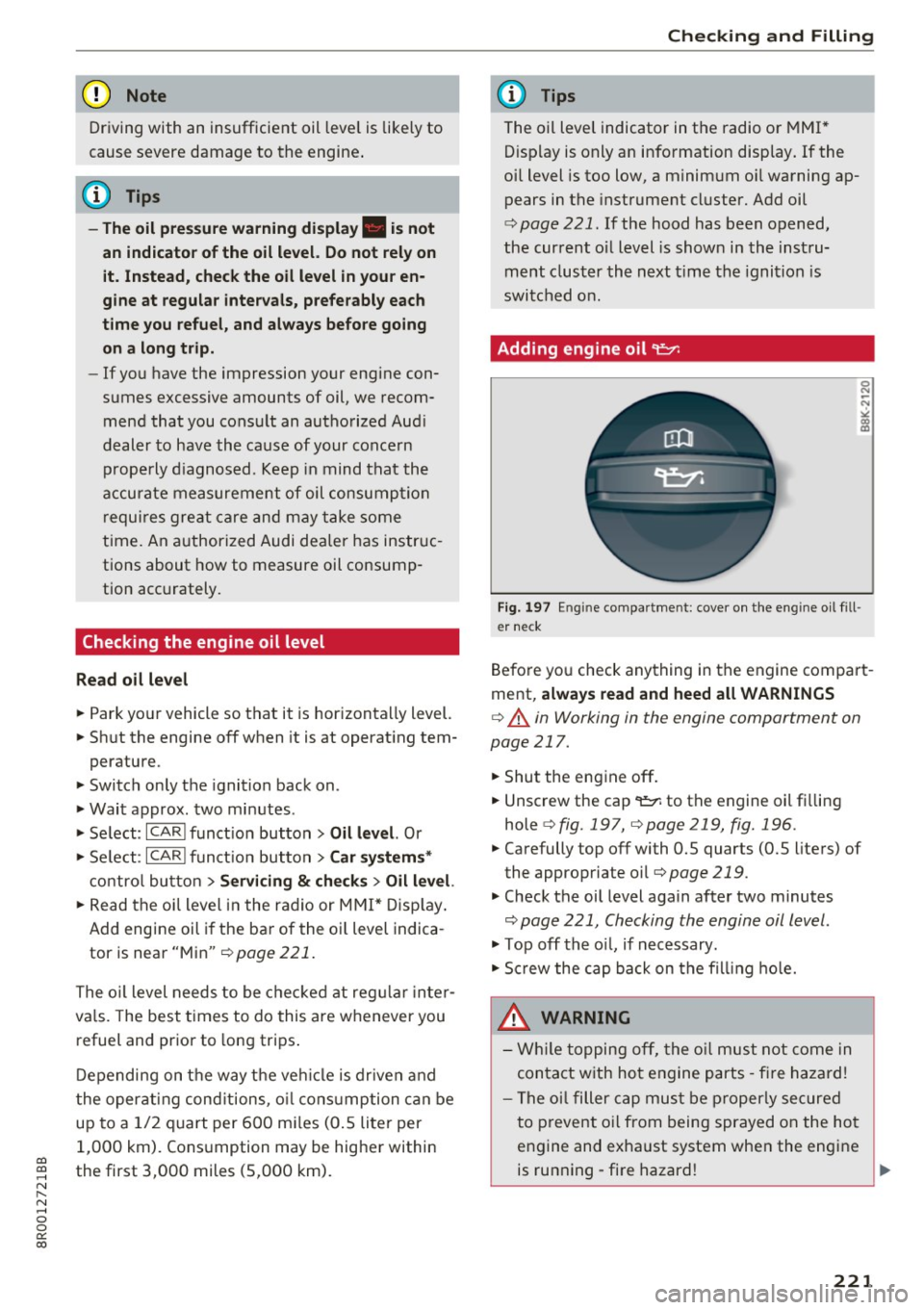
Adding engine oil~
Fig. 197 En gin e co mpa rt m ent: cove r o n th e eng ine o il fill
e r neck
Befo re yo u check any thing in the engine compa rt
ment,
always read and heed all WARNINGS
¢ A in Working in the engine compartment on
page 217.
"' Shu t the eng ine off .
"' Unscrew the cap
9=;1: to the engine oil f illing
hole
¢ fig.197, ¢page 219, fig.196 .
"'Carefully top off with 0.5 quarts (0. 5 liters) of
the appropriate oil¢
page 219.
"' Check the oil level again after two minutes
~ page 221, Checking the engine oil level .
"'Top off th e oil, if nec essary.
"' Scr ew the cap ba ck on the fi lling hole.
_&. WARNING
- Whi le toppin g off , the o il mus t no t come in
con tact w ith ho t en gine parts -fir e hazard !
- Th e oi l filler c ap must b e pr oper ly sec ure d
t o p reve nt o il from being spraye d on t he ho t
e ngine an d exha ust system whe n the engi ne
-
is run ning -fi re hazard ! Ill>-
221
Page 224 of 296
Check ing and F illing
- If your skin has come in contact with the en
gine oil, you must subsequently cleanse it
thoroughly .
@ Note
-Check the oil level using the radio or the
M MI *. If the message
Please reduce oil le v
el
appears, contact your authorized Aud i
dealer or other qualified workshop to have
excess oil extracted if necessary.
- Audi does not recommend the use of o il
add it iv es. They may damage the eng ine
and ad ve rs ely affect your N ew V ehicl e
Warranty .
@ For the sake of the environment
-Under no circumstances can the oil come in
contact with the sewage network o r the soil.
- Observe and follow legal regulations when
dispos ing of empty oil conta ine rs .
Changing the engine oil
We recommend tha t have your oil changed by an
authorized Audi dealer or a qualified service s ta
tion .
Befo re you check anyth ing in the eng ine compart
ment,
alwa ys read an d heed all WARNINGS ¢.&
in Working in the engine compartment on
page 217 .
The engine oil must be changed accord ing to the
intervals specif ied in your Warranty
& Mainte
nance booklet. This is very important because the
lubricat ing propert ies of o il d iminish gradually
during normal vehicle use .
Under some circumstances the eng ine o il should
be changed more frequently . Change oil more of
ten if you d rive mostly short distances, operate
the vehicle in dusty areas or under predominant ly
stop-and-go traffic cond it ions , or have yo ur vehi
cle where temperat ures remain below freezing
for extended periods.
Detergent addi tives in the oil will make fresh o il
loo k da rk afte r th e eng ine has been ru nning fo r a
short t ime. This is no rma l and is not a re ason to
change the oil more o ften than re commended.
222
Because of the p roblem of prope r disposa l, along
with the specia l tools and necessary expertise re
quired, we strongly recommend that yo u have
your oi l changed by an authori zed
Audi deale r or
a qual ified service station.
If you choo se to change you r oil yourself , please
note the fo llow ing important information:
A WARNING
To reduce the risk of persona l injury if you
must change the eng ine oil in your vehicle
yourself:
- Wea r eye protect ion.
- To reduce the r is k of burns from hot engine
oil, let the engine cool down to the touch.
-
- W hen removing the oil drain plug with your
fingers, stay as far away as possible. Always
keep your forearm pa rallel to the gro und to
he lp prevent hot oil from run ning down your
arm .
- Drain the oil into a container designed for
this purpose, one la rge enough to hold at
least the tota l amount of oi l in you r engine.
- Engine oil is poisonous. Keep it well out of
the reach of childre n.
- Continuous contact with used eng ine o il is
harmf ul to your skin . Always protect your
skin by washing oil off thoroughly with soap
a nd water .
@ Note
Never mix oil additives with your engine oil.
These additives can damage your engine and
adverse ly affect you r Audi Limi ted New Vehi
cle Warranty .
@ For the sake of the environment
-Before chang ing your oi l, first make sure
you know where you can properly dispose o f
the used oil.
- Always dispose of used e ngine o il pro perly .
Do not dump i t on garden soil, wooded
areas, into open streams o r down sewage
dr ains.
- Recycle used e ngine o il by tak ing it to a used
eng ine oil collect ion fac ility in yo ur area, o r
c ontact a servi ce st ation.
Page 226 of 296
Checking and Filling
cooling system is not leakin g, a loss can come
from t he coolant boiling through overheat ing
an d be ing pushed out o f the coo ling system .
A WARNING
-
-The cooling system is under pressure. Do
not open t he coolant expansion tank ca p
when the eng ine is hot. This inc reases the
risk of bu rns .
- The coolant add itive and the coolant can be
dangerous to your health. For this reason,
keep the coolant in the o rigina l container
and away from children. There is a risk of
po isoning .
- When working in the eng ine compartmen t,
r emembe r that the rad iator fan ca n switch
on even if the ign ition is swi tc h ed off, which
in creases the risk of in jury.
(D Note
Do not add coolant if the expansion tank is
empty. Air could enter the cooling system and
damage the engine. If this is the case , do no t
cont inue driv ing. See an authorized Audi deal
er or author ized Audi Se rvice Facility for assis
tance .
Brake fluid
Checking brake fluid level
The brake fluid level can be checked with a quick
glance.
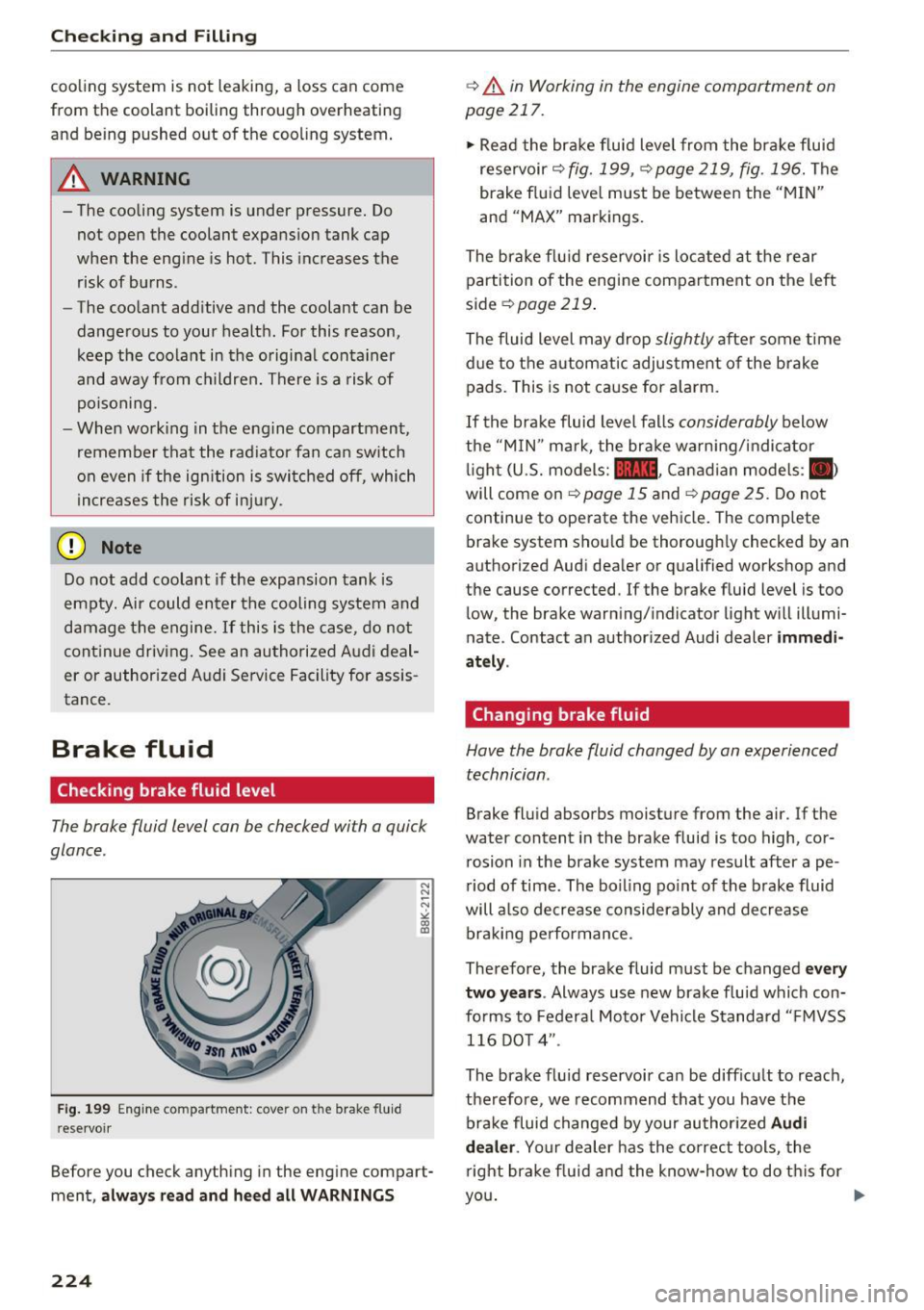
F ig. 19 9 En gi ne co mpa rtme nt: cove r on the brak e fluid
r ese rvoi r
N N
-N
" "' IX)
Before you check anyth ing in the eng ine compart
ment,
a lways read and h eed all WARNING S
224
¢.&. in Working in the engine compartment on
page 217.
.,. Read the bra ke fluid level from the brake f lu id
reservoir ¢
fig. 199, ~ page 219, fig. 196. The
brake fluid leve l must be between the "M IN"
and "MAX" markings.
The brake flu id reservoir is located a t the rear
partition of the engine compartment on the left
side
¢ page 219.
The fluid level may drop slightly afte r some t ime
due to t he automatic adjustme nt of the brake
pads. This is not ca use for a larm.
If the brake fluid level falls considerably below
the
" M IN " mark, the bra ke warn ing/ indica tor
li gh t (U.S. models:
11111 . Canadian models: .
will come on ¢
page 15 and¢ page 25. Do not
continue to ope rate the veh icle. The comp lete
brake system shou ld be thoroughly checked by an
a uthor ized Audi dealer or qualified workshop and
the cause corrected. If the brake fluid level is too l ow, the brake warn ing/ indicator light w ill illumi
nate. Contact a n author ized Audi dealer
immedi
ately .
Chang ing brake fluid
Have the brake fluid changed by an experienced
technician .
Brake fluid absorbs moisture from the air. If the
water content in the brake fluid is too high, cor
rosion in the brake system may result after ape
riod of time . The boiling po int of the brake fluid
will a lso decrease considerably and decrease
bra king pe rformance.
Therefore, the brake fluid must be changed
every
two years .
Always use new brake f lu id which con
fo rms to Federa l Moto r Vehicle S tandard " FMVSS
116 DO T 4".
The brake fluid reservoir can be diff icult to reach,
therefore, we recommend that you have the
brake fluid changed by your author ized
Audi
dealer .
Your dealer has the correct tools, the
right brake fluid a nd the know -how to do t his for
you . ..,.
Page 244 of 296
Wheels
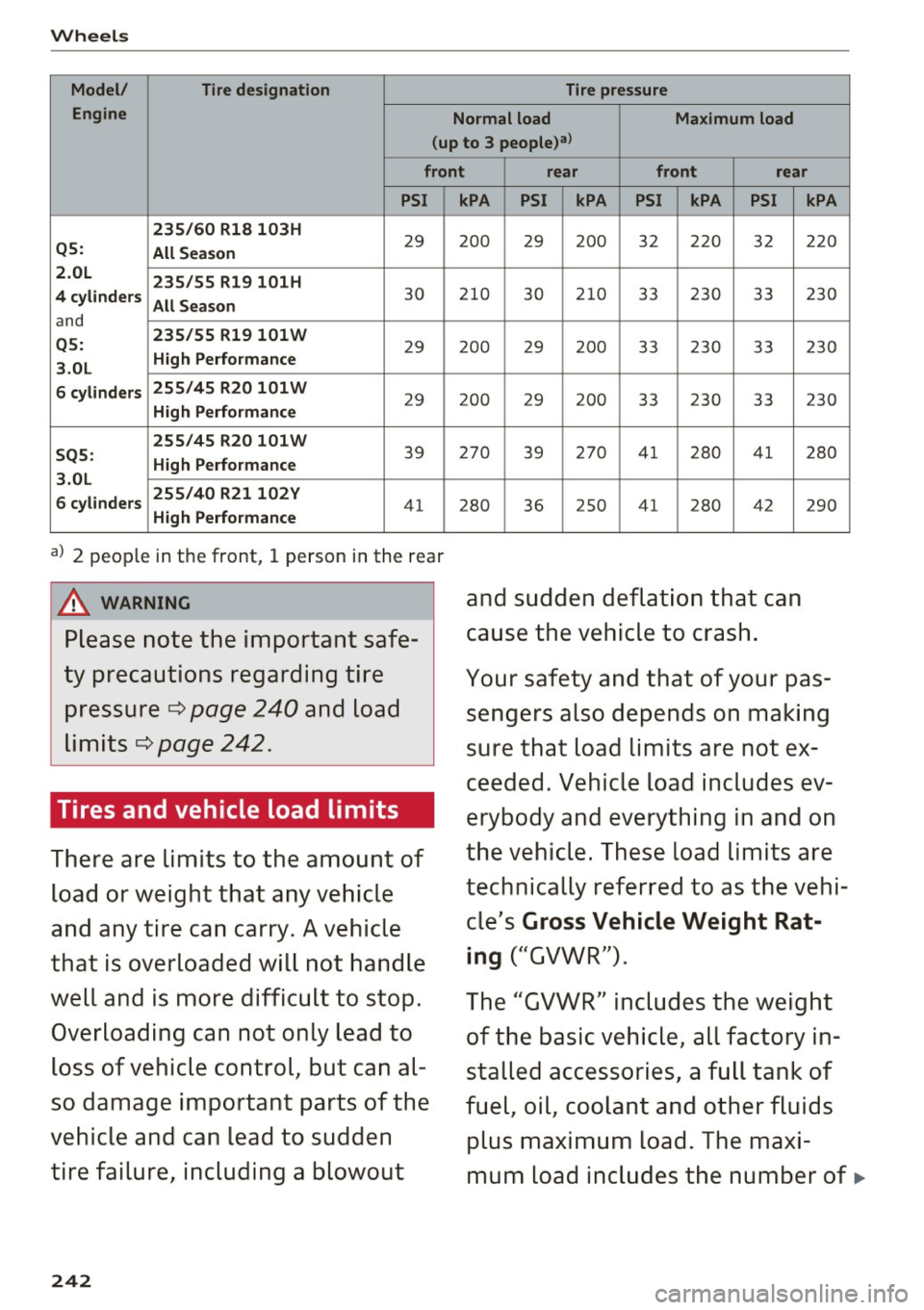
Model/ Tire designation Tire pressure
Engine Normal load
Maximum load
(up to
3 people)a)
front rear front rear
PSI
235/60 Rl8 103H
29 Q5:
All Season
2.0L 235/55 Rl9 101H
4 cylinders
All Season
30
and
Q5: 235/55 Rl9
101 W 29 High Performance
3.0L
6 cylinders 255/45 R20 101W
29 High Performance
255/45R20101W
39 SQ5:
High Performance
3.0L
6 cylinders 255/40
R21102Y
41 High Performance
a) 2 people in the front, 1 perso n in the r ear
A WARNING
Please note the important safe
ty precautions regarding tire pressure ¢
page 240 and load
limits ¢
page 242.
Tires and vehicle load limits
There are limits to the amount of
load or weight that any vehicle
and any tire can carry . A vehicle
that is overloaded will not handle
well and is more difficult to stop.
Overloading can not only lead to
loss of vehicle control, but can al
so damage important parts of the
vehicle and can lead to sudden
tire failure, including a blowout
242
kPA PSI kPA PSI kPA PSI
200 29 2 00 32 220 32
210 30 210 33 230 33
200 29 200 33 230 33
2 00 29 2 00 3 3 230 33
270 39 270 41 280 41
2 80
36 2
50 41
28 0 42
and sudden deflation
that can
cause the vehicle to crash.
kPA
220
230
230
230
280
2 9 0
Your safety and that of your pas
sengers also depends on making
sure that load limits are not ex
ceeded. Vehicle load includes ev
erybody and everything in and on
the vehicle. These load limits are
technically referred to as the vehi
cle's
Gross Vehicle Weight Rat
ing
("GVWR") .
The "GVWR" includes the weight
of the basic vehicle, all factory in
stalled accessories , a full tank of
fuel, oil, coolant and other fluids
plus maximum load. The maxi
mum load includes the number of
11-