Heat AUDI Q5 2017 Owner's Manual
[x] Cancel search | Manufacturer: AUDI, Model Year: 2017, Model line: Q5, Model: AUDI Q5 2017Pages: 296, PDF Size: 74.43 MB
Page 195 of 296
CD
CD
.... N ,-... N ..... 0 0 C<'. 00
ignition switched off, it controls the energy sup
ply to the various electrical components . Data
from battery diagnosis is considered.
Depending on the battery 's state of charge, ind i
vid ual consumers are gradually turned off to pre
ve nt excessive discharge of the battery and thus
maintain starting capability.
Dynamic en ergy management
Wh ile the veh icle is being driven , dynamic energy
management dist ributes the energy ge nerated
according to the needs of the individua l compo
nents . It regulates consumption, so that more
e lectrical energy is not being used than is being
generated and ensures an optimal state of
charge for the battery.
- But even energy management cannot neg
ate the limits of physics. Consider that the power and life of a battery are limited.
- If starting ability is threatened, the indica
tor light (•] appears
¢ page 30 .
What you should know
The highest priority is given to maintaining start
ing capability .
The battery is severely taxed in short-distance
driving, in city traffic and during the co ld time of
year. Abundant electrical energy is required, but only a little is generated . It is also crit ica l if the
engine is not runn ing and electrical components
are turned on . In this instance energy is being
consumed but none is being generated .
It is in precisely these situations that you will no
tice energy management actively regulat ing the
d istr ibution of energy .
Vehicle stands for an extended p eriod
If you do not drive your vehicle over a period of
several days or weeks, electrical components are
gradually cut back or sw itched off. This reduces
energy consumption and ma inta ins starting ca
pability over a longer pe riod . Some of the con
ve nience funct ions may not operate, suc h as the
inte rior ligh ts or the powe r seat adjustment. The
Intellig ent Technology
convenience functions will be availab le aga in
when you switch on the ignition and sta rt the en
gine.
With the engine turn ed off
If you listen to the rad io, for examp le, with the
engi ne turned off or use other
MM I* functions,
the battery is being discharged .
If s tarting capab ility is jeopardized due to energy
consumption, a message appears in the rad io or
MM I* disp lay. The message indica tes that the
system will be switched off automatically in a
moment . If you wish to continue using the func
t ions, you have to start the engine.
With the engine running
Although e lectr ic al energy is generated when t he
vehicle is being driven, the batte ry can become
discharged. This happens mostly when litt le en
ergy is being generated and a great dea l con
sumed and the battery's state of charge is not
optimal.
To bring the energy balance back into equilibr i
um, consumers whic h require especia lly large
amounts of energy are temporari ly cut back or
switched off. Heating systems in particular re
quire a great deal of energy. If you notice, for ex
ample, that the heated seats* or the heated rear
window a re not heati ng, they have bee n tempo
rarily cut bac k or switched off . T hese systems will
be available again as soon as the ene rgy balance
has been restored.
You w ill also notice that engine idle speed has
been increased s light ly. This is no rma l and not a
ca use for concern. By increas ing engine idle
speed the additional energy required is genera t
ed and the battery is charged.
193
Page 197 of 296
CD
CD
.... N ,-... N .... 0 0 c:<: 00
-Do not apply additional undercoating or
rustproofing on or near the exhaust mani
fold, exhaust pipes, catalytic converter or heat shields. During dr iv ing, the substance
used for undercoating could overheat and
cause a fire.
Q) Note
- Be aware that just one tank filling with
leaded fuel will already ser iously degrade
t h e pe rformance of the catalytic converter .
- Do not exceed the correct eng ine o il level
c:> page 221.
-Do not drive until the fuel tank becomes
complete ly empty. The engine could mis
fire. Unburned fuel could also get into the
exhaust system and this cou ld cause the
catalytic conve rte r to overheat.
- Do not tur n off the ignition whi le the vehicle
i s mov ing.
- Do not continue to operate your vehicle un
der these cond it ions, as otherwise fuel can
r each the catalytic converte r. This cou ld re
su lt in ove rheating of the converte r, req uir
i ng its replacement.
- To assu re efficient operation of the Emis
s ion Control System:
- Have your vehicle maintained properly and
in accordance with the service recommen
dations in your Warranty
& Maintenance
booklet.
- Lack of proper maintenance as well as im
proper use of the vehicle will impair the
function of the em ission control system
and co uld lead to damage.
@) For the sake of the environment
Even when the Em ission Control System is op
erat ing properly, the exhaust gas can have a
sulfur-like exhaust gas smell under some op
erat ing states. This depends on the su lfu r
conten t of the fuel being used. Using a differ
ent brand of fue l may he lp, or filling the tan k
with lead -free s uper grade gasoline.
Driving and the envir onment
Diesel particulate filter
App lies to : veh icles w ith diesel en gine
The diese l particu late filter filters near ly all of
the soot particles out of the exhaust. The filter
cleans itself automatica lly under norma l driving
condit ions. If the filter cannot clean itself (for ex
amp le, because you are only driving short distan
ces), the filter becomes clogged with soot and
the m symbol for the d iesel part icu late filter il
luminates
c:> page 31 .
_&. WARNING
-Do not park your veh icle over flammab le
mate ria ls s uch as grass or leaves because
the high temperature of the diesel particu
late filter cou ld start a fi re.
-
- Do not app ly an underbody pro te ctant in the
exhaust system area or a fire could sta rt .
Avoid damaging the
vehicle
When you are driving on poor roads, or over
curbs, steep ramps, etc., make certain that low
ly ing parts such as spo ilers and exhaust system
parts do not bottom out and get damaged .
This is especially true for vehicles with low-s lung
chassis (sports chass is)* and fully loaded
vehicles.
Economical and environ
mentally-friendly driving
General
Your personal style of driving will determine the
economy of your vehicle, as well as exhaust and
noise levels .
Fuel economy, env ironmental impact, and wear
o n your engine, brakes and tires large ly depend
on three factors :
- your pe rsonal d riving s tyle
- operat ing cond itions
- technical limitat ions
If you ant ic ipate what you need to do next and
drive economically, you can easily cut your fuel
195
Page 198 of 296
Driving and th e en vironm ent
consumption by 10-15 percent. This section will
give you some tips on how you can help the envi
ronment and your pocketbook.
(D Tips
The consumption estimates as published by
ENVIRONMENTAL PROTECTION AGENCY
(EPA) and Transport Canada may not corre
spond to your actual consumption on the
road, which will vary depend ing upon vehicle
load and speed, road and weather conditions,
trip length, etc .
Drive smoothly and keep a lookout ahead
Vehicles use the most fuel when they are acceler
ating .
"'Avo id unnecessary accelerating and braking.
Vehicles use the most fuel when they are acceler
ating . If you anticipate what is going to happen
next, you will need to brake less and, thus, accel
erate less . Let the vehicle coast whenever possi
ble -for example when you see that the next traf
fic light is red .
Avoid full throttle
Driving a t moderate speeds saves fuel and im
proves your mileage .
"'Try and keep well below your car 's maximum
speed .
Accelerating gent ly reduces fuel consumption,
engine wear, and does not disturb the environ
ment.
Fue l cons umption, exhaust emissions and engine
noise increase d isproportionately at high speeds .
If you drive at approximately three q uarters of
top speed, fuel consumpt ion w ill be reduced by
one half. Never drive faster than the posted
speed limit and weather conditions permit.
196
· Reducing unnecessary idling
E ven when your car is just idling it burns up fuel .
"'Shut the engine off when you are not driving
the vehicle.
"' Do not warm up the vehicle by letting the en-
gine run at idle .
The idling phase is automatically reduced for
vehicles with the Start-Stop-System*. It is effi c ient to sw itch off the engine in vehicles without
the Start-Stop-System* when stopped at ra ilroad
cross ings and long red lights. Turning the engine
off fo r just 30-40 seconds saves more fuel than is
bur ned by s tarting the engine again .
It takes a long time for the engine to warm up
fully when it is runn ing at id le . However, wea r
and noxious emissions are especially high when
the engine is warming up . So yo u should dr ive
away as soon as you sta rt the eng ine and avo id
running at hig h rpms whi le the engine is st ill
warming up .
Q) Note
Do not leave eng ine idling una ttended after
starting. If warning lights shou ld come on to
indicate improper operation, they would go
unheeded. Extended idling also prod uces
heat, which could result in overheating or
other damage to the vehicle or other proper
ty .
· Regular maintenance
A badly tuned engine unnecessarily wastes a lot
of fuel .
"' Have your vehicle serviced at regular interva ls.
By having your vehicle regular ly serv iced by an
authorized Audi dea le r helps to ensure that it
r uns prope rly and economically . The condition of
your vehicle not on ly affects its safety and ability
to hold its value, it also affects
fuel consump
t ion .
Check your oil each time you fill your tank.
The amou nt o f oi l used is related to engine load
and speed. ..,
Page 199 of 296
CD
CD
.... N ,-... N .... 0 0 C<'. 00
It is normal for the oil consumption of a new en
gine to reach its lowest value after a certain mile
age has been driven .
You must drive your vehicle abo ut 3,000 miles
(5,000 k ilometers) before you can proper ly as
sess oi l cons umption.
This a lso applies to fuel consumption and engine
ou tput.
(y Note
- Have your vehicle maintained properly and
in accordan ce with the servi ce recommend a
tions in yo ur Warranty
& Ma intenance book
l et. Lack of proper maintenance as well as
i mproper use of the vehicle will impair the
funct ion of the emission control system and
could lead to damage.
- Do not alter or remove any component of
the Em ission Control System unless ap
proved by the manufacturer.
- Do not a lter or remove any device, such as
heat shie lds, sw itches, ignition wires,
valves, which are designed to protect your
vehicle's Em ission Control System and other
i mportant vehicle components .
Fewer short trips
Fuel consumption will always be relatively high
on short trips .
.. Try to avoid driving short distances with a cold
engine.
The engine and catalyt ic converter have to reach
their optimal
ope rating temperature to reduce
fuel consumption and noxious emissions effec
t ively .
Just after starting, a co ld engine in a mid-size car
only achieves a fuel economy of 6-8 miles per
ga llon (30-40 l/100 km). After about a half a
mile, fuel economy cl imbs to 12 mpg (20 l/100
km). After about
2 .5 miles (4 km), the engine is
at its proper operating temperature and fuel
economy has reac hed a norma l level. So you can
see that you sho uld avo id short t rips w henever
possib le.
Driving and the envir onment
The out side tempe rature is a lso crit ica l in this re
gard . Your car consumes more fuel in the winter
than in the summer .
197
Page 204 of 296
Trailer towing
Sp eed
The higher the speed, the more d ifficult it be
comes for the driver to contro l the rig. Do not
dr ive at the maximum permissible speed. Reduce
your speed even more if load, w eather or wind
conditions are unfavorable -particularly when
going downhill.
Red uce vehicle speed
immediatel y if the trai le r
shows the s lightest sign of swaying .
Do not try
to stop the swayin g by ac cele rating.
Observe speed limits . In some areas, speeds for
vehicles towing trailers are lower than for reg ular
ve hicles.
A lways apply b rakes early . When dr iving down
hi ll, shi ft into a lower gear to use the engine
braking effect to slow the vehicle. Use of the
brakes a lone can cause them to overheat and fail.
Coolant temperature
The coolant temperatu re gauge ¢ page 8 must
be observed ca refully . If the needle moves close
to the upper end of the scale, reduce speed im
mediately and/or turn off the air conditioner .
I f t he coolan t temperature warn ing light i n the
instr ument cluster s tarts flashing ., pull off
the road, stop and let the engine
idle for about
two minutes to prevent heat bu ild-up .
A WARNING
Anyone not properly restrained in a moving
vehicle is at a much greater risk in an acci
dent . Never let anyone ride in your car who is
not properly wearing the restraints provided
by Audi .
Trailer towing
information
Important to know
Your veh icle hand les different ly when tow ing a
tra iler because of the additional weight and dif
fe rent weight d istr ibut ion . Safety, performance
and economy w ill great ly depend on how careful
ly you load you r trailer and operate your rig .
202
Before you actually tow your trailer, practice
turning, stopping and backing up in an area away
from traffic . Keep pract icing unt il yo u h ave be
come comp lete ly familiar w ith the way your vehi
cle-tra iler combination behaves and responds.
Backing up is difficult and requires practice .
Backing up w ith a trailer generally req uires steer
i ng action opposite to that when backing up your
vehicle without a trailer.
Maintain a greater distance between your vehicle
and the one in front of you . You will need more
room to stop. To compensate for the trailer, you
will need a larger than normal turning radius.
When passing, remember that you cannot accel erate as fast as you normally wou ld because of
the added load. Make sure you have enough room
to pass. After passing, allow p lenty of room for
your trailer before changing lanes again.
Avo id jerky starts, sharp turns or rapid lane
changes.
(D Tips
- Do not tow a trailer during the break-in peri
od of your veh icle.
- If you tow a trai ler, your Audi may requi re
more frequent maintenance due to the ex
tra load ¢
page 2 76.
' Parking on a slope
Do not park on a slope with a trailer. If it cannot
be avoided, do so only after doing the following:
When parking:
.,. App ly the foot bra ke .
.,. Have someone place cho cks under bot h the ve
hicle and the trailer wheels .
.,. With choc ks in place, slowly release the brakes
until the wheel chocks absorb the load.
.,. Turn the wheels towards the curb .
.,. App ly the parking brake .
.,. Move the selector lever to P .
When restarting after parking :
.,. App ly the foot brake .
.,. Start the eng ine .
.,. Move the se lector lever to D/S.
Page 210 of 296
Care and cleaning
avoid scratches, move the scraper on ly in
one direction and not back and forth.
- Never remove snow or ice from door win
dows and mirrors using warm or hot water
because this could cause cracks to form .
- To avoid damage to the rear w indow de
fogger, do not apply any stickers on the
heating wires on the inside of the window .
-Decorative parts /trim
- Never use chrome care or cleaning prod-
ucts.
-Paint
-To red uce the risk of scratches, the vehicle
must be free of dirt and dust before pol
ishing or waxing .
- T o prevent pa int damage, do not polish or
wax the veh icle in direct sunlight.
- To red uce the risk of pa int damage, do not
polish away rust spots.
- Remove cosmetics and sunscreen immedi
ately -these could damage the paint.
- Di spla ys
- To avoid scratches, do not use dry cleaning
methods on displays .
-Controls
- Make sure that no fluids enter the con-
trols, because this could cause damage.
- Safety belts
- Do not remove the safety belts to clean
them.
- Never clean safety belts o r th eir compo
nents chemically or with cor rosive fl uids
or so lvents and neve r al low sha rp objects
t o come into con ta ct w ith the safe ty belts.
T his could cause damage to the belt web
bing .
-If there is damage to the webbing, the
connections, the retractors or the buckles,
have them replaced by an author ized Audi
dealer or authorized Audi Service Facility.
- Textiles /artificial leather/ Alcantara
- Never treat artificia l leather/ Alcantara
w ith leather care products, so lvents, floor
polish, shoe polish, spot remove or similar
prod uct s.
- Have a specialist remove st ubborn stains
to prevent damage.
208
- Never use steam cleaners, brushes, hard
sponges, etc . when cleaning .
- D o not turn on the seat heating* to dry the
seat.
- Objects w ith sharp edges, such as zippe rs
or rivets on clothing or belts, can cause
damage to the surface .
- Open hook and loop fasteners, fo r exam
p le on clothing, can damage seat covers.
Make sure hook and loop fastene rs are
closed.
- Natural leather
- Never treat leather with solvents, floor
polish, shoe polish, spot remover or sim i
lar p roducts .
- Objects w ith sharp edges, such as zippers
or rivets on clothing or belts, can cause
damage to the surface.
- Never use steam cleaners, brushes, hard
sponges, etc. when cleaning.
- Do not turn on the seat heating * to dry the
seat.
- To he lp prevent the leather from fad ing,
do not leave the vehicle in d irect sunlight
for long periods of time . If leav ing the ve
h icl e parked fo r long pe riods of time, you
should cove r the leathe r to pro te ct it from
d irec t sunlight.
{D Tips
- Insects are easier to remove from paint that
has been freshly waxed.
- Regular waxing can prevent rust spots from
forming.
Placing your vehicle out
of service
If you would like to take your vehi cle out of serv
ice for a longer period of time, contact an author
ized Audi dealer or authorized Audi Service Facili
ty. They will adv ise you of important measures,
such as corrosion protect ion, serv ice and storage
procedures . Also follow the information about
the battery ~
page 225.
Page 213 of 296
CD
CD
.... N ,-... N .... 0 0 C<'. 00
Gasoline additives
Applies to: vehicles with gasoline engine
A major concern among many auto manufactur
ers is carbon deposit build-up caused by the type
of gasoline you use.
Although gasoline grades differ from one manu
facturer to another, they have certain things in
common. All gasoline grades contain substances
that can cause deposits to collect on vital engine parts, such as fuel injectors and intake valves . Al
though most gasolin e brands include additives to
keep engine and fuel systems clean, they are not
equally effe ctive.
Audi recommends using TOP TIER Detergent Gas
oline. For more information on TOP TIER Deter
gent Gasoline , please go to the official website
(www.toptiergas.com).
After an extended period of using inadequate
fuels, built-up carbon depos its can rob your en
gine of peak performance.
CD Note
- Damage or malfunction due to poor fuel
quality is not covered by the Audi New Vehi
cle Limited Warranty .
- Do not add aftermarket fuel additive prod
ucts to your fuel tank.
Diesel fuel
Applies to: veh icles with diesel eng ine
Always use ULSD (Ultra Low Sulfur Diesel) No. 2.
The ULSD No . 2 meets the ASTM 0975.
Diesel fuel with concentrations of biodiesel high
er than S % such as 811,820 or 8100 are strictly prohibited.
Service station fuel pumps are labeled with the
correct fuel information for easy recognition by
the user. If the diesel fuel pump is not labeled
ask the station operator what fuel is being dis
pensed before filling up your vehicle .
ULSD No . 2 may not be available outside the USA
and Canada. Be sure to check before traveling to
other countries.
Fuel and Refueling
ULSD No. 2 can become thicker in very cold tem
peratures, and this can impair the engine 's start
ing and running. Depending on the season, gas
stations provide ULSD No.
2 that flows better in
cold temperatures so tha t you can continue oper
ating your vehicle as usual.
CD Note
- Your vehicle's diesel engine was designed
soley for use with ULSD No.
2. Therefore,
never use gasoline, heating oil, other fuels
or flow improvers . These contain substances
that will severely damage the fuel system
and the engine. Such damage will not be
covered by your New Vehicle Limited War
ranty.
- If you put any amount of incorrect fuel in
the fuel tank, do not start the engine under
any circumstances. Immediately contact the
nearest authorized Audi dealer or author
ized Audi Service Facility for assistance.
These fuels contain substances that can se
verely damage the fuel system and the en gine if the engine is started .
Refueling
Fuel filler neck
The fuel filler neck is located on the right rear
side panel behind the fuel filler flap.
If the power locking system should fail, you can
still open the flap manually -for detailed instruc
tions see
¢ page 213.
You can find the fuel tank capacity of your vehicle
in
¢ page 273.
The label on the inside of the fuel filler flap tells
you the correct fuel for your vehicle. For more in
format ion about fuel specificat ions, see
¢ page 209.
Your vehicle fuel tank has an on-board refuelling
vapor recovery system. This feature helps to pre
vent fuel vapors from escaping from the tank and polluting the environment while you refuel your
vehicle. In order to fill the tank properly while
protecting the environment, please follow this
refueling procedure carefully.
211
Page 220 of 296
Checking and Filling
-Always let the engine cool down. Hot com
ponents will burn skin on contact .
- To reduce the risk of being burned, never
open the hood if you see or hear steam or
coolant escaping from the engine compart
ment. Wait until no steam or coolant can be
seen or heard before carefully opening the
hood.
- Keep children away from the engine com
partment.
- Never spill fluids on hot engine compo
nents . They can cause a fire.
- Never touch the radiator fan. The auxiliary
electric fan is temperature controlled and
can switch on suddenly.
- Never open the coolant reservoir cap when
the engine is still warm. The coolant system
is pressurized and hot coolant could spray
out .
- Protect your face, hands and arm from steam or hot engine coolant by placing a
thick rag over the cap when you open the coolant reservoir.
- Do not remove the engine cover under any
circumstances . This increases the risk of
burns.
- If work on the fuel system or the electrical
system is necessary:
- Always disconnect the battery.
- Never smoke or work near heaters or open flames. Fluids in the engine compartment
could start a fire.
- Keep an approved fire extinguisher imme
diately available.
- To avoid electrical shock and personal injury
while the engine is running or being started, never touch:
- Ignition cables
- Other components of the high voltage
electronic ignition system .
- If you must perform a check or repair with
the engine running:
- First, fully apply the parking brake, move
selector lever of automatic transmission
to P (Park).
218
- Always use extreme caution to prevent
clothing, jewelry, or long hair from get
ting caught in the radiator fan, V-belts or
other moving parts, or from contacting hot parts . Tie back hair before starting,
and do not wear clothing that will hang or
droop into the engine.
- Minimize exposure to emission and chemi
cal hazards
~ &.
&, WARNING
California Proposition 65 Warning:
- Engine exhaust, some of its constituents,
and certain vehicle components contain or
emit chemicals known to the State of Cali
fornia to cause cancer and birth defects and
reproductive harm. In addition, certain flu
ids contained in vehicles and certain prod
ucts of component wear contain or em it
chemicals known to the State of California
to cause cancer and birth defects or other
reproductive harm .
- Battery posts, terminals and related acces sories contain lead and lead compounds,
chemicals known to the State of California
to cause cancer and reproductive harms .
Wash hands after handling.
('.!) Note
When adding fluids, always make sure that
they are poured into the proper container or
filler opening, otherwise serious damage to
vehicle systems will occur.
@ For the sake of the environment
To detect leaks in time, inspect the vehicle
floor pan from underneath regularly . If you
see spots from oil or other vehicle fluids, have
your vehicle inspected by an authorized Audi dealer.
Page 226 of 296
Checking and Filling
cooling system is not leakin g, a loss can come
from t he coolant boiling through overheat ing
an d be ing pushed out o f the coo ling system .
A WARNING
-
-The cooling system is under pressure. Do
not open t he coolant expansion tank ca p
when the eng ine is hot. This inc reases the
risk of bu rns .
- The coolant add itive and the coolant can be
dangerous to your health. For this reason,
keep the coolant in the o rigina l container
and away from children. There is a risk of
po isoning .
- When working in the eng ine compartmen t,
r emembe r that the rad iator fan ca n switch
on even if the ign ition is swi tc h ed off, which
in creases the risk of in jury.
(D Note
Do not add coolant if the expansion tank is
empty. Air could enter the cooling system and
damage the engine. If this is the case , do no t
cont inue driv ing. See an authorized Audi deal
er or author ized Audi Se rvice Facility for assis
tance .
Brake fluid
Checking brake fluid level
The brake fluid level can be checked with a quick
glance.
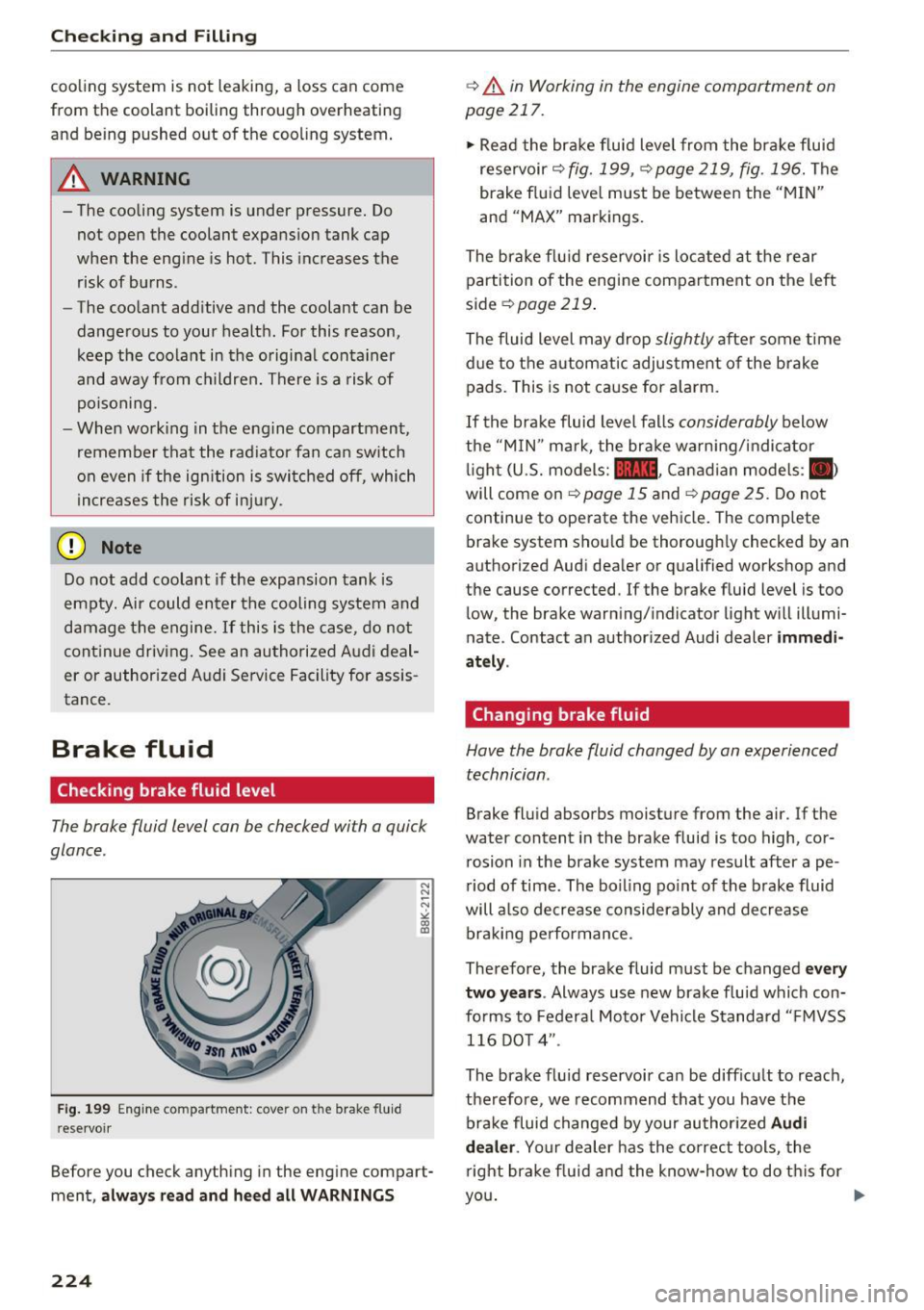
F ig. 19 9 En gi ne co mpa rtme nt: cove r on the brak e fluid
r ese rvoi r
N N
-N
" "' IX)
Before you check anyth ing in the eng ine compart
ment,
a lways read and h eed all WARNING S
224
¢.&. in Working in the engine compartment on
page 217.
.,. Read the bra ke fluid level from the brake f lu id
reservoir ¢
fig. 199, ~ page 219, fig. 196. The
brake fluid leve l must be between the "M IN"
and "MAX" markings.
The brake flu id reservoir is located a t the rear
partition of the engine compartment on the left
side
¢ page 219.
The fluid level may drop slightly afte r some t ime
due to t he automatic adjustme nt of the brake
pads. This is not ca use for a larm.
If the brake fluid level falls considerably below
the
" M IN " mark, the bra ke warn ing/ indica tor
li gh t (U.S. models:
11111 . Canadian models: .
will come on ¢
page 15 and¢ page 25. Do not
continue to ope rate the veh icle. The comp lete
brake system shou ld be thoroughly checked by an
a uthor ized Audi dealer or qualified workshop and
the cause corrected. If the brake fluid level is too l ow, the brake warn ing/ indicator light w ill illumi
nate. Contact a n author ized Audi dealer
immedi
ately .
Chang ing brake fluid
Have the brake fluid changed by an experienced
technician .
Brake fluid absorbs moisture from the air. If the
water content in the brake fluid is too high, cor
rosion in the brake system may result after ape
riod of time . The boiling po int of the brake fluid
will a lso decrease considerably and decrease
bra king pe rformance.
Therefore, the brake fluid must be changed
every
two years .
Always use new brake f lu id which con
fo rms to Federa l Moto r Vehicle S tandard " FMVSS
116 DO T 4".
The brake fluid reservoir can be diff icult to reach,
therefore, we recommend that you have the
brake fluid changed by your author ized
Audi
dealer .
Your dealer has the correct tools, the
right brake fluid a nd the know -how to do t his for
you . ..,.
Page 228 of 296
Check ing and F illing
in the luggage compartment, re ad and heed all
W ARNING S~
A .
Hybr id d rive*: you can find important information
about the h igh vo ltage bat tery unde r
c;>poge 100.
Always heed the s afet y warning s, when working
on the vehicle battery or the vehicle electrical
system to prevent injury .
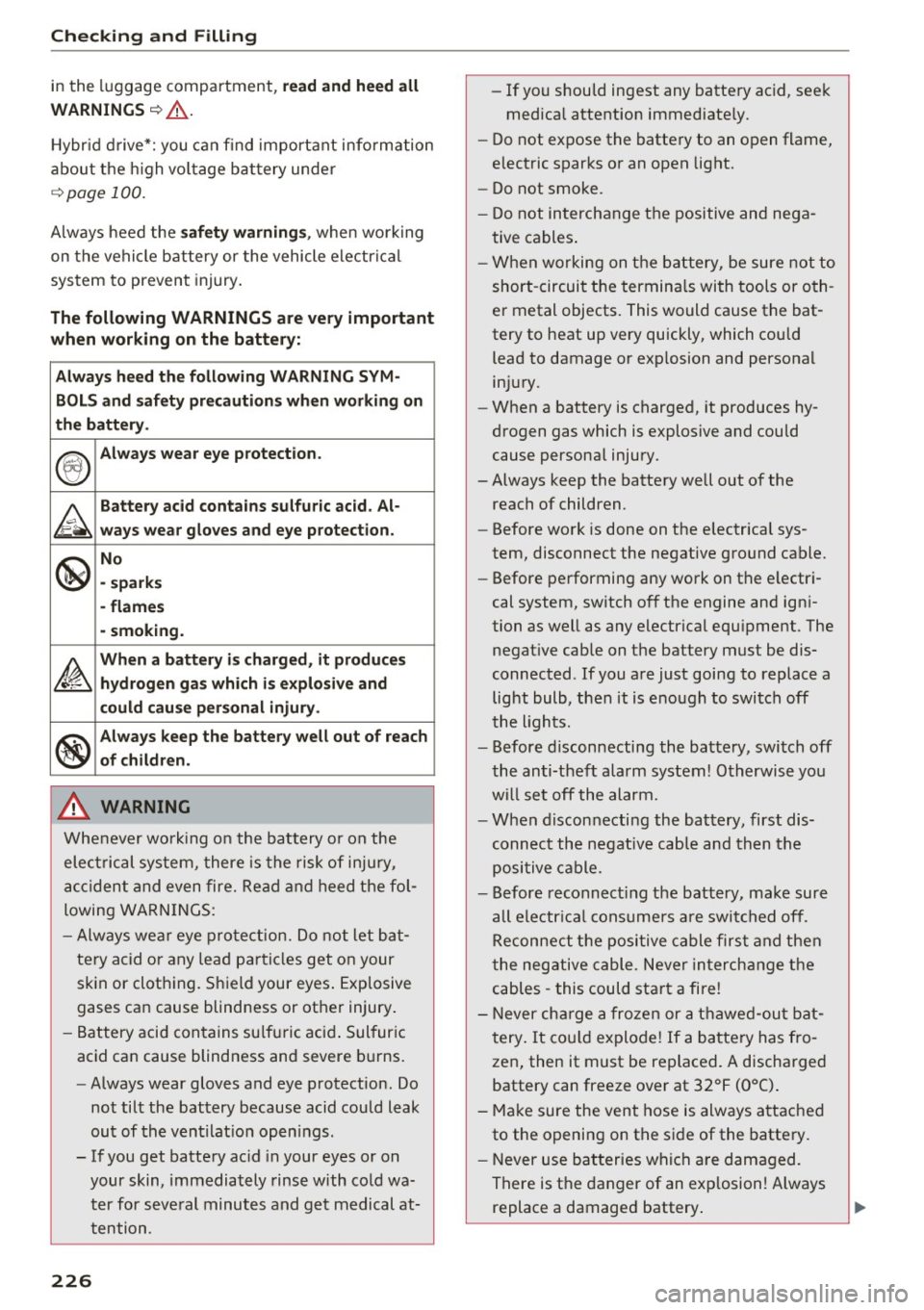
The following WARNINGS are very important
when working on the battery:
A lway s heed the following WARNING SYM-
BOLS and saf ety pr ecautions when working on
the battery.
®
A lway s wear ey e protection .
A
Batter y acid conta ins sulfu ric acid. Al -
w ays wear glo ves and eye p rotection .
.
@
No
- spa rks
- flame s
- smoking.
~
When a battery is charg ed, it produc es
hydrogen gas whi ch is ex pl osi ve and
c o uld cause p ers ona l injury.
®
Alwa ys keep the ba ttery we ll out of rea ch
of child ren.
A WARNING
Whenever work ing on the battery or on the
elect rical system, there is the risk of inju ry,
accident and even fire. Read and heed the fol
lowing WARN INGS:
- Always we ar eye pro tection. Do not let bat
tery acid or any lead particles get on your
skin or clothing. Shield your eyes . Explosive
gases can cause blindness or other injury .
- Battery acid con tains su lfu ric acid . Sulfur ic
acid can cause blindness and severe b urns.
- Always wear gloves and eye protection. Do
not tilt the battery because acid could leak
out of the ventilat ion open ings.
- If you get battery ac id in your eyes or on
your skin, immediately rinse with cold wa
ter for several minutes and get medical at
tention .
226
-If you should ingest any batte ry acid, seek
medical attention immediate ly.
- Do not expose the battery to an open flame,
electric sparks or an open light.
- Do not smoke.
- Do not interchange t he positive and nega -
tive cables .
- When working on t he ba ttery, be sure not to
short -circuit the termina ls with tools or o th
er metal objects. This would cause the bat
tery to heat up very quickly, which could lead to damage or exp losion and personal
injury .
- When a battery is charged, it produces hy
drogen gas which is explosive and could
cause persona l injury.
- Always keep the battery well out of the
reach of children.
- Before wo rk is done on the electrical sys
tem, disconnect the negative ground cable.
- Before performing any work on the e lectri
cal system, sw itch off the engine and ign i
tion as well as any electrical equ ipment. The
negat ive cab le on the battery must be dis
connected . If you a re just going to replace a
light bulb, then it is enough to switch off
the l ights.
- Before d isconnecting the battery, switch off
the anti-theft alarm system ! Otherwise you
will set off the alarm.
- When disconnecting the battery, first dis
connect the negative cable and then the
positive cable.
- Before reconnect ing the battery, make sure
all electr ica l cons umers a re switched off.
Reconnect the positive cable firs t and then
the negative cable . Never in terchange the
cables -this could start a fire !
- Never cha rge a fro zen or a t hawe d-ou t bat
tery . It co uld explode! If a ba tte ry has fro
ze n, then it must be replaced. A discharged
battery can freeze over at 32°F (0°() .
- Ma ke sure the vent hose is always attached
to the opening on the side of the battery .
- Never use bat teries which a re damaged.
There is the danger of an exp losion! Always
replace a damaged battery .