radio AUDI Q5 2017 Owner's Manual
[x] Cancel search | Manufacturer: AUDI, Model Year: 2017, Model line: Q5, Model: AUDI Q5 2017Pages: 296, PDF Size: 74.43 MB
Page 223 of 296
CD
CD
.... N ,-... N .... 0 0 C<'. 00
(D Note
Driving with an insufficient oil leve l is likely to
cause severe damage to the engine .
@ Tips
-The oil pressure warning display. is not
an indicator of the oil level. Do not rely on
it. Instead , check the oil level in your en
gine at regular intervals, preferably each
time you refuel, and always before going
on a long trip.
- If yo u have the impression your engine con
sumes excessive amounts of oil, we recom
men d that you cons ult an autho riz ed Au di
dealer to hav e the ca use of your conce rn
properly diagnosed. Keep in mind that the
a ccu ra te measurement of oil consump tion
r equi re s gre at care and m ay ta ke some
time. An a uthorized Audi de aler has instr uc
tions about how to measure oil consump
tion acc urately.
Checking the engine oil level
Read oil level
"' Park your vehicle so that it is hor izonta lly level.
"' Shu t the engine off when it is at operat ing tem-
perature.
"' Switch only the ignition back on .
"' Wai t approx. two mi nutes .
"' Se lect:
I CARI funct ion button > Oil lev el. Or
"' Se le ct:
ICARI f u n ct ion butto n> Car sy stem s*
contro l button > Servicing & checks > Oil level.
"' Read the oil level in the r adio or M MI* Disp lay.
Add engine oil if the ba r of the o il level indica
tor is near "Min"
¢ page 221.
The o il level needs to be c heck ed at reg ular i nter
va ls. The bes t times to do this are w henever you
refuel and pr io r to long trips .
D epending on t he way t he ve hicle is dr iven and
the operat ing cond itions, o il cons umption can be
up to a 1 /2 q uart per 600 m iles ( O.S li ter per
1,000 km) . Cons umption may be hig he r within
the first 3,000 miles (5,000 km).
Checking and Filling
{!) Tips
The oil leve l indicator in t he radio o r MMI*
D isp lay is only an i nfo rmation disp lay. If the
oi l level is too low, a minimum o il wa rning ap
pears in the instrument cl uster. Add oil
¢ page 221. If the hood has been o pened ,
t he cur rent oi l level is show n in the inst ru
ment clust er the n ext time t he igni tion is
swi tched o n.
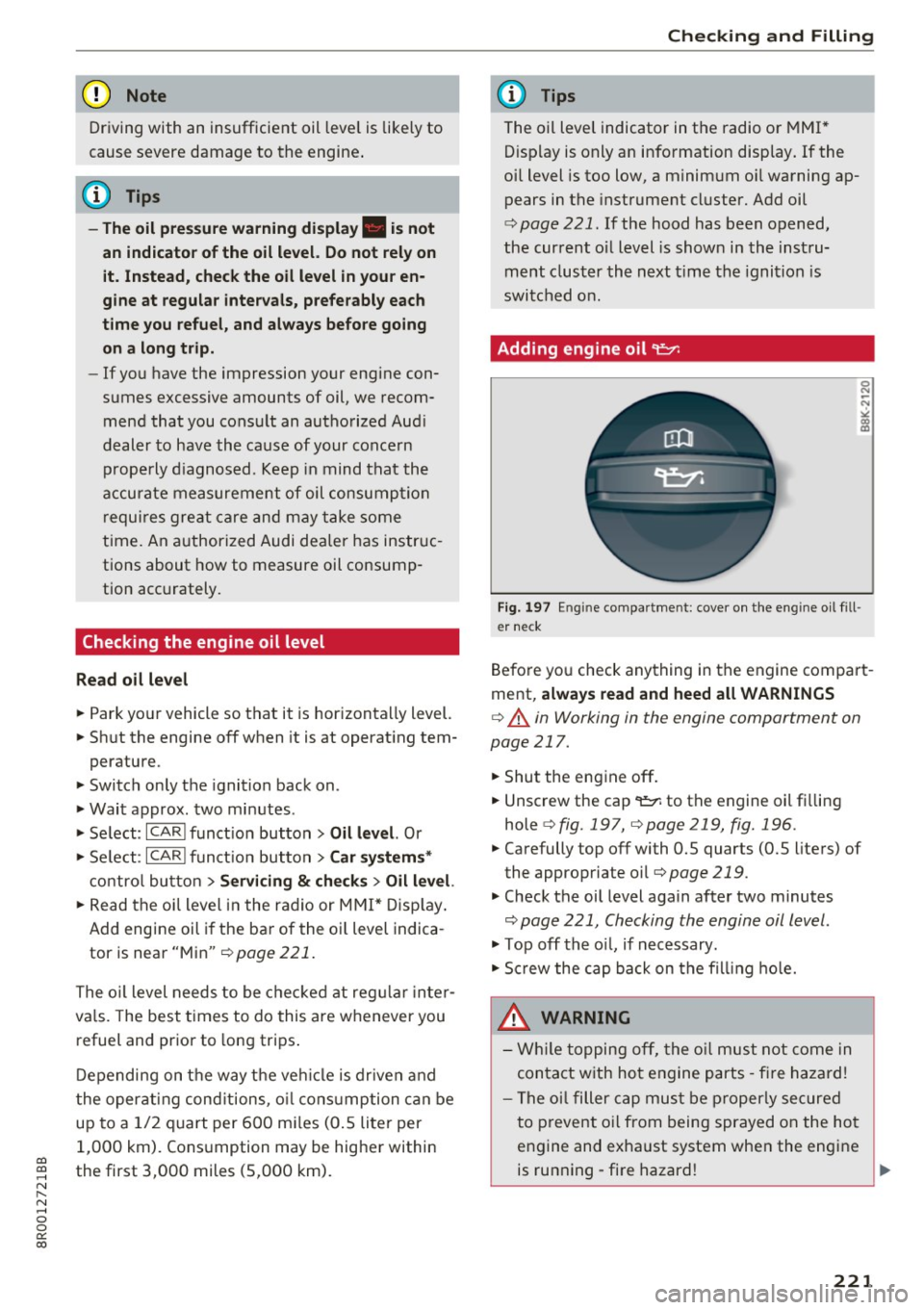
Adding engine oil~
Fig. 197 En gin e co mpa rt m ent: cove r o n th e eng ine o il fill
e r neck
Befo re yo u check any thing in the engine compa rt
ment,
always read and heed all WARNINGS
¢ A in Working in the engine compartment on
page 217.
"' Shu t the eng ine off .
"' Unscrew the cap
9=;1: to the engine oil f illing
hole
¢ fig.197, ¢page 219, fig.196 .
"'Carefully top off with 0.5 quarts (0. 5 liters) of
the appropriate oil¢
page 219.
"' Check the oil level again after two minutes
~ page 221, Checking the engine oil level .
"'Top off th e oil, if nec essary.
"' Scr ew the cap ba ck on the fi lling hole.
_&. WARNING
- Whi le toppin g off , the o il mus t no t come in
con tact w ith ho t en gine parts -fir e hazard !
- Th e oi l filler c ap must b e pr oper ly sec ure d
t o p reve nt o il from being spraye d on t he ho t
e ngine an d exha ust system whe n the engi ne
-
is run ning -fi re hazard ! Ill>-
221
Page 224 of 296
Check ing and F illing
- If your skin has come in contact with the en
gine oil, you must subsequently cleanse it
thoroughly .
@ Note
-Check the oil level using the radio or the
M MI *. If the message
Please reduce oil le v
el
appears, contact your authorized Aud i
dealer or other qualified workshop to have
excess oil extracted if necessary.
- Audi does not recommend the use of o il
add it iv es. They may damage the eng ine
and ad ve rs ely affect your N ew V ehicl e
Warranty .
@ For the sake of the environment
-Under no circumstances can the oil come in
contact with the sewage network o r the soil.
- Observe and follow legal regulations when
dispos ing of empty oil conta ine rs .
Changing the engine oil
We recommend tha t have your oil changed by an
authorized Audi dealer or a qualified service s ta
tion .
Befo re you check anyth ing in the eng ine compart
ment,
alwa ys read an d heed all WARNINGS ¢.&
in Working in the engine compartment on
page 217 .
The engine oil must be changed accord ing to the
intervals specif ied in your Warranty
& Mainte
nance booklet. This is very important because the
lubricat ing propert ies of o il d iminish gradually
during normal vehicle use .
Under some circumstances the eng ine o il should
be changed more frequently . Change oil more of
ten if you d rive mostly short distances, operate
the vehicle in dusty areas or under predominant ly
stop-and-go traffic cond it ions , or have yo ur vehi
cle where temperat ures remain below freezing
for extended periods.
Detergent addi tives in the oil will make fresh o il
loo k da rk afte r th e eng ine has been ru nning fo r a
short t ime. This is no rma l and is not a re ason to
change the oil more o ften than re commended.
222
Because of the p roblem of prope r disposa l, along
with the specia l tools and necessary expertise re
quired, we strongly recommend that yo u have
your oi l changed by an authori zed
Audi deale r or
a qual ified service station.
If you choo se to change you r oil yourself , please
note the fo llow ing important information:
A WARNING
To reduce the risk of persona l injury if you
must change the eng ine oil in your vehicle
yourself:
- Wea r eye protect ion.
- To reduce the r is k of burns from hot engine
oil, let the engine cool down to the touch.
-
- W hen removing the oil drain plug with your
fingers, stay as far away as possible. Always
keep your forearm pa rallel to the gro und to
he lp prevent hot oil from run ning down your
arm .
- Drain the oil into a container designed for
this purpose, one la rge enough to hold at
least the tota l amount of oi l in you r engine.
- Engine oil is poisonous. Keep it well out of
the reach of childre n.
- Continuous contact with used eng ine o il is
harmf ul to your skin . Always protect your
skin by washing oil off thoroughly with soap
a nd water .
@ Note
Never mix oil additives with your engine oil.
These additives can damage your engine and
adverse ly affect you r Audi Limi ted New Vehi
cle Warranty .
@ For the sake of the environment
-Before chang ing your oi l, first make sure
you know where you can properly dispose o f
the used oil.
- Always dispose of used e ngine o il pro perly .
Do not dump i t on garden soil, wooded
areas, into open streams o r down sewage
dr ains.
- Recycle used e ngine o il by tak ing it to a used
eng ine oil collect ion fac ility in yo ur area, o r
c ontact a servi ce st ation.
Page 230 of 296
Checking and Filling
-Always follow the operating instructions
provided by the battery charger manufactur
er when charging your battery.
- Never charge a frozen battery . It may ex
plode because of gas trapped in the ice. Al
low a frozen battery to thaw out first.
- Do not reuse batteries which were frozen .
The battery housing may have cracked and
weakened when the battery froze .
- Charge the battery in a well ventilated area.
Keep away from open flame or electrical
spark . Do not smoke. Hydrogen gas generat
ed by the battery is explosive .
- To reduce the danger of explosion, never
connect or disconnect charger cables while
the charger is operating .
- Fast charging a battery is dangerous and should only be attempted by a competent
technician with the proper equipment .
- Battery acid that may spill during charging should be washed off with a solution of
warm water and baking soda to neutralize
the acid.
(D Note
Never use a fast charger as a booster to start
the engine. This will seriously damage sensi
tive electronic components, such as control
units , relays , radio, etc., as well as the battery
charger.
Battery replacement
The new battery must have the same specifica
tions and dimensions as the original equipment
battery.
Intelligent energy management in your vehicle is
responsible for distributing the electrical energy
throughout your vehicle
~ page 192. The intelli
gent energy management system will keep the
engine battery charged better then vehicles with
out this system. To mak e sure the additional
electrical energy is available once again after you
have changed the battery, we recommend that
you install batteries of the same type and manu facture only (the same as those installed at the
time your vehicle was delivered) . Specifications
228
are listed on the battery housing. Your author
ized dealer must cod e the battery in the energy
management system to enable you to use the en
ergy management functions correctly after re
placing the battery.
If it is not possible to use a battery of this type,
the new battery must have the same capacity,
voltage (12 volts), amperage, construction and plug sealing.
When installing the battery, make sure the igni
tion and all electrical consumers are turned off.
([) Note
- Make sure the ventilation hose on the side
of the battery is connected, otherwise
fumes or battery acid can leak out.
- Vehicles with the Start-Stop-System* are
equipped with a special cycle-proof AGM
battery. Installing a different type of bat
tery can cause problems in the vehicle elec
trical system. When replacing the vehicle battery, always install one with the same
specifications as the original battery.
@ For the sake of the environment
Because of the problem of proper disposal of
a battery, we recommend your authorized
Audi dealer change the battery for you. Bat
teries contain sulfuric acid and lead and must
always be disposed of properly in compliance
with all environmental regulations. Disposing
of vehicle batteries improperly is
very danger
ous to the environment.
Page 234 of 296
Wheel s
® Mud and snow capability
"M/5" or "M+S" indicates the tire
is sui table for driving on mud and
snow.
& indicates a winter tire.
@ Composition of the tire cord
and materials
The number of plies indicates the
number of rubberized fabric lay
ers in the t ire. In general: the
more layers, the more weight a
tire can carry . Tire manufacturers
must also specify the materials
used in the tire. These include
steel, nylon, po lyester and other
materials.
@ Maximum permitted load
This number indicates the maxi
mum load in kilograms and
pounds that the tire can carry .
@Uniform tire quality grade
standards for treadwear,
traction and temperature resist ance
Treadwear, traction and tempera
ture ranges ¢
page 247.
@ Running direction
The arrows indicate the running
direction of unidirectional t ires .
You must always follow the speci
fied running direction
¢page 259.
232
@ Ma ximum permitted
inflation pressure
This number indicates the maxi
mum pressure to which a tire can
be inflated under normal operat
ing condit ions.
Glossary of tire and loading
terminology
Acces sory we ight
means the combined weight (in
excess of those standard items
which may be replaced) of auto matic transmission, power steer
ing, power brakes, power win
dows, power seats, radio, and
heater, to the extent that these
items are available as factory-in
stalled equipment (whether in
stalled or not) .
Aspect ratio
means the ratio of the height to
the width of the tire in percent .
Numbers of 55 or lower indicate a
low sidewall for improved steer
ing response and better overall
handling on dry pavement.
Bead
means the part of the tire that is
made of steel wires, wrapped or
reinforced by ply cords and that is
shaped to fit the r im . ...
Page 255 of 296
a,
a,
..... N r-N ..... 0 0
0:
co
Tire mobility kit
General information and safety precautions
Appl ies to: ve hicles with tire repair kit
The tire repair is only meant for temporary use.
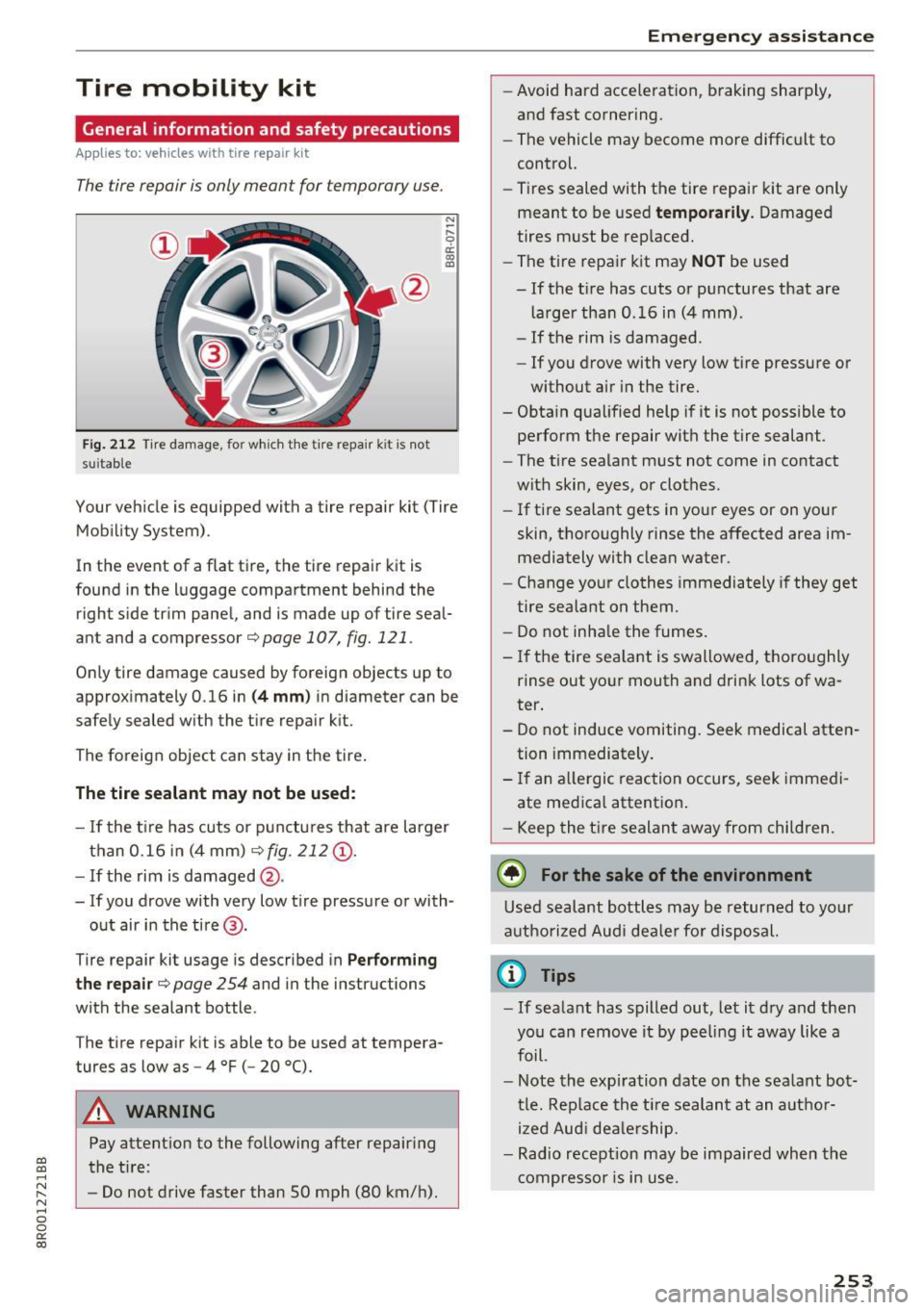
Fig. 212 T ire damage, for which the ti re repair kit is not
su itable
N
-r--0 ci: co ID
Your veh icle is equipped with a tire repair kit (Tire
Mobility System) .
In the event of a flat tire, the tire repair kit is
found in the luggage compartment behind the right side trim panel, and is made up of tire seal
ant and a compressor¢
page 107 , fig. 121 .
Only tire damage caused by foreign objects up to
approx imately 0.16 in
( 4 mm ) in diameter can be
safely sealed with the tire repair kit.
The foreign object can stay in the tire .
The tire sealant may not be used :
-If the t i re has cuts or punctures that are larger
than 0.16 in (4 mm)
,=;,fig. 212@.
-If the rim is damaged @.
- If you drove with very low t ire pressure or with-
out air in the tire@.
Tire repair kit usage is described in
Performing
t he repai r
c;, page 254 and in the instructions
with the sealant bottle .
The tire repair kit is able to be used at tempera
tures as low as -4
°F ( -20 °().
A WARNING
Pay attent ion to the following after repairing
the tire:
- Do not drive faster than SO mph (80 km/h).
Em ergen cy a ssis tanc e
-Avoid hard acce leration, braking sharply,
and fast cornering .
- The vehicle may become more difficult to
control.
- Tires sealed with the tire repair kit are only
meant to be used
t e mpo ra ril y . Damaged
tires must be replaced.
- The tire repa ir k it may
NO T be used
- If the t ire has cuts or punctures that are
larger than 0.16 in (4 mm) .
- If the rim is damaged.
- If you drove with very low tire pressure or
without air in the tire.
- Obta in qualified help if it is not possible to
perform the repair with the tire sealant.
- The tire sealant must not come in contact
with skin, eyes, or clothes.
- If tire sealant gets in your eyes or on your
skin, thoroughly rinse the affected area im
mediately with clean water .
- Change your clothes immediately if they get
tire sealant on them.
- Do not inha le the fumes .
- If the tire sea la nt is swallowed, thoro ughly
rinse out your mouth and drink lots of wa
ter .
- Do not induce vomiting . Seek medical atten
tion immediately.
- If an a llergic reaction occurs, seek immedi
ate med ica l attent ion .
- Keep the t ire sealant away from child ren.
@ For the sake of the environment
Used sealant bottles may be returned to yo ur
authorized Audi dea le r fo r disposal.
@ Tips
- If sealant has spilled out, let it dry and then
you ca n remove it by pee ling it away like a
foil.
- Note the expiration date on the sealant bot
tle. Rep lace the ti re sealant at an a utho r
ized Aud i dea le rship.
- Radio reception may be impaired when the
compressor is in use .
253
Page 265 of 296
a,
a,
..... N r-N ..... 0 0
0:
co
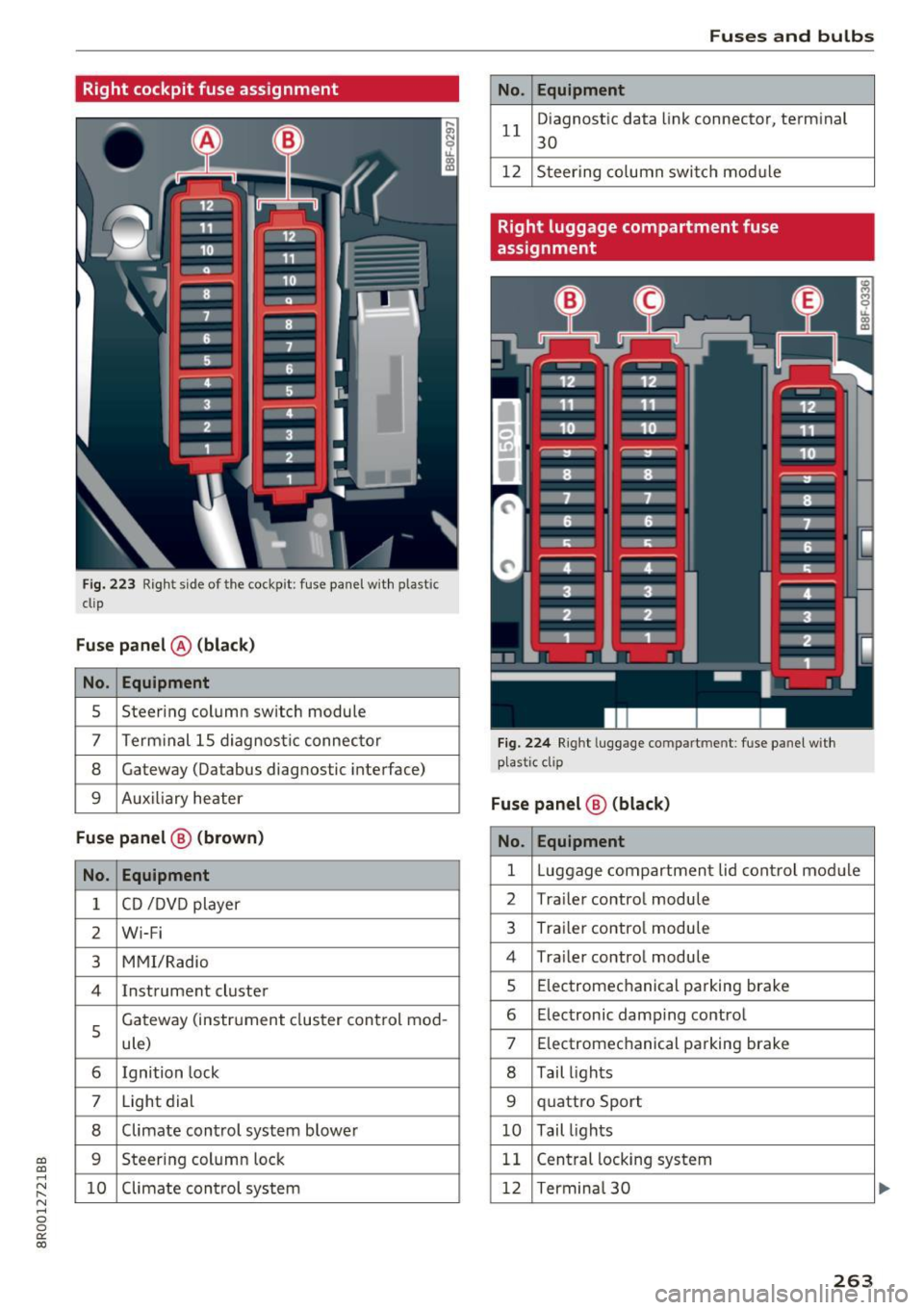
Right cockpit fuse assignment
Fig. 223 Right side of the cockpit: fuse panel wit h plastic
clip
Fuse panel @ (black)
No . Equipment
5 Steering column switch module
7 Terminal 15 diagnostic connector
8 Gateway (Databus diagnostic interface)
9 Auxil iary heater
Fuse panel @ (brown)
No. Equipment
1 CD /DVD player
2 Wi-Fi
3 MMI/Radio
4 Instrument cluster
5
Gateway (instrument cluster control mod-
ule)
6 Ignition lock
7 Light dial
8 Climate control system blower
9 Steering column lock
1 0 Climate control system
Fuses and bulbs
No . Equipment
11 Diagnostic data
link connector, terminal
30
12 Steering column switch module
Right luggage compartment fuse
assignment
Fig. 224 Right luggage compartment: fuse panel with
pla stic dip
Fuse panel @ (black)
No. Equipment
1 Luggage compartment lid control module
2 Trailer control module
3 Traile r control module
4 Tra iler control module
5 Electromechanical parking brake
6 Electronic damping control
7 Electromechanical parking brake
8 Tail lights
9 quattro Sport
10 Tail lights
11 Central locking system
12 Termina l 30
263
Page 266 of 296
Fuses a nd bul bs
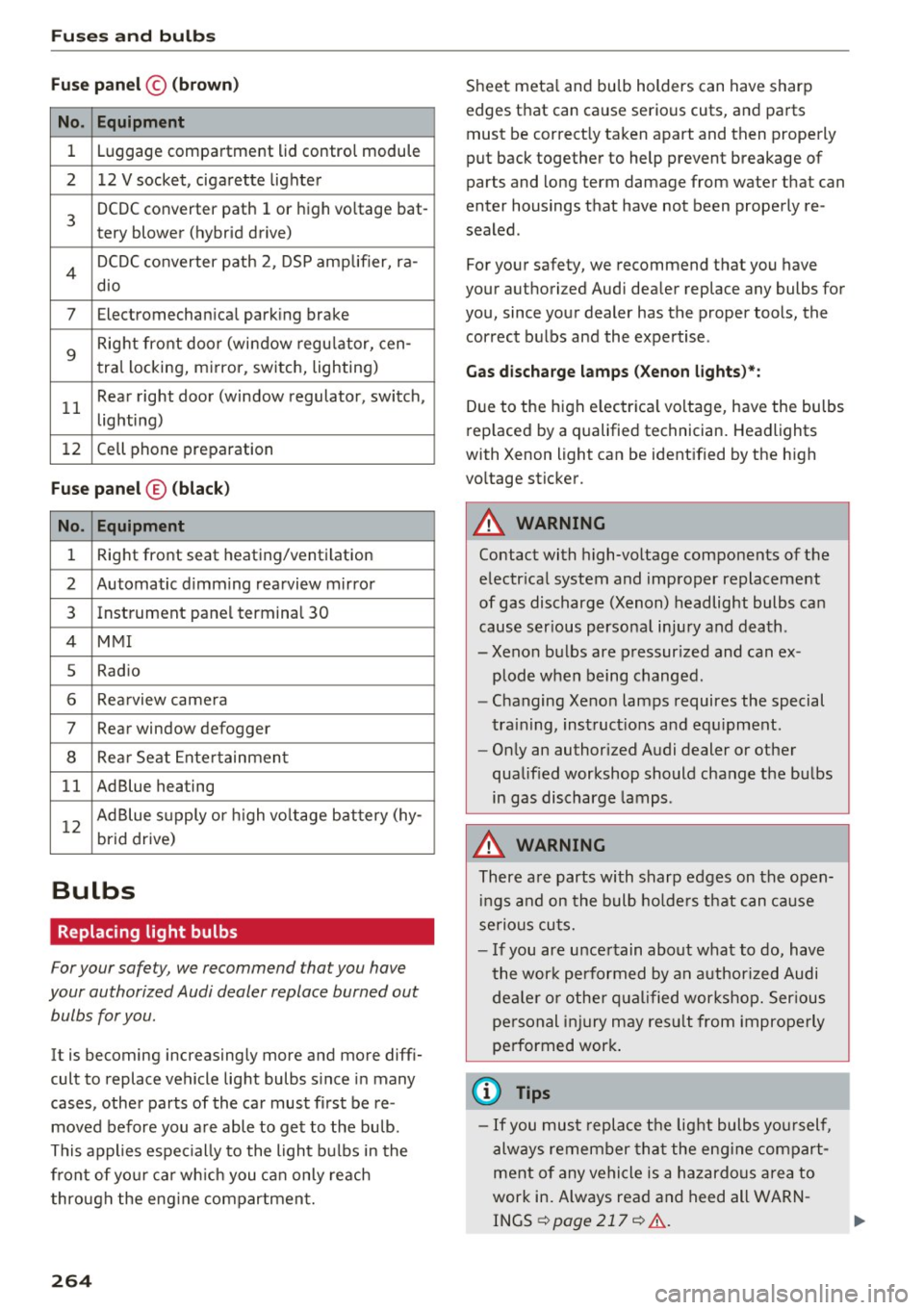
Fu se pa nel© (bro wn)
No. Equipment
1 Luggage compartment lid control module
2 12 V socket, cigarette lighter
3
DCDC converter path 1 or high vo ltage bat-
tery blower (hybrid drive)
4 DCDC converter path 2, DSP amp lifier, ra-
dio
7 Electromechanical
parking brake
9
Right front door (window regu lator, cen-
tral locking, mirror, switch, lighting)
11 Rear right
door (window regulator, switch,
lighting)
12 Cell phone preparation
F
use panel © (black )
No. Equipment
1 Rig ht
front seat heating/venti lation
2 Automatic dimming rearview mirror
3 Instrument
panel terminal 30
4 MMI
5 Radio
6 Rearview camera
7 Rear window defogger
8 Rear Seat Entertainment
11 AdBlue heating
12 Ad Blue supply or h
igh vo ltage battery (hy-
brid drive)
Bulbs
Replacing light bulbs
For your safety, we recommend that you have
your authorized Audi dealer replace burned out bulbs for you.
It is becoming increasingly more and more diffi
cult to replace vehicle light bulbs since in many
cases, other parts of the car must first be re
moved before you are able to get to the bu lb.
This applies espec ially to the light bulbs in the
front of your ca r wh ich you can only reach
through the eng ine compartment.
2 6 4
Sheet meta l and bu lb holders can have sharp
edges that can cause serious cuts, and parts
must be correctly taken apart and then properly
put back together to help prevent breakage of
parts and long term damage from water that can
enter housings that have not been properly re
sealed.
For your safety, we recommend that you have
your authorized Audi dealer replace any bulbs for
you, since your dealer has the proper tools, the correct bulbs and the expertise.
Ga s d ischar ge lam ps (Xeno n light s)*:
Due to the high e lectrica l voltage, have the bulbs
rep laced by a qualified technician. Headlights
with Xenon light can be identified by the h igh
voltage sticker.
A WARNING
-
Contact with high-voltage components of the
electr ical system and improper replacement
of gas discharge (Xenon) headlight bulbs can
cause ser ious persona l injury and death .
- Xenon bulbs are pressur ized and can ex
plode when being changed .
- Changing Xenon lamps requires the special
tra ining, instruct ions and equ ipment .
- Only an authorized Audi dealer or other
qualified workshop should change the bulbs
in gas discharge lamps .
A WARNING
There are parts with sharp edges on the open
ings and on the bulb ho lders that can cause
serious cuts.
- If you are uncertain about what to do, have
the wor k performed by an authorized Audi
dea ler or other qual ified workshop. Ser ious
personal injury may resu lt from improperly
performed work .
(D Tips
-If you must replace the light bulbs you rself,
always remember that the eng ine compart
ment of any vehicle is a hazardous area to
work in. Always read and heed all WARN
INGS
¢page 217 ¢ &.
Page 268 of 296
Emergency situations
Emergency situations
General
This chapter is intended for trained emergency crews and working personnel who have the nec
essary tools and equipment to perform these
operations.
Starting by pushing or
towing
(D Note
Vehicles with an automatic transmission
cannot be started by pushing or towing.
Starting with jumper
cables
If necessary, the engine con be started by con
necting it to the battery of another vehicle.
If the engine should fail to start because of a dis
charged or weak battery, the battery can be con
nected to the battery of
another vehicle, using a
pair of jumper cables to start the engine.
Jumper cables
Use only jumper cables of sufficiently large cross
section
to carry the starter current safely. Refer
to the manufacturer's specifications.
Use only jumper cables with
insulated terminal
clamps which are distinctly marked :
plus(+) cable in most cases colored red
minus(-) cable
in most cases colored black.
A WARNING
Batteries contain electricity, acid, and gas.
Any of these can cause very serious or fatal in
jury. Follow the instructions below for
safe
handling of your vehicle's battery.
-Always shield your eyes and avoid leaning
over the battery whenever possible.
-A dead battery can freeze at temperatures
around 32 °F (0 °C) . If the vehicle battery is
frozen, you must thaw it before connecting
the jump start cables.
If you do not, this in-
266
creases the risk of an explosion and chemi
cal burns. After jump starting the vehicle,
drive to an authorized Audi dealer or author
ized Audi Service Facility immediately to
have the vehicle battery checked.
- Do not allow battery acid to contact eyes or
skin . Flush any contacted area with water
immediately.
- Improper use of a booster battery to start a
vehicle may cause an explosion .
- Vehicle batteries generate explosive gases.
Keep sparks, flame and lighted cigarettes
away from batteries.
- Do not try to jump start any vehicle with a
low acid level in the battery.
- The voltage of the booster battery must also
have a 12-Volt rating. The capacity (Ah) of
the booster battery should not be lower
than that of the discharged battery. Use of
batteries of different voltage or substantial
ly different "Ah" rating may cause an explo
sion and personal injury.
- Never charge a frozen battery. Gas trapped
in the ice may cause an explosion.
- Never charge or use a battery that has been
frozen. The battery case may have be weak
ened.
- Use of batteries of different voltage or sub
stantially different capacity (Ah) rating may
cause an explosion and injury. The capacity (Ah) of the booster battery should not be
lower than that of the discharged battery.
- Before you check anything in the engine
compartment, always read and heed all
WARNINGS
r=:> poge 217.
([) Note
-Applying a higher voltage booster battery
will cause expensive damage to sensitive electronic components, such as control
units, relays, radio, etc.
- There must be no electrical contact between
the vehicles as otherwise current could al
ready start to flow as soon as the positive
(+) terminals are connected.
Page 274 of 296
Technical data
Technical data
Vehicle identification
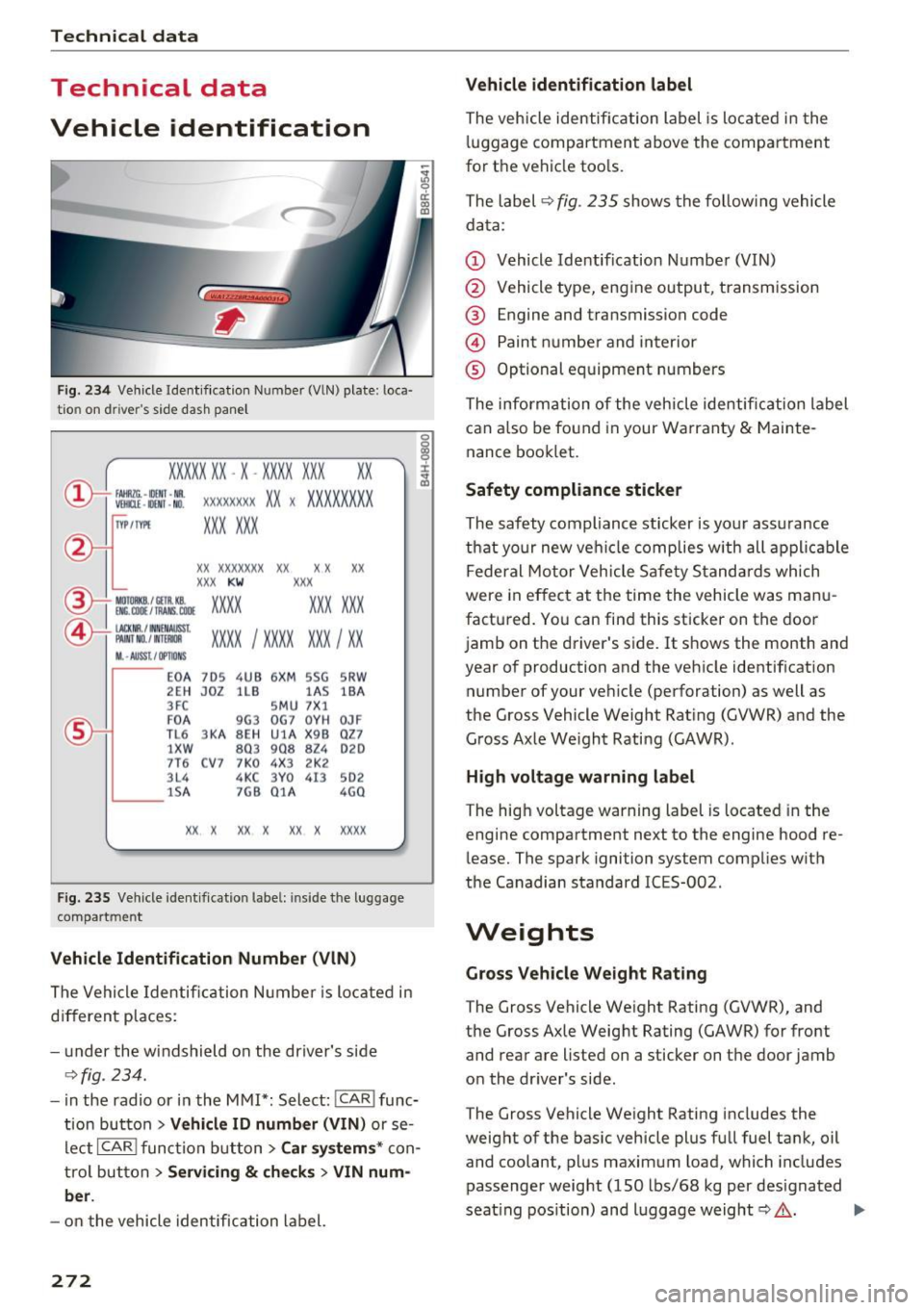
Fig. 234 Vehicle Ident if ication Numbe r (VlN) plate : loca·
tio n on d river 's side dash panel
XXXXX XX -X -XX XX XXX XX
@-+ ~J:~t::1 ::: xxxxxxxx xx x xxxx xxx x
IYP lf'VPE XXX X XX
xx xxxxxxx xx xx xx
XXX KW
XXX
EM:. COil / fAANS , COOE xxxx XXX XXX ®i MOIOlll
©-+ IAC KIIR . / tN NEN AIJSSt
XXXX I XXXX XXX I XX PAI NT NO./ WT£Jldl
II. -AUSST . / OPTIO NS
E0 A 7D5 4UB 6X
M SSG SR W
2EH JOZ lLB lAS
lBA
3FC SM U 7 X1
F0 A
9G3 0
G7 0Y H
0JF
TL 6 3 KA 8EH UlA X 9B Q
Z7
1 XW
803 908
824 020
7T6 C V7 7 K0 4X3 2K2
3L4 4KC 3Y0 413
502
lS A 7GB 01A
4G0
XX X XX X
XX X xxxx
Fig. 235 Vehicle identificat ion labe l: in side the luggage
compart ment
Vehicle Identification Number (VlN)
The Vehicle Identification Number is located in
different places :
- under the windshield on the driver's side
¢fig . 234.
-in the radio or in the MMI*: Select: !CAR i func·
tion button
> Vehicle ID number (VIN) or se·
Leet
I CAR ! function button > Car systems* con·
trol button
> Servicing & checks > VIN num
ber .
-on the vehicle identification label.
272
Vehicle identification label
The vehicle identification label is located in the
luggage compartment above the compartment
for the vehicle tools.
The label ¢
fig. 235 shows the following vehicle
data:
(D Vehicle Identification Number (VIN)
@ Vehicle type, engine output, transmission
® Engine and transmission code
@ Paint number and interior
® Optional equipment numbers
The information of the vehicle identification label
can also be found in your Warranty
& Mainte·
nance booklet.
Safety compliance sticker
The safety compliance sticker is yo ur ass urance
that your new vehicle complies with all applicable
Federal Motor Vehicle Safety Standards which
were in effect at the time the vehicle was manu
factured. You can find this sticker on the door
jamb on the driver's side. It shows the month and
year of production and the vehicle identification
number of your vehicle (perforation) as well as
the Gross Vehicle Weight Rating (GVWR) and the
Gross Axle We ight Rating (GAWR).
High voltage warning label
The high voltage warning label is located in the
engine compartment next to the engine hood re·
lease. The spark ignition system complies w ith
the Canadian standard ICES-002 .
Weights
Gross Vehicle Weight Rating
The Gross Vehicle Weight Rating (GVWR), and
the Gross Axle Weight Rating (GAWR) for front
and rear are listed on a sticker on the door jamb
on the dr iver's side .
The Gross Vehicle Weight Rating includes the
weight of the basic vehicle plus full fuel tank, oil
and coolant, plus maximum load, which includes
passenger weight (150 lbs/68 kg per designated
seat ing position) and luggage weight¢,&. .
Page 281 of 296
CD
CD
.... N ,-... N ..... 0 0 C<'. 00
means that you risk both a substant ia l reduction
in the operationa l safety of your vehicle and an
increased wear of vehicle parts¢
A.
Author ized Audi dealers w ill per form this wor k in
a professional and competent manner or, in spe
cial cases, refer you to a professional company
that spec ializes in such modifications.
A WARNING
Improper repairs and mod ificat ions can
change the way veh icle systems work and
cause damage to the veh icle and ser ious per
sonal injury.
If emergency repa irs must be pe rformed else
where, have the vehicle examined by an au thorized A udi dealer as soon as possib le .
Declaration of
Compliance, Telecom munications and
Electronic Systems
Radio Frequency Devices and Radiocommunica
tion Equipment User Manual Notice.
T he manufacturer is not respons ible for any radio
or TV interference caused by unauthor ized modi
fications to this equ ipment .
Devices
The fo llow ing devices each comp ly w ith FCC Part
15.19, FCC Part 15.21 and RSS-Gen Issue
1:
- Adaptive cruise control*
- Convenience key*
- Audi s ide ass ist*
- Cell phone package*
- E lectron ic immobilizer
- Homelink universal remote contro l"
- Remote contro l key
FCC Part 15.19
This devi ce comp lies with p art 15 of the FCC
Ru les. Ope ra tion is subject to the following two
conditions :
Consumer inf ormation
(1) This dev ice may not ca use ha rmf ul inter fer
ence, and
( 2 ) th is d evice m us t ac cep t any inte rference re
c e ived, in clu ding in terference tha t may c ause un
desired ope ra tion.
FCC Part 15.21
CAU TION:
Changes or mod ificat ions not express ly approved
by the party responsible for compliance cou ld
vo id the user's a uth ori ty to ope rate t he equ ip
me nt.
RSS-Gen Issue 1
Operat ion is subject to the following two cond i
t ions:
(1) this device may not cause inte rfe rence, and
( 2 ) this devi ce m us t a cc ep t any inte rference, in
cl udi ng interference tha t may cause undes ired
operation of the device .
279