wheel AUDI Q5 2017 Owner's Guide
[x] Cancel search | Manufacturer: AUDI, Model Year: 2017, Model line: Q5, Model: AUDI Q5 2017Pages: 296, PDF Size: 74.43 MB
Page 189 of 296
a,
a,
..... (',J r-(',J ..... 0 0
0:
co
@ Tips
-ABS and AS R on ly work correctly when a ll
fo ur whee ls are e quipped w ith identical
tires. Different tire sizes can lead to a reduc
tion in eng ine power.
Switching on/off
Intelligent Technology
- You may hear noises when the sy stems de
scribed a re worki ng .
- Whe n in st alling a factory -s up plied roo f ra ck
system o n the roof ra iling, the ESC wi ll
adapt itself to a different center of grav ity .
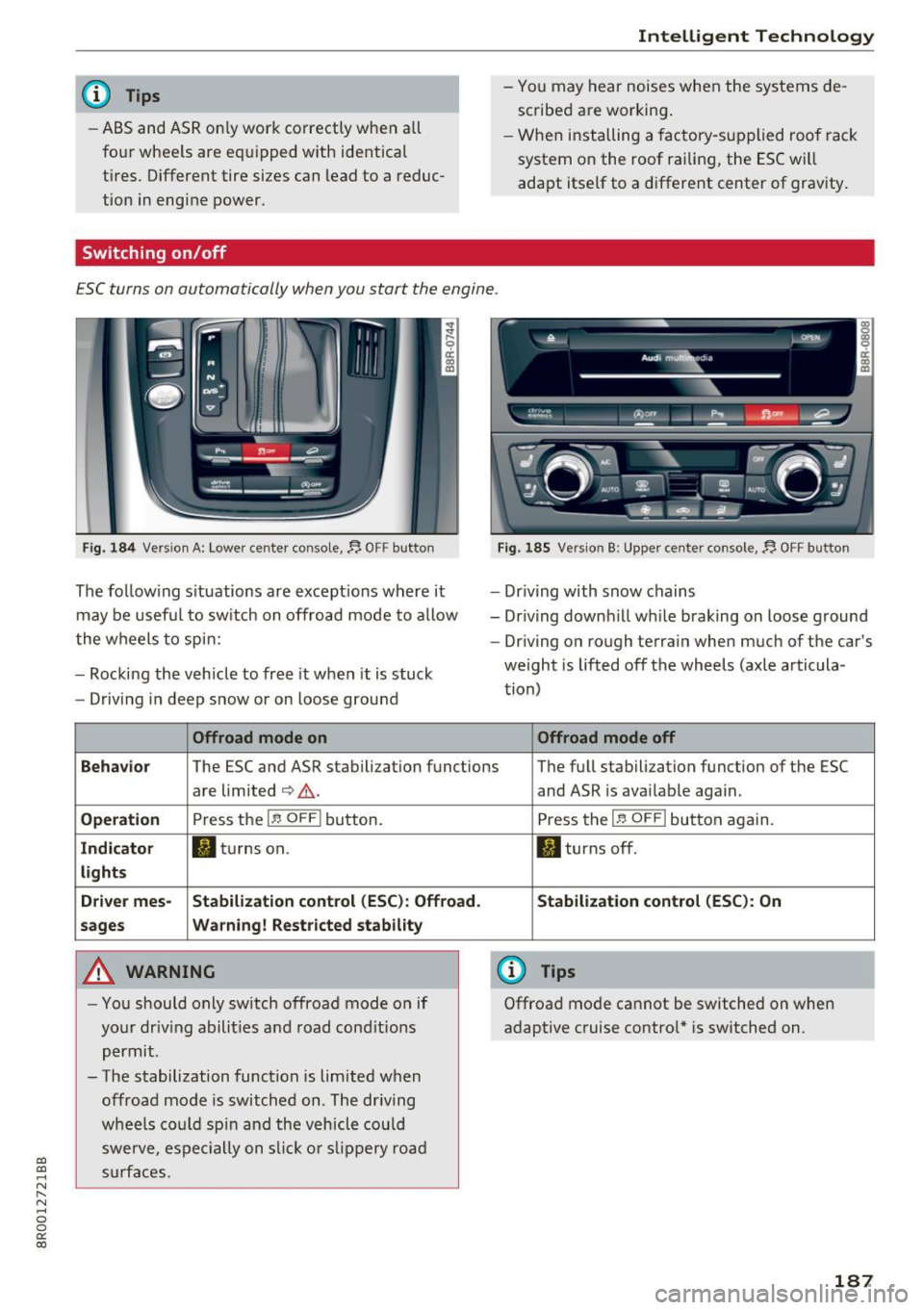
ESC turns on automatically when you start the engine.
Fig . 184 Versio n A: Lower cente r console,~ OFF button
The follow ing s ituations ar e except ions where i t
may be usef ul to sw itch on offroad mode to allow
the w heels to sp in:
- Rocking the vehicle to free it when it is stuck
- Driv ing i n deep snow or on loose ground
Offroad mode on
Fig. 185 Version B : Upper center console,~ OFF butto n
-Dr iv ing with snow chains
- Dr iv ing down hill while braking on loose g round
- Dr iving on rough terra in when much of t he car's
weight is lifted off the wheels (axle artic ula
t ion)
Offroad mode off
Behavior
The ESC and ASR stabilization functions The fu ll stabilization function of the ESC
are limited
¢ ,&. .
Operation Press the 1.$ OFF I button.
Indicator Ii) tu rns on.
lights
Driver mes- St abilization control (ESC ): Offroad.
sages Warning! Restricted stability
A WARNING
- Yo u should only sw itch offroad mode o n if
yo ur dr iv ing abilit ies a nd road cond it io ns
permit.
- The stabilization function is limited when
offroad mo de is switched on. The dr iving
w he els co uld s pin and the v eh icle cou ld
swe rve, es peci ally on s lick or slipp ery roa d
s ur fac es. and ASR
is ava ilable again.
P ress the
I!.! OFFI but ton again.
II turns off.
Stabilization control (ESC ): On
(D Tips
Offroad mode cannot be switched on whe n
adaptive c ruise contro l* is switched on.
187
Page 190 of 296
Inte llig ent Techn olo gy
Hill descent assist
The hill descent assist makes it possible to drive
down an incline at a constant speed .
~~,·~ ('l)ofF ___ P..1 --- fl~ IIL..~
---
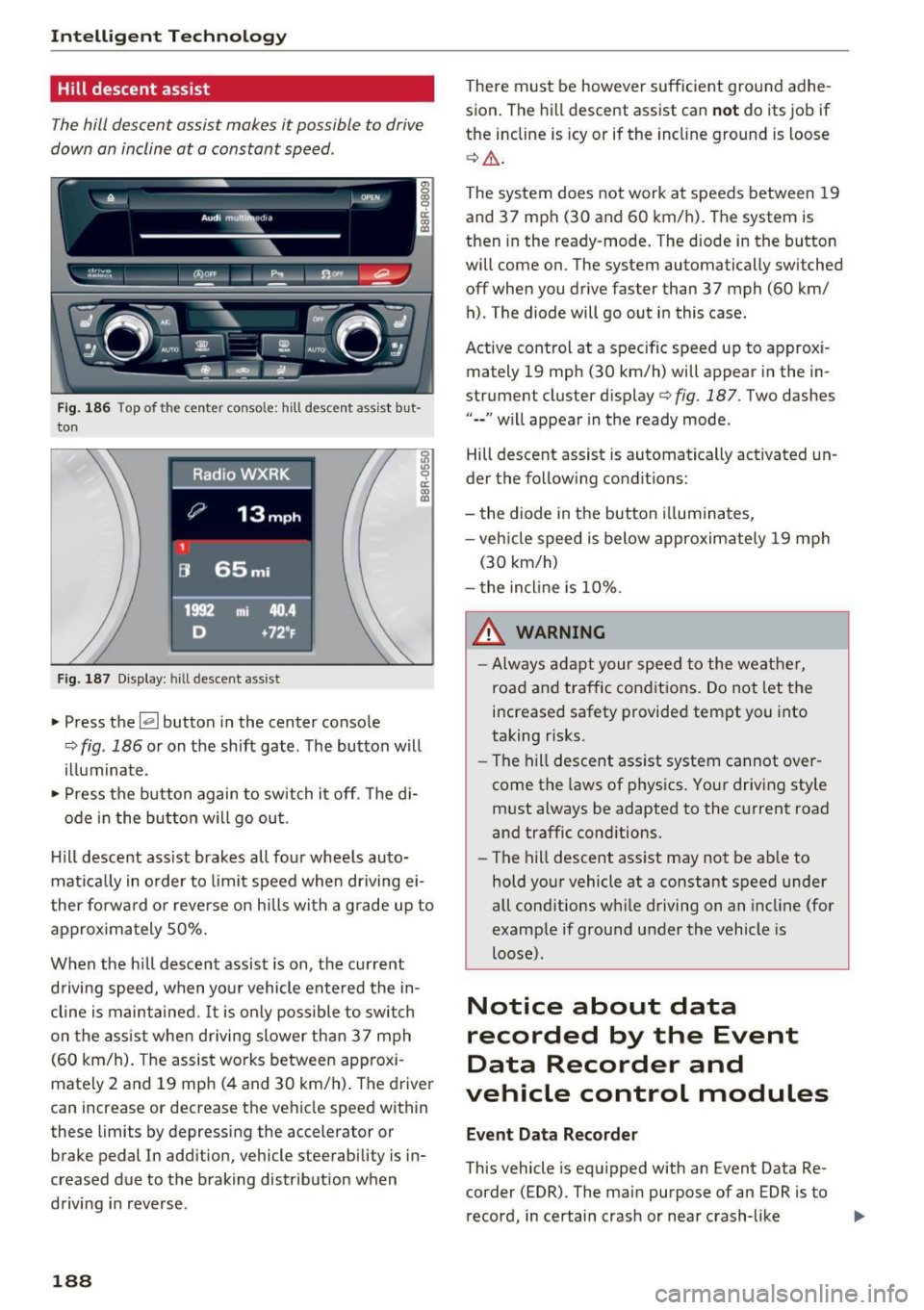
Fig. 186 Top of the center conso le: hill descent assist but
ton
Fig. 187 Display: hill descent assist
.. Press the~ button in the center console
¢ fig . 186 or on the shift gate . The button will
illuminate .
" Press the button again to switch it off. The di-
ode in the button will go out .
H ill descent ass ist brakes all four wheels auto
matically in order to limit speed when driving ei
ther forwa rd o r reverse on hills with a grade up to
approx imately 50%.
When the hill descent assist is on, the current
driving speed, when your vehicle entered the in
cline is maintained.
It is only possible to switch
on the assist when driving slower than 37 mph
(60 km/h). The assist works between app roxi
mately 2 and 19 mph (4 and 30 km/h) . The driver
can increase or decrease the vehicle speed within
these limits by depressing the accelerator or
brake pedal In addition, vehicle steerability is in
creased due to the braking distribution when
driving in reverse .
18 8
There must be however sufficient ground adhe
sion . The hill descent assist can
no t do its job if
the incline is icy or if the incl ine ground is loose
¢ &.
The system does not work at speeds between 19
and 37 mph (30 and 60 km/h). The system is
then in the ready-mode. The diode in the button
will come on . The system automatically sw itched
off when you drive faster than 37 mph (60 km/ h) . The diode will go out in this case .
Active control at a specific speed up to approxi
mately 19 mph (30 km/h) will appear in the in
strument cluster display
c:> fig. 187 . Two dashes
" •• " w ill appear in the ready mode .
Hill descent assist is automatically activated un
der the following conditions:
- the diode in the button ill uminates,
- veh icle speed is below approximately 19 mph
(30 km/h)
- the incl ine is 10%.
& WARNING
- Always adapt your speed to the weather,
road and traffic cond itions. Do not let the
increased safety provided tempt you into
taking risks.
-
-The hill descent assist system cannot over
come the laws of phys ics. Your driving style
must always be adapted to the current road
and traffic conditions.
- The hill descent assist may not be ab le to
hold your vehicle at a constant speed under
all cond itions wh ile driving on an incline (for
example if ground under the vehicle is
loose).
Notice about data
recorded by the Event
Data Recorder and
vehicle control modules
E ven t Data R eco rde r
This vehicle is equipped with an Event Data Re
corder ( EDR). The main purpose of an EDR is to
record, in certain crash or near crash-like .,,_
Page 192 of 296
Intelligent Technology
Braking
What affects braking efficiency?
New brake pads
During the firs t 25 0 miles (400 km), new b rake
pads do not possess their full braking effect , they
have to be "broken i n" first ¢& .
Operating conditions and driving habits
The brakes on today 's automobiles a re sti ll sub
ject to wea r, depend ing la rgely on ope rating con
d itions and dr iv ing habits
c::> .&,. . On veh icles that
are either dr iven most ly in stop-and -go city traf
f ic or are driven hard, the brake pads should be
checked by your authorized Audi dea ler more of
ten than spec ified in the
Warr ant y & Ma inte
nance booklet .
Failure to have your brake pads
inspected can result in reduced brake perform
ance .
On steep slopes, you shou ld use the braking ef
fect of the eng ine. This way, you prevent unnec
essary wear on t he brake system . If you must use
your brakes , do not hold the brakes down cont in
uously . Pump the brakes at interva ls.
Oper ating noise
Noises may occur when braking depend ing on the
speed, braking force and outs ide cond itions such
as temperature and humidity .
Effect of wat er and road salt
In certain s ituations, for example after driving
through water, in heavy ra in, after overnight con
densat ion or after washing your car, the braking
effect can be reduced by moisture or ice on the brake rotors and b rake pads . The brakes must be
dried first with a few careful b rake applications.
At higher speeds and with the windshie ld wipers
turned on, the brake pads press aga inst the brake
rotors for a short amount of t ime. Th is occurs at
regular intervals w ithout the driver noticing and
provides fo r bette r brake response time under
wet conditions.
The effectiveness of the brakes can be reduced
when the vehicle is dr iven on a salt-covered road
and the brakes a re not used . Likewise , you clean
off acc umu lated salt coat ing from brake d iscs
190
and pads with a few cautious app lications of the
bra ke
c::> & .
Corrosion
There may be a tendency fo r dirt to build up on
the b rake pads and corrosion to form on the discs
if the car is not dr iven regu la rly or only for short
trips wi th little use of the brakes .
If the bra kes are not used frequent ly, o r if cor ro
s io n has formed on the discs , it is advisable to
clean off the pads and discs by b rak ing firmly a
few times from a moderately high speed
c::> & .
Faults in the brake system
If you s hou ld notice a sudden increase in brake
pedal travel, then one of the two brake circu its
may have fai led ¢
_&.
Low brake fluid level
Malfunctions can occur in the brake system if the
brake fluid level is too low . The brake fluid level
i s monitored electronically.
Brake booster
The brake booster increases the pressure that
you generate with the brake pedal. It only oper
ates wh ile the eng ine is r unning or w ith the igni
tion switched on (hybr id drive *) ¢ & .
Brake lining wear statu s
Brake lining wear may be checked by visual in
spection of the condition of the brake pads
through the openings in the wheel. If necessary,
the wheel may be removed for t his inspection
¢page 255, Replacing wheels .
A WARNING
-New brake pads do n't have the best s top
ping power and m ust be "broken-in" du ring
the initial 250 miles (400 km) . You can
compensate for this by pressing the brake pedal more firmly . This a lso applies later
when new pads are installed.
- You shou ld perform braking maneuvers for
the purpose of cleaning the brake system
only if road condit ions permit. Other road
users must not be put at risk -you may
cause an accident!
Page 193 of 296
CD
CD
.... N ,-... N ..... 0 0 C<'. 00
-Before descending a steep grade , reduce
speed and shift transm iss ion into a lower
gear or lower driving range. Do not ride the
brakes or hold the pedal down too long or
too often . This could cause the brakes to get
hot and d iminish brak ing efficiency .
- Do not "r ide the brakes" by resting your foot
on the pedal when you do not intend to
bra ke. This may cause the bra kes to over
heat , premat ure wea r and increased stop
ping distance.
- Under certa in climat ic and operating condi
tions su ch as p assing thro ugh w ater, dr iving
in heavy ra in or after washing the vehicle,
the ef fectiveness of the brakes can be re
duced. In winter, ice can acc umulate on the
brake pads, linings, discs and drums . Care
fully apply b rakes for a test. Brakes wi ll dry
and ice coatings wi ll be cleaned off after a
few careful brake applications .
- Driv ing for an extended period of time on
salt-covered roads without using your
bra kes can also affect bra king efficiency .
Clean off accumulated sa lt coating from
bra ke discs and pads with a few caref ul
bra ke appl ic a tion s.
- If you damage the front spoiler, or if yo u in
sta ll a differen t spoi le r, be sure the air flow
to the front br akes is not o bstru cte d. O the r
wise the br ake system could over heat reduc
ing the e ffec tiveness of the entire brake sys
tem.
- Failure of one brake circuit will imp air the
brak ing capability resulting in an increased
stopping distance . Avoid driving the vehicle
and have it towed to the nearest a uthorized
Audi dealer or qualif ied workshop.
- Never let the vehicle roll to a stop with the
engine shut off .
- If the brake booster is not wor king, the
brake pedal m ust be pressed considerably
harder to make up for the lack of booster
assistance .
Intelligent Technology
Electromechanical power
assist, Dynamic steering
The electromechanical power assist helps the
driver when steering .
Power steering adap ts elec tronically based on
the vehicle speed .
Indicator lights and message s
• Steering defecti ve! Do not drive vehicle!
If this indi ca to r li ght tur ns on and st ays on and
t hi s message appea rs, the powe r steering may
have failed.
Stop t he vehi cle in a safe location as soon as pos
s ible. Do
not cont inue drivi ng. See yo ur author
ized Audi dea ler or o ther qualif ied repa ir facility
for assistance .
l;rij Dynamic steering : Sy stem fault! You can
continue driving
If the indicator light turns on and the message
appea rs , the steer ing may be more diffic ult to
move o r more sensitive than usu a l. Th e steering
m ay also be at an angle when dr iving st raig ht.
D rive slowly to your a uthorized Aud i dea le r or
qualified wo rksh op to have t he malfunct io n cor
rec ted .
'Iij Dynamic steering: Initializing
Aud i drive select* : if the indicato r light blinks and
the driver message appears, the dynamic steer
ing* is re init ia liz ed . After sta rting the engine , the
steering wheel will move slig htly . Re -initializa
t io n m ight be necessary if the steer ing whee l was
moved hard to t he left and r ight wh ile the veh icle
was not mov ing. The display turns off if the initi
aliza tion was successful.
(D Tips
- If the . or l~ij indicato r light only stays on
for a shor t time, you m ay cont inue drivi ng.
- The dynam ic stee ring* sta bility systems
r=;, page 186 are no t ava ilable in the event of
a system mal func tio n.
- For add itiona l information on dy namic
steering*
r=;, page 122 .
191
Page 194 of 296
Intelligent Technology
Driving with your
quattro
With all-wheel drive, all four wh eels are driven.
G eneral information
With all-whee l drive, power is distributed to all
four wheels. This happens automatically depend
ing on you r driv ing style and the road condit ions
at the time. See also¢
page 186 .
A center differentia l distrib utes the driving power
variably to the front and rear axle. It works to
gether with selective wheel torque control, which
activates when driving t hrough curves
~ page 186.
The all-wheel drive concept is designed for high
engine power. Your vehicle is exceptionally pow
erful and has excellent driving characterist ics
both under normal dr iv ing condit ions and on
snow and ice . Always read and fo llow safety pre
cautions ~
/1..
Winter tires
When driving in the winter, your vehicle with all
wheel drive has an advantage, even with regular tires. In winter road conditions it may be adv isa
b le to mount wi nte r tires (or all-season tires) for
improve d driveab ility and bra king: these tires
m ust be mounted on
all four wheel s. See also
¢ page 245, Winter tires.
Tire cha ins
Where tire chains are mandatory on certain
roads, this norma lly also applies to vehi cles w ith
all-whee l d rive ~
page 245, Snow chains.
Replacing wheels /tires
Veh icles with all-whee l dr ive must always have
tires of the same s ize. A lso avo id tires with d iffer
ent t read depths. For details see page
~ page 237, New tires or wheels.
.&, WARNING
Always adjust yo ur drivi ng to road and traff ic
c ondi tions . Do not let the extra safety afford
ed by all -wheel drive tempt you into ta king
extra risks .
192
-Although the all-wheel d rive is very e ffec
tive, always remember that braking capacity
is limited by tire tract ion. You shou ld there
fore not drive at excessive speeds on icy or
slippery road s urfaces.
- On wet road surfaces, be careful not to dr ive
too fast because the front wheels could be
gi n to slide on top of t he water (aquapla n
ing). If th is should occur, you will h ave no
warn ing from a s udden increase i n engine
spee d as wi th a front-wheel d rive vehicle.
Always d rive at speeds which are suited to
the road conditions -risk of crash.
Energy management
· Starting ability is optimized
Energy management controls the distribution of
electrical energy and thus optimizes the availa
bility of electrical energy for starting the engine .
If a vehicle with a conventional energy system is
not dr iven for a long period of time, the batte ry is
discharged by id ling current consumers (e.g. im
mobilizer) . In certain c ircumstances it can resu lt
i n the re being insuffic ient energy ava ilable to
start the eng ine.
Intelligent energy management in your vehicle
handles the d istribution of elec trical energy .
Start ing ability is markedly improved and the life
of the batte ry is ex tended.
Bas ically, energy management consists of
bat
tery diagnosis , idling current man agement
and
dynamic ene rgy management .
Battery diagnos is
Battery d iagnosis continuously determines the
state of the battery. Sensors determine battery
vo ltage , battery current and battery tempera
ture . This determines the current state o f charge
and the power of the battery .
Idling current management
Idling cur rent management reduces energy con
sumption while the vehicle is standing. With the ..,.
Page 200 of 296
Offroad dri ving
Offroad driving
Driving under difficult
conditions and off-road
General information
The operation of the Electronic Stabilization Con
trol (ESC) is expanded for operation away from
paved roads. In situations where slip or a differ
ential locking function is required, the offroad mode can be activated
<=> page 186. Your Audi al
so has permanent all-wheel drive in addition .
However, your Audi is not a pure offroad vehicle.
It was not built for driving under extreme condi
tions, e.g. for trips that are in the nature of an
expedition .
Drive only on roads and offroad sections which
match the design of your vehicle and your abili
ties as a driver. Never take risks!
Befo re driving offroad
-Check the eng ine oil level, tire pressure, coo l
ant level, and the fluid leve l in the windshield
washer reservoir.
- Stow luggage items and other objects in the
lu ggage compartment, and secure them
against sliding around.
After driving offroad
-After trips offroad, remove any twigs and other
foreign objects from the grill, the underbody
and the wheels. Pay specia l attention to foreign
objects (stones) which have become lodged in
the tire tread.
- Clean the body and the vehicle underside, and
inspect the vehicle for possible damage.
- Clean dirty windows, headlamp lenses, rear
lights, and license plates.
- Perform a brake check (particularly after travel
ling through water) .
A WARNING
- Drive especially attentive ly and plan ahead
in difficult road conditions and when off
road. Excessive speed or incorrect maneu
vers can cause in juries and damage to the
vehicle.
198
- Always adapt your speed and driving style to
road, offroad, traffic, and weather condi
tions. Drive especially slowly offroad when
your view is restricted.
- Please be aware that in offroad mode, par
ticularly on a smooth and slippery road, the
wheels may have an increased tendency to
spin and the vehicle may break away - dan
ger of skidding!
- Stability is limited in the offroad mode.
® For the sake of the environment
Avoid damage to the environment and re
spect nature.
(D Tips
Only drive where it is permitted and stay on
marked roads and paths.
Explanation of some technical terms
The following data refer to ideal conditions. De pending on vehicle load and ground conditions
and the env ironment, the numbers may vary. It is
the driver's responsibility to decide whether ave
hicle can overcome a specific s ituation
<=> .&. .
Gradient angle
The number of meters in alt itude gained over a
distance of 109.4 yards or 100 meters (grade)
are given as a percentage or degrees . Informa
tion about the gradient the vehicle can cl imb un
der its own power (depends in part on the road
surface and eng ine power). Maximum permitted
grade: 31
°
Ground clearance
The distance between the road surface and the lowest point of the vehicle underbody. Ground
clearance 7.9 in (200 mm)
.&, WARNING
Exceeding the stated maximum figures can
result in severe injuries or vehicle damage.
- All the information was gathered on level,
firm and non-slippery road surfaces, and un-
-
der dry weather conditions. ..,
Page 201 of 296
CD
CD
.... N ,-... N ..... 0 0 C<'. 00
-Ideal conditions do not prevail offroad . Nev
er utilize the maximum readings to their
fullest, always leave a safety reserve.
Driving tips
On poor rood and offrood, there is always only
one motto: Plan ahead and drive slowly!
Please observe the following when driving away
from paved roads:
~ Drive only on roads and offroad sections wh ich
match the design of your veh icle and your abili
ties as a driver. Never take risks!
~ Drive slowly and plan ahead!
~ Take into consideration the ground clearance
of your veh icle.
~ Activate the off road mode q page 186 as need
ed .
~ Use the hill descent assist q page 188 when
driv ing down steep sections on h ills.
Unpaved road s and offroad
Drive s low ly on unfamiliar roads and unknown
offroad sections, and look out for unexpected ob
stacles (e .g . potholes, rocks, tree stumps, etc .).
T o prevent the vehicle from bottoming and avoid
damage to the underbody, you should drive
stra ight across severe bumps in the ground with
only one side of the vehicle so that only two of
your wheels cross the bumps .
Drive briskly through sandy or marshy offroad
sections and do not stop, if at all possible.
Driving through water
Note the following to avoid vehicle damage when
driving through water, for example on flooded
roads:
- Th e wate r must not be any higher than the bot-
tom of the vehicle body.
- Do not drive faster than walking speed.
Driving on a slope
If you ever find yourself not able to climb a slope,
do not try to turn around, drive back down in
re
verse.
Othe rw ise, you run the risk of tipping over.
Offroad driving
If the vehicle threatens to tip over when driving
across a slope, you must immediately steer
downhill in the direction of the slope.
Do not park your vehi cle on steep slopes or
grades .
T o reduce the risk of tipping over, drive on slopes
i n the direction of the downward slope (fall line) -
not crosswise .
& WARNING ~ -
After driving thro ugh water, mud, slush, etc.,
the brakes may be slow to take effect beca use
of wet brake rotors and pads. Dry the brakes
f ir st by braking carefu lly to restore the full
braking effect.
(D Note
-Vehicle components such as the engine,
transmission, suspension or electrical sys
tem can be severely damaged by driving
through water .
- Always switch off the Start-Stop-System*
when driving through water
Q page 90.
(D Tips
-Check the depth of the water before driving
through it.
- Do not stop the vehicle, drive in reverse or
switch the engine off when driving through
water.
- Keep in mind that oncoming vehicles may
create waves that raise the water level and
make it too deep for your vehicle to drive
through safely.
-Avoid dr iv ing through salt water because it
can cause corros ion.
199
Page 204 of 296
Trailer towing
Sp eed
The higher the speed, the more d ifficult it be
comes for the driver to contro l the rig. Do not
dr ive at the maximum permissible speed. Reduce
your speed even more if load, w eather or wind
conditions are unfavorable -particularly when
going downhill.
Red uce vehicle speed
immediatel y if the trai le r
shows the s lightest sign of swaying .
Do not try
to stop the swayin g by ac cele rating.
Observe speed limits . In some areas, speeds for
vehicles towing trailers are lower than for reg ular
ve hicles.
A lways apply b rakes early . When dr iving down
hi ll, shi ft into a lower gear to use the engine
braking effect to slow the vehicle. Use of the
brakes a lone can cause them to overheat and fail.
Coolant temperature
The coolant temperatu re gauge ¢ page 8 must
be observed ca refully . If the needle moves close
to the upper end of the scale, reduce speed im
mediately and/or turn off the air conditioner .
I f t he coolan t temperature warn ing light i n the
instr ument cluster s tarts flashing ., pull off
the road, stop and let the engine
idle for about
two minutes to prevent heat bu ild-up .
A WARNING
Anyone not properly restrained in a moving
vehicle is at a much greater risk in an acci
dent . Never let anyone ride in your car who is
not properly wearing the restraints provided
by Audi .
Trailer towing
information
Important to know
Your veh icle hand les different ly when tow ing a
tra iler because of the additional weight and dif
fe rent weight d istr ibut ion . Safety, performance
and economy w ill great ly depend on how careful
ly you load you r trailer and operate your rig .
202
Before you actually tow your trailer, practice
turning, stopping and backing up in an area away
from traffic . Keep pract icing unt il yo u h ave be
come comp lete ly familiar w ith the way your vehi
cle-tra iler combination behaves and responds.
Backing up is difficult and requires practice .
Backing up w ith a trailer generally req uires steer
i ng action opposite to that when backing up your
vehicle without a trailer.
Maintain a greater distance between your vehicle
and the one in front of you . You will need more
room to stop. To compensate for the trailer, you
will need a larger than normal turning radius.
When passing, remember that you cannot accel erate as fast as you normally wou ld because of
the added load. Make sure you have enough room
to pass. After passing, allow p lenty of room for
your trailer before changing lanes again.
Avo id jerky starts, sharp turns or rapid lane
changes.
(D Tips
- Do not tow a trailer during the break-in peri
od of your veh icle.
- If you tow a trai ler, your Audi may requi re
more frequent maintenance due to the ex
tra load ¢
page 2 76.
' Parking on a slope
Do not park on a slope with a trailer. If it cannot
be avoided, do so only after doing the following:
When parking:
.,. App ly the foot bra ke .
.,. Have someone place cho cks under bot h the ve
hicle and the trailer wheels .
.,. With choc ks in place, slowly release the brakes
until the wheel chocks absorb the load.
.,. Turn the wheels towards the curb .
.,. App ly the parking brake .
.,. Move the selector lever to P .
When restarting after parking :
.,. App ly the foot brake .
.,. Start the eng ine .
.,. Move the se lector lever to D/S.
Page 205 of 296
CD
CD
.... N ,-... N ..... 0 0 C<'. 00
~ Release the parking brake and slowly pull out
and away from the whee l chocks.
~ Stop and have someone retrieve t he whee l
chocks .
(D Tips
If you move the selector lever of the a utomat
ic transm ission to P before applying the park
ing brake and before block ing the wheels, you
may have to use more force later to move the
lever out of the P position .
Trailer towing
203
Page 207 of 296
CD
CD
.... N ,-... N ..... 0 0 C<'. 00
wash operator to reduce the risk of accidents.
- To reduce the risk of cuts, protect yourself
from sharp metal components when wash
ing the underbody or the inside of the wheel
housings .
- After washing the vehicle, the brak ing effect
may be delayed due to mo isture on the
brake rotors or ice in the w inter . This in
creases the risk of an acc ident. The brakes
must be d ried fi rst w ith a few careful b rake
applications.
(D Note
- If you wash t he vehicle in an automatic car
wash, yo u m ust fold the exte rior m irrors in
to reduce the risk of damage. Power fo ld ing
exter ior mir ro rs* m ust only be folded in and
out using t he power folding fu nction .
- To reduce the risk of damage to the rims
a nd ti res, compare the width between the
whee ls on your vehi cle w it h the dis tance be
tween the guide rai ls in the car wash.
- To reduce t he risk of damage, compare the
height and width o f yo ur vehicle wi th the
Ca re and cleaning
height and w idth of the inside of the car
was h.
- T o red uce the risk of pa int damage, do not
was h the vehicle in d irect sun light .
- T o red uce the risk of d am age to the s urf ace,
do not use insect removing sponges, k itche n
sponges or similar items .
- Mat te finish painted veh icle components:
- To reduce the risk of damage to the sur-
face, do not use polishing agents or hard
wax .
- Never use protective wax. It can destroy
the matte finish effect .
- Do not place any stickers or magnetic
signs on vehicle parts painted with matte
finish paint . The paint cou ld be damaged
when the stickers or magne ts are re
moved .
@ For the sake of the environment
Only wash t he vehicle in facilities s pec ially de
s igned for that pu rpose . This will reduce the
r isk of dirty wate r contaminated with oil from
ente ring the sewe r sys tem.
Cleaning and care information
When clea ning and caring for individua l vehicle
components, refer to the following tables. The
i nformation contained there is simply recom
mendations. For quest ions or for components t
h at are not listed, cons ult an autho rized Aud i
de aler or au thori zed Audi Se rvice Fac ility. Also
f o llow the information fo und in ~ .&. -
Exterior cleaning
Component Situation Solution
Windshield wiper
Deposits ~ page 55, Cleaning windshield wiper blades
blades
Headlights /
Deposits Soft spo nge with a m ild soap solution3>
Tail lights
Sensors /
Deposits Sensors: soft cloth wit h solvent-free cleaning solut ion
camera lens es Camera le nses: soft cloth w ith a lcohol -free cleaning solu-
tion
Snow/ice Hand br
ush/solvent-free de-icing spray
Wheels Road salt Water
Brake dust Acid-free special cleaning so
lution
E xhaust tail pipes Road salt Water, clean ing so lution su itab le for stainless stee l, if nee-
essary
205