ESP AUDI Q5 2017 Repair Manual
[x] Cancel search | Manufacturer: AUDI, Model Year: 2017, Model line: Q5, Model: AUDI Q5 2017Pages: 296, PDF Size: 74.43 MB
Page 197 of 296
CD
CD
.... N ,-... N .... 0 0 c:<: 00
-Do not apply additional undercoating or
rustproofing on or near the exhaust mani
fold, exhaust pipes, catalytic converter or heat shields. During dr iv ing, the substance
used for undercoating could overheat and
cause a fire.
Q) Note
- Be aware that just one tank filling with
leaded fuel will already ser iously degrade
t h e pe rformance of the catalytic converter .
- Do not exceed the correct eng ine o il level
c:> page 221.
-Do not drive until the fuel tank becomes
complete ly empty. The engine could mis
fire. Unburned fuel could also get into the
exhaust system and this cou ld cause the
catalytic conve rte r to overheat.
- Do not tur n off the ignition whi le the vehicle
i s mov ing.
- Do not continue to operate your vehicle un
der these cond it ions, as otherwise fuel can
r each the catalytic converte r. This cou ld re
su lt in ove rheating of the converte r, req uir
i ng its replacement.
- To assu re efficient operation of the Emis
s ion Control System:
- Have your vehicle maintained properly and
in accordance with the service recommen
dations in your Warranty
& Maintenance
booklet.
- Lack of proper maintenance as well as im
proper use of the vehicle will impair the
function of the em ission control system
and co uld lead to damage.
@) For the sake of the environment
Even when the Em ission Control System is op
erat ing properly, the exhaust gas can have a
sulfur-like exhaust gas smell under some op
erat ing states. This depends on the su lfu r
conten t of the fuel being used. Using a differ
ent brand of fue l may he lp, or filling the tan k
with lead -free s uper grade gasoline.
Driving and the envir onment
Diesel particulate filter
App lies to : veh icles w ith diesel en gine
The diese l particu late filter filters near ly all of
the soot particles out of the exhaust. The filter
cleans itself automatica lly under norma l driving
condit ions. If the filter cannot clean itself (for ex
amp le, because you are only driving short distan
ces), the filter becomes clogged with soot and
the m symbol for the d iesel part icu late filter il
luminates
c:> page 31 .
_&. WARNING
-Do not park your veh icle over flammab le
mate ria ls s uch as grass or leaves because
the high temperature of the diesel particu
late filter cou ld start a fi re.
-
- Do not app ly an underbody pro te ctant in the
exhaust system area or a fire could sta rt .
Avoid damaging the
vehicle
When you are driving on poor roads, or over
curbs, steep ramps, etc., make certain that low
ly ing parts such as spo ilers and exhaust system
parts do not bottom out and get damaged .
This is especially true for vehicles with low-s lung
chassis (sports chass is)* and fully loaded
vehicles.
Economical and environ
mentally-friendly driving
General
Your personal style of driving will determine the
economy of your vehicle, as well as exhaust and
noise levels .
Fuel economy, env ironmental impact, and wear
o n your engine, brakes and tires large ly depend
on three factors :
- your pe rsonal d riving s tyle
- operat ing cond itions
- technical limitat ions
If you ant ic ipate what you need to do next and
drive economically, you can easily cut your fuel
195
Page 198 of 296
Driving and th e en vironm ent
consumption by 10-15 percent. This section will
give you some tips on how you can help the envi
ronment and your pocketbook.
(D Tips
The consumption estimates as published by
ENVIRONMENTAL PROTECTION AGENCY
(EPA) and Transport Canada may not corre
spond to your actual consumption on the
road, which will vary depend ing upon vehicle
load and speed, road and weather conditions,
trip length, etc .
Drive smoothly and keep a lookout ahead
Vehicles use the most fuel when they are acceler
ating .
"'Avo id unnecessary accelerating and braking.
Vehicles use the most fuel when they are acceler
ating . If you anticipate what is going to happen
next, you will need to brake less and, thus, accel
erate less . Let the vehicle coast whenever possi
ble -for example when you see that the next traf
fic light is red .
Avoid full throttle
Driving a t moderate speeds saves fuel and im
proves your mileage .
"'Try and keep well below your car 's maximum
speed .
Accelerating gent ly reduces fuel consumption,
engine wear, and does not disturb the environ
ment.
Fue l cons umption, exhaust emissions and engine
noise increase d isproportionately at high speeds .
If you drive at approximately three q uarters of
top speed, fuel consumpt ion w ill be reduced by
one half. Never drive faster than the posted
speed limit and weather conditions permit.
196
· Reducing unnecessary idling
E ven when your car is just idling it burns up fuel .
"'Shut the engine off when you are not driving
the vehicle.
"' Do not warm up the vehicle by letting the en-
gine run at idle .
The idling phase is automatically reduced for
vehicles with the Start-Stop-System*. It is effi c ient to sw itch off the engine in vehicles without
the Start-Stop-System* when stopped at ra ilroad
cross ings and long red lights. Turning the engine
off fo r just 30-40 seconds saves more fuel than is
bur ned by s tarting the engine again .
It takes a long time for the engine to warm up
fully when it is runn ing at id le . However, wea r
and noxious emissions are especially high when
the engine is warming up . So yo u should dr ive
away as soon as you sta rt the eng ine and avo id
running at hig h rpms whi le the engine is st ill
warming up .
Q) Note
Do not leave eng ine idling una ttended after
starting. If warning lights shou ld come on to
indicate improper operation, they would go
unheeded. Extended idling also prod uces
heat, which could result in overheating or
other damage to the vehicle or other proper
ty .
· Regular maintenance
A badly tuned engine unnecessarily wastes a lot
of fuel .
"' Have your vehicle serviced at regular interva ls.
By having your vehicle regular ly serv iced by an
authorized Audi dea le r helps to ensure that it
r uns prope rly and economically . The condition of
your vehicle not on ly affects its safety and ability
to hold its value, it also affects
fuel consump
t ion .
Check your oil each time you fill your tank.
The amou nt o f oi l used is related to engine load
and speed. ..,
Page 200 of 296
Offroad dri ving
Offroad driving
Driving under difficult
conditions and off-road
General information
The operation of the Electronic Stabilization Con
trol (ESC) is expanded for operation away from
paved roads. In situations where slip or a differ
ential locking function is required, the offroad mode can be activated
<=> page 186. Your Audi al
so has permanent all-wheel drive in addition .
However, your Audi is not a pure offroad vehicle.
It was not built for driving under extreme condi
tions, e.g. for trips that are in the nature of an
expedition .
Drive only on roads and offroad sections which
match the design of your vehicle and your abili
ties as a driver. Never take risks!
Befo re driving offroad
-Check the eng ine oil level, tire pressure, coo l
ant level, and the fluid leve l in the windshield
washer reservoir.
- Stow luggage items and other objects in the
lu ggage compartment, and secure them
against sliding around.
After driving offroad
-After trips offroad, remove any twigs and other
foreign objects from the grill, the underbody
and the wheels. Pay specia l attention to foreign
objects (stones) which have become lodged in
the tire tread.
- Clean the body and the vehicle underside, and
inspect the vehicle for possible damage.
- Clean dirty windows, headlamp lenses, rear
lights, and license plates.
- Perform a brake check (particularly after travel
ling through water) .
A WARNING
- Drive especially attentive ly and plan ahead
in difficult road conditions and when off
road. Excessive speed or incorrect maneu
vers can cause in juries and damage to the
vehicle.
198
- Always adapt your speed and driving style to
road, offroad, traffic, and weather condi
tions. Drive especially slowly offroad when
your view is restricted.
- Please be aware that in offroad mode, par
ticularly on a smooth and slippery road, the
wheels may have an increased tendency to
spin and the vehicle may break away - dan
ger of skidding!
- Stability is limited in the offroad mode.
® For the sake of the environment
Avoid damage to the environment and re
spect nature.
(D Tips
Only drive where it is permitted and stay on
marked roads and paths.
Explanation of some technical terms
The following data refer to ideal conditions. De pending on vehicle load and ground conditions
and the env ironment, the numbers may vary. It is
the driver's responsibility to decide whether ave
hicle can overcome a specific s ituation
<=> .&. .
Gradient angle
The number of meters in alt itude gained over a
distance of 109.4 yards or 100 meters (grade)
are given as a percentage or degrees . Informa
tion about the gradient the vehicle can cl imb un
der its own power (depends in part on the road
surface and eng ine power). Maximum permitted
grade: 31
°
Ground clearance
The distance between the road surface and the lowest point of the vehicle underbody. Ground
clearance 7.9 in (200 mm)
.&, WARNING
Exceeding the stated maximum figures can
result in severe injuries or vehicle damage.
- All the information was gathered on level,
firm and non-slippery road surfaces, and un-
-
der dry weather conditions. ..,
Page 204 of 296
Trailer towing
Sp eed
The higher the speed, the more d ifficult it be
comes for the driver to contro l the rig. Do not
dr ive at the maximum permissible speed. Reduce
your speed even more if load, w eather or wind
conditions are unfavorable -particularly when
going downhill.
Red uce vehicle speed
immediatel y if the trai le r
shows the s lightest sign of swaying .
Do not try
to stop the swayin g by ac cele rating.
Observe speed limits . In some areas, speeds for
vehicles towing trailers are lower than for reg ular
ve hicles.
A lways apply b rakes early . When dr iving down
hi ll, shi ft into a lower gear to use the engine
braking effect to slow the vehicle. Use of the
brakes a lone can cause them to overheat and fail.
Coolant temperature
The coolant temperatu re gauge ¢ page 8 must
be observed ca refully . If the needle moves close
to the upper end of the scale, reduce speed im
mediately and/or turn off the air conditioner .
I f t he coolan t temperature warn ing light i n the
instr ument cluster s tarts flashing ., pull off
the road, stop and let the engine
idle for about
two minutes to prevent heat bu ild-up .
A WARNING
Anyone not properly restrained in a moving
vehicle is at a much greater risk in an acci
dent . Never let anyone ride in your car who is
not properly wearing the restraints provided
by Audi .
Trailer towing
information
Important to know
Your veh icle hand les different ly when tow ing a
tra iler because of the additional weight and dif
fe rent weight d istr ibut ion . Safety, performance
and economy w ill great ly depend on how careful
ly you load you r trailer and operate your rig .
202
Before you actually tow your trailer, practice
turning, stopping and backing up in an area away
from traffic . Keep pract icing unt il yo u h ave be
come comp lete ly familiar w ith the way your vehi
cle-tra iler combination behaves and responds.
Backing up is difficult and requires practice .
Backing up w ith a trailer generally req uires steer
i ng action opposite to that when backing up your
vehicle without a trailer.
Maintain a greater distance between your vehicle
and the one in front of you . You will need more
room to stop. To compensate for the trailer, you
will need a larger than normal turning radius.
When passing, remember that you cannot accel erate as fast as you normally wou ld because of
the added load. Make sure you have enough room
to pass. After passing, allow p lenty of room for
your trailer before changing lanes again.
Avo id jerky starts, sharp turns or rapid lane
changes.
(D Tips
- Do not tow a trailer during the break-in peri
od of your veh icle.
- If you tow a trai ler, your Audi may requi re
more frequent maintenance due to the ex
tra load ¢
page 2 76.
' Parking on a slope
Do not park on a slope with a trailer. If it cannot
be avoided, do so only after doing the following:
When parking:
.,. App ly the foot bra ke .
.,. Have someone place cho cks under bot h the ve
hicle and the trailer wheels .
.,. With choc ks in place, slowly release the brakes
until the wheel chocks absorb the load.
.,. Turn the wheels towards the curb .
.,. App ly the parking brake .
.,. Move the selector lever to P .
When restarting after parking :
.,. App ly the foot brake .
.,. Start the eng ine .
.,. Move the se lector lever to D/S.
Page 206 of 296
Care and cleaning
Care and cleaning
General information
Regular, proper care helps to maintain your vehi
cle's value.
It can also be a requirement when
submitting warranty claims for corrosion damage
and paint defects on the body.
The necessary care products can be obtained
from an authorized Audi dealer or authorized
Audi Service Facility. Read and follow the instruc
tions for use on the packaging.
A WARNING
-Using cleaning and care products incorrectly
can be dangerous to your health .
- Always store cleaning and care products out
of reach of children to reduce the risk of poi
soning .
@ For the sake of the environment
- Preferably purchase environmentally-friend
ly cleaning products.
- Do not dispose of leftover cleaning and care
products with household trash.
Car washes
The longer that deposits such as insects, bird
droppings, tree sap or road salt remain on the ve hicle, the more the surface can be damaged. High
temperatures such as those caused by sunlight
increase the damaging effect .
Before washing, rinse off heavy deposits with
plenty of water.
Stubborn deposits such as bird droppings or tree
sap are best removed with plenty of water and a microfiber cloth.
Also, wash the underside of your vehicle once road salt stops being used for the season .
Pressure washers
When washing your veh icle w ith a pressure wash
er, always follow the operating instructions pro
vided with the pressure washer. This is especially
important in regard to the pressure and spraying
distance. Do not aim the spray directly at the
204
seals on the side windows, doors, lids or the sun
roof* or at tires, rubber hoses, insulating materi
al, sensors* or camera lenses* . Keep a distance of
at least 16 inches (40 cm).
Do not remove snow and ice with a pressure
washer.
Never use cone nozzles or high pressure nozzles.
The water temperature must not be above 140 °F
(60 °().
Automatic car washes
Spray off the vehicle before washing.
Make sure that the windows and roof* are closed
and the windshield wipers are off . Follow instruc
tions from the car wash operator, especially if
there are accessories attached to your vehicle.
If possible, use car washes that do not have
brushes.
Washing by hand
Clean the vehicle starting from the top and work
ing down using a soft sponge or cleaning brush.
Use solvent-free cleaning products.
Washing vehicles with matte finish paint by
hand
To avoid damaging the paint when washing, first
remove dust and large particles from your vehi
cle. Insects, grease spots and fingerprints are
best removed with a special cleaner for matte
finish paint .
Apply the product using a microfiber cloth. To
avoid damaging the paint surface, do not use too
much pressure.
Rinse the vehicle thoroughly with water. Then
clean using a neutral shampoo and a soft micro
fiber cloth .
Rinse the veh icle thoroughly again and let it air
dry. Remove any water residue using a chamois .
A WARNING
-
- Only wash the vehicle when the ignition is
off and follow the instructions from the car
Page 208 of 296
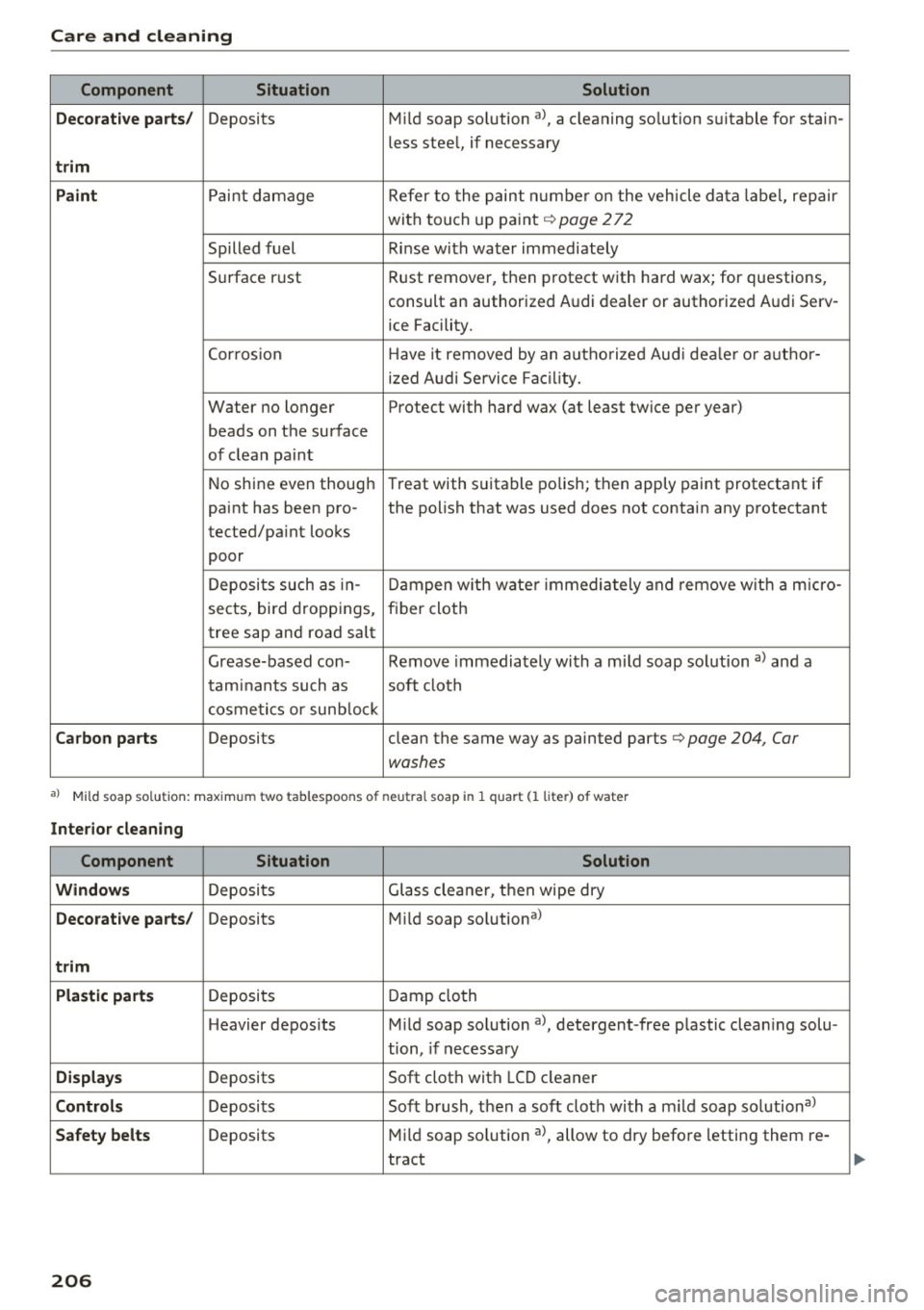
Care and cleaning
Component Situation Solution
D eco ra tiv e p art s/
Deposits Mild soap so lution a>, a cleaning solution suitable for stain-
less steel, if necessary
trim
Paint
Paint damage Refer to the paint n umber on the vehicle data label, repair
with touch up pa int ¢
page 272
Spilled fuel Rinse with water immediately
Surface rust Rust remover, then protect with hard wax;
for questions,
consult an authorized Audi dealer or authorized Audi Serv-
ice Facility.
Corros ion Have it removed by an authorized Aud i dea le r or author-
ized A udi Service Fac il ity.
Water no longer Protect with hard wax (at least twice per year)
beads on the surface
of clean paint
No shine even though Treat with suitable polish; then apply paint protectant if
paint has been pro- the polish that was used does not contain any protectant
tected/pa int looks
poor
Deposits such as in- Dampen w ith water immediately and remove w ith a micro -
sects, bird droppings, fiber cloth
tree sap and road salt
Grease-based con- Remove immediately with a mild soap solution a) and a
tam inants such as soft cloth
cosmetics or sunb lock
C arbon p arts Deposits clean the same way as painted parts ¢ page 204, Car
washes
•> Mi ld soap solution: maxim um two tablespoons of neutral soap in 1 quart (l liter) of water
Interior cle ani ng
Component Situation Solution
Window s
Deposits Glass cleaner, then wipe dry
D ec orativ e p arts/ Deposits Mild soap so lutional
trim
Pla stic pa rts
Deposits Damp cloth
Heavier deposits M ild soap solution a>, detergent -free plastic cleaning solu-
tion, if necessary
Di sp la ys Deposits Soft cloth with LCD cleaner
Co ntr ols Deposits Soft brush, then a soft cloth with a m ild soap solutiona>
S afe ty belt s Deposits Mild soap solution a>, allow to dry before letting them re-
tract
206
...
Page 209 of 296
CD
CD
.... N ,-... N .... 0 0 c:<: 00
Care and cleaning
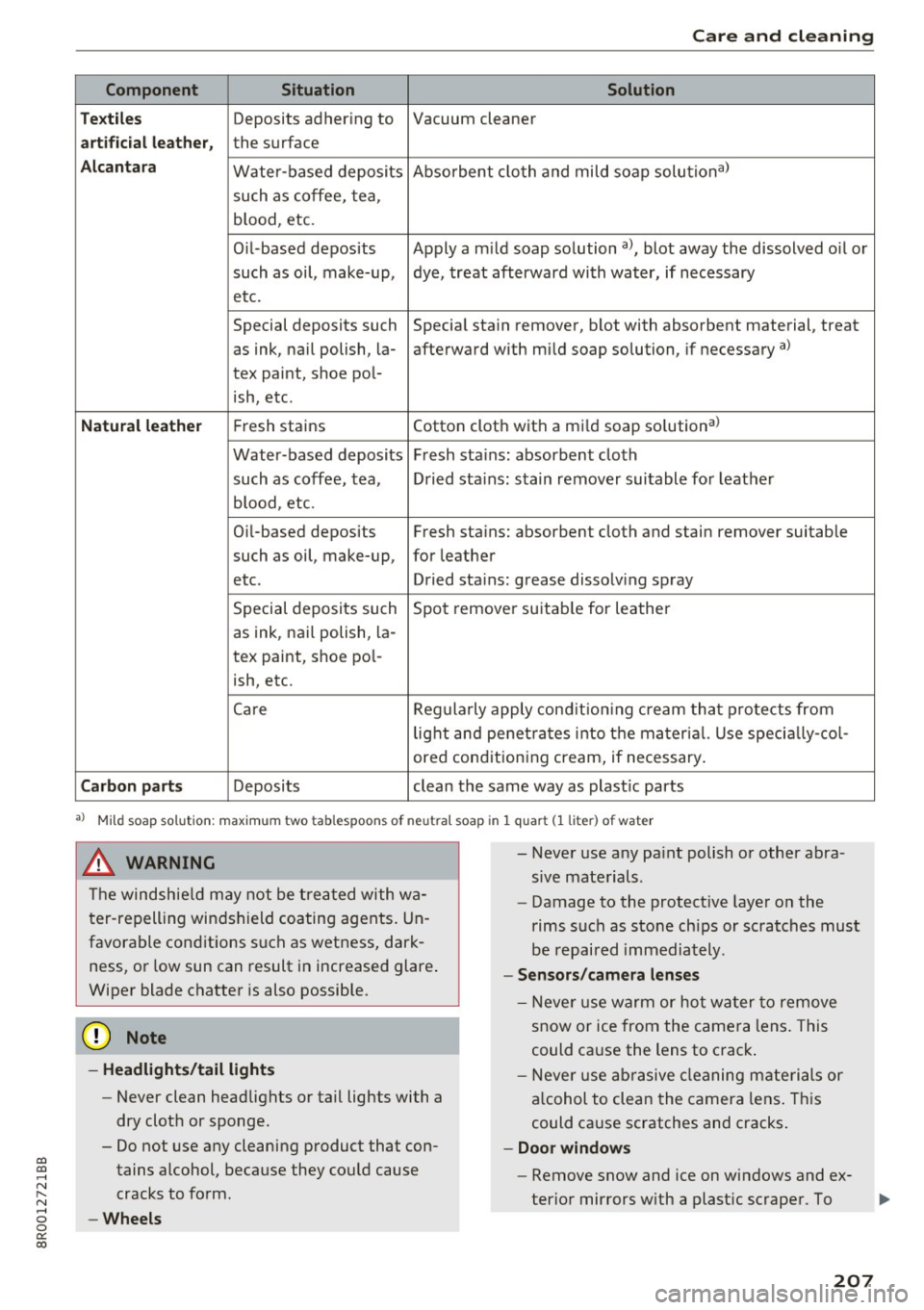
Component Situation Solution
T ex til es
Deposits adhering to Vacuum cleaner
art ifici al leat her, the surface
A lcan tara Water-based deposits Absorbent
cloth and mild soap solutiona>
such as coffee, tea,
b lood, etc.
Oil -based deposits Apply a m ild soap solution
a), blot away the dissolved o il or
such as oil, make-up, dye, treat afterward with water, if necessary
etc.
Special deposits such Special stain
remover, blot with absorbent material, treat
as ink, nail polish, la- afterward with mild soap solution, if necessary
a)
tex paint, shoe pol-
ish, etc.
Natu ral le ath er Fresh stains Cotton cloth with a mild soap solution a>
Water-based deposits Fresh stains: absorbent cloth
such as coffee, tea, Dried stains : stain
remover suitable fo r leather
b lood , etc.
Oi l-based deposits Fresh stains: absorbent cloth and stain
remover suitable
such as oil, make-up, for leather
etc. Dried stains : grease dissolving spray
Special deposits such Spot remove r suitab le for leather
as ink, nai l polish, la-
tex paint, shoe pol-
ish, etc.
Care Regularly apply condit ion ing c ream that protects from
lig ht and penet rates into the material. Use specia lly-co l-
ored conditioning cream, if necessary .
Carbon part s Deposits clean the same way as plast ic parts
a) Mi ld soap solution: maximum two tablespoons of neutral soap in 1 q uart (1 liter) of water
.8, WARNING
The windshield may not be trea ted with wa
ter-repelling windshield coating agents. Un
favorable cond itions such as wetness, dark
ness, or low sun can result in increased glare.
Wiper blade chatter is also possible.
@ Note
- Headlight s/tail li ght s
-Never clean headlights or tail lights with a
dry cloth or sponge.
- Do not use any cleaning product that con
tains alcohol, because they could cause
cracks to form.
- Whe els
-
- Never use a ny pa int polish or other abra
sive materials .
- Damage to the protect ive layer on the
rims such as sto ne ch ips or scratches must
be repaired immediately .
-Sen sor s/camera l enses
- Neve r use warm or hot water to remove
snow or ice from the camera lens . This
could cause the lens to crack .
- Neve r use ab rasive cleaning materials or
a lcohol to clean the camera lens . This
could cause scratches and cracks .
-Door window s
-Remove snow and ice on windows and ex-
terior mirrors w ith a plast ic scraper . To
207
Page 212 of 296
Fuel and R efu eli ng
Many gasoline grades are b lended to perform es
pecia lly we ll for winter or summer driving. Dur
ing seasonal change-over, we suggest that you
fill up at busy gas stations where the seasonal
adjustment is more likely to be made in time.
@) Note
-Fuels containing a high percentage of etha
nol such as ESO and E85 may only be used in
vehicles with flexible fuel* engines. Using high ethanol fuel in vehicles not equipped
with flexible fuel* engines can cause severe
engine damage.
- Methanol fuels which do not meet these re quirements may cause corros io n and dam
age to plast ic and rubber components in the
fuel system.
- Do not use fuels that fail to meet the spec i
fied c riter ia in this chapter.
- If you a re unable to determine whether or
not a particular fuel blend meets the spec i
ficat ions, ask your service station or its fuel
supplier.
- Do not use fuel for wh ich the contents can
not be identified.
- Fuel system damage and performance p rob
l ems result ing from the use of fue ls diffe r
ent from those specified are not the respon
s ibility of Audi and are not covered under
the New Vehicle or the Emission Control
System Warranties .
- If you experience a loss of fue l economy o r
driveability and performance prob lems due
to the use of one of these fuel b lends, we
recommend that you switch to unblended
fuel.
Ethanol fuel (Bio -ethanol)
Ap plies to: vehicl es w ith flex ible fuel engine
You con recognize vehicles with a flexible fuel
engine by looking at the label on the inside of
the fuel filler flop.
Vehicles with flexible f uel engines may be oper
ated w ith bio-ethanol fuels such as E85 (85%
ethanol and 15% gasoline) or with unleaded gas
oline (91 AKI/ROZ 95). The vehicle may also be
operated with a mixture of these fuels .
210
Your fuel consumpt ion wi ll increase when using
bio-ethano l fue ls due to the lower amount of en
ergy contained per un it vo lume in ethanol.
Warming up th e fle xible fuel engine in low
temperatures
Due to the chemical composition of bio-ethanol ,
a certain amount of fuel ends up in the engine o il
when driving short distances in very low temper
atures. This fuel evaporates again when the en
gine is warmed up .
II Please warm up engine .
If the driver message appears in the instr ument
cluster disp lay, drive with a warm engine to re
duce the oil leve l.
(D Note
- N ever fill with methano l o r with a h igher
percentage of bio -e thanol than 85% (E85).
A highe r percentage of bio-ethanol in the
fuel can cause damage to the engine or to
the fuel system.
- If you use on ly E85, it is recommended to
fill the fue l tank comp lete ly with unleaded
premium grade gasoline every 5,000 mi les.
- If you experience starting, rough id le or hes
itat ion driveab ility prob lems, f ill the fuel
tank comp lete ly with unleaded prem ium
grade gaso line and drive it no rma lly until
the gaso line is used. See your author ized
Audi dealer if the prob lem pers ists.
- Inform your authorized Audi dealer that you
are operat ing or have operated the vehicle
with E85.
- Read and follow the informat ion and tips
about gasoline~
page 209.
(D Tips
It may take longer to start the engine when
the outs ide temperature is ve ry cold . If possi
ble, use winterized fue l if tempe ratu res are
below free zing .
Page 215 of 296
a,
a,
..... N ,-... N ..... 0 0
0:
co
Static electricity can cause sparks that can ignite fuel vapors released during refueling.
- Never smoke or have an open flame any
where in or near your vehicle when refueling or filling a portable fuel container.
- For your safety, we strongly recommend
that you do not travel with a portable fuel
container in your vehicle. The container, full
or empty may leak and could cause a fire,
especially in a crash.
- If, under exceptional circumstances, you
must transport a portable fuel container,
please observe the follow ing :
- Never fill a portable fuel container while it
is anywhere in or on the vehicle (for exam
ple, in the luggage compartment, or on
the trunk) . Static electricity can build up
while filling and can ignite fuel vapors causing a fire .
- Always p lace a portable fuel container on
the ground before filling.
- Always keep the filler nozzle completely
ins ide the portable container before and
during filling.
- If filling a portable container made of
metal, the filler nozzle must always be in
contact with the container . This will help
prevent static electric ity from discharg ing
and cause a fire .
- Never spill fuel inside the vehicle or lug
gage compartment . Fuel vapors are h ighly
flammab le.
-Always observe local and state/provincial
laws regarding the use, storage and trans
portation of fuel containers.
- Make certa in the fuel co nta iner meets in
dustry standards (ANSI/ ASTM F852 -86) .
(D Note
If any fuel has spilled onto the car, it should
be removed immediately to prevent damage
to the paint .
@ For the sake of the environment
As soon as the correctly operated nozzle sw itches off automatically for the first time,
the tank is full. Do not try to add more fuel
Fuel and Refueling
because fuel may spill out. In addition, the
expansion space in the fuel tank will be filled -
causing the fue l to overflow when it becomes
warm and pollute the environment.
@ Tips
- Running your engine while refuelling may
cause vapors to escape or even cause fuel to
spill out of the tank. This would then shut
off the fuel nozzle before the tank is full.
- Do not refuel your vehicle with the ignition
turned on. The fuel gauge may otherwise not indicate the correct fuel level after refu
elling .
- Diesel vehicles* are equipped with a diesel
m isfueling protector . It allows the vehicle
to be fueled only with a diesel fuel pump
nozzle. A worn or damaged nozzle or a noz
zle that is too small may not be able to open
the diesel misfueling protector.
If this is the
case, try turning the nozzle before inserting
it in the fuel filler neck, use a different fuel
pump or see your authorized Audi dealer or
authorized repair facility for assistance.
- The fuel filler flap of your vehicle is not
locked when you lock the vehicle from the
inside.
Unlocking the fuel filler flap
by hand
You can open the fuel filler flap by hand if the
power locking system should fail.
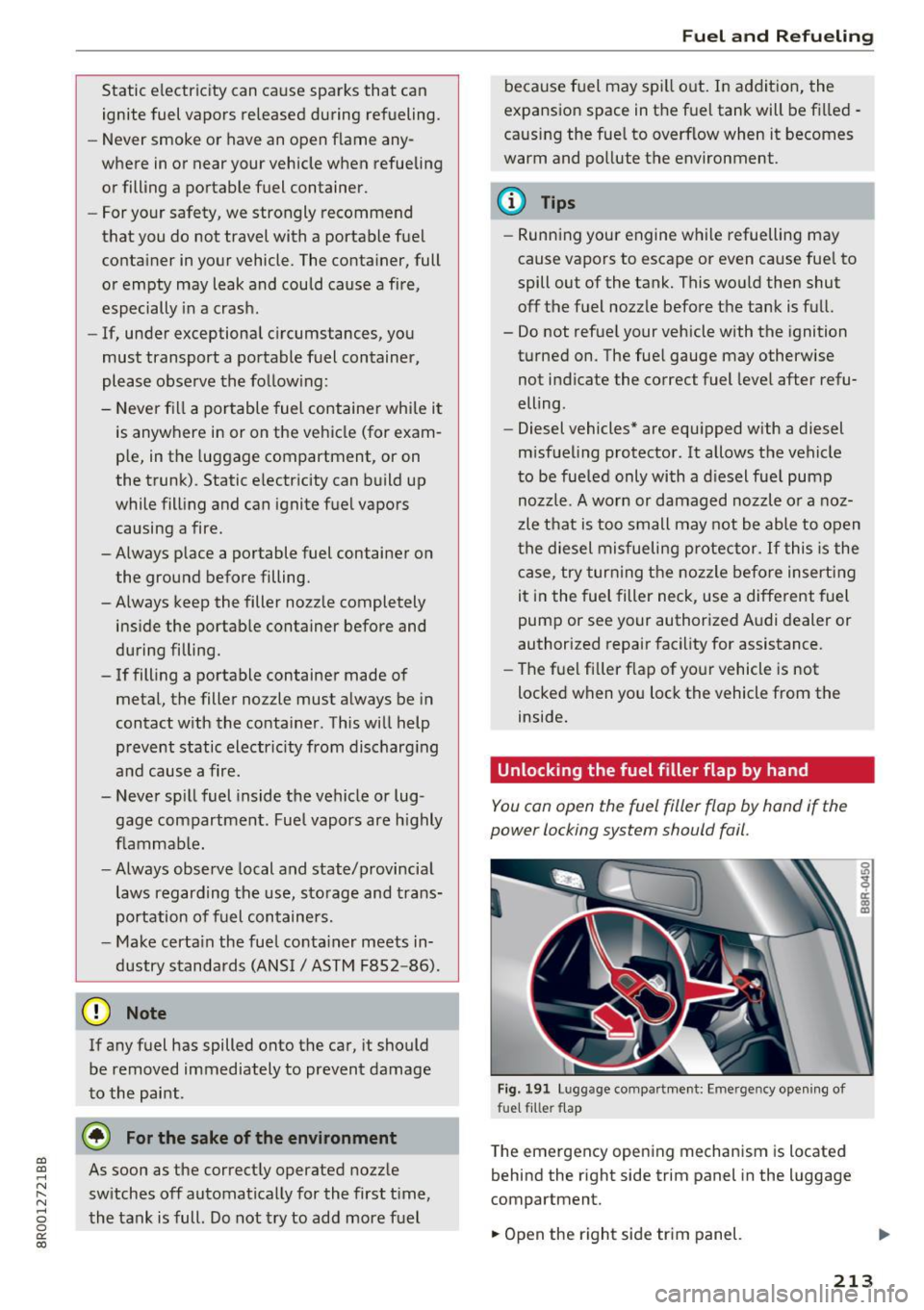
Fig. 191 Lu ggage compa rtmen t: E merge ncy opening of
fu e t fitte r flap
The emergency opening mechanism is located
behind the right side trim panel in the luggage
compartment.
.. Open the right side trim panel.
213
Page 217 of 296
a,
a,
..... N r-N ..... 0 0
0:
co
Filling AdBlue
Applies to: vehicles with selective catalytic reduction
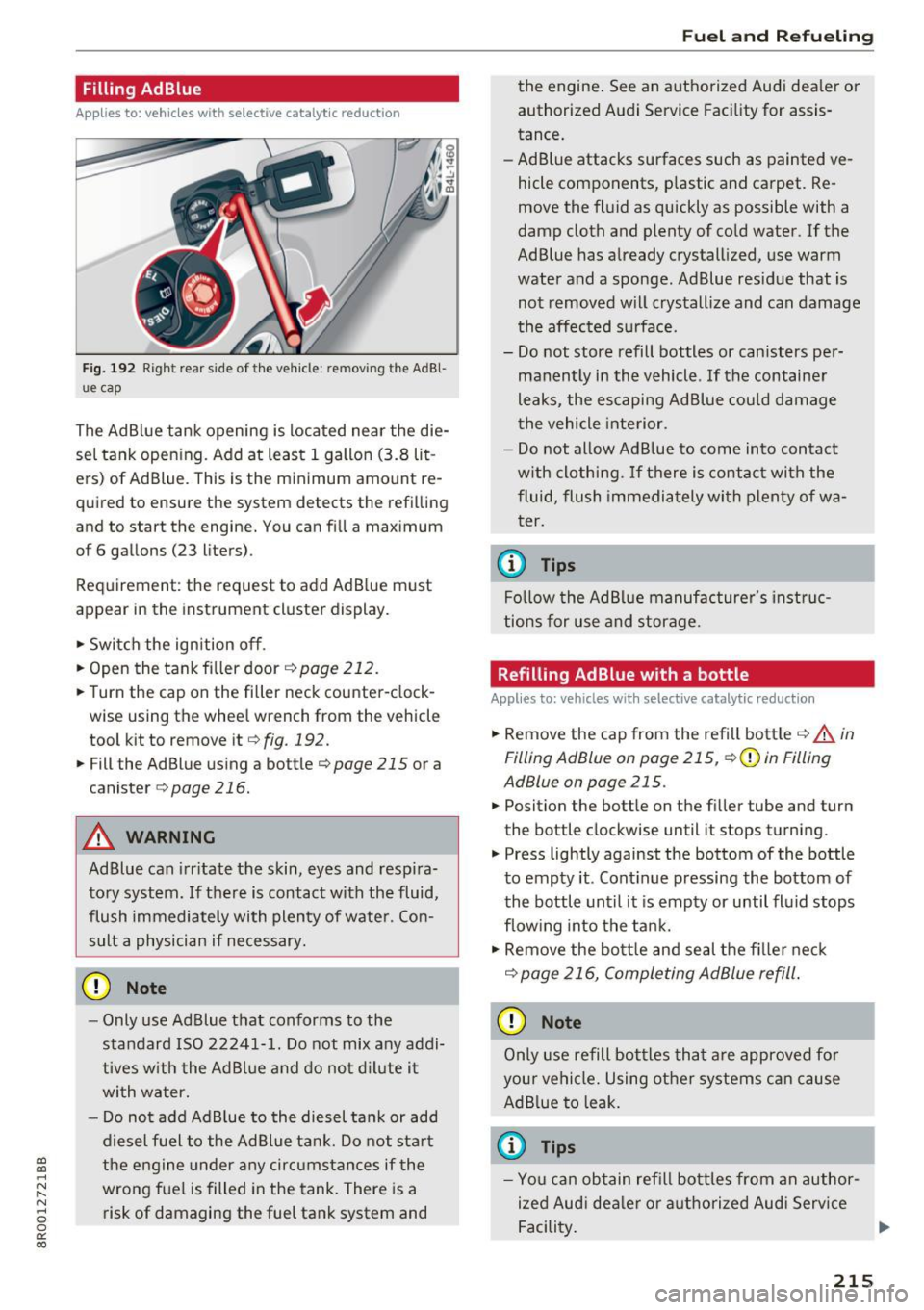
Fig. 192 Right rear side of the vehicle : remov ing the AdBl
ue cap
The Ad Blue tank opening is located nea r the die
sel tank open ing. Add at least 1 gallon (3.8 lit
e rs) of Ad Blue. This is the minimum amount re
quired to ensure the system detects the refilling
and to start the engine. You can fill a maximum
of 6 gallons (23 liters) .
Requirement: the request to add Ad Blue must
appear in the instrument cluster display.
• Switch the ignition off.
• Open the tank fi ller door ¢
page 212.
• Turn the cap on the filler neck counter-clock
wise using the whee l wrench from the vehicle
tool kit to remove it¢
fig . 192.
• Fill the Ad Blue using a bottle¢ page 215 or a
canister
c> page 216.
A WARNING
Ad Blue can irr itate the skin, eyes and resp ira
tory system. If there is contact with the fluid,
flush immediately with plen ty of wate r. Con
sult a physician if necessary.
CD Note
- Only use Ad Blue that conforms to the
standard ISO 22241-1. Do not mix any addi
tives w ith the Ad Blue and do not d ilute it
with water.
- Do not add Ad B lue to the diesel tank or add
diesel fuel to the Ad Blue tank. Do not start
the engine under any circumstances if the
wrong fuel is filled in the tank. There is a
risk of damaging the fuel tank system and
Fue l an d Re fuelin g
the engine . See an authorized Audi dea ler or
authorized Audi Service Facility for assis
tance.
- Ad Blue attacks surfaces such as painted ve
hicle components, p lastic and carpet. Re
move the fluid as quickly as possible with a
damp cloth and plenty of cold water . If the
Ad Blue has already crystallized, use warm
water and a sponge. Ad Blue residue that is not removed w ill crystallize and can damage
the affected surface.
- Do not store refill bottles or canisters per
manently in the vehicle . If the container
leaks, the escaping Ad Blue could damage
the vehicle interior.
- Do not al low Ad Blue to come into contact
w ith clothing.
If there is contact with the
fluid, flush immediately with plenty of wa
ter.
© Tips
Fo llow the AdBl ue manufacturer's instruc
tions for use and storage.
Refilling AdBlue with a bottle
Applies to: vehicles wit h selective catalytic reduction
• Remove the cap from the refill bott le ¢ A in
Filling AdBlue on page 215,
c> (D in Filling
AdBlue on page 215.
• Position the bottle on the filler tube and turn
the bottle clockwise until it stops turning.
• Press lightly against the bottom of the bottle
to empty it . Cont inue pressing the bottom of
the bottle until it is empty or until fluid stops
f low ing into the tank.
• Remove the bott le and seal the f iller neck
¢ page 216, Completing AdBlue refill .
CD Note
Only use refill bottles that are approved for
your vehicle. Using other systems can cause AdB lue to leak.
(0 Tips
- You can obtain refill bo ttles from an author
ized Aud i dea le r or authorized Audi Serv ice
Facility.
215