ESP AUDI Q5 2017 Workshop Manual
[x] Cancel search | Manufacturer: AUDI, Model Year: 2017, Model line: Q5, Model: AUDI Q5 2017Pages: 296, PDF Size: 74.43 MB
Page 173 of 296
CD
CD
.... N ,-... N ..... 0 0 C<'. 00
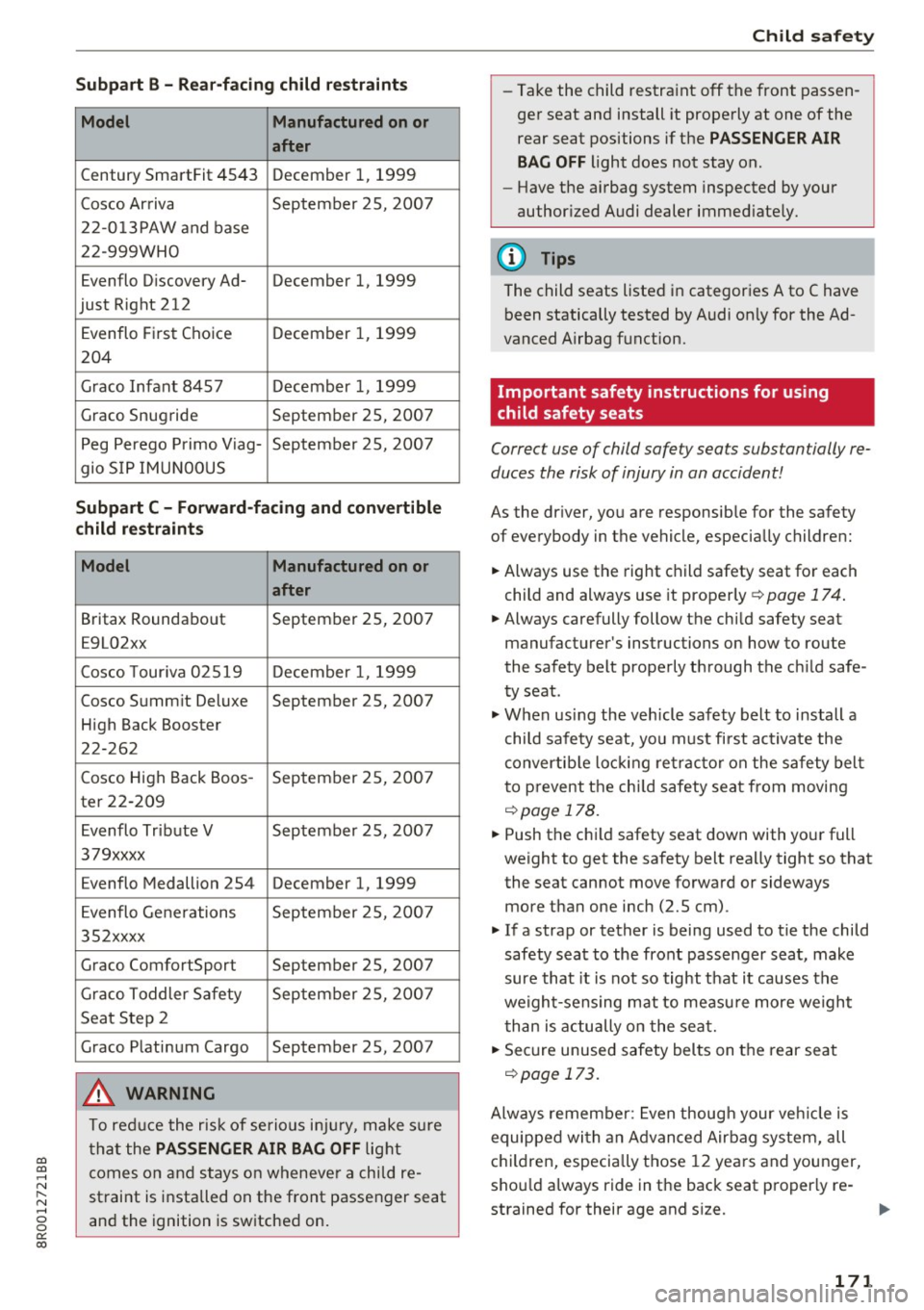
Subpart B - Rear-facing child restraints
Model Manufactured on or
after
Century SmartFit 4543 December 1, 1999
Cosco Arriva September 25, 2007
22-013PAW and base
22-999WHO
Evenflo Discovery Ad- December 1, 1999
just Right 212
Evenflo First Choice December 1, 1999
204
Graco Infant 8457 December 1, 1999
Grace Snug ride September 25, 2007
Peg Perego Primo Viag- September 25, 2007
gio S IP IMUNOOUS
Subpart C -Forward-facing and convertible
child restraints
Model Manufactured on or
after
Britax Roundabout September 25, 2007
E9L02xx
Cosco Tour iva 02519 December 1, 1999
Cosco Summit Deluxe September 25, 2007
High Back Booster
22-262
Cosco High Back Boos-
September 25, 200 7
ter 22-209
Evenflo Tribute V September 25, 2007
379xxxx
Evenflo Medallion 2S4 December 1, 1999
Evenflo Generations September 25, 2007
352xxxx
Grace ComfortSport September 25, 2007
Grace Toddler Safety September 25, 2007
Seat Step 2
Grace Platinum Cargo September 25, 2007
A WARNING
To reduce the risk of serious injury, make sure
that the
PASSENGER AIR BAG OFF light
comes on and stays on whenever a child re
straint is installed on the front passenger seat
and the ignition is switched on.
Child safety
- Take the child restraint off the front passen
ger seat and install it properly at one of the
rear seat positions if the
PASSENGER AIR
BAG OFF
light does not stay on.
- Have the airbag system inspected by your
authorized Audi dealer immed iately.
(D Tips
The child seats listed in categor ies A to C have
been statically tested by Audi only for the Ad
vanced Airbag function.
Important safety instructions for using
child safety seats
Correct use of child safety seats substantially re
duces the risk of injury in an accident!
As the driver, you are responsible for the safety
of everybody in the vehicle, especially children:
.,. Always use the right child safety seat for each
child and always use it properly ¢
page 174 .
.,. Always carefully follow the chi ld safety seat
manufacturer's instructions on how to route
the safety belt properly through the child safe ty seat .
.,. When using the vehicle safety belt to install a
child safety seat, you must first activate the
convertible locking r etractor on the safety belt
to prevent the chi ld safety seat from moving
~page 178.
.,. Push the chi ld safety seat down with yo ur full
weight to get the safety belt really tight so that the seat cannot move forward or sideways more than one inch (2.5 cm).
.,. If a strap or tether is being used to tie the child
safety seat to the front passenger seat, make
sure that it is not so tight that it causes the
weight-sens ing mat to measure more weight
than is actually on the seat.
.,. Secure unused safety belts on the rear seat
~page 173.
Always remember: Even though your veh icle is
equipped with an Advanced Airbag system, all
children, especia lly those 12 years and younger,
shou ld a lways ride in the back seat proper ly re-
strained for their age and s ize.
liJJ..
171
Page 174 of 296
Child safety
A WARNING
Not using a child safety seat, using the wrong
child safety seat or improperly installing a
child restraint increases the risk of serious
personal injury and death.
- All vehicle occupants and especially children
must always be restrained properly whenev
er riding in a vehicle.
- An unrestrained or improperly restrained
child can be injured or killed by being
thrown against the inside of the vehicle or
by being ejected from it during a sudden
maneuver or impact.
- An unrestrained or improperly restrained
child is at much greater risk of injury or
death by being struck by an inflating air
bag.
- Commercially available child safety seats
are required to comply with U.S. Federal
Motor Vehicle Safety Standard (FMVSS) 213
(in Canada CMVSS 213).
- When buying a child restraint, select one
that fits your child and the vehicle.
- Only use child restraint systems that fully
contact the flat portion of the seat cush ion. The child restraint must not tip or
lean to either side. Audi does not recom
mend using child safety seats that rest on
legs or tube-like frames. They do not pro
vide adequate contact with the seat.
- Always heed all legal requirements per
taining to the installation and use of child
safety seats and carefully follow the in
structions provided by the manufacturer
of the seat you are using.
- Never allow children under 57 inches
(1.45 meters) to wear a normal safety belt.
They must always be restrained by a proper child restraint system. Otherwise, they
could sustain injuries to the abdomen and
neck areas during sudden braking maneu
vers or accidents.
- Never let more than one child occupy a child
safety seat.
- Never let babies or older children ride in a
vehicle while sitting on the lap of another
passenger .
172
-Holding a child in your arms is never a sub
stitute for a child restraint system.
- The strongest person could not hold the
child with the forces that exist in an acci
dent. The child will strike the interior of
the vehicle and can also be struck by the passenger.
- The child and the passenger can also in
jure each other in an accident.
- Never install rear-facing child safety seats
or infant carriers on the front passenger
seat . A child will be seriously injured and
can be killed when the passenger airbag in
flates -even with an Advanced Airbag Sys
tem.
- The inflating airbag will hit the child safety
seat or infant carrier with great force and
will smash the child safety seat and child
against the backrest, center armrest, door
or roof.
- Always install rear-facing child safety seats
or infant carriers on the rear seat.
- Make sure there is enough space in front of
the child in the child seat.
If necessary, ad
just the angle and position of the seat in
front of the child seat.
- Forward-facing child safety seats installed
on the front passenger's seat can interfere
with the airbag when it inflates and cause
serious injury to the child. Always install for
ward-facing child safety seats on the rear
seat.
- If exceptional circumstances require the use
of a forward-facing child restraint on the
front passenger's seat, the child's safety
and well-being require that the following
special precautions be taken:
- Make sure the forward-facing seat has been designed and certified by its manu
facturer for use on a front seat with a pas
senger front and side airbag.
- Always carefully follow the manufacturer's
instructions provided with the child safety
seat or carrier.
- Always move the front passenger seat to
the highest position in the up and down
adjustment range and move it back to the
rearmost position in the seat's fore and
~
Page 175 of 296
a,
a,
..... N ,....
N ..... 0 0
0:
co
aft adjustment range, as far away from
the airbag as possible, before installing
the forward-facing child restraint.
- Always make sure that the safety belt up
per anchorage is behind the child restraint
and not next to or in front of the child re
straint so that the safety belt will be prop
erly positioned.
- Always make sure that nothing prevents
the front passenger's seat from being
moved to the rearmost position in its fore
and aft adjustment range.
- Always make sure that the backrest is in the upright position.
-Always buckle the child safety seat firmly in
place even if a child is not sitting in it. A
loose child safety seat can fly around during
a sudden stop or in a collision.
-Always read and heed all WARNINGS when
ever using a child restrained in a vehi .cle is
being used
~ page 140, Safety belts,
~ page 148, Airbag system and
~ page 168, Child safety.
& WARNING
To reduce the risk of serious injury, make sure
that the
PASSENGER AIR BAG OFF light
comes on and stays on whenever a child re
straint is installed on the front passenger seat
and the ignition is switched on.
- Take the child restraint off the front passen
ger seat and install it properly at one of the
rear seat positions if the
PASSENGER AIR
BAG OFF
light does not stay on.
- Have the airbag system inspected by your
authorized Audi dealer immediately.
Child safety
Secure unused safety belts on the rear seat
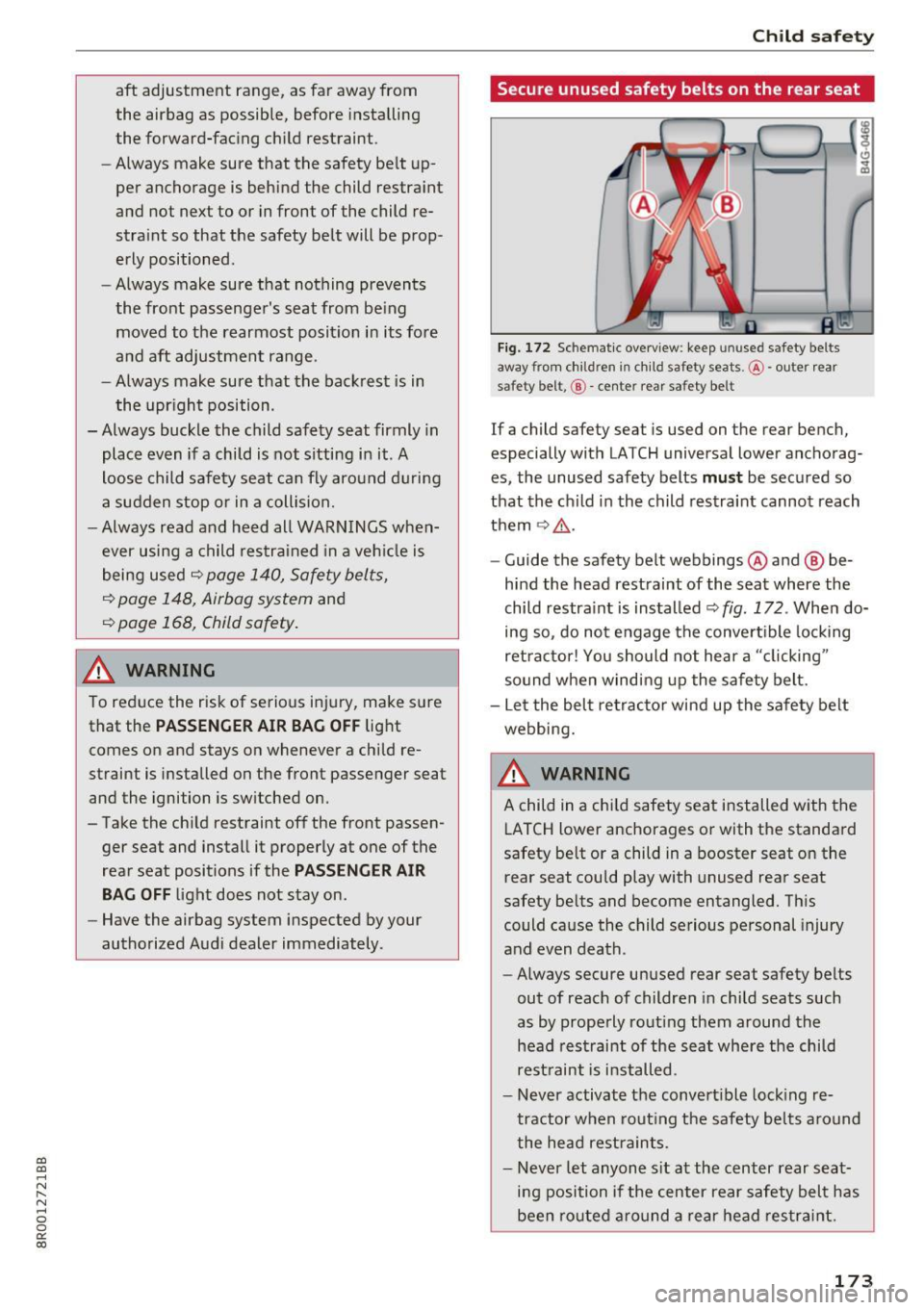
Fig. 172 Sc hema tic overv iew: keep unused safety belts
away from children in chil d safety seats.@· ou ter rear
safety belt ,@ -center rear safety belt
If a child safety seat is used on the rear bench,
especially with LATCH universal lower anchorag
es, the unused safety belts
must be secured so
that the child in the child restraint cannot reach
them ~.&. -
- Guide the safety belt webbings @ and @ be
hind the head restraint of the seat where the
child restraint is installed
<::) fig. 172 . When do
ing so, do not engage the convertible locking
retractor! You should not hear a "clicking"
sound when winding up the safety belt.
- Let the belt retractor wind up the safety belt
webbing.
A WARNING
-
A child in a child safety seat installed with the LATCH lower anchorages or with the standard
safety belt or a child in a booster seat on the rear seat could play with unused rear seat
safety belts and become entangled. This
could cause the child serious personal injury
and even death.
- Always secure unused rear seat safety belts
out of reach of children in child seats such
as by properly routing them around the head restraint of the seat where the child
restraint is installed .
- Never activate the convertible locking re
tractor when routing the safety belts around
the head restraints.
- Never let anyone sit at the center rear seat
ing position if the center rear safety belt has
been routed around a rear head restraint .
173
Page 179 of 296
use the safety belt height adjustment to help
adjust the shoulder portion properly.
~ Secure unused safety belts on the rear seat
¢ page 173.
Children up to at least 8 years old (over 40 lbs. or
18 kg) are best protect ed in child safety s eats de
signed for their age and weight. Experts say that
the skeletal structure, particularly the pelvis, of
these children is not fully developed, and they
must not use the vehicle safety belts without a
suitable child restra int .
It is usually best to put these children in appro priate booster seats . Be sure the booster seat
meets all applicable safety standards .
Booster seats raise the seating position of the
child and reposition both the lap and shoulder
parts of the safety belt so that they pass across
the child's body in the right places. The rout ing of
the belt over the child's body is very important
for the child's protection, whether or not a boos
ter seat is used. Chi ld ren age 12 and unde r must
a lways ride in the rear seat .
Ch ildren who are at least 4 ft . 9 in. (57 inches/
1.45 mete rs) tall ca n genera lly use the veh icle's
three po int lap and shoulder be lts. Neve r use the
l ap belt po rtion of the vehicle 's safety belt alone
to restrain any child, regardless of how big the
chi ld is. A lways remember that children do not
have the pronounced pelvic structure required for
the proper function of lap belt port ion of the ve
h icle 's three point lap and shoulder be lt s. The
chi ld 's safety absolutely requires that a lap belt
port ion of the safety belt be fastened snugly and
as low as possible around the pelvis . Never let
the lap belt portion of the safety belt pass over
the child's stomach or abdomen.
In a crash, a irbags must inflate within a blink of
an eye and wit h considerable force . In order to do
its job, the airbag needs room to inflate so that it
will be there to p rotect the occupant as the occu
pant moves forward into the a irbag.
A vehicle occupant who is out of position and too
~ close to the airbag gets in the way of an inflating ....
~ ai rbag. When an occ upant is too close, he o r she
N 8 will be struck v iolently and will receive ser ious or
~ possibly even fatal injury. 00
Ch ild safety
In order for the a irbag to offer protection, it is
important that a ll vehicle occupants, especially
any ch ildren, who m ust be in the front seat be
cause of exceptiona l circumstances, be properly
restra ined and as far away from the airbag as
poss ible. By keeping room between the child 's
body and the front of the passenger compart
ment, the a irbag can inflate completely and pro
vide s upplementa l protec tion in certain frontal
collisions.
A WARNING
-
Not using a booster seat, using the booster
seat improperly, incorrect ly installing a boos
ter seat or using the vehicle safety belt im
properly increases the risk of serious personal
i njury and death in a collision or other emer
gency situation. To help reduce the risk of se rious personal injury and/or death:
- The shou lder belt must lie as close to the
center of the ch ild's collar bone as possible
and must lie flat and snug on the upper
body. It must never lie across the throat or
neck. The lap belt must lie ac ross the pelvis
and never across the stomach o r abdomen.
Make sure the bel t lies flat and sn ug. Pu ll on
the belt to tighten if necessary.
- Fail ure to properly route safety bel ts over a
child's body w ill cause severe injuries in an
accident or other emergency situation
¢ page 140.
- The rear side of the chi ld safety seat should
be positioned as close as possible to the
backrest on the vehicle seat. Adjust or re
move the rear seat head restraint if it is dif
f icult to insta ll the ch ild seat with the head
restraint in place¢
page 64 . Install the
head restraint again immed iately once the
child seat is removed . Driving without head
rest raints or with head restra ints that a re
not properly adj usted increases the r is k of
serio us or fatal ne ck in jury dramatically .
- Never let a chi ld put the shoulder belt under
the arm or behind the ba ck, because i t could
cause severe inj uries in a crash .
- Ch ild ren on the fron t seat of any car, even
with Advanced Airbags, can be seriously in-
jured or even ki lled when an airbag inflates .
Ill>
177
Page 180 of 296
Child safety
-Never let a child stand or kneel on any seat,
for example the front seat.
- Never let a child ride in the cargo area of
your vehicle.
- Always remember that a child leaning for
ward, sitting sideways or out of position in
any way during an accident can be struck by
a deploying airbag. This will result in serious
personal injury or death.
- If you must install a booster seat on the
front passenger seat because of exceptional
circumstances the
PASSENGER AIR BAG
OFF
light must come on and stay on, when
ever the ignition is switched on.
- If the
PASSENGER AIR BAG OFF light does
not come on and stay on, perform the
checks described
Q page 158, Monitoring
the Advanced Airbag System.
- Take the child restraint off the front passen
ger seat and install it properly at one of the
rear seat positions if the
PASSENGER AIR
BAG OFF
light does not stay on whenever
the ignition is switched on.
-Always read and heed all WARNINGS when
ever using a child restrained in a vehicle is
being used
Q page 140, Safety belts,
Q page 148, Airbag system and
Q page 168, Important information.
Securing child seats
Securing a child safety seat using a safety
belt
Safety belts for the rear seats and the front pas
senger can be locked with the convertible locking
retractor to properly secure child safety seats .
The safety belts emergency locking retractors for
the rear seats safety belts and for the front pas
senger's seat safety belt have a convertible lock
ing retractor for child restraints. The safety belt
must be locked so that belt webbing cannot un
reel. The retractor can be activated to lock the
safety belt and prevent the safety belt webbing
from loosening up during normal driving. A child
safety seat can only be properly installed when
the safety belt is locked so that the child and
child safety seat will stay in place .
178
Always remember: Even though your vehicle is
equipped with an Advanced Airbag system, all
children, especially those 12 years and younger,
should always ride in the back seat properly re
strained for their age and size.
A WARNING
Improperly installed child safety seats in
crease the risk of serious personal injury and
death in a collision.
-
- Always make sure that the safety belt re
tractor is locked when installing a child
safety seat. An unlocked safety belt retrac
tor cannot hold the child safety seat in place
during normal driving or in a crash.
- Always buckle the child safety seat firmly in
place even if a child is not sitting in it. A
loose child safety seat can fly around during
a sudden stop or in a collision.
- Always make sure that the rear seat back
rest to which the center rear safety belt is
attached is securely latched whenever the
rear center safety belt is being used to se
cure a child restraint.
- If the backrest is not securely latched, the
child and the child restraint will be thrown
forward together with the backrest and will strike parts of the vehicle interior. The child
can be seriously injured or killed .
- Never install rear-facing child safety seats
or infant carriers on the front passenger
seat . A child will be seriously injured and
can be killed when the passenger airbag in
flates.
- The inflating airbag will hit the child safety
seat or infant carrier with great force and
will smash the child safety seat and child
against the backrest, center armrest, door
or roof.
- Always install rear-facing child safety seats
or infant carriers on the rear seat.
- Forward-facing child safety seats or infant
carriers installed on the front passenger's
seat may interfere with the deployment of
the airbag and cause serious injury to the
child.
- It is safer to install a forward-facing child
safety seat on the rear seat.
Page 181 of 296
CD
CD
.... N ,-... N ..... 0 0 C<'. 00
-Always read and heed all WARNINGS when
ever using a child restrained in a vehicle is
being used
c::;, page 168 . Special precautions
apply when installing a child safety seat on
the front passenger seat
c::;, page 149, Child
restraints on the front seat -some impor
tant things to know.
A WARNING
Always take special precaut ions if you must
install a forward or rearward-fac ing ch ild re
straint on the front passenger's seat in excep
tional situations:
- Whenever a forward or rearward-facing
child restraint is installed on the front pas
senger seat, the
PA SSENG ER AIR BAG OFF
light must come on and stay on whenever
the ignition is switched on .
- If the
PASSENGER AIR BAG OFF light does
not come on and stay on, perform the
checks described
c::;, page 158, Monitoring
the Advanced Airbag System.
-
- Take the child restraint off the front passen
ger seat and install it properly at one of the
rear seat positions if the
P ASS ENGER AIR
BA G O FF
light does not stay on whenever
the ignition is switched on .
- Improper installation of child restraints can
reduce their effect iveness or even prevent
them from providing any protection .
-An improperly installed ch ild restraint can
interfere w ith the airbag as it deploys and
seriously injure or even kill the child .
- Always carefully follow the manufacturer's
instructions provided w ith the child safety
seat or car rier.
- Never place additional items on the seat
that can increase the total weight registered by the weight-sensing mat and can cause in
jury in a crash .
A WARNING
Forward-facing child restraints :
- Always ma ke sure the forward-fac ing seat
has been designed and certified by its man
ufact urer for use on a front seat with a pas
senger front and side airbag .
Child safety
-Never put the forward-facing child restraint
up, against or very near the instrument pan
el.
- Always move the front passenger seat to
the highest position in the up and down ad
justment range and move it back to the rearmost posit ion in the seat's fore and aft
adjustment range, as far away from the air bag as possible, before installing the for
ward-facing ch ild restraint.
- Always make sure that the safety be lt upper
anchorage is behind the ch ild rest raint and
not next to o r in front of the child restraint
so that the safety be lt will be properly posi
tioned.
- Make sure that t he
PASSENGER AIR BAG
OFF
li ght comes on and stays on a ll the time
whenever the ignition is switched on .
A WARNING ~
Rearward-facing child restraints:
- A child in a rearward-fac ing ch ild safety seat
installed on the front passenger seat will be
serious ly injured and can be ki lled if the
front airbag inflates - even with an Ad
vanced Airbag System .
- The inflating airbag will hit the child safety
seat or infant carrier with great force and
will smash the child safety seat and child aga inst the backrest, center armrest, door
or roof .
- Always be especially carefu l if you must in
stall a rearward facing child safety seat on
the front passenger seat in except ional cir
cumstances .
- A t ight tether strap on a rearward-facing
child restraint attached to the front passen
ger seat can put too much p ressure on the
weight -mat in the seat and reg ister a heav i
er weight in the Advanced Airbag System.
The heavier weight reg istered can make the
system work as though an adult were on the
seat and deploy the Advanced Airbag when
it must be suppressed causing serious or
even fata l injury to the child .
179
Page 187 of 296
CD
CD
.... N ,-... N .... 0 0 C<'. 00
would also be permanently stretched around
the tether strap. This applies especially to
leather seats.
Using tether straps on rearward-facing
child restraints
Currently, few rear-facing child restraint systems
come with a tether . Please read and heed the
child restraint system manufacturer's instruc
tions carefully to determine how to properly in
stall the tether.
A WARNING
A child in a rearward-facing child safety seat
installed on the front passenger seat will be
seriously injured and can be killed if the front
airbag inflates -even with an Advanced Airbag
System.
- The inflating airbag will hit the child safety seat or infant carrier with great force and
will smash the child safety seat and child against the backrest, center armrest, or
door .
-A tight tether or other strap on a rearward
facing child restraint attached to the front
passenger seat can put too much pressure
on the weight-mat in the seat and register a
heavier weight in the Advanced Airbag Sys
tem. The heavier weight registered can make the system work as though an adult
were on the seat and deploy the Advanced
Airbag when it must be suppressed causing serious or even fatal injury to the child.
- If you must install a rearward facing child
safety seat on the front passenger seat be
cause of exceptional circumstances and the
PASSENGER AIR BAG OFF light does not
come on and stay on, immediately install
the rear-facing child safety seat in a rear
seating position and have the airbag system
inspected by your Audi dealer.
Child safety
Additional information
Sources of information about child
restraints and their use
There are a number of sources of additional in
formation about child restraint selection, instal
lation and use:
NHTSA advises that the best child safety seat is
the one that fits your child and fits in your vehi
cle, and that you will use correctly and consis
tently.
Try before you buy!
U.S National Highway Traffic Safety Administra
tion
Tel. : 1-888-327-4236 (TTY: 1-800-424-9153)
http://www.nhtsa.gov
http:/ /www.safercar.gov
National SAFE KIDS Campaign
Tel. : (202) 662-0600
http://www.safekids .org
Safety BeltSafe U.S.A
Tel. : (800) 745-SAFE (English)
Tel. : (800) 747-SANO (Spanish)
http://www.carseat.org
Transport Canada Information Centre
Tel. : 1-800-333-0371 or call 1-613-998-8616 if
you are in the Ottawa area
http://www.tc.gc.ca/ eng/roadsafety/men u. htm
Audi Customer Relations
Tel.: (800) 822-2834
185
Page 188 of 296
Intelligent Technology
Intelligent Technology
Electronic Stabilization
Control (ESC)
Description
The Electronic Stabilization Control (ESC) reinfor
ces driver safety . It reduces the risk of slipping
and improves driving stability. ESC detects crit i
cal s ituations such as the vehicle oversteering
and understeering or the wheels sp inning. The
veh icle is stab ilized by applying the brakes or re
ducing engine torque . Once t he ESC is active, the
indicator light
Ji) blinks in t he instrument clus
ter.
The fo llow ing systems are integrated in the ESC :
Ant i-loc k brake system (ABS)
ABS preve nts the wheels from locking up when
braking. The veh icle can still be steered even dur
ing hard brak ing. Apply steady pressure to the
brake pedal. Do not pump t he pedal. A pulsing in
the brake pedal indicates that the system is help
i n g you to brake the vehicle .
Br ake assist system
The brake assist system can decrease brak ing dis
tance . It increases braking power when the driver
presses the brake pedal quick ly in emergency sit
uations . You must press and hold the b rake pedal
until the situa tion is over. In vehicles w it h adap
tive c ruise contro l* , the brake assist system is
mo re sensit ive if the di stance de te cte d to the ve
h icle ahead is too small.
Anti -slip regulation (ASR)
ASR reduces eng ine power when the drive wheels
begin to spin and adapts t he force to the road
conditions . This makes it easie r to sta rt, acceler
ate and dr ive up h ills.
Electronic differential lock (EDL )
The EDL brakes w heels that a re spinning and
transfers the drive power to the other whee ls .
This f unction is not avai lab le at higher speeds.
In extreme cases, EDL automatically switches off
to help keep the brake on the braked wheel from
186
overheating . EDL will sw itch on again automati
ca lly when conditions have returned to normal.
Steering recommendation
The ESC he lps to s tabilize the vehicle by chang ing
t h e s teer ing torque.
On vehicles with dynam ic steeri ng*, ESC helps
stab ilize the steer ing in crit ica l sit uat io ns.
Selective wheel torque control
Se lective wheel torque cont rol is used when driv
i ng on curves. The front whee l on the inside of
the curve or both wheels on the inside of the cu rve are braked se lectively as needed. This al
l ows mo re precise dr iving in c urves . The applica
ble system may not ac tiv ate when d riving in wet
o r snowy cond it ions.
_&. WARNING
- The ESC and i ts in teg ra ted systems can not
overcome the laws of physics . This is espe
cially important on slippery or wet roads. If
the systems begin act ing to stab ilize your
veh icle, you should immediately change
your speed to match the road and traffic conditions. Do not let the increased safety
provided by t hese systems tempt yo u to
take risks. Doing so will i ncrease the r isk of
a loss of vehicle con trol, collisi on and se ri
ous person al injur ies.
- Always a dapt your speed to road, traffic and
weather condi tions. The risk of los ing c on
t rol of the vehicle in creases w hen driving
too fast, es pecially through curves and on
slippe ry or wet roads, and when driving too
close to ve hicles up ahead. The ESC and its
integ rated systems cannot always prevent
col lisions - there is still a risk of accidents!
- Always accelerate w ith special care on even,
smooth su rfaces s uch as those that are wet
or covered wit h ice and snow. The drive
wheels can spin even w it h these assistance
sys tems t hat cannot a lways help to reduce
t he risk of loss of vehicle co ntro l.
Page 192 of 296
Intelligent Technology
Braking
What affects braking efficiency?
New brake pads
During the firs t 25 0 miles (400 km), new b rake
pads do not possess their full braking effect , they
have to be "broken i n" first ¢& .
Operating conditions and driving habits
The brakes on today 's automobiles a re sti ll sub
ject to wea r, depend ing la rgely on ope rating con
d itions and dr iv ing habits
c::> .&,. . On veh icles that
are either dr iven most ly in stop-and -go city traf
f ic or are driven hard, the brake pads should be
checked by your authorized Audi dea ler more of
ten than spec ified in the
Warr ant y & Ma inte
nance booklet .
Failure to have your brake pads
inspected can result in reduced brake perform
ance .
On steep slopes, you shou ld use the braking ef
fect of the eng ine. This way, you prevent unnec
essary wear on t he brake system . If you must use
your brakes , do not hold the brakes down cont in
uously . Pump the brakes at interva ls.
Oper ating noise
Noises may occur when braking depend ing on the
speed, braking force and outs ide cond itions such
as temperature and humidity .
Effect of wat er and road salt
In certain s ituations, for example after driving
through water, in heavy ra in, after overnight con
densat ion or after washing your car, the braking
effect can be reduced by moisture or ice on the brake rotors and b rake pads . The brakes must be
dried first with a few careful b rake applications.
At higher speeds and with the windshie ld wipers
turned on, the brake pads press aga inst the brake
rotors for a short amount of t ime. Th is occurs at
regular intervals w ithout the driver noticing and
provides fo r bette r brake response time under
wet conditions.
The effectiveness of the brakes can be reduced
when the vehicle is dr iven on a salt-covered road
and the brakes a re not used . Likewise , you clean
off acc umu lated salt coat ing from brake d iscs
190
and pads with a few cautious app lications of the
bra ke
c::> & .
Corrosion
There may be a tendency fo r dirt to build up on
the b rake pads and corrosion to form on the discs
if the car is not dr iven regu la rly or only for short
trips wi th little use of the brakes .
If the bra kes are not used frequent ly, o r if cor ro
s io n has formed on the discs , it is advisable to
clean off the pads and discs by b rak ing firmly a
few times from a moderately high speed
c::> & .
Faults in the brake system
If you s hou ld notice a sudden increase in brake
pedal travel, then one of the two brake circu its
may have fai led ¢
_&.
Low brake fluid level
Malfunctions can occur in the brake system if the
brake fluid level is too low . The brake fluid level
i s monitored electronically.
Brake booster
The brake booster increases the pressure that
you generate with the brake pedal. It only oper
ates wh ile the eng ine is r unning or w ith the igni
tion switched on (hybr id drive *) ¢ & .
Brake lining wear statu s
Brake lining wear may be checked by visual in
spection of the condition of the brake pads
through the openings in the wheel. If necessary,
the wheel may be removed for t his inspection
¢page 255, Replacing wheels .
A WARNING
-New brake pads do n't have the best s top
ping power and m ust be "broken-in" du ring
the initial 250 miles (400 km) . You can
compensate for this by pressing the brake pedal more firmly . This a lso applies later
when new pads are installed.
- You shou ld perform braking maneuvers for
the purpose of cleaning the brake system
only if road condit ions permit. Other road
users must not be put at risk -you may
cause an accident!
Page 195 of 296
CD
CD
.... N ,-... N ..... 0 0 C<'. 00
ignition switched off, it controls the energy sup
ply to the various electrical components . Data
from battery diagnosis is considered.
Depending on the battery 's state of charge, ind i
vid ual consumers are gradually turned off to pre
ve nt excessive discharge of the battery and thus
maintain starting capability.
Dynamic en ergy management
Wh ile the veh icle is being driven , dynamic energy
management dist ributes the energy ge nerated
according to the needs of the individua l compo
nents . It regulates consumption, so that more
e lectrical energy is not being used than is being
generated and ensures an optimal state of
charge for the battery.
- But even energy management cannot neg
ate the limits of physics. Consider that the power and life of a battery are limited.
- If starting ability is threatened, the indica
tor light (•] appears
¢ page 30 .
What you should know
The highest priority is given to maintaining start
ing capability .
The battery is severely taxed in short-distance
driving, in city traffic and during the co ld time of
year. Abundant electrical energy is required, but only a little is generated . It is also crit ica l if the
engine is not runn ing and electrical components
are turned on . In this instance energy is being
consumed but none is being generated .
It is in precisely these situations that you will no
tice energy management actively regulat ing the
d istr ibution of energy .
Vehicle stands for an extended p eriod
If you do not drive your vehicle over a period of
several days or weeks, electrical components are
gradually cut back or sw itched off. This reduces
energy consumption and ma inta ins starting ca
pability over a longer pe riod . Some of the con
ve nience funct ions may not operate, suc h as the
inte rior ligh ts or the powe r seat adjustment. The
Intellig ent Technology
convenience functions will be availab le aga in
when you switch on the ignition and sta rt the en
gine.
With the engine turn ed off
If you listen to the rad io, for examp le, with the
engi ne turned off or use other
MM I* functions,
the battery is being discharged .
If s tarting capab ility is jeopardized due to energy
consumption, a message appears in the rad io or
MM I* disp lay. The message indica tes that the
system will be switched off automatically in a
moment . If you wish to continue using the func
t ions, you have to start the engine.
With the engine running
Although e lectr ic al energy is generated when t he
vehicle is being driven, the batte ry can become
discharged. This happens mostly when litt le en
ergy is being generated and a great dea l con
sumed and the battery's state of charge is not
optimal.
To bring the energy balance back into equilibr i
um, consumers whic h require especia lly large
amounts of energy are temporari ly cut back or
switched off. Heating systems in particular re
quire a great deal of energy. If you notice, for ex
ample, that the heated seats* or the heated rear
window a re not heati ng, they have bee n tempo
rarily cut bac k or switched off . T hese systems will
be available again as soon as the ene rgy balance
has been restored.
You w ill also notice that engine idle speed has
been increased s light ly. This is no rma l and not a
ca use for concern. By increas ing engine idle
speed the additional energy required is genera t
ed and the battery is charged.
193