light AUDI Q5 2017 Manual PDF
[x] Cancel search | Manufacturer: AUDI, Model Year: 2017, Model line: Q5, Model: AUDI Q5 2017Pages: 296, PDF Size: 74.43 MB
Page 134 of 296
Driving safety
• Sit properly in your seat and make sure that
your passengers do the same
c:> page 60,
General information.
• Fasten your safety belt and wear it properly . Al
so instruct your passengers to fasten their safe
ty belts properly
c:> page 140 .
What impairs driving safety?
Safe driving is directly related to the condition of
the vehicle, the driver as well as the driver 's abili
ty to concentrate on the road without being dis
tracted .
The driver is responsible for the safety of the ve
hicle and all of its occupants. If your ability to
drive is impaired, safety risks for everybody in the
vehicle increase and you also become a hazard to
everyone else on the road
c:> Li').. Therefore :
• Do not let yourself be distracted by passengers
or by using a cellular telephone .
• NEVER drive when your driving ability is im
paired (by medications, alcohol, drugs, etc.).
• Observe all traffic laws, rules of the road and
speed limits and plain common sense.
• ALWAYS adjust your speed to road, traffic and
weather conditions.
• Take frequent breaks on long trips. Do not drive
for more than two hours at a stretch.
• Do NOT drive when you are tired, under pres
sure or when you are stressed.
A WARNING
Impaired driving safety increases the risk of
ser ious personal injury and death whenever a
vehicle is being used.
132
Correct passenger
seating positions
Proper seating position for the driver
The proper driver seating position is important
for safe, relaxed driving.
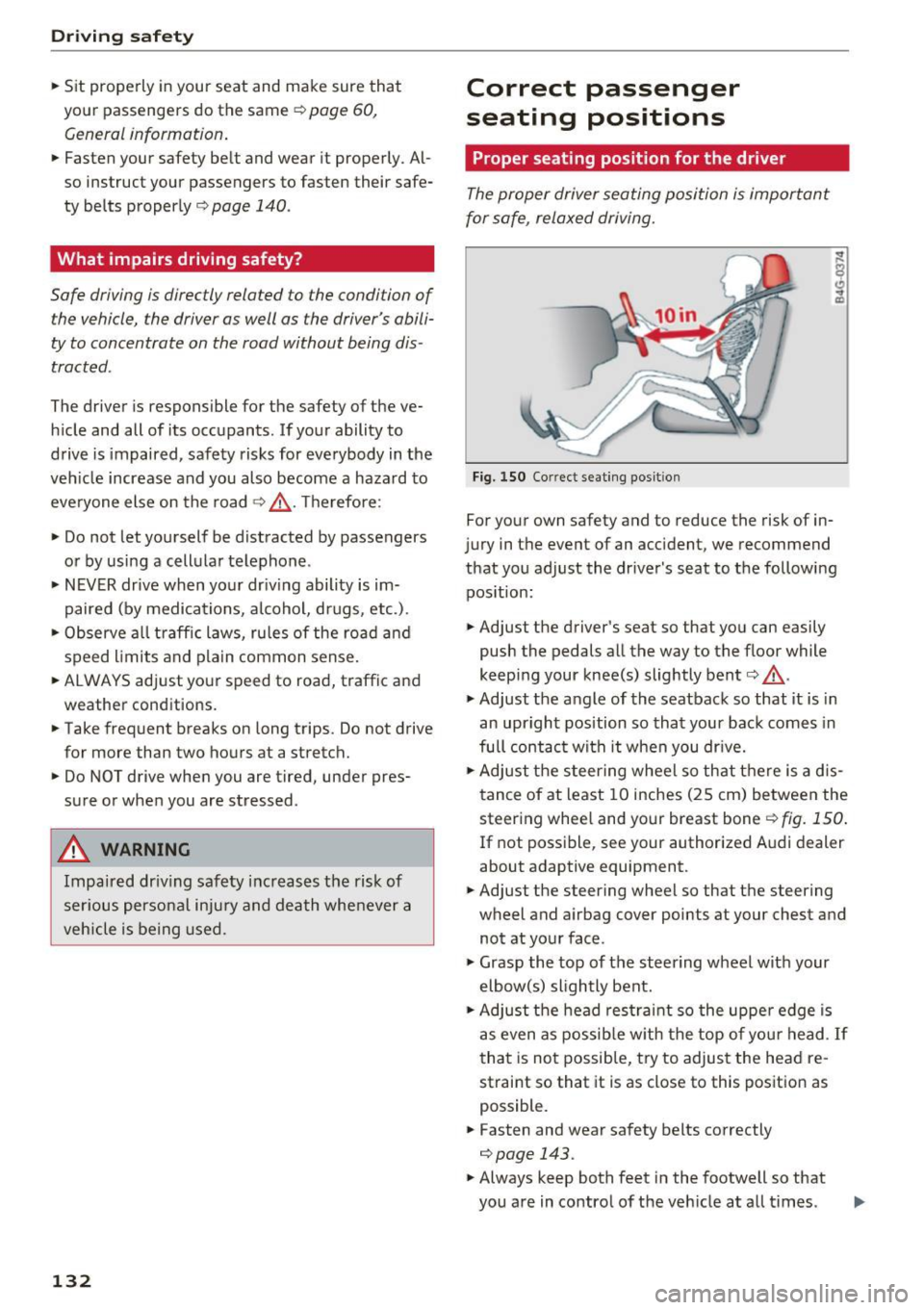
Fig. 150 Correct seating posit ion
For your own safety and to reduce the risk of in
jury in the event of an accident, we recommend
that you adjust the driver's seat to the following position:
• Adjust the driver's seat so that you can easily
push the pedals all the way to the floor while
keeping your knee(s) slightly bent
c:> .&_ .
• Adjust the angle of the seatback so that it is in
an upright position so that your back comes in
full contact with it when you drive.
• Adjust the steering wheel so that there is a d is
tance of at least 10 inches (25 cm) between the
steering wheel and your breast boner::!)
fig. 150.
If not possible, see your authorized Audi dealer
about adaptive equipment.
• Adjust the steering wheel so that the steering
wheel and airbag cover points at your chest and
not at your face.
• Grasp the top of the steering wheel with your
elbow(s) slightly bent.
• Adjust the head restraint so the upper edge is
as even as possible with the top of your head .
If
that is not possible, try to adjust the head re
straint so that it is as close to this position as
possible.
• Fasten and wear safety belts correctly
c:> page 143.
• Always keep both feet in the footwell so that
you are in control of the veh icle at all times .
Page 142 of 296
Safety belt s
Safety belts
General information
Always wear safety belts!
Wearing safe ty belts correctly saves lives!
This chapte r explains why safety be lts a re neces
sary, how they work and how to adjust and wear
them correct ly.
.. Read all the information that follows and heed
all of the instructions and WARNINGS.
&_ WARNING
Not wea ring safety belts or wearing them im
properly increases the risk of ser ious personal
injury and dea th .
- Safety belts are the s ingle most effective
mea ns ava ilab le to reduce the risk of serious
injury and dea th in automob ile accidents .
For yo ur protect ion and that of your passe n
gers, alw ays co rre ctly wea r sa fety be lt s
when the veh icle is moving .
- Pregnant wom en, in ju re d, o r physically i m
paired persons mus t also use s afety be lts.
L ik e all vehi cle o ccu pants, they are mo re
li kely to be serio usly injure d if th ey do no t
wea r safety be lts. The best way to protect a
fetus is to protect the mothe r -th roughout
the ent ire pregnancy .
Number of seats
Your Audi has a total of five seating positions:
two in the front and three in the rear. Each seat
i n g position has a safety belt.
&_ WARNING
N ot wea ring safety bel ts or weari ng them im
properly increases th e r isk of ser ious personal
inju ry and dea th.
- N ever st rap more tha n one perso n, includ
ing small ch ildren, into a ny be lt .
It is espe
ci ally dan gerous to pla ce a sa fety bel t over a
c hild s itting on you r lap.
- N ever le t mo re people ride in t he vehicle
t h an t he re are saf ety bel ts availab le.
140
-Be sure everyone riding in the vehicle is
properly restrained with a separate safety
be lt or ch ild restraint.
Safety belt warning light
Your vehicle has a warning system for the driver
and (on USA models only) front seat passenger
to remind you about the importance of buckling
up .
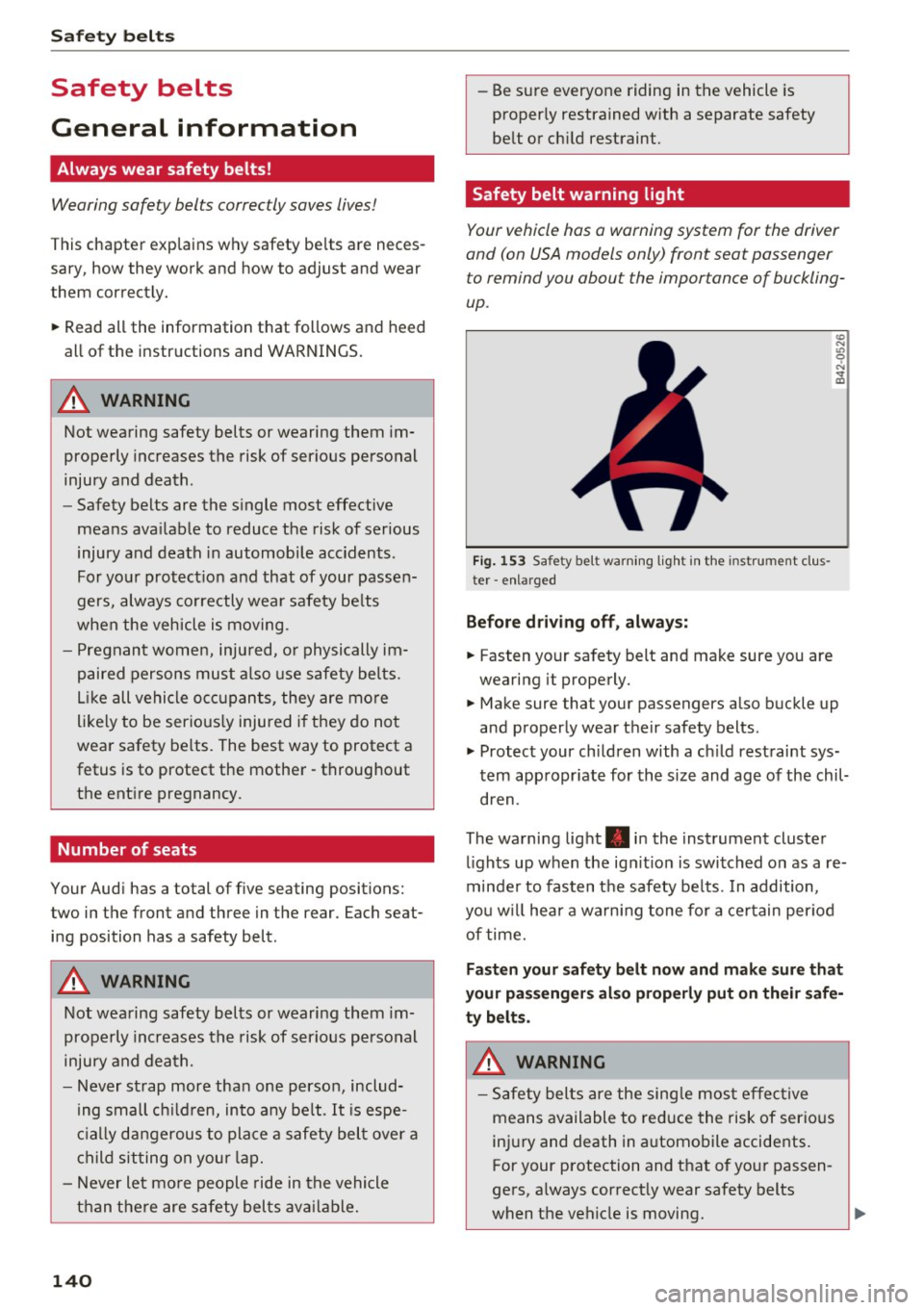
Fig. 153 Safety belt wa rning lig ht in th e in st rument clu s
ter -enl arged
Before driv ing off , alway s:
.. Fasten your sa fety belt and make sure you are
wearing it prope rly .
(0
"'
"' 0 N
and proper ly wea r th eir safety belts .
.. Protec t your ch ildren with a ch ild rest raint sys
tem app ropr iate for the size and age of the chil
dren .
The wa rning lig ht . in the instrument cluste r
l ights up when the ig nition is swi tched on as a re
minde r to fas ten t he safety be lts. In addition,
yo u w ill hea r a wa rn ing tone for a ce rt ain per io d
of time.
Fasten your safety belt now and make sure that
your passengers also properly put on their safe
ty belts.
&_ WARNING
-
- Safety belts are the sing le mos t eff ec tive
means available to re duce the risk of serio us
in jur y and death in a utomo bile accidents.
For your protection and t hat of yo ur passen
ge rs , a lways cor rect ly wear safety belts
when t he veh icle is moving .
Page 143 of 296
a,
a,
..... N r-N ..... 0 0
0:
co
-Failure to pay attention to the warn ing light
that come on, could lead to persona l injury.
Why use safety belts?
Frontal collisions and the law of physics
Frontal crashes create very strong forces for peo
ple riding in vehicles .
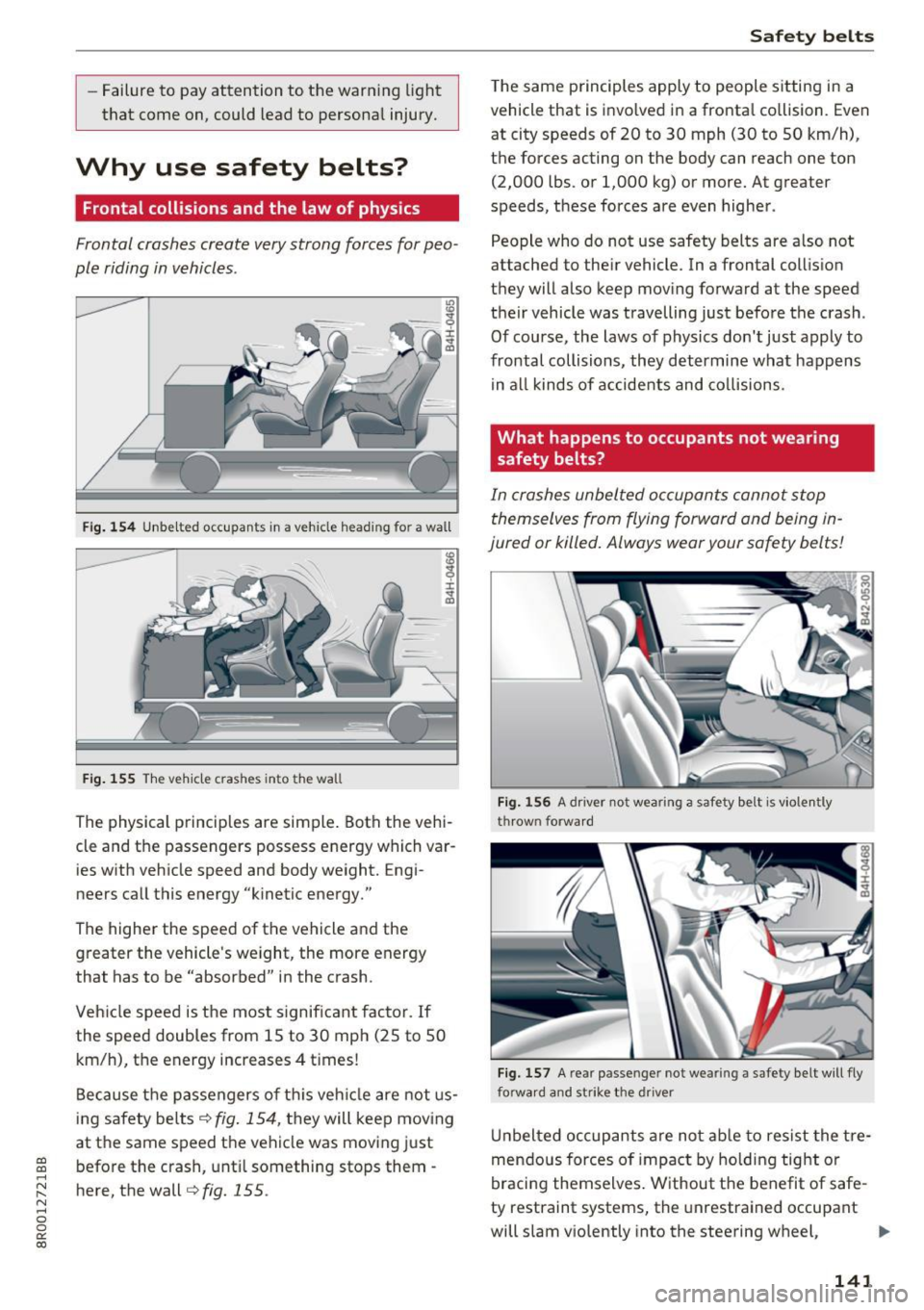
Fig. 154 Unbelted occupants in a vehicle heading for a wall
Fig. 155 The vehicle crashes into the wall
The physical principles are simple. Both the vehi
cle and the passengers possess energy which var ies with vehicle speed and body weight. Engi
neers call this energy "kinetic energy."
The higher the speed of the vehicle and the greater the vehicle's we ight, the more energy
that has to be "absorbed" in the crash.
Veh icle speed is the most significant factor. If
the speed doubles from 15 to 30 mph (25 to 50
km/h), the energy increases 4 t imes!
Because the passengers of this vehicle are not us
ing safety belts
¢fig. 154, they will keep moving
at the same speed the vehicle was moving just
before the crash, until something stops them -
here, the wall¢
fig. 155 .
Safety belts
The same p rinciples apply to people sitting in a
vehicle that is invo lved in a fronta l co llision. Even
at city speeds of 20 to 30 mph (30 to 50 km/h),
the forces acting on the body can reach one ton
(2,000 lbs. or 1,000 kg) or more. At greater
speeds, these forces are even higher.
People who do not use safety belts are a lso not
attached to the ir vehicle. In a frontal collis ion
they will also keep moving forward at the speed
their vehicle was travelling just before the crash .
Of course, the laws of physics don't just apply to
frontal collisions, they determine what happens in all kinds of accidents and collisions .
What happens to occupants not wea ring
safety belts?
In crashes unbelted occupants cannot stop
themselves from flying forward and being in
jured or killed. Always wear your safety belts!
Fig. 156 A dr iver not wearing a safety belt is violently
thrown forward
Fig . 157 A rear passe nger not wearing a safety belt will fly
forwa rd and strike the driver
Unbelted occupants are not able to resist the tre
mendous forces of impact by holding tight or
bracing themselves . Without the benefit of safe
ty restraint systems, the unrestrained occupant
will slam v iolently into the steering wheel,
Ill>-
141
Page 146 of 296
Safe ty belts
Autom ati c s afet y belt retr actors
Every safety belt is equ ipped with an automa tic
be lt retractor on the shoulder belt. This feature
locks the belt when the belt is pulled out fast,
during hard braking and in a n accident. The belt
may a lso lock when you drive up or down a steep
hill or through a sharp curve. Dur ing normal driv
ing the belt lets you
move freely.
Safety belt p ret en sion ers
The safety belts are equipped with a belt preten
sioner that helps to t ighten the safety belt and
remove slack when the pretensioner is activated.
The function of the pretensioner is mon itored by
a warning light
r:::') page 13.
Swi tc hable l ocking f eature
Every safety belt except the one on the driver
seat is equipped with a switchable locking fea
ture that
must be used when the safety belt is
used to attach a child safety seat. Be sure to read
the impo rtant information about this feature
r=;,page 178.
.&_ WARNING
Improperly pos itioned safety be lts can cause
ser ious injury in an accident
c:> page 144,
Safety belt position.
- Safety belts offer optimum protection only
when the seatback is upright and belts are
properly positioned on the body.
- Always make sure that the rear seat bac k
rest to which the center rea r safety belt is
attached is secure ly latched whenever the
rear center safety belt is being used. If the
backrest is not securely latched, the passen
ger will move forward with the backrest dur
ing sudden braking, in a sudden maneuver
and especially in a crash.
- Never attach the safety belt to the buckle for another seat. Attaching the belt to the
wrong buckle wi ll reduce safety belt effec
t iveness and can cause serious persona l in
jury.
- A passenger who is not properly restrained can be seriously in ju red by the safety be lt it
self when it moves from the stronger parts
144
of the body into critical areas like the abdo men.
- Always lock the convertible locking retractor
when you are securing a child safety seat in
the vehicle
c:> page 180.
Safety belt position
Correct belt position is the key to getting maxi
mum protection from safety belts .
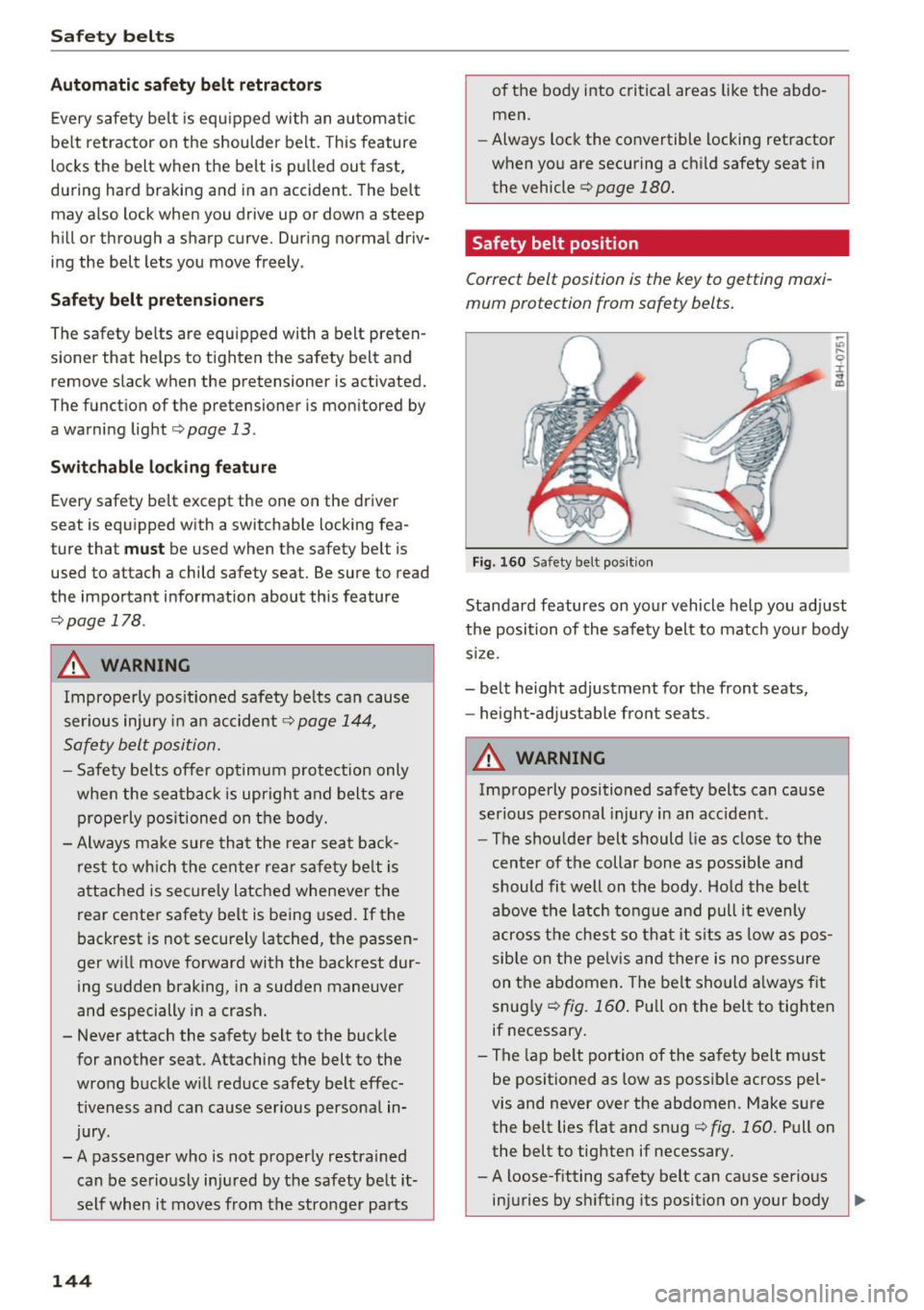
Fig. 160 Safety belt posit ion
-"' .... 9 I ... a,
Standard features on your vehicle help you adjust
the position of the safety belt to match your body
s ize.
- belt height adjustment for the front seats,
- height-adjustab le front seats.
.&_ WARNING
Improperly positioned safety belts can cause
serious pe rsonal injury in an acc ident .
- The shoulder belt should lie as close to the
center of the collar bone as possible and
should fit well on the body. Hold the belt
above the latch tongue and pull it evenly
across the chest so that it s its as low as pos
sib le on the pe lvis and there is no p ressure
on the a bdomen . The belt sho uld a lways f it
snug ly
r:::;, fig. 160. Pull on the belt to tig hten
if necessary .
- The lap be lt portion of the safety belt must
be positioned as low as possible across pel
vis and never over the abdomen. Make sure
the belt lies flat and snug
c:> fig. 160. Pull on
the belt to tighten if necessary.
- A loose-fitting safety belt can cause serious injuries by sh ifting its position on your body ..,_
Page 152 of 296
Airbag syste m
safety seat. It can be a very dangerous p lace for
an infant or a child in a rearward-facing seat.
The Advanced Airbag System i n your veh icle has
been ce rt ified to comp ly with the requirements
of United States Federal Motor Vehicle Safety
Standard (FMVSS)
208, as well as Canada Motor
Veh icle Safety Standard (CMVSS)
208 as applica
b le at the time your vehicle was manufactured.
According to requirements, the front Advanced
Airbag System on the passenger s ide has been
certified for "suppression " for infants of about
12 month old and younger and for "low risk de
p loyment " for children aged
3 to 6 years o ld (as
defined in the standard).
The
PA SSENGER AIR BAG OFF light in the instru
ment panel tells you when the front Advanced
Ai rbag on the passenger side has been tu rned off
by the elect ronic cont rol unit.
Each t ime you tur n on the ignit ion , the
PASSEN
GER AIR BAG OFF
light will come on fo r a few
seconds and :
- will stay on if the front passenger seat is not
occupied,
- will s tay on if there is a small c hild or child re
straint on the front passenger seat,
- will go off if the front passenger seat is occu
pied by an adult as reg istered by the weight
sensing mat¢
page 158, Monitoring the Ad
vanced Airbag System .
The PAS SENGER AIR BAG O FF light comes on
when the control unit detects a total we ight on
the front passenger seat that requires the front
airbag to be turned off.
If the tota l weight on the front passenger seat is
more than that of a typical 1 year -old child but
less than the we ight of a small adult, the front
a irbag on the passenger side can deploy (the
PAS SENGER AIR BAG OFF light does not come
on) .
If the PAS SENGER AIR BAG OFF light does
not come on, the front a irbag on the passenger
side has not been turned off by the electronic
control unit and can deploy if the control unit
senses an impact that meets the condit ions stor
ed in its memory.
For e xample, the airbag may deploy if:
150
- a small chi ld that is heavier than a typica l 1
year-o ld child is on th e front passenger seat
(regard less of whether the child is in one of the
child safety seats listed¢
page 170), or
- a child who has outgrown c hild restraints is on
the front passenger seat.
If the front passenger a irbag is t urned off, the
PASSENGER AIR BAG OFF light comes on in the
instrument cluster and stays on.
The fro nt airbag on the passenge r side may
not
deploy (the PAS SENGER AIR BAG OFF light does
not ill uminate and stay lit) even if a small adu lt
or teenager, or a passenger who is not sitting up
right with thei r back against a non-recl ined back
rest with the ir fee t on the vehicle floor in front of
the sea t is on the fron t passenger sea t
<=> page 132, Proper seating position for the driv
er .
If the front passenger a irbag deploys, the Feder
al Standard requires the airbag to meet the "low
risk" deployment cr iteria to reduce the r isk of in
jury through interaction w ith the airbag . "low
risk " deployment occurs in those crashes that
take place at lowe r de cele rations as defined in
the e lec tronic co ntro l unit ¢
page 159, PASSEN
GER AIR BAG OF F light.
Always remembe r, a chi ld safety seat or infant
c ar rie r ins talled on the front seat may be s truck
and knocked ou t of posit ion by t he rap idly i nflat
i ng passenge r's airbag in a frontal coll is ion . The
airbag could greatly red uce the effectiveness of
the child restraint and even seriously injure the child during inflation.
Fo r th is reason, and beca use the back seat is the
safest place for children -when properly restrain
ed according to their age and size -we strongly
recommend that children always sit in the back
seat
c> page 168, Child safety .
A WARNING
A child in a rearward-facing child safety seat
installed on the front passenger seat will be
seriously injured and can be killed if the front
a ir bag inflates - even with an Advanced Airbag
Sys tem.
Ill>
Page 153 of 296
CD
CD
.... N ,-... N ..... 0 0 C<'. 00
-The inflating airbag will hit the child safety
seat or infant carrier with great force and
will smash the chi ld safety seat and child
against the backrest, center armrest, door
or roof .
- Always install rear-facing child safety seats
on the rear seat.
- If you must install a rearward fac ing ch ild
safety seat on the front passenger seat be cause of exceptional circumstances and the
PASSENGER AIR BAG OFF light does not
come on and stay on, immed iate ly install
the rear-fac ing ch ild safety seat in a rear
seating pos it ion and have the airbag system
inspected by your a uthorized Audi dea le r.
- Forward-fac ing ch ild safety sea ts installed
on the front passenger's seat may interfere
with the deployment of the airbag and
cause serious personal injury to the child.
~ WARNING
If, in except ional circumstances, you must in
stall a forward-facing chi ld restraint on the
front passenger 's seat:
- Always ma ke sure the forward-fac ing seat
has been designed and certified by its man
ufacturer for use on a front seat with a pas
senger front and s ide a irbag.
- Never put the forward-facing child restraint
up against or very near the instrument pan
el.
-Always move the front passenger seat to
the highest position in the up and down ad
justment range and move it back to the
rea rmost position in the seat's fore and aft
adjustment range, as fa r away from the air
bag as possib le, before insta lling the for
ward- facing child restra int .
- Always ma ke sure tha t the safety belt upper
anchorage is beh ind the child restrain t and
not next to or in front o f the chi ld restraint
so that the safety belt will be properly pos i
tioned.
- Make sure that the
PASSENGER AIR BAG
OFF
light comes on and stays on all the time
whenever the ignition is switched on.
Airb ag sys tem
A WARNING
To reduce the risk of serious injury, make sure
that the
PASSENGER AIR BAG OFF light will
be d isplayed whenever a child restraint is in
stalled on the front passenger seat and the
i gnition is switched on .
-If the PASSENGER AIR BAG OFF light does
not stay on , perform t he checks desc ribed
~ page 158, Monitoring the Advanced Air
bag System.
- Take the child restra int off t he front passen
ge r seat an d install it prope rly at one of the
rear sea t positions i f the
PASSENGER AIR
BAG OFF
light does not stay on .
- Have the air bag system inspec ted by your
author ized Audi dealer immed iate ly .
- Always c are fully follow ins tructions from
child restrain t manufacture rs when instal
ling child restraints .
If, in exceptional c ircumstances, you must in
stall a forward or rearward-facing child re
stra int on the front passenger's seat:
- Imp roper installation of child restraints can
reduce their effectiveness or even prevent
them from providing any protect ion.
- An improperly installed child restra int can
interfere with the airbag as it deploys and
serious ly injure or even kill the chi ld -even
with an Advanced A irbag System.
- Always care fully follow the manufacturer 's
instr uctions provided with the child safety
seat or carr ie r.
- Never p lace add itiona l items on the seat
that can increase the total weight registered by the weight -sensing mat and can cause in
jury in a crash.
151
Page 155 of 296
CD
CD
.... N ,-... N ..... 0 0 C<'. 00
Advanced front airbag system
Your vehicle is equipped with a front Advanced
Airbag System in compliance with Un ited States
F edera l Motor Vehicle Safety Standard 208, as
well as Canada Motor Vehicle Safety Standard
(CMVSS) 208 as applicable at the time your vehi
cle was manufactured .
The front Advanced Airbag System supp lements
the safety belts to provide additional protection
for the driver 's and front passenger's heads and
upper bodies in frontal crashes . The airbags in
f late only in frontal impacts when the veh icle de
cele rat ion is high enough.
The front Advanced Airbag System for the front
seat occupants is not a substitute for your safety be lts . Rather, it is part of the overall occupant re
s tra int system in your vehicle. Always remember
that the airbag system can on ly help to protect
you, if you are sitting upr ight, wear ing your safe
ty belt and wear ing it prope rly . This is why you
and your passengers must always be prope rly re
stra ined, not just beca use the law req uires yo u to
be .
The Advanced Airbag System in your veh icle has
been ce rtified to meet the "low r is k" requi re
ments fo r 3 and 6 ye ar-old children o n the pas
senger side and very sma ll adults on the drive r
side . The low risk dep loyment cr iteria are intend
ed to help reduce the risk of injury through inter
action with the front a irbag that can occur, for
examp le, by being too close to the steering wheel
and instrument panel when the airbag inflates .
In addition , the system has been certified to
comp ly with the "suppression" requi rements of
the Safety Standard, to turn off the front a irbag
for i nfants 12 months old and younger who are
restrained on the front passenger seat in child re
stra ints that are listed in the Standa rd
¢ page 170, Child restraints and Advanced Air
bags.
"Suppress ion" requ ires the front a irbag on the
passenger side to be turned off if:
- a ch ild up to about one year of age is restra ined
on the front passenger seat in one of the rear
facing or forward -fac ing infant restra ints listed
Airb ag sys tem
in Federal Motor Veh icle Safety Standard 208
with which the Advanced Airbag System in your
veh icle was certif ied. For a List ing of the child
restraints that were used to certify your vehi
cle's compliance with the US Safety Standard
¢ page 170,
-weight less than a threshold level stored in the
con trol un it is detected on the front passenger
seat .
When a person is detected on the front passen ger seat, weighing more than the total weight of
a chi ld that is about
1 year old restra ined in one
of the rear-facing or forward -fac ing infant re
straints (listed in Federal Motor Veh icle Safety
Standard 208 with w hich the Advanced A irbag
System in your veh icle was certified), the front
airbag on the passenge r side may o r may not de
ploy .
T he
PAS SENGER AIR BAG OFF lig ht comes o n
whe n the elect ronic con trol uni t detects a tota l
weight on the fron t passenger sea t th at req uires
the front a irbag to be turned off . If the
PASSEN
GER AIR BAG OFF
light does not come on, the
front airbag on the passenger side has not been
turned off by the control unit and can dep loy if
the control unit senses an impact that meets the
condit io ns stored in its memory .
If the total weight on the front passenger seat is
more than that of a typica l 1 year-old, but less
than the weight of a small adult, the front airbag
o n the passenger s ide may deploy (the
PAS SEN
GER AIR BAG OFF
light does not come on) .
For example , the ai rb ag may deploy if :
- a small ch ild that is heav ier than a typ ica l 1
yea r-o ld child is on the front passenger seat
(regard less of whether the child is in one of the
child safety seats listed
¢ page 170),
- a child who has outgrown c hild restraints is on
the front passenger seat.
If the front passenge r a irbag is t urned off, the
PASSENGER AIR BAG OFF light in the center of
the instr ument pane l wi ll come on and stay on .
T he front airbag on the passenger s ide m ay
not
deploy (the PASSENGER AIR BAG OFF light does
not illuminate and stay lit) if: ..,.
153
Page 156 of 296
Airbag syste m
-a small adu lt or teenager is on the front pas
senger seat
- a passenger who is not sitting upright with
their back against a non -reclined backrest with
their feet on the vehicle floor in front of the
seat is on the front passenger seat.
I f the front passenger airbag dep loys, the Feder
al Standard requires the airbag to meet the "low
risk" deployment criteria to help reduce the risk
of injury through interaction with the airbag.
"Low risk" deployment occurs in those crashes
that take place at lower decelerations as def ined
in the electronic control unit.¢
page 158
Alway s remember: Even though your vehicle is
equ ipped w ith Advanced Airbags, the safest place
for children is properly restrained on the back
seat . Please be sure to read the important infor
mat ion in the sections that follow and be sure to
heed a ll of the WARN INGS.
A WARNING
To red uce the risk of inj ury when an ai rbag in
fla tes, a lways wear safety bel ts p roperly.
- If you are unrestrained, leaning fo rwa rd, s it
t ing s ideways or o ut of pos ition in any way,
yo ur risk of in jury is much h igher .
- Yo u will also re ceive serious injur ies and
could even be killed if you are up aga inst the
airbag or too close to it when it inflates -
even with an Advanced Airbag ¢
page 148.
A WARNING
A child in a rearward-facing chi ld safety seat
installed on the front passenger seat wi ll be
ser iously injured and can be killed if the front
airbag inflates - even w ith an Advanced Airbag
System.
- Although the Advanced A irbag System in
your vehicle is designed to turn off the front
airbag when a rearward-facing child re
straint has been installed on the front pas
senger seat, nobody can absolutely g uaran
tee that deployment is impossible in all con
ceivable s ituations that may happen during
the useful life of your vehicle .
- The inflating a irbag w il l hit the child safety
seat or infant c arrier with great force and
154
w ill smash the child safety seat and child
aga inst the back rest, center armrest, door,
or roof.
- Always install rearward-facing child re
straints in the back seat.
- If you must install a rearward facing child
safety seat on the front passenger seat be
cause of exceptional circumstances and the
PASSENGER AIR BAG OFF light does not
come on and stay on, immediately install
the rea r-facing child safety seat in a rear
seating posi tion and have the ai rbag system
inspected by your au thori zed Au di dealer.
A WARNING
If, in exceptional ci rcums tances, you must in
stall a forward-facing child res traint on the
front passenger's seat:
- Always make sure the forward-fa cing sea t
has been des igned and certified by its man
ufacturer for use on a front seat with a pas
senger front and side airbag.
- Never put the fo rward -facing child restraint
up against or very nea r the instrument pan ·
el.
-Always move the front passenger seat to
the highest position in the up and down ad
justment range and move it back to the
rearmost position in the seat's fo re and aft
adjustment range , as far away from the air
bag as poss ible, before install ing the for
ward-facing chi ld restraint.
- Always make sure that the safety be lt upper
anchorage is behind the ch ild restraint and
no t next to o r in front of the child rest raint
so that the safety be lt will be p roperly posi
tioned.
- Ma ke sure that the
PASSENGER AIR BAG
OFF
li ght comes on and stays on a ll the time
wheneve r the ign it ion is swi tched on.
Advanced Airbag System components
The front passenge r sea t in your veh icle has a lot
of ve ry important parts o f the Advanced Airbag
System in it. These parts include the weight
sensing mat, sensors, wiring, brackets, and
more. The function of the system in the front
1111>
Page 157 of 296
CD
CD
.... N ,-... N ..... 0 0 C<'. 00
passenger seat is checked by the electronic con
tro l unit when the ignition is on . The control unit
monitors the Advanced A irbag System and turns
the airbag indicator light on when a malfunct ion
in the system components is detected. The func
tion of the airbag indicator l ight is descr ibed in
greater detai l below . Because the front passen
ge r seat conta ins important parts of the Ad
vanced A irbag System, you must take care to p re
ve nt i t from being damaged. Damage to the seat
may prevent the Advanced Airbag for the fron t
passenger seat from doing its job in a crash.
The front Advanced Airbag System consists
of the following :
-Crash sensors in the front of the vehicle that
measure vehicle acceleration/deceleration to
provide information to the Advanced Airbag
System a bout the severity of the crash.
- An e lectronic control unit, with integrated
crash sensors for front and side impacts. The
control unit "decides" whether to fire the front
airbags based on the information received from
the crash sensors. The control unit a lso "de
c ides" whether the safety belt pretens ioners
should be activated .
- An Advanced Airbag with gas generator and
control
valve for the driver ins ide the steer ing
wheel hub .
- An Advanced Airbag with gas generator and contro l
valve inside the instrument pa nel for
the front passenger.
- A weig ht-sensing mat under the upho lstery
padd ing of the front passenge r seat cushion
t h at meas ures the total weight on the seat. The
i nforma tion registered is sent continuously to
the e lectron ic cont rol unit to reg ulate dep loy
ment o f the front Adv a need A irbag on the pas
senger side .
- An airbag monito ring system and indicator
li ght in the instrument cluster
¢ page 158.
-A senso r in eac h front sea t registers the dis
tance between the respective seat and the
steering wheel or instrument pane l. The infor
mation reg istered is sent contin uously to the
electronic control unit to regulate deployment
of the front Adva need A irbags.
Airb ag sys tem
-The PASSENGER AIR BAG OFF light comes on
and stays on in the center of the instrument
pane l¢
page 159, fig . 167 and te lls yo u when
the front Advanced Airbag on the passenger side has been turned off.
- A sensor below the safety be lt latch for the
front seat passenger to measure the tension on the safety belt. The tension on the safety belt
and the we igh t registered by the weight -sens
ing mat help the contro l unit "decide" whethe r
t he front airbag fo r th e fron t passe nger seat
should be tu rned off o r not ¢
page 149, Child
restrain ts on the front seat -some impor tant
things to know.
- A sensor in the s afety be lt latch for the drive r
an d for the front seat passenger that senses
whether tha t safety be lt is la tched o r not and
transmits this information to the e lectronic
control un it.
A WARNING ,-
Damage to the front passenge r seat can pre-
vent the front airbag from working properly.
- Improper repair or disassembly of the front
passenger and driver seat will p revent the
Advanced A irbag System from f unct ion ing
properly .
- Repairs to the front passenger seat must be
performed by qualified and p roper ly trai ned
wo rkshop personne l.
- Never remove the front passenger or d river
seat from the vehicle.
- Never remove the upholstery from the front
passenger seat.
- Never d isassemble o r remove parts from the
seat or disco nnect w ires from it.
- Never carry sharp objects in your pockets or
p lace them on the seat . If the weight-sens
ing mat in the passenger seat is punctu red
it cannot work p roper ly .
- Never carry things on your lap or carry ob
jects on the passenge r seat . S uch items can
increase t he weight reg istered by the
weight-sensing mat and s end the wro ng in
formation to the a irbag con trol u nit.
- Never store i tems unde r the front passenger
seat. Parts of the Advanced Airbag System
un der the pas senger se at could be
~
155
Page 158 of 296
Airbag syste m
damaged, preventing them and the airbag
system from working properly.
- Never place seat covers or rep lacement up
holstery that have not been specifically ap
proved by Audi on the front seats .
- Seat covers can prevent the Advanced Air
bag System from recognizing child re
straints or occupants on the front passenger
seat and prevent the side a irbag in the seat
backrest from deploying properly.
- Never use cush ions, pillows, blankets or
similar items on the front passenger seat.
The add it ional padding will prevent the
weight-sens ing mat in the seat from acc u
rately reg istering the ch ild restraint or per
son on the seat and prevent the Advanced
Airbag System from funct ioning properly.
- If you must use a child rest raint on the front
passenge r seat and the child restraint man
ufacturer 's instructions require the use of a
towel, foam cushion or something else to properly position the ch ild restraint, make
certain that the
PA SSENGER AIR BAG OFF
light comes on and stays on whenever the
child restraint is installed on the front pas
senger seat.
- If the
PASSEN GER AIR B AG OFF light does
not come on and stay on, immed iately in
stall child restraint in a rear seating position and have the airbag system inspected by
yo ur autho rized Aud i deale r.
How the Advanced Airbag System
components work together
The front Advanced Airbag System and the side
airbags supplement the protection offered by the
front three-po int safety belts with pretensioners
and load limiters and the adjustable head re
stra ints to help reduce the r isk of injury in a wide
range of accident and crash situations. Be sure to read the important informa tion about safety and
heed the WARN INGS in t his chapter.
Deployment of the Advanced Airbag System and
the act ivat ion of the safety belt pretensioners de
pend on the deceleration measu red by the crash
sensors and regis tered by the electronic control
unit. Crash severity depends on speed and decel-
156 eration as well as the mass and stiffness of the
vehicle or object involved in the crash
.
On the passenger side, regard less of safety be lt
u se, the airbag will be turned off if the weight on
the passenger seat is less than the amount pro
grammed in the electronic control unit . The front
airbag on the passenger side will also be turned
off if one of the child safety seats that has been certified under Federal Motor Vehicle Safety
Standard 208 has been recogn ized on the seat .
The
PASSENGER A IR BAG OFF lig ht comes o n
and stays on to te ll you when the front Advanced
Airbag on the passenger side has been turned off
q page 149, Child restraints on the front seat
some important things to know.
A WARNING
To reduce the ris k of injury when an airbag in
f lates, always wea r safety belts properly.
- If you are un restrained, leaning forward, sit
ting sideways or out of position i n any way,
your risk of injury is much higher.
- You will a lso receive serious injuries and
could even be killed if you are up against the
airbag or too close to it when it inflates -
even with an Advanced Airbag
q page 148.
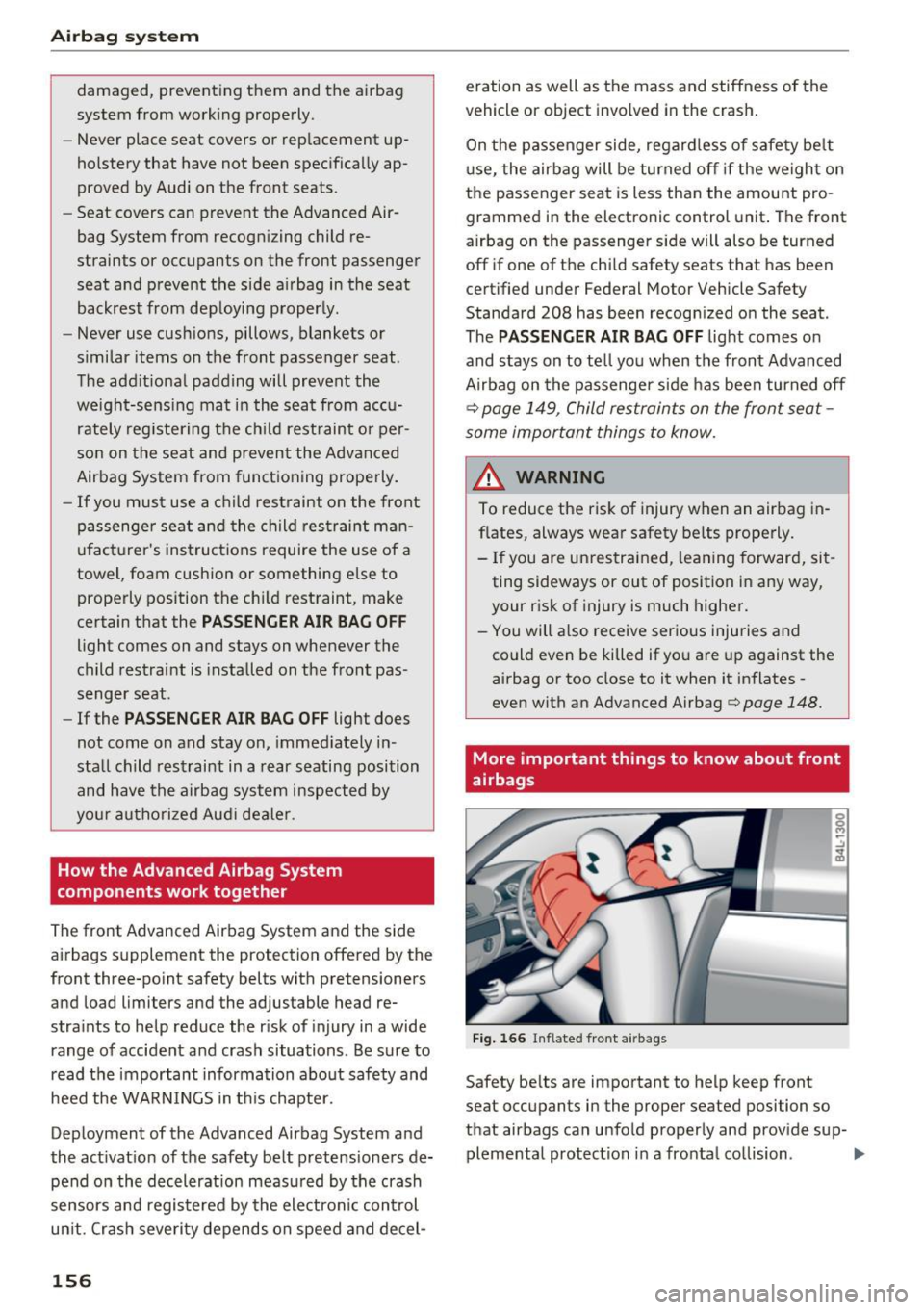
More important things to know about front
airbags
Fig . 166 Inflated front a irbags
Safety be lts are important to help keep front
seat occupants in the proper seated position so
that airbags can unfold properly and prov ide sup-
plemental protection in a fronta l collision . ..,.