gas AUDI Q5 2018 User Guide
[x] Cancel search | Manufacturer: AUDI, Model Year: 2018, Model line: Q5, Model: AUDI Q5 2018Pages: 392, PDF Size: 60.56 MB
Page 271 of 392
u co ..... N r--N ..... 0 <( 0 00
Airbag system Important information
Importance of wearing safety belts and
sitting properly
Airbags are only supplemental restraints. For
airbags to do their job, occupants must always
properly wear their safety belts and be in a prop er seating position.
For your safety and the safety of your passen
gers, before driving off, always:
.,. Adjust the driver's seat and steering wheel
properly ~ page 253,
.,. Adjust the front passenger's seat properly
~page 254,
.,. Wear safety belts properly ~page 263,
.. Always properly use the proper child restraint
to protect children¢
page 291.
In a collision, airbags must inflate within the
blink of an eye and with considerable force. The
supplemental airbags can cause injuries if the
driver or the front seat passenger is not seated
properly. Therefore in order to help the airbag to
do its job, it is important, both as a driver and as
a passenger to sit properly at all times.
By keeping room between your body and the
steering wheel and the front of the passenger
compartment, the airbag can inflate fully and
completely and provide supplemental protection in certain frontal
collisions¢ page 253, Correct
passenger seating positions .
For details on the
operation of the seat adjustment controls
¢page 56.
It's especially important that children are proper
ly
restrained ¢ page 291.
There is a lot that the driver and the passengers
can and must do to help the individual safety fea
tures installed in your Audi work together as a
system.
Proper seating position is important so that the
front airbag on the driver side can do its job. If
you have a physical impairment or condition that prevents you from sitting properly on the driver
seat with the safety belt properly fastened and
Airbag system
reaching the pedals, or if you have concerns with
regard to the function or operation of the Ad
vanced Airbag System, please contact your au
thorized Audi dealer or qualified workshop, or call Audi Customer Relations at 1-800-822-2834
for possible modifications to your vehicle.
When the airbag system deploys, a gas generator
will fill the airbags, break open the padded cov ers, and inflate between the steering wheel and
the driver and between the instrument panel and
the front passenger. The airbags will deflate im
mediately after deployment so that the front oc
cupants can see through the windshield again
without interruption.
All of this takes place in the blink of an eye, so
fast that many people don't even realize that the
airbags have deployed. The airbags also inflate
with a great deal of force and nothing should be
in their way when they deploy. Front airbags in
combination with properly worn safety belts slow
down and limit the occupant's forward move
ment. Together they help to prevent the driver
and front seat passenger from hitting parts of
the inside of the vehicle while reducing the forces acting on the occupant during the crash. In this
way they help to reduce the risk of injury to the
head and upper body in the crash. Airbags do not
protect the arms or the lower parts of the body.
Both front airbags will not inflate in all frontal
collisions . The triggering of the airbag system de
pends on the vehicle deceleration rate caused by
the collision and registered by the electronic con
trol unit . If this rate is below the reference value
programmed into the control unit, the airbags
will not be triggered, even though the car may be badly damaged as a result of the collision. Vehi
cle damage, repair costs or even the lack of vehi
cle damage is not necessarily an indication of
whether an airbag should inflate or not.
Since the circumstances will vary considerably between one collision and another, it is not possi
ble to define a range of vehicle speeds that will
cover every possible kind and angle of impact
that will always trigger the airbags. Important
factors include, for example, the nature (hard or
soft) of the object which the car hits, the angle of
impact, vehicle speed , etc. The front airbags will
.,.
269
Page 279 of 392

u co ..... N r--N ..... 0 <( 0 00
Airbag System for the front passenger seat from
doing its job in a crash.
The front Ad vanced Airbag System con sists
o f the follo wing :
-Cras h sensors in the front of the vehicle that
measure vehicle acceleration/deceleration to
provide information to the Advanced Airbag
System a bout the severity of the crash.
- An electronic control unit, with integrated
crash sensors for front and side impacts. The
contro l unit "decides" whether to fire the front
airbags based on the information received from
the crash sensors . The control unit also "de
c ides" whether the safety belt pretens ione rs
shou ld be activated .
-An Advanced Airbag with gas generator and
contro l valve for the d river ins ide the steer ing
whee l hub.
-An Advanced Airbag with gas generator and
contro l valve inside the instrument pane l for
the fron t passenger.
-A capac itive passenger detect ion system under
neath the front passenger seat cover. This sys
tem measures the elect ric al capac ita nce of the
person in the seat. The informat ion registe red
is sent contin uous ly to the e lectron ic control
unit to regulate deployment of the front Ad
vanced Airbag on the passenger side.
-An airbag monitoring system and indicator
light
m in the instrument cluster.
-A sensor in eac h front seat registers the dis
tance between the respective seat and the
stee ring wheel or instrument pane l. The infor
mation reg istered is sent continuously to the
electronic control unit to regulate deployment
of the front Adv a need A irbags .
-The PASS EN GER AIR BAG OFF ~; ON@ light
comes on in the headliner
c:> page 281,
fig. 236 and tells you the status of the Ad
vanced Airbag o n the passenge r side .
-A sensor i n the safety belt latch for the driver
and for the front seat passenger that senses
whethe r that safety belt is latched or not and
t ransm its this info rmat io n to the elect ronic
c ontro l unit.
Airbag syste m
A WARNING ~ -
Damage to the front passenger seat can pre
vent the front airbag from working properly.
-Improper repair or disassembly of the front
passenger and driver seat will p revent the
Advanced A irbag System from f unct ion ing
p roperly.
-Repa irs to the front passenger seat must be
pe rformed by qualified a nd p roperly tra ined
wo rkshop personne l.
-Never remove the front passenger or driver
seat from the vehicle .
-Never remove the upholstery from the front
passenger sea t.
-Never d isassemble or remove parts from the
seat o r disconnect w ires from it .
-Never carry sharp objects in your pockets or
put them on the seat . The capacit ive pas
senger de tec tion mat in the front passenger
seat will not funct ion p roperly if i t is punc
tured.
-Never carry things on your lap or carry ob
jects on the front passenge r seat. S uch ob
jects ca n infl uence the capaci tance reg is
t ered by the cap aci tive passenge r detection
sys tem, so that incorrect in forma tion is pro
vided to the ai rbag control unit.
-N eve r store i tems unde r the front p assenger
seat . Parts of the Advanced Airbag System
under the passenger seat cou ld be dam
aged, p reventing them and the airbag sys
tem from wor king p roper ly.
-Never p lace seat covers or replacement up
holstery that have not been specifically ap
proved by Audi on the front seats.
-Seat covers can prevent the Advanced Air
bag System from recognizing chi ld re
stra ints or occupants on the front passenger
seat and preven t the side airbag in the seat
backrest from deploy ing properly.
-If a seat heater has bee n retrofitted or oth
erwise added to the front passe nger seat,
neve r ins tall any child restra int system on
t his seat.
-Never use cushions, p illows , blankets, or
sim ila r it ems o n the front passenge r seat .
277
Page 289 of 392

u co ..... N r-N .....
~ 0 co
How supplemental side airbags work
Side airbags deploy instantly and can help re
duce the risk of upper torso injuries for occu
pants who are properly restrained.
Fig. 238 Inflated side airbags on left side of vehicle , rea r
side airbag optiona l equipment
When the system is triggered, the airbag is filled
with propellant gas and breaks through a seam in the seat surface area.
It expands between the
side trim panel and the passenger. In order to
help provide this additional protection, the side
airbag must inflate within a fraction of a second
at very high speed and with great force. The sup p leme ntal side airbag could injure you if your
seating position is not proper or upright or if
items are located in the area where the supp le
mental side airbag expands. This applies espe
cially to children
<=:>page 291, Child safety . Sup
plemental side airbags inflate between the occu
pant and the door panel on the side of the vehicle
that is struck in certain side collision<=:>
fig. 238.
Although they are not a soft pillow, they can
"cushion" the impact and in this way they can
help to reduce the risk of injury to the upper part
of the body.
A fine dust may develop when the airbag deploys.
This is normal and does not mean there is a fire
in the vehicle.
Airbag system
Important safety instructions on the side
airbag system
Airbags are only supplemental restraints. Always
properly wear safety belts and ride in a proper
seating position .
There is a lot that you and your passengers must
know and act accordingly to help the safety belts
and airbags do their job to provide supplemental
protection.
_&. WARNING
An inflating side airbag can cause serious or
fatal injury. Improperly wearing safety belts
and improper seating positions increase the
risk of serious personal injury and death
whenever a vehicle is being used.
- In order to reduce the risk of injury when
the supplemental side airbag inflates:
- Always sit in an upright position and never
lean against the area where the supple
mental side airbag is located.
- Never let a child or anyone else rest their
head against the side trim panel in the
area where the supplemental side airbag inflates.
- Always make sure that safety belts are
worn correctly,
- Do not let anyone sitting in the front seat
put their hand or any other parts of their
body out of the window.
- Always make sure that the side airbag can
inflate without interference.
- Never install seat covers or replacement
upholstery over the front seatbacks that
have not been specifically approved by
Audi.
- Never use additional seat cushions that
cover the areas where the side airbags de ploy.
- Damage to the original seat covers or to
the seam in the area of the side airbag
module must always be repaired immedi
ately by an authorized Audi dealer.
-
- Objects between you and the airbag can in
crease the risk of injury in an accident by in
terfering with the way the airbag unfolds or
.,.
287
Page 291 of 392

collision. It is not possible to define an airbag
triggering range that will cover every possible an
g le of impact, s ince the circumstances will vary
considerably between one collision and another.
Important factors include, for example, the na
ture (hard or soft) of the impacting object, the
angle of impact, vehicle speed, etc.
Q page 289,
How side curtain airbags work .
Aside from their normal safety function, safety
be lts work to he lp keep the driver or front pas
senger in pos it ion in the event of a collision so
that the side curtain airbags can p rovide protec
tion .
The airbag system is not a substitute for your
safety belt . Rat he r, it is part of the overa ll occu
pant restraint system in your veh icle . Always re
member that the airbag system can only help to
p rotect yo u if you are wea ring your safety bel t
and wearing it properly . T his is another reason
why you should always wear your safety belts, not j ust because the law requires you to do so
¢ page 261, General information.
It is important to remember that whi le the s ide
curtain ai rbag system is designed to he lp reduce
the likelihood of serious injuries, other inj uries,
for example, swelling, bruising, friction burns and minor abrasions can also be associated with
these airbags upon deployment . Remember too,
these airbags will deploy only once and only in
certa in ki nds of acc idents
-you r safety belts are
always there to offer protection .
The side curtain airbag sy stem basically
consists of:
- The electronic contro l modu le and external s ide
impact senso rs
- The side curtain airbags above the w indows of
the outer seating positions with ejection miti
gation feat ures
- The airbag ind icator light in the instrument
panel
The airbag system is monitored electronically to make certain it is funct ion ing properly at all
u times. Each time you turn on the ignit ion, the air-co
~ bag system ind icator light will come on for a few r--
~ seconds (self d iagnost ics) .
~ 0 co
Airbag system
The side curtain airbag is not activ ated :
-if the ignition is turned off
- in side co llisions whe n the acceleration meas-
ured by the sensor is too low
- in rear-end col lisions .
_&. WARNING
-Safe ty bel ts and the airbag system will only
provide protect ion when occupants are i n
the proper seating position
¢ page 56,
Front seats.
- I f the airbag ind icator light¢ page 26
comes when the veh icle is being used, have
the system inspected immediately by your
authorized Audi dealer. It is possib le that
the airbag will inflate when it is not sup
posed to, or will not inf late when it should.
How side curtain airbags work
Side curtain airbags con work together with side
airbags to help reduce the risk of head and upper
torso injuries for occupants who are properly re
strained.
Fi g. 24 0 Illustration of pr incip le: Inflated s ide curta in air
bags o n the left s ide
The side curtain airbags inflate between the oc
cupant and the w indows in a side collis ion
¢ fig . 240.
When the system is triggered, the side curtain
airbag is filled with propellant gas and breaks
through a seam above the front and rear side
windows identified by the AIRBAG label. In order
to help provide this additional protect io n, the
s ide curtain a irbag must inf late w ithi n the blink
of a n eye at very high speed a nd with g reat fo rce .
T he side c urtain airbag cou ld injure you if yo ur
..,.
289
Page 312 of 392
Checking and Filling
Checking and Filling Fuel
Gasoline grade
A pp lies to: ve hicles w ith gasoline engines
The correct gasoline grade is stated on the inside
of the fuel filler door .
The vehicle is equipped with a catalytic converter
and must only be driven with
unleaded gasoline .
Audi recommends using TOP TIER Detergent Gas
oline. Additional information on TOP TIER Deter
gent Gasoline can be found on the official web
site (www .toptiergas.com).
The individual gasoline grades are differentiated
by
octane ratings. This value is given with (R +M)/
2 equating to AKI or in RON.
The following headings match the corresponding
sticker in the fuel filler door .
UNLEADED FUEL ONLY MIN. (R+M)/2 87
Regular/ MIN. RON 91 Regular
Use regular gasoline with minimum 87 AKI/
91 RON
i::>@ .
The max imum eng ine power is only reached if
p rem ium gasol ine 91 AKI/ 95 RON is used.
UNLEADED FUEL ONLY PREMIUM MIN. (R
+M)/2 91 / SUPER MIN. RON 95
Using premium gaso line with minimum 91 AKI/
95 RON is recommended.
If premium gasoline is not available, you can also use regular gasoline 87 AKI/ 91 RON . However
this does reduce th e engine powe r slight ly.
0 Note
- Fillin g the tank just one time with leaded
fuel or other metallic additives will cause
permanent deter iorat ion to the catalytic
converter function.
- When gasoline with an octane rat ing that is
too low is used , h igh speeds or heavy engine
load can lead to engine damage.
310
(D Tips
The vehicle may be filled with fuel that has a
h igher octane rating than what is required by
the eng ine.
Blended gasoline
App lies to : vehicles wi th gaso line e ngi ne
Use of gasoline containing alcohol or MTBE
(methyl tertiary butyl ether)
You may use unleaded gasoline blended with al
cohol or MTBE (commonly referred to as oxygen
ates) if the blended mixture meets the following
criteria:
Blend of gasoline methanol (wood alcohol or
methyl alcohol)
- Anti-knock index must be 87 AKI or h igher.
- Blend must contain no more than
3% metha-
nol.
- Blend must contain more than
2% co-solvents.
Blend of gasoline and ethanol (grain alcohol or
ethyl alcohol)
-Anti-knock index must be 87 AK I or h igher.
- Blend must not conta in more than 15% etha-
nol.
Blend of gasoline and MTBE
- Anti -knock index must be 87 AKI or higher.
- Blend must not contain more than 15% MTBE.
Seasonally adjusted gasoline
Many gasoline grades are blended to perform es
pecially well for winter or summer dr iv ing . Dur
i ng seasonal change-over, we suggest that you
fill up at busy gas stat ions where the seasonal
adjustment is more lik ely to be made in t ime.
@ Note
- Methanol fuels which do not meet these re
quirements may cause corrosion and dam
age to plastic and rubber components in the
fuel system.
- Do not u se fue ls that fail to meet the speci-
fied criteria in this chapter.
...
Page 313 of 392
u co ..... N r-N .....
~ 0 co
-If you are unable to determine whether or
not a particular fuel blend meets the speci
fications, ask your service station or its fuel
supplier.
- Do not use fuel for which the contents can
not be identified.
- Fuel system damage and performance prob
lems resulting from the use of fuels differ
ent from those specified are not the respon
sibility of Audi and are not covered under
the New Vehicle or the Emission Control
System Warranties .
- If you experience a loss of fuel economy or
driveability and performance problems due
to the use of one of these fuel blends, we
recommend that you switch to unblended
fuel.
Gasoline additives
A major concern among many auto manufactur
ers is carbon deposit build-up caused by the type
of gasoline you use.
Although gasoline grades differ from one manu
facturer to another, they have certain things in
common. All gasoline grades contain substances
that can cause deposits to collect on vital engine
parts, such as fuel injectors and intake valves.
Al
though most gasoline brands include additives to keep engine and fuel systems clean, they are not
equally effective .
Audi recommends using TOP TIER Detergent Gas
oline. For more information on TOP TIER Deter
gent Gasoline, please go to the official website
(www.toptiergas .com) .
After an extended period of using inadequate
fuels, carbon deposit build-ups can rob your
en
gine of peak performance.
(D Note
Damage or malfunction due to poor fuel qual
ity is not covered by the Audi New Vehicle
Limited Warranty.
Checking and Filling
Refueling
Fueling procedure
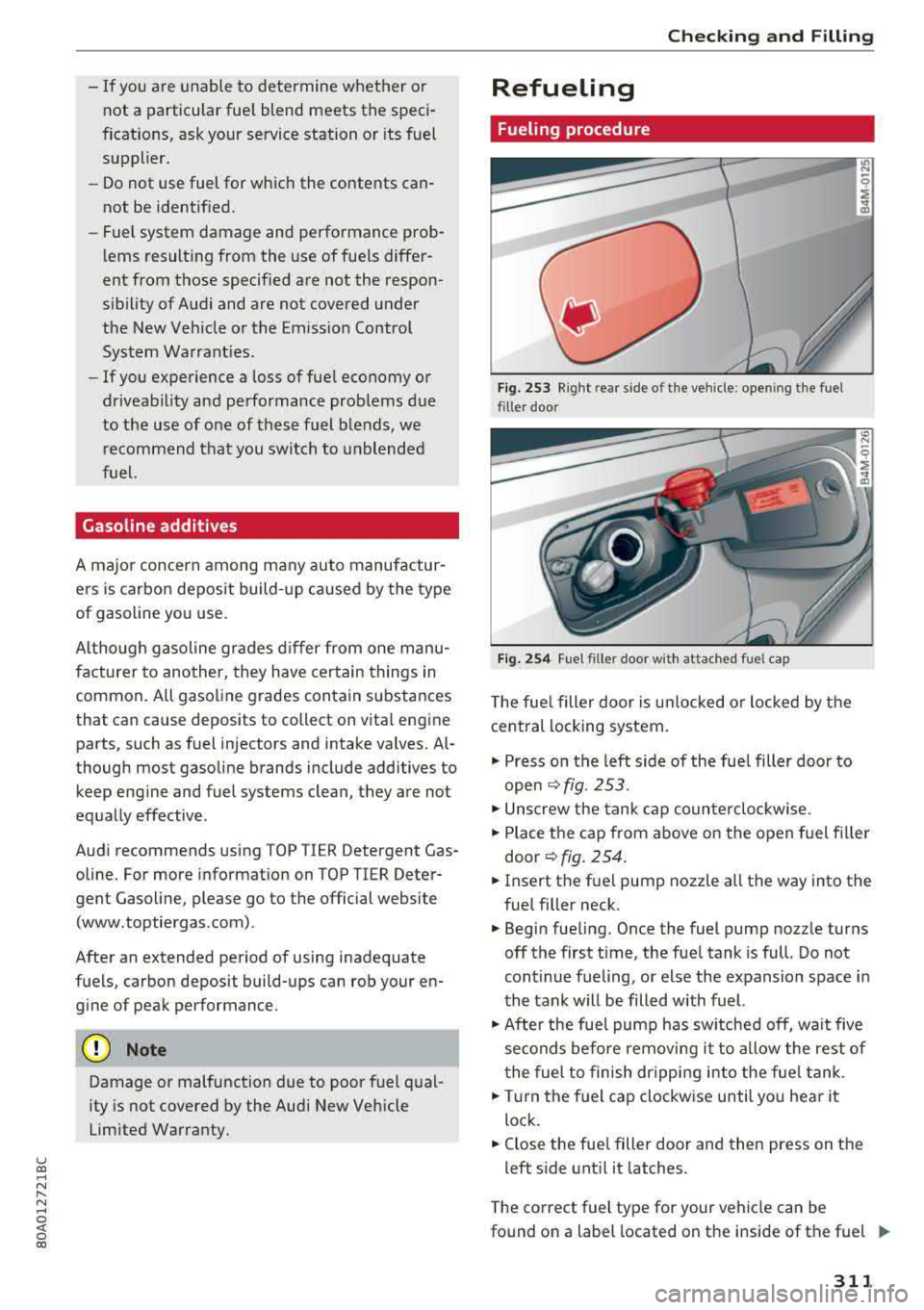
Fig. 253 Right rear s ide o f th e ve hicle : ope ning the fuel
filler door
Fig. 254 Fuel filler door with attached fue l cap
The fuel filler door is unlocked or locked by the
central locking system.
"' Press on the left side of the fuel filler door to
open
r::::>fig. 253.
"' Unscrew the tank cap counterclockwise.
"'Place the cap from above on the open fuel filler
door
r::::> fig. 254.
"'Insert the fuel pump nozzle all the way into the
fuel filler neck.
.,. Begin fueling. Once the fuel pump nozzle turns
off the first time, the fuel tank is full. Do not
continue fueling, or else the expansion space in
the tank will be filled with fuel.
"'After the fuel pump has switched off, wait five
seconds before removing it to allow the rest of
the fuel to finish dripping into the fuel tank.
"'Turn the fuel cap clockwise until you hear it
lock.
"' Close the fuel filler door and then press on the
left side until it latches .
The correct fuel type for your vehicle can be
found on a label located on the inside of the fuel
Iii>
311
Page 315 of 392
u co ..... N r-N .....
~ 0 co
Fuel filler door emergency release
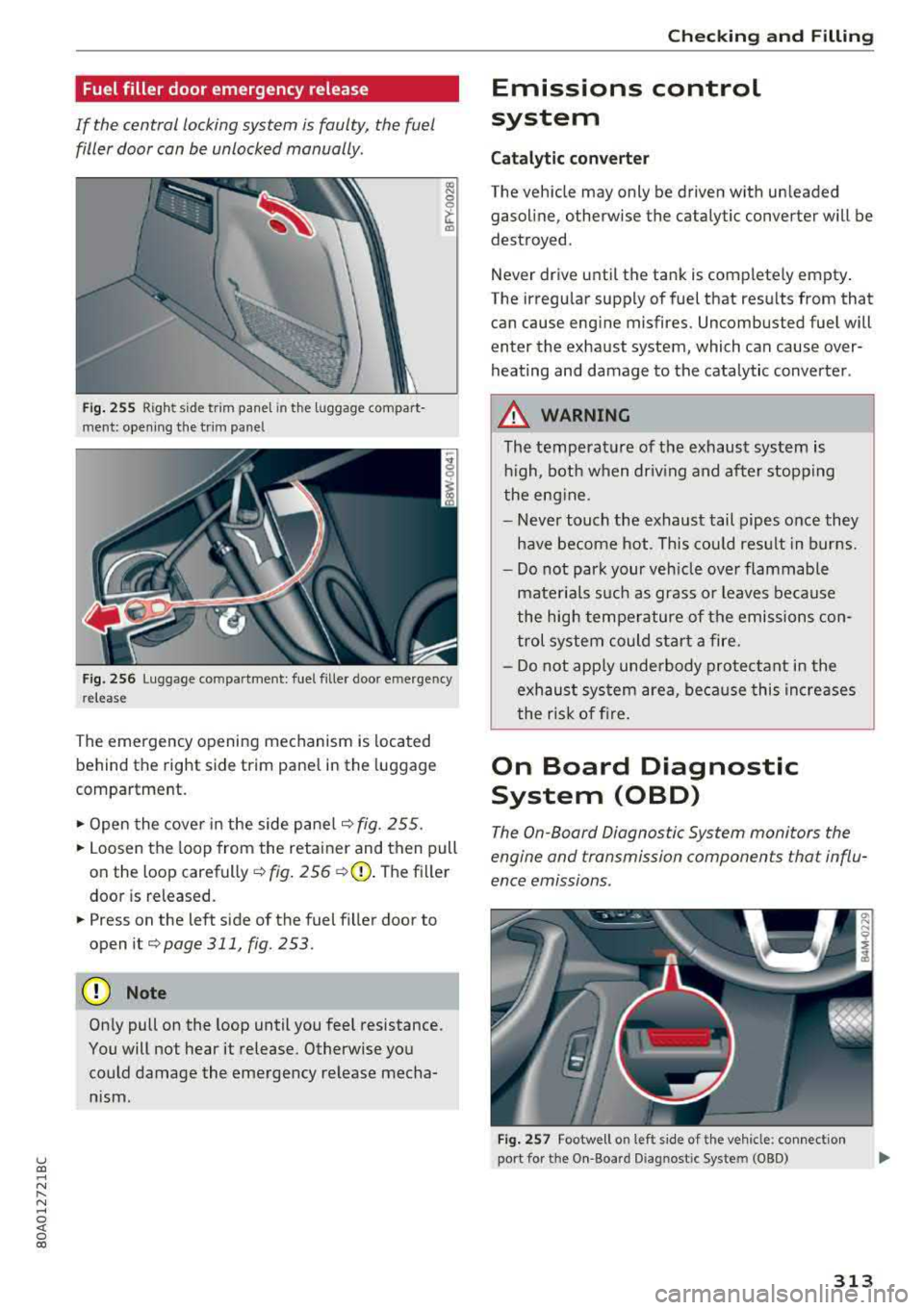
If the central locking system is faulty, the fuel filler door can be unlocked manually.
Fig . 255 Right side trim j)anel in the luggage compart
ment: opening the trim panel
Fig. 256 Luggage compartment: fuel filler door emergency
release
The emergency opening mechanism is located
behind the right side trim panel in the luggage
compartme nt.
.,. Open the cover in the side pane l¢ fig. 255.
.,. Loosen the loop from the retainer and then pull
on the loop
carefully¢ fig . 256 ¢ Q) . The filler
door is released .
.,. Press on the left side of the fuel filler door to
open it
¢page 311, fig. 253.
(D Note
On ly pull on the loop until you feel resistance.
You will not hear it release. Otherwise you could damage the emergency release mecha
nism.
Chec king and Filling
Emissions control
system
Cat alytic con verter
The vehicle may only be driven with unleaded
gasoline, otherwise the catalytic converter will be
destroyed.
Never drive until the tank is completely empty .
The irregu lar supply of fuel that results from that
can cause engine misfires. Uncombusted fuel will
enter the exhaust system, which can cause over
heating and damage to the catalytic converter .
A WARNING
The temperature of the exhaust system is
hi gh, both when driv ing and after stopping
the eng ine.
-
- Never touch the exhaust tail pipes once they
have be come hot. This cou ld resu lt in burns.
- Do not park your veh icle over flammable
mate ria ls such as grass or leaves because
the high temperature of the emissions con
trol system could start a fire.
- Do not app ly unde rbody protectant in the
exhaust sys tem area, beca use this increases
the risk of f ire.
On Board Diagnostic
System (OBD)
The On-Board Diagnostic System monitors the
engine and transmission components that influ
ence emissions .
Fig. 257 Footwell on left s ide of th e veh icle: conn ect io n
port fo r the O n-Board D iagnost ic System (08D)
313
Page 324 of 392
Checking and Filling
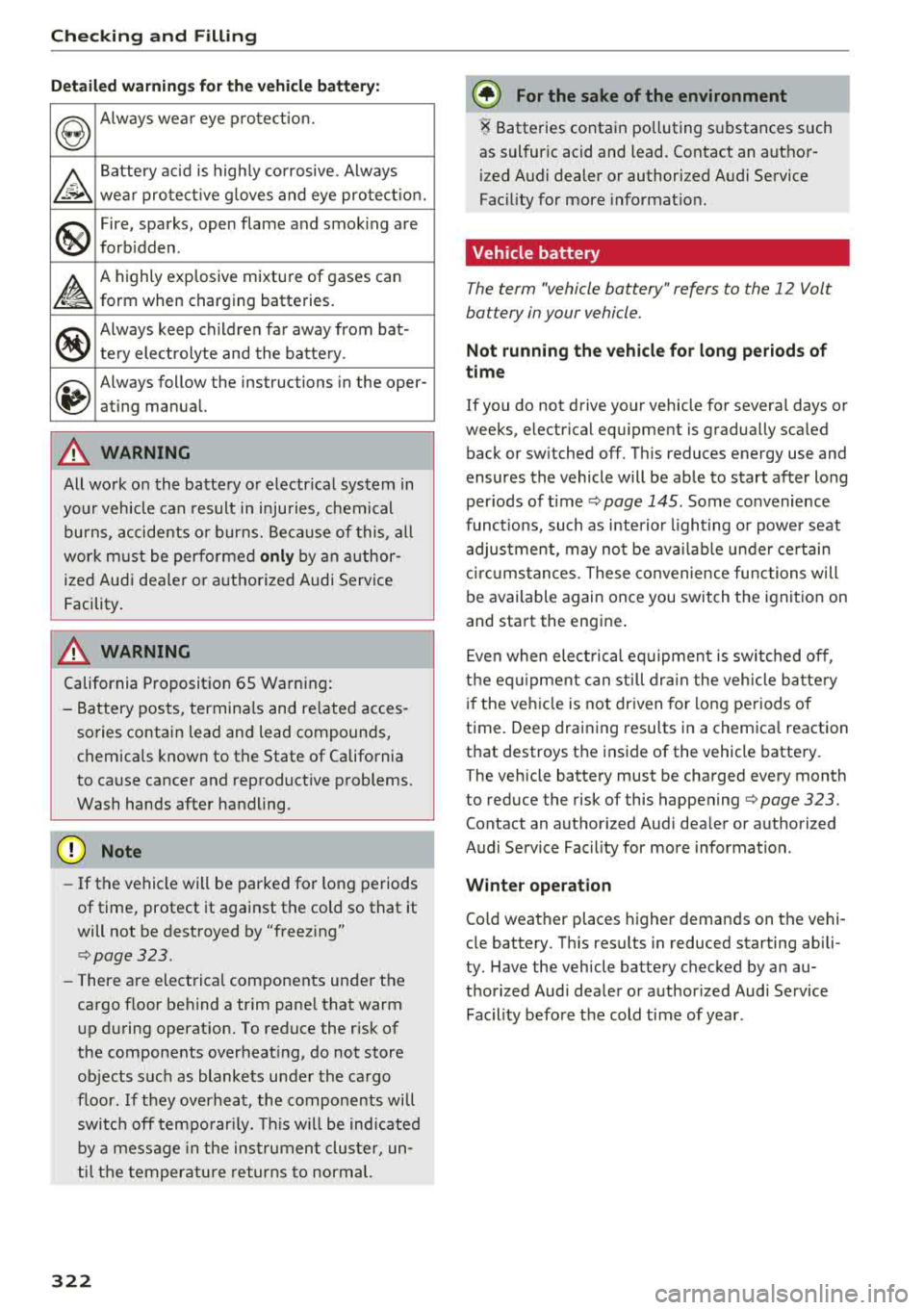
Detailed warnings for the vehicle battery:
~
Always wea r eye protection.
~
Battery acid is highly corrosive. Always
wea r protect ive g loves and eye pro tect io n .
.
®
Fire, sparks, open flame and smok ing are
forb idden .
~
A highly explosive mixture of gases can
form when charging batteries.
®
Always keep childre n far away from bat-
tery electrolyte and the batte ry .
~
Always follow the instructions in the oper-
ating manual.
A WARNING
All wo rk on the batte ry o r electrical system in
yo ur vehicle can result in inju ries, chemical
burns, accidents or burns. Because of this, all
wor k must be performed
only by an author
ized Audi dealer or authorized Audi Service
Facility.
A WARNING
California Proposition 65 Warning:
- Battery posts, terminals and re lated acces
sories contain lead and lead compounds,
chemica ls known to the State of California
to cause cancer and reproductive problems.
Wash hands after handling .
@ Note
-If the vehicle will be parked for long periods
of time, protect it against the cold so that it
will not be destroyed by "freezing"
<=>page 323.
-There are electrical components under the
cargo floor behind a trim pane l that warm
up during operation. To reduce the risk of
the components overheat ing, do not store
objects such as blankets under the cargo
floor . If they overheat, the components wi ll
switc h off temporarily. This will be ind icat ed
by a message in the instrument cluster, un
til the temperature returns to normal.
322
@ For the sake of the environment
i Batteries contain polluting substances such
as sulfur ic acid and lead. Contact an author
i zed Audi dealer or authorized Audi Service
Fac ility for more informat ion.
Vehicle battery
The term "vehicle battery" refers to the 12 Volt
battery in your vehicle.
Not running the vehicle for long periods of
time
If you do not drive your vehicle for severa l days or
weeks, electrical equ ipment is gradually sca led
back or switched off. This reduces energy use and
ensures the vehicle will be able to start after long
periods of
time<=> page 145 . Some convenience
funct ions, such as interior lighting or power seat
adjustment, may not be available under certain
circumstances . These convenience functions will
be available again once you switch t he ignition on
and start the engine .
Even when electrical equipment is switched off,
the equipm ent can still drain the vehicle battery
if the vehicl e is not driven for long periods of
time. Deep draining results in a chemical reaction
that destroys the inside of the vehicle battery.
The vehicle battery must be charged every month
to reduce the risk of this happening
<=> page 323.
Contact an authorized Aud i dealer or authorized
Audi Service Fac il ity for more information.
Winter operation
Cold weather places higher demands on the vehi
cle battery. This results in reduced starting abili
ty. Have the vehicle battery checked by an au
thorized Audi dealer or authorized Audi Service
Fac il ity before the cold time of year .
Page 325 of 392
u co ..... N r-N .....
~ 0 co
Charging the vehicle battery
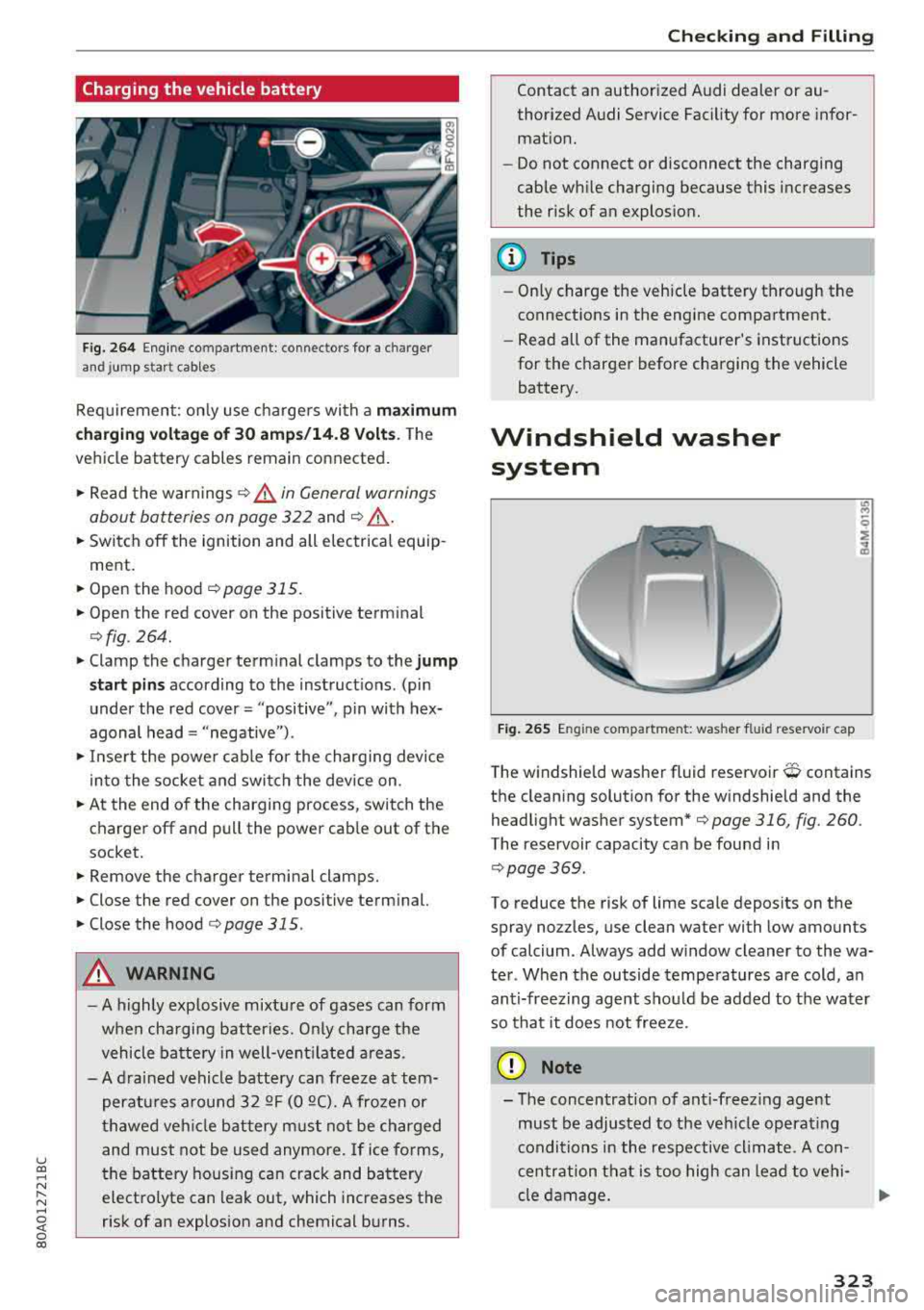
Fig. 264 Engine co mpartment : connec tor s fo r a charg er
and jump s ta rt cab les
Req uirement: on ly use charge rs with a maximum
c harging voltage of 30 amp s/14 .8 Volt s.
T he
vehicle battery cables remain connected .
.,. Read the warnings ¢ & in General warnings
about batteries on page 322
and ¢ ,& .
.,. Switch off the ignition and all e lectrical equip
ment .
.,. Open the hood ¢ page 315 .
.,. Open the red cover on the positive term inal
¢ fig . 264 .
.,. Clamp the charger term inal clamps to the jump
s tart pins
according to the instruct ions . (pin
under the red cover = "positive", p in with hex
agonal head= "negative ") .
.,. In se rt the powe r cable for the charging device
in to the socket and swi tch the device on .
.,. At the end of the charging process, switch the
charger off and pull the power cab le out of the
socket.
.,. Remove the charger terminal clamps .
.,. Close the red cover on the positive term inal.
.,. Close the hood ¢ page 315 .
A WARNING
-A highly explosive mixtu re of gases can form
whe n cha rging batter ies. O nly charge the
vehicle ba tte ry in well-ven tilated are as.
- A dra ined vehicle battery can freeze at tem
peratu res a round 3 2
QF (0 QC). A frozen or
t hawed veh icle bat tery m ust not be charged
and must not be used anymore. If ice forms,
the battery housing can crack and battery electrolyte can leak out, which increases the
risk of an explosion and chemical b urns .
Chec king and Filling
Contact an author ized Audi dealer or au
thorized Audi Service Facility for more infor
mat ion.
- Do not connect or disconnect the charging
cable wh ile charging because this increases
the risk of an explos ion.
(D Tips
- Only charge the veh icle battery through the
connect ions in the engine compartment .
- Read all of the manufacturer's instructions
for the charger before charging the vehicle battery.
Windshield washer system
F ig. 265 Engine compar tmen t: was her fluid reservo ir ca p
T he windshield washer fluid reservoir O contains
the clean ing solut ion for the w indshield and the
headlight washer system*
¢page 316, fig. 260 .
The reservoir capacity can be found in
¢page 369 .
To reduce the risk of lime scale deposits on the
spray no zzles, use clean water with low amounts
of calcium . Always add w indow cleaner to the wa
ter . When the outside tempe ratures are cold, an
anti-freez ing agent sho uld be added to t he water
so that it does not free ze.
@ Note
- The concentration of ant i-freez ing agent
must be adjusted to the ve hicle operat ing
conditio ns in the respective cl imate . A con
c en tration that is too high can lead to vehi
cle d am age .
323
Page 339 of 392
u co .... N r--N .... 0 <( 0 00
on the label on the driver's side B
pillar, always follow the specifica
tion on the B-pillar label
c:::> page 335, fig. 268.
Make sure that the tire designa
tion on your tire matches the des-
Model/ Tire designation
Wheels
ignation on the tire pressure label
and the tire pressure table.
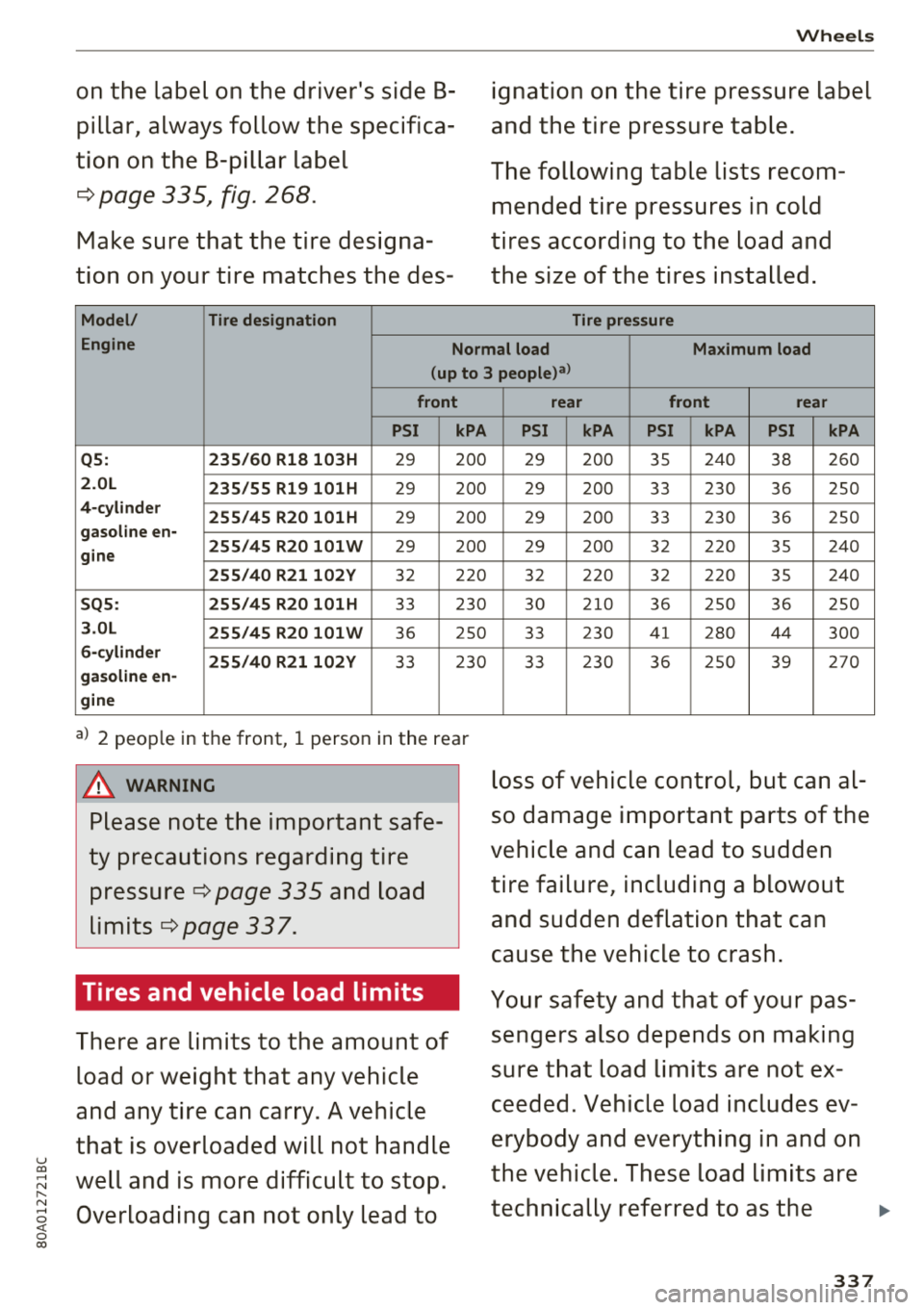
The following table lists recom mended tire pressures in cold
tires according to the load and
the size of the tires installed.
Tire pressure
Engine Normal load Maximum load
(up to 3
people)a)
front
PSI kPA
Q5: 235/60 R18 103H 29 200
2.0L
235/55 R19 101H 29 200
4-cylinder
255/45 R20 101H 29 200
gasoline en-
255/45 R20 101W
29 200 gine
255/40 R21102Y
32 220
SQ5: 255/45 R20 101H 33 230
3.0L
255/45 R20 101W 36 250
6-cylinder
gasoline en- 255/40 R21102Y 33 230
gine
a
) 2 people in the front, 1 person in the rear
A WARNING
Please note the important safe
ty precautions regarding tire
pressure
c:::> page 335 and load
limits
c:::> page 337.
Tires and vehicle load limits
There are limits to the amount of
load or weight that any vehicle
and any tire can carry. A vehicle
that is overloaded will not handle
well and is more difficult to stop .
Overloading can not only lead to
rear front rear
PSI kPA PSI kPA PSI kPA
29 200 35 240 38 260
29 200 33 230 36 250
29 200 33 230 36 250
29 200 32 220 35 240
32 220 32 220 35 240
30 210 36 250 36 2 50
33 230 4
1
280 44
300
33 230 36 250 39 270
loss of vehicle control, but can al
so damage important parts of the
vehicle and can lead to sudden
tire failure, including a blowout
and sudden deflation that can
cause the vehicle to crash.
Your safety and that of your pas
sengers also depends on making
sure that load limits are not ex
ceeded. Vehicle load includes ev
erybody and everything in and on
the vehicle . These load limits are
technically referred to as the
..,
337