rear light AUDI Q5 2018 Owner's Manual
[x] Cancel search | Manufacturer: AUDI, Model Year: 2018, Model line: Q5, Model: AUDI Q5 2018Pages: 392, PDF Size: 60.56 MB
Page 130 of 392
Ass is tance sy stem s
Systems comfort
Engine sound*
subtle
AC C* comfortable
al Subtle in th e se lector lever position "D" and sporty in " S".
@ Tips
Your sett ings a re automatical ly saved in Indi
vidual mode.
Raising/lowering the vehicle
Applies to: veh icles w ith a ir suspe nsion
.,.. Press the left or right arrow key ¢ page 127,
fig . 126
until the desired mode appears in the
instrument cluster/Infotainment system d is
play. Or
.,.. Select in the Infotainment system: I MENU I but
ton
> Ve hicle > Aud i d rive sele ct .
.,.. Select and conf irm the desired setting.
CD Note
The Lift / Offroad mode switches to All road
mode when dr iv ing above approximately
20 mph (30 km/h) and the vehicle automati
cally lowe rs again . These modes may only be
used on a tempo rary bas is and are not intend
ed for continuo us d riving.
(D Tips
- The filled -in boxes in the Infotainment sys
tem represent the current vehicle level. If
the segment is white or blinking, then the
vehicle is lifting or lowering. If only the bot
tom segment is filled in, then the veh icle is
at the lowest level ( lowest ground clear
ance). If all the segments are filled in, then
the vehicle is at the highest level (highest
ground clear a nee) .
- The target level is highlighted with a
red
frame while the vehicle is lifting or lower
i ng . The frame is then h idden when the ve
hicle reaches the target level.
- The vehicle lifts up to the highest level
when you select
Lift / Offroad . Select an
other mode to lower the vehicle again .
128
auto dynamic
subtle/sportyal sporty
ba lanced sporty
Rear lowering
Applies to: vehicles wit h air suspensio n
The rear of the vehicle con be lowered to make
loading and unloading easier.
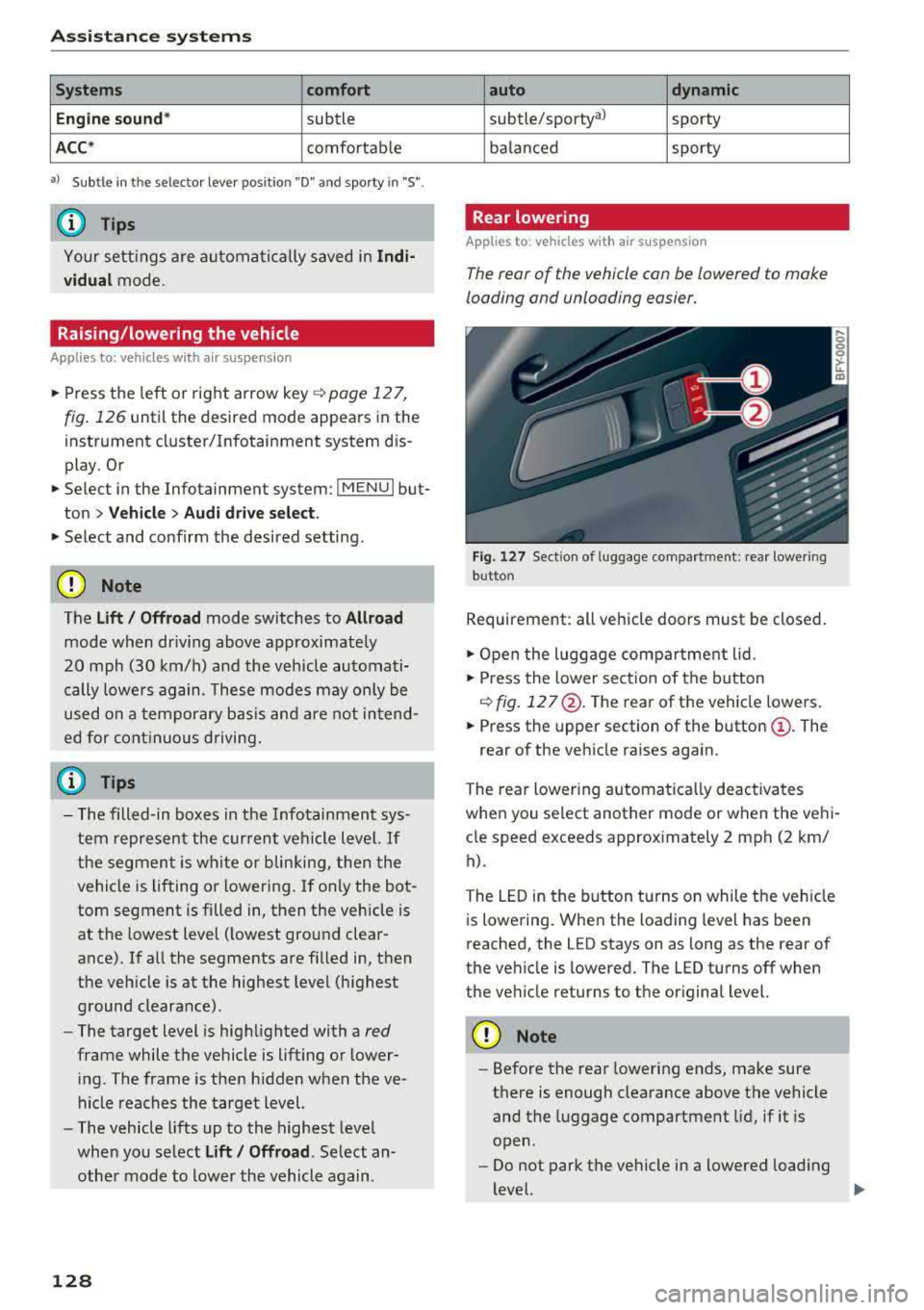
Fig. 127 Section of luggage compa rtment: rear lower ing
but ton
Requirement: all vehicle doors must be closed.
.,.. O pen the luggage compar tment lid.
.,.. Press the lower sect io n of the button
C) fig. 12 7@ . The rear of the vehicle lowe rs .
.,.. Press the upper section of the button@. The
rear of the veh icle raises again.
The rear lowering a utomat ica lly deactiva tes
whe n you select another mode or when the ve hi
cle speed exceeds approx imately 2 mph (2 km/
h).
The LED in the button t urns on while the veh icle
is lowering. When the loading level has been
reached, the LED stays on as long as the rear of
the vehicle is lowered. The LED turns off when
the veh icle returns to the original level.
CD Note
-Before the rear lowering ends, make sure
there is enough clearance above the vehicle
and the luggage compartment lid, if it is
open .
- Do not park the vehicle in a lowered load ing
level.
..,..
Page 132 of 392
Parking aid
Parking aid
General information
A pplies to: ve hicles w ith a rea r parking sys te m /parking sys
tem p lus/rearv iew camera/peripheral cameras
Depending on your vehicle's equipment , various
parking aids will help you when parking and ma
neuvering.
The
rear parking system is an audible parking aid
that warns you of obstacles
behind the vehicle
¢ page 131.
The parking system plus assists you when park
ing by audibly and visually indicating objects de
tected
in front of and behind the vehicle
¢ page 131.
The rearview camera shows the area behind the
vehicle in the Infotainment system display. The lines in the rearview camera image help you to
park or maneuver
¢ page 133.
The peripheral cameras give various views to
help you when parking or maneuvering
¢ page 135 . The parking system plus functions
are also available ¢
page 131.
_& WARNING
-Always look for traffic and check the area
around your vehicle by looking at it directly
as well. The parking system cannot replace
the driver's attention. The driver is always
responsible when entering or leaving a park
ing space and during similar maneuvers.
- Please note that some surfaces, such as
clothing, are not detected by the system.
-
- Sensors and cameras have blind spots in
which people and objects cannot be detect
ed . Be especially cautious of small children
and animals.
- Always keep your eyes on the vehicle's sur roundings, using the rearview mirror as
well.
- The sensors can be displaced by impacts or
damage to the radiator grille, bumper,
wheel housing and the underbody . The park
ing system may be impaired as a result.
Have an authorized Audi dealer or author-
130
ized Audi Service Facility check their func
tion .
@ Note
-Some objects are not detected or displayed
by the system under certain circumstances:
- objects such as barrier chains, trailer draw
bars, vertical poles or fences
- objects above the sensors such as wall ex
tensions
- objects with certain surfaces or structures
such as chain link fences or powder snow
- If you continue driving closer to a low ob
ject, it may disappear from the sensor range . Note that you will no longer be
warned about this obstacle.
- Keep enough distance from the curb to re
duce the risk of damage to the rims .
(D Tips
-The system may provide a warning even
though there are no obstacles in the cover
age area in some situations, such as:
- certain road surfaces or when there is tall
grass
- external ultrasonic sources such as from
cleaning vehicles
- in heavy rain, snow, or thick vehicle ex
haust
- We recommend that you practice parking in
a traffic-free location or parking lot to be
come familiar with the system. When doing
this, there should be good light and weath
er conditions.
- You can change the volume of the signals
and the display ¢
page 138.
-Please refer to the instructions for towing a
trailer located in
¢page 139.
-What appears in the infotainment display is
somewhat time-delayed.
- The sensors must be kept clean and free of
snow and ice for the parking aid to operate.
- The rearview camera is cleaned when clean
ing the rear window
¢page 51.
Page 146 of 392
Intelligent Technology
(D Tips
-If the brake booster is not working, you
must press the brake pedal with much more
force than normal.
- If you retrofit your vehicle with a front spoil
er, whee l covers or similar items, make sure
that the a ir flow to the front wheels is not
in terrupted. Otherw ise the brake system
can become too hot .
Electromechanical
steering, Dynamic
steering
The electromechanical steering supports the
driver's steering movements.
Power steering adapts electronically based on
the vehicle speed.
Indicator lights and messages
• Steering: malfunction! Please stop vehicle
If th is ind icator light turns on and stays on and
this message appears, the power steering may
have fa iled.
Stop the vehicle in a safe location as soon as pos
sible . Do
not continue driving . See an author ized
Aud i deale r or authorized Aud i Serv ice Facility fo r
assistance .
,~n Steering: malfunction! You can continue
driving
If the indicator light turns on and the message
appears, the steering wheel may be more diffi
cult to move or more sensit ive than usual. The
steer ing wheel may also be at an angle when
driving st raight.
Drive slowly to an au thorized Audi dealer or au
thor ized Audi Service Fac il ity to have the mal
function corrected .
I@ Dynamic steering: correcting steering wheel
position
If the indicator light turns on and this message
appears, the dynamic steering* is reinitializing.
The steering wheel will be easy to move after
starting the engine. Re initialization might be
144
necessary if the steering wheel was moved while
the engine was switched
off. T he disp lay turns
off if the initialization was successfu l.
(D Tips
-If the . or Erfl indicator light only stays on
for a short time, you may continue driving.
- T he dynamic steering stability systems
¢page 140 are not avai lab le in the event of
a system malfunction .
- For additional information on dynamic
steering, see
¢ page 125.
All-wheel drive (quattro)
General information
In all wheel drive, the driv in g power is distribut
ed between all four whee ls when needed. This
happens automatically depending on your driving
behavior as well as the current road conditions.
Also see
c> page 140 , Electronic Stabilization
Con trol (ESC).
The all-whee l drive system distributes the driving
power variably to the front and rear axle. It works
together with selective wheel torque control,
which activates when driving through curves
c> page 140. With the sport differential*, power
distribution to the rear wheels is variable and can
be adjusted using the drive select
c>poge 125 .
The all wheel drive concept is designed for high
engine power . Your vehicle is excep tionally pow
erful and has excellent driving characteristics
both under normal driving conditions and on
snow and ice. Always read and follow safety pre
cautions ¢.&. .
Winter tires
By using all wheel dr ive, your veh icle has good
forward motion w ith standard tires in winter con
ditions. However, using winter or all season t ires
o n oil four wheels in the winter is recommended,
because this w ill imp rove the braking effect.
Snow chains
If there are snow chain laws, snow chains must
also be used on veh icles with all wheel drive
c> page 340, Snow chains . .,.
Page 233 of 392
u co ..... N r-N .....
~ 0 co
the inside of the vehicle in a crash and cause
serious injuries. Store these types of devices
securely while driving.
- Do not use any wireless devices on the front
seats within range of the airbags while driv
ing. Also read and follow the warnings in
c::> page 2 73 , Front airbags .
CD Note
-Always follow the information found in c:>@
in Wi-Fi hotspot on page 194 .
-Please note that there generally are addi
tional costs when using an online media
service account, especially when it is used internationally .
(D Tips
-Depending on the Internet connection and
network traffic, a connection loss can occur
during playback of on line media services .
-Online media and Internet radio usage de
pends on the service availability of the third
party provider .
- Audi AG simply makes the access to online
media services possible through the MMI
and does not take any respons ibility for the
contents of the online media services .
- Always read the chapter
c::> page 194, Audi
connect (Infotainment) general informa tion .
- Depending on the mobile device used, there
may be interruptions during media playback
and when using the
Audi MMI connect app.
To avoid interruptions when using a mobile
device , do not lock the screen on your mo
bile device and keep the
Audi MMI connect
app in the foreground .
- Contact an authorized Audi dealer or au
thorized Audi Service Facility for additional
information about online media .
Media
Multimedia connections
USB adapter for Audi music interface o r
USB charging port
Depending on the vehicle equipment, you can
connect your mobile devices (such as a smart
phone or MP3 player) to the Audi music interface
or a USB charging port using a special USB
adapter.
@-
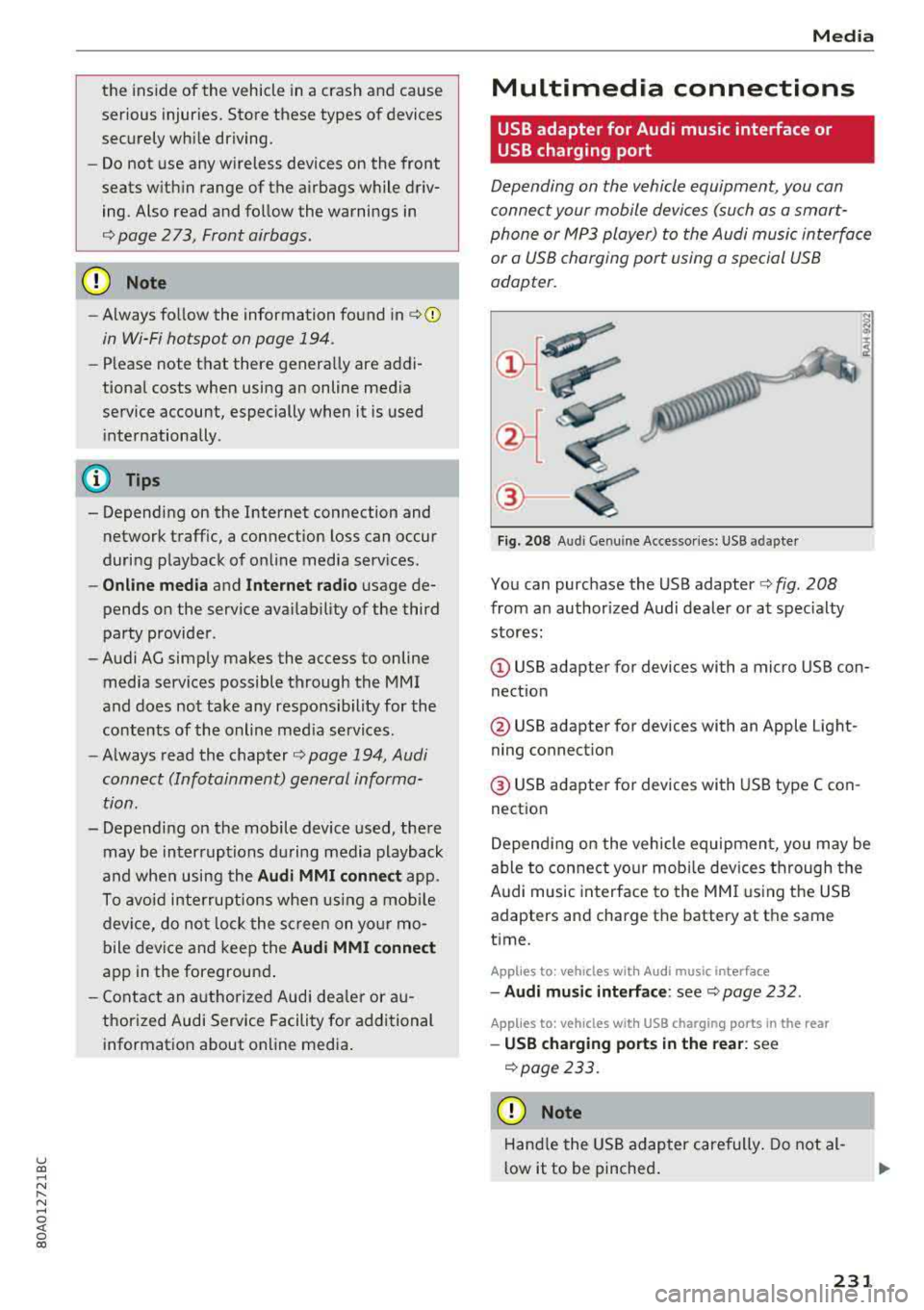
Fig. 208 A udi Genuin e Acce ssories: USB a dapter
You can purchase the USB adapter c::> fig. 208
from an authorized Audi dealer or at specialty
stores:
I
(D USB adapter for devices with a micro USB con
nection
@ USB adapter for devices with an Apple Light
ning connection
@ USB adapter for devices with USB type C con
nection
Depending on the vehicle equipment, you may be
able to connect your mobile devices through the
Audi music interface to the MMI using the USB
adapters and charge the battery at th e same
time .
Applies to : vehicles wit h Aud i music interface
-Audi music interface : see c::> page 232.
Applies to: vehicles with USB charging ports in the rear
-USB charging ports in the rear : see
c::>page233.
CD Note
Hand le the USB adapter carefully . Do not al
low it to be pinched.
231
Page 235 of 392
u C0 .... N ,..._
N
adapter(¢ page 231). They may impair the
functionality.
- You can purchase the AUX connector cable
from an authorized Audi dealer or at spe
cialty stores.
- Audi recommends setting the volume of a
mobile device connected to the AUX input to
approximately 70% of the maximum vol ume .
- Functionality is not guaranteed for mobile
devices that do not conform to the USB 2.0
specification.
- USB hubs are not supported.
- Some versions of the iPod such as the iPod
shuffle cannot be connected to the USB
adapter for devices with Apple Dock connec
tor. Connect these devices using a AUX con nector cable.
- Changed content on a mobile device
l) that
is connected to the Audi music interface
may not be displayed in the media center.
In this case, reset the
Media settings back
to
Factory settings ¢ page 246.
- Video playback through the Audi music in
terface is only supported if the connected
device is recognized as a USB storage device
(for example a USB stick). Apple devices and
MTP devices (such as smartphones) are not
recognized as USB storage devices.
- iPod/iPhone malfunctions also affect the
operation of the MMI. Reset your iPod/
iPhone if this happens.
- Audi recommends updating the iPod/iPhone
software to the latest version. For impor
tant information on operating your iPod/ iPhone, refer to the user guide for the de
vice.
- The USB adapter on the Audi music inter
face will support iPod touch/iPhone from
the 5th generation or later with the light
ning connector.
- For more information about the Audi music
interface and supported devices, check the
Audi database for mobile devices at
www .audiusa .com/mp3 or contact an au -
.... o l) A ppli es o nly t o MTP devic e s. Doe s not a pply to Ap ple de vi
thorized Audi dealer or authorized Audi
Service Facility.
USB charging ports in the rear
Applies to: vehicles with USB charging ports in the rear
You con charge the battery on your mobile device
through a USB charging port.
Two USB charging ports are located at the back
of the center console .
-USB adapter: refer to ¢ page 2 31, USB adopter
for Audi music interface or USB charging port.
- Charging a mobile device using the USB
adapter:
connect your mobile device to a USB
charging port using a suitable USB adapter.
- Disconnecting a mobile device from the charg
ing port:
remove the USB adapter from the USB
charging port .
-Disconnecting mobile devices with an Apple
Dock connector :
remove the Apple Dock con
nector from the Apple device with the release
tabs pressed in.
A WARNING
= -
Driving requires your complete and undivided
attention. As the driver, you have complete
responsibility for safety in traffic. Never oper
ate your mobile devices while driving, because
this increases the risk of an accident.
@ Note
Extremely high or low temperatures that can
occur inside vehicles can damage mobile devi
ces and/or impair their performance . Never
leave mobile devices in the vehicle in ex
tremely high or low temperatures .
(D Tips
-In preparation at the time of printing.
- Always follow the information found in
<=> page 60 .
-When you switch the ignition off, the USB
ports are still supplied with power until the
energy management intervenes .
233
Page 263 of 392
u co ..... N r--N ..... 0 <( 0 00
Safety belts
General information
Always wear safety belts!
Wearing safety belts correctly saves lives!
This chapter exp lains why safety be lts are neces
sary, how they work and how to adjust and wear
them correctly.
• Read all the information that follows and heed
all of the instructions and WARNINGS.
A WARNING
Not wearing safety belts or wearing them im
properly increases the risk of serious personal
injury and death.
- Safety belts are the s ingle most effective
means ava ilable to reduce the risk of serious
injury and death in automobile accidents.
For your protection and that of your passen
gers, always correctly wear safety belts
when the vehicle is moving.
-Pregnant women, injured, o r physically im
paired persons must also use safety belts.
Like all vehicle occupants, they are more
like ly to be seriously injured if they do not
wear safety belts. The best way to protect a
fetus is to protect the mother
-throughout
the entire pregnancy.
Number of seats
Your Aud i has a total of five seating positions:
two in the front and three in the rear. Each seat
ing position has a safety belt.
A WARNING
Not wearing safety belts or wear ing them im
properly increases the risk of serious personal
inju ry and death.
- Never strap more than one person, includ
ing small children, into any belt.
It is espe
cia lly dangerous to place a safety belt over a
child sitt ing on you r lap.
- Never let more people ride in the vehicle
than there are safety belts available.
Safety belts
- Be sure everyone riding in the vehicle is
properly restrained with a separate safety
belt or child restraint.
Safety belt warning light
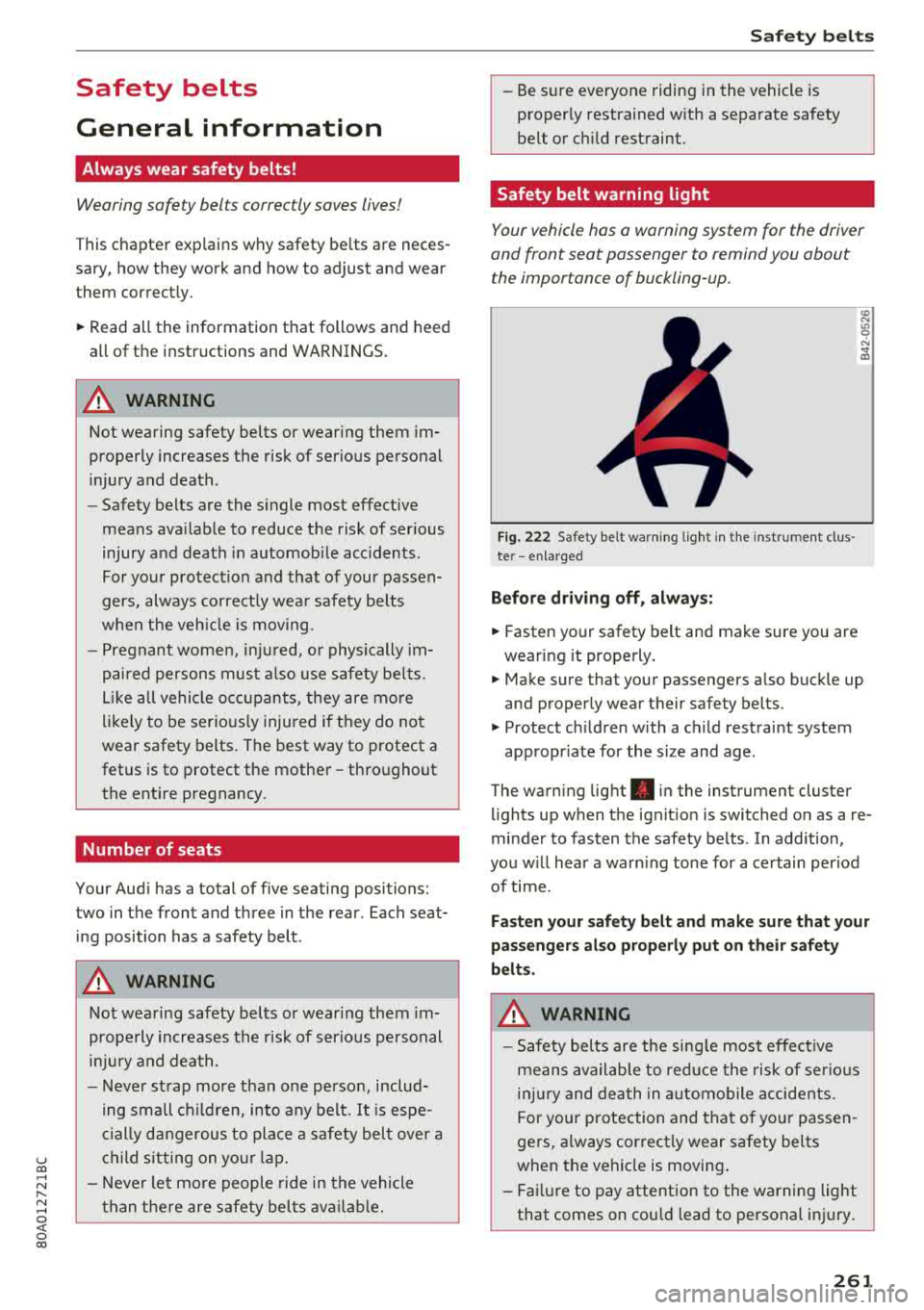
Your vehicle has a warning system for the driver
and front seat passenger to remind you about the importance of buckling-up.
Fig. 222 Safety belt warn ing ligh t in the instrument clus ·
te r - en larged
Before driving off, always:
• Fasten your safety belt and make sure you are
wearing it properly.
;;i;
• Make sure that your passengers also buckle up
and properly wear their safety belts.
• Protect ch ildren with a child restraint system
appropr iate for the size and age .
The warning light . in the instrument cluster
lights up when the ignit ion is switched on as a re
minder to fasten the safety belts . In add ition,
you w ill hear a warn ing tone for a certain period
of time.
Fasten your safety belt and make sure that your
passengers also properly put on their safety
belts.
A WARNING
-
- Safety belts are the single most effect ive
means available to red uce the risk of serious
i njur y and death in automobile accidents.
F or your protection and that of yo ur passen
gers, a lways correct ly wear safety belts
when the vehicle is moving .
- Fail ure to pay attention to the warning light
that comes on cou ld lead to personal injury.
261
Page 267 of 392
u co ..... N r-N .....
~ 0 co
Automatic saf ety belt retractor s
Every safety be lt is equ ipped with an automatic
be lt retractor on the shoulder belt. Th is feature
l ocks the belt when the belt is pull ed out fast,
during hard braking and in an accident. The be lt
may a lso lock when you drive up or down a steep
h ill or through a sharp curve. During normal driv
ing the belt lets you move freely .
Safety be lt pret en sioner s
Safety belts with pretensioners he lp to tighten
the safety belt and remove slack when the pre
tensioners are activated
c:> page 267. The func
tion of the pretensioner is monitored by a warn
i ng light
<=> page 26 .
Con vertible loc king retract or
Every safety belt except the one on the driver
seat is equipped with a convertible locking retrac
tor that
m ust be used when the safety belt is
used to attach a child safety seat. Be sure to read
the important information about this feature
<=>page 302 .
A WARNING
Improperly posit ioned safety be lts ca n cause
ser ious injury in an accident
c:> page 265,
Safety belt position.
-Safety belts offer optimum protection only
when the seatback is upright and belts are
prope rly pos itioned on the body.
-Always ma ke sure tha t the rear seat bac k
rest to wh ich the center rear safety be lt is
attached is secure ly latched whenever the
rear center safety belt is being used. If the
backrest is not securely latched, the passen
ger will move forward with the backrest dur
ing sudden braking, in a sudden maneuver
and especially in a cras h.
-Never attach the safety belt to the buckle
for another seat. Attaching the belt to the
wrong buckle w ill reduce safety belt effec
t iveness and can cause serious personal in
jury.
-A passenger who is not properly restrained can be seriously in jured by the safety be lt it
self when it moves from the stronger parts
Safet y bel ts
of the body into critical areas like the abdo
men .
-Always lock the convertible locking retractor
when you are securing a child safety seat in
the vehicle
c:> page 304.
Safety belt position
Correct belt position is the key to getting maxi
mum protection from safety belts.
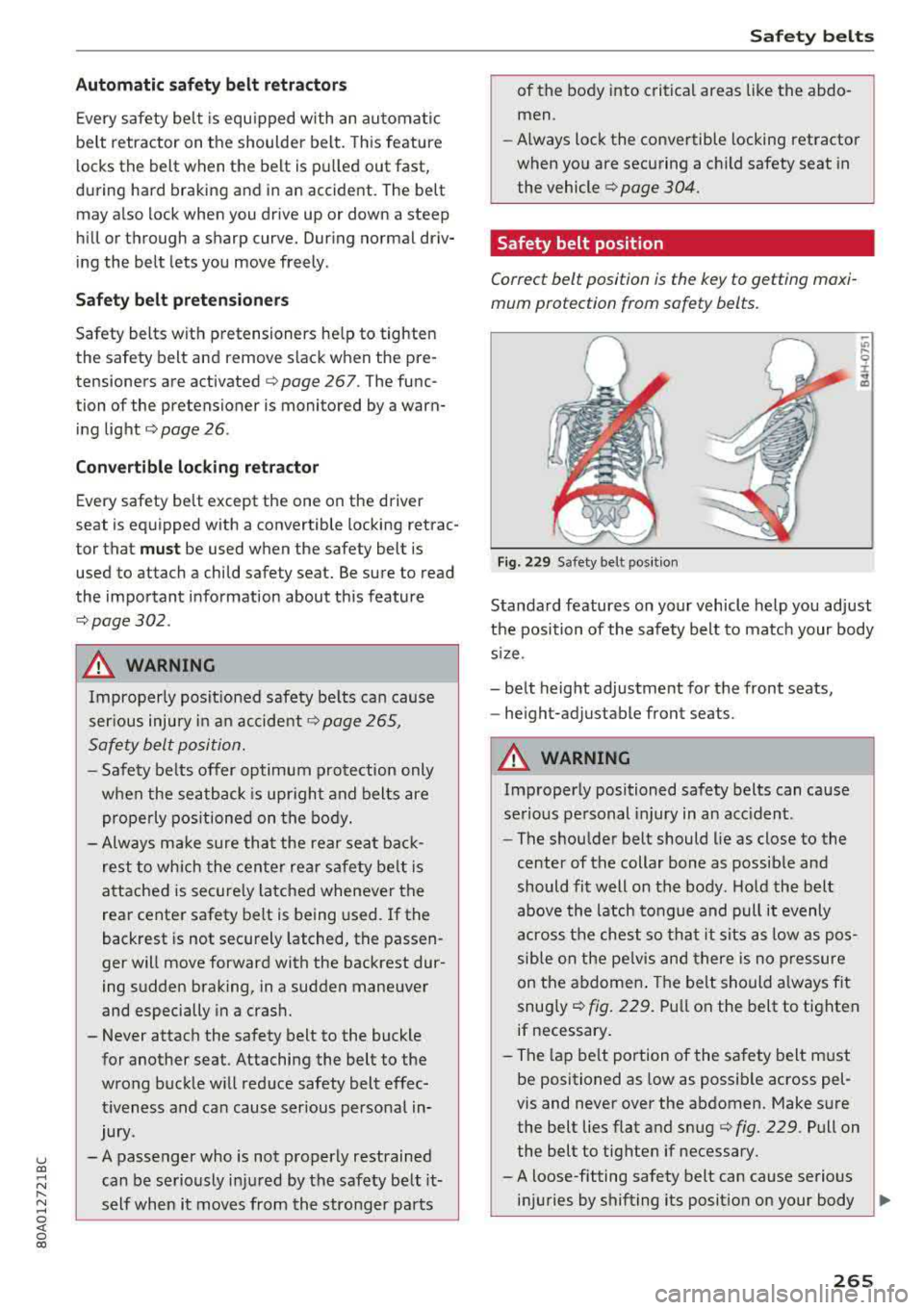
Fig. 229 Safety belt pos it ion
Standard features on your vehicle help you adjust
the position of the safety belt to ma tch your body
s iz e.
-belt height adjustment for the front seats,
-height-adjustable front seats.
A WARNING
Improperly positioned safety belts can cause
se rious personal injury in an acc ident.
-The shou lder belt should lie as close to the
center of the collar bone as possib le and
should fit well on the body. Ho ld the belt
above the latch tongue and pull it evenly
across the chest so th at it sits as low as pos
sible on the pe lvis and there is no p ressure
on the abdomen . The belt should a lways fit
snug ly
c:> fig. 229. Pu ll on the belt to tighten
if necessary .
-The lap be lt portion of the sa fety belt must
be positioned as low as possible across pel
vis and never over the abdomen. Make sure
the belt lies flat and snug
c:> fig. 229. Pull on
the belt to tighten if necessary.
-A loose-fitting safety belt can cause serious
in juries by shifting its position on your body
ll>
265
Page 273 of 392
u co ..... N r--N ..... 0 <( 0 00
about children and Advanced Airbags
¢page 291 .
Even though yo ur vehicle is equ ipped with an Ad
vanced Airbag System, make certain that a ll chil
dren, especially those 12 years and younger, al
ways ride in the back seat proper ly restrained for
their age and size. The airbag on the passenger
side makes the front seat a potentially dangerous
place for a child to ride. The front seat is not the
safest place for a child in a forward-facing child
safety seat. It can be a very dange rous place for
a n in fant or a child in a rearward-fac ing seat.
The Advanced Airbag System i n your veh icle has
been certified to comply with the requirements
of United States Federal Motor Vehicle Safety
Standa rd (FMVSS) 208, as well as Canada Motor
Ve hicle Safety Standa rd (CMVSS) 208 as applica
b le at the time your veh icle was man ufactu red.
According to requirements, the front Advanced
Airbag System on the passenger side has been
certified for "suppression" for infants of about 12 month old and younger and for "low risk de
p loyment" for children aged 3 to 6 years o ld (as
defined in the standard).
The
PASSENGER AIR BAG O FF ~ ; light in the
headliner tells you when the front Advanced Air
bag on the passenger side has been turned off by
the electronic control unit.
Each time yo u turn on the ignition, the
PAS SEN
GER AIR BAG OFF
- PASSENGER AIR BAG OFF ~; will come on if
the front passenger seat is not occupied
- PASSENGER AIR BAG OFF
pacitive passenger detection system for the
front passenger seat equals the comb ined ca
pacitance of an infant up to about one year of
age and one of the rearward-facing or forward
facing child restra ints listed in Federal Motor
Vehicle Safety Standard (FMVSS) 208 with
wh ich the Advanced Airbag System in your ve hi
cle was certified. Fo r a listing of the child re
straints that were used to ce rtify you r vehicle 's
compliance with the Safety Standard
¢ page 293 .
Airbag syste m
- PASSEN GER AIR BAG OFF ~; will come on if
there is a small chi ld or child restraint on the
front passenger seat
- PASSENGER AIR BAG ON @ will come on if the
front passenger seat is occupied by an adu lt as
registered by the capacitive passenger detec
tion system
¢ page 281, Monitoring the Ad
vanced Airbag System.
The PAS SEN GER AIR BAG OFF ~; light comes on
when e lectrica l capacitance registered on the
front passenger seat is equal to or less than the
combined capacitance of a typical 1 year-old in
fant and one of the rearward-facing or forward
facing child restra ints listed in Federal Motor Ve
hicle Safety Standard (F MVSS) 208 with wh ich
t h e Advanced Airbag System in you r vehicle was
ce rtified.
If the total electr ical capacitance reg istered on
t h e front passenger seat is mo re than that of a
typ ica l 1 yea r-old ch ild but less than the weight
of a sm all adul t, the front airbag on the passen
ger side can deploy (the
PASSENGER AIR BAG
OFF
not come on, the fro nt airbag on the passenge r
side has not been t urned off by the e lectronic
contro l unit and can deploy if the contro l unit
senses an impact that meets the conditions stor
ed in its memory.
For example , th e ai rb ag ma y deplo y if:
- a small c hild that is heav ier than a typ ica l 1
year -o ld child is on the front passenger seat
(regard less of whethe r the child is in one of t he
child sa fe ty seats
listed ¢ page 293), or
- a child who has outgrown c hild rest raints is on
the front passenger seat .
If the front passenge r a irbag is tu rned off, the
PASSENGER AIR BAG OFF ~; light comes on in
t h e headliner a nd stays o n.
If the front passenger a irbag deploys, the Feder
al Standard requ ires t he a irbag to meet the " low
r isk" deployment cr ite ria to redu ce the r isk of in
j u ry throug h interact ion w it h t he airbag. "Low
risk" deployment occurs in t hose crashes that
take place at lower decelerations as defined in
..,.
271
Page 274 of 392
Airbag syste m
the electronic control unit c> page 281, PASSEN
GER AIR BAG
OFF-,,;, ON@ light .
Always remember, a child safety seat o r infa nt
carrier insta lled on the front seat may be st ru ck
and knocked out of position by the rapid ly inflat
ing passenger's airbag in a fronta l co llision . The
airbag cou ld greatly reduce the effect iveness of
the child restraint and even seriously injure the
child dur ing inflation.
F or this reason, and because the back seat is the
safest place for ch ildren
-when properly restra in
ed according to the ir age and si ze
-we strong ly
recommend that children always sit in the back
seat
c> page 291, Child safety .
A WARNING
A child in a rearward-facing child safety seat
installed on the front passenger seat w ill be
ser iously injured and can be killed if the front
airbag infla tes
-even w ith an Advanced Ai rbag
System.
- T he inflating a irbag w ill hit the child safety
seat or infant carrier wi th great force and
will smash the chi ld safety seat and child
against the backrest, center armrest, door
or roof.
- Always install rear -facing child safety seats
on the rear seat .
- If you must install a rearward fac ing ch ild
safety seat on the front passenger seat be
cause of exceptiona l circumstances and the
PA SSENGER AIR BAG OFF ,;; light does not
come on and stay on, immed iate ly install
the rear-fac ing ch ild safety seat in a rear
seat ing pos ition and have the airbag system
inspected by your authorized Audi dea ler .
- Forward-facing ch ild safety seats installed
on the front passenger's seat may interfere
with the deployment of the airbag and ca use serio us pe rsonal injury to the child.
A WARNING
If, in except ional circumst ances, you must in
stall a forward-f acing chi ld res train t on the
front passenger's seat:
- Always make sure the forward-f acing se at
h as been designed and ce rt ified by its man-
272 ufacturer for use on a front seat with a pas
senger front and side airbag.
- Never put the forward-facing child restraint
up against or very near the instrument pan
el.
- Always move the front passenger seat to
the highest posit ion in the up and down ad
justment range and move it back to the rearmost posit ion in the seat's fore and aft
ad justment range, as far away from the a ir
bag as poss ible, before ins tall ing the for
ward-facing chi ld restraint.
- Always make sure that the safety belt upper
anchorage is behind the ch ild rest raint and
not next to o r in fron t of the child rest raint
so th at the s afety be lt will be p roperly posi
tioned.
- Ma ke sure th at the
PASSENGER AIR BAG
OFF -,,;, light comes on and stays on all the
time wheneve r the ign it ion is swi tched on .
A WARNING
To reduce the risk o f serious injury, ma ke sure
that the PASSENGER AIR BAG OFF -,,;; light
will be disp layed whenever a ch ild restraint is
installed on the front passenger seat and the
ignit ion is switched on.
- If the
PA SSENGER AIR BAG OFF -,,;, light
does not stay on, perform the checks descri
bed
c> page 281, Monitoring the Advanced
Airbag System .
-Take the child restra int off the front passen
ger seat and install it properly at one of the rear seat positions if the
PASSENGER AIR
BAG
OFF ,;; light does not stay on .
- Have the airbag system inspected by your author ized Audi dealer immed iate ly.
- Always carefully follow instructions from
child restraint manufacturers when instal ling child restra ints.
A WARNING
I f, in exceptional ci rcumstances, you must in
stall a forward or rearward-fac ing child re-
stra int on the fron t passenger's seat:
Ill>
Page 277 of 392
u co ..... N r--N ..... 0 <( 0 00
The fr ont Advance d Airbag System for the front
seat occupants is not a substitute for your safety
be lts. Rather, it is part of the overa ll occupant re
stra int system in your vehicle. A lways remember
that the airbag system can on ly help to protect
you, if you are sitting upr ight, wear ing your safe
ty belt and wear ing it properly . This is why you
and your passengers must always be prope rly re
stra ined, not just beca use the law req uir es yo u to
be.
The Advanced Airbag System in your ve hicle has
been ce rt ified to meet the " low r isk" requ ire
ments fo r 3 and 6 yea r-o ld children o n the pas
senger side and very sma ll adul ts on the d rive r
side . The low r is k dep loymen t cr iteria are intend
ed to he lp reduce t he ris k of injury through inter
action with the front airbag that can occ ur, for
examp le, by being too close to the steering whee l
and instrument pane l when the airbag inflates .
I n addition, the system has been certified to
comp ly with the "suppression" requirements of
the Safety Standard, to t urn off the front a irbag
for infants 12 months old and younger who are
restrained on the front passenger seat in c hild re
stra ints that are listed in the Standard
<=:> page 293, Child restraints and Advanced Air
bags.
"Suppress ion" requ ires the front a irbag on the
passenger side to be turned
off if:
- a ch ild up to about one year of age is restra ined
on the front passenger seat in one of the rear
facing or forward-fac ing infant restra ints listed
in Federal Motor Vehicle Safety Standard 208
with wh ic h the Advanced Airbag System in your
vehicle was ce rt ified. For a listing of the c hild
r estra in ts tha t were used to certify your ve hi
cl e's comp lian ce wi th t he US S afety St andard
<=:> page 293,
- When a person is de te cte d on the fron t passen
ger sea t th at has an electr ica l capaci tance t hat
is mo re t han t he tota l electrical capac itance of
a chi ld that is about 1 year old restrained in one
of the rea r-facing or forward-facing infant re
straints (listed in Federal Motor Vehicle Safety Standard 208 w ith which the Advanced A irbag
System in your ve hicle was certified), the front
Airbag syste m
airbag on the passenger side may or may not
dep loy.
T he
PASSENGER AIR BAG OFF ~; ligh t comes on
whe n the elect ronic con trol uni t detec ts a t otal
electrica l capacitance on the front passenger seat
that requires the front airbag to be turned
off. If
the
PASSENGER AIR BAG OFF ~; light does not
come on, the front airbag on the passenger side
has not been turned
off by the contro l unit and
can deploy if the contro l unit senses a n impact
t h at meets the cond it ions stored in its memory .
If the total electr ica l capacitance reg istered on
the front passenger seat is more t han that of a
typ ical 1 year-old , but less than the weight of a
small ad ult, the front a irbag on the passenger
s ide may dep loy (the
PASSENGER AIR BAG OFF
~; light does not come on).
For example, the airbag may deploy if :
-a small ch ild that is heav ier than a typica l 1
year-o ld child is on the front passenger seat
(regardless of whether the child is in one of t he
child safety seats
listed<=:> page 293),
- a child who has outgrown c hild restraints is on
the front passenger seat.
If the front passenge r ai rbag is t urned off, the
PASSENGER AIR BAG OFF ~; light in the head
liner w ill come on and stay on.
If the front passenge r airbag deploys, the Feder
al Standard requi res t he airbag to meet the " low
risk" deployment criteria to he lp reduce the r is k
of i njury through interaction with the a irbag.
"Low risk" deployment occurs in those crashes
that take place at lower decelerations as defined
i n the electronic co ntro l unit .
<=:>page 281
Always remember : Even though your vehicle is
equipped with Advanced Airbags, the safest place
for ch ildre n is properly restra ined o n the back
seat . Please be s ure to read the impo rtant in for
mation in the sect ions that fo llow and be sure to
heed all of the WAR NIN GS.
_&. WARNING
To redu ce th e r is k of injury when an air bag in -
fl ates, always wea r sa fe ty be lts properly .
...,
275