roof AUDI Q5 2018 Owner's Manual
[x] Cancel search | Manufacturer: AUDI, Model Year: 2018, Model line: Q5, Model: AUDI Q5 2018Pages: 392, PDF Size: 60.56 MB
Page 300 of 392
Child sa fety
should ride only in special restraints in which the
chi ld faces the back of the vehicle. These infant
seats support the baby's back, neck and head in a
crash
c::> fig. 242.
The airbag on the passenger side makes the front
seat a potentially dangerous p lace for a child to
ride . The front seat is not the safest place for a
child in a forward -facing child seat. It is a very
dangerous place for an infant or a larger child in
a rearward -facing seat .
A WARNING
Not using a ch ild safety seat, using the wrong
child safety seat o r improperly install ing a
child restra int increases the r is k of se rious
personal inju ry and death in a crash.
- Never install rear-facing chi ld safety seats
o r infant carr iers on the front passenger
seat
-even with an Advanced A irb ag Sys
tem . A child w ill be seriously injured and can
be ki lled when the inflating airbag hits the
child safety seat or infant carrier with great
force and smashes the child safety seat and
child against the backrest, center armrest,
door or roof c::> page 2 70, Child restraints on
the front seat
-some important things to
know .
- Always install rear-facing child safety seats
or infant carr iers on the rear seat.
- Never install a rear-facing child restra int in
the forward-facing direct ion . Such restraints
are designed for the spec ial needs of infants
and very sma ll children and cannot protect
them properly if the seat is forward-fa cing.
- If you must install a rearward fac ing ch ild
sa fety seat on the front passenger seat be
ca use of exception al circumst ances and the
PASSENGER AIR BAG OFF ,;; light does not
come on and stay on, immediate ly install
the rear-facing chi ld safety seat in a rear
seat ing pos ition and have the airbag system
inspected by your Audi dealer.
- Never place or use any electrical device
(s uch as a laptop, CD player, elect ronic
games dev ice, powe r inverter or seat heater
for child seats) on the front passenger seat
298
if the device is connected to the 12-volt
socket or the ciga rette lighte r socket.
- If a seat heater has been ret rofitted or oth
erwise added to the front passenger seat, never install any child restra int system on
this seat.
- Make sure that there are no wet objects (such as a wet towel) and no water or other
liquids on the front passenger seat cush ion .
- Never p lace objects on the seat (such as a
laptop, CD p layer, electron ic games device,
power inverte r or seat heater for ch ild
seats). These may influence the elect rical
capacitance measu red by the capacitive pas
senger detect ion system and can also fly
a round in an accident and cause se rious per
sonal injury .
- Always read and heed all WARNINGS when
eve r us ing a child restrained in a vehicle is
be ing used
c::> page 261, Safety belts,
c::> page 269, Airbag system and
¢ page 291 , Important information .
Page 301 of 392
Convertible child safety seats
Properly used convertible child safety seats can
help protect toddlers and children over age one
who weigh between
20 and 40 lbs. (9 and 18 kg)
in a crash.
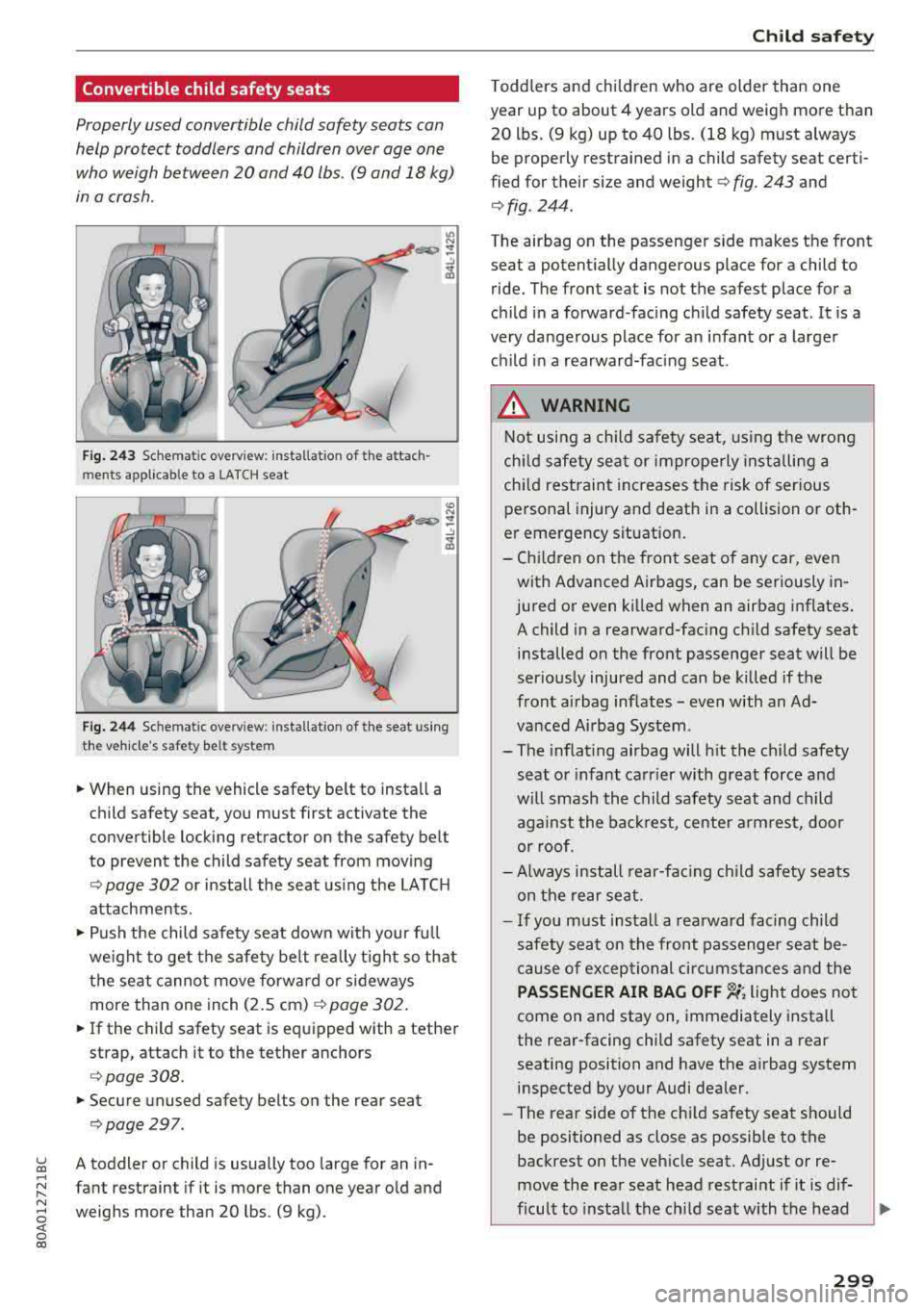
f ig . 243 Sche matic overview: installatio n of the attach
ments applica ble to
a LA TCH seat
Fig. 2 44 Schematic overview: installat ion of the seat using
the vehicle's safety belt system
~ When using the vehicle safety belt to install a
child safety seat, you must first activate the
convertible locking retractor on the safety belt
to prevent the child safety seat from moving
¢page 302 or install the seat us ing the LA TC H
attachments .
~ Push the child safety seat down with your fu ll
weight to get the safety be lt rea lly t ight so that
the seat cannot move forward o r sideways
more than one inch (2.5
cm)¢ page 302 .
~ If the child safety seat is equipped with a tether
strap, attach it to the tether anchors
¢page 308.
~ Secure unused safety belts on the rear seat
¢page 297.
~ A toddler or child is usually too large for an in-
~ fant restraint if it is more than one year old and r--
~ weighs more than 20 lbs. (9 kg).
~ 0 co
Child s afe ty
Todd lers and children who are older than one
year up to about 4 years old and weigh more than
20 lbs. (9 kg) up to 40 lbs . (18 kg) must always
be properly restrained in a child safety seat certi
fied for their size and
weight¢ fig. 243 and
¢ fig. 244.
The airbag on the passenger side makes the front
seat a potent ially dangerous place for a child to
ride. The front seat is not the safest place for a
child in a forward -fac ing child safety seat . It is a
very dangerous place for a n in fant or a larger
child in a rearward-facing seat .
_&. WARNING
Not using a child safety seat, using t he wrong
chi ld safety seat or imprope rly insta lling a
chi ld restraint increases the risk of ser ious
personal injury and death in a collision or oth
er emergency situation.
-Ch ildren on the front seat of any car, eve n
wit h Advanced Airbags, can be seriously in
jured or even killed when an airbag inflates .
A child in a rearward-fac ing ch ild safety seat
installed on the front passenger seat will be
serious ly injured and can be killed if the
front airbag inflates -even with an Ad
va nced Ai rbag System .
-The inflat ing airbag will h it the ch ild safety
seat or infant carr ier with great force and
will smash the child safety seat and child aga inst the backrest, ce nter a rmrest, door
or roof.
- Always ins tall rear-fa cing c hild safety seats
on the rear seat .
-If you m ust instal l a rea rwa rd facing child
safety seat on the front passenger seat be
cause of exceptional circ ums tan ces and the
PASSENGER AIR BAG OFF "1; light does not
come on and stay on, immediately insta ll
the rea r-facing child safety seat in a rear
seating position and have the a irbag system
inspected by your Audi dealer.
-The rear side of the ch ild safety seat shou ld
be positioned as close as possible to the
backrest on the veh icle seat. Adjust or re
move the rear seat head restraint if it is dif-
f icult to instal l the ch ild seat with the head ._.
299
Page 305 of 392
u co ..... N r--N ..... 0 <( 0 00
A WARNING
-
Improperly in stalled chi ld safety seats in
crease the risk of serious personal injury and
death in a collision.
- Always make sure that the safety belt re
tractor is locked when installing a child safety seat. An unlocked safety belt retrac
tor cannot hold the child safety seat in place dur ing normal driving or in a crash.
- Always buckle the child safety seat firmly in
place even if a child is not sitting in it. A
loose child safety seat can fly around during
a sudden stop or in a collision.
- Always make sure that the rear seat back
rest to wh ich the center rear safety belt* is
attached is secure ly latched whenever the
rea r cente r safety belt is being used to se
cur e a ch ild rest raint.
- If the backrest is not securely latched, the
child and the child restraint will be thrown
forwar d toge ther w it h the backrest and will
st rike parts of the vehicle interior. The ch ild
can be se riously in jured or killed .
- Never ins tall rear-f acing chi ld safety sea ts
or infant carriers on the front passen ger
seat . A child will be serious ly inju red and
can be killed when the passenger airbag in
flates.
- The inflating airbag will hit the child safety
seat or infant carrier with great force and
will smash the ch ild safety seat and chi ld
against the backrest, center armrest, door
or roof .
- Always install rear-facing child safety seats
o r infant carriers on the rear seat.
- Forward-fac ing ch ild safety seats or infant
carriers installed on the front passenger's
seat may interfere with the deployment of
the a irbag and cause serious injury to the
child.
- It is safe r to install a forward-fac ing ch ild
safety seat on the rear seat.
- Always read and heed all WARNINGS when
ever using a child res trained in a veh icle is
being
used~ page 291 . Specia l precaut ions
apply when installing a child safety seat on
t h e fron t passenger
sea t~ page 2 70, Child
Ch ild saf ety
restraints on the front seat -some impor
tant things to know.
A WARNING
--
A lways take special precautions if you must
i nstall a forward or rearward-facing child re
stra int on the front passenger's seat in excep
tional s ituations:
- Whenever a forward or rearward-fac ing
child restraint is installed on the front pas
senger sea t, the
PASSENGER AIR BAG OFF
~; lig ht must come on and stay on whenev
er the ign ition is swi tched on.
- I f the
PASSENGER AIR BAG OFF ~; light
does not come on and stay on, perform the
checks desc ribe d
~ page 281, Monito ring
t he Advanced Airbag System.
- T ake the child res tra int off the front passen
ge r seat and inst all it prope rly at one of the
rear sea t positions i f the
PASSENGER AIR
BAG
OFF ~; light does not stay on whenever
the ignition is switched on .
- Imp roper installat ion of child restra ints can
reduce the ir effectiveness or even prevent
them from providing any protect ion .
- An imprope rly installed child restra int can
interfere with the airbag as it deploys and
serio usly injure or even kill the chi ld.
- Always carefully follow the manufacturer's
instr uctions provided with the child sa fety
seat or ca rr ie r.
- After checking to make su re that the child
rest raint is proper ly installed, make ce rtain
that the child restraint is co rrectly recog
n ized by the capacitive passenger detection
system in the front passenger seat and that
the
PASSENGER AIR BAG OFF ~; light sig
na ls the correct front passenger fronta l air
b ag sta tus.
A WARNING
F orw ard-facing child restra int s:
- Always make sure the forward-facing sea t
has been des igned and certified by its man
ufa cturer for use on a fron t sea t with a pa s
senger front and side air bag.
303
Page 306 of 392
Child sa fety
- Never put the forward -facing child restraint
up, against or very near the instrument pan
el.
- Always move the front passenger seat to
the h ighest position in the up and down ad
justment range and move it back to the
rearmost position in the seat's fore and aft
adjustment range, as far away from the air
bag as possib le, before insta lli ng the for
wa rd-facing child restra int.
- Always make sure that the safety belt upper
anchorage is beh ind the child restra int and
not next to or in front of t he ch ild restraint
so tha t the safety belt w ill be properly pos i
tioned.
- Make s ure tha t the
PASSENGER AIR BAG
OFF ~; light comes on and stays on a ll the
time whenever the ignition is switched on.
A WARNING
Rearward-facing child restraints:
- A ch ild in a rea rw ar d-facing child safety seat
insta lled on the front passenger seat wi ll be
seriously injured and can be killed if the
front airbag inflates
-even with an Ad
vanced Airbag System.
- The inflating airbag wi ll hit the child safety
seat or infant carrier with great force and
will smash the chi ld safety seat and child
against the backrest , center armrest, door
or roof.
- Always be especially careful if you must in
sta ll a rearward facing child safety seat on
the front passenger seat in exceptional c ir
c u mstances.
- Make sure that the
PAS SENGER AIR BAG
OFF ~; light comes on and stays on all the
t ime whenever the ignition is switched on.
- If the PASSENGER AIR BAG OFF ~; light
does not come o n and stay o n, immed iate ly
install the rea r-fa cing child safety seat in a
re ar seat ing pos ition and have the airbag
system inspe cte d by your Aud i de aler.
304
Activating the convertible locking retractor
Use the convertible locking retractor to secure a
child restraint.
Always heed the child safety seat manufacturer's
i nstruct ions when installing a child restra int in
your vehicle. To activate the convertible locking r etractor:
.,. Place the child restraint on a seat, preferably
on the rear seat .
.,. Slowly pull the belt all th e w ay out .
.,. Route it around or through the child restra int
be lt
path~ .,&..
.,. Push the ch ild safety sea t down with yo ur full
weigh t to ge t the safety belt rea lly tigh t.
.,. Insert t he be lt tong ue into the b uck le for that
seating position .
.,. Guide the safety be lt back into the retractor un
til the belt lies flat and snug on the ch ild safety
seat.
.,. You shou ld hear a "cl icking" noise as the belt
w inds back into the inertia reel. Test the con
vert ib le lock ing retractor by pull ing on the belt.
You s hou ld no lo nge r be able to pull the belt
out of the retracto r. T he convertib le lock ing re
tracto r is now activa ted .
.,. Make sure that the red release button is facing
away from the chi ld restraint so that it can be
unb uc kled quickly .
.,. Pull on the belt to make sure the safety belt is
properly t ight and fastened so that the seat
cannot move forward or s ideways more than
one inch (2 .5 cm) .
A WARNING
Using the wrong ch ild rest raint or an improp
e rly insta lled child restra int can ca use se rio us
pe rsonal injury or death in a crash.
- Always make sure that the safety be lt re
tr actor is locked whe n in stalling a c hild
safety seat . An un lo cked sa fety be lt retr ac
tor cannot hold the chi ld safety seat in p lace
during normal driving or in a crash.
- Always buckle t he chi ld safety seat fi rm ly in
p lace even if a chi ld is not sitting in it. A
loose chi ld safety seat can fly a round during
a sudden stop or in a crash.
Page 332 of 392
Wheels
Production options we igh t
means the combined weight of
those installed regular production
options weighing over 5 lbs.
(2.3 kg) in excess of those stand
ard items which they replace, not previously considered in curb
weight or accessory weight, in
cluding heavy duty brakes, ride levelers, roof rack, heavy duty
battery, and special trim.
Radial pl y tir e
means a pneumatic tire in which
the ply cords that extend to the beads are laid at substantially
90 degrees to the centerline of
the tread.
R ecomm ended in flation
pressure
see¢ page 328 , Cold tire infla
tion pressure.
R einforced tire
means a tire designed to operate
at higher loads and at higher in
flation pressures than the corre
sponding standard tire . Rein
forced tires may be identified as
"XL" "xl" "EXTRA LOAD" or "RF" , , ,
on the sidewall.
330
Rim
means a metal support for a tire
or a tire and tube assembly upon
which the tire beads are seated.
Rim diam eter
means nominal diameter of the
bead seat . If you change your
wheel size, you will have to pur
chase new tires to match the new rim diameter .
Rim size designation
means rim diameter and width.
Rim width
means nomina l distance between
r im
flanges .
Sidewall
means that portion of a tire be
tween the tread and bead .
Speed rating (letter code )
means the speed at which a tire is
designed to be driven for extend
ed periods of time. The ratings range from 93 mph (150 km/h)
to
186 mph (298 km/h) ¢ table
on page 326 .
You may not find
this information on all tires be
cause it is not required by law .
The speed rating letter code,
where applicable, is molded on
the tire sidewall and indicates the
...
Page 346 of 392
Care and cleaning
Care and cleaning
General information
Regular, proper care helps to maintain your vehi
cle's value. It can also be a requirement when
submitting warranty claims for corrosion damage
and paint defects on the body.
The required cleaning and care products can be
obtained from an authorized Audi dealer or au
thorized Service Facility . Read and follow the in
structions for use on the packaging .
A WARNING
-Using cleaning and care products incorrectly
can be dangerous to your health.
- Always store clean ing and care products out
of reach of children to reduce the r isk of poi
son ing.
@ For the sake of the environment
- Preferab ly purchase environmenta lly-friend
l y cleaning products.
- Do not dispose of leftover cleaning and care
products with household trash.
Car washes
The longer that deposits such as insects, bird
droppings, tree sap or road salt remain on the ve
h icle, the more the surface can be damaged. High
temperatures such as those caused by sunlight
increase the damaging effect.
Before washing, r inse
off heavy deposits with
p lenty of water.
Stubborn deposits such as bird droppings or tree
sap are best removed with plenty of water and a microfiber cloth.
A lso, wash the underside of yo ur vehicle once
road sa lt stops being used for the season .
Pressure washers
When washing your veh icle w ith a pressure wash
er , al ways fo llow the operating instructions pro
vided with the press ure washer. This is especially
important in regard to the pressure and spraying
distance. Do not aim the spray directly at the
344
seals on the side windows, doors, lids or the sun
roof* or at tires, rubber hoses, insulating materi
a l, sensors* or camera lenses* . Keep a distance of
at least 16 in (40 cm).
Do not remove snow and ice with a pressure
washer.
Never use cone nozz les or high pressure nozzles.
The water temperature must not be above 140 °F
(60 °() .
Automatic car washes
Spray off the vehicle before washing.
Make sure that the windows and roof* are closed
and the windshie ld wipers are
off . Follow instruc
tions from the car wash operator, especially if
there are accessories attached to your vehicle.
If possible, use car washes that do not have
brushes.
Washing by hand
Clean the vehicl e starting from the top and work
in g down using a soft sponge or cl eaning br ush.
Use solvent-free cleaning products.
Washing vehicles with matte finish paint by
hand
To avoid damaging the paint when washing, first
remove dust and large part icles from you r vehi
cle. Insects, grease spots and fingerprints are
best removed with a special cleaner for matte
finish paint .
Apply t he product using a microfiber cloth. To
avoid damaging th e paint surface, do not use too
much pressure.
R inse the vehicl e thoroughly with wate r. Then
clean using a neutra l shampoo and a soft micro
f iber cloth .
Rinse the vehicl e thoroughly again and let it air
dry. Remove any water residue using a chamois.
A WARNING
-Only wash the vehicle when the ignition is
off and follow the instructions from the car
-
Page 362 of 392
Fuses and bulb s
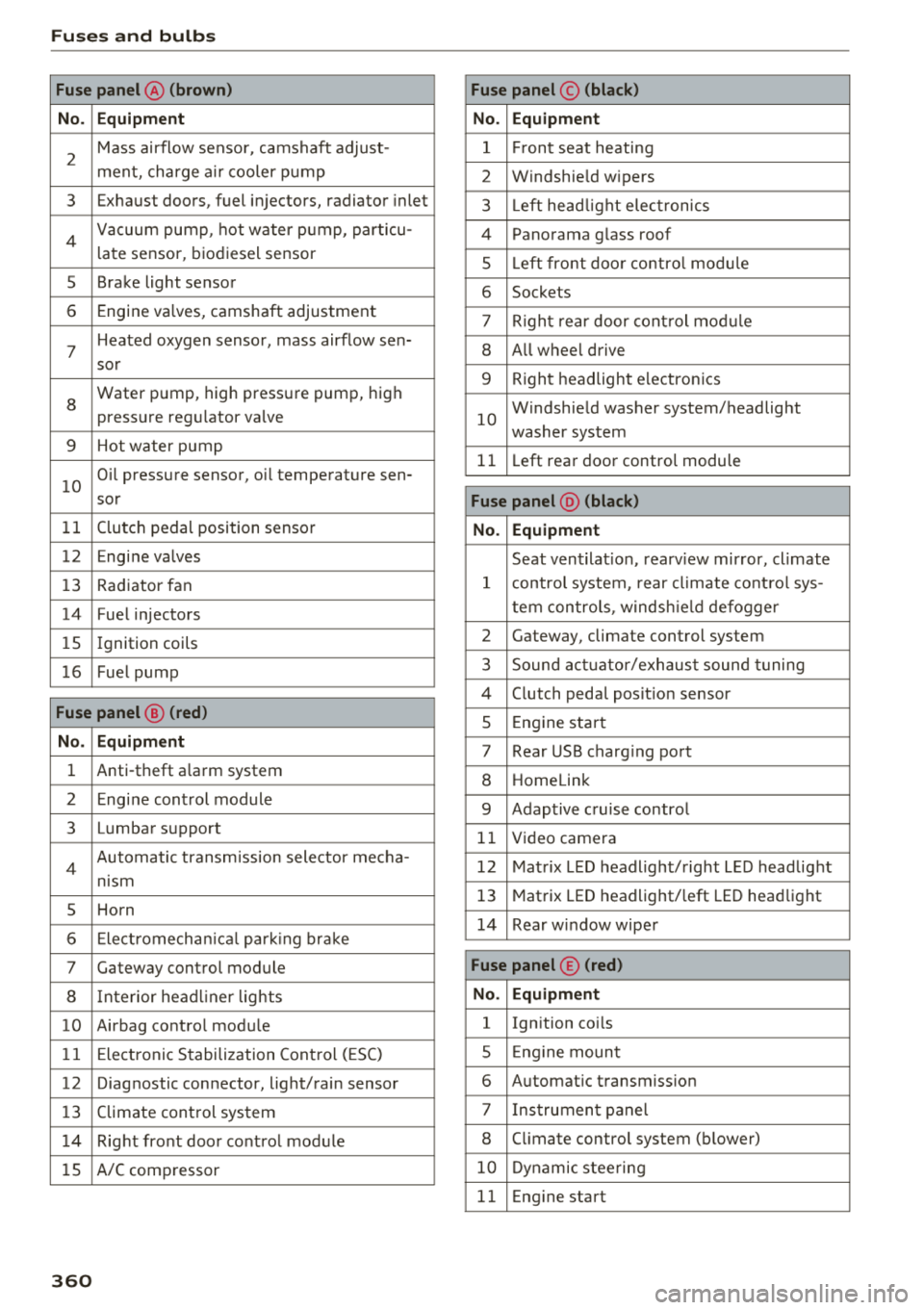
Fuse panel@ (brown ) Fuse panel© (blac k)
N o. E quip ment No. Equipmen t
2
Mass airflow sensor, camshaft adjust-
ment, charge air cooler pump 1 Fr ont seat heating
2 Windshie ld wipers
3 Exhaust doors, fuel injectors, radiator inlet 3 Left head light elect ronics
4 Vacuum pump , hot water p ump, particu-
late sensor, biodiesel sensor 4 Panorama glass roof
s L eft front doo r contro l modu le
5 Brake light sensor 6 Sockets
6 Engine valves, camshaft adjustment 7 Right rear door cont rol mod ule
7
Heated oxygen sensor, mass airflow sen-8 All wheel drive
sor
8
Water pump, high pressure pump, high
pressure regulator va lve
9 Hot water pump
9 R ight headlight electronics
10
Windshield washer system/headlight
washer system
1 1 Left rear door contro l module
10
Oil pressure sensor, oil temperature sen-
sor
Fu se p anel @ (blac k)
11 Clutch pedal position sensor No. Equipment
12 Engine valves
Seat ventilation, rearv iew mirror, cl imate
13 Radiator fan 1 control system, rear cl imate control sys-
14 Fuel injectors tern controls
, windsh ie ld defogger
15 Ignition coils 2 Gateway, climate control system
16 Fuel pump 3 Sound act uator/exhaust sound tuning
Fuse panel @ (red )
4 Clutch pedal posit ion sensor
5 Engine start
N o. Equipment 7 Rear USB charging port
1 Anti-theft a larm system 8 Homelink
2 Engine control module 9 Adaptive cruise control
3 Lumbar support 11 Video camera
4 Automatic transm ission selector mecha-
nism 12 Matrix LED headlight/right LED headlight
5 Horn
13 Matrix LED headlight/ left LED headlight
6 Electromechan ica l park ing brake
14 Rear window wiper
7 Gateway control module Fu se panel © (red )
8 Interior headliner lights No . Equipmen t
10 Airbag control module 1 Ignition coils
11 Electronic Stabilization Control (ESC) 5 E ng ine mount
12 Diagnostic connector, light/rain sensor 6 Automatic transmiss ion
13 Climate control system 7 I nstrument panel
1 4 Right front door control module 8 C limate control system (blower)
lS A/C compressor
10 Dynamic stee ring
11 Eng ine start
36 0
Page 372 of 392
Technical data
Weights
= 111 11 I~ I III I I II Ill llllll 1 111 111111 111 111111 11111111
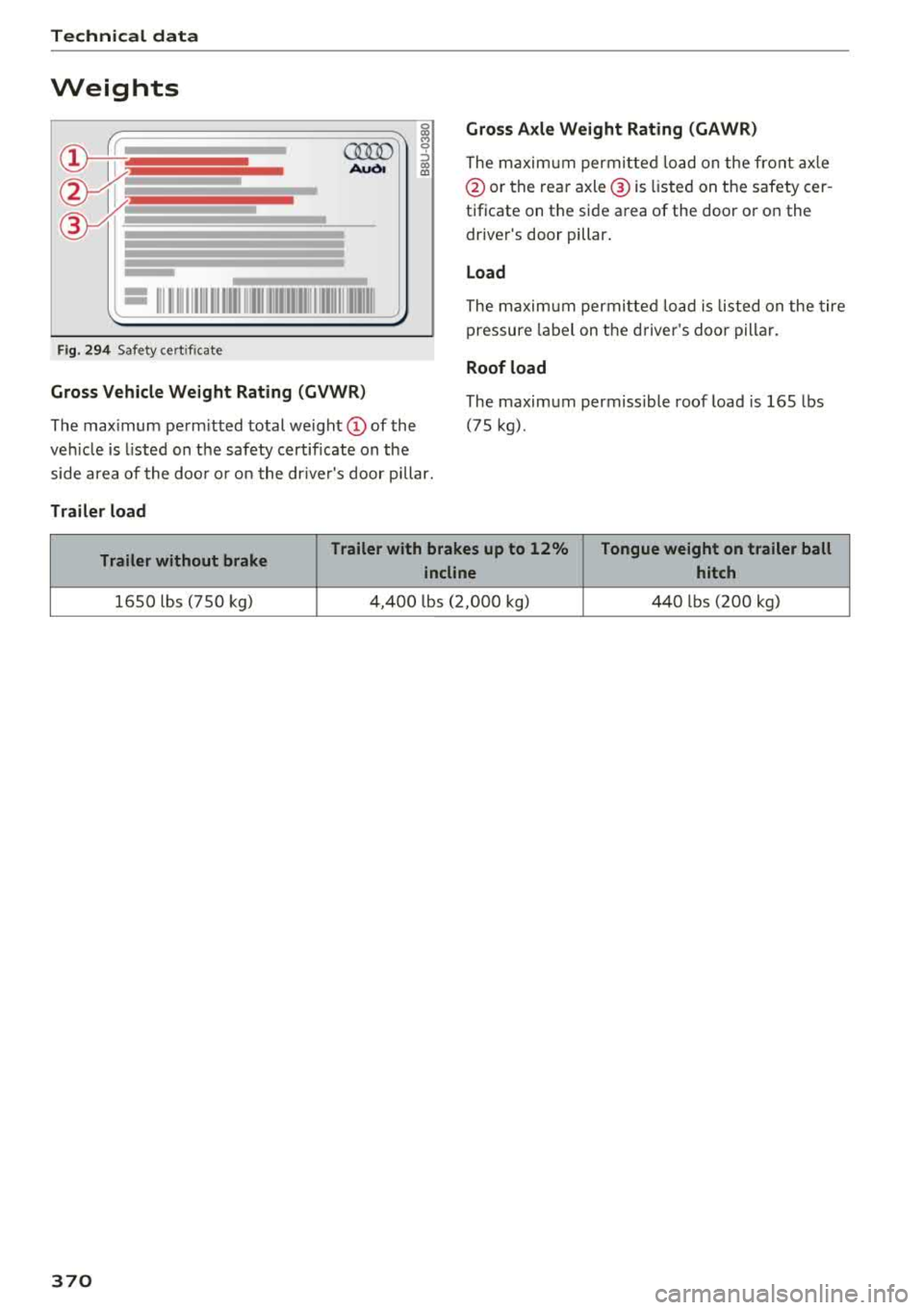
F ig . 294 Safety cert ificate
Gross Vehicle Weight Rating (GVWR )
The maximum pe rm itted total we ight (D of the
ve hicl e is listed on t he safety certificate on the
side area of the doo r or o n t he dr ive r's door p illar.
Trailer load Gross Axle Weight Rating
(GAWR)
The m axim um permi tte d l oad on the front ax le
@ or the rea r axle @ is listed on t he safety cer
tificate on t he side area of the doo r or on the
drive r's door pillar .
Load
The maxim um per mit te d loa d is lis ted on the tire
p ressure labe l on t he drive r's doo r pilla r.
Roof load
The maxim um permiss ible roof load is 165 lbs
(75 kg).
Trailer without brake Trailer with brakes up to 12% Tongue weight on trailer ball
incline hitch
1650 lbs (750 kg) 4,400 lbs ( 2,0 00 kg) 440 lbs (20 0 kg)
370
Page 374 of 392
Consum er Info rmation
today's automobi les, have steadi ly red uced the
scope of maintenance and repairs which can be
carried out by veh icle owners.
Al so , sa fet y and
en vironmental
concerns place very strict limits
on the nature of repairs and adjustments to en
g ine and transmission parts w hich an owner can
perform .
Maintenance, adjustments and repairs usually re
qu ire special tools, testing devices and other
equ ipment available to specially trained work
shop personnel in order to assure proper per
forma nce, re liab ility and safety of the ve hicle and
its many systems .
Improper maintenance, adjustments and repairs
can impair the operation and reliab il ity of your
ve hicle and eve n void your vehicle warra nty .
Therefo re, proof of se rvicing in accordance w ith
the m aintenance schedule may be a condition fo r
up hold ing a possible wa rranty claim made wi thin
the warranty pe riod.
Above all, ope rational safety can be adversely af
fected, c re ating unnecessa ry risks fo r you and
your passengers.
I f in doubt about any servicing, have it done by
your author ized Audi dealer or any other prope rly
eq uipped and qualified workshop . We strongly
urge yo u to g ive your author ized Audi dealer the
opportunity to perform a ll scheduled mainte
nance and necessary repairs. Your dealer has the
facilities, origina l parts and tra ined specialists to
keep your veh icle running properly.
Performing limit ed maint enanc e yourself
The fo llowing pages describe a limited number of
procedures whic h can be performed on your ve hi
cle with ordinary tools, should the need arise and
tra ined personnel be unava ilable. Before per
forming any of these procedures, always thor
ough ly read all of the app licab le text and carefu l
ly follow the instructions g iven . Always rigorously
observe the
W ARNINGS prov ided .
Befo re yo u check an ything in the engine com
partment , alway s read and h eed all WARNINGS
c> .&. and c> .&. in Working in the engine compart
ment on page 314 .
372
A WARNING
-Ser ious personal injury may occur as a result
of improperly performed maintenance, ad
justments or repairs .
- Always be extreme ly careful when work ing
on the vehicle . Always follow commonly ac
cepted safety practices and general com mon sense. Never r is k personal in jury.
- Do not attempt any of the maintenance,
checks or repairs described on the following pages if you are not fu lly fam il iar with these
or other procedu res with respect to the ve
hicle, or are uncertain how to proceed.
- Do not do any work wi thout the prope r tools
and eq uipmen t. H ave the necessary wo rk
done by your authorized Audi dealer or an
other properly equipped and qualified work
shop.
- The engine compartment of any motor vehi
cle is a potentially hazardous area . Never
reach into the area around or touch the radi
ator fan. It is temperature controlled and
can switch on suddenly - even when the en
gine is off and the ignition key has been re
moved. The rad iator fan switches on auto
mat ically when the coolant reaches a certain
temperature and will con tinue to run until
the coolant temperat ure drops.
- Always remove the igni tion key before any
one gets under the vehicle.
- Always support your vehicle with safety
stands if it is necessary to work underneath
the vehicle. The jack* s upplied w ith the vehi
cle is no t ad equate for th is pu rpose and
could collapse causing se rious personal in
jury .
- If you must work underneath the vehicle
with the wheels on the ground, always make
sure the vehicle is on level ground, that the
wheels a re always sec urely blocked and that
the engine cannot be started.
- Always make sure the transmission se lector
lever (automatic t ransm iss ion) is in P (Park
position) and the park b rake is applied .
Page 385 of 392
u co ..... N ,..._
N ..... 0 <( 0 00
Overview (Cockpit) . . . . . . . . . . . . . . . . . . . . . . 8
p
Pai nt damage . . . . . . . . . . . . . . . . . . . . . . . . 346
Paint number . . . . . . . . . . . . . . . . . . . . . . . . 369
Panorama g lass roof. . . . . . . . . . . . . . . . . . . . 42
Emergency operation . . . . . . . . . . . . . . . . . . 42
Parental control
DVD... .. .. ................. .. .. .. . 237
Park assist
Cleaning the sensors/camera . . . . . . . . . .
345
Parking aid . . . . . . . . . . . . . . . . . . . . . . . . . . 130
Parking brake
refer to Electromechanica l parking brake . 80
Parking lights . . . . . . . . . . . . . . . . . . . . . . . . . 45
Parking location
Audi connect vehicle control
Parking system
refer to Parking systems
Parking systems
198
131,133
Peripheral cameras . . . . . . . . . . . . . . . . . . 135
Rearview camera . . . . . . . . . . . . . . . . . . . . 133
Sett ings . . . . . . . . . . . . . . . . . . . . . . . . . . . 138
Trailer h itch . . . . . . . . . . . . . . . . . . . . . . . . 139
Partition net . . . . . . . . . . . . . . . . . . . . . . . . . . 64
Parts replacement . . . . . . . . . . . . . . . . . . . . 373
PASSENGER AIR BAG light . . . . . . . . . . . . . . 281
Pause (audio/video file) . . . . . . . . . . . . . . . . 234
Pedals . . . . . . . . . . . . . . . . . . . . . . . . . . . . . . 256
Personal route assistance
Phonebook 209
refer to
Contacts . . . . . . . . . . . . . . . . . . . . 183
Physical principles of a frontal collision . . . 262
Picture format (video) . . . . . . . . . . . . . . . . . 237
Pitch angle . . . . . . . . . . . . . . . . . . . . . . . . . . . 83
Playback (media) . . . . . . . . . . . . . . . . . . . . . 234
Playlist . . . . . . . . . . . . . . . . . . . . . . . . . . . . . 23 7
Point of interest . . . . . . . . . . . . . . . . . . . . . . 206
Point of interest search . . . . . . . . . . . . . . . . 207
also refer to
Point of interest . . . . . . . . . . 206
Polishing . . . . . . . . . . . . . . . . . . . . . . . . . . . . 346
Pollutant filter (automatic A/C system) . . . . 69
Power sources .. ............... 60, 232 , 233
Predictive efficiency assist . . . . . . . . . . . . . . 100
Index
Pregnant women
Special considerations when wearing a safe-
ty belt . . . . . . . . . . . . . . . . . . . . . . . . . . . . .
266
pre sense
refer to Aud i pre sense . . . . . . . . . . . . . . . 112
Presentation mode . . . . . . . . . . . . . . . . . . . . 212
Presets (radio) . . . . . . . . . . . . . . . . . . . . . . . 223
Pressure
Tire pressure monitoring system . . . . . . .
342
T ires . . . . . . . . . . . . . . . . . . . . . . . . . . . . . . 335
Program guide
Radio . . . . . . . . . . . . . . . . . . . . . . . . . . . . .
221
Programming buttons (multifunction steering
wheel) . . . . . . . . . . . . . . . . . . . . . . . . . . . . . . .
14
Proper occupant seating positions . . . . . . . 253
Proper safety belt position . . . . . . . . . . . . . . 265
Proper seating position
Front passenger . . . . . . . . . . . . . . . . . . . . .
254
Occupants. . . . . . . . . . . . . . . . . . . . . . . . . . 253
Rear passengers . . . . . . . . . . . . . . . . . . . . . 254
Prot ecting . . . . . . . . . . . . . . . . . . . . . . . . . . . 346
Q
quattro 144
Se lective wheel torque control . . . . . . . . . 140
Question
What happens to unbelted occupants?
262
R
Radio ....... ... .. .. ................ . 220
Additional station information . . . . . . . . . 222
Presets . . . . . . . . . . . . . . . . . . . . . . . . . . . . 223
Radio text . . . . . . . . . . . . . . . . . . . . . . . . . . 221
Station list . . . . . . . . . . . . . . . . . . . . . . . . . 220
Radio Standards Specification (RSS) . . . . . . 374
Rail carrier . . . . . . . . . . . . . . . . . . . . . . . . . . . 368
Rain/l ight sensor
Headlights . . . . . . . . . . . . . . . . . . . . . . . . . .
45
Interval mode (wipers) . . . . . . . . . . . . . . . . 51
Raising the vehicle . . . . . . . . . . . . . . . . . . . . 367
Random
refer to Shuffle . . . . . . . . . . . . . . . . . . . . . 23 7
Range (fuel level) . . . . . . . . . . . . . . . . . . . . . .
16
Reading lights . . . . . . . . . . . . . . . . . . . . . . . . . 48
Rear fog lights . . . . . . . . . . . . . . . . . . . . . . . . 45
383