engine AUDI Q7 2009 Owner´s Manual
[x] Cancel search | Manufacturer: AUDI, Model Year: 2009, Model line: Q7, Model: AUDI Q7 2009Pages: 426, PDF Size: 97.13 MB
Page 340 of 426
___ C_h_ e_ c_k _in --== g'-- a_n _d_ f_il _li _n ..:::g:::..- ___________________________________________ _
models; 60% for Canadian models). This mixture both assures the
necessary frost protection and protects metal components in the
engine's cooling system from corrosion and scaling. It also raises
the boiling point of the coolant.
Do not reduce the concentration of the coolant in the summer by
adding plain water.
Th e pro port io n of coo la nt additi ve mu st be at
lea st 50 % but n ot mor e th an 60 %
to maintai n ant ifreeze protection
and cooling efficiency. If the coolant frost protection is too low , the
coolant could free ze and damage the veh icle heating and engine
cooling system .
For year-round driving , antifreeze is added at the factory for temper
atures down to:
• -31 °F ( -35 °c1 usA
• - 40 °F ( - 40 °C) Canada.
You can mix the
Gl 2+ + coolant additive with other additives (G12+
or G12). Always check w ith your authorized Audi dealer.
& WARNING
B efo re you che ck anyt hing in th e eng ine compartmen t, alway s
re ad a nd he ed all WARN ING S~
& in " Working in the engine
c ompar tm ent " on
page 33 1.
0 Not e
• Before winter sets in, have the coolant checked to see if the
coo lant additive in your vehicle is sufficient to meet the climate
conditions. This is especia lly important if you live in a region where
the winter is extremely cold . If necessary, increase the proportion of
coolant additive to 60%.
• When adding coolan t additive to your coo ling system,
remember:
-We recommend using only coolant additive
G12+ + (check the
label) for your vehicle. This coolant additive is avai lable at autho
riz ed Audi dealers. Other types of antifreeze can significantly reduce corrosion protection. The resulting corrosion can cause a
loss of coolant and serious engine damage.
• Do not add any type of radiator leak sealant to your vehicle's
engine coolan t. Adding radiator repair fluid may adversely affect the
function and performance of your cooling system and could result
in damage not covered by your New Vehicle Limited Warranty. •
Checking the engine coolant level
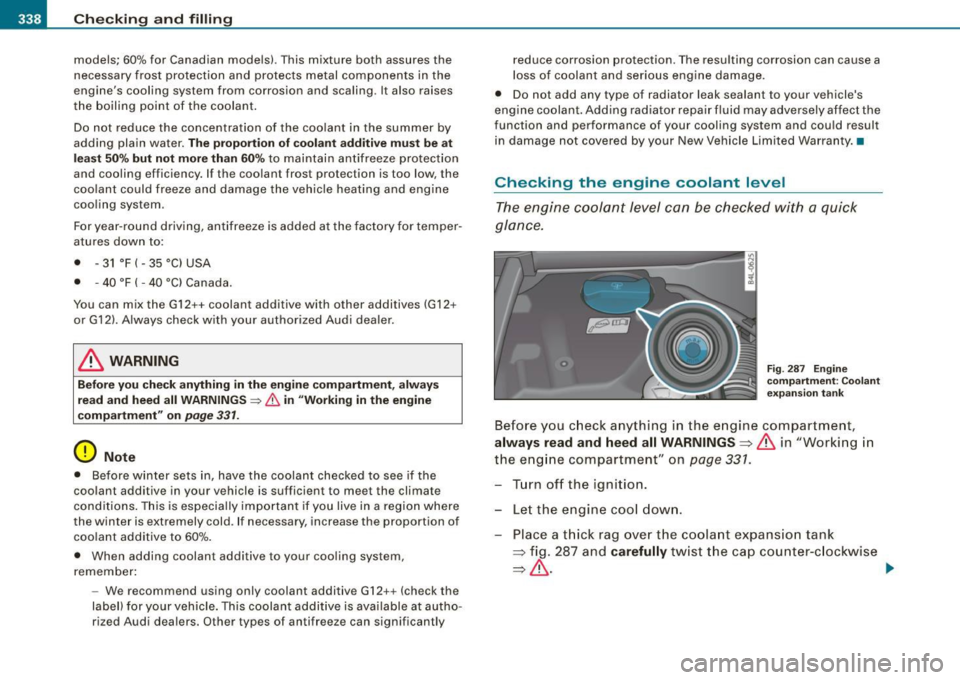
The engine coolant level can be checked with a quick
glance.
F ig . 287 E ngine
com partm ent : Cool ant
ex pans io n tank
Before you check anything in the engine compartment,
alw ays read and h eed all WARNINGS ~
& in "Working in
the eng ine compartment" on page 331.
- Turn off the ignition.
- Let the engine coo l dow n.
Place a thick rag over the coola nt expansio n tank
~ fig . 287 and carefully twist the cap counter-c lockwise
~ & - .,
Page 341 of 426
___________________________________________ C_ h_e _c_ k_ i_n _g _ a_n _d_ f_il _li _n _g __ lR
•
- Read the engine coolant level in the open coolant expan
sion tank :::::>
page 338, fig. 287. With a cold engine, the
coolant level should be between the "min" and "max"
markings. When the engine is warm, the level may be
slightly above the "max" marking.
The location of the coolant expansion tank can be seen in the
engine compartment illustration~
page 332.
To obtain an accurate reading, the engine must be switched off.
The expansion tank in your vehicle is equipped with an electric
coolant level sensor.
When the coolant level is too low, the warning light in the Auto
Check System~
page 33will blink until you add coolant and the
level has been restored to normal. Even though there is an electric
coolant level sensor, we still recommend you check the coolant level
from time to time .
Coolant loss
Coolant loss may indicate a leak in the cooling system . In the event
of coolant loss, the cooling system should be inspected immedi
ately by your authorized Audi dealer . It is not enough merely to add
coolant.
In a
sealed system, losses can occur only if the boiling point of the
coolant is exceeded as a result of overheating.
& WARNING
The cooling system is under pressure and can get very hot. Reduce
the risk of scalding from hot coolant by following these steps.
• Turn off the engine and allow it to cool down.
• Protect your face, hands and arms from escaping fluid and
steam by covering the cap with a large, thick rag.
& WARNING (continued)
• Turn the cap slowly and very carefully in a counter-clockwise
direction while applying light, downward pressure on the top of
the cap .
• To avoid being burned, do not spill antifreeze or coolant on the
exhaust system or hot engine parts. Under certain conditions, the
ethylene glycol in engine coolant can catch fire.
0 Note
Do not add any type of radiator leak sealant to your vehicle's engine
coolant. Adding radiator repair fluid may adversely affect the func
tion and performance of your cooling system and could result in
damage not covered by your New Vehicle Limited Warranty. •
Adding coolant
Be very careful when adding engine coolant.
Before you check anything in the engine compartment,
always read and heed all WARNINGS:::::> & in "Working in
the engine compartment" on
page 331.
- Turn off the engine.
Let the engine cool down.
Place a thick rag over the coolant expansion tank
=:> page 338, fig. 287 and carefully twist the cap counter
clockwise :::::>& .
Add coolant.
- Twist the cap on again
tightly.
Replacement engine coolant must conform to exact specifications
~ page 337, "Coolant". Even in an emergency, if coolant additive .,,
Vehicle care I t •
Page 342 of 426
-~_C_ h_e _c _ k_ i_n ...:::g::;...._ a_n_ d_ f_ i_ll _in -'g:::;.._ ___________________________________________ _
G12+ +, G12 + or G12 is not available, do not use a different addit ive .
Use p lain water ins tead until you ca n get the c orrec t additive and
can restore the correct ratio . This should be done as soon as
poss ible.
If you have los t a considerable amount o f coo lant, then you s hould
add co ld antifreeze and cold water only when the engine is cold .
A lways us e
new en gi ne c oolant when refi llin g .
Do not fi ll coo lant above the "MAX" mark. Excess coolant wil l be
forced out through the pressure relief valve in the cap when the
engine beco mes hot.
& WARNING
• The cooling sy stem is under pressure and can get very hot .
Reduce the risk of s calding from hot coolant by following these
steps .
- Turn off the engine and allow it to cool down.
- Protect your face, hands and arms from escaping fluid and
steam by covering the cap with a large, thick rag .
- Turn the cap slowly and very carefully in a counter -clockwise
dire ction while applying light , downward pressure on the top
of the cap .
- To avoid being burned , do not spill antifreeze or coolant on
the exhaust system or hot engine parts . Under certain condi
tions , the ethylene glycol in engine coolant can catch fire.
• Antifreeze is po isonous . Always store antifreeze in its original
container and well out of the reach of children.
• If you drain the coolant , it must be caught and safely stored in
a proper container clearly marked "poison ".
0 Note
• Coo lant po llutes t he e nviro nment and cou ld cause a n en gin e
fire. Excess coolant wi ll be forced out through the pressure re lief
va lve in the cap when the eng ine becomes hot.
• I f, in an emergency, on ly wate r can be added, the correct ratio
between wate r and ant ifree ze::::>
page 337 must be restored as soon
as possib le .
W For the sake of the environment
Drained coolant should not be reused. Always dispose of used
coo la nt whi le observ ing all env iro nmen tal reg ulat io n s. •
Radiator fan
The radiato r fan switches on au toma tic ally by i tself.
The radiator fa n is dr iven by the eng ine via th e V -belt. The visco us
clutch regulates the speed of the fan according to the temperature
o f t he coo la nt.
An auxiliary electric radiator fan * sw itches on and off depending on
coo la nt t empe rat ure a nd othe r vehic le operating c ondi tio ns.
A ft er you sw itch the e ngine o ff, the au xiliary fa n ca n conti nue
running for up to 10 m inutes- even with the ignition off. It can even
switch o n again lat er by itsel f::::> & , if
• the temperature of the eng ine coo lant rises due to the heat
bu ild -up from the eng ine in the eng ine compartment, or
• the engine compartment heats up because the vehic le is parked
in i ntense sun ligh t.
& WARNING
• To reduce the ri sk of personal injury never touch the radiator
fan .
~
Page 343 of 426
_____________________________________________ C_h_ e_ c _ k_in -= g_a _ n_d _ f_il _li _n ..;::g =-- ____.•
& WA RNING ! continued )
• The auxiliary ele ctric fan is temperature controlled and can
s w itch on suddenly even wh en t he engine is not runn ing .
• The auxiliary radiator fan swit ches on automatic ally when the
engin e coolant rea che s a cer tain temperature and will con tinue to
run until the coolant temperature drop s. •
Brake f luid
Checking brake fluid level
The brake fluid level c an be checke d with a quick gl ance .
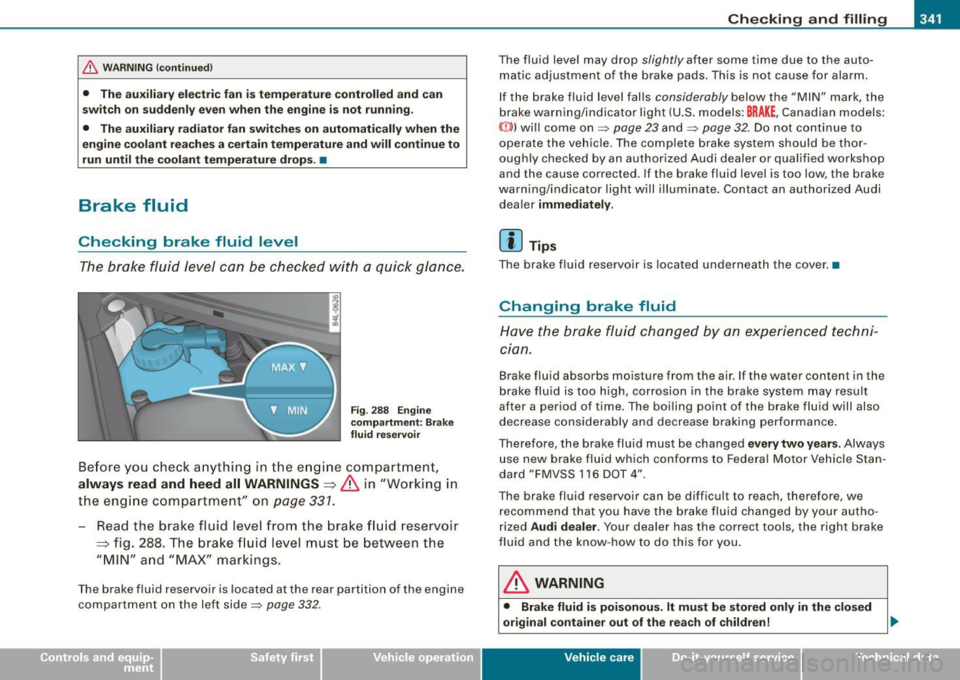
Fig. 288 E ngine
comp artm ent: B ra ke
flui d rese rvoir
Be fore you check a nything in th e en g in e co mpart ment,
always read and heed all WARNINGS=> & in "Working in
t h e eng ine compartment" on
page 331.
- Read the brake fluid l eve l from the brake fluid reservoir
=> fig. 288. The brake flu id level mus t be between the
"MIN" and "MAX" markings.
The brake fluid reservoir is locate d at the rear partition of the engine
compartment on the left side=>
page 332.
The fluid level may drop slightly after some time due to the auto
ma tic adjustment of the brake pads. This is not cause for alarm .
If the brake fluid leve l falls
considerably below the "MIN" mark , the
brake warning/indicator light (U.S. models:
BRAKE , Canadian models:
«D> l will come on=>
page 23 and=> page 32 . Do not continue to
operate the vehicle. The complete brake system should be thor
oughly checked
by an author ized Audi dealer or qua lif ied workshop
and the cause corrected . If th e brake fluid level is too low, the brake
warning/indicator light w ill illumi nate. Contact an authorized Audi
dea ler
immedi ately .
[ i ] Tips
The brake fluid reservoir is located underneath the cover .•
Changing brake fluid
Have the brake fluid changed by an experience d techni
cian.
Brak e fluid absorbs mois ture from the air. If the wate r conten t in the
brake fluid is too high, corrosion in the brake sys tem may res ult
after a period of time . The boiling point of the brake fluid will also
decrease conside rably and decrease braking performance .
Therefore , the brake fluid mus t be changed
every two year s. Always
use new brake fluid which conforms to Federal Motor Vehicle S tan
da rd "FMVSS 116 DOT 4".
The brake fluid reservoir can be difficul t to reach, therefore , we
recommend that y ou have the brake fluid changed by your autho
rized
Audi deal er. Your dealer has the correct tools, the right brake
fluid and the know -how to do this for you .
& WARNING
• Brak e fluid is poi sonou s. It mu st be stored only in the clo sed
o riginal conta iner out of the rea ch of children! ..,.
Vehicle care I I irechnical data
Page 344 of 426
-~_C_ h_e _c _ k_ i_n ...:::g::;...._ a_n_ d_ f_ i_ll _in -'g:::;.._ ___________________________________________ _
& WARN ING (c o ntinued )
• Brake failure can re sult from old or inappr opriate brake fluid .
Ob serve the se precautio ns:
- Use only brake fluid that meets SAE specific ation J 1703 and
c onform s to Fed era l Moto r Vehi cle St anda rd 116. Al ways c heck
with your authori zed Audi dealer to make sure you are u sin g
the corre ct brake fluid. The correct typ e of brake fluid i s also
indicated o n the brake fluid reser vo ir .
- The br ake flu id mu st be ne w. Heavy u se of the brake s can
c au se a vapor lock if the brake fluid i s left in the s ystem too
long. Thi s can seriou sly affect the effi cien cy of the brake s as
w ell a s your safet y. Thi s could re sult in an acci dent .
0 Note
Brake fluid will damage the paint of your vehicle .
For the sake of the environment
Because of the problem of proper disposal of brake fluid as well as
the special too ls required and the necessa ry expertise, we recom
mend that you have the brake fluid changed by your authorized Audi
dea ler .•
Battery
General information
Under normal operating condi tions, the battery in your Audi does
not need any maintenance. With
high outside temperatures or long
daily drives we recommend that you have the e lectrolyte level
checked by an au thorized Audi dealer or qualified workshop . The
e lectrolyte level should also be ch ecked each time the battery is
charged ~
page 344.
Have the battery checked when you take your vehicle in for service .
Yo u are well advised to replace a battery that is o lder than 5 years .
With certain types of airbag dep loyment, the battery is discon
nected from the vehicle electrical system for safety reasons~
& in
"Repair, care and disposal of the airbags" on
page 255.
Disconnecti ng th e batt ery termin als
Some vehicle functions (power window regulators , for example) are
lost if the battery termina ls are disconnected. These functions have
to be relearned after the battery terminals are connected again . To
prevent this, the battery should only be disconnected from the
vehic le electrical sys tem when abso lutely necessary for repairs .
Vehicles not driven for long per iods
If you do not drive your vehicle ove r a period of several days or
weeks, electrical components are gradually cut back or switched off .
T his reduces energy consumption and maintains starting capab ility
over a longer period
~ page 295 .
Take i nto consideration that whe n you u nlock your vehicle, some
convenience functions, such as the master key remote function or
powe r seat adjustme nt, may not be ava ilable. The convenience
functions will be available again when you turn on the ignition and
start the engine .
Wint er op erati on
Duri ng the winter mont hs, batte ry capacity tends to decrease as
temperatures drop . This is because more power is also consumed
whi le star tin g, and the headlights, rear window defogger, etc ., are
used more often.
Avoid unnecessary power consumption, particular ly in city traffic or
when trave li n g o nly short dis tances . Let your authorized Audi dea ler
check the capacity of the vehicle battery before winter sets in
~ page 344. A we ll cha rged battery w ill not only preven t starting
problems when the weather is cold, but will also last longer . ..,_
Page 346 of 426
•---=C:.:h..:. e=-= c..:.k :..:.in :..:.:= g:.....= a..:.n :.:d::....:. f.:.:il .:.:li ..:.n :..::g~ --------------------------------------------
& WARNING (continued )
battery to heat up very quickly, wh ich could lead to damage or
explosion and personal injury .
• When a battery is charged , it produces h ydrogen gas which i s
explosive and could cau se personal injury .
• Always keep the battery well out of the reach of children.
• Before work is done on the electrical system , disconnect the
negative ground cable .
• Before performing any work on the ele ctri cal system , switch off
the engine and ignition as well as any electrical equipment. The negative cable on the battery m ust be disconnected . If you are ju st
going to replace a light bulb , then it is enough to switch off the
lights .
• Before disconnecting the battery , switch off the anti -theft
alarm system! Otherwise you will set off the alarm .
• When disconne cting the battery , first disconnect the negative
c able and then the positive cable .
• Before reconnecting the battery , make sure all electrical
c onsumers are swit ched off . Reconnect the positive cable first and
then the negative cable. Never interchange the cables - this could start a fire !
• Never charge a frozen or a thawed -out battery. It could
explode! If a battery has frozen , then it must be replaced . A
discharged battery can freeze over at 32 °F (0 °Cl.
• Make sure the vent hose is always attached to the opening on
the side of the battery.
• Never use batteries whi ch are damaged . There is the danger of
an explosion! Always replace a damaged battery.
& WARNING
Californ ia Proposition 65 W arning :
& WARNING (continued )
• Battery posts, terminals and related accessories contain lead
and lead compounds, chemicals known to the State of California
to cause can cer and reproductive problems . Wash hands after
handling .
0 Note
• Do not disconnect t he veh icle battery w he n th e ign itio n is
switched on or when the engine is running , otherwise, you will
damage e le ctronic co mponents in the elec trical sys tem.
• I f your vehicle i s going to stand for a long period of time without
b ei ng dr iven, prot ec t the batte ry from "fr ee zing", otherwise it will
be damaged and will then have to be rep laced. •
Battery charging
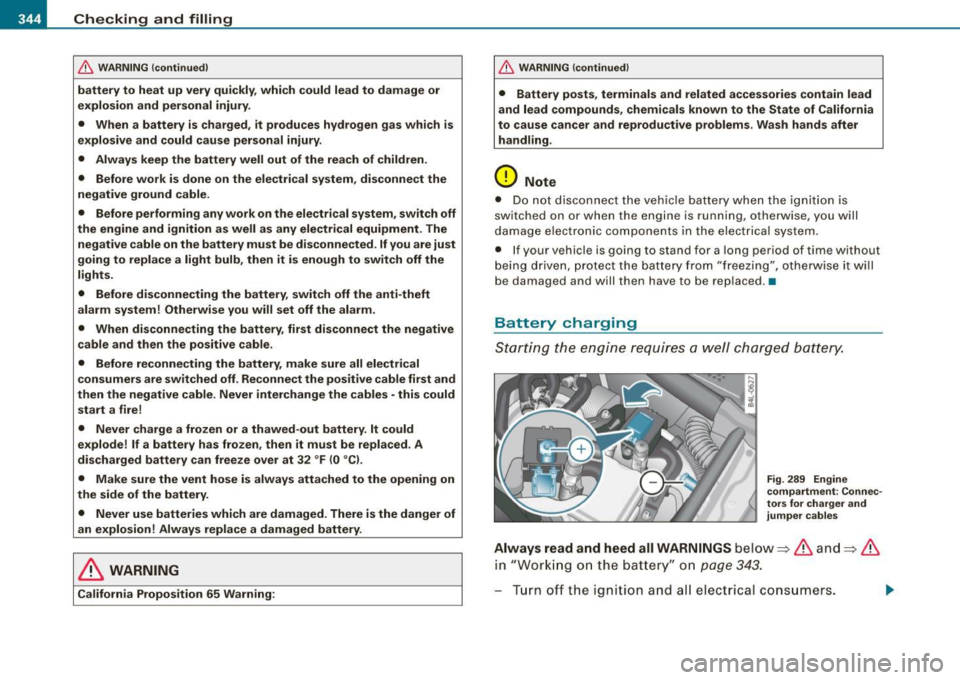
Sta rti ng th e e ngin e req uires a well c harged ba tte ry.
F ig . 289 Engine
compartment : Conne c
tors fo r charge r and
jumper cable s
Always read and heed all WARNINGS be low ~ & and::::} &
in "W orkin g on the b atte ry" on pa ge 34 3.
- Tur n off the ig ni tio n a nd a ll elec tric al co nsum ers.
Page 347 of 426
___________________________________________ C_ h_e _c_ k_ i_n _g _ a_n _d_ f_il _li _n _g __ _
•
-Make sure the area is well ventilated when you charge
the battery.
- Open the hood
::::> page 330.
-Open the red cover on the positive pole ::::> fig. 289.
- Connect the charger connectors according to the instruc-
tions to the
jump start bolts. (Bolts under the red cover=
"positive", Bolts with hex head = "negative").
- Only now plug the mains lead for the charging equip
ment into the wall outlet and turn it on
::::> &.
- Make sure the charging rate is not over 30 amps/14.8
Volt.
- When the battery is fully charged: Turn the charging
equipment off and remove the mains lead from the wall
outlet.
- Now remove the clamps for the charging equipment.
- Close the red cover on the positive pole.
- Close the hood=>
page 331.
A discharged battery can freeze at temperatures of only O °C. Allow
a frozen battery to thaw completely before attempting to charge it
~ & .However, we recommend not using a thawed battery again
because the battery casing can be cracked due to ice formation and
can leak battery acid.
Battery charging (Maximum charging rate of 30
amps/14.8 Volt)
When charging at /ow voltages (e.g. with a trickle charger), the
battery cables do not have to be disconnected first. The battery caps
should
not be opened when charging a battery.
It is not necessary to remove the battery from the luggage compart
ment.
Fast charging the battery (charging rate above 14 .8
Volts)
For technical reasons do not use a battery charger that uses voltage
greater than 14.8 Volts to charge your vehicle's battery.
& WARNING
Charging a battery can be dangerous.
• Always follow the operating instructions provided by the
battery charger manufacturer when charging your battery.
• Never charge a frozen battery. It may explode because of gas
trapped in the ice. Allow a frozen battery to thaw out first.
• Do not reuse batteries which were frozen. The battery housing
may have cracked and weakened when the battery froze.
• Charge the battery in a well ventilated area. Keep away from
open flame or electrical spark . Do not smoke. Hydrogen gas gener
ated by the battery is explosive.
• To reduce the danger of explosion, never connect or disconnect
charger cables while the charger is operating.
• Fast charging a battery is dangerous and should only be
attempted by a competent technician with the proper equipment.
• Battery acid that may spill during charging should be washed
off with a solution of warm water and baking soda to neutralize
the acid .
0 Note
Never use a fast charger as a booster to start the engine. This will
seriously damage sensitive electronic components, such as control
units, relays, radio, etc ., as well as the battery charger. •
Vehicle care I t •
Page 348 of 426
llftl __ C _h_ e_ c_k _in --== g'-- a_n _d_ f_il _li _n ..:::g:::..- ___________________________________________ _
Battery replacement
The new battery must have the same specffications and
dimensi ons as the original equipment battery.
Intel ligen t energy management in your vehicle is responsible for
distributing the e lectrica l ene rgy throughout your vehicle
::} page 295. The intelligent energy management system will keep
the engine battery charged bette r then vehicles wi thou t this system .
To make sure the additional electrical energy is available once again
after you have changed the batte ry, we recommend that you install
batteries of the same type and manufacture only (the same as those
installed at the time your vehicle was delivered). Specifications are
listed on the battery housing . Your authorized Audi dealer will then
code the battery management cont rol unit .
If i t is no t possib le to use a ba ttery o f this type, the new battery m ust
have the same capacity, vo ltage (12 volts), amperage, construction
and plug seal ing.
When installing the battery, make sure the ignition and all electrica l
consumers are turned off .
0 Note
Make sure the ventilation hose on the side of the bat tery is
connected, otherwise fumes or battery acid can leak out .
W For the sake of the environment
Because of the problem of proper d isposal of a battery , we recom
mend your authorized Aud i dea ler change the battery for you .
Ba tteries contain sulfuric acid a nd lead and must always be
disposed of properly in compliance with all environmental regula
tions. D isposi ng o f vehicle ba tteries i mproper ly is very dangerous to
the environment .•
Windshield/headlight washer
container
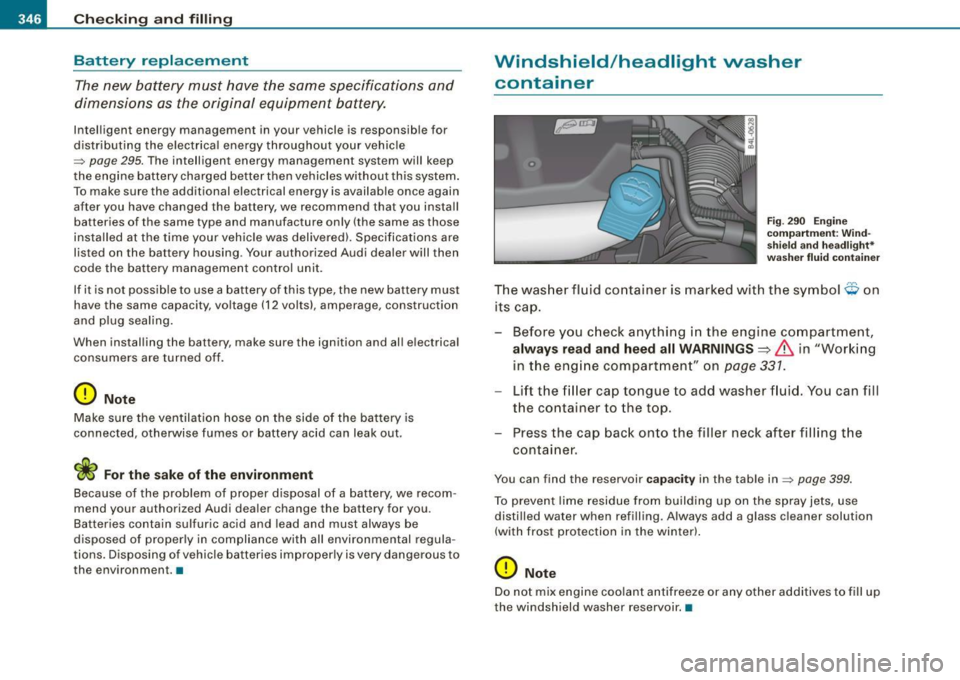
Fi g. 290 Engine
co mpartment : Wind
s hield and h eadli ght *
washer fluid container
T he w as her fluid co ntainer is m arke d with the sy mbol ¢' on
its cap .
- Before you c heck anything in the engine compartment,
always read and heed all WARNINGS~
& in "Wor kin g
in t he en gine comp artmen t" on
page 33 7.
- Lift the fi ller cap tongue to add washer fluid. You can fill
the containe r to the top.
- Press the cap bac k on to the filler neck after fi lling t he
contai ner .
You can find the reservoir capa city in the tab le in ::} page 399.
To prevent lim e residue from building up on the sp ray je ts, use
distilled water when refilling . Always add a glass cleaner solution
(with fr ost protection in the winter).
0 Note
Do no t mix engine coo lant antifreeze or any o ther additives to fill up
the windshield washer reservoir. •
Page 372 of 426
lllffll.___W_ h_ a_t _d_ o_ l _d _o_ n_ o_ vv_ ? ______________________________________________ _
What do I do now?
Jack, tools and inflatable spare tire
Jack and folding chocks
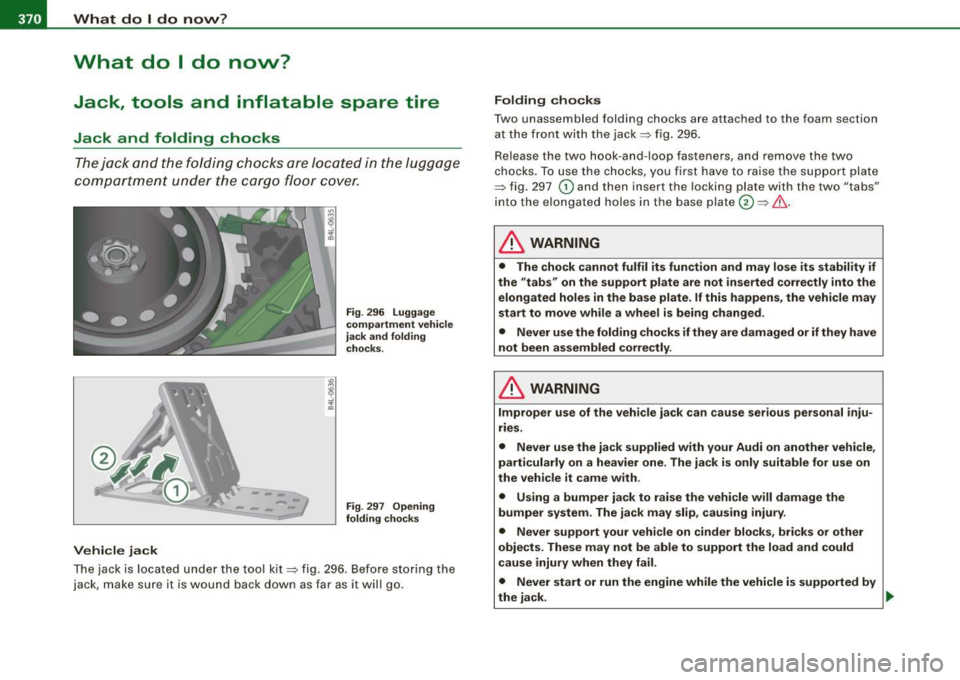
The jack and the folding chocks are located in the lug gage
comp artmen t under t he ca rgo floor co ver.
Vehicle jack
Fig . 296 Luggage
comp artment v ehi cle
jack and fold ing
c ho ck s.
Fig . 2 97 Opening
fold ing ch ocks
The jac k is located under the too l kit:::;, fig. 296 . B efore sto ring the
jack, ma ke su re it is wo und back down as fa r as it w il l go.
Folding chocks
Two unassembled fold ing chocks a re attached to the foam section
at the fron t w ith th e jack :::;, fig. 296 .
Release the two hook -and -loop fasteners, and remove the two
chocks . To use the chock s, you fi rst ha ve to raise the sup port pla te
:::;, fig. 297
G) and then insert the locking plate with the two "tabs"
into the e longated holes in the base plate@:::;,& .
& WARNING
• The chock cannot fulfil its fun ction and may lose its stability if
the "tabs " on the support plate are not inserted corre ctly into the
elongated holes in the base plate. If this happens , the vehicle may
sta rt to move while a wheel is being changed .
• Never u se the folding chocks if they are damaged or if they have
not been assembled co rre ctly .
& WARNING
Improper use of the vehi cle jack can cause serious pe rsonal inju
rie s.
• Never use the jack supplied with your Audi on another vehicle,
particularly on a heavier one. The jack is only suitable for use on
the veh icle it came with .
• Using a bumper jack to raise the veh icle will damage the
bumper system . The jack may slip , caus ing injury .
• Never support your vehicle on cinder blocks , bricks or other
objects. These may not be able to support the load and could
cause injury when they fail.
• Never start or run the engine while the vehicle is supported by
the jack .
~
Page 375 of 426
What do I do now? -
---------------~.;______
•
& WARNING (continued)
• Loose items in the passenger compartment can cause serious
personal injury during hard braking or in an accident .
- Never store the inflatable spare tire or jack and tools in the
passenger compartment.
- Always store all jacking equipment, tools, and the inflatable
spare tire in the luggage compartment.
- Tighten the knurled retaining screw for the inflatable spare
tire securely.
0 Note
• Th e inflatable spare tire has been developed specifically for this
vehicle model. It must not be exchanged or used for other vehicle
models. Similarly, inflatable tires from other vehicle models must
not be used.
• Normal summer or winter tires must not be installed on the
inflatable tire rim.•
Changing a wheel
Before changing a wheel
Observe the following precautions for your own and your
passenger's safety when changing a wheel.
-After you experience a tire failure, pull the car well away
from moving traffic and try to reach
level ground before
you stop => & .
- All passengers should
leave the car and move to a safe
location (for instance, behind the guardrail)=> &.
- Engage the
parking brake to prevent your vehicle from
rolling unintentionally=> &. -
Move
selector lever to position P =:> & .
- If you are towing a trailer: unhitch the trailer from your
vehicle.
- Block the diagonally opposite wheel with the folding
chocks or other objects.
- Take the
jack and the inflatable spare tire out of the
luggage compartment=>
page 370.
& WARNING
You or your passengers could be injured while changing a wheel if
you do not follow these safety precautions:
• If you have a flat tire, move a safe distance off the road. Turn off
the engine, turn the emergency flashers on and use other warning
devices to alert other motorists.
• Make sure that passengers wait in a safe place away from the
vehicle and well away from the road and traffic.
• To help prevent the vehicle from moving suddenly and possibly
slipping off the jack , always fully set the parking brake and block
the wheel diagonally opposite the wheel being changed with the
folding chocks or other objects. When one front wheel is lifted off
the ground, placing the Automatic Transmission in "P" (Park) will
not prevent the vehicle from moving.
• Before you change a wheel, be sure the ground is level and firm .
If necessary, use a sturdy board under the jack.
• After installing the inflatable spare tire, make sure that you
replace the flat tire/wheel in its storage area properly and tighten
the knurled retaining screw securely. •
Do-it -yourself service