warning AUDI Q7 2009 Owner´s Manual
[x] Cancel search | Manufacturer: AUDI, Model Year: 2009, Model line: Q7, Model: AUDI Q7 2009Pages: 426, PDF Size: 97.13 MB
Page 259 of 426
possible that an airbag will not deploy at a seating position where
the safety belt is being used but will inflate at the position where the
safety belt is not being used . It is important that nothing interfere
with the safety belt buckles so that the sensors can send the correct
information about safety belt use to the electronic control unit .
& WARNING
Changing the vehicle's suspension including use of unapproved
tire -rim combinations can change Advanced Airbag performance
and increase the risk of serious personal injury in a crash.
• Never install suspension components that do not have the
same performance characteristics as the components originally
installed on your vehicle.
• Never use tire-rim combinations that have not been approved
by Audi.
& WARNING
Items stored between the safety belt buckle and the center
console can cause the sensors in the buckle to send the wrong
information to the electronic control module and prevent the
Advanced Airbag System from working properly.
• Always make sure that nothing can interfere with the safety
belt buckles and that they are not obstructed.
as Perchlorate Material -special handling may apply, see
www.dtsc .ca.gov/ha zardouswaste/perchlorat e. When the vehicle or
parts of the restraint system including airbag modules and safety
belts with pretensioners are scrapped, all applicable laws and regu
lations must be observed. Your authorized Audi dealer is familiar
with these requiremen ts and we recommend that you have your
dealer perform this service for you.•
Safety first
Side airbags
Description of side airbags Airbag
system
The airbag system
can provide supplemental protection
to properly restrained occupants.
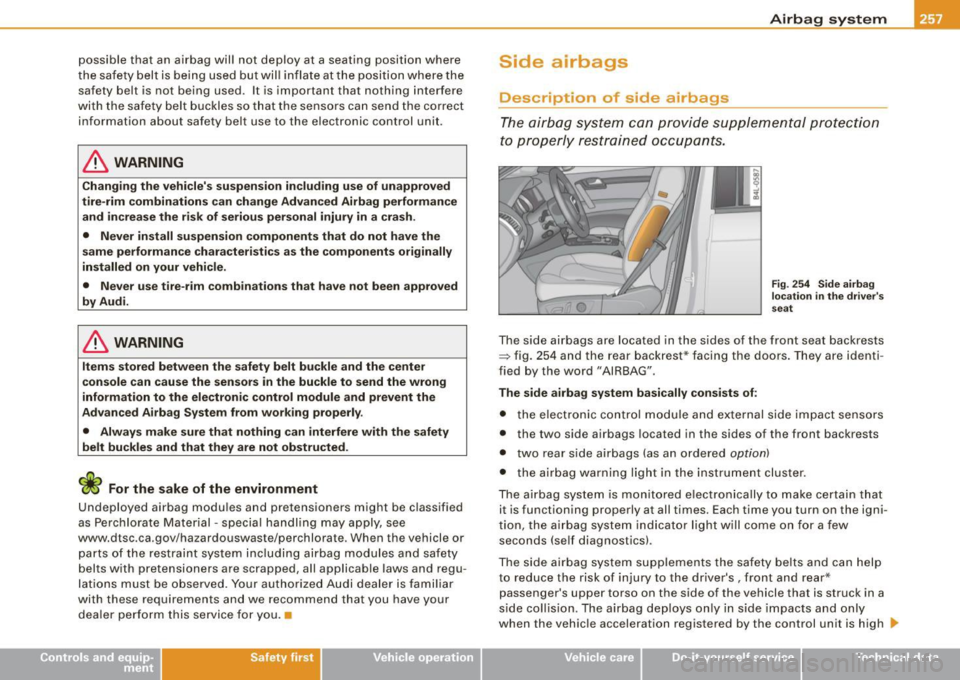
Fig . 254 Side airbag
location in the driver's
sea t
The side airbags are located in the sides of the front seat backrests
~ fig. 254 and the rear backrest * facing the doors . They are identi
fied by the word "AIRBAG" .
The side airbag system basically consists of:
• the electronic control module and external side i mpact sensors
• the two side airbags located in the sides of the front backrests
• two rear side airbags (as an ordered
option)
• the airbag warning light in the instrument cluster.
The airbag system is mon itored e lectronica lly to make certain that
it is functioning prop erly at all times. Each time you turn on the igni
tion, the airbag system indicator light will come on for a few
seconds (se lf diagnostics) .
The side airbag system supplements the safety belts and can help
to reduce the risk of injury to the driver's , front and rea r*
passenger's upper torso on the side of the vehicle that is struck in a
s ide collision . The airbag dep loys on ly in side impacts and only
when the vehicle acceleration registered by the control unit is high
~
Vehicle care I I irechnical data
Page 260 of 426
___ A_ ir_b _a_ g;:::;_ s--:.. y_s _t _e _m _________________________________________________ _
enough. If this rate is below the reference value programmed into
t he control unit, the side airbags will not be triggered, even though
the car may be badly damaged as a result of the collision . It is not
possible to define an airbag triggering range that wi ll cover every
possible angle of impact, since the circumstances will vary consid
erably between one collision and another . Important factors
include, for example, the nature (hard or soft) of the impacting
object, the angle of impact, vehicle speed, etc.=>
page 259, "Impor
tant safety instructions on the side airbag system".
Aside from their normal safety function, safety belts work to help keep the driver or front passenger in position in the event of a side
collision so that the side airbags can provide protection .
The airbag system is
not a substitute for your safety belt . Rather, it
is part of the overa ll occupant restraint system in your vehicle .
Always remember that the side airbag system can on ly help to
protect you if you are wearing your safety be lt and wearing it prop
erly . This is another reason why you should always wear your safety
belts, not just because the law requires you to do so=>
page 231,
"General notes" .
It is important to remember that while the supplemental side airbag
system is designed to reduce the likelihood of serious injuries, other
injuries, for example, swel ling, bruising, and minor abrasions can
a lso be associated with deployed s ide airbags. Remember too, side
airbags wil l deploy only once and only in certain kinds of accidents
- your safety belts are always there to offer protection.
Vehicle damage, repair costs or even the lack of vehicle damage are not necessari ly an indication of over -sensitive or failed airbag acti
vation. In some collisions , both front and side airbags may inflate.
Remember too, that airbags will deploy only once and only in
certain kinds of collis ions - your safety belts are always there to
offer protection in those accidents in which airbags are not
supposed to deploy or when they have already dep loyed.
The sid e a irba g sy stem w ill not deploy :
• when the ignition is turned off •
in side collisions when the acceleration measured by the sensor
is too low
• in front -end collisions
• in rear-end co llisions
• in ro llovers .
In some types of accidents the front airbags, side curtain airbags
and side airbags may be triggered together .
& WARNING
• Safety b elt s and the airb ag sy ste m will only prov id e pr ote ction
whe n occ upant s are in the prop er se ating po sit io n
=> pag e 259.
• If the airb ag indic ator light come s on w hen the v ehicl e is bei ng
u sed , h av e the syste m inspe cte d immedi ate ly by y our authoriz ed
Audi de aler . Th e ai rbag m ay not w ork properly when the vehicle
a ccel erat ion in a side collision is high e nough to ac tivate th e
a ir bag .•
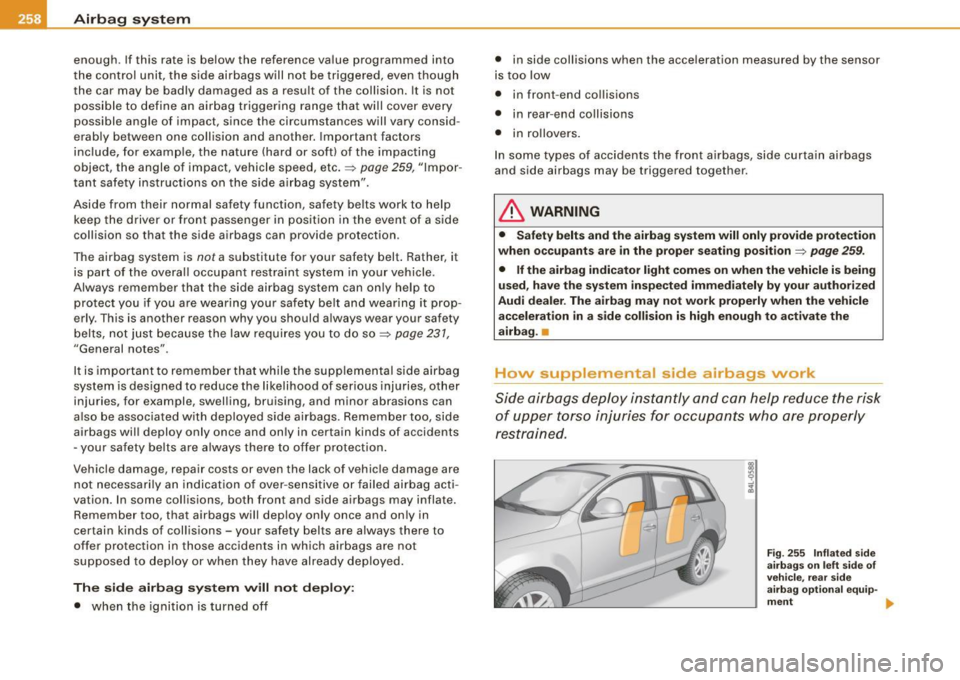
Hovv supplemental side airbags vvork
Side airbags deploy instantly and can help reduce the risk of upper torso injuries for occupants who are properly
restrained.
F ig . 255 Inf late d sid e
a ir bags o n left side of
v ehi cle, rea r si de
a ir bag opti on al eq uip-
m ent .,
Page 261 of 426

__________________________________________________ A_ i_ r _b _a...; g::- s_ y=--- s_t _e _m __ lJ!III
When the system is triggered , the airbag is f ill ed with propel lant gas
and br eaks t hroug h a seam in the seat surface area marked
" AIRBAG ". It expands between the side trim panel and the
passenger . In order to he lp provide this additional protection, the
side airbag must inflate within a frac tion of a second at very high
speed and w ith great force . The supplemental side airbag could
injure you i f your seating position is not proper or upright or i f items
are located in the area where the supplemental side airbag expands .
This app lies especia lly to children ~ page 263 , "Child Safety".
Suppl em ental sid e airbags inflate betw een the occupant and the
door panel on the s ide of the veh ic le that is struck in certain side
collision
~ page 258, fig. 255 .
A lthough they are not a soft pi llow, they can "cus hion" the impact
and in this way they can he lp to reduce the risk of injury to the upper
part of the body.
A fine dust may develop when the airbag deploys. This is normal and does not m ean there is a fire in the vehicle . •
Important safety instructions on the side
airbag system
Airbags are only supplemental restraints . Always prop
erly wear safety belts and ride in a proper seating posi
tion .
There is a lo t t ha t you and you r passengers mus t know a nd act
according ly to he lp th e sa fety belts and airbags do th eir job to
prov ide supp lemental pro tec tion .
& WARNING
An inflating side airbag can cause seriou s or fatal injury. Improp
erly wearing safety belts and improper seating posit ions increa se
the ri sk of serious personal injury and death whenever a vehicle is
being u sed .
Controls and equip ment Safety first
Vehicle operation
& WAR N ING (continued )
• In order to redu ce the risk of injury when the supplement al s ide
airbag infl ates :
- Alway s sit in an upright position and never lean against the
a rea where the supplement al s ide airbag is lo cated .
- Never let a child or anyone else rest their head against the
side t rim panel i n the area where the supplemental side airb ag
inflates.
- Always make sure that safety belts are worn corre ctly ,
- Do not let anyone sitting in the front seat put their hand or
any other parts of their bod y out of the window.
• Alway s make sure that the side airbag can inflate without inter
ference .
- Ne ver in stall se at cover s or repla cement upholste ry o ver the
front seat back s that have not been specifically approved by
Audi .
- Never use additional seat cushion s that cover the areas
where the side airbag s deploy .
- Dama ge to the original seat covers or to the seam in the a rea
of the side airb ag module must always be repaired immedi
ately by an authori zed Audi dealer .
• Obje cts bet ween you and the airbag can in crease the ri sk of
injury in an accident by interfering wi th the way the a irbag unfolds
or by be ing pu shed int o yo u as the airb ag inflat es.
- Never place or atta ch acce ssorie s or other object s (such as
c up holders , telephone bra ckets , or even lar ge, bul ky obje cts )
on the doors , over or near the area marked "AIRBAG" on the
se at backre sts .
- Su ch ob ject s and acces sories can be come dangerou s projec
tile s and cau se injury when the supplemental side airbag
deploys. _.
Vehicle care Do-it-yourself service Technical data
Page 262 of 426
___ A_ ir_b _a_ g;:::;_ s--:.. y_s _t _e _m _________________________________________________ _
& WARNING (continued)
-Never carry any objects or pets in the deployment space
between them and the airbags or allow children or other
passengers to travel in this position .
• Always use the built-in coat hooks only for lightweight
clothing. Never leave any heavy or sharp-edged objects in the
pockets that may interfere with side airbag deployment and can
cause personal injury in an accident .
• Always prevent the side airbags from being damaged by heavy
objects knocking against or hitting the sides of the seatbacks.
• The airbag system can only be triggered once . If the airbag has
been triggered, the system must be replaced by an authorized
Audi dealership .
• Damage (cracks, deep scratches etc.) to the original seat covers
or to the seam in the area of the side airbag module must always
be repaired immediately by an authorized Audi dealer.
• If chi ldren are seated improperly, their risk of injury increases
in the case of an accident:::::,
page 263, "Child Safety".
• Never attempt to modify any components of the airbag system
in any way.
• In a side collision , side airbags will not function properly if
sensors cannot correctly measure increasing air pressure inside
the doors when air escapes through larger, unclosed openings in
the door panel.
-Never drive with interior door trim panels removed.
- Never drive when parts have been removed from the inside
door panel and the openings they leave have not been properly
closed.
- Never drive when loudspeakers in the doors have been
removed unless the speaker holes have been properly closed .
- Always make certain that openings are covered or filled if
additional speakers or other equipment is installed in the
inside door panels .
& WARNING (continued)
-Always have work on the doors done by an authorized Audi
dealer or qualified workshop . •
Side curtain airbags
Description of side curtain airbags
The side curtain airbags can provide supplemental
protection to properly restrained occupants.
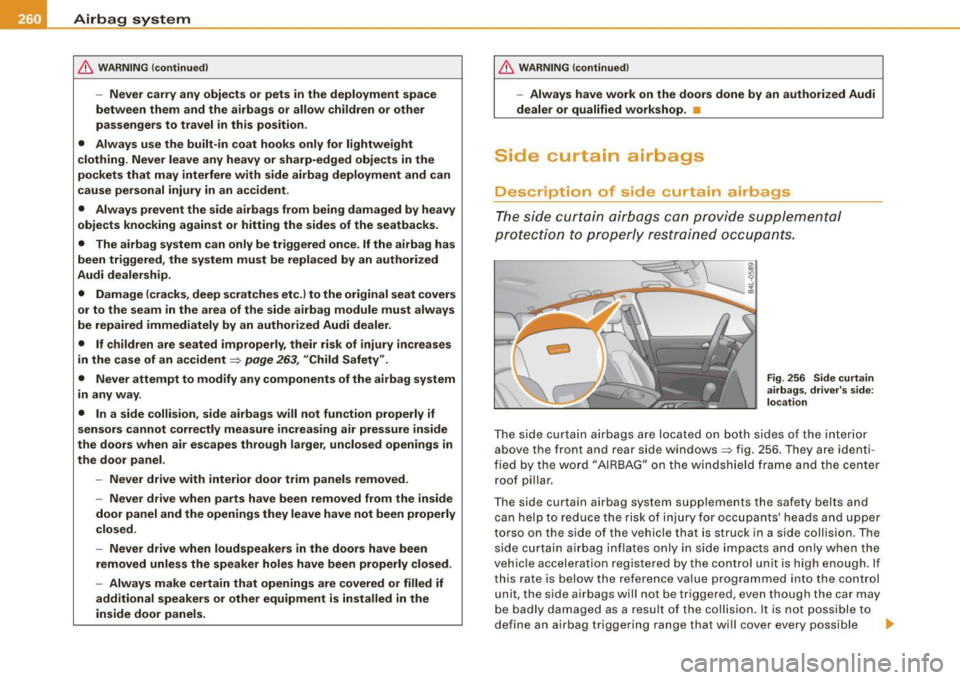
Fig. 256 Side curtain
airbags , driver 's side:
location
The side curtain airbags are located on both sides of the interior
above the front and rear side windows:::::, fig. 256 . They are identi
fied by the word "AIRBAG" on the windshield frame and the center
roof pillar.
The side curtain airbag system supplements the safety belts and can help to reduce the risk of injury for occupants' heads and upper
torso on the side of the vehicle that is struck in a side collision. The
side curtain airbag inflates only in side impacts and only when the
vehicle acceleration registered by the control unit is high enough. If
this rate is below the reference value programmed into the control
unit, the side airbags will not be triggered, even though the car may
be badly damaged as a result of the collision. It is not possible to
define an airbag triggering range that will cover every possible ..,
Page 263 of 426
angle of impact, s inc e the ci rcumstanc es w ill vary considerably
bet ween one collisi on and another. Important factors include, for
example, the na ture (hard or soft) of the impacting object, the ang le
of impact, vehicle speed, etc.~
page 267, "How side curtain ai rbags
work".
Aside from their norma l safety function, safety be lts work to help
keep the driver or front passenger in position in the event of a col li
sion so tha t the side curtain airbags can provide protection .
The airbag system is not a substitute for your safety belt. Rather, it
is part of the overa ll occupant restraint system in your vehicle .
Always remembe r that the airbag sy stem can only help to protect
you if you are wea ring your safety belt and wearing it proper ly. This
is another reason why you should a lways wear your safety belts, not
just because the law requires you to do so~
page 231, "General
notes".
I t is important to remember tha t while the side curtain airbag
system is designed to help reduce the likelihood of serious injuries,
other in jur ies, for examp le, swelling, bruising, and minor abrasions
can a lso be associated with these airbags upon dep loyment.
Remember too, these airbags will dep loy only once and only in
certa in kinds o f accidents -your safety belts are always there to
offer protection.
T he side curtain airbag s ystem basi cally consists of :
• T he electronic control module and external side impac t sensors
• T he side curtain airbags above the front and rear side windows
• The airbag indicator light in the instrument panel
T he airbag system is monitored electronically to make certain i t is
functioning prope rly at a ll times. Each time you turn on the ignition,
the airbag system indicator light will come on for a few seconds
(self diagnos tics).
The side curtain airbag is not a cti vated :
• if the ignition is tur ned off
Safety first
Airb ag sy ste m
• in side collisions when the acceleration measured by the sensor
is too low
• in front -end collisions
• in rear -end co llisions.
& WARNING
• Safety belt s and the airbag sy stem will only p rov ide protect ion
when o ccupants are in the proper seating po sition
=> page 92 ,
"General recommendation s".
• If the airbag indicator light come s on when the vehicle i s being
used , ha ve the system inspected immediatel y by your aut horized
Audi dealer . The side curtain airbag may not work properly even
when the vehicle acceleration in a side colli sion i s high enoug h to
act ivate the a irbag. •
How side curtain airbags work
Side curtain air bags can work together with side airbags
to help reduce the risk of head and upper torso injuries for
occ upants who are pro perly res trained.
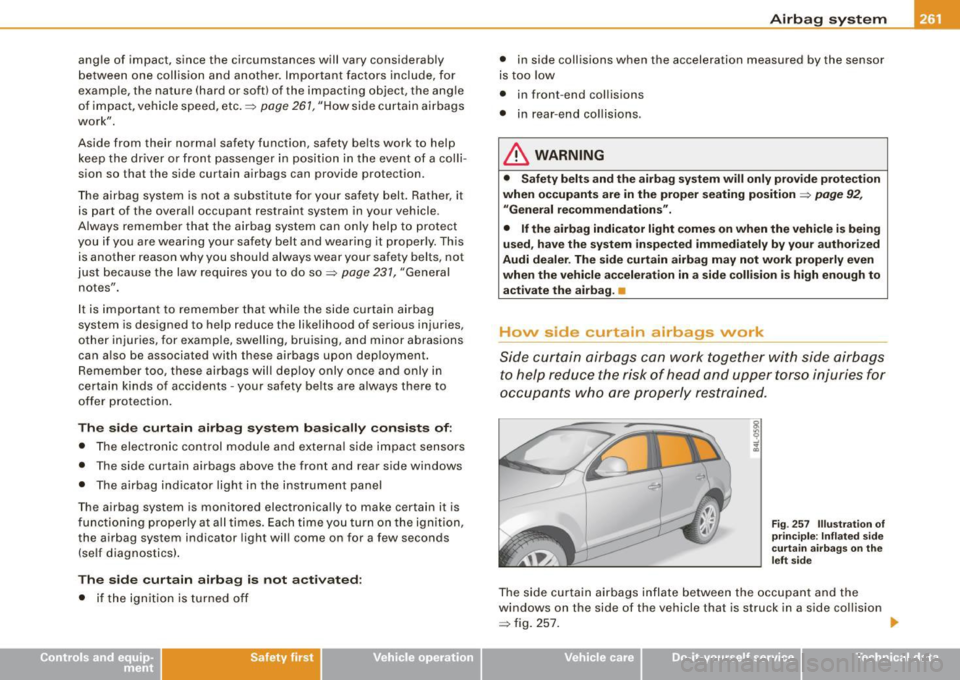
F ig . 2 57 Illus trat ion of
p rinc iple : In fl ate d side
c urt ain a irb ag s on the
left side
The side cu rta in airbags inflate between the occupant and the
windows on the side of the vehicle that is struck in a side collision
~ fig. 257. tt
Vehicle care I I irechnical data
Page 264 of 426
lffl) __ A_ ir_ b_ a-g _ s_y _s_ t_ e_ m _________________________________________________ _
When the system is triggered, the side curtain airbag is filled with
p ropel lan t gas and b rea ks th roug h a sea m above the fron t and rear
side windows identified by the A IR BAG labe l. In order to help
provide th is additi ona l protec tion, the side curtain ai rbag must
inflate within the b link of an eye at very high speed and with great
force . The side cu rtain ai rbag could inju re you if yo ur seating posi
t ion is not p roper or upright or if items are located i n the a rea w here
the supplementa l side curtain airbag inflates . This applies espe
cia lly to child re n :::::,
page 263.
Although they are not a soft pi llow, side curtain airbags can
"cus hion" the im pac t and in this way they can hel p to reduce the risk
of injury to the head and the upper part of the body .
A fine dust may develop when the airbag deploys . This is q uite
n orma l and does no t mean t he re is a fi re i n th e ve hicle .•
Important safety instructions on the side
curtain airbag system
A irb ags are only suppl emen ta l res tr a int s. A lways prop
erl y wear safety b elts and ride in a proper s ea ti ng posi
t io n.
T here is a lot that you and your passengers must know and do to
he lp th e sa fety belts and ai rbags do their j ob to prov ide su pple
mental protection .
& WARNING
Improperly wearing safety belts and improper seating positions
increase the risk of serious personal injury and death whenever a
vehicle is being used .
• Never let occupants place any parts of their bodies in the area
from which the side curtain airbags inflate .
• Always make sure that the side curtain airbags can inflate
without interference . Unsuitable accessories fitted inside the
& WARNING (continued)
expansion range of a side curtain a irbag can dangerously interfere
with its function. A deploying head airbag develops enough force
to catapult any p iece of add-on component out of its path of infla
tion and into the passenger compartment. An occupant hit by such a projectile can suffer serious inju ry or death
=> page 404 ,
"Technical Modifications" .
• Do not sw ivel the sun visors to the s ide if you have any objects
clipped onto them (for example pensl.
If the airbag should deploy ,
you could be injured by these objects .
• Use the built -in coat hooks only for lightweight clothing . Never
leave any heavy or sharp-edged objects in the pockets that may
interfere with airbag deployment and can cause personal injury in
an accident .
• Never u se hangers to hang clothing from the hooks.
• Only use fa ctory-installed sun shades or , in the case of shades
installed after the vehicle leaves the factory , only Audi roll -up
suns creens m ay be used => page 403 , "Additional a ccessories and
parts replacement ".
• Always sit in proper seating position and wear safety belts
while traveling so that the side curtain airbags can help provide protect ion .
• The airbag system can only be triggered once.
If the airbag has
been triggered, the system must be replaced by an author ized
Audi dealer or qualified workshop.
• Always have work involving the side curtain airbag system ,
removal and installation of the airbag components, or other
repairs performed by an authorized Audi dealer or qu alified wor k
shop . Otherwise the airbag sy stem may not work correctly.
• Never attempt to modify any components of the airbag system
in anyway. •
Page 265 of 426

_______________________________________________ C_h _ i_ld _ S_ a_ f_ e_ t..,:c y __ lfflllll
Child Safety
Important things to know
Introduction
The rear seat is generally the safes t place in a collision.
The p hysica l pr inciples of what happens when you r veh ic le is in a
crash apply also to children => page
233, "What happens to occu
pa nts not wearing safety bel ts?" . But un like adults and teenagers,
their musc les and bones are not fully developed. In many respects
children a re a t greater ris k of serious injury in cras hes than a dults .
B ecause chi ldren's bodies are no t fully deve loped, they require
restraint systems especial ly designed for their size, weight, and
body structu re. Ma ny countries and al l sta tes of the U nited States
and provinces of Canada have laws requiring the use of approved
chil d restraint sys te m s for infa nts and smal l children .
I n a frontal crash at a speed of 20 -35 mph (30 -56 km/h) the forces
acting on a 13-pou nd (6 kg) infant wi ll be mo re than 20 times the
weight of the child. This means the weight of the child would
suddenly be more than 260 pounds ( 120 kg). Under these condi
t ions, only an appropriate child restraint proper ly used can reduce
the risk of serious injury. Child restraints, like adult safety belts,
must be used properly t o be effective. Used impro perly, they can
increase the risk of serious injury in an accident.
Co nsul t the c hild safety seat man ufacture r's ins truc tions to be su re
the seat is right for your child's size=> page 266, "Important safety
instructions for using child safety seats" . Please be sure to read and
heed a ll of the important information and WARNI NGS about child
safety, Advanced Airbags, and the insta llation of child restraints in
this chapter.
T here is a lot you need to know about the Advanced Airbags in your
veh ic le and how they work whe n inf an ts and ch ild ren in c hild
restraints are on the front passenger seat. Because of the large
Controls and equip ment Safety first Vehicle operation amoun
t of important informat ion, we cannot repeat it all here. We
urge you to read the detai led information in this owner's manua l
about a irbags and the Advanced Airbag Sys tem in your ve hic le and
the very important information about transporting children on the
fr ont passenger sea t. Please b e sure to hee d th e WAR NINGS -th ey
are extreme ly important for your safety and the safety of your
p asse ngers, es pecia lly inf ant s and s mall ch ildren .
& WARNING
• Accident statistics have shown that children are generally safer
in the rear seat area than in the front seating position . Always
restrain any child age 12 and under in the rear.
• All vehicle o ccupants and especially children must be
restrained properly whenever riding in a vehicle . An unrestrained
or improperly restrained child could be injured by striking the inte
rior or by being ejected from the vehicle during a sudden
maneuver o r impact . An unrestrained or improperly restrained
c hild is also at greater risk of injury or death through conta ct with
an inflating a irbag .
• A suitable child restraint properly installed and used at one of
the rear seating positions provides the highest degree of protec
tion for infants and small children in most ac cident situations .
& WARNING
Children on the front seat of any car even with Advanced Airb ag s
c an be seriously injured or even killed when an airbag inflates . A
child in a rearward -fa cing child safety seat installed on the front
pas senger seat will be seriously injured and can be killed if the
front airbag inflates.
• The inflating airbag will hit the ch ild safety seat or infant
carrier with great force and will sma sh the child safety seat and
child against the backrest , center arm rest , or door. •
Vehicle care Do-it-yourself service Technical data
Page 266 of 426
-Child Safety ------=---------------------------------
& WARNING (continued )
• Always install rear-facing child safety seats on the rear seat .
• If you must install a rearw ard fa cing child safety seat on the
front passenger seat in exceptional circumstances and the
PASSENGER AIR BAG OFF light does not come on and stay on,
immediately install the rear-facing child safety seat in a rear
seating posit ion and have the airbag system inspected immedi
ately by your authorized Audi dealer .
& WARNING
If, in exceptional circumstances, you must install a forward -facing
child restraint on the front passenger's seat :
• Always make sure the forward -facing seat has been designed
and certified by its manufacturer for use on a front seat with a
passenger front and side airbag.
• Always follow the manufacturer's instructions provided with
the child safety seat or carrier.
• Always move the passenger seat into its rearmost position in
the seat's fore and aft adjustment range , as far away from the
a irbag as possible before installing the child restraint . The back
rest must be adjusted to an upright position.
• Always make sure that the PASSENGER AIR BAG OFF light
comes on and stays on all the time whenever the ignition is
switched on . •
Advanced front airbag system and children
Y our vehicle is equipped with an " Advanced Airbag Syste m" in
co mplia n ce wi th Unit ed States F edera l Moto r Veh icle Saf ety S tan
dard ( FMVSS) 208 as appl icable at the time your vehicle was manu
f actu re d . T
he Advanced Airbag system in your vehicle has been certified to
m eet the " lo w -ris k" req uiremen ts for 3 and 6 year -ol d c hildren on
the passenger side a nd smal l adults on the driver side . The low risk
de ploymen t criteria a re i ntended to reduce the risk of i nju ry t hroug h
interaction with the airbag that can occur, for example, by bei ng too
close to the s tee rin g w heel and instrume nt panel whe n the ai rbag
i n fl ates. In add it ion, t he sys tem has been cer tified to co mply wi th
the "suppre ssion" req uirement s of the Safety Standa rd, to turn off
the front a irbag f or infants up to 12 month s who ar e restrai ned on
the front passenger seat in child restraints that are listed in the
S tan dard.
E ven though your vehicle is equipped with an Advanced Airbag
sy stem , a ll ch ildr en, especia lly those 12 yea rs and yo unge r, should
a lways ride i n the back seat prop erly re stra ined for t heir a ge and
s ize . The ai rbag on the pas se nger side make s th e fr on t sea t a poten
t ia lly dangero us p lace for a c hild to r ide. The front seat is no t the
safest p lace for a child in a forward -facing child safety seat. It can be
a ve ry da nger ous place for a n inf ant or a la rg er c hild i n a rea rward
facing seat. •
Advanced Airbags and the weight-sensing
mat in the front seat
Th e Ad vanced Ai rbag Sys te m in your vehic le de tec ts the prese nce
o f an inf ant or c hild in a chi ld rest raint on the front pass eng er s eat
us ing the weight -sensing mat in the seat cushion and the senso r
b elow t he safety be lt latch on t he front pass enger s eat that
measures the tension on the safety belt.
T he weig ht-se nsin g m at m easu res total weig ht of th e chi ld an d th e
c h ild safety s eat and a ch ild bl anket on the front passen ger seat . T he
w eig ht on th e front p assenge r seat is re la te d to th e des ig n of t he
c h ild re straint and its "footpr int", t he size and shap e of the bottom
of t he child restraint a s it sits on the seat . Th e w eight of a child
r e stra int and its "footprint" vary for diff ere nt k inds of c hild ..,.
Page 267 of 426

-------------------------------------------~C::._! h~ i~ ld ~ S~ a~ f~e :_!t tY ~--
restraints and for the different models of the same kind of child
restraint offered by child restraint manufacturers.
The weight ranges for the individual types, makes and models of
child restraints that the NHTSA has specified in the Safety Standard
together with the weight ranges of typ ical infants and typical 1 year
old child have been stored in the control unit of the Advanced
Airbag System. When a child restraint is being used on the front
passenger seat with a typical 1 year -old child, the Advanced Airbag
System compares the weight measured by the weight sensing mat
with the information stored in the electronic control unit.
The electronic control unit also registers the tension on the front
passenger safety belt. The tension on the safety belt for the front
passenger seat will be different for an adult who is properly using
the safety belt as compared to the tension on the belt when it is
used to attach a child restraint to the seat. The sensor below the
latch for the safety belt for the front seat passenger measures the
tension on the belt . The input from this sensor is then used with the
weight to "decide" , whether there is a child restraint with a typical 1
year-old child on the front passenger seat and whether or not the airbag must be turned off.•
Child restraints and Advanced Airbags
Regardless of the child restraint that you use, make sure that it has
been certified to meet United States Federal Motor Vehicle Safety
Standards and has been certified by its manufacturer for use with
an airbag. Always be sure that the chi ld restraint is properly
installed at one of the rear seating positions. If in exceptiona l
circumstances you must use it on the front passenger seat, carefully
read all of the information on child safety and Advanced Airbags
and heed a ll of the applicable WARNINGS. Make certain that the
child restraint is correctly recognized by the weight -sensing mat
inside the front passenger seat, that the front passenger airbag is
turned off and that the airbag status is always correctly signaled by
th e
PASSENGER AIR BAG OFF light .
Controls and equip
ment Safety first Vehicle operation
Many
types and models of child restraints have been available over
the years, new mode ls are introduced regularly incorporating new
and improved designs and older mode ls are taken out of produc
tion. Child restraints are not standardized . Child restraints of the
same type typically have different weights and sizes and different
'footprints,' the size and shape of the bottom of the chi ld restraint
that sits on the seat, when they are installed on a vehicle sea t. These
differences make it virtual ly impossible to certify comp liance with
the requirements for advanced airbags with each and every child
restraint that has ever been sold in the past or will be sold over the
course of the usefu l life of your vehic le.
For this reason, the United States National Highway Traffic Safety
Administration has pub lished a list of specific type, makes and
models of child restraints that must be used to certify compliance
of the Advanced Airbag System in your vehicle with the suppression
requirements of Federal Motor Vehicle Safety Standard 208. These
child restraints are:
A. Car beds, manufactured on or after September 1,
2004:
• Cosco Dream Ride 02-719
B. Rear facing child restraint systems, manufactured
on or after September 1, 2004:
(When the restraint system comes equipped with a removable base,
compliance has to be certified with or without the base) .
• Britax Handle with Care 191
• Century Assura 4553
• Century Smart Fit 4543
• Cosco Arriva 02727
• Evenflo Discovery Adjust Right 212
• Evenflo First Choice 204
• Graco lnfant8457
Vehicle care Do-it-yourself service Technical data
Page 268 of 426
___ C_h_ i_ ld _ S_ a_ f_ e_ t_y ____________________________________________ _
C. Forward-facing convertible child restraint systems,
manufactured on or after September 1, 2004:
• Britax Roundabout 161
• Britax Expressway
• Century Encore 4612
• Century STE 1000 4416
• Cosco Olympian 02803
• Cosco Touriva 02519
• Evenflo Horizon V 425
• Evenflo Medallion 254
• Safety First Comfort Ride 22-400
& WARNING
To reduce the risk of serious injury, make sure that the PASSENGER
AIR BAG OFF light comes on and stays on whenever a child
restraint is installed on the front passenger seat and the ignition
is switched on.
• Take the child restraint off the front passenger seat and install
it properly at one of the rear seat positions if the PASSENGER AIR
BAG OFF light does not stay on.
• Have the airbag system inspected by your authorized Audi
dealer immediately.
[ i] Tips
The child seats listed in categories A to C have been tested by Audi
only for the Advanced Airbag function. •
Important safety instructions for using child
safety seats
Correct use of child safety seats substantially reduces the
risk of injury in an accident!
As the driver, you are responsible for the safety of every
body in the vehicle, especially children:
- Always use the right child safety seat for each child and
always use it properly ::::>
page 268.
-Always carefully follow the child safety seat manufac
turer's instructions on how to route the safety belt prop
erly through the child safety seat.
- When using the vehicle safety belt to install a child safety
seat, you must first activate the convertible locking
retractor on the safety belt to prevent the child safety
seat from moving ::::>
page 273.
-Push the child safety seat down with your full weight to
get the safety belt really tight so that the seat cannot
move forward or sideways more than one inch (2.5 cm).
- If a strap or tether is being used to tie the child safety
seat to the front passenger seat, make sure that it is not
so tight that it causes the weight-sensing mat to
measure more weight than is actually on the seat.
Always remember: Even though your vehicle is equipped with an
Advanced Airbag system, all children, especially those 12 years and
younger, should always ride in the back seat properly restrained for
their age and size. _,,