brake light AUDI Q7 2009 Owner´s Manual
[x] Cancel search | Manufacturer: AUDI, Model Year: 2009, Model line: Q7, Model: AUDI Q7 2009Pages: 426, PDF Size: 97.13 MB
Page 301 of 426

- Lack of proper maintenance as wel l as improper use of the
vehic le wi ll impair the func tion of the emission con tro l system
and could lead to damage.
<£> For the sake of th e envir onm ent
Even when the Emission Control System is operating properly, the
exhaust gas can have a su lfur -like exhaust gas smell under some
operating states . This depends on the sulfur content of the fuel
being used. Using a different brand of fue l may help, or filling the
tank with lead-free super grade gasoline. •
Avoid damaging the vehicle
When you are driving on poor roads, or over curbs, steep ramps,
etc., make certain that low- lying parts such as spoi lers and exhaust
system parts do not bottom out and get damaged.
This is especially true for vehicles with low-slung chassis (sports
chassis) * and fully loaded vehicles .
a
Operate your vehicle economically
and minimize pollution
General
Your personal style of driving will determine the economy
of your vehicle, as well as exhaust and noise levels.
Fuel economy, environmental impact, and wear on your engine,
brakes and tires largely depend on three factors:
• your personal driving style
• operating cond itions
• technica l limitations
Controls and equip
ment Safety first Vehicle operation
Dri
ving and environm ent
If you anticipate what you need to do next and drive economica lly,
you can easily cut your fuel consumption by 10 -15 percent . This
section wil l give you some tips on how you can help the environ
ment and your pocketbook.
[ i ] Tips
The consumption estimates as published by ENV IRONMENTAL
PRO TEC TION AGENCY (EPA) and Transport Canada may not corre
spond to your actua l consumption on the road, which wi ll vary
depending upon vehic le load and speed, road and weather condi
tions, trip length, etc. •
Drive smoothly and keep a lookout ahead
Vehicles use the most fuel when they ore accelerating.
-Avoid unnecessary accelerat ing and braking.
Vehicles use the most fuel when they are accelerating . If you antici
pate what is going to happen next, you wi ll need to brake less and,
thus, acce lerate less. Let the vehicle coast whenever possib le - for
examp le when you see that the next traffic light is red. •
Avoid full throttle
Driving at moderate speeds saves fuel and improves your
mileage.
-Try and keep well below your car 's max imum speed.
Acce lerating gently reduces fue l consumption , engine wear, and
does not disturb the environment.
Fue l consumption, exhaust emissions and engine noise increase
disproportionately at high speeds . If you drive at approximate ly
three quarters of top speed, fuel consumption wil l be reduced by
Vehicle care Do-it-yourself service Technical data
Page 307 of 426

Trailer towing
Driving with a trailer
Genera l information
Your Audi was designed primarily for passenger transpor
ta tion.
If you plan to tow a trailer, please remember that the add itional load
wi ll affect durability, economy and performance.
Trai ler towing no t only places more s tress on the vehicle, it a lso ca lls
for more concentration from the driver.
F or this reaso n, always fol low the operating and driving instructions
prov ided and use common sense.
(D Note
If you are going to tow a tra iler, you must activate the trailer opera
tion mode =>
page 211, "Towing a trailer".
Technical requirements
Trailer hitch
Use a we ight-carry ing hitch conforming to the gross tra iler weig ht.
T he hitch must be suitable for your vehic le and trailer and must be
m ounted secure ly on the veh icle's chassis at a
technically sound
location. Use only a trailer hitch with a removable ball mount.
Always check with the trai ler hitch ma nufacturer to make sure that
you are using the correct hitch .
Do not use a bumper hitch.
The hitch must be instal led in such a way that it does not in terfere
with the impact-absorbing bumper system. No modifications shou ld be made to the vehicle exhaust and b rake systems . Fro m
Controls and equip
ment Safety first Vehicle operation
Tr
aile r t owing
time to time, check that all hitch mounting bolts remain securely
fastened .
When you are not towing a trai ler, rem ove the t railer hi tch bal l
mount. This prevents the hitch from causing damage should your
vehicle be struck from behind =>
&.
Trailer bra kes
If your trai ler is equipped with a b raking system, check to be sure
that it conforms to all regulations.
The tra iler hydraul ic bra ke system must not be directly co nnecte d to
the veh icle's hydrau lic brake system=> &.
Safety chains
Always use safety chains between your vehicle and the trailer.
Trail er lights
Trai ler lights must meet a ll regulations. Be sure to check with your
au thorized Audi dea ler for correct wiring, switches, an d relays.
Mirrors
If you are unab le to see the traff ic behind you using the regular
outside mirrors, then you
must instal l extended mirrors. It is impor
t ant that you
always have clear v isi on to the rear.
& WARNING
• If a trailer has electrical brake s please note that the se brakes
are not act ivated by the fa ctory-fitted control unit -ris k of acci
dent!
• After removing the trailer hitch , do not store it in your vehicle.
In case of sudden braking , the hitch could fly forward and injure
you or your passengers .
Vehicle care Do-it-yourself service Technical data
Page 308 of 426
llffl!I Trailer towing
------=---------------------------------
& W ARN ING (continued )
• The Gros s Vehicle Weight Rating for your Audi 07 vehicle ,
found on the safety compliance l abel on the driver's side B -pillar ,
must never be ex ceeded under any cir cumstances . E xceeding the
Gross Vehi cle Weight Rating of your vehicle is likely to damage
your vehicle , and such damage w ill not be covered by your Limited
New Vehicle Warranty. Exceeding the Gro ss Vehicle Weight Rating
will also change the performan ce and handling characteristics of
your vehicle , which could cause a crash resulting in serious injury
or death .
• The Gros s Vehicle Weight Rating for your Audi 0 7 would be
e xc eeded if your veh icle is simultaneously equipped with
Panoramic sliding sunroof ; third -row seating ; trailer towing equip
ment (factory or dealer -installed) , and running boards (dealer
installedl. UNDER NO CIRCUMSTANCES MAY ALL SUCH ITEMS BE
INSTALLED ON THE SAME VEHICLE .
a
Operating instructions
---------~--~-------
MAX 6.9"
MAX 175mm
Trailer towing weights
Fi g. 2 76 P erm itted ball
po sition of the trailer
hitch
With a factory-installed trai ler hitch, the maximum permissible
trai ler weight is 6,615 lbs (3,000 kg). The maximum permissible
unbraked trailer weight is 1,650 lbs (750 kgl. With an
aftermarket
tr ailer h itch , the maxi mum pe rm iss ib le tra iler weigh t is 5,51 2 lb s (2,500
kg). These specifications apply when driv ing on roads having
an in cli ne of less t han 12% .
Permissible tongue load
Fo r best v ehicle ha ndling under th es e changed con ditio ns, a dju st
the trai ler load so that the tongue load is at the maximum allowable
or s lightly lower. Y ou ca n ge t an ap proxi mati on of the tong ue load
with a bathroom sca le or you can measure the load at a trucking
company or weig hing s tati on.
Wtih a
factory -installed trailer hi tch, the max imum perm issib le load
on the ball hitch may not exceed 66 2 lbs (300 kg) . With an
after
market
t ra iler hitc h, the max imum pe rmi ssible loa d on the ball h itch
may not exceed 55 1 lbs (250 kg). It is recommended to use the
m aximum p ermi ssi ble l oad.
Trailer load distribution B e sure the load in the trai ler is he ld securel y in place to prevent it
from shifting forward, backward or sideways.
Never allow a passenger to ride in a trailer=> & in "D riving ins truc
tions" on page 307.
Ball mount
T he trai ler hitch may only be used with suitab le ball mount and ball
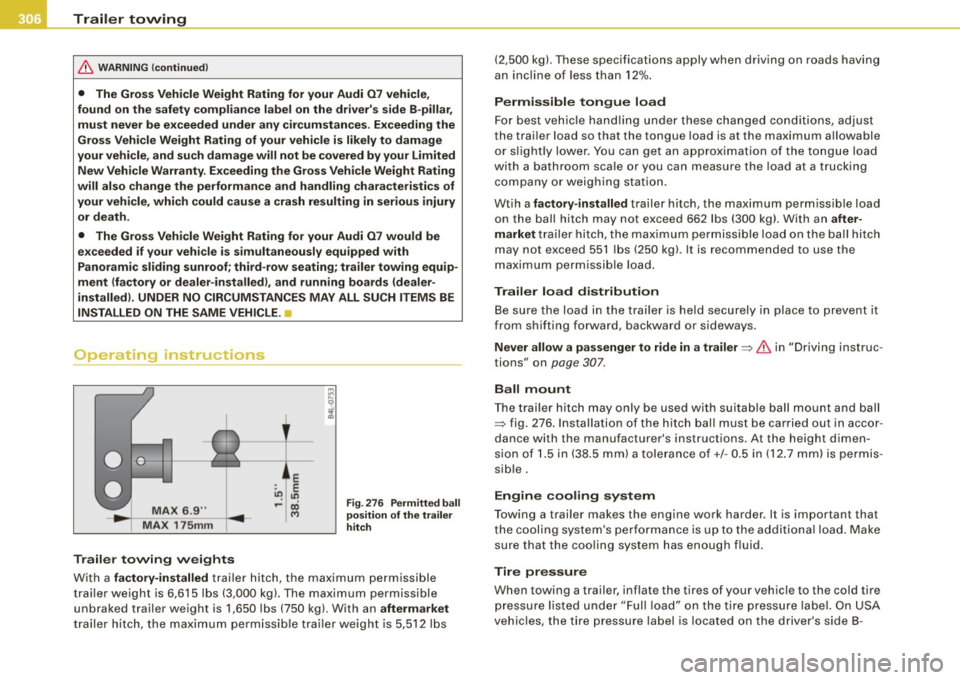
=> fig. 276 . In sta llati on of t he hitch ball must be ca rr ie d o ut i n a ccor
dance with the manufacturer's instructions. At the height dimen
s io n of 1 .5 in (38 .5 mm) a tole ran ce o f+/- 0 .5 in (12 .7 mm) is pe rmis
sib le.
Engine cooling system
T owing a trai ler makes the engine work harder. It is important that
th e c ooli ng system 's per forman ce is u p to the a ddi tiona l loa d. Ma ke
sure that the coo ling s ystem has enough f luid.
Tire pressure
When towing a trailer, inflate the tires of your vehic le to the cold tire
p re ssure l is ted unde r "Full load" on th e tire press ure l abe l. On USA
vehic les, the tire pressure label is located on the driver's side 8 -
Page 309 of 426
pillar. On Canada vehicles, the tire pressure label is located either on
t he driver's side 8 -pillar or inside the fuel fil ler flap. Inflate trailer
tires to trailer and tire manufacturers' specifications.
L ight s
The head light settings should be checked with the trailer attached
before driving off . Check to make sure both vehicle and trai ler lights
are working properly.
Sa fety c hain s
Be sure trailer safety chains are properly connected from the trailer
to the hitch on the vehicle . Leave enough slack in the chains to
permit turning corners. When you insta ll safety chains, make sure
they will not drag on the road when you are driving .
The chains should cross under the tra iler tongue to prevent it from
dropping in case of separation from the hitch.
0 Note
If you are going to tow a traile r, you must activate the trailer opera
tion mode =>
page 211, "Towing a trailer" .
Driving instructions
Driving with a trailer always requires extra care and
consideration.
To obtain the best possible handling of vehicle and trailer,
please note the fo llow ing:
- Do not tow a loaded trailer when your car i tse lf is not
loaded .
- Be especia lly careful when passing other vehicles .
- Observe speed l imits.
- Do not drive at the maximum permiss ible speed .
Controls and equip
ment Safety first Vehicle operation
Tr
aile r t owing
Always apply brakes early .
- Monitor the temperature gauge .
Weigh t dis tr ibution
Towing a loaded trailer wi th an empty car results in a highly
unstable dis tribution of weight . If this cannot be avoided , drive at
very low speeds only to avoid the risk of losing steering control.
A "balanced" rig is easier to operate and control. This means that
the tow vehicle should be loaded to the extent possible and permis
sib le, while keeping the trailer as light as possib le under the circum
stances . Whenever possible, transfer some cargo to the luggage
compartment of the tow vehicle whi le observing tongue load
requirements and vehicle loading considerations .
Speed
The higher th e speed, the more difficu lt it becomes for the driver to
control the rig . Do not drive at t he maximum pe rmissible speed.
Reduce your speed even more
if load, weather or wind conditions
a re unfavorable -particularly when going downhil l.
Reduce vehicle speed
i mmedi ate ly if the trailer shows the slightest
sign of swaying.
Do not tr y to s top the swaying by accelerating .
Observe speed limits . In some areas, speeds for vehicles towing
trailers are lower than for regular vehicles .
Always apply brakes early. When driving downhill, shift into a lower gear to use the engine braking effect to slow the vehicle. Use of the
brakes alone can cause them to overheat and fa il.
Coo lant t emperatu re
The coolant temperature gauge=> page 13 must be obse rved care
ful ly. If the need le moves close to the upper end of the sca le , reduce
speed immediately and/or turn off the air conditioner .
If the coolant temperature warning light in the instrument cluster
starts f lashing
- f- , pul l off the road, stop and let the engine idle for
about two minutes t o prevent heat build -up.
Vehicle care Do-it-yourself service Technical data
Page 320 of 426
![AUDI Q7 2009 Owner´s Manual _L-_C=..:..: le=- a =-=- n:..:.i.:....n :..::g ~ a:..: n..:. d.:::... ?:: P..:..r -=o --=t :..:e :....:c.:.... t:..:. i-=o -=-n..:.._ __________________________________________ _
[ i ] Tips
Keep s](/img/6/40274/w960_40274-319.png "AUDI Q7 2009 Owner´s Manual _L-_C=..:..: le=- a =-=- n:..:.i.:....n :..::g ~ a:..: n..:. d.:::... ?:: P..:..r -=o --=t :..:e :....:c.:.... t:..:. i-=o -=-n..:.._ __________________________________________ _
[ i ] Tips
Keep s")
_L-_C=..:..: le=- a =-=- n:..:.i.:....n :..::g ~ a:..: n..:. d.:::... ?:: P..:..r -=o --=t :..:e :....:c.:.... t:..:. i-=o -=-n..:.._ __________________________________________ _
[ i ] Tips
Keep si licone sprays off the windshie ld to avoid wiper smear in
rain. •
Cast (light) alloy wheels
Cast (light) alloy wheels require special care.
-Wash the wheels with a sponge or hose brush every
o ther week.
- For deep clean ing afterwards, use only a dedicated acid
free cast alloy whee l cleaner.
Rub a coat of liquid wax onto the rims every t hree month .
Be sure to reach and treat all parts of the rim.
To preserve the decorative appearance of the cast alloy wheels,
some special care is necessary. In add ition to road dirt and salt,
brake dust is also corrosive . If left on for too long, brake dust can
cause pitting.
Use on ly special
acid -free cleaners formu lated for a lloy rims . Safe
produc ts are available at your authorized Audi dealer. Never leave
the cleaner on the rims longer than specified on the label. If not rinsed off promptly, the acid contained in some cleaners can attack
the threads on the wheel bolts .
Never use abrasive or metal po lishing c leaning agents. If the protec
t ive coating has been chipped, e.g . by kicked up road dirt, touch it
up as soon as possible .
& WARNING
• Moisture a nd i ce on b rake s m ay affect brak ing effi cienc y
=> page 291 , "General information ". Te st the brake s carefully ea ch
t ime you wa sh the vehi cle .
& W ARN IN G (c ontinued )
• Always read and h eed all WARNINGS and other inform ation
=> p age 31 2. •
Body cavity sealing
The b ody cavity sealing does not need to b e checked.
All body cavities which could be affected by corrosion have been
thoroughly protected at the factory .
T his seal ing does not require any inspection or add it ional trea t
ment. If any wax should seep out of the cavity wh en the ambient
t emperature is h igh, i t ca n be removed with a p lastic scrape r and a
suitable solvent.
& WARNING
S olvent s can be dangerous .
• Ben zine is flammable and toxic . If you use benz ine for re moving
the wax , keep sparks , flame and l ighted cigarettes away . Never
dump benzine on th e ground , into open streams or down sewage
dr ains.
• Be sure to ob serve all safety and environmental regulat ion s.
Follow all instru ctions on the cont ainer .
• Alway s r ead and heed all WARNINGS and other info rmation
=> page 312 . •
Chassis
Have the undercoating checked for damage from time to
time.
The lower body shell of your Audi is also thoroughly protected
against corrosion .
Page 343 of 426
_____________________________________________ C_h_ e_ c _ k_in -= g_a _ n_d _ f_il _li _n ..;::g =-- ____.•
& WA RNING ! continued )
• The auxiliary ele ctric fan is temperature controlled and can
s w itch on suddenly even wh en t he engine is not runn ing .
• The auxiliary radiator fan swit ches on automatic ally when the
engin e coolant rea che s a cer tain temperature and will con tinue to
run until the coolant temperature drop s. •
Brake f luid
Checking brake fluid level
The brake fluid level c an be checke d with a quick gl ance .
Fig. 288 E ngine
comp artm ent: B ra ke
flui d rese rvoir
Be fore you check a nything in th e en g in e co mpart ment,
always read and heed all WARNINGS=> & in "Working in
t h e eng ine compartment" on
page 331.
- Read the brake fluid l eve l from the brake fluid reservoir
=> fig. 288. The brake flu id level mus t be between the
"MIN" and "MAX" markings.
The brake fluid reservoir is locate d at the rear partition of the engine
compartment on the left side=>
page 332.
The fluid level may drop slightly after some time due to the auto
ma tic adjustment of the brake pads. This is not cause for alarm .
If the brake fluid leve l falls
considerably below the "MIN" mark , the
brake warning/indicator light (U.S. models:
BRAKE , Canadian models:
«D> l will come on=>
page 23 and=> page 32 . Do not continue to
operate the vehicle. The complete brake system should be thor
oughly checked
by an author ized Audi dealer or qua lif ied workshop
and the cause corrected . If th e brake fluid level is too low, the brake
warning/indicator light w ill illumi nate. Contact an authorized Audi
dea ler
immedi ately .
[ i ] Tips
The brake fluid reservoir is located underneath the cover .•
Changing brake fluid
Have the brake fluid changed by an experience d techni
cian.
Brak e fluid absorbs mois ture from the air. If the wate r conten t in the
brake fluid is too high, corrosion in the brake sys tem may res ult
after a period of time . The boiling point of the brake fluid will also
decrease conside rably and decrease braking performance .
Therefore , the brake fluid mus t be changed
every two year s. Always
use new brake fluid which conforms to Federal Motor Vehicle S tan
da rd "FMVSS 116 DOT 4".
The brake fluid reservoir can be difficul t to reach, therefore , we
recommend that y ou have the brake fluid changed by your autho
rized
Audi deal er. Your dealer has the correct tools, the right brake
fluid and the know -how to do this for you .
& WARNING
• Brak e fluid is poi sonou s. It mu st be stored only in the clo sed
o riginal conta iner out of the rea ch of children! ..,.
Vehicle care I I irechnical data
Page 344 of 426
-~_C_ h_e _c _ k_ i_n ...:::g::;...._ a_n_ d_ f_ i_ll _in -'g:::;.._ ___________________________________________ _
& WARN ING (c o ntinued )
• Brake failure can re sult from old or inappr opriate brake fluid .
Ob serve the se precautio ns:
- Use only brake fluid that meets SAE specific ation J 1703 and
c onform s to Fed era l Moto r Vehi cle St anda rd 116. Al ways c heck
with your authori zed Audi dealer to make sure you are u sin g
the corre ct brake fluid. The correct typ e of brake fluid i s also
indicated o n the brake fluid reser vo ir .
- The br ake flu id mu st be ne w. Heavy u se of the brake s can
c au se a vapor lock if the brake fluid i s left in the s ystem too
long. Thi s can seriou sly affect the effi cien cy of the brake s as
w ell a s your safet y. Thi s could re sult in an acci dent .
0 Note
Brake fluid will damage the paint of your vehicle .
For the sake of the environment
Because of the problem of proper disposal of brake fluid as well as
the special too ls required and the necessa ry expertise, we recom
mend that you have the brake fluid changed by your authorized Audi
dea ler .•
Battery
General information
Under normal operating condi tions, the battery in your Audi does
not need any maintenance. With
high outside temperatures or long
daily drives we recommend that you have the e lectrolyte level
checked by an au thorized Audi dealer or qualified workshop . The
e lectrolyte level should also be ch ecked each time the battery is
charged ~
page 344.
Have the battery checked when you take your vehicle in for service .
Yo u are well advised to replace a battery that is o lder than 5 years .
With certain types of airbag dep loyment, the battery is discon
nected from the vehicle electrical system for safety reasons~
& in
"Repair, care and disposal of the airbags" on
page 255.
Disconnecti ng th e batt ery termin als
Some vehicle functions (power window regulators , for example) are
lost if the battery termina ls are disconnected. These functions have
to be relearned after the battery terminals are connected again . To
prevent this, the battery should only be disconnected from the
vehic le electrical sys tem when abso lutely necessary for repairs .
Vehicles not driven for long per iods
If you do not drive your vehicle ove r a period of several days or
weeks, electrical components are gradually cut back or switched off .
T his reduces energy consumption and maintains starting capab ility
over a longer period
~ page 295 .
Take i nto consideration that whe n you u nlock your vehicle, some
convenience functions, such as the master key remote function or
powe r seat adjustme nt, may not be ava ilable. The convenience
functions will be available again when you turn on the ignition and
start the engine .
Wint er op erati on
Duri ng the winter mont hs, batte ry capacity tends to decrease as
temperatures drop . This is because more power is also consumed
whi le star tin g, and the headlights, rear window defogger, etc ., are
used more often.
Avoid unnecessary power consumption, particular ly in city traffic or
when trave li n g o nly short dis tances . Let your authorized Audi dea ler
check the capacity of the vehicle battery before winter sets in
~ page 344. A we ll cha rged battery w ill not only preven t starting
problems when the weather is cold, but will also last longer . ..,_
Page 385 of 426
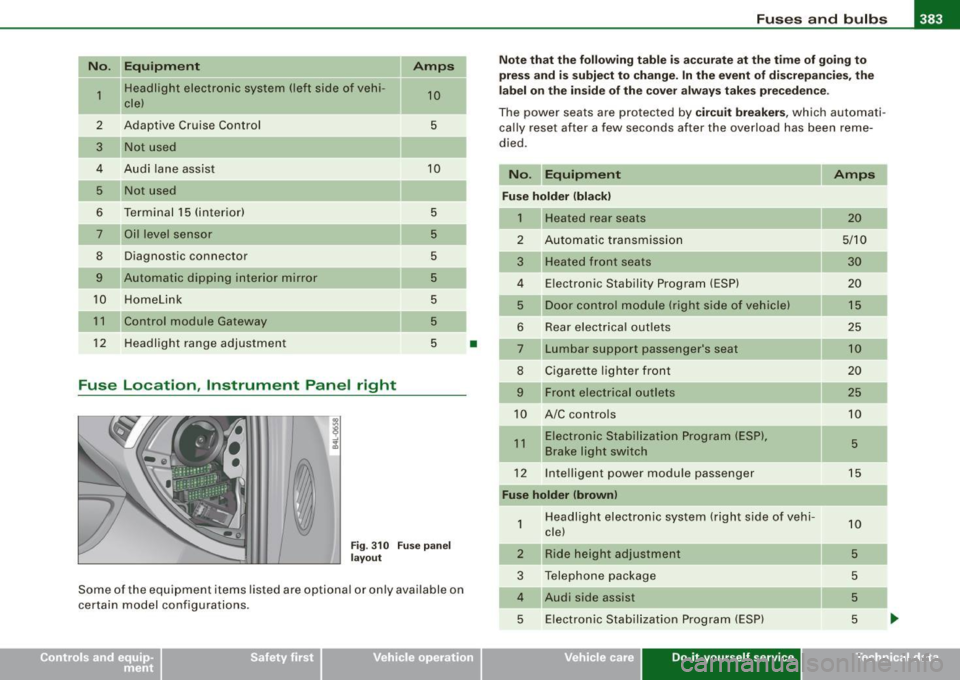
Fuses and bul bs 11111 ________________________________ ..:....:,:_=-.::..:....:.;.:_.:..:..,_,;__,;____,J
....
No.
1
-
2
3
4
5
6
Eq uipm ent
Headlight electronic system (left side of vehi -
cle)
Adaptive Cruise Control
Not used
Audi lane assis t
Not used
Terminal 15 (interior)
Oil level sensor
8 Diagnostic connector
9 Automatic dipping interior mirror
10 Homelink
1 1 Control module Gateway
12 Headlight range adjustment
Amps
10
5
10
5
5
5
5
5
5
5
Fuse Location , Instrument Panel right
Fi g. 310 F use pane l
l ayo ut
Some of the equipment items listed are optional or only avai lable on
certain model configurations .
•
Note that th e fo llo wi ng ta ble is acc urate a t the time of goi ng to
pre ss and is subject to change. In th e event of di screpan cies, t he
l a b el on the ins ide o f th e cover a lw ays ta ke s prec eden ce.
The power seats are protected by circ uit breakers , which automati
ca lly reset af ter a few seconds after the overload has been reme
died .
No. Equipm ent
Fu se holder (bla ck )
1 Heated rear seats
2 Automatic transmission
3 Heated front seats
4 E lectronic Stability Program (ESP)
5 Door control module (right side of vehicle)
6 Rear electrical out
lets
7 Lumbar support passenger's seat
8 Cigarette lighter front
9 Front electrical outlets
10 A/C controls
1 1 Electronic Stabilization Prog ram (ESP),
Brake light switch
12 Inte lligent power modu le passenger
Fuse holder (brown )
1
2
3
Headlight electronic system (right side of vehi
cle)
Ride height adjustment
Telephone package
4 Audi side assist 5 E lectronic Stab ilizat ion Program (ESP)
Vehicle care Do-it-yourself service
Amps
20
5/10
30 20
15
25
10
20
25
10
5
15
1 0
5
5
5
5
-
irechnical data
Page 390 of 426
IIIII.___E_ m_ e_r -=g "-e_ n _ c-=y _ s_ i_t _u _a _t_ i_o _n_ s _______________________________________________ _
& WARN ING (c ontinu ed )
• Bef ore you chec k anything in the engin e compartment , always
re ad and h eed all W ARNINGS =>
page 324, "Engine compa rtment".
0 Note
• Applying a higher voltage booster battery wil l cause expensive
damage to sensitive electronic components, such as contro l units,
relays, radio, e tc.
• There must be no electrical contact between the vehicles as
otherwise current could already start to flow as soon as the positive
( + ) terminals are connected .
[ i ] Tip s
• The discharged battery must be properly connected to the
vehic le's e lectrical system. When jump starting or charging the
battery, never connect the negative ground cable to the battery
negative pos t because the battery manager system must be ab le to
detect the battery's state of charge . Always connect the negative
ground cable to the negat ive ground post of the battery manager
control unit. •
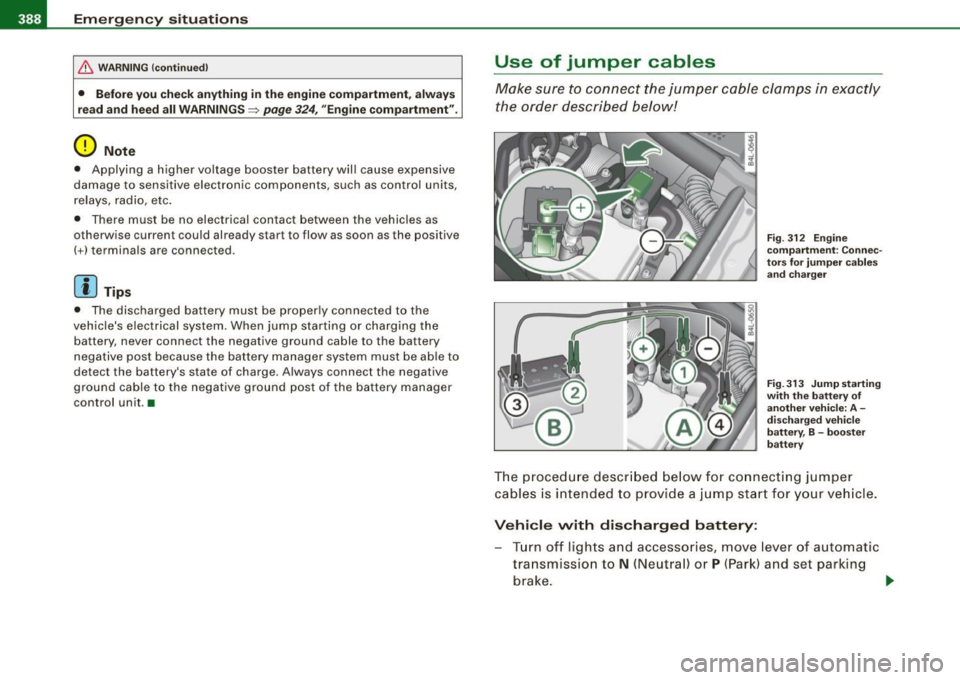
Use of jumper cables
Make sure to connect the jumper c able clamps in exac tly
the order described below!
F ig . 3 12 E ngin e
co mpartm ent : Co nnec
to rs for ju mp er ca ble s
and cha rger
F ig . 3 13 Ju mp st artin g
w it h th e batte ry o f
ano ther v eh icle : A -
d isc harg ed ve h icle
b att ery, B -boo ster
b att ery
The procedure descr ibed below for co nnect ing jumper
cables is intended to provide a j ump star t for your vehi cle .
Vehi cle with discharged battery :
-Turn off lights and accessories, move lever of automatic
tra nsmissio n to
N (Neutral) or P (Par k) and set parking
brake .
~
Page 411 of 426

______________________________________________ A_ l_,_ p _h_ a_ b_e _t_ic _ a _ l _in _ d_e _ x __ lll
Important things to know . ... .. .... 241
Indi cator light ...... .. .... ... ..... 252
Monitoring ... .... .... ..... .. .... 252
PASSENGER AIR BAG OFF light ... .. 253
Repairs .. .... .... .... ... .... .... 255
Safety instructions ... .... ..... .. . 254
Side airbags ... .. .... .... ...... .. 257
Side curtain airbags ... .. .... .... . 260
Weight -sensing mat .... ........ .. 264
When must the system be inspected? ..
252
All Wheel Drive .. .... ....... ...... .. 294
Alloy wheels ... .. .... .... ..... .. .... 318
All-whee l drive
Winter tires .... .. .... ...... ... .. . 363
Alternator Malfunction . .... .... ........ ..... 32
Anti-freeze
See Engine coo lant system .. ...... . 337
Anti-glare inside day-night mirror .... 86, 87
Anti -lock brake system
How the ABS system works . .... ... 292
Warning/indicator lights .. .... .... .. 22
Anti-Slip Regulation System (ASR)
How the system works ........ .... 290
Anti-theft systems
Anti-theft alarm system ... ......... 63
Elec tronic immobilizer .. ... .... .... 51
Approach/departure angle ............ 302
Ashtray Front .. .... ... .. .... .... ...... .. 116
R ear .... ... .. .... .... ........... 116
Controls and equip
ment Safety first
ASR
How the Anti-Slip Regulation System
works ...... ............. ...... 290
Asterisk What does it mean when something is
marked with an asterisk? .. ....... .. 6
Audi braking guard ....... .... ... .... 168
Error messages ....... .... ... .... 170
Settings ........... ... .... .... ... 169
Status messages .......... .... ... 170
Switching on and off .. .... .... .... 169
Audi Service Repair Manuals and Literature
401
AUTO mode AC climate contro ls ..... ...... .... 126
Auto Safety Hotline ..... ... ... .. .... . 229
Auto -Check Control ...... ..... ... .... . 30
Automatic belt retractor ... .. .... .... . 235
Automatic car wash
See Washing ............... .... .. 313
Au tomatic mode
Four -zone automatic comfort air
conditioning .... ...... ...... ... 132
Automatic Shif t Lock (ASU ...... ... ... 186
Automatic transmission
6 -speed automatic transmission .... 184
Automatic Shift Lock (ASU ...... .. . 186
Driving ...... ....... ...... .... ... 1 84
Dynamic shift program .... ........ 187
Emergency release for selector lever 189
F ail-safe mode ...... ... .. .... ... . 189
Ignition key safety lock ..... .. .... . 143 Manua
l sh ift program .. .. ....... .. 188
Selector lever .................... 185
Shift buttons ...... .... .... ...... . 189
Steering wheel with tiptronic® ..... 189
Average speed ....................... 40
Avo id damaging the vehicle ... .... .... 299
B
Background lighting
Lighting profiles . ......... ......... 79
Bass box ........... ... .. .... ...... . 371
Battery ...... .... ... .... .... .... ... 342
Battery location .......... .... .... 343
Charging ........................ 344
Important warnings when working on the
battery ...... ....... .... ...... . 343
Jump starting ................ .... 387
Low ...... ........... ....... .. .. 295
Replacing the battery ............ . 346
State of charge ................... 295
Voltage ........... ...... .... .... . 36
Winter operation ............ ... .. 342
Working on the battery ... ....... .. 343
Before driving ... .... .... ...... .... . 221
Blended gasoline .................... 325
Body cavity sealing .. .... .... .... ... . 318
Booster seats ...... ... .. .... .... .... 271
How do I properly insta ll a booster seat in
my vehic le? . .... .... .... ... .... 271
Safety instructions .... .......... .. 271
Brake assistant .......... .... .... ... 293
K ick -down .... .... ...... ...... ... 187 Brake booster ....................... 292
Vehicle operation Vehicle care Do-it-yourself service Technical data