service AUDI Q7 2009 Owner´s Manual
[x] Cancel search | Manufacturer: AUDI, Model Year: 2009, Model line: Q7, Model: AUDI Q7 2009Pages: 426, PDF Size: 97.13 MB
Page 344 of 426
-~_C_ h_e _c _ k_ i_n ...:::g::;...._ a_n_ d_ f_ i_ll _in -'g:::;.._ ___________________________________________ _
& WARN ING (c o ntinued )
• Brake failure can re sult from old or inappr opriate brake fluid .
Ob serve the se precautio ns:
- Use only brake fluid that meets SAE specific ation J 1703 and
c onform s to Fed era l Moto r Vehi cle St anda rd 116. Al ways c heck
with your authori zed Audi dealer to make sure you are u sin g
the corre ct brake fluid. The correct typ e of brake fluid i s also
indicated o n the brake fluid reser vo ir .
- The br ake flu id mu st be ne w. Heavy u se of the brake s can
c au se a vapor lock if the brake fluid i s left in the s ystem too
long. Thi s can seriou sly affect the effi cien cy of the brake s as
w ell a s your safet y. Thi s could re sult in an acci dent .
0 Note
Brake fluid will damage the paint of your vehicle .
For the sake of the environment
Because of the problem of proper disposal of brake fluid as well as
the special too ls required and the necessa ry expertise, we recom
mend that you have the brake fluid changed by your authorized Audi
dea ler .•
Battery
General information
Under normal operating condi tions, the battery in your Audi does
not need any maintenance. With
high outside temperatures or long
daily drives we recommend that you have the e lectrolyte level
checked by an au thorized Audi dealer or qualified workshop . The
e lectrolyte level should also be ch ecked each time the battery is
charged ~
page 344.
Have the battery checked when you take your vehicle in for service .
Yo u are well advised to replace a battery that is o lder than 5 years .
With certain types of airbag dep loyment, the battery is discon
nected from the vehicle electrical system for safety reasons~
& in
"Repair, care and disposal of the airbags" on
page 255.
Disconnecti ng th e batt ery termin als
Some vehicle functions (power window regulators , for example) are
lost if the battery termina ls are disconnected. These functions have
to be relearned after the battery terminals are connected again . To
prevent this, the battery should only be disconnected from the
vehic le electrical sys tem when abso lutely necessary for repairs .
Vehicles not driven for long per iods
If you do not drive your vehicle ove r a period of several days or
weeks, electrical components are gradually cut back or switched off .
T his reduces energy consumption and maintains starting capab ility
over a longer period
~ page 295 .
Take i nto consideration that whe n you u nlock your vehicle, some
convenience functions, such as the master key remote function or
powe r seat adjustme nt, may not be ava ilable. The convenience
functions will be available again when you turn on the ignition and
start the engine .
Wint er op erati on
Duri ng the winter mont hs, batte ry capacity tends to decrease as
temperatures drop . This is because more power is also consumed
whi le star tin g, and the headlights, rear window defogger, etc ., are
used more often.
Avoid unnecessary power consumption, particular ly in city traffic or
when trave li n g o nly short dis tances . Let your authorized Audi dea ler
check the capacity of the vehicle battery before winter sets in
~ page 344. A we ll cha rged battery w ill not only preven t starting
problems when the weather is cold, but will also last longer . ..,_
Page 357 of 426
Tires and wheels -_____________ .:.....::...=..____:__:_:_:_=-=----
•
& WARNING (continu ed )
• Incorrect tire pressure and /or under inflation can cause
in creased tire wear and can affect the handling of the vehicle and
stopping ability .
• Incorrect t ire pressures and /o r underinflat ion can also lead to
sudden tire failure, including a blowout and sudden deflation,
causing lo ss of vehicle control .
• The driver is respon sible for the correct tire pressures for all
tires on the vehicle. The applicable pre ssure values are located on
a sticker on the driver 's side 8-pillar or on the inside of the fuel
filler flap .
• Only when all tires on the vehicle are filled to the correct pres
sure , the tire pressure monitoring sy stem can work correctly .
• The use of incorrect tire pressure values can lead to accidents
or other damage . Therefore it is essential that the driver observe
the specified tire pressure value s for the tires and the correct pres
sures for the function of the tire pressure monitoring system.
• Always inflate tires to the re commended and correct tire pres
sure before driving off .
• Driving with underinflated tires bend more , letting them get
too hot resulting in tread separation , sudden tire failure and loss
of control.
• Ex cessive speed and /overloading can cause heat build-up ,
s udden tire failure and lo ss of control .
• If the tire pres sure is too low or too high , the t ires will wear
prematurely and the vehicle will not handle well .
• If the tire is not flat and you do not have to change a wheel
immediately , drive at reduced speed to the nearest service station
to check the t ire pressure and add air as required.
0 Note
Dr iving wi thout valve stem caps ca n cause damage to t he tire
valves. To prevent this, always make sure that factory instal led va lve
stem caps o n all wheels are sec urely mou nted on the va lve .
c£> For the sake of the environment
Underi nflate d tir es w ill a lso inc rease the fue l consu mptio n.•
Tires and vehicle load limits
There are li m its to the a mou nt o f load or weig ht th at any ve hic le and
any tire can carry . A vehicle that is overloaded wil l not handle wel l
and is more diff icu lt to stop . Overload ing ca n no t only lead to loss
of vehic le control, but can also damage important parts of the
ve hicle a nd can lead to sud den tire failu re, i nclu di ng a bl owou t and
sudden deflat ion that can cause the vehic le to crash.
Your safety an d that of your passengers also depends on ma kin g
su re tha t load l imits are not exceeded . Vehicle load includes eve ry
body and everything in and on the vehic le. These load limits are
t echnica lly re ferred to as the ve hicle's
Gross Vehicle Weight Rating
("GVWR"l.
The "GVWR" in clu de s th e we ig ht of t he basi c ve hicle, all fac tory
insta lled accessories, a ful l tank of fuel, oil, coolant and other fluids
plus m aximu m load. The maxi mum l oad inc lude s the n umber of
passen gers that the vehicle is intended to carry !"seating capacity")
with an assumed weight of 150 lbs (68 kg) fo r each passenger at a
designated seating position and the total weight of any lugga ge in
the vehicle. If you tow a trailer, the weight of the trailer hitch and the
to ngue we ig ht of th e loaded tra iler must b e included as par t of th e
vehic le load.
The
Gross Axle Weight Rating ("GAWR") is the m aximum loa d th at
can be applied at each of the vehicle's two ax les. _,,,
Vehicle care I t •
Page 359 of 426
3. Subtract the combined weight of the driver and passengers from
"XXX" kilo
grams or
"XXX" pounds shown on the
sticker=>
page 351, fig. 291.
4. The resulting figure equals the available amount of cargo and luggage load capacity. For example, if the
"XXX"
amount equals 1400 lbs. and there will
be five 150 lbs. passengers in your
vehicle, the amount of available cargo and luggage load capacity is 650 lbs. (1400-750 (5
X 150) = 650 lbs.)
5. Determine the combined weight of luggage and cargo being loaded on the
vehicle. That weight may not safely exceed the available cargo and luggage
load capacity calculated in Step 4.
6. If your vehicle will be towing a trailer, load from your trailer will be transferred
to your vehicle. Consult this manual to determine how this reduces the avail
able cargo and luggage load capacity of
your vehicle.
Tires and wheels -
-Check the tire sidewall (=> page 359,
fig. 295) to determine the designated
load rating for a specific ti re. •
Tire service life
The service life of tires depends on a lot of different things
including proper installation and balancing, correct tire
pressure and driving style.
--
~-----------~
Tread Wear Indicator (TWI)
Fig. 293 Tire tread:
tread wear indicators
(TWI)
Fig. 294 Rotating tires
for more even wear
The original tires on your vehicle have 1 /16 inch (1.6 mm) high "wear
indicators" => fig. 293 running across the tread. Depending on the ._
Vehicle care I I irechnical data
Page 360 of 426
-~_T_ ir_e_ s_ a_ n_d _ w_ h_ e_e _l_s _________________________________________________ _
make, there will be six to eight of them evenly placed around the
tire. Marks on the tire sidewall (for example "TWI" or other symbols)
indicate the positions of the tread wear indicators. Worn tires must
be replaced. Different figures may apply in other countries=>& .
Tire pressure
Incorrect tire pressure causes premature wear and can cause
sudden tire blow-out. For this reason, tire pressure must be checked
at least once a month =>
page 353.
Driving style
Driving fast around curves, heavy acceleration and hard braking
increase tire wear.
Rotating tires for more even wear
For all four tires on your vehicle to have the same service life, we
recommend that the front and rear tires are rotated according to the
tire manufacturer's suggested tire rotation intervals. Please
remember the following:
• Tire rotation intervals may differ from the vehicle service inter
vals outlined in your Warranty
& Maintenance booklet.
• The longer one tire is used in one location on the vehicle , the
more it wears at certain points; therefore, we recommend that you
follow the tire manufacturer's suggested tire rotation intervals .
• Vehicles with front-wheel drive experience more tread wear on
the front wheels compared to all-wheel drive (quattro ®l.
• Please rotate tires as shown =>
page 357, fig. 294.
• Extra care must be taken when rotating direction-specific tires
=>
page 379.
Wheel balancing
The wheels on new vehicles are balanced. However, various situa
tions during everyday driving can cause them to become unbal
anced, resulting in vibrations you can usually feel through the
steering wheel. Unbalanced
wheels must be rebalanced to avoid excessive wear on
steering, suspension and tires. A wheel must also be rebalanced
when a new tire is installed.
Incorrect wheel alignment
Incorrect wheel alignment can cause excessive tire wear , impairing
the safety of the vehicle. If tires show excessive wear, have the
wheel alignment checked by an authorized Audi dealer or qualified
workshop.
All Wheel Drive
Vehicles with quattro® must always have tires of the same size,
construction and tread type. For details see=>
page 294.
& WARNING
Sudden tire failure can lead to loss of control, a crash and serious
personal injury!
• Never drive a vehicle when the tread on any tire is worn down
to the wear indicators.
• Worn tires are a safety hazard, they do not grip well on wet
roads and increase your risk of "hydroplaning" and loss of control.
• Always keep chemicals that can cause tire damage, such as
grease, oil, gasoline and brake fluid away from tires .
• Tires age even if they are not being used and can fail suddenly,
especially at high speeds. Tires that are more than 6 years old can
only be used in an emergency and then with special care and at
lower speeds .
• Never mount used tires on your vehicle if you are not sure of
their "previous history." Old used tires may have been damaged
even though the damage cannot be seen that can lead to sudden
tire failure and loss of vehicle control. •
Page 363 of 426
__________________________________________________ T_ ir_e_ s_ a_ n_d _ w_ h_ e_ e_l_s __ _
•
U.S. DOT Tire Identification Number (TIN) and tire
manufacture date
This is the tire's "serial number". It begins with the letters "DOT"
and indicates that the tire meets all federal standards . The next two
numbers or letters indicate the plant where it was manufactured,
and the last four numbers represent the week and year of manufac
ture . For example, the numbers 2208 mean that the tire was
produced in the 22th week of 2008. The other numbers are
marketing codes that may or may not be used by the tire manufac
turer. This information is used to contact consumers if a tire defect
requires a recall.
Tire ply composition and materials used
The number of plies indicates the number of layers of rubber-coated
fabric in the tire. In general, the greater the number of plies, the
more weight a tire can support. Tire manufacturers also must indi
cate the materials in the tire, which include steel, nylon, polyester,
and others.
Maximum Load Rating
This number indicates the maximum load in kilograms and pounds
that can be carried by the tire.
Tire quality grading for treadwear, traction, and
temperature resistance
Tread wear, traction and temperature grades~ page 363.
Maximum Permissible Inflation Pressure
This number is the greatest amount of air pressure that should ever
be put in the tire under normal driving conditions.
Replacing tires or rims on vehicles equipped with tire
pressure monitoring system
The wheels on your vehicle are equipped with a sensor which
constantly monitors the air pressure inside the tire, and then trans
mits this information to the tire pressure monitoring system. If you
are going to replace the wheel rims on your vehicle, make sure the new rims also have these sensors
. The sensors must be compatible
with the tire pressure monitoring system on your vehicle.
If you install rims, which do not have the sensors, or have sensors
which are not compatible, then the tire pressure monitoring system
will not work properly. In this case, the tire pressure monitoring
system would not be able to monitor the tire pressure or warn you
if it is necessary.
• The battery inside of the tire pressure sensor has a limited
service life.
• Always drive with the valve stem caps securely mounted. We
recommend using factory installed valve stem caps. Ask your autho
rized Audi dealer to replace lost valve stem caps .
The installation of replacement tires with steel cord body plies in
the tire sidewall may cause malfunction of the tire pressure moni
toring system, and is not recommended (cord material information
in molded on the tire sidewall).
Always check your tire pressure monitoring system indicator after replacing one or more tires on your vehicle. If the tire pressure
monitoring system indicator flashes, or is on, your system is not
working properly. Your replacement tire might be incompatible with
your tire pressure monitoring system, or some component of the
tire pressure monitoring system may be damaged.
& WARNING
• Using incorrect or unmatched tires and/ or wheels or improper
tire and wheel combinations can lead to loss of control, collision and serious personal injury.
• Always use tires, rims and wheel bolts that meet the specifica
tions of original factory-installed tires or other combinations that
have been specifically approved by the vehicle manufacturer .
• Tires age even if they are not being used and can fail suddenly,
especially at high speeds. Tires that are more than 6 years old can
only be used in an emergency and then with special care and at
lower speeds . .,.
Vehicle care
I t •
Page 365 of 426
__________________________________________________ T_ ir_e_ s_ a_ n_d _ w_ h_ e_ e_l_s __ lllll
•
Uniform tire quality grading
• Tread wear
• Traction AA A B C
• Temperature A B C
Quality grades can be found where applicable on the tire side wall
between tread shoulder and maximum section width=>
page 359,
fig. 295.
For example: Tread wear 200, Traction AA, Temperature A.
All passenger car tires must conform to Federal Safety Require
ments in addition to these grades .
Tread wear
The tread wear grade is a comparative rating based on the wear rate
of the tire when tested under controlled conditions on a specified
government test course .
For example, a tire graded 150 would wear one and
one half (1 1/2)
times as well on the government course as a tire graded 100.
The relative performance of tires depends upon the actual condi
tions of their use, however, and may depart significantly from the
norm due to variations in driving habits, service practices and differ
ences in road characteristics and climate.
Traction
The traction grades, from highest to lowest, are AA, A, B and C.
Those grades represent the tire's ability to stop on wet pavement as measured under controlled conditions on specified government
test surfaces of asphalt and concrete. A tire marked C may have
poor traction performance => & .
Temperature
The temperature grades are A (the highest), B, and C, representing
the tire's resistance to the generation of heat and its ability to dissi
pate heat when tested under controlled conditions on a specified
indoor laboratory test wheel. Sustained high temperature can cause the material of the tire to
degenerate and reduce
tire life, and excessive temperature can lead
to sudden tire failure=>&.
The grade C corresponds to a level of performance which all passenger car tires must meet under the Federal Motor Vehicle
Safety Standard No. 109. Grades Band A represent higher levels of
performance on the laboratory test wheel than the minimum
required by law .
& WARNING
The traction grade assigned to this tire is based on straight-ahead
braking traction tests, and does not include acceleration,
cornering, hydroplaning or peak traction characteristics.
& WARNING
The temperature grade for this tire is established for a tire that is properly inflated and not overloaded. Excessive speed, underinfla
tion, or excessive loading, either separately or in combination, can
cause heat buildup and possible tire failure. •
Winter tires
Winter tires can improve vehicle handling on snow and
ice. At temperatures below 45 °F (7 °C) we recommend
changing to winter tires.
In some heavy snow areas, local governments may require true
winter or "snow" tires, those with very deeply cut tread. These tires
should only be used in pairs and be installed on all four wheels .
Make sure you purchase snow tires that are the same size and
construction type as the other tires on your vehicle .
Your vehicle is equipped with all -wheel drive, this will improve trac
tion during winter driving, even with the standard tires. However,
we strongly recommend that you always equip all four wheels on .,_
Vehicle care I t •
Page 373 of 426
_____________________________________________ W.:..:..; h:..:.= a:.:t ..:.d=-= o:....:... I .::d :.:o :....:.. n:.:o::.. w.:...:.. ?:...___J -
& WARNING !continued)
• If you must work under the vehicle, always use safety stands
specifically designed for this purpose.
• Always make sure the inflatable spare tire and even a flat tire
are secured in place and not loose, otherwise they could fly
forward, causing personal injury to passengers in the vehicle in an
accident or sudden maneuver . •
Tools
The tool kit is located in the luggage compartment under
the cargo floor cover.
The onboard tool kit includes:
• Hook for removing wheel covers *
• Plastic hook to remove wheel bolt covers
• Wheel bolt wr ench
• Alignment p in for changing wheels
• Screwdriver with reversible blade
• 10
x 13 open ended wrench
• Towing eye
Fig . 298 Luggage
compartment : vehicle
tool kit
[ i] Tips
Some of the on board items listed above are provided on certain
models only or are optional extras .•
A pp lies to ve hicles: w ith bass box
R emoving bass box
Before the inflatable spare tire can be taken out, the bass
box must be removed.
Fig . 299 Spare wheel
well : Bass box
Removing bass box
- Squeeze the locking tabs~ fig. 299 G) of the connector.
- Disconnect the connector @ and place the lead to one
side.
- Turn the large screw counter-clockwise.
- Carefully remove the bass box.
Installing bass box
-Carefully place the bass box in the wheel. The inscription
" FRONT " on the bass box must face forward.
- Reconnect the connector that was removed.
Vehicle care Do-it-yourself service irechnical data
Page 375 of 426
What do I do now? -
---------------~.;______
•
& WARNING (continued)
• Loose items in the passenger compartment can cause serious
personal injury during hard braking or in an accident .
- Never store the inflatable spare tire or jack and tools in the
passenger compartment.
- Always store all jacking equipment, tools, and the inflatable
spare tire in the luggage compartment.
- Tighten the knurled retaining screw for the inflatable spare
tire securely.
0 Note
• Th e inflatable spare tire has been developed specifically for this
vehicle model. It must not be exchanged or used for other vehicle
models. Similarly, inflatable tires from other vehicle models must
not be used.
• Normal summer or winter tires must not be installed on the
inflatable tire rim.•
Changing a wheel
Before changing a wheel
Observe the following precautions for your own and your
passenger's safety when changing a wheel.
-After you experience a tire failure, pull the car well away
from moving traffic and try to reach
level ground before
you stop => & .
- All passengers should
leave the car and move to a safe
location (for instance, behind the guardrail)=> &.
- Engage the
parking brake to prevent your vehicle from
rolling unintentionally=> &. -
Move
selector lever to position P =:> & .
- If you are towing a trailer: unhitch the trailer from your
vehicle.
- Block the diagonally opposite wheel with the folding
chocks or other objects.
- Take the
jack and the inflatable spare tire out of the
luggage compartment=>
page 370.
& WARNING
You or your passengers could be injured while changing a wheel if
you do not follow these safety precautions:
• If you have a flat tire, move a safe distance off the road. Turn off
the engine, turn the emergency flashers on and use other warning
devices to alert other motorists.
• Make sure that passengers wait in a safe place away from the
vehicle and well away from the road and traffic.
• To help prevent the vehicle from moving suddenly and possibly
slipping off the jack , always fully set the parking brake and block
the wheel diagonally opposite the wheel being changed with the
folding chocks or other objects. When one front wheel is lifted off
the ground, placing the Automatic Transmission in "P" (Park) will
not prevent the vehicle from moving.
• Before you change a wheel, be sure the ground is level and firm .
If necessary, use a sturdy board under the jack.
• After installing the inflatable spare tire, make sure that you
replace the flat tire/wheel in its storage area properly and tighten
the knurled retaining screw securely. •
Do-it -yourself service
Page 377 of 426
What do I do now? -
------------------
Applies to vehic les: w ith deco ra ti ve whee l covers
Decorative wheel covers
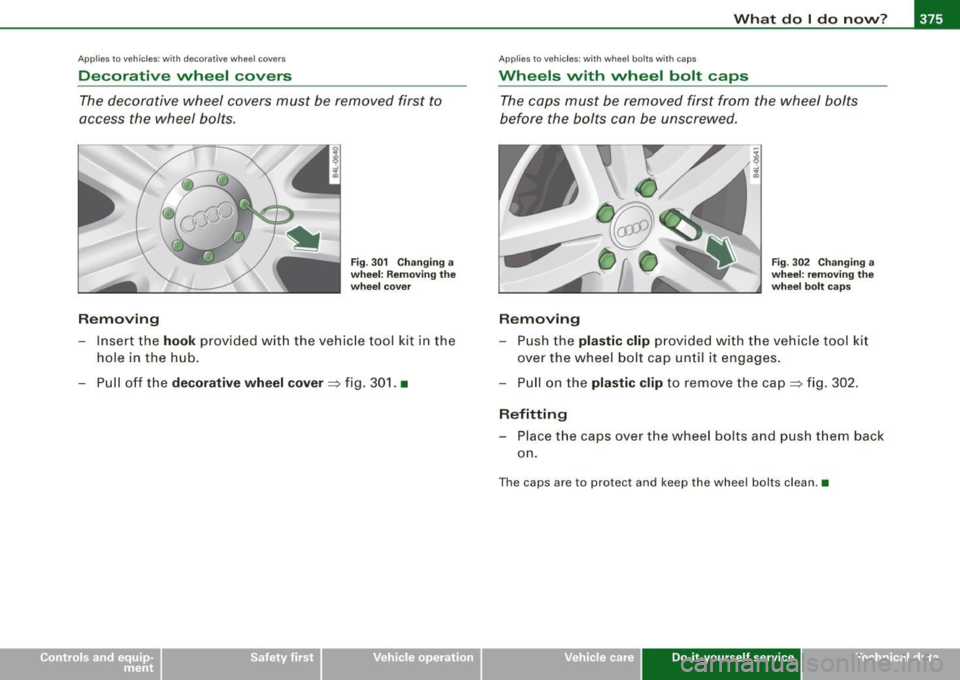
The decorative wheel covers must be removed first to
access the wheel bolts .
Removing
Fig. 301 Changing a
wheel: Removing the
wheel cover
- Insert the hook provided with the vehicle tool kit in the
hole in the hub.
- Pull off the
decorative wheel cover=> fig. 301. •
App lies to veh ic les: w ith w hee l bo lts with caps
Wheels with wheel bolt caps
The caps must be removed first from the wheel bolts
before the bolts can be unscrewed .
Removing
Fig. 302 Changing a
wheel: removing the
wheel bolt caps
-Push the plastic clip provided with the vehicle tool kit
over the w heel bolt cap until it engages.
- Pull on the
plastic clip to remove the cap => fig. 302.
Refitting
- Place the caps over the wheel bolts and push them back
on.
The ca ps are to pro tect and ke ep the wheel bolts clean. •
Vehicle care Do-it-yourself service irechnical data
Page 379 of 426
_____________________________________________ W_ h_ a_t _d_ o_l _ d_o _ n_o_ w_ ? _ __._
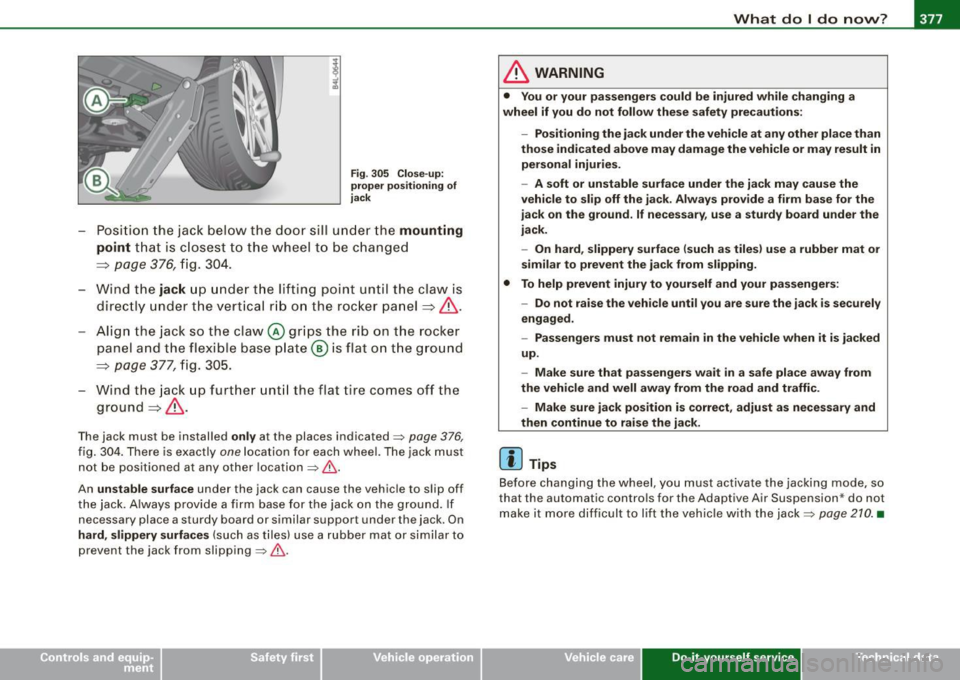
Fig. 30 5 Close- up:
prope r po sit io ning of
jack
- Posi tion the jack b elow the doo r sill u nder t he mounting
point
t ha t is clos est to the w hee l to be cha nged
==> p age 376, fi g. 30 4.
- Wind the jack up un der the liftin g p oint un til the c law is
d ir ect ly un der t he ver tical rib on th e ro cke r pane l==:> & .
- Align t he jack so the claw@ grip s the rib on th e rocke r
pane l and th e fl exible base plate @ is flat o n the gr oun d
==> page 3 77, fig. 30 5.
- Wind t he jack up furt her u ntil the flat ti re come s off the
g roun d==:> & .
The jack must be instal led only at the places indicated=> pa ge 376,
fi g. 30 4. T here is e xactl y on e loca tion for each w heel. The jack must
not be positioned at any oth er location =:>& .
A n
unstable surface under the jack can cause the vehic le to s lip off
the ja c k. Al ways pro vid e a firm base for the jack on t he grou nd. If
necessary place a sturd y board or s imilar sup port under the jack. On
hard , slippery surface s {such as tile s) us e a rub ber mat or s imi lar to
p revent the jack from slipping =:>& .
& WARNING
• You or your passengers could be injured wh ile changing a
wheel if you do not follow these safety precautions:
-Positioning the jack under the vehicle at any othe r place than
those indicated above may damage the vehicle or may result in personal injuries.
- A soft or unstable surface under the jack may cause the
vehicle to slip off the jack . Always provide a firm base for the
jack on the ground. If necessary, use a sturdy board under the
jack.
- On hard, slippery surface (such as tiles ) use a rubber mat or
similar to prevent the jack from slipping .
• To help prevent injury to yourself and your passengers:
-Do not raise the vehicle until you are sure the jack is securely
engaged.
- Passengers must not remain in the vehicle when it is jacked
up.
- Make sure that passengers wait
in a safe place away from
the vehicle and well away from the road and traffic.
- Make sure jack position is correct, adjust as necessary and
then continue to rai se the jack.
[ i ] Tips
B efore c hang in g the whee l, you must activate the jac king mode, so
that the au tomatic con trols for the Adaptive Air Suspension * do not
m ak e it mo re diff icu lt to lif t the v ehic le wi th t he jack =:>
page 210. •
Vehicle care Do-it-yourself service irechnical data