service AUDI Q7 2009 Owner´s Manual
[x] Cancel search | Manufacturer: AUDI, Model Year: 2009, Model line: Q7, Model: AUDI Q7 2009Pages: 426, PDF Size: 97.13 MB
Page 381 of 426
_______________________________________________ W_ h_ a_t _ d_ o_ l _d _o_ n_ o _ w_ ? __ IIIII
•
- Let the compressor run until it has reached 50 PSI (3.5
bar). Switch the compressor off after running for 8
minutes at the most -danger of overheating!
& WARNING
The compressor and the tire filler hose can become extremely hot
while they are running -danger of burns!
0 Note
Switch the compressor off after running for 8 minutes at the most -
danger of overheating! Allow the compressor to cool down for a few
minutes before you use it again.
[ i] Tips
The compressor must not be connected to the cigarette lighter
socket, as this socket does not provide the required power .•
Tires with unidirectional tread design
Tires with unidirectional tread design must be mounted
with their tread pattern pointed in the right direction.
Using a spare tire with a tread pattern intended for use
in a specific direction
When using a spare tire with a tread pattern intended for use in a
specific direction, please note the following:
• The direction of rotation is marked by an arrow on the side of the
tire.
• If the spare tire has to be installed in the incorrect direction, use
the spare tire only temporarily since the tire will not be able to
achieve its optimum performance characteristics with regard to
aquaplaning, noise and wear. •
We recommend that you pay particular attention to this fact
during wet weather and that you adjust your speed to match road
conditions.
• Replace the flat tire with a new one and have it installed on your
vehicle as soon as possible to restore the handling advantages of a
unidirectional tire. •
Notes on wheel changing
Please read the information => page 359, "New tires and replacing
tires and wheels " if you are going to use a spare tire which is
different from the tires on your vehicle.
After you change a tire :
• Check the tire pressure on the spare immediately after installa
tion.
• Have the wheel bolt tightening torque checked with a torque
wrench as soon as possible by your authorized Audi dealer or a
qualified workshop.
• With steel and alloy wheel rims, the wheel bolts are correctly
tightened at a torque of 120 ft lb (160 Nm).
• If you notice that the wheel bolts are corroded and difficult to
turn while changing a tire, they should be replaced before you check
the tightening torque.
• Replace the flat tire with a new one and have it installed on your
vehicle as soon as possible. Remount the wheel cover.
Until then, drive with extra care and at reduced speeds .
& WARNING
• If you are going to equip your vehicle with tires or rims which
differ from those which were factory installed, then be sure to read
the information
=> page 359, "New tires and replacing tires and
wheels". ..
Do-it -yourself service
Page 383 of 426

_________________________________________________ F_ u_ s_ e_s _ a_n _d_ b_ u _ lb_ s _ __._
Fuses and bulbs
Fuses
Replacing a fuse
A problem in the electrical system may be caused by a
blown fuse.
Fig . 307 Ins trument
pa nel left: Face c over
F ig . 308 I nst rume nt
pa nel left: Co ntent
F ac e cover
- Locate the fuse which belongs to the component which
failed.
- Switch off the ignition and the e lectr ica l component
affected. - Carefully p
ry t he face cover off the instr umen t pane l
using the ignition key or a screwdriver~ fig. 307.
- Rem ove the plastic clip @ from i ts retainer in the face
cove r~ fig. 308, p lace i t over the questionable fuse and
remove the fuse.
- Replace a blown fuse (recognizable by the melted metal
str ip inside) wi th a f use of the
same amperage.
The individual circuits are protected by fuses. T he fuse panels with
the fuses are located on the left and right front faces of the instru
ment pane l behind a cover and in the right storage area in the
luggage compartment.
There is a plastic clip @ in the cover on the lef t side of the instru
ment pane l, which can be used to remove the fuses . The crank © is
used for emergency operation of the Panoramic sliding sun roof *.
You w ill also find a label on both covers in the instrument panel with
the fuse layout © for the corresponding fuse panel.
& WARNING
Nev er replac e a fuse with one that ha s a high er amperag e rati ng.
• A fu se w ith a to o high ampe rage could damage the ele ctr ical
pa rt a nd cause a fire .
0 Note
• On no account should fuses be repaired (e .g. patched up wi th tin
foil or wire) as this may cause serious damage elsewhere in the e lec
trica l circuit o r cause fire.
• If a fuse blows repeatedly, do not keep replacing it. Instead , have
the cause of the repea ted short circuit or overload located and fixed.
ti>
Vehicle care Do-it-yourself service Technical data
Page 385 of 426
Fuses and bul bs 11111 ________________________________ ..:....:,:_=-.::..:....:.;.:_.:..:..,_,;__,;____,J
....
No.
1
-
2
3
4
5
6
Eq uipm ent
Headlight electronic system (left side of vehi -
cle)
Adaptive Cruise Control
Not used
Audi lane assis t
Not used
Terminal 15 (interior)
Oil level sensor
8 Diagnostic connector
9 Automatic dipping interior mirror
10 Homelink
1 1 Control module Gateway
12 Headlight range adjustment
Amps
10
5
10
5
5
5
5
5
5
5
Fuse Location , Instrument Panel right
Fi g. 310 F use pane l
l ayo ut
Some of the equipment items listed are optional or only avai lable on
certain model configurations .
•
Note that th e fo llo wi ng ta ble is acc urate a t the time of goi ng to
pre ss and is subject to change. In th e event of di screpan cies, t he
l a b el on the ins ide o f th e cover a lw ays ta ke s prec eden ce.
The power seats are protected by circ uit breakers , which automati
ca lly reset af ter a few seconds after the overload has been reme
died .
No. Equipm ent
Fu se holder (bla ck )
1 Heated rear seats
2 Automatic transmission
3 Heated front seats
4 E lectronic Stability Program (ESP)
5 Door control module (right side of vehicle)
6 Rear electrical out
lets
7 Lumbar support passenger's seat
8 Cigarette lighter front
9 Front electrical outlets
10 A/C controls
1 1 Electronic Stabilization Prog ram (ESP),
Brake light switch
12 Inte lligent power modu le passenger
Fuse holder (brown )
1
2
3
Headlight electronic system (right side of vehi
cle)
Ride height adjustment
Telephone package
4 Audi side assist 5 E lectronic Stab ilizat ion Program (ESP)
Vehicle care Do-it-yourself service
Amps
20
5/10
30 20
15
25
10
20
25
10
5
15
1 0
5
5
5
5
-
irechnical data
Page 387 of 426

_________________________________________________ F_ u_ s_ e_s _ a_n _ d_ b_ u_lb _ s __ llll
No . Equipm ent Amps No. Equipm ent Amps
Fuse holder (brow n) 10 Trailer hitch (left side of vehicle) 20
1 Not used 11 Trailer hitch (right side of v ehicle) 20
2
Not used 12 Not used •
3 Not used
4 Not used Bulbs
5 K -box (MMll, antenna amplifier 5
Not used Replacing light bulbs
7 Navigation 5 For your safety, we recommend that you have your autho-
Digital Signal Processing (DSP)/ rized Audi dealer replace burned out bulbs for you .
8 BOSE amplifier 30
It is becoming increasingly more and more difficult to replace --
9 Digital Tuner 5 vehic le light bu lbs since in many cases, other parts of the car must
10 Bang & Olufsen amplifier 30 first be removed before you are able to get to the bulb. This applies
especially to the light bulbs in the front of your car which you can
11 Rear view camera 5 only reach through the engine compartment.
12 Not us ed
Sheet metal and bulb holders can have sharp edges that can cause
Fuse holde r (re d ) serious cuts, and parts must be correctly taken apart and then prop -
1 Not used erly put back together to he
lp prevent breakage of parts and long
term damage from water that can enter housings that have not
2 Not used been properly resealed.
3 Not used For your safety, we recommend that you have your authorized Audi
4 Not used dea
ler replace any bu lbs for you, since your dealer has the proper
tools, the correct bulbs and the expertise.
5 Not used Gas disch arge lamp s (Xeno n ligh ts)*:
6 Soft close 20 Due to the high electrica
l voltage, have the bulbs replaced by a qua I -
7 Power rear lid 30 ified technician. Headlights with Xenon light can be identified by the
8 Power rear lid 30 h igh voltage sticker . .,,,
9 Trailer hitch 15
• Do-it-yourself service
Page 389 of 426
________________________________________________ E _m_ e_r.:g :;,. e_ n_c ...: y:.- s_ i_ t _u _a_ t_ i_ o _ n_ s __ lll
•
Emergency situations
General
This chapter is intended for trained emergency crews and working
pe rsonnel who have the necessary tools and equ ipment to perform
these operations. •
Starting by pushing or towing
(D Note
You r ve hicle is eq uipped w ith an automatic trans missi on. C o nse
quent ly, the engine cannot be started by pushing or towing .•
Starting with jumper cables
If necess ary, the en gine can b e sta rted by conn ectin g it to
the battery of anothe r vehicle.
If th e engine should fail to start because of a discharged or weak
b at te ry, the batt ery ca n be co nnected t o the ba ttery of
another
vehicle, using a pair of jumper cables to start the engine .
Jumper cables
Use
only jumper cables of sufficiently large cross section to carry the
s tarte r curre nt safely. Refer t o the manu fac tu rer 's specif ica tions.
Use only ju mper cabl es with
insulated terminal clamps whic h are
distinct ly marked:
plus (+l cable in mo st cas es c olored red
minus
(- 1 cable in most cases colored black.
& WARNING
Batteries contain electricity, acid , and gas. Any of the se can cause
very ser ious or fatal injury . Follow the instructions below for safe
handling of your vehicle 's battery .
• Always shield your eyes and avoid leaning over the battery
whenever possible .
• A discharged battery can freeze at temperatures just below
32 °F (0 °C l. Before connecting a jumper cable , you must thaw the
frozen battery completely , otherwise it could explode .
• Do not allow battery acid to conta ct eyes or skin. Flush any
contacted area with water immediately.
• Improper use of a booster battery to start a vehicle may cause
an explosion.
• Vehicle batteries generate explosive gases . Keep sparks , flame
and lighted c igarettes away from batteries.
• Do not try to jump start any vehicle with a low acid level in the
battery.
• The voltage of the booster battery must also have a 12-Volt
rating. The capacity (Ah l of the booster battery should not be
lower than that of the discharged battery . Use of batteries of
different voltage or substantially different "Ah" rating may cause
an explosion and personal injury .
• Never charge a frozen battery. Gas trapped in the ice may cause
an explosion.
• Never charge or use a battery that has been frozen . The battery
c ase may have be weakened .
• Use of batter ies of different voltage or substantially different
c apacity (Ah l rating may cause an explosion and injury . The
capacity (Ahl of the booster batte ry should not be lower than that
of the discharged battery. _..
Do-it -yourself service
Page 391 of 426
________________________________________________ E _m_ e_r.:g :;,. e_ n_c ...: y:.- s_ i_ t _u _a_ t_ i_ o _ n_ s __ lfflll
•
Conn ect POSITIVE (+ ) to PO SITIVE (+ ) (r ed )
- Open the red cover on the pos itive pole => page 388,
fig. 312.
1. Connect one end of the positive cable (red) on the
jump
start bolt=>
page 388, fig. 3 13 G) (Bo lts under red cover
= "positive") of the vehicle to be started @.
2. Connect the other end to the positive terminal@ of the
booster battery ®·
Conn ect NEGATIVE (- ) to NEGATIVE (-) (black )
3. Connect one end to the negat ive termi nal 0 of t he
boos ter battery ®·
4 . Connect the other end of the negative cable (black) to the
jump sta rt bolt 0 (Bolts with hex head = "n egative") of
the vehicle to be s tarted @.
Startin g th e e ngin e
-Start the engine of the veh icle w ith the booster battery .
Run t he engine at a moderate speed .
- Start engine with discharged ve hicle battery in the usual
ma nner.
- If the engine fails to s tart: do not keep the star ter
cranking for longer than 10 seconds. Wait f or about
30 seconds and then try again.
- With engine running, remove jumper cables from both
vehicles in the exact reverse order.
- Close the red cover on the positive pole.
The battery is vented to the outside to prevent gases from entering
the vehic le interior . Make sure that the jumper clamps are well connected with their
metal parts in full contact with the battery
t erminals .
& WARNING
To avoid seriou s per sonal in jur y a nd d amage to the vehicle , heed
a ll wa rning s and in stru ction s o f th e jum per ca ble man ufa cturer . If
in doubt , call for ro ad serv ice.
• Jump er c able s must b e lo ng eno ugh s o that the vehi cle s do not
touch .
• When conne cting jumpe r cable s, ma ke sure th at the y cannot
g et caught in an y mo ving p arts i n the engine comp art m ent .
• Before you che ck anyth ing in the en gin e com partm ent , a lwa ys
r ea d and h eed all W ARNIN GS~ pag e 32 4, "E ngine compa rtm ent ".
0 Note
Improper hook -up of jumper cables can ruin the generato r.
• Always connect POSITIVE(+) to POS ITIVE( +), and NEGATIVE( -) to
NEGATIVE( -) ground post of the battery manager control unit.
• Check that al l screw p lugs on the battery ce lls are screwed in
firm ly . If not, tighten plugs prior to connecting clamp on negative
battery termi nal.
• Please note that the procedure for connecting a jumper cab le as
described above applies specifical ly to the case of your vehicle
being jump started. When you are giving a jump start to another
vehicle, do not connect the negative(-) cable to the negative (-1
terminal on the discharged battery©~ page 388, fig. 313. Instead,
securely connect the negative ( -1 cable to either a solid metal
component that is firmly bolted to the engine b lock or to the engine
block itself . If the battery that is being charged does not vent to the
outside, escap ing battery gas could ignite and exp lode! •
Do-it-yourself service
Page 393 of 426
________________________________________________ E_ m ___ e_r .::g :...e_ n _ c_,!y:._ s_ i_t _u _a_ t_ i_o _n_ s _--J_
- Screw the towing loop t ightly into the threaded hole as
far as it will go::::>
page 390, fig. 315.
When it is no longer needed, unscrew the towing loop and put it
back into the vehicle toolkit. Be sure to have the towing loop stored
in the vehicle at all times.
When installing the grill for the air duct, be sure that the tabs on the
gril l are first inserted into their guides on the vehicle above the
fog lamp. Then position the opposite side of the grill
=> page 390,
fig. 314 ® and push it firmly into its guide.
& WARNING
If the towing loop is not screwed in as far as it will go, the thread
can pull out when the vehicle is towed -potential risk of an
accident. •
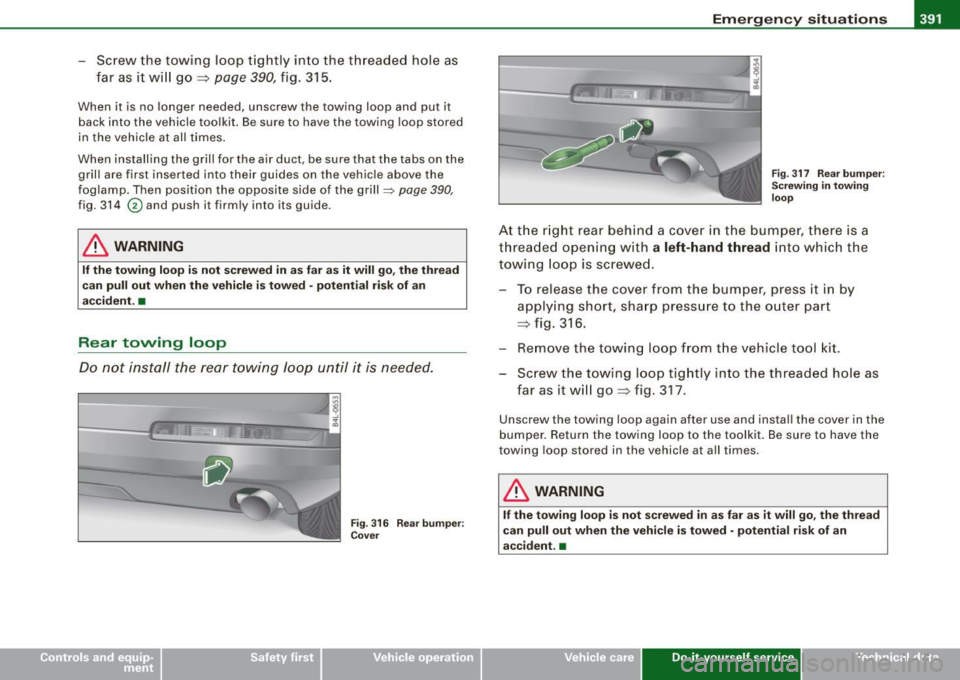
Rear towing loop
Do not install the rear towing loop until it is needed.
Fig. 316 Rear bumper:
Cover Fig
. 317 Rear bumper:
Screwing in towing
loop
At the right rear behind a cover in the bumper, there is a
threaded opening with
a left-hand thread into which the
towing loop is screwed.
- To release the cover from the bumper, press it in by
applying short, sharp pressure to the outer part
==> fig. 316.
- Remove the towing loop from th e vehicle tool kit.
- Screw the towing loop tightly into the threaded hole as
far as it will go ::::> fig. 317.
Unscrew the towing loop again after use and instal l the cover in the
bumper. Return the towing loop to the toolkit. Be sure to have the
towing loop stored in the vehicle at all times .
& WARNING
If the towing loop is not screwed in as far as it will go, the thread
can pull out when the vehicle is towed -potential risk of an
accident. •
Vehicle care Do-it-yourself service irechnical data
Page 395 of 426
________________________________________________ E _m_ e_r.:g :;,. e_ n_c ...: y:.- s_ i_ t _u _a_ t_ i_ o _ n_ s __ lllll
•
- Inse rt a rubbe r pad betwee n th e floo r ja ck/work shop
h oi st an d the lift ing p oin ts.
If you must lift your vehicle with a floor jack to wo rk underneath , be
sure the veh icle is safely supported on stands intended for this
purpose .
Front lifting point
T he lift ing p oint i s located o n th e flo or pan rei nforce men t about at
the same l eve l as th e jac k m ounting point=> page
392 , fig. 3 19 . Do
not lift the vehicle at the vertical sill reinforcement.
Rear lifting point
The li fti ng poi nt is located on the ve rt ical re in forceme nt of t he low er
sill for the on board jack=> page
392 , fig. 320.
Lifting with vehi cle ja ck
R efer to => page
376 .
& WARNING
• To reduce the risk of serious injury and vehicle damage.
-Always l ift the vehicle only at the special workshop hoist and
floor jack lift points illustrated => page
392 , fig. 319 and
=> page
392 , fig. 320.
- Failure to lift the vehicle at these points could cause the
vehicle to tilt or fall from a lift if there is a change in vehicle
weight distribution and balance . This might happen , for
e x ample , when heavy components such as the engine block or
transmission are removed .
• When remo ving heavy components like these, anchor vehicle
to hoist or add correspond ing we ights to maintain the center of
gravity. Otherwise , the vehicle might tilt or slip off the hoi st,
c ausing serious personal injury .
0 Note
• Be awar e of the fo llow ing po ints before l ifting t he ve hicle:
- The vehicle should never be lifted or jacked up from unde r
neath the engine oil pan , the transmission housing , the front or
rear a xle or the body side members. This could lead to serious
damage.
- To avoid damage to the underbody or chassis frame, a rubber
pad must be in serted between the floor jack and the lift po ints .
- Before driving over a workshop ho ist, check that the vehicle
weight does not exceed the permissible lifting capacity of the hoist.
- Before driving over a workshop hoist , ensure that there is
sufficient clearance between the hoist and low parts of the
vehicle. •
Do-it-yourself service
Page 399 of 426
_________________________________________________ G_ e_ n_ e_r _a _l_ i_n _f_o _ r_ m_ a_ t _i _o _ n __ ll'II
v e hic le identificatio n number of your vehic le (p erforation) as well as
th e G ro ss V ehic le We ight Rat ing (GVWR) an d the Gro ss A xle We ig ht
R ating (GAWRl .
The high voltage warning label is located on the lock carrier.
The spark ignition system complies with the Canadian standard ICES-002 . •
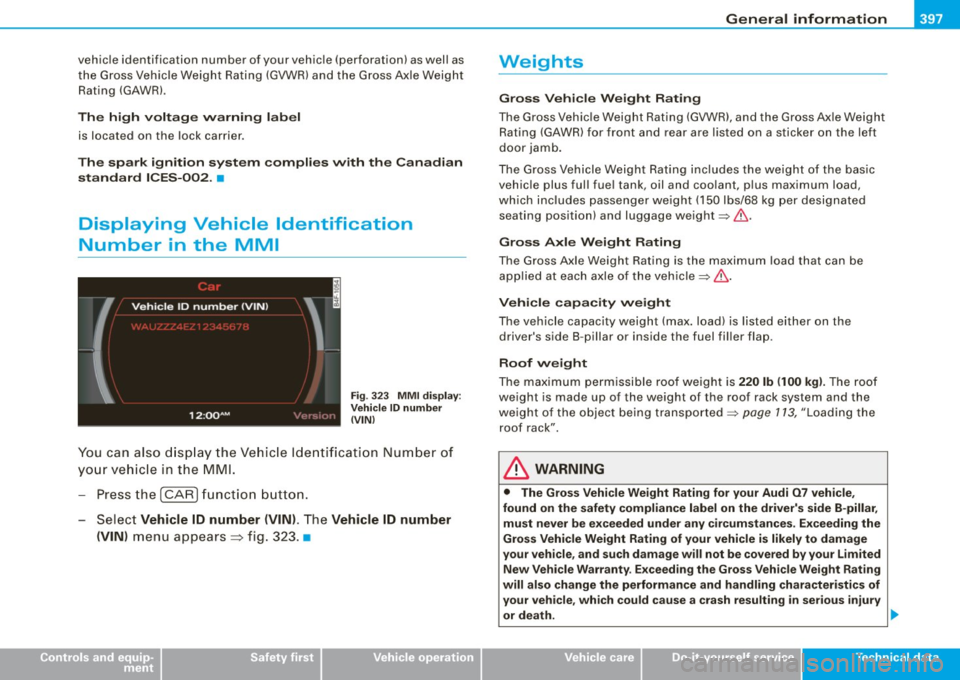
Displaying Vehicle Identification
Number in the MMI
Fig . 323 MMI di splay :
Vehicle ID number
(VIN)
Y ou can also display t he Vehi cle Id ent ifi catio n Num ber of
y o ur vehi cle in the MM I.
- Pre ss th e
(CA RI fun ctio n bu tton.
- Selec t
Vehicle ID number (VIN) . The Vehicle ID number
(VIN)
m enu appea rs=> fig. 3 23 . •
Controls and equip
ment Safety first Vehicle operation
Weights
Gross Vehicle Weight Rating
The G ross Ve hicle We ight Rating (GVWR), a nd the Gross A xle Weight
R ating (GAW R) for front and rear are l isted on a stic ker on the left
doo r jamb .
T he G ross Ve hicle We igh t R ating includes t he weight o f the bas ic
vehic le plus full fue l tank , oil and coo lant, p lus maximum load,
w hi ch includes passe nger we ight (1 50 lbs/68 kg per des ignat ed
seat ing position) and luggage weight:::::,&.
Gross Axle Weight Rating
The Gross Axle Weight Rating is the maximum load that can be
ap plied at each axl e of the vehicle:::::, .&,.
Vehicle capacity weight
The vehic le capacity weig ht (max. load) is list ed e ither on the
driver's side B -pillar or ins ide the fuel fi ller flap.
Roof weight
The maxi mum pe rm is s ible roof we ig ht i s 220 lb (100 kg ). The ro of
we ight is made up of th e wei ght of t he roof rack system an d the
we igh t of t he o bjec t being tra nspo rted :::::, page 1 13, "Lo adi ng the
roo f rack".
& WARNING
• The Gross Vehi cle Weight Rating for your Audi 07 vehi cle ,
found on the safety compliance label on the driver's side B -pillar ,
must never be exceeded under any circumstances . Exceeding the
Gross Vehicle Weight Rating of your vehicle is likely to damage
your vehicle , and such damage will not be covered by your Limited
New Vehicle Warranty . Exceeding the Gross Vehicle Weight Rating
will also change the performance and handling characteristics of
your veh icle , which could cause a crash resulting in serious injury
or death. .,_
Vehicle care Do-it-yourself service Tec hn ica l da ta
Page 401 of 426
_____________________________________________________ D_a_ t_ a __ lffllll
Data
280 hp, 6 -cylinder engine, with all wheel drive
Engine data
Maximum output SAE net
Maximum torque SAE net
No. o f cy li n ders
Displacement
Stroke Bore
Compression ratio
Fuel
Dimensions (approx .)
Length (with lice nce plate bracket)
Width (with outside mirrors fo lded)
Height (unloaded)
Turning circle d iameter (curb to curb)
Capacities (approx .)
Fuel tank
- Total capacity
- Reserve (of total capacity)
Wind shield and headlight * wa sher fluid container
Engine oil
with fi lter change
Controls and equip
ment Safety first
hp@rpm
lb
-ft@ rpm
C ID (cm
3
)
in (mm)
in (mm) 280@ 6200
266@2750
6 cy
lind er
219 .5 (3597)
3 .65 (96 .4)
3.50 (89)
12 .0 : 1
Premium unleaded (91 AKO Recommended for maximum engine pe rformance . Fur
ther details~
page 325, "Gasoline"
i n ( mm)
i n (mm)
in (mm)
ft ( ml 200
.2 (5086)
78 .1 (1983)
68 .4 (1 737)
36.4 (12)
gal ( liters)
gal !liters)
quarts (liters)
quarts !liters) 26
.4 (100)
2 .6 -3 .2 (10 -12)
4.8 (4.5)
7 .3 (6 .9)
•
Vehicle operation Vehicle care Do-it-yourself service Tec hn ica l da ta