service AUDI Q7 2009 Owner´s Manual
[x] Cancel search | Manufacturer: AUDI, Model Year: 2009, Model line: Q7, Model: AUDI Q7 2009Pages: 426, PDF Size: 97.13 MB
Page 249 of 426

__________________________________________________ A_ i_ r _b _a...; g::- s_ y=--- s_t _e _m __ l!ftlll
Whe n a person is detected on the front passenger seat, weighing
more than the to tal weight of a child t hat is about 1 year old
restrained in one of the rear-facing or forward -facing infant
restraints (listed in Federa l Motor Vehicle Safety Standard 208 with
which the Advanced Airbag System in your vehicle was certified), the front airbag on the passenger side may or may not deploy .
The
PA SSENGER AIR BAG OFF light comes on when the e lectronic
control unit detects a total weight on the front passenger seat that
requires the front a irbag to be turned off . If the
PA SSENGER AIR BAG
O FF
light does not come on, the front airbag on the passenger side
has not been tu rned off by the contro l u nit and can dep loy if the
control unit senses an impact that meets the conditions stored in its
memory .
I f the total weight on the front passenger seat is more than that o f
a typical
1 year -old, but less than the we ight of a small adult, the
front airbag on the passenger side may dep loy (the
PA SS ENGER AIR
BAG OFF
l ight does not come on).
For example , the airbag may deploy if :
• a small ch ild that is heavier than a typ ical 1 year-o ld child is on
the front passenger seat (regardless of whether the child is in one
of the child sa fety seats listed ~ page 265),
• a child who has outgrown child res traints is on the front
passenger seat.
I f the front passenger airbag is turned off, the
PASSENGER AIR BAG
O FF
light in the cen ter of the instrument panel wi ll co me on and stay
on .
T he front airbag on the passenge r side may
not deploy (the
PASS ENGER AIR BAG OFF light does not illuminate and stay lit) if:
• a small adult or teenager is on the front passenger seat
• a passenger who is not sitting upright with their back against a
non -reclined backrest with their feet on the vehicle floor in front of
the seat is on the front passenger seat.
I f the front passenger airbag dep loys, the Federal Standard requires
the airbag t o meet the "low risk" deployment criteria to help reduce
Controls and equip ment Safety first Vehicle operation the risk of injury through interaction with the airbag
. "Low risk"
dep loyment occurs in those crashes that ta ke place at l ower decel
erations as defined in the electronic contro l unit .~ page 252
Al way s remembe r: Even though your vehicle is equipped with
Advanced Airbags, the safes t place for chi ldren is properly
restrained on the back seat. Please be sure to read the important
informat ion in t he sections tha t follow a nd be sure to heed a ll of the
WARNINGS.
& WARNING
To reduce the risk of injury when an airbag inflates , always wear
s afety belts prope rly.
• If you are unrestrained , leaning forward , sitt ing s ideways or out
of position in any w ay, your risk of injury i s mu ch higher .
• You will al so receive se riou s injurie s and could even be killed if
you are up against the airbag or too clo se t o it when it inflate s -
even with an Advanced Airbag=> page 241 .
& WARNING
A child in a rearward -facing child safety seat in stalled on the front
pa ssenge r seat will be ser iou sly injured and can be killed if the
front airb ag inflate s -even with an Advanced Airbag System .
• Although the Advan ced Airbag S ystem in your vehicle is
de signed to turn off the front airbag when a rearward -fa cing child
restraint h as been in stalled on the front pa ssenger seat , nobod y
c an ab solutely guarantee that deployment i s impo ssible in all
c onceivable situations that may happen during the useful life of
your vehicle .
• The inflating airbag will hit the ch ild s afety seat or inf ant
c arrier with great force and will smash the chi ld safety seat and
c hild ag ain st the ba ckre st, center a rm re st, door , or roof .
• Always in stall rearward -fa cing child restraints on the rear seat ....
Vehicle care Do-it-yourself service Technical data
Page 251 of 426

__________________________________________________ A_ i _r_b _a...; g::-- s_ y =--- s_t _e _m __ ffllll
passeng er seat shou ld be turn ed off or not~ page 243 , "Ch ild
restr aint s o n the fro nt seat - some impor tant thin gs to know".
• A sensor in the safety belt latch fo r the d rive r and for the front
s e at pass enger th at s enses wh ether th at safe ty belt i s la tch ed o r not
and transmits this information to the e lectronic contro l unit.
& WARNING
Damage to the front passenger seat can prevent the front airbag
from working properly .
• Improper repair or disassembly of the front passenger and
driver seat will prevent the Advanced Airbag System from func
tioning properly .
• Repairs to the front passenger seat must be performed by qual
ified and properly trained workshop personnel .
• Never remove the front passenger or driver seat from the
vehicle.
• Never remove the upholstery from the front passenger seat .
• Never disassemble or remove parts from the seat or disconnect
wires from it.
• Never carry sharp objects in your pockets or place them on the
seat . If the weight-sensing mat in the passenger seat is punctured
it cannot work properly.
• Never carry things on your lap or carry objects on the
passenger seat . Such items can increase the weight registered by
the weight-sensing mat and send the wrong information to the
airbag control unit .
• Never store items under the front passenger seat . Parts of the
Advanced Airbag System under the passenger seat could be damaged , preventing them and the airbag system from working
properly.
• Never place seat covers or replacement upholstery that have
not been specifically approved by Audi on the front seats.
Controls and equip ment Safety first
Vehicle operation
& WARNING (continued)
• Seat covers can prevent the Advanced Airbag System from
recognizing child restraints or occupants on the front passenger
seat and prevent the side airbag in the seat backrest from
deploying properly.
• Never use cushions, pillows, blankets or similar items on the
front passenger seat. The additional padding will prevent the
weight-sensing mat in the seat from accurately registering the
child restraint or person on the seat and prevent the Advanced
Airbag System from functioning properly .
• If you must use a child restraint on the front passenger seat
and the child restraint manufa cturer's instructions require the use
of a towel , foam cushion or something else to properly position
the child restraint, make certain that the PASSENGER AIR BAG OFF
light comes on and stays on whenever the child restraint is
installed on the front passenger seat.
• If the PASSENGER AIR BAG OFF light does not come on and stay
on , immediately install child restraint in a rear seating position
and have the airbag system inspected by your authorized Audi
dealer .•
How the Advanced Airbag System
components work together
T he front Advance d Airbag System and the si de ai rbags s upple m ent
the p rotection offe red by the front thre e-point safety belts with
p retensioner s and load limiters and the adjustable head restraints
to hel p re d uc e th e ris k o f inj ury i n a w ide ra nge o f accid ent a nd
crash situations. Be s ure to read the important info rmation about
saf ety an d hee d the WARNI NGS in thi s c hap ter.
De ployment of th e Advanc ed Airbag System and the activation of
t he sa fe ty be lt pretensi oners de pend on the de ce lerat io n m easur ed
by the crash sensors and registered by the el ectronic control unit. _,
Vehicle care Do-it-yourself service Technical data
Page 253 of 426
Airbag system -----------------=---=---
or the lower parts of the body. Front airbags suppl em ent the three
poi nt s afet y be lts o nly in s ome fro ntal c oll isi ons i n whi ch the v ehicl e
deceleration is hi gh enough to d eploy the airbags .
Front airbags will not deploy:
• if the ignition is switched off when a crash occurs
• i n sid e collisi ons
• i n rea r- e nd collisi ons
• in ro llovers
• when the cras h de celer ation me asured b y th e a ir bag sy ste m i s
less than the minimum threshold nee ded for airbag dep loyment as
r egi stere d by t he ele ctronic control un it
The front passenger airbag also will not deploy :
• when the front p assenger s eat i s not o cc up ied
• whe n the weig ht on th e front pass enger seat as se nsed by t he
Adva nced A irb ag System indi cate s that the fr ont airba g on the
p as se n ge r side h as to be turned off b y the e lectronic cont rol unit
(the PASSENGER AIR BAG OFF l ig ht co me s on and stays on )
& WARNING
Sitting in the wrong position can increase the risk of serious injury
in crashes .
• To reduce the risk of injury when the airbags inflate , the driver
and passengers must always sit in an upright position , must not
lean against or place any part of their body too close to the area
where the airbags are located .
• Occupants who are unbelted , out of position or too close to the
airbag can be seriously injured by an airbag as it unfolds with
great force in the blink of an eye
~ page 243.
Controls and equip ment Safety first
Vehicle operation
& WARNING
A child in a rearward-facing child safety seat installed on the front
passenger seat will be seriously injured and can be killed if the
front airbag inflates - even with an Advanced Airbag System .
• The inflating airbag will hit the child safety seat or infant
carrier with great force and will smash the child safety seat and
child against the backrest , center arm rest , door or roof.
• Always install rear-facing child safety seats on the rear seat .
• If you must install a rearward -facing child safety seat on the
front passenger seat because of exceptional circumstances and
the PASSENGER AIR BAG OFF light does not come on and stay on, immediately install the rear-facing child safety seat in a rear
seating position and have the airbag system inspected by your
authorized Audi dealer .
& WARNING
Objects between you and the airbag will in crease the risk of injury
in a crash by interfering with the way the airbag unfolds or by
being pushed into you as the airbag inflates .
• Never hold things in your hands or on your lap when the vehicle
is in use.
• Never transport items on or in the area of the front passenger
seat. Objects could move into the area of the front airbags during
braking or other sudden maneuvers and become dangerous
projectiles that can cause serious personal injury if the airbags
inflate .
• Never place or attach accessories or other objects (such as
cupholders , telephone brackets, large, heavy or bulky objects) on
the doors, over or near the area marked "AIRBAG" on the steering
wheel , instrument panel , seat backrests or between those areas
and yourself . These objects could cause injury in a crash , espe-
cially when the airbags inflate . ...
Vehicle care Do-it-yourself service Technical data
Page 255 of 426

Airbag syst em -----------------=~-
& WARN ING (co ntinued)
po ssib le th at the airb ag will inf late wh en it is not suppo sed to , or
will not inflate when it should.
• Hav e the air bag sy stem in spe cted immedi ate ly by y our autho
ri zed Audi de aler. •
PASSENGER AIR BAG OFF light
Fig. 253 S ecti on from
t he in strum ent pan el:
PA SS ENGER A IR B AG
OFF light
The PA SS ENGER AIR BA G OFF light is located in the center o f the
instrument pane l
~ fig. 253.
The
PA SSENGER AIR BAG OFF light wil l come on and stay on to tel l
you when the front Advanced Airbag on the passenger side has
been turned off by the electronic control unit. Each time you turn on
the ignition, the
PA SS ENGER AIR B AG OFF light wi ll flash for a few
seconds and:
• will stay on if the front passenger seat is not occupied
• will stay on if there is a small child or chi ld restraint on the front
passenger seat
• will go out if the front passenger seat is occupied by an adult as
registered by the weight-sensing mat
T he
PAS SENGER AIR BAG OFF light mu st co me on and sta y on if the
ign ition is on and
Controls and equip
ment Safety first
Vehicle operation
• a car bed has been installed on the front seat. or
• a rearward-facing chi ld restraint has been insta lled on the front
passenger seat, or
• a forward-facing child restraint has been insta lled on the front
passenger seat, or
• the weight registered on the front passenger seat is equal to or
less than the combined weight of a typica l 1 year -old restrained in
one of the rear-fac ing or forward -facing in fant restraints listed in
Federal Motor Vehicle Safety Standard 208 with which the Advanced
Airbag System in your vehicle was certified .
I f the front passenger seat is not occupied, the front airbag will not
deploy, and the
PA SS ENGER AIR BAG OFF light wi ll stay on. Never
install a rearward-facing child restraint on the front passenger seat,
the safest place for a child in any kind of child restraint is at one of
the seating positions on the rear seat~
page 243, "Child restraints
on the front seat -some important things to know" and~
page 263,
"Chi ld Safety".
If the PAS SEN GER AIR BAG OFF light come s on when one of the
conditions lis ted above is me t, be sure to check the ligh t regu lar ly
to make certain that the
PA SS ENGER AIR BA G OFF light stays on
continuously whenever the ignition is on. If the
PASSENGER AIR
BAG OFF
light does not appear on and does not stay on all the time,
stop as soon as i t is safe to do so and
• react ivate the system by turning the ignition of f and then turning
it on again;
• remove and reinstall the child restraint. Make sure that the ch ild
restraint is properly installed and that the safety belt for the front
passenger seat has been correctly routed through the chi ld restra int
as described in the child restraint manufacturer's instructions;
• make sure that the convertible locking feature on the safety belt
for the front passenger seat has been activated and that the safety
belt has been pulled tight. The belt must not be loose or have loops
of slack so that the sensor be low the safety belt latch on the seat can
do its job~
page 273. •
Vehicle care Do-it-yourself service Technical data
Page 257 of 426

Airbag system -----------------=~-
& WARNING (continued )
• Always install forward or rear-facing child safety seats on the
rear seat -even with an Advanced Airbag Sy stem.
• If you must install a rearward -facing child safety seat on the
front passenger seat because of exceptional circumstances and
the PASSENGER AIR BAG OFF light does not appear and stay on,
immediately inst all the rear -facing child safety seat in a rear
seating position and have the airbag system inspected by your
authorized Audi dealer.
• A tight tether or other strap on a rearward-facing child restraint
attached to the front pas senger seat can put too much pressure
on the weight-sensing mat in the se at and reg ister more weight
than is actually on the seat. The heavier weight registered can make the system work as though an adult were on the seat and
deploy the Advanced Airbag when it must be suppressed causing
serious or even fatal injury to the ch ild .
• If, in exceptional circumstance s, you must install a forward
facing child restraint on the front passenger seat, always move the
seat into its rearmost position in the seat's fore and aft adjust
ment range , as far away from the airbag as possible . The backrest
must be adjusted to an upright position . Make sure that the
PASSENGER AIR BAG OFF light comes on and stays on all the time
whenever the ignition is switched on .
& WARNING
• If the PASSENGER AIR BAG OFF light does not go out when an
adult is sitting on the front passenger seat after taking the steps
described above, make sure the adult is properly seated and
restrained at one of the rear seating positions .
• Have the airbag sy stem inspected by your authorized Audi
dealer before transporting anyone on the front passenger seat .
Controls and equip ment Safety first
Vehicle operation
[ i ] Tips
If th e we ight-se nsing mat in t he front passenger seat detects an
e m pty seat, the front airbag on the passenger si de wil l be turned
o ff , a nd t he
PASSENGER AIR BAG OFF lig ht will stay on. a
Repair, care and disposal of the airbags
Pa rts o f the airba g syste m are in sta lled a t many d ifferent places on
your Audi. Insta lling, removing, servicing or repa ir ing a part in an
ar ea of the ve hicle ca n dama ge a par t of a n airbag sys te m and
prevent that system from wor king properly in a co llision.
There are so me i mpor ta nt thi ngs you have to know to make sure
that the effectiveness of the system w ill not be impaired and that
d iscarded components do no t cause inju ry o r po llute the e nvir on
m ent.
& WARNING
Improper care , servicing and repair pro cedures can increase the
risk of personal injury and death by preventing an airbag from
deploying when needed or deploying an airbag unexpectedly :
• Never cover, obstruct, or change the steering wheel horn pad
or airbag cover or the instrument panel or modify them in any way .
• Never attach any objects such as cupholders or telephone
mountings to the surfaces covering the airbag units .
• For cleaning the horn pad or instrument panel , use only a soft ,
dry cloth or one moistened with pla in water . Solvents or cleaners
could damage the airbag cover or change the stiffness or strength
of the material so that the airbag cannot deploy and protect prop
erly .
• Never repair , adjust , or change any parts of the airbag system .
• All work on the steering wheel , instrument panel, front seats or
electrical system (including the installation of audio equipment ,
~
Vehicle care Do-it-yourself service Technical data
Page 258 of 426
-L~A:::..:,: ir:....: b:!..::: a~g L.:: s:1y :...:s::..: t~ e:.: m:...:...:.. ________________________________________________ _
& WARN ING (continued )
cellular telephones and CB radios , et c.) must be performed by a
qualified technician who has the training and spec ial equipment
ne cessary .
• For any work on the airbag system , we strongly recommend
that you see your author ized Audi dealer or qual ified workshop .
• Never modify the front bumper or parts of the vehicle body.
• Always make sure that the side airbag can inflate without inter
ference :
- Never install seat covers or replacement upholstery over the
front seatba cks that have not been spe cific ally approved by
Audi.
- Never use additional seat cushions that cover the areas
where the side airbags inflate.
- Damage to the original seat covers or to the seam in the area
of the side airbag module must always be repaired immedi
ately by an authorized Audi dealer .
• The airbag system can be activated only once. Afte r an airbag
has inflated , it must be replaced by an authorized Audi dealer or
qualified technician who has the te chnical information , training
and spe cial equipment necessary.
• The airbag sy stem can be deployed only once. After an airbag
has been deployed , it must be repla ced with new repla cement
parts designed and approved especially for your Audi model
version . Replacement of complete airbag systems or airbag
components must be performed by qualified workshops only .
Make sure that any airbag service action is entered in your Audi
Warranty
& Maintenan ce booklet under AIRBAG REPLACEMENT
RECORD .
• For safety reasons in severe accidents , the alternator and
starter are separated from the vehicle battery with a pyrotechni c
c ircuit interrupter.
- Work on the pyrotechni c circuit interrupter must only be
performed by a qualified dealer -risk of an accident!
& WAR NING (continued )
-If the vehicle or the circuit interrupter is s crapped , all appli
cable safety precautions must be followed.
ffi For the sake of the environment
Undeployed airbag modules and pretensioners might be c lassified
as Pe rchlorate Material -special handling may apply, see
www .dtsc.ca .gov/hazardouswaste/perc hlo ra te . When t he veh icle or
parts of the restraint system inc luding airbag mod ules and safety
be lts wi th pre tensio ners are sc rapp ed, all ap plicab le laws a nd regu
l ations must be observed . Your authorized Audi dealer is fam iliar
wit h these requir ements an d we re co mmen d t hat yo u have your
dea ler perform this service for you. •
Other things that can affect Advanced Airbag
performance
Changing the veh ic le 's su spension system can change the way that
th e Advanced Air bag Syste m performs in a c rash. Fo r example,
using tire-rim combinations not approved by Audi, lowering the
v eh ic le, c hang ing the stif fness of th e suspe nsio n, in cl ud in g the
springs, suspension struts, shoc k absorbers etc . can change the
fo rces that a re m eas ure d b y the air bag senso rs and se nt to the elec
tronic control unit. Some suspension changes can, for example,
increa se the fo rce level s measured by the sen so rs and ma ke the
a irbag syste m dep loy in crash es in which it wou ld not dep loy if the
changes ha d not been made . Othe r kinds of change s may red uce
t he fo rce lev els measu red by the se nso rs a nd preve nt the airba g
from deploying when it should.
T he sens ors i n th e safe ty bel t buc kle for th e driver a nd fr ont
passenger seat tell the electronic control modu le if the safety belt is
l a tc h ed or not. I f th e safe ty belt is being used, the fron t airbag wi ll
deploy at a slight ly h igher rate of vehic le dece leration than if the
sa fe ty be lt is n ot b ein g use d. Therefore, i n a partic ular c ollisi on, it i s -.,
Page 259 of 426
possible that an airbag will not deploy at a seating position where
the safety belt is being used but will inflate at the position where the
safety belt is not being used . It is important that nothing interfere
with the safety belt buckles so that the sensors can send the correct
information about safety belt use to the electronic control unit .
& WARNING
Changing the vehicle's suspension including use of unapproved
tire -rim combinations can change Advanced Airbag performance
and increase the risk of serious personal injury in a crash.
• Never install suspension components that do not have the
same performance characteristics as the components originally
installed on your vehicle.
• Never use tire-rim combinations that have not been approved
by Audi.
& WARNING
Items stored between the safety belt buckle and the center
console can cause the sensors in the buckle to send the wrong
information to the electronic control module and prevent the
Advanced Airbag System from working properly.
• Always make sure that nothing can interfere with the safety
belt buckles and that they are not obstructed.
as Perchlorate Material -special handling may apply, see
www.dtsc .ca.gov/ha zardouswaste/perchlorat e. When the vehicle or
parts of the restraint system including airbag modules and safety
belts with pretensioners are scrapped, all applicable laws and regu
lations must be observed. Your authorized Audi dealer is familiar
with these requiremen ts and we recommend that you have your
dealer perform this service for you.•
Safety first
Side airbags
Description of side airbags Airbag
system
The airbag system
can provide supplemental protection
to properly restrained occupants.
Fig . 254 Side airbag
location in the driver's
sea t
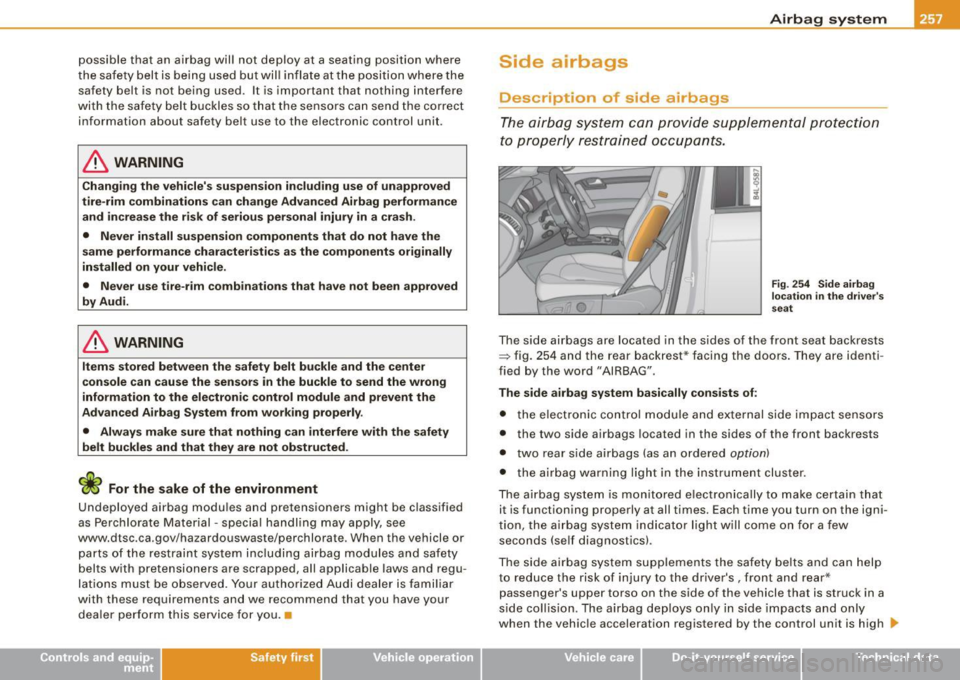
The side airbags are located in the sides of the front seat backrests
~ fig. 254 and the rear backrest * facing the doors . They are identi
fied by the word "AIRBAG" .
The side airbag system basically consists of:
• the electronic control module and external side i mpact sensors
• the two side airbags located in the sides of the front backrests
• two rear side airbags (as an ordered
option)
• the airbag warning light in the instrument cluster.
The airbag system is mon itored e lectronica lly to make certain that
it is functioning prop erly at all times. Each time you turn on the igni
tion, the airbag system indicator light will come on for a few
seconds (se lf diagnostics) .
The side airbag system supplements the safety belts and can help
to reduce the risk of injury to the driver's , front and rea r*
passenger's upper torso on the side of the vehicle that is struck in a
s ide collision . The airbag dep loys on ly in side impacts and only
when the vehicle acceleration registered by the control unit is high
~
Vehicle care I I irechnical data
Page 261 of 426

__________________________________________________ A_ i_ r _b _a...; g::- s_ y=--- s_t _e _m __ lJ!III
When the system is triggered , the airbag is f ill ed with propel lant gas
and br eaks t hroug h a seam in the seat surface area marked
" AIRBAG ". It expands between the side trim panel and the
passenger . In order to he lp provide this additional protection, the
side airbag must inflate within a frac tion of a second at very high
speed and w ith great force . The supplemental side airbag could
injure you i f your seating position is not proper or upright or i f items
are located in the area where the supplemental side airbag expands .
This app lies especia lly to children ~ page 263 , "Child Safety".
Suppl em ental sid e airbags inflate betw een the occupant and the
door panel on the s ide of the veh ic le that is struck in certain side
collision
~ page 258, fig. 255 .
A lthough they are not a soft pi llow, they can "cus hion" the impact
and in this way they can he lp to reduce the risk of injury to the upper
part of the body.
A fine dust may develop when the airbag deploys. This is normal and does not m ean there is a fire in the vehicle . •
Important safety instructions on the side
airbag system
Airbags are only supplemental restraints . Always prop
erly wear safety belts and ride in a proper seating posi
tion .
There is a lo t t ha t you and you r passengers mus t know a nd act
according ly to he lp th e sa fety belts and airbags do th eir job to
prov ide supp lemental pro tec tion .
& WARNING
An inflating side airbag can cause seriou s or fatal injury. Improp
erly wearing safety belts and improper seating posit ions increa se
the ri sk of serious personal injury and death whenever a vehicle is
being u sed .
Controls and equip ment Safety first
Vehicle operation
& WAR N ING (continued )
• In order to redu ce the risk of injury when the supplement al s ide
airbag infl ates :
- Alway s sit in an upright position and never lean against the
a rea where the supplement al s ide airbag is lo cated .
- Never let a child or anyone else rest their head against the
side t rim panel i n the area where the supplemental side airb ag
inflates.
- Always make sure that safety belts are worn corre ctly ,
- Do not let anyone sitting in the front seat put their hand or
any other parts of their bod y out of the window.
• Alway s make sure that the side airbag can inflate without inter
ference .
- Ne ver in stall se at cover s or repla cement upholste ry o ver the
front seat back s that have not been specifically approved by
Audi .
- Never use additional seat cushion s that cover the areas
where the side airbag s deploy .
- Dama ge to the original seat covers or to the seam in the a rea
of the side airb ag module must always be repaired immedi
ately by an authori zed Audi dealer .
• Obje cts bet ween you and the airbag can in crease the ri sk of
injury in an accident by interfering wi th the way the a irbag unfolds
or by be ing pu shed int o yo u as the airb ag inflat es.
- Never place or atta ch acce ssorie s or other object s (such as
c up holders , telephone bra ckets , or even lar ge, bul ky obje cts )
on the doors , over or near the area marked "AIRBAG" on the
se at backre sts .
- Su ch ob ject s and acces sories can be come dangerou s projec
tile s and cau se injury when the supplemental side airbag
deploys. _.
Vehicle care Do-it-yourself service Technical data
Page 265 of 426

_______________________________________________ C_h _ i_ld _ S_ a_ f_ e_ t..,:c y __ lfflllll
Child Safety
Important things to know
Introduction
The rear seat is generally the safes t place in a collision.
The p hysica l pr inciples of what happens when you r veh ic le is in a
crash apply also to children => page
233, "What happens to occu
pa nts not wearing safety bel ts?" . But un like adults and teenagers,
their musc les and bones are not fully developed. In many respects
children a re a t greater ris k of serious injury in cras hes than a dults .
B ecause chi ldren's bodies are no t fully deve loped, they require
restraint systems especial ly designed for their size, weight, and
body structu re. Ma ny countries and al l sta tes of the U nited States
and provinces of Canada have laws requiring the use of approved
chil d restraint sys te m s for infa nts and smal l children .
I n a frontal crash at a speed of 20 -35 mph (30 -56 km/h) the forces
acting on a 13-pou nd (6 kg) infant wi ll be mo re than 20 times the
weight of the child. This means the weight of the child would
suddenly be more than 260 pounds ( 120 kg). Under these condi
t ions, only an appropriate child restraint proper ly used can reduce
the risk of serious injury. Child restraints, like adult safety belts,
must be used properly t o be effective. Used impro perly, they can
increase the risk of serious injury in an accident.
Co nsul t the c hild safety seat man ufacture r's ins truc tions to be su re
the seat is right for your child's size=> page 266, "Important safety
instructions for using child safety seats" . Please be sure to read and
heed a ll of the important information and WARNI NGS about child
safety, Advanced Airbags, and the insta llation of child restraints in
this chapter.
T here is a lot you need to know about the Advanced Airbags in your
veh ic le and how they work whe n inf an ts and ch ild ren in c hild
restraints are on the front passenger seat. Because of the large
Controls and equip ment Safety first Vehicle operation amoun
t of important informat ion, we cannot repeat it all here. We
urge you to read the detai led information in this owner's manua l
about a irbags and the Advanced Airbag Sys tem in your ve hic le and
the very important information about transporting children on the
fr ont passenger sea t. Please b e sure to hee d th e WAR NINGS -th ey
are extreme ly important for your safety and the safety of your
p asse ngers, es pecia lly inf ant s and s mall ch ildren .
& WARNING
• Accident statistics have shown that children are generally safer
in the rear seat area than in the front seating position . Always
restrain any child age 12 and under in the rear.
• All vehicle o ccupants and especially children must be
restrained properly whenever riding in a vehicle . An unrestrained
or improperly restrained child could be injured by striking the inte
rior or by being ejected from the vehicle during a sudden
maneuver o r impact . An unrestrained or improperly restrained
c hild is also at greater risk of injury or death through conta ct with
an inflating a irbag .
• A suitable child restraint properly installed and used at one of
the rear seating positions provides the highest degree of protec
tion for infants and small children in most ac cident situations .
& WARNING
Children on the front seat of any car even with Advanced Airb ag s
c an be seriously injured or even killed when an airbag inflates . A
child in a rearward -fa cing child safety seat installed on the front
pas senger seat will be seriously injured and can be killed if the
front airbag inflates.
• The inflating airbag will hit the ch ild safety seat or infant
carrier with great force and will sma sh the child safety seat and
child against the backrest , center arm rest , or door. •
Vehicle care Do-it-yourself service Technical data
Page 267 of 426

-------------------------------------------~C::._! h~ i~ ld ~ S~ a~ f~e :_!t tY ~--
restraints and for the different models of the same kind of child
restraint offered by child restraint manufacturers.
The weight ranges for the individual types, makes and models of
child restraints that the NHTSA has specified in the Safety Standard
together with the weight ranges of typ ical infants and typical 1 year
old child have been stored in the control unit of the Advanced
Airbag System. When a child restraint is being used on the front
passenger seat with a typical 1 year -old child, the Advanced Airbag
System compares the weight measured by the weight sensing mat
with the information stored in the electronic control unit.
The electronic control unit also registers the tension on the front
passenger safety belt. The tension on the safety belt for the front
passenger seat will be different for an adult who is properly using
the safety belt as compared to the tension on the belt when it is
used to attach a child restraint to the seat. The sensor below the
latch for the safety belt for the front seat passenger measures the
tension on the belt . The input from this sensor is then used with the
weight to "decide" , whether there is a child restraint with a typical 1
year-old child on the front passenger seat and whether or not the airbag must be turned off.•
Child restraints and Advanced Airbags
Regardless of the child restraint that you use, make sure that it has
been certified to meet United States Federal Motor Vehicle Safety
Standards and has been certified by its manufacturer for use with
an airbag. Always be sure that the chi ld restraint is properly
installed at one of the rear seating positions. If in exceptiona l
circumstances you must use it on the front passenger seat, carefully
read all of the information on child safety and Advanced Airbags
and heed a ll of the applicable WARNINGS. Make certain that the
child restraint is correctly recognized by the weight -sensing mat
inside the front passenger seat, that the front passenger airbag is
turned off and that the airbag status is always correctly signaled by
th e
PASSENGER AIR BAG OFF light .
Controls and equip
ment Safety first Vehicle operation
Many
types and models of child restraints have been available over
the years, new mode ls are introduced regularly incorporating new
and improved designs and older mode ls are taken out of produc
tion. Child restraints are not standardized . Child restraints of the
same type typically have different weights and sizes and different
'footprints,' the size and shape of the bottom of the chi ld restraint
that sits on the seat, when they are installed on a vehicle sea t. These
differences make it virtual ly impossible to certify comp liance with
the requirements for advanced airbags with each and every child
restraint that has ever been sold in the past or will be sold over the
course of the usefu l life of your vehic le.
For this reason, the United States National Highway Traffic Safety
Administration has pub lished a list of specific type, makes and
models of child restraints that must be used to certify compliance
of the Advanced Airbag System in your vehicle with the suppression
requirements of Federal Motor Vehicle Safety Standard 208. These
child restraints are:
A. Car beds, manufactured on or after September 1,
2004:
• Cosco Dream Ride 02-719
B. Rear facing child restraint systems, manufactured
on or after September 1, 2004:
(When the restraint system comes equipped with a removable base,
compliance has to be certified with or without the base) .
• Britax Handle with Care 191
• Century Assura 4553
• Century Smart Fit 4543
• Cosco Arriva 02727
• Evenflo Discovery Adjust Right 212
• Evenflo First Choice 204
• Graco lnfant8457
Vehicle care Do-it-yourself service Technical data