seats AUDI Q7 2009 Owner´s Manual
[x] Cancel search | Manufacturer: AUDI, Model Year: 2009, Model line: Q7, Model: AUDI Q7 2009Pages: 426, PDF Size: 97.13 MB
Page 284 of 426
___ C_h_ i_ld _ S_ a_ f_ e_ t-= y'------------------------------------------------
Mounting and releasing the anchorage hook
If you use a child restraint system with hooks or other
latches attached to adjustable strops.
Mounting
- Press the anchorage hook with the spring catch release
onto the lower anchorage so that the anchorage hook
locks into place.
Pull on the anchorage hook to make sure that it has
securely engaged the lower anchorage.
- Tighten the strap following the child restraint manufac
turer's instructions.
Releasing
Loosen the tension on the strap following the child
restraint manufacturer's instructions.
- Depress the spring catch on the hook.
- Hold the spring catch in depressed position.
- Move the hook in the direction of the vehicle floor so that
there is enough space to release the anchorage hook
from the lower anchorage.
& WARNING
• Improper installation of child restraints will increase the risk of
injuries in a crash.
• Always refer to the child restraints manufacturer's instructions
for proper installation of the child restraint and proper use of the
lower anchorages or safety belts in your vehicle. •
Tether anchors
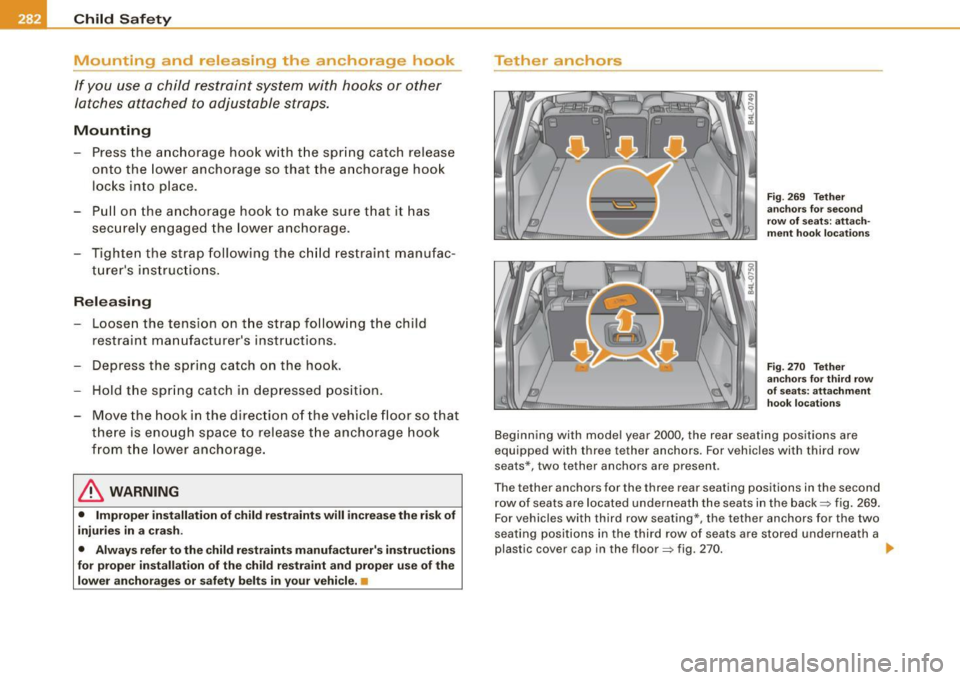
Fig. 269 Tether
anchors for second
row of seats: attach
ment hook locations
Fig. 270 Tether
anchors for third row
of seats: attachment
hook locations
Beginning with model year 2000, the rear seating positions are
equipped with three tether anchors. For vehicles with third row
seats*, two tether anchors are present.
The tether anchors for the three rear seating positions in the second
row of seats are located underneath the seats in the back=> fig. 269.
For vehicles with third row seating*, the tether anchors for the two
seating positions in the third row of seats are stored underneath a
plastic cover cap in the floor=> fig. 270. .._
Page 285 of 426
& WARNING
Improper installation of child restraints will increase the risk of
injury and death in a crash.
• Improper use of child restraint anchors (tether anchors) could
lead to injury in a collision. The anchors are designed to withstand
only those loads imposed by correctly fitted child restraints .
• Never mount two child restraint systems on one LATCH lower
anchor point .
• Never attach two child restraint systems to one tether strap or
tether anchorage .
• Always follow the instructions provided by the manufacturer of
the child restraint you intend to install in your Audi .
• Never use child restraint tether anchorages to secure safety
belts or other kinds of occupant restraints.
• Never attach a tether strap to a tie-down hook in the luggage
compartment.
• Never secure or attach any luggage or other items to the LATCH
lower anchorages or to the tether anchors.
• If a tether or other strap is used to attach a child restraint to the
front passenger seat, make sure that it is not so tight, that it causes the weight-sensing mat to measure more weight than is
actually on the seat.
• The heavier weight registered can make the system work as
though an adult were on the seat and deploy the Advanced Airbag
when it must be suppressed causing serious or even fatal injury to
the child. •
Safety first
Child Safety
Tether strap
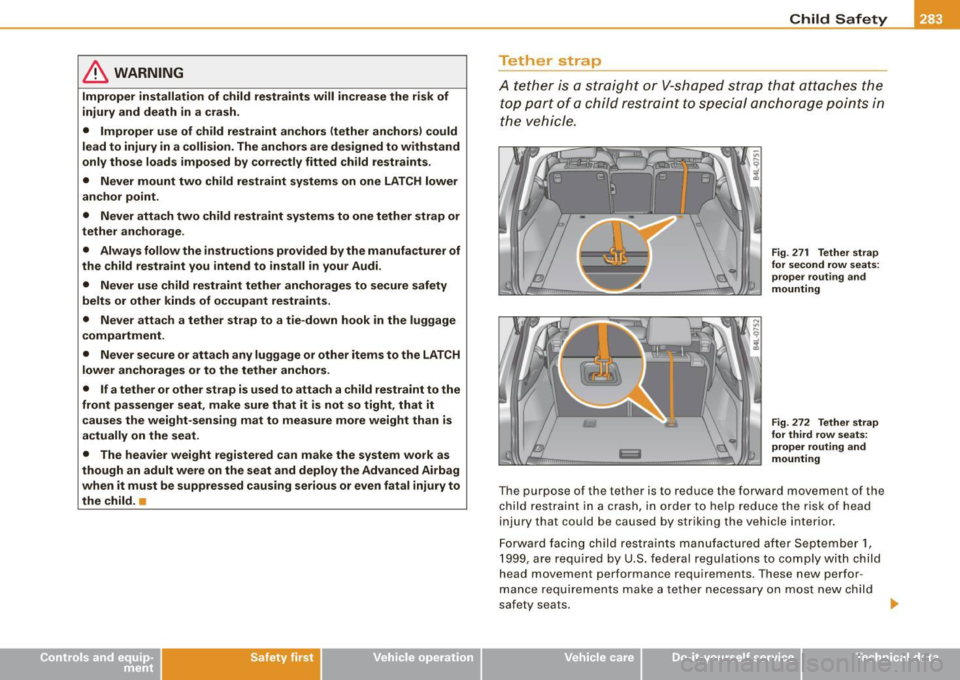
A tether is a straight or V-shaped strap that attaches the
top part of a child restraint to special anchorage points in
the vehicle.
Fig . 271 Tether strap
for second row seats:
proper routing and
mounting
Fig . 272 Tether strap
for third row seats:
proper routing and
mounting
Th e purpose of the tether is to reduce the forward movement of the
child restraint in a crash, in order to help reduce the risk of head
injury that could be caused by striking the vehicle interior.
Forward facing child restraints manufactured after September 1,
1999 , are required by U.S. federal regulations to comply with child
head movement performance requirements. These new perfor
mance requirements make a tether necessary on most new child
safety seats.
~
Vehicle care I I irechnical data
Page 287 of 426
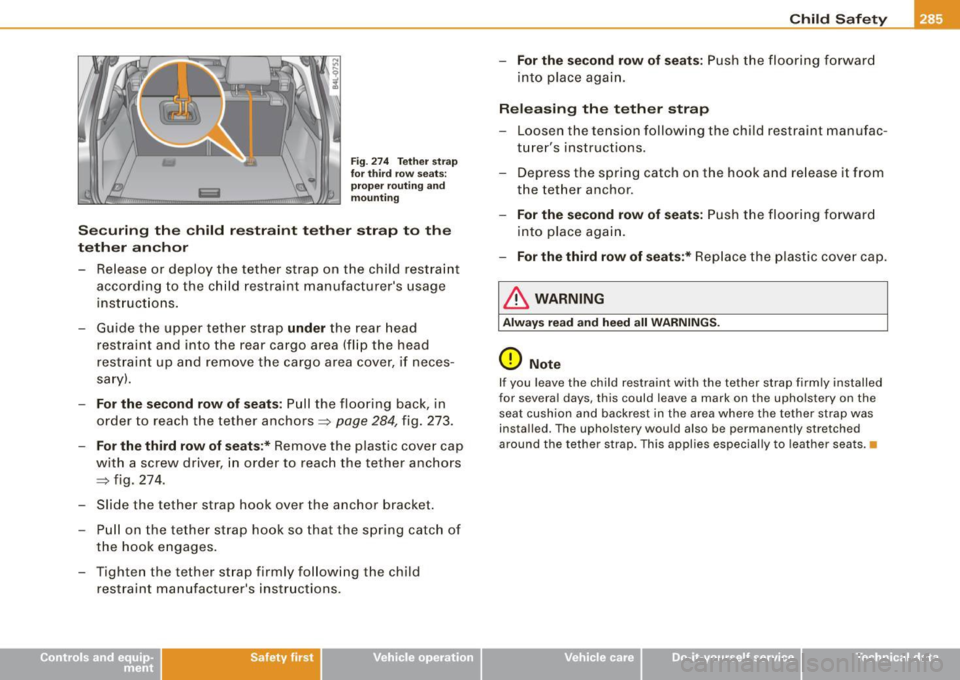
Fig. 274 Tether strap
for third row seats:
proper routing and
mounting
Securing the child restraint tether strap to the
tether anchor
- Release or deploy the tether strap on the child restraint
according to the child restraint manufacturer's usage
instructions.
- Guide the upper tether strap
under the rear head
restraint and into the rear cargo area (flip the head
restraint up and remove the cargo area cover, if neces
sary).
- For the second row of seats: Pull the flooring back, in
order to reach the tether anchors~
page 284, fig. 273.
-For the third row of seats:* Remove the plast ic cover cap
with a screw driver, in order to reach the tether anchors
~ fig. 274 .
- Slide the tether strap hook over the anchor bracket.
- Pull on the tether strap hook so that the spring catch of
the hook engages.
- Tighten the tether strap firmly following the child
restraint manufacturer's instructions.
Safety first
Child Safety
-For the second row of seats: Push the flooring forward
into place again.
Releasing the tether strap
- Loosen the tension following the ch ild restra int manufac
turer 's instructions.
- Dep ress the spring catch on the hook and release it from
the tether anchor.
- For the second row of seats: Push the flooring forward
into place again.
- For the third row of seats:* Replace the plastic cover cap.
& WARNING
Always read and heed all WARNINGS.
0 Note
If you leave the child restraint with the tether strap firmly installed
for several days, this could leave a mark on the uphols tery on the
seat cushion and backrest in the area where the tether strap was
ins talled . The uphols tery would also be permanen tly st ret ched
around the tether strap. This applies especially to leather seats.•
Vehicle care
I I irechnical data
Page 298 of 426
llffl __ ln_ t _e_ ll-'"ig ...,_ e_ n_t _t_ e_ c_ h _ n_o _ l_o _,.g= y,_ __________________________________________ _
Vehicle stands for an extended period
If you do not drive your vehicle over a period of several days or
weeks, electrical components are gradually cut back or switched off.
This reduces energy consumption and maintains starting capability
over a longer period.
Take into consideration that when you unlock your vehicle, some
convenience functions, such as the remote key or power seat
adjustment, may not be available. The convenience functions will be
available again when you turn on the ignition and start the engine.
With the engine turned off
If you listen to the radio, for example, with the engine turned off or
use other MMI functions, the battery is being discharged.
If starting capability is jeopardized due to energy consumption, the
following warning appears in the MMI display:
Please start engine, otherwise system will switch off in
3 minutes.
The warning indicates that the system will be turned off automati
cally after 3 minutes. If you wish to continue using the functions,
you have to start the engine.
With the engine running
Although electrical energy is generated when the vehicle is being
driven, the battery can become discharged. This happens mostly
when little energy is being generated and a great deal consumed and the battery's state of charge is not optimal.
To bring the energy balance back into equilibrium, consumers
which require especially large amounts of energy are temporarily
cut back or switched off. Heating systems in particular require a
great deal of energy. If you notice, for example, that the heated
seats* or the heated rear window are not heating, they have been
temporarily cut back or switched off. These systems will be available
again as soon as the energy balance has been restored.
You will also notice that engine idle speed has been increased
slightly. This is normal and not a cause for concern. By increasing engine idle speed the additional energy required is generated and
the battery is charged. •
Driver notification in the instrument cluster
display
If battery power drops into the range where it can limit the ability of
the engine to start, this is shown in the instrument cluster display
with the following driver message:
C Low battery charge: battery will be charged while driving
This notification reminds you that the starting capability of the
engine may be limited. As soon as you start driving again, the
battery will be recharged and the notification will go out.
Driver notification appears and goes out again
If this driver notification appears after the ignition is turned on or
while driving and it goes out again after a while, the battery has
been adequately recharged.
Driver notification appears and does not go out again
If this driver notification appears after the ignition is turned on or
while driving and does not go out again, the battery's state of
charge is not in the optimal range. Starting ability is restricted. Have
the battery checked as soon as possible by an authorized Audi dealer or qualified workshop. •
Page 321 of 426
_____________________________________________ C_ l_ e _a_ n_ in_ g_a _ n_d_ p_ r_ o_ t _e_ c_t _io _ n __ lftlll
•
Any damage to the undercoating caused by road hazards should be
repa ired promptly.
& WARNING
Too mu ch undercoating in the wro ng pl ace s can cause a fir e.
• Do not appl y ad ditional und ercoating or ru stproofing on or
n ea r the e xhaus t man ifold , ex haust pipe s, catalyt ic c onverter or
heat shields . While d riving , the s ub stan ce used for undercoating
c ould overheat and cau se a fire.
• Alw ays read and heed all WARNINGS and other informat ion
=> pag e 312 . •
Care of interior
MMI display
- C lean the M MI display with a soft c lean cloth and an LCD
cleaner.
The MM I display can be cleaned with a professional ly available "LCD
cleaner". The clot h should be s lightly dampened with the c leaning
fluid to clean the display.
0 Note
T o avoid scratching the MMI display, you should never c lean it dry. •
MMI terminal
- First clean the MMI terminal with a brush to remove dust
from the housing . T
hen w ipe the MM I terminal wit h a clean, so ft, s light ly
dam p cloth.
The M MI termina l shou ld be c leaned w ith a brush first so that no
dirt is trapped between the buttons and the housing. We recom
mend giving the MMI terminal a fina l w ipe with a c loth moistened
with water and dish washing detergent.
0 Note
To prevent damage, make sure that no fluid ever gets into the MMI
terminal. •
Aluminum trim
Use only neutral -pH produc ts to remove spots and deposits from
aluminum surfaces. Chrome care products and alkaline cleaners
wi ll attack aluminum surfaces and can damage them over time.
& WARNING
Al way s read and h eed all WARNINGS and oth er information
=> page 31 2. •
Fabrics and fabric coverings
Fabrics and fabric coverings (e.g . seats, door trim panels, etc.)
shou ld be c leaned at regular inte rvals with a vacuum cleaner . This
removes surface dirt particles which could become embedded in
the fabric th rough use. Steam cleaners shou ld not be used, because
the steam tends to push the dirt deeper into the fabric and lock it
there .
~
Vehicle care I t •
Page 323 of 426
Cleaning and protection IJI
----------------=-----=------
•
Applie s to vehicles: with natural leather
Natural leather
Audi makes great efforts to maintain the properties,
natural look and feel of interior leather.
General
We offer many different types of leather on our vehicles. Most are
different types of nappa leather, which has a smooth surface and
comes in various colors.
The intensity of the color determines the visua l characteristics and
appearance. If the surface of the leather has a typica l natural look,
then the leather is a nappa leather that has been left in a re latively
natural condition. This leather offers particular ly good comfort and
breathes well. Fine veins, closed grains, insect bites, skin folds, and
subtle variations in color remain visible. These characteristics
demonstrate that the material is natural.
Natura l nappa leather is not covered by a color finish. It is therefore
more sensitive to soiling and wear, which is something you need to
consider if children, animals or other factors might prove to be
particularly hard on the leather .
By contrast, leather types that are covered by a colored finish layer
are more durable. This has a positive effect on the leather's resis
tance to wear and soiling in daily use . On the other hand, the typical
characteristics of natural leather are barely or not apparent.
However, this does not mean that the leather itself is of inferior
quality.
Care and handling
Because of the exclusive nature of the types of leather that Audi
uses and their unique properties (such as sensitivity to oils, grease,
soiling, etc.l, you will need to be somewhat careful with these
leathers, and a certain type of care is required. For example, dark
clothing materials can discolor leather seats (especial ly if such
clothing is damp and was not dyed correctly) . Dust and dirt particles in pores, folds, and seams can have an abrasive effect and can
damage the leather surface as well as weaken seams
.
The leather should be cleaned regularly as needed . After having
been used for a relatively long time, your leather seats will acquire
a rich aged finish. This is a characteristic of natural leather and a
sign of true quality.
In order to maintain the value of this natural product over the life of
your vehicle, you should follow the recommendations below:
0 Note
• To keep your leather from bleaching out, do not allow it to be
exposed to bright sun light for long periods of time. If you have to
leave the vehicle parked outside for long periods, cover the leather
to protect it from direct exposure to sunlight.
• Sharp objects on clothing, such as zippers, rivets or sharp pieces
on belts can leave permanent scratches or scrape marks on the
surface of the leather.
[ i ] Tips
• After each time you clean the leather and at regular intervals, use
a leather preservative creme that contains UV -blockers and that
works into the leather . This creme wil l nourish and moisturize the
leather, helping it to breathe and stay supple. It also helps to build
up a protective coating on the surface .
• Clean the leather every 2 -3 months, and clean any areas that get
soiled.
• Remove fresh marks made by ballpoint pens, ink, lipstick, shoe
polish, etc. as soon as possible .
• Preserve the color of the leather as needed by using a special
colored leather care creme to touch up areas of uneven color. •
Vehicle care I t •
Page 350 of 426
-~_T_ ir_e_ s_ a_ n_d _ w_ h_ e_e _l_s _________________________________________________ _
& WARNING (continued)
crashes and serious personal injuries . Have worn or damaged tires
replaced immediately.
• Tires age even if they are not being used and can fail suddenly,
especially at high speeds. Tires that are more than 6 years old can
only be used in an emergency and then with special care and at
low speed.
Glossary of tire and loading terminology
Accessory weight
means the combined weight (in excess of those standard items
which may be replaced) of automatic transmission, power steering,
power brakes, power windows, power seats, radio, and heater, to
the extent that these items are available as factory-installed equip
ment (whether installed or not).
Aspect ratio means the ratio of the height to the width of the tire in percent.
Numb ers of 55 or lower indicate a low sidewall for improved
steering response and better overall handling on dry pavement.
Bead
means the part of the tire that is made of steel wires, wrapped or reinforced by ply cords and that is shaped to fit the rim.
Bead separation means a breakdown of the bond between components in the bead.
Cord
means the strands forming the plies in the tire.
& WARNING (continued)
• Never mount used tires on your vehicle if you are not sure of
their "previous history." Old used tires may have been damaged
even though the damage cannot be seen that can lead to sudden
tire failure and loss of vehicle control.
• If you notice unusual vibration or if the vehicle pulls to one side
when driving, always stop as soon as it is safe to do so and check
the wheels and tires for damage . •
Cold tire inflation pressure
means the tire pressure recommended by the vehicle manufacturer
for a tire of a designated size that has not been driven for more than
a couple of miles (kilometers) at low speeds in the three hour period
before the tire pressure is measured or adjusted.
Curb weight means the weight of a motor vehicle with standard equipment
including the maximum capacity of fuel, oil, and coolant, air condi
tioning and additional weight of optional equipment.
Extra load tire
means a tire design to operate at higher loads and at higher infla
tion pressures than the corresponding standard tire. Extra load tires
may be identified as "XL",
"xi", "EXTRA LOAD", or "RF" on the side
wall.
Gross Axle Weight Rating ("GAWR")
means the load-carrying capacity of a single axle system, measured
at the tire -ground interfaces.
Gross Vehicle Weight Rating ("GVWR"l
means the maximum total loaded weight of the vehicle.
Page 358 of 426
-~_T_ ir_e _s_ a_n_ d_ w_ h _e_e_ l_ s _______________________________________________ _
The Gross Veh icl e We ight Rating and the Gross Axle Weight Rating
ar e l isted on th e safe ty comp lia nce st icker labe l located ei ther on
the driver's side 8 -p illar or on the inside of the fue l filler flap. Your
Audi has 5 seating positi ons, 2 in the fron t and 3 in the rea r for total
seating capacity of 5 . On vehicles with s ix seats*, your ve hicle has
two front seats, two seats in the second row seating an d two sea ts
i n t he t hir d row seating. On ve hic les w ith seven seats*, your ve hicle
has two front seats, three seats in the second row seating and two
seats in the th ir d row sea tin g. Eac h seat ing pos it ion has a seat belt
=>
page 231, " S afety belts".
T he fact that there is a n upper l imit to your ve hicle's Gro ss Vehic le
Weight Rating means that the total we ight of whatever is bein g
carried in the vehic le ( including the we ig ht of a t rai le r h itc h a nd the
t on gue wei ght o f the load ed trai ler) is lim ited. The more passen ge rs
in the ve hicle o r passe nger s w ho are heavier t han the s tanda rd
we ights assumed mea n th at l ess wei ght ca n be ca rri ed as lu gg age .
Th e tire pressure labe l on your Audi also lists the maximum
co mbi ned we igh t of all o f th e occ upa nts a nd luggage o r othe r ca rgo
that the vehicle can carry. For the location of the label=>
page 351,
fig . 291 .
LJ}. WARNING
Overloading a vehicle can cause loss of vehicle control , a crash or
other accident , serious personal injury , and even death .
• Carrying more weight than your vehicle was designed to carry
will prevent the vehicle from handl ing properly and increase the
ri sk of the loss of vehicle control.
• The brakes on a vehicle that has been overloaded may not be
able to stop the vehicle within a safe distance.
• Tires on a vehicle that has been overloaded can fail suddenly ,
including a blowout and sudden deflation , causing loss of control
and a crash .
• Always make sure that the total load being transported -
including the weight of a trailer hitch and the tongue weight of a
& WARNING (continued)
loaded trailer -does not make the vehicle heavier than the
vehicle's Gross Vehicle Weight Rating .•
Determining correct load limit
Use the example below to calculate the
total weight of the passengers and
luggage or other things that you plan to
transport so that you can make sure that
your vehicle will not be overloaded.
Steps for Determining Correct
Load Limit
1. Locate the statement "THE COMBINED WEIGHT OF OCCUPANTS AND CARGO SHOULD NEVER EXCEED XXX KG OR XXX LBS"on your vehicle's placard (tire infla
tion pressure label)=>
page 351, fig. 291.
2. Determine the combined weight of the driver and passengers that will be riding
in your vehicle.
~
Page 384 of 426
lllftl.,___F_ u_ s_ e_s _ a_n _ d_ b_ u_lb _ s _______________________________________________ _
[ i J Tips
You are well advised to keep a supply of spare fuses in your vehicle .
Fuses with the proper ampere ratings are available at your autho
rized Audi dealer. •
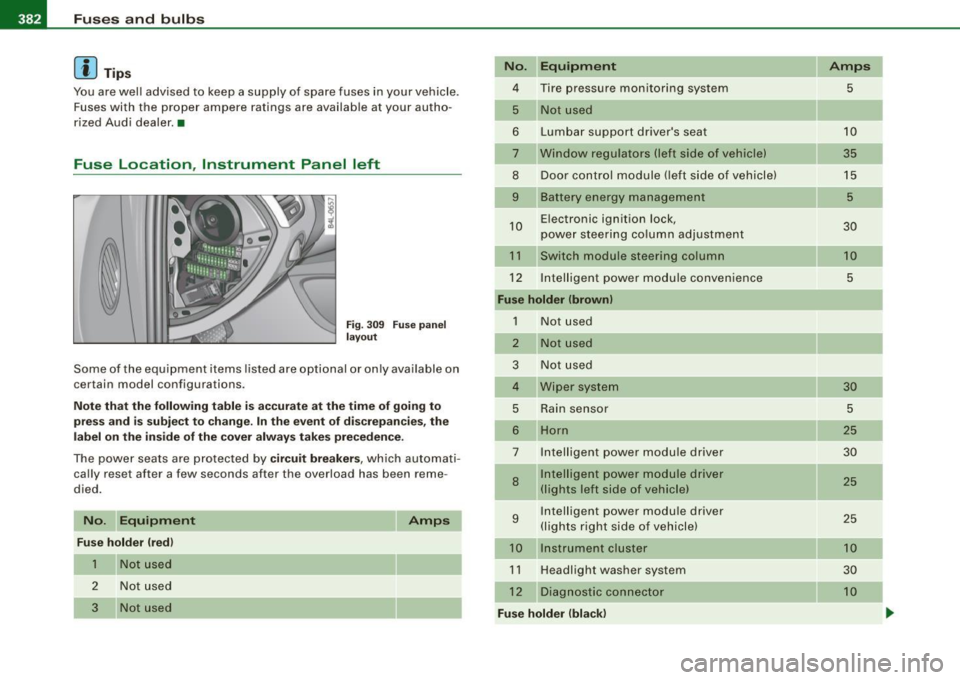
Fuse Location, Instrument Panel left
Fig . 309 Fuse panel
layout
Some of the equipment items listed are optional or only available on
certain model configurations .
Note that the following table is accurate at the time of going to
press and is subject to change. In the event of discrepancies, the
label on the inside of the cover always takes precedence.
The power seats are protected by circuit breakers, which automati
cally reset after a few seconds after the overload has been reme
died.
No.
Equipment
Fuse holder (red)
1
2
3
Not used
Not used
Not used
Amps
No. Equipment
4 Tire pressure monitoring system
5 Not used
6 Lumbar support driver's seat
7 Window regulators (left side of vehicle)
8 Door control module (left side of vehicle)
9 Battery energy management
10 Electronic ignition lock,
power steering column adjustment
11 Switch module steering column
12 Intelligent
power module convenience
Fuse holder (brown)
1
2
Not used
Not used
3 Not used
4 Wiper system
5 Rain sensor
6 Horn
7
8
9
Intelligent power module driver
Intelligent power module driver
(lights left side of vehicle)
Intelligent power module driver
(lights right side of vehicle)
10 Instrument cluster
11 Headlight washer system
12 Diagnostic connector
Fuse holder (black) Amps
5
10
35 15
5
30
10 5
30
5
25
30
25 25
10
30
10
-
Page 385 of 426
Fuses and bul bs 11111 ________________________________ ..:....:,:_=-.::..:....:.;.:_.:..:..,_,;__,;____,J
....
No.
1
-
2
3
4
5
6
Eq uipm ent
Headlight electronic system (left side of vehi -
cle)
Adaptive Cruise Control
Not used
Audi lane assis t
Not used
Terminal 15 (interior)
Oil level sensor
8 Diagnostic connector
9 Automatic dipping interior mirror
10 Homelink
1 1 Control module Gateway
12 Headlight range adjustment
Amps
10
5
10
5
5
5
5
5
5
5
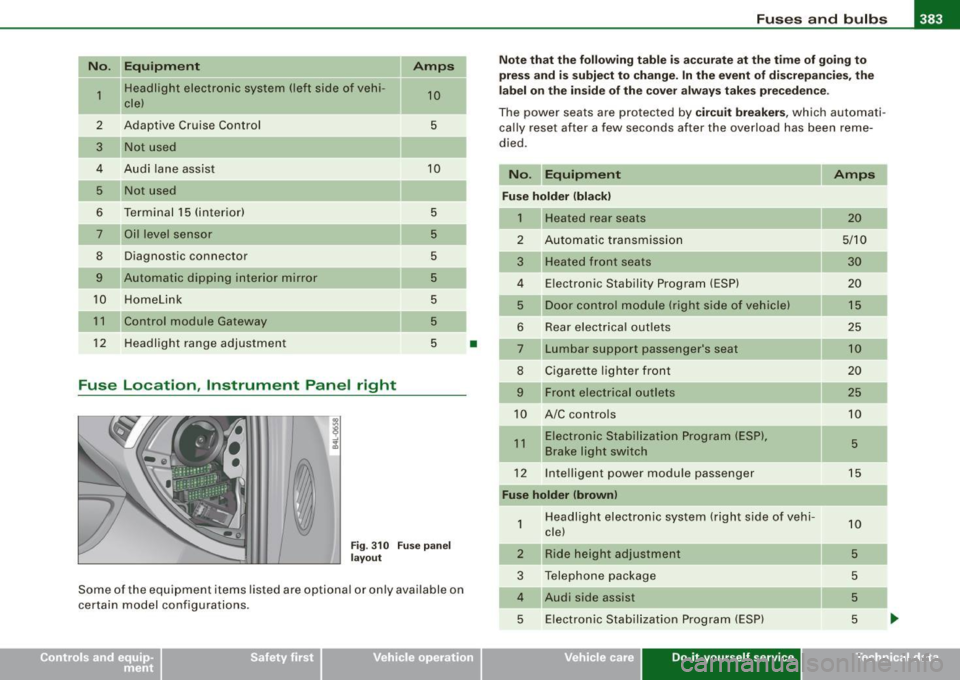
Fuse Location , Instrument Panel right
Fi g. 310 F use pane l
l ayo ut
Some of the equipment items listed are optional or only avai lable on
certain model configurations .
•
Note that th e fo llo wi ng ta ble is acc urate a t the time of goi ng to
pre ss and is subject to change. In th e event of di screpan cies, t he
l a b el on the ins ide o f th e cover a lw ays ta ke s prec eden ce.
The power seats are protected by circ uit breakers , which automati
ca lly reset af ter a few seconds after the overload has been reme
died .
No. Equipm ent
Fu se holder (bla ck )
1 Heated rear seats
2 Automatic transmission
3 Heated front seats
4 E lectronic Stability Program (ESP)
5 Door control module (right side of vehicle)
6 Rear electrical out
lets
7 Lumbar support passenger's seat
8 Cigarette lighter front
9 Front electrical outlets
10 A/C controls
1 1 Electronic Stabilization Prog ram (ESP),
Brake light switch
12 Inte lligent power modu le passenger
Fuse holder (brown )
1
2
3
Headlight electronic system (right side of vehi
cle)
Ride height adjustment
Telephone package
4 Audi side assist 5 E lectronic Stab ilizat ion Program (ESP)
Vehicle care Do-it-yourself service
Amps
20
5/10
30 20
15
25
10
20
25
10
5
15
1 0
5
5
5
5
-
irechnical data