wheel AUDI Q7 2009 Owner´s Manual
[x] Cancel search | Manufacturer: AUDI, Model Year: 2009, Model line: Q7, Model: AUDI Q7 2009Pages: 426, PDF Size: 97.13 MB
Page 350 of 426
-~_T_ ir_e_ s_ a_ n_d _ w_ h_ e_e _l_s _________________________________________________ _
& WARNING (continued)
crashes and serious personal injuries . Have worn or damaged tires
replaced immediately.
• Tires age even if they are not being used and can fail suddenly,
especially at high speeds. Tires that are more than 6 years old can
only be used in an emergency and then with special care and at
low speed.
Glossary of tire and loading terminology
Accessory weight
means the combined weight (in excess of those standard items
which may be replaced) of automatic transmission, power steering,
power brakes, power windows, power seats, radio, and heater, to
the extent that these items are available as factory-installed equip
ment (whether installed or not).
Aspect ratio means the ratio of the height to the width of the tire in percent.
Numb ers of 55 or lower indicate a low sidewall for improved
steering response and better overall handling on dry pavement.
Bead
means the part of the tire that is made of steel wires, wrapped or reinforced by ply cords and that is shaped to fit the rim.
Bead separation means a breakdown of the bond between components in the bead.
Cord
means the strands forming the plies in the tire.
& WARNING (continued)
• Never mount used tires on your vehicle if you are not sure of
their "previous history." Old used tires may have been damaged
even though the damage cannot be seen that can lead to sudden
tire failure and loss of vehicle control.
• If you notice unusual vibration or if the vehicle pulls to one side
when driving, always stop as soon as it is safe to do so and check
the wheels and tires for damage . •
Cold tire inflation pressure
means the tire pressure recommended by the vehicle manufacturer
for a tire of a designated size that has not been driven for more than
a couple of miles (kilometers) at low speeds in the three hour period
before the tire pressure is measured or adjusted.
Curb weight means the weight of a motor vehicle with standard equipment
including the maximum capacity of fuel, oil, and coolant, air condi
tioning and additional weight of optional equipment.
Extra load tire
means a tire design to operate at higher loads and at higher infla
tion pressures than the corresponding standard tire. Extra load tires
may be identified as "XL",
"xi", "EXTRA LOAD", or "RF" on the side
wall.
Gross Axle Weight Rating ("GAWR")
means the load-carrying capacity of a single axle system, measured
at the tire -ground interfaces.
Gross Vehicle Weight Rating ("GVWR"l
means the maximum total loaded weight of the vehicle.
Page 353 of 426
Tires and wheels -_______________ _____.
Occupant loading and distribution for vehicle normal load for various designated seating capacities
Designated seating capa city , num
ber of o ccupants Vehicle normal load
, number of
occupants Occupant distribution in a normally
loaded vehicle
5/6*/7* 3
2 in front, 1 in second seat •
Cold tire inflation pressure
Tire
pressure affects the overall handling, performance and safety of a vehicle.
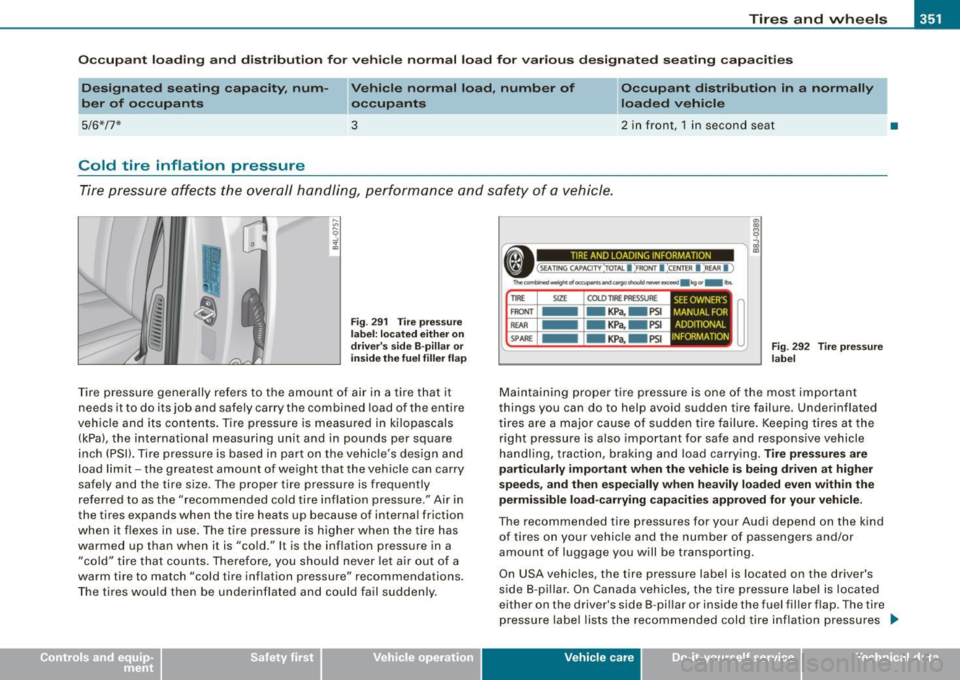
Fig. 291 Tire pressure
label: located either on
driver's side B-pillar or
inside the fuel filler flap
Tire pressure generally refers to the amount of air in a tire that it
needs it to do its job and safely carry the combined load of the entire
vehicle and its contents. Tire pressure is measured in kilopascals
(kPa), the international measuring unit and in pounds per square
inch (PSI). Tire pressure is based in part on the vehicle's design and
load limit -the greatest amount of weight that the vehicle can carry
safely and the tire size . The proper tire pressure is frequently
referred to as the "recommended cold tire inflation pressure ." Air in
the tires expands when the tire heats up because of internal friction
when it flexes in use. The tire pressure is higher when the tire has
warmed up than when it is "cold." It is the inflation pressure in a
"cold" tire that counts. Therefore, you should never let air out of a
warm tire to match "cold tire inflation pressure " recommendations .
The tires would then be underinflated and could fail suddenly.
i
,,-,~ ---------------- ixl
• (SEATING CAPAC ITY :roTAL I :FRO NT I :cENTER I :REAR I ) al
Thecombh,d""'91wclo«U,,..,.andco,-goshoulcl.......,""""' •1cg., -b.
TIRE AND LOADING INFORMATION
TIRE SIZE COLO TIRE PRESSURE
FRONT -KPa, -PSI
REAR -KPa, - PSI
SPARE -KPa, - PSI
MANUAL FOR
INFORMATION SEE OWNER'S I
ADDITIONAL
Fig . 292 Tire pressure
label
Maintaining proper tire pressure is one of the most important
things you can do to help avoid sudden tire failure. Underinflated
tires are a major cause of sudden tire failure. Keeping tires at the
right pressure is also important for safe and responsive vehicle
handling, traction, braking and load carrying.
Tire pressures are
particularly important when the vehicle is being driven at higher
speeds, and then especially when heavily loaded even within the
permissible load -carrying capacities approved for your vehicle.
The recommended tire pressures for your Audi depend on the kind
of tires on your vehicle and the number of passengers and/or
amount of luggage you will be transporting.
On USA vehicles, the tire pressure label is located on the driver's
side B-pillar. On Canada vehicles, the tire pressure label is located
either on the driver's side 8 -pillar or inside the fuel filler flap . The tire
pressure label lists the recommended cold tire inflation pressures _,,,
Vehicle care I I irechnical data
Page 354 of 426
-Tires a nd wh eels rm __________________ _
for the vehicle at its maximum capacity weight and tires that were
on your veh ic le at the time it was manufactured.
If you w is h t o improve co mfort w hen opera ting the vehicle a t
n ormal lo ad (up t o 3 o ccupant s), you can a djust ti re pre ss ure s to
tho se s pecified for norm al v ehi cle load . B efore operating the vehi cle
at m aximum lo ad , y ou must i ncreas e the t ire p re ss ure s to tho se
s pe cifi ed for m axim um vehicle lo ad
=> & .
Bear in mind that the tire pressure monitoring system can only
monitor the tire pressures you have stored. The system does not
recognize the load condition of your vehic le.
The effectiveness of the tire pressure monitoring system will be impaired if you store normal load pressures but then operate the
vehic le at its maximum load=>&. See the
illustration=>
page 351, fig. 291 for the location of the label
either on driver's side B -p illar or inside the fuel fi ller flap (color of
the actual label and exact location on the vehicle will vary slight ly).
Note that the fol lowing tab le is accurate at the time of going to
press and is subject to change . In the event of discrepanc ies, the tire
pressure label (On USA vehic les, the tire pressure label is located on
the driver's s ide B-pillar . On Canada vehicles, the tire pressure label
is located either on the driver's side B-pillar or inside the fue l fi ller
fl ap) always takes precedence.
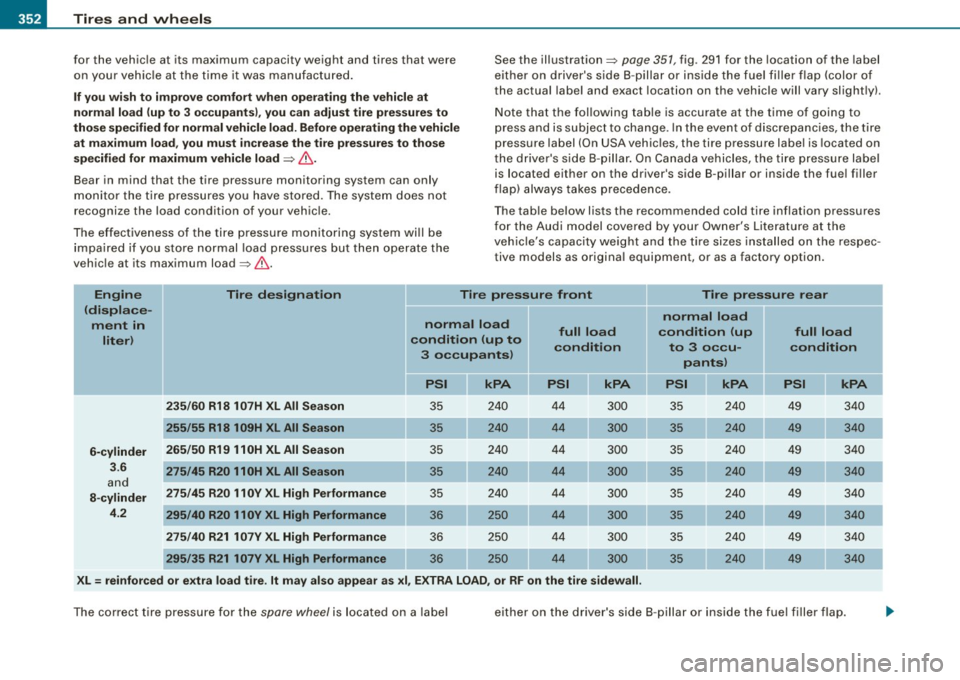
T he table below lists the recommended cold tire inflation pressures
for the Audi model covered by your Owner's Literature at the
vehic le's capacity weight and the tire sizes installed on the respec
tive models as origina l equipment, or as a factory option.
En gin e
( displ ac e
m ent in
liter) Tir
e desi gnatio n Tire pressure fr ont Tire pressur e re ar
normal load norm
al lo ad
full l oad conditi
on (up
full load
condition (up to c ondit ion t o 3 o ccu- co nditi on 3 occupants)
pant s)
II
PSI II kPA PSI kPA PSI II kPA PSI kPA
235/6 0 R18 10 7H XL All Sea son 35 240 44 300 35 240 49 340
255/55 R18 109H XL All S easo n 35 2
40 44
300 35 240 49 3
40
6 -cy lind er 2
65 /50 R19 11 OH XL All Seas on 35 240 44 300 35 240
49 340
3.6
275 /45 R20 11 OH XL All Se ason 35 240 44 300 35 240 49 340
and
8- cy linder 2
75/ 45 R20 11 0 Y XL Hig h Pe rfo rman ce
35 240 44
300 35 240 49 340
4
.2 295 /40 R20 11 0Y XL Hi gh P erform ance 36 44 300 35 240 49
340
2 75/40 R21 10 7V XL High Perf ormanc e 36 250 44 300 35 240 49 340
295 /3 5 R21 107 V XL High P erforman ce 36 250 4
4
300 35 240 49 340
X
L = re infor ced or extr a load tire . It ma y als o app ear as x i, EXTRA LOAD , or RF on the tire side wa ll.
The correct tire pressure for the spare wheel is located on a label either on the driver's side B -pillar or inside the fue l filler flap.
Page 356 of 426
-~_T_ ir_e_ s_ a_ n_d _ w_ h_ e_e _l_s _________________________________________________ _
ment tires that were on your vehicle at the time it was manufac
tured. For the location of the labe l =>
page 351, fig. 291 .
Most tires lose air natural ly over time. They can also lose some air if
you drive over a pothole or hit a curb while parking. It is usually not
possible to see whether the radial tires used today are underinflated
just by looking at them.
Therefore, be sure to check tire pressures at least once a month and
always before going on a long trip. Make sure to take the number of
people and the amount of luggage into account when adjusting tire
pressure for a trip - even one that you wou ld not consider to be
"long." See=>
page 355, "Tires and vehicle load limits" for more
important informat ion .
Always use an accurate tire pressure gauge when checking and adjusting inflation pressures. Check a ll of the tires and be sure not
to forget the spare tire . If the pressure in any tire is too high when
the tire is "cold," let air out of the tire slowly with the edge of the tire
gauge and keep checking the pressure until you reach the pressure
that is correct for the load (passengers and luggage) and kind of
driving you p lan to do.
If the pressure in any tire is too low, note the difference between the
pressure in the cold t ire and the pressure you need and add the air
that you need to reach the correct pressure for the vehicle load
(passengers and luggage) for the tires on your vehic le as listed on
the on your vehicle and in this manual and the kind of driving you
plan to do .
Nev er e xceed th e m ax imum inf lation p ressu re li sted on the tir e
s id ew all for any re ason .
Remember that the veh icle manufacturer, not the tire manufacturer,
determines the correct tire pressure for the tires on your vehicle .
It is important to check the ti re pressure when the tires are cold.
• Read the required tire pressure from the tire pressure label. On
USA vehicles, the tire pressure label is located on the driver's side
B-pillar. On Canada vehicles, the tire pressure label is located either
on the driver's s ide 8 -pillar or inside the fue l fil ler flap . The tire pres -sure labe
l lists the recommended co ld tire inflation pressures for
t he vehicle at its maximum capaci ty weight and the tires that were
on your vehicle at the time it was manufactured. For recommended
tire p ressures for normal load conditions, please see chapter
=>
page 351 .
• Turn the va lve stem cap counter -clockwise to remove it from the
tire valve.
• Place the air pressure gauge on the valve.
• T he tire pressures should only be checked and adjusted when
the tires are cold . The s lightly raised pressures of war m tires must
not be reduced.
• Adjust the tire pressure to the load you are carrying .
• Reinstal l the valve stem cap on the valve.
Wh en sh o uld I ch eck th e tir e pr es su re?
The correct tire pressure is especially important at high speeds. The
pressure should therefore be checked at least once a month and
always before starti ng a journey . Do not forget to check the tire pres
sure for the spare wheel.
When should I adjust the tire pre ssures ?
Adjust the tire pressure to the load you are carrying . After changing
a whee l
or replacing whee ls you have to adjust the tire pressures on
all wheels. In addition, you must then initialize the new tire pres
sures in the tire pressure monito ring system =>
page 42.
& WARNING
Incorrect tire pre ssure s and /or underinflation can lead sudden tire
fa ilure , loss o f control , colli sion , seriou s per so nal inj ury or e ven
death.
• When the warning symbo l
r appe ars in th e instr ument
clu ste r, sto p and in spect the tire s.
Page 357 of 426
Tires and wheels -_____________ .:.....::...=..____:__:_:_:_=-=----
•
& WARNING (continu ed )
• Incorrect tire pressure and /or under inflation can cause
in creased tire wear and can affect the handling of the vehicle and
stopping ability .
• Incorrect t ire pressures and /o r underinflat ion can also lead to
sudden tire failure, including a blowout and sudden deflation,
causing lo ss of vehicle control .
• The driver is respon sible for the correct tire pressures for all
tires on the vehicle. The applicable pre ssure values are located on
a sticker on the driver 's side 8-pillar or on the inside of the fuel
filler flap .
• Only when all tires on the vehicle are filled to the correct pres
sure , the tire pressure monitoring sy stem can work correctly .
• The use of incorrect tire pressure values can lead to accidents
or other damage . Therefore it is essential that the driver observe
the specified tire pressure value s for the tires and the correct pres
sures for the function of the tire pressure monitoring system.
• Always inflate tires to the re commended and correct tire pres
sure before driving off .
• Driving with underinflated tires bend more , letting them get
too hot resulting in tread separation , sudden tire failure and loss
of control.
• Ex cessive speed and /overloading can cause heat build-up ,
s udden tire failure and lo ss of control .
• If the tire pres sure is too low or too high , the t ires will wear
prematurely and the vehicle will not handle well .
• If the tire is not flat and you do not have to change a wheel
immediately , drive at reduced speed to the nearest service station
to check the t ire pressure and add air as required.
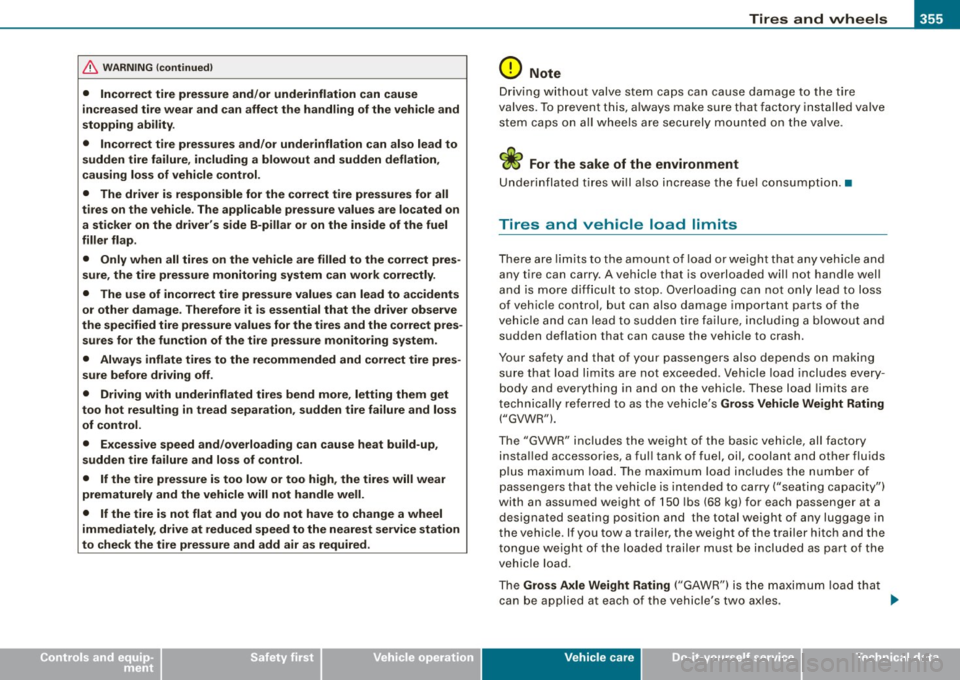
0 Note
Dr iving wi thout valve stem caps ca n cause damage to t he tire
valves. To prevent this, always make sure that factory instal led va lve
stem caps o n all wheels are sec urely mou nted on the va lve .
c£> For the sake of the environment
Underi nflate d tir es w ill a lso inc rease the fue l consu mptio n.•
Tires and vehicle load limits
There are li m its to the a mou nt o f load or weig ht th at any ve hic le and
any tire can carry . A vehicle that is overloaded wil l not handle wel l
and is more diff icu lt to stop . Overload ing ca n no t only lead to loss
of vehic le control, but can also damage important parts of the
ve hicle a nd can lead to sud den tire failu re, i nclu di ng a bl owou t and
sudden deflat ion that can cause the vehic le to crash.
Your safety an d that of your passengers also depends on ma kin g
su re tha t load l imits are not exceeded . Vehicle load includes eve ry
body and everything in and on the vehic le. These load limits are
t echnica lly re ferred to as the ve hicle's
Gross Vehicle Weight Rating
("GVWR"l.
The "GVWR" in clu de s th e we ig ht of t he basi c ve hicle, all fac tory
insta lled accessories, a ful l tank of fuel, oil, coolant and other fluids
plus m aximu m load. The maxi mum l oad inc lude s the n umber of
passen gers that the vehicle is intended to carry !"seating capacity")
with an assumed weight of 150 lbs (68 kg) fo r each passenger at a
designated seating position and the total weight of any lugga ge in
the vehicle. If you tow a trailer, the weight of the trailer hitch and the
to ngue we ig ht of th e loaded tra iler must b e included as par t of th e
vehic le load.
The
Gross Axle Weight Rating ("GAWR") is the m aximum loa d th at
can be applied at each of the vehicle's two ax les. _,,,
Vehicle care I t •
Page 359 of 426
3. Subtract the combined weight of the driver and passengers from
"XXX" kilo
grams or
"XXX" pounds shown on the
sticker=>
page 351, fig. 291.
4. The resulting figure equals the available amount of cargo and luggage load capacity. For example, if the
"XXX"
amount equals 1400 lbs. and there will
be five 150 lbs. passengers in your
vehicle, the amount of available cargo and luggage load capacity is 650 lbs. (1400-750 (5
X 150) = 650 lbs.)
5. Determine the combined weight of luggage and cargo being loaded on the
vehicle. That weight may not safely exceed the available cargo and luggage
load capacity calculated in Step 4.
6. If your vehicle will be towing a trailer, load from your trailer will be transferred
to your vehicle. Consult this manual to determine how this reduces the avail
able cargo and luggage load capacity of
your vehicle.
Tires and wheels -
-Check the tire sidewall (=> page 359,
fig. 295) to determine the designated
load rating for a specific ti re. •
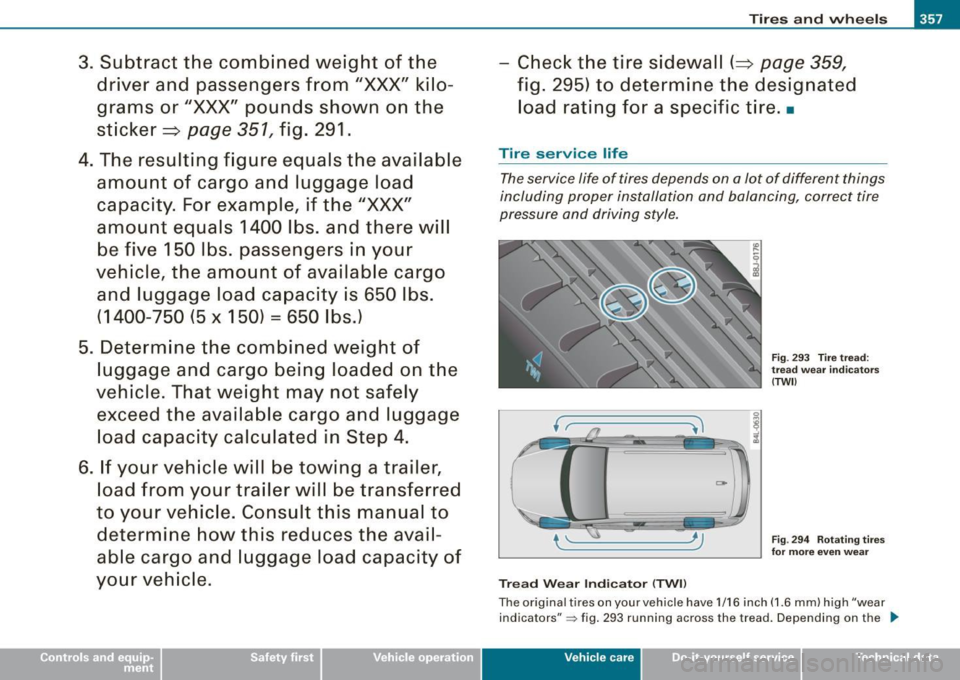
Tire service life
The service life of tires depends on a lot of different things
including proper installation and balancing, correct tire
pressure and driving style.
--
~-----------~
Tread Wear Indicator (TWI)
Fig. 293 Tire tread:
tread wear indicators
(TWI)
Fig. 294 Rotating tires
for more even wear
The original tires on your vehicle have 1 /16 inch (1.6 mm) high "wear
indicators" => fig. 293 running across the tread. Depending on the ._
Vehicle care I I irechnical data
Page 360 of 426
-~_T_ ir_e_ s_ a_ n_d _ w_ h_ e_e _l_s _________________________________________________ _
make, there will be six to eight of them evenly placed around the
tire. Marks on the tire sidewall (for example "TWI" or other symbols)
indicate the positions of the tread wear indicators. Worn tires must
be replaced. Different figures may apply in other countries=>& .
Tire pressure
Incorrect tire pressure causes premature wear and can cause
sudden tire blow-out. For this reason, tire pressure must be checked
at least once a month =>
page 353.
Driving style
Driving fast around curves, heavy acceleration and hard braking
increase tire wear.
Rotating tires for more even wear
For all four tires on your vehicle to have the same service life, we
recommend that the front and rear tires are rotated according to the
tire manufacturer's suggested tire rotation intervals. Please
remember the following:
• Tire rotation intervals may differ from the vehicle service inter
vals outlined in your Warranty
& Maintenance booklet.
• The longer one tire is used in one location on the vehicle , the
more it wears at certain points; therefore, we recommend that you
follow the tire manufacturer's suggested tire rotation intervals .
• Vehicles with front-wheel drive experience more tread wear on
the front wheels compared to all-wheel drive (quattro ®l.
• Please rotate tires as shown =>
page 357, fig. 294.
• Extra care must be taken when rotating direction-specific tires
=>
page 379.
Wheel balancing
The wheels on new vehicles are balanced. However, various situa
tions during everyday driving can cause them to become unbal
anced, resulting in vibrations you can usually feel through the
steering wheel. Unbalanced
wheels must be rebalanced to avoid excessive wear on
steering, suspension and tires. A wheel must also be rebalanced
when a new tire is installed.
Incorrect wheel alignment
Incorrect wheel alignment can cause excessive tire wear , impairing
the safety of the vehicle. If tires show excessive wear, have the
wheel alignment checked by an authorized Audi dealer or qualified
workshop.
All Wheel Drive
Vehicles with quattro® must always have tires of the same size,
construction and tread type. For details see=>
page 294.
& WARNING
Sudden tire failure can lead to loss of control, a crash and serious
personal injury!
• Never drive a vehicle when the tread on any tire is worn down
to the wear indicators.
• Worn tires are a safety hazard, they do not grip well on wet
roads and increase your risk of "hydroplaning" and loss of control.
• Always keep chemicals that can cause tire damage, such as
grease, oil, gasoline and brake fluid away from tires .
• Tires age even if they are not being used and can fail suddenly,
especially at high speeds. Tires that are more than 6 years old can
only be used in an emergency and then with special care and at
lower speeds .
• Never mount used tires on your vehicle if you are not sure of
their "previous history." Old used tires may have been damaged
even though the damage cannot be seen that can lead to sudden
tire failure and loss of vehicle control. •
Page 361 of 426
__________________________________________________ T_ ir_e _ s_ a_ n _ d_ w_ h_ e_ e_ls _ ____.11111
New tires and replacing tires and wheels
New tires and wheels have to be broken in.
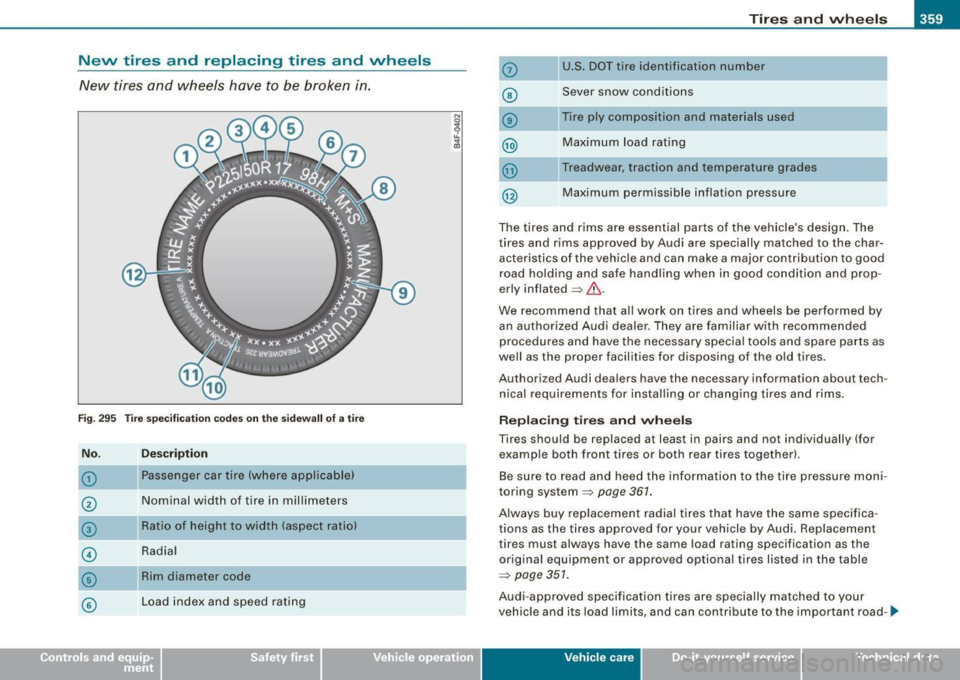
Fig. 295 Tire specification codes on the sidewall of a tire
No.
G)
@
©
©
©
©
Description
Passenger car tire (where appl icable)
Nominal width of tire in millimeters
Ratio of height to width (aspect ratio)
Radial
Rim diameter code
Load index and speed rating
0
©
U.S. DOT tire identificat ion number
Sever snow conditions
Tire ply composition and materials used
Maximum load rating
@ Treadwear, traction and temperature grades
@ Maximum permissible inflation pressure
The tires and rims are essential parts of the vehicle's design. The
tires and rims approved by Audi are specially matched to the char acteristics of the vehicle and can make a major contribution to good
road holding and safe handling when in good condition and prop
erly inflated =>& .
We recommend that all work on tires and wheels be performed by
an authorized Audi dealer. They are familiar with recommended
procedures and have the necessary special tools and spare parts as
well as the proper facilities for disposing of the old tires.
Authorized Audi dealers have the necessary information about tech
nical requirements for installing or changing tires and rims.
Replacing tires and wheels
Tires should be replaced at least in pairs and not individually (for
example both front tires or both rear tires together).
Be sure to read and heed the information to the tire pressure moni
toring system =>
page 361.
Always buy replacement radial tires that have the same specifica
tions as the tires approved for your vehicle by Audi. Replacement
tires must always have the same load rating specification as the original equipment or approved optional tires listed in the table
=> page 351.
Audi -approved specification tires are specially matched to your
vehicle and its load limits, and can contribute to the important road-.,_
Vehic le care I I irechnical data
Page 362 of 426
-~_T_ ir_e_ s_ a_ n_d _ w_ h_ e_e _l_s _________________________________________________ _
holding, driving characteristics, and safety of the vehicle. The table
(~ page 357) lists specifications of the tires approved for the Audi
models covered by your Owner's Literature .
The tire pressure label (On USA vehicles, the tire pressure label is
located on the driver 's side 8 -pillar . On Canada vehicles, the tire
pressure label is located either on the driver's side 8 -pillar or inside
the fue l fi ller flap)( ~
page 351, fig. 292) lists the specifications of
the original equipment tires instal led on your vehic le at the time i t
was manufactured.
Federal law requires tire manufacturers to place standardized infor
mation on the sidewa ll of all tires~
page 359, fig. 295 . This informa
tion identifies and describes the fundamental characteristics, the quality grade of the tire and also provides a tire identification
number for safety standard certificat ion and in case of a recall.
Ti re sp ec ifica tio ns
Knowledge of tire specifications makes it easier to choose the
correct tires . Radial tires have the tire specifications marked on the
sidewa ll, for example:
P 235 / 6 0 R 18 107 H XL
This contains the fo llowing information :
P Indicates the tire is for passenger cars (where applicable)
235 Nominal tire width in mm of the tire from sidewall edge to side -
wall edge. In general, the larger the number, the wider the tire
60 Height/width ratio in percent (aspect ratio)
R T ire construction: Radial
18 Rim diameter code (in inches)
10 7 Load rat ing code
H Speed rat ing letter code
X L (or "xi" , "EXTRA LOAD", or "RF" Indicates that the tire is a"Rein
forced" or an "Extra Load" tire
M+ S (or "M/S"l Indicates that the tire has some mud and snow capa
bility T
he tires could also have the information of direction of rotation
~ page 347.
Ti re manuf acturing d ate
The manufacturing date is a lso indicated on the tire sidewa ll
(possibly only on the
inner side of the wheel) :
"DOT ... 2208 ... " means, for example, that the tire was produced in
the 22th week of 2008 .
Speed rating
permissible road speeds~
& in "Winter tires" on page 363.
p
up to 93 mph ( 150 km/h)
Q up to 99 mph (158 km/h)
R upto 106mph(170km/hl
s upto 110 mph (180 km/h)
T up to 118 mph (190 km/h)
u up to 124 mph (200 km/h)
H up to 130 mph (210 km/h)
V up to 149 mph (240
km/h)4
l
z over 149 mph (240 km/h)4
l
w up to 168 mph (270 km/h)41
y up to 186 mph (298 km/h)41
Your vehic le is norma lly factory equipped with tires, which possess
exce llent driving characteristics and give your Audi optimum
driving comfort . An e lectronic speed limiter ~
page 29will normal ly
prevent your vehicle from going faster than the tire speed rating
~ & - ..
41 For tires w ith a maximum speed capab ility over 149 mph (240 km /h ), tire
manufacture rs som etim es us e th e lette rs "ZR."
Page 363 of 426
__________________________________________________ T_ ir_e_ s_ a_ n_d _ w_ h_ e_ e_l_s __ _
•
U.S. DOT Tire Identification Number (TIN) and tire
manufacture date
This is the tire's "serial number". It begins with the letters "DOT"
and indicates that the tire meets all federal standards . The next two
numbers or letters indicate the plant where it was manufactured,
and the last four numbers represent the week and year of manufac
ture . For example, the numbers 2208 mean that the tire was
produced in the 22th week of 2008. The other numbers are
marketing codes that may or may not be used by the tire manufac
turer. This information is used to contact consumers if a tire defect
requires a recall.
Tire ply composition and materials used
The number of plies indicates the number of layers of rubber-coated
fabric in the tire. In general, the greater the number of plies, the
more weight a tire can support. Tire manufacturers also must indi
cate the materials in the tire, which include steel, nylon, polyester,
and others.
Maximum Load Rating
This number indicates the maximum load in kilograms and pounds
that can be carried by the tire.
Tire quality grading for treadwear, traction, and
temperature resistance
Tread wear, traction and temperature grades~ page 363.
Maximum Permissible Inflation Pressure
This number is the greatest amount of air pressure that should ever
be put in the tire under normal driving conditions.
Replacing tires or rims on vehicles equipped with tire
pressure monitoring system
The wheels on your vehicle are equipped with a sensor which
constantly monitors the air pressure inside the tire, and then trans
mits this information to the tire pressure monitoring system. If you
are going to replace the wheel rims on your vehicle, make sure the new rims also have these sensors
. The sensors must be compatible
with the tire pressure monitoring system on your vehicle.
If you install rims, which do not have the sensors, or have sensors
which are not compatible, then the tire pressure monitoring system
will not work properly. In this case, the tire pressure monitoring
system would not be able to monitor the tire pressure or warn you
if it is necessary.
• The battery inside of the tire pressure sensor has a limited
service life.
• Always drive with the valve stem caps securely mounted. We
recommend using factory installed valve stem caps. Ask your autho
rized Audi dealer to replace lost valve stem caps .
The installation of replacement tires with steel cord body plies in
the tire sidewall may cause malfunction of the tire pressure moni
toring system, and is not recommended (cord material information
in molded on the tire sidewall).
Always check your tire pressure monitoring system indicator after replacing one or more tires on your vehicle. If the tire pressure
monitoring system indicator flashes, or is on, your system is not
working properly. Your replacement tire might be incompatible with
your tire pressure monitoring system, or some component of the
tire pressure monitoring system may be damaged.
& WARNING
• Using incorrect or unmatched tires and/ or wheels or improper
tire and wheel combinations can lead to loss of control, collision and serious personal injury.
• Always use tires, rims and wheel bolts that meet the specifica
tions of original factory-installed tires or other combinations that
have been specifically approved by the vehicle manufacturer .
• Tires age even if they are not being used and can fail suddenly,
especially at high speeds. Tires that are more than 6 years old can
only be used in an emergency and then with special care and at
lower speeds . .,.
Vehicle care
I t •