brake AUDI Q7 2009 Owner´s Manual
[x] Cancel search | Manufacturer: AUDI, Model Year: 2009, Model line: Q7, Model: AUDI Q7 2009Pages: 426, PDF Size: 97.13 MB
Page 350 of 426
-~_T_ ir_e_ s_ a_ n_d _ w_ h_ e_e _l_s _________________________________________________ _
& WARNING (continued)
crashes and serious personal injuries . Have worn or damaged tires
replaced immediately.
• Tires age even if they are not being used and can fail suddenly,
especially at high speeds. Tires that are more than 6 years old can
only be used in an emergency and then with special care and at
low speed.
Glossary of tire and loading terminology
Accessory weight
means the combined weight (in excess of those standard items
which may be replaced) of automatic transmission, power steering,
power brakes, power windows, power seats, radio, and heater, to
the extent that these items are available as factory-installed equip
ment (whether installed or not).
Aspect ratio means the ratio of the height to the width of the tire in percent.
Numb ers of 55 or lower indicate a low sidewall for improved
steering response and better overall handling on dry pavement.
Bead
means the part of the tire that is made of steel wires, wrapped or reinforced by ply cords and that is shaped to fit the rim.
Bead separation means a breakdown of the bond between components in the bead.
Cord
means the strands forming the plies in the tire.
& WARNING (continued)
• Never mount used tires on your vehicle if you are not sure of
their "previous history." Old used tires may have been damaged
even though the damage cannot be seen that can lead to sudden
tire failure and loss of vehicle control.
• If you notice unusual vibration or if the vehicle pulls to one side
when driving, always stop as soon as it is safe to do so and check
the wheels and tires for damage . •
Cold tire inflation pressure
means the tire pressure recommended by the vehicle manufacturer
for a tire of a designated size that has not been driven for more than
a couple of miles (kilometers) at low speeds in the three hour period
before the tire pressure is measured or adjusted.
Curb weight means the weight of a motor vehicle with standard equipment
including the maximum capacity of fuel, oil, and coolant, air condi
tioning and additional weight of optional equipment.
Extra load tire
means a tire design to operate at higher loads and at higher infla
tion pressures than the corresponding standard tire. Extra load tires
may be identified as "XL",
"xi", "EXTRA LOAD", or "RF" on the side
wall.
Gross Axle Weight Rating ("GAWR")
means the load-carrying capacity of a single axle system, measured
at the tire -ground interfaces.
Gross Vehicle Weight Rating ("GVWR"l
means the maximum total loaded weight of the vehicle.
Page 351 of 426
________________________________________________ T_ i _r_e _s_ a_n_ d_ w_ h_ e_e _ l_s __ lllll
•
Groove
means the space between two adjacent tread ribs.
L oad ra ting (code)
means the maximum load that a tire is rated to carry for a given
inflation pressure. You may not find this information on all tires
because it is not required by law.
M ax im um l oad ra tin g
means the load rating for a tire at the maximum permissib le infla
tion pressure for that tire.
Ma ximum l oaded v ehi cle weigh t
means the sum of:
(a) Curb weight
(b) Accessory weight
(c) Vehic le capacity weight, and
(ct) Production options weight
M ax im um (p er mi ssibl e) infl ati on pr essur e
means the maximum cold inflation pressure to wh ich a tire may be
inflated. Also ca lled "maximum inflation pressure."
Normal occ upa nt wei ght
means 150 lbs. (68 kilograms) times the number of occupants
seated in the vehicle up to the to tal seating capacity of your vehicle.
O ccupant di stributi on
means distribution of occupants in a vehicle .
Outer di am eter
means the overall diameter of an inflated new tire.
O ve rall wi dth
means the linear distance between the exteriors of the sidewa lls of
an inflated tire, includ ing elevations due to labeling, decorations, or
protective bands or ribs.
Pl y
means a layer of rubber -coated para lle l cords.
P rodu ction opt io ns wei ght
means the combined weight of those installed regular production
options weighing over 5 lbs . (2.3 kg) in excess of those standard
i t ems wh ich they replace, not previously considered in curb weigh t
or accessory weight, including heavy duty brakes, ride levelers, roof
rack, heavy duty battery, and specia l trim .
Radi al p ly tire
means a pneumatic tire in which the ply cords that extend to the
beads are laid at substantially 90 degrees to the centerline of the
tread .
Reco mm ended infl ati on pr essu re
see => page 348, "Cold tire inflation pressure".
Rein force d tir e
means a tire des ign to operate at higher loads and at higher infla
tion pressures than the corresponding standard tire. Reinforced
t ires may be identi fied as "XL", "x i", "EXTRA LOAD", or "RF" on the
sidewall.
R im
means a metal support for a tire or a tire and tube assembly upon
wh ich the t ire beads are seated.
Rim di amet er
means nominal diameter of the bead seat. If you change your whee l
size, you wi ll have to purchase new tires to match the new rim diam
eter .
Rim siz e de sig nation
means rim diameter and width.
Rim wid th
means nominal distance between rim flanges.
Vehicle care I t •
Page 355 of 426
Tires a nd wh eels -
----------------
•
Because technical changes may be made to vehicle equipment
during the mode l year, always compa re the tire size designation on
the tire pressure label on your vehic le with the tires on your vehicle.
Make sure that the tire size information on the vehicle labe l is the
same as the size of the tires on the vehicle . This is especially impor
tant if the vehicle belongs to someone else or you bought the
veh ic le with different rims/tires or you bought the vehicle as a previ
ously owned vehicle.
Remember, your safety and that of your passengers also depends
on making sure that load limits are not exceeded. Vehicle load
includes everybody and everything in and on the vehicle . These load
limits are technically referred to as the vehicle's Gross Vehicle
Weight Rating ("GVWR"l. The Gross Axle Weight Rating ("GAWR"l is
the maximum load that can be applied at each o f the vehicle's two
ax les . The Gross Vehic le Weight Rating and the Gross Ax le Weight
Rating are l isted on the safety compl iance sticker labe l located
either on the driver's side 8 -pillar or on the inside of the fuel fi ller
flap. The ti re pressure labe l on your Audi lists the maximum
combined we ight of a ll of the occupants and luggage or other cargo
t hat the vehic le can carry. For the location of the tire pressure la bel
=>
page 357, fig . 291.
& WARNING
O verload ing a vehi cle can c ause loss of vehi cle co ntrol , a cra sh or
other a ccid ent , s eriou s per sonal injury , and even death.
• Carrying more weight than your vehicle wa s de signed to carry
w ill p revent the vehicle from h andling properly and incre ase the
ri sk of a l oss of vehi cle control .
• The brake s on a vehicle that ha s been o verloaded m ay not be
a ble to stop the vehicle with in a safe distance .
• Tires on a v ehi cle that ha s been o verlo aded can fail suddenl y
c au sin g loss o f control a nd a cra sh .
• Alwa ys ma ke sure that the total l oad being tr ansp o rted -
including th e wei ght of a trailer hit ch and the tongu e weight of a
& W AR N IN G (c ontinued )
loaded trailer -does not m ake the vehi cle heavier than the
v ehicle' s Gro ss Vehicle W eight Rating.
& WARNING
• Incor re ct t ire pre ssures a nd/o r underi nfl ation can le ad to a
s erious or fatal a ccident.
• Incorre ct t ire pre ssure s and/or u nderinfla tion ca use in crea sed
tire w ear and can affect th e handling of the vehicle.
• Incorre ct t ire p ressu res and /or underinfl ation c an als o lead to
s udden tire failure , including a blowout and sudden deflation ,
c au sin g lo ss of vehi cle co ntr ol. •
Checking tire pressure
The correct tire pressure for the tires originally installed
o n your vehicle is listed on the tire pressure label located
either on driver's side 8 -pil/ar or inside the fuel filler flap .
The recommended tire pressures are on the tire pressure label and
in the table=>
page 351, "Cold tire inflation pressure" .This means
that the pressure must be checked and adjusted when the tire has
not been driven for more than a couple of mi les (kilomete rs} at low
speeds during the previous three hours. Air in the tires expands
when the tire heats up as a result of internal fric tion as i t flexes in
use. The tire pressure is higher when the tire has warmed up than
when it is "cold ."
It is the inflation pressure in a "cold" tire that counts. Therefore, you
should never let air out of a warm tire to match "Co ld tire inflation
pressure" recommendations=>
page 351 . The tires wou ld then be
underinflated and could fail suddenly.
The tire pressure label on your Audi lists the recomme nded cold tire
inflation pressures at maximum capacity for the new, origina l equip -.,.
Vehicle care I t •
Page 358 of 426
-~_T_ ir_e _s_ a_n_ d_ w_ h _e_e_ l_ s _______________________________________________ _
The Gross Veh icl e We ight Rating and the Gross Axle Weight Rating
ar e l isted on th e safe ty comp lia nce st icker labe l located ei ther on
the driver's side 8 -p illar or on the inside of the fue l filler flap. Your
Audi has 5 seating positi ons, 2 in the fron t and 3 in the rea r for total
seating capacity of 5 . On vehicles with s ix seats*, your ve hicle has
two front seats, two seats in the second row seating an d two sea ts
i n t he t hir d row seating. On ve hic les w ith seven seats*, your ve hicle
has two front seats, three seats in the second row seating and two
seats in the th ir d row sea tin g. Eac h seat ing pos it ion has a seat belt
=>
page 231, " S afety belts".
T he fact that there is a n upper l imit to your ve hicle's Gro ss Vehic le
Weight Rating means that the total we ight of whatever is bein g
carried in the vehic le ( including the we ig ht of a t rai le r h itc h a nd the
t on gue wei ght o f the load ed trai ler) is lim ited. The more passen ge rs
in the ve hicle o r passe nger s w ho are heavier t han the s tanda rd
we ights assumed mea n th at l ess wei ght ca n be ca rri ed as lu gg age .
Th e tire pressure labe l on your Audi also lists the maximum
co mbi ned we igh t of all o f th e occ upa nts a nd luggage o r othe r ca rgo
that the vehicle can carry. For the location of the label=>
page 351,
fig . 291 .
LJ}. WARNING
Overloading a vehicle can cause loss of vehicle control , a crash or
other accident , serious personal injury , and even death .
• Carrying more weight than your vehicle was designed to carry
will prevent the vehicle from handl ing properly and increase the
ri sk of the loss of vehicle control.
• The brakes on a vehicle that has been overloaded may not be
able to stop the vehicle within a safe distance.
• Tires on a vehicle that has been overloaded can fail suddenly ,
including a blowout and sudden deflation , causing loss of control
and a crash .
• Always make sure that the total load being transported -
including the weight of a trailer hitch and the tongue weight of a
& WARNING (continued)
loaded trailer -does not make the vehicle heavier than the
vehicle's Gross Vehicle Weight Rating .•
Determining correct load limit
Use the example below to calculate the
total weight of the passengers and
luggage or other things that you plan to
transport so that you can make sure that
your vehicle will not be overloaded.
Steps for Determining Correct
Load Limit
1. Locate the statement "THE COMBINED WEIGHT OF OCCUPANTS AND CARGO SHOULD NEVER EXCEED XXX KG OR XXX LBS"on your vehicle's placard (tire infla
tion pressure label)=>
page 351, fig. 291.
2. Determine the combined weight of the driver and passengers that will be riding
in your vehicle.
~
Page 360 of 426
-~_T_ ir_e_ s_ a_ n_d _ w_ h_ e_e _l_s _________________________________________________ _
make, there will be six to eight of them evenly placed around the
tire. Marks on the tire sidewall (for example "TWI" or other symbols)
indicate the positions of the tread wear indicators. Worn tires must
be replaced. Different figures may apply in other countries=>& .
Tire pressure
Incorrect tire pressure causes premature wear and can cause
sudden tire blow-out. For this reason, tire pressure must be checked
at least once a month =>
page 353.
Driving style
Driving fast around curves, heavy acceleration and hard braking
increase tire wear.
Rotating tires for more even wear
For all four tires on your vehicle to have the same service life, we
recommend that the front and rear tires are rotated according to the
tire manufacturer's suggested tire rotation intervals. Please
remember the following:
• Tire rotation intervals may differ from the vehicle service inter
vals outlined in your Warranty
& Maintenance booklet.
• The longer one tire is used in one location on the vehicle , the
more it wears at certain points; therefore, we recommend that you
follow the tire manufacturer's suggested tire rotation intervals .
• Vehicles with front-wheel drive experience more tread wear on
the front wheels compared to all-wheel drive (quattro ®l.
• Please rotate tires as shown =>
page 357, fig. 294.
• Extra care must be taken when rotating direction-specific tires
=>
page 379.
Wheel balancing
The wheels on new vehicles are balanced. However, various situa
tions during everyday driving can cause them to become unbal
anced, resulting in vibrations you can usually feel through the
steering wheel. Unbalanced
wheels must be rebalanced to avoid excessive wear on
steering, suspension and tires. A wheel must also be rebalanced
when a new tire is installed.
Incorrect wheel alignment
Incorrect wheel alignment can cause excessive tire wear , impairing
the safety of the vehicle. If tires show excessive wear, have the
wheel alignment checked by an authorized Audi dealer or qualified
workshop.
All Wheel Drive
Vehicles with quattro® must always have tires of the same size,
construction and tread type. For details see=>
page 294.
& WARNING
Sudden tire failure can lead to loss of control, a crash and serious
personal injury!
• Never drive a vehicle when the tread on any tire is worn down
to the wear indicators.
• Worn tires are a safety hazard, they do not grip well on wet
roads and increase your risk of "hydroplaning" and loss of control.
• Always keep chemicals that can cause tire damage, such as
grease, oil, gasoline and brake fluid away from tires .
• Tires age even if they are not being used and can fail suddenly,
especially at high speeds. Tires that are more than 6 years old can
only be used in an emergency and then with special care and at
lower speeds .
• Never mount used tires on your vehicle if you are not sure of
their "previous history." Old used tires may have been damaged
even though the damage cannot be seen that can lead to sudden
tire failure and loss of vehicle control. •
Page 364 of 426
_L_T~ i~ r ~e ~s '..... a ~ n~d ~ w~ h~e~ e::. l !.:s ~ ---------------------------------------------
& WARN ING (continued )
• Never mount used tire s on your vehicle if you are not sure of
their "pre vious history. " Old used tire s may have been damaged
even though the damage cannot be seen that c an lead to sudden
tire f ailure and los s of vehicle control .
• All four wheels must be fitted with radial tires of the same type,
s ize (rolling circumference ) and the same tread pattern. Driv ing
with different tires reduces veh icle handling and can lead to a loss
of cont rol.
• If the spare tire is not the same as the tires that are mounted
on the vehicle • for e xample with winter tires · only use the spare
tire for a short period of time and drive with extra care . Refit the
normal road wheel a s soon as safely possible.
• Never drive faster than the maximum speed for whi ch the tires
on your vehicle are rated because tires that are driven faster than
their rated speed can fail suddenly .
• Overloading tires cause heat build -up , sudden tire failure,
including a blowout and sudden deflation and lo ss of control.
• Temperature grades apply to tires that are properly inflated and
not over or underinflated.
• Fo r te chni cal reasons it is not always possible to use wheels
from other vehicles -in some cases not even wheels from the
same vehi cle model .
• If you install wheel trim di scs on the vehicle wheels , make sure
that the air flow to the brakes is not blo cked . Redu ced airflow to
the brakes can them to overheat , increasing stopping distances
and causing a collision .
• Run flat tires may only be used on vehicle s that were equipped
with them at the factory . The vehicle must have a chassis designed
for run flat tires and a factory -installed tire pressure monitoring
system that indi cates a loss of t ire pres sure . In corre ct u se of run
flat tires can lead to vehicle damage or accident s. Check with an
authorized Aud i dealer or tire specialist to see if your vehicle can
& WAR NING (continued )
be equipped with run flat tires . If run flat tires are used , they must
be installed on all four wheels . Mixing tire types is not permitted .
0 Note
• For tec hnical reas ons, it is not gen erally poss ible to use t he
whee l rims from other vehicles . T his can ho ld true for whee ls of the
sa me v ehicle type.
• I f the spare tire is different from the tires that you have mounted
o n yo ur vehicle ( for example wi nter tires or wide pro file tires), then
use the spare tire for a short period of time on ly and drive with extra
ca re. Replac e th e fl at t ire wi th the tire m atchi ng t he othe rs on you r
vehic le as soon as possib le .
• I f you should put different w heels and tires o n yo ur ve hic le (e. g.
winter wheels and t ires), you must be certain that the wheels and
t ires a re c omp atible with the tire pressure moni tor in g sys tem.
O therwise the system will register a malfunction and a fau lt
m es sage w ill be displayed . For more info rmation, c ontac t yo ur
authorized Audi dea ler.
0 Note
• When insta lling new tires, b e care fu l not to damage the va lv e s or
t ire p ressu re mon itoring syste m sensors .
• N ever drive without the valve stem cap . The va lves could get
damaged.
• I f the sensors must be replaced, then the valve must also be
r e pl ace d at t he same time .
'£> For the sake of the environment
Dispose o f old tires i n acco rdance wit h the local re qu ire ment s.•
Page 375 of 426
What do I do now? -
---------------~.;______
•
& WARNING (continued)
• Loose items in the passenger compartment can cause serious
personal injury during hard braking or in an accident .
- Never store the inflatable spare tire or jack and tools in the
passenger compartment.
- Always store all jacking equipment, tools, and the inflatable
spare tire in the luggage compartment.
- Tighten the knurled retaining screw for the inflatable spare
tire securely.
0 Note
• Th e inflatable spare tire has been developed specifically for this
vehicle model. It must not be exchanged or used for other vehicle
models. Similarly, inflatable tires from other vehicle models must
not be used.
• Normal summer or winter tires must not be installed on the
inflatable tire rim.•
Changing a wheel
Before changing a wheel
Observe the following precautions for your own and your
passenger's safety when changing a wheel.
-After you experience a tire failure, pull the car well away
from moving traffic and try to reach
level ground before
you stop => & .
- All passengers should
leave the car and move to a safe
location (for instance, behind the guardrail)=> &.
- Engage the
parking brake to prevent your vehicle from
rolling unintentionally=> &. -
Move
selector lever to position P =:> & .
- If you are towing a trailer: unhitch the trailer from your
vehicle.
- Block the diagonally opposite wheel with the folding
chocks or other objects.
- Take the
jack and the inflatable spare tire out of the
luggage compartment=>
page 370.
& WARNING
You or your passengers could be injured while changing a wheel if
you do not follow these safety precautions:
• If you have a flat tire, move a safe distance off the road. Turn off
the engine, turn the emergency flashers on and use other warning
devices to alert other motorists.
• Make sure that passengers wait in a safe place away from the
vehicle and well away from the road and traffic.
• To help prevent the vehicle from moving suddenly and possibly
slipping off the jack , always fully set the parking brake and block
the wheel diagonally opposite the wheel being changed with the
folding chocks or other objects. When one front wheel is lifted off
the ground, placing the Automatic Transmission in "P" (Park) will
not prevent the vehicle from moving.
• Before you change a wheel, be sure the ground is level and firm .
If necessary, use a sturdy board under the jack.
• After installing the inflatable spare tire, make sure that you
replace the flat tire/wheel in its storage area properly and tighten
the knurled retaining screw securely. •
Do-it -yourself service
Page 385 of 426
Fuses and bul bs 11111 ________________________________ ..:....:,:_=-.::..:....:.;.:_.:..:..,_,;__,;____,J
....
No.
1
-
2
3
4
5
6
Eq uipm ent
Headlight electronic system (left side of vehi -
cle)
Adaptive Cruise Control
Not used
Audi lane assis t
Not used
Terminal 15 (interior)
Oil level sensor
8 Diagnostic connector
9 Automatic dipping interior mirror
10 Homelink
1 1 Control module Gateway
12 Headlight range adjustment
Amps
10
5
10
5
5
5
5
5
5
5
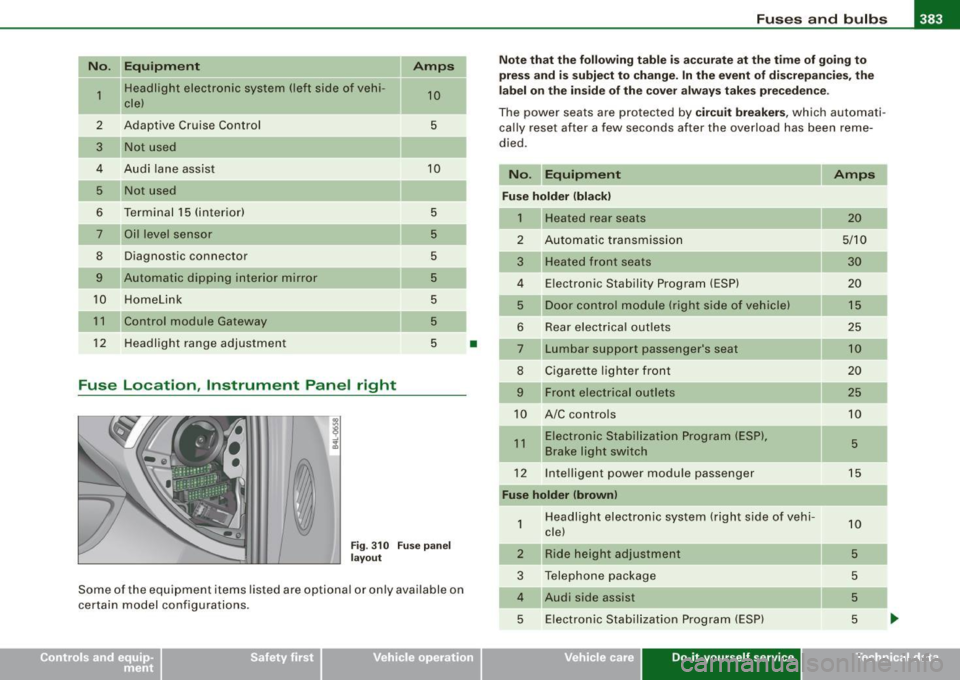
Fuse Location , Instrument Panel right
Fi g. 310 F use pane l
l ayo ut
Some of the equipment items listed are optional or only avai lable on
certain model configurations .
•
Note that th e fo llo wi ng ta ble is acc urate a t the time of goi ng to
pre ss and is subject to change. In th e event of di screpan cies, t he
l a b el on the ins ide o f th e cover a lw ays ta ke s prec eden ce.
The power seats are protected by circ uit breakers , which automati
ca lly reset af ter a few seconds after the overload has been reme
died .
No. Equipm ent
Fu se holder (bla ck )
1 Heated rear seats
2 Automatic transmission
3 Heated front seats
4 E lectronic Stability Program (ESP)
5 Door control module (right side of vehicle)
6 Rear electrical out
lets
7 Lumbar support passenger's seat
8 Cigarette lighter front
9 Front electrical outlets
10 A/C controls
1 1 Electronic Stabilization Prog ram (ESP),
Brake light switch
12 Inte lligent power modu le passenger
Fuse holder (brown )
1
2
3
Headlight electronic system (right side of vehi
cle)
Ride height adjustment
Telephone package
4 Audi side assist 5 E lectronic Stab ilizat ion Program (ESP)
Vehicle care Do-it-yourself service
Amps
20
5/10
30 20
15
25
10
20
25
10
5
15
1 0
5
5
5
5
-
irechnical data
Page 390 of 426
IIIII.___E_ m_ e_r -=g "-e_ n _ c-=y _ s_ i_t _u _a _t_ i_o _n_ s _______________________________________________ _
& WARN ING (c ontinu ed )
• Bef ore you chec k anything in the engin e compartment , always
re ad and h eed all W ARNINGS =>
page 324, "Engine compa rtment".
0 Note
• Applying a higher voltage booster battery wil l cause expensive
damage to sensitive electronic components, such as contro l units,
relays, radio, e tc.
• There must be no electrical contact between the vehicles as
otherwise current could already start to flow as soon as the positive
( + ) terminals are connected .
[ i ] Tip s
• The discharged battery must be properly connected to the
vehic le's e lectrical system. When jump starting or charging the
battery, never connect the negative ground cable to the battery
negative pos t because the battery manager system must be ab le to
detect the battery's state of charge . Always connect the negative
ground cable to the negat ive ground post of the battery manager
control unit. •
Use of jumper cables
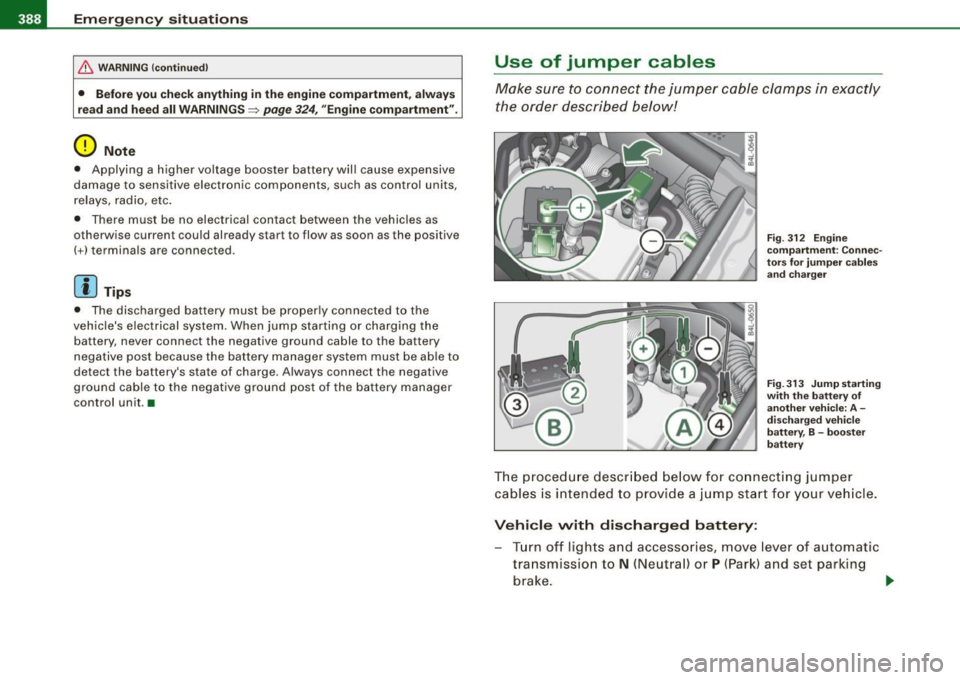
Make sure to connect the jumper c able clamps in exac tly
the order described below!
F ig . 3 12 E ngin e
co mpartm ent : Co nnec
to rs for ju mp er ca ble s
and cha rger
F ig . 3 13 Ju mp st artin g
w it h th e batte ry o f
ano ther v eh icle : A -
d isc harg ed ve h icle
b att ery, B -boo ster
b att ery
The procedure descr ibed below for co nnect ing jumper
cables is intended to provide a j ump star t for your vehi cle .
Vehi cle with discharged battery :
-Turn off lights and accessories, move lever of automatic
tra nsmissio n to
N (Neutral) or P (Par k) and set parking
brake .
~
Page 392 of 426
lllffll.,___E_ m _ e _r.;:g '-e_ n_ c-=y _ s_ i_t _u _a _t_ i_o _n_ s _______________________________________________ _
Emergency towing with commercial
tow truck
General hints
Your Audi requires special handling for towing.
The following information is to be used by commercial tow truck
operators who know how to operate their equipment safely.
• Never tow your Audi, towing will cause damage to the engine
and transmission.
• Never wrap the safety chains or winch cables around the brake
lines.
• To prevent unnecessary damage, your Audi must be transported
with a flat bed truck.
• To load the vehicle on to the flat bed, use the towing loop found
in the vehicle tools and attach to the front or rear anchorage
~ page 390 and~ page 391.
& WARNING
A vehicle being towed is not safe for passengers. Never allow
anyone to ride in a vehicle being towed, for any reason. •
Front towing loop
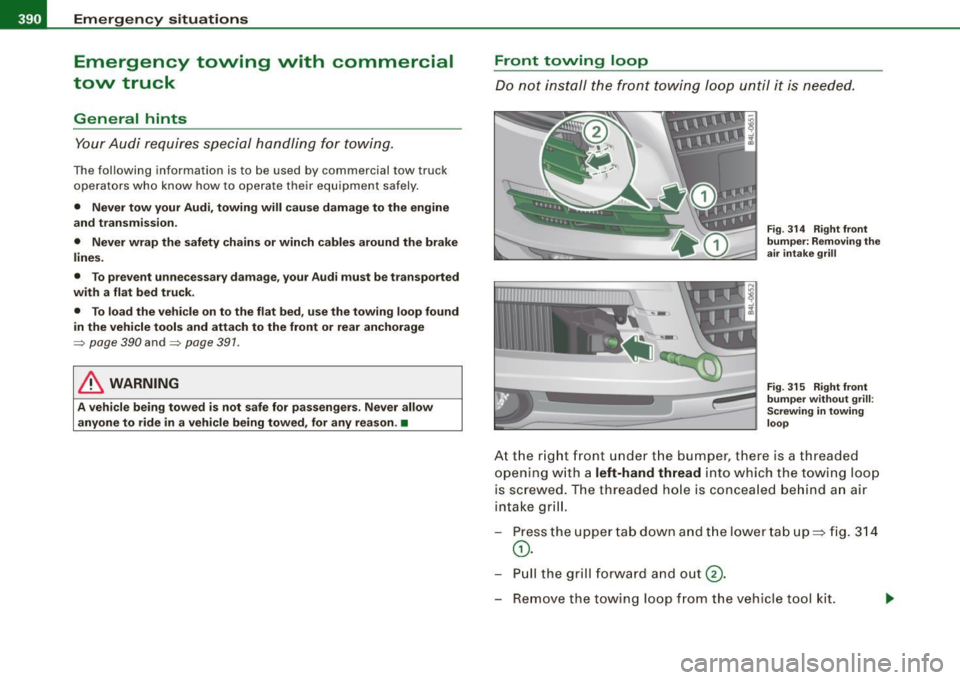
Do not install the front towing loop until it is needed.
Fig. 314 Right front
bumper: Removing the
air intake grill
Fig . 315 Right front
bumper without grill:
Screwing in towing
loop
At the right front under the bumper, there is a threaded
opening with a
left-hand thread into which the towing loop
is screwed. The threaded hole is concealed behind an air
intake grill.
- Press the upper tab down and the lower tab up~ fig. 314
(i).
- Pull the grill forward and out 0-
- Remove the towing loop from the vehicle tool kit.