warning AUDI Q7 2010 Owner´s Manual
[x] Cancel search | Manufacturer: AUDI, Model Year: 2010, Model line: Q7, Model: AUDI Q7 2010Pages: 390, PDF Size: 93.04 MB
Page 245 of 390
_____________________________________________ C _h_i_ld _ S_ a_ f_ e_ t ... Y'--- __
& WARNING (continued)
the weight-mat in the seat and register a heavier weight in the
Advanced Airbag System. The heavier weight registered can make
the system work as though an adult were on the seat and deploy
the Advanced Airbag when it must be suppressed causing serious
or even fatal injury to the child.
• Make sure that the PASSENGER AIR BAG OFF light comes on
and stays on all the time whenever the ignition is switched on.
• If the PASSENGER AIR BAG OFF light does not come on and
stay on, immediately install the rear-facing child safety seat in a
rear seating position and have the airbag system inspected by
your Audi dealer. •
Activating the convertible locking retractor
Use the convertible locking retractor to secure a child
restraint.
Always heed the child safety seat manufacturer 's instruc
tions when installing a child restraint in your vehicle. To acti
vate the convertible locking retractor:
- Place the child restraint on a seat, preferably on the rear
seat .
- Slowly pull the belt
all the way out.
- Route it around or through the child restraint belt path
=>& .
- Push the child safety seat down with your full weight to
get the safety belt really tight.
- Insert the belt tongue into the buckle for that seating
position.
Controls and equip ment Safety first Vehicle operation
-
Guide the safety belt back into the retractor until the belt
lies flat and snug on the child safety seat.
- You should hear a "clicking" noise as the belt winds back into the inertia reel. Test the convertible lock ing retractor
by pulling on the belt. You should no longer be able to pull
the belt out of the retractor. The convertible lock ing
retractor is now activated.
- Make sure that the red release button is facing away from the child restraint so that it can be unbuckled quickly .
- Pull on the belt to make sure the safety belt is properly tight and fastened so that the seat cannot move forward
or sideways more than one inch (2 .5 cm) .
& WARNING
Using the wrong child restraint or an improperly installed child
restraint can cause serious personal injury or death in a crash.
• Always make sure that the safety belt retractor is locked when
installing a child safety seat. An unlocked safety belt retractor
cannot hold the child safety seat in place during normal driving or
in a crash.
• Always buckle the child safety seat firmly in place even if a
child is not sitting in it. A loose child safety seat can fly around
during a sudden stop or in a crash.
• Always make sure the seat backrest to which the child restraint
is installed is in an upright position and securely latched into place
and cannot fold forward. Otherwise, the seat back with the child
safety seat attached to it could fly forward in the event of an acci
dent or other emergency situation.
• Always read and heed all WARNINGS whenever using a child
restrained in a vehicle is being used=>
page 231. Special precau-
tions apply when installing a child safety seat on the front
lill-
Vehicle care Do-it-yourself service Technical data
Page 246 of 390
lffll,___C_ h_ il_d _ S_a _ f_ e _ t-= y ;....._ ____________________________________________ _
& WARNING (conti nued)
passenger seat => page 211, "Child restraints on the front seat -
s ome important thing s to know ".•
Deactivating the convertible locking
retractor
The convertible lockin g retractor for child restraints will
be d eac tiv a ted aut omatic all y when the bel t is wou nd all
t he wa y back in to the retrac tor.
-Press the r ed button on the sa fety belt buckl e. T he b elt
t o ngue will po p out of t he buckle .
- Guid e the safety belt a ll the way back into its stowe d posi-
t ion.
Always le t the sa fety be lt retrac t co mple tely i nto i ts s tow ed position .
The safety bel t can now be used as a n or dinary sa fe ty belt withou t the
convert ib le locking ret ractor fo r chi ld rest raints .
If the convertible locking retractor should be activated inadvertently,
t he s afety be lt mus t be unfa stened and guide d comple tely b ack in to
its stowed position to deactivate this feature. If t he convert ib le
lo ckin g ret ractor is no t d eactiv ated , the sa fe ty bel t w ill grad ually
become tighter and uncomfo rtable to wea r.
& WARNING
Imp roperly installed child safety seats increase the risk of serious
personal injury and death in a colli sion.
• Never unfasten the safety belt to deactivate the convertible
locking retractor for child restraints while the vehicle is moving.
You would not be restrained and could be seriously injured
in an
accident.
& WARNING (con tinued )
• Alway s read and heed all WARNINGS whenever u sing a child
restrained in a vehicle is being used
=> page 231. Special precau
tions apply when installing a child safety seat on the front
pass enger seat =:>
page 211, "Child restraints on the front seat -
some impo rtant things to know ".•
LATCH Lower anchorages and
tethers for children
Child Restraint System anchors and how
are they related to child safety
T o prov ide a simpler and more practicable way to attach the child
restrain t on the vehicle seat, Federa l regulat io ns re quire spe cial
lower ancho rages in ve hicles and devices o n new chi ld restraints to
at ta ch to the ve hicle an chor ages.
The combination of the tether anchorages and t he lower anchorages
is now gene rally called the
LATCH system fo r "Lowe r Ancho rages and
T ethers for Childre n."
Forward-fac ing c hild restraints manufactured after Se ptember 1,
199 9, are requ ired by U .S. feder al reg ulat ion s to comp ly w ith new
child head moveme nt performance requirements . These new perfor
m anc e req uire men ts ma ke a tether nece ssary on m ost new child
seats.
Insta lling a child restraint that req uires a top tether w ithout one can
ser iously impair t he p erf or mance of th e chi ld res tra int and its ab ility
to p rotect the ch ild in a collision. Insta llin g a c hild rest raint that
req uires a top te ther w ithout t he top tet her m ay be a v iol at ion of
state law. ..
Page 247 of 390
Child restraint manufacturers offer LATCH lower anchorages on the ir
c hild seats with hook-on or push-on connectors attached to adjust
able straps .
I n addition to the LATCH lower anchorages, these child restraint
systems usually require the use of tet he r straps to he lp keep the child
restra int f irm ly in place.
& WARNING
Improper installation of child restraints will increase the risk of
injury and death in a crash.
• Always follow the instructions provided by the manufacturer
of the child restraint you intend to install in your vehicle.
• Never install a child restraint without a properly attached top
tether strap if the child restraint manufacturer's instructions
require the top tether strap to be used.
• Improper use of child restraint LATCH lower anchorage points
can lead to injury in a colli sion . The LATCH lower anchorage points
are designed to withstand only those loads imposed by correctly
fitted child restraints .
• Never mount two child restraint systems on one LATCH lower
anchorage point .
• Never secure or attach any luggage or other item to the LATCH
lower anchorages .
(I) Tips
• In Canada, the terms "top tether " with " lower universa l anchor
ages" (or "lower universal anchorage bars") are used to describe the
system .
• In other countries, the term "ISO FIX" is used to describe the lower
anchorages. •
Safety first Vehicle OP-eration
Location
Child Safety
Fig. 210 Schematic
overview: LATCH
anchorage point loca
tions
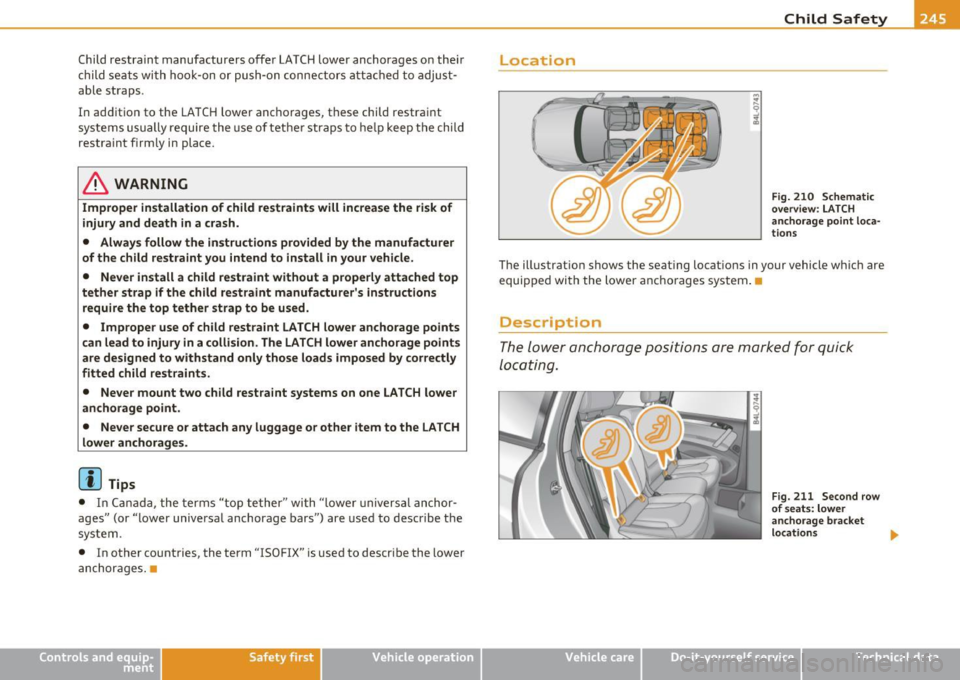
The illustrat ion shows the seating locations in your vehicle whic h are
equipped with the lower anchorages system. •
Description
The lower anchorage positions are marked for quick
locating.
Vehicle care
Fig. 211 Second row
of seats: lower
anchorage bracket
locations ..
Do-it-yourselt service iTechnical data
Page 248 of 390
___ C_h _i_ld _ S_ a_ f_ e_ t_,, y'-----------------------------------------------
Fig. 212 Third row of
seats: locator buttons
for lower anchorages
Attachment locator markers for lower anchorages
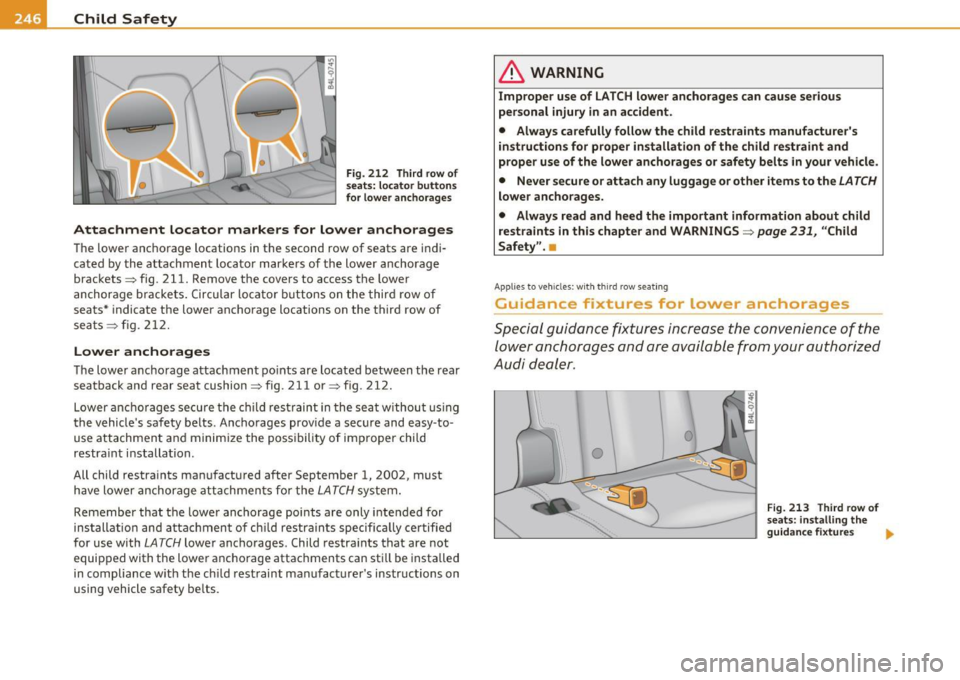
The lower anchorage locations in the second row of seats are indi
cated by the attachment locator markers of the lower anchorage
brackets :::::, fig . 211. Remove the covers to access the lower
anchorage brackets. Circular locator buttons on the third row of
seats * indicate the lower anchorage locations on the third row of
seats :::::, fig. 212.
Lower anchorages
The lower anchorage attachment points are located between the rear
seatback and rear seat cushion:::::, fig. 211 or:::::, fig . 212.
Lower anchorages secure the child restraint in the seat without using
the vehicle's safety belts . Ancho rages prov ide a secure and easy-to
use attachment and minim ize the poss ibility of improper chi ld
restra int installation .
All child restra ints manufactured after September 1, 2002, must
have lower anchorage attachments for the
LATCH system.
Remember that the lower anchorage points are only intended for
ins tallatio n and attachment of child restrain ts specifica lly certified
for use with
LATCH lower anchorages . Child restraints that are not
equipped with the lower anchorage attac hments can still be installed
in compliance w ith the ch ild restraint manufact urer's instructions on
using vehicle safety be lts.
& WARNING
Improper use of LATCH lower anchorages can cause serious
personal injury in an accident.
• Always carefully follow the child restraints manufacturer's
instructions for proper installation of the child restraint and
proper use of the lower anchorages or safety belts in your vehicle.
• Never secure or attach any luggage or other items to the
LATCH
lower anchorages.
• Always read and heed the important information about child
restraints in this chapter and WARNINGS :::::,
page 231, "Child
Safety". •
Applies to veh icles: wi th third row seating
Guidance fixtures for lower anchorages
Special guidance fixtures increase the convenience of the
lower anchorages and are available from your authorized
Audi dealer.
o,
Fig. 213 Third row of
seats: installing the
guidance fixtures ..
Page 249 of 390
I
I I
I I
I I
0
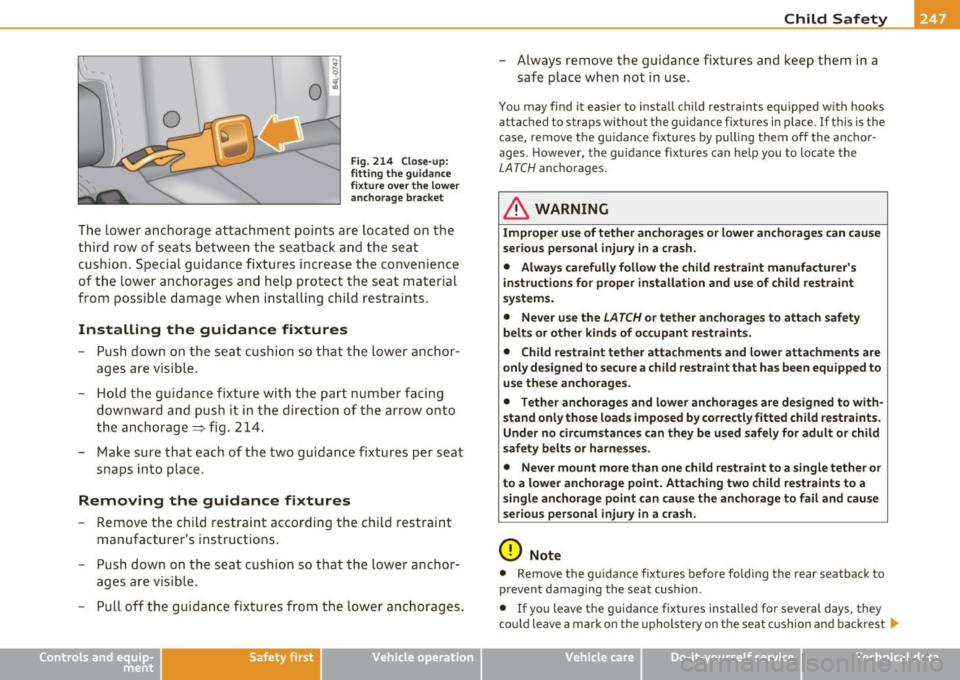
Fig. 214 Close-up:
fitting the guidance
fixture over the lower
anchorage bracket
The lower anchorage attachment points are located on the
third row of seats between the seatback and the seat
cushion. Special guidance fixtures increase the convenience
of the lower anchorages and help protect the seat material
from possible damage when installing child restraints.
Installing the guidance fixtures
- Push down on the seat cushion so that the lower anchor
ages are visible.
- Hold the guidance fixture with the part number facing
downward and push it in the direction of the arrow onto
the anchorage => fig. 214.
- Make sure that each of the two guidance fixtures per seat snaps into place.
Removing the guidance fixtures
- Remove the child restraint according the child restraint
manufacturer's instructions.
- Push down on the seat cushion so that the lower anchor
ages are visible.
- Pull off the guidance fixtures from the lower anchorages.
Safety first Vehicle OP-eration
Child Safety
-Always remove the guidance fixtures and keep them in a
safe place when not in use.
You may find it easier to install child restraints equipped with hooks
attached to straps without the guidance fixtures in place. If this is the
case , remove the guidance fixtures by pulling them off the anchor
ages. However , the guidance fixtures can help you to locate the
LATCH anchorages.
& WARNING
Improper use of tether anchorages or lower anchorages can cause
serious personal injury in a crash.
• Always carefully follow the child restraint manufacturer's
instructions for proper installation and use of child restraint
systems.
• Never use the
LATCH or tether anchorages to attach safety
belts or other kinds of occupant restraints.
• Child restraint tether attachments and lower attachments are
only designed to secure a child restraint that has been equipped to
use these anchorages.
• Tether anchorages and lower anchorages are designed to with
stand only those loads imposed by correctly fitted child restraints.
Under no circumstances can they be used safely for adult or child
safety belts or harnesses.
• Never mount more than one child restraint to a single tether or
to a lower anchorage point. Attaching two child restraints to a
single anchorage point can cause the anchorage to fail and cause
serious personal injury in a crash.
0 Note
• Remove the guidance fixtures before folding the rear seatback to
prevent damaging the seat cushion .
• If you leave the guidance fixtures installed for several days, they
could leave a mark on the upholstery on the seat cushion and backrest•
Vehicle care Do-it-yourselt service iTechnical data
Page 250 of 390
• .___C_ h_ il_d _ S_a _ f_ e _ t--= y '------------------------------------------------
in the area that the guidance fixtures were installed . The upholstery
would also be permanently stretched around the guidance fixtures.
This applies especially to leather seats .•
Installing a child restraint with LATCH
lower anchorages
Whenever you install a child restraint always follow the
child restraint manufacturer's instructions.
Mounting
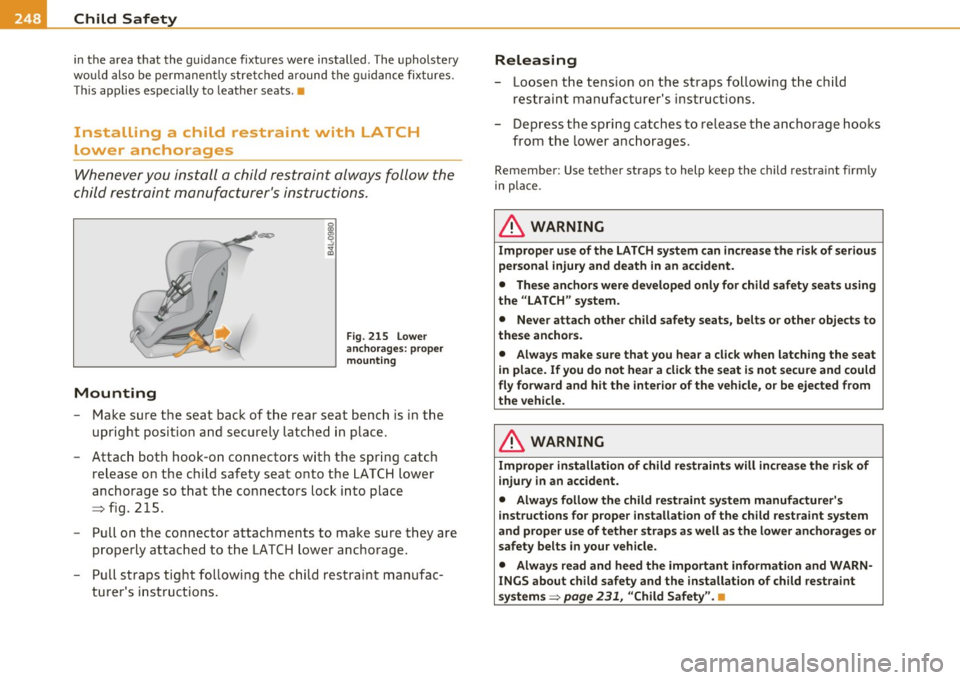
Fig. 215 Lower
anchorages: proper
mounting
- Make sure the seat back of the rear seat bench is in the
upright position and securely latched in place.
- Attach both hook-on connectors with the spring catch
release on the child safety seat onto the LATCH lower
anchorage so that the connectors lock into place
~ fig. 215.
- Pull on the connector attachments to make sure they are
properly attached to the LATCH lower anchorage.
- Pull straps tight following the child restraint manufac
turer's instructions.
Releasing
- Loosen the tension on the straps following the child
restraint manufacturer's instructions.
- Depress the spring catches to release the anchorage hooks
from the lower anchorages.
Remember: Use tether straps to help keep the child restraint firmly
in place.
& WARNING
Improper use of the LATCH system can increase the risk of serious
personal injury and death in an accident.
• These anchors were developed only for child safety seats using
the "LATCH" system.
• Never attach other child safety seats, belts or other objects to
these anchors.
• Always make sure that you hear a click when latching the seat
in place. If you do not hear a click the seat is not secure and could
fly forward and hit the interior of the vehicle, or be ejected from
the vehicle.
& WARNING
Improper installation of child restraints will increase the risk of
injury in an accident.
• Always follow the child restraint system manufacturer's
instructions for proper installation of the child restraint system
and proper use of tether straps as well as the lower anchorages or
safety belts in your vehicle.
• Always read and heed the important information and WARN
INGS about child safety and the installation of child restraint
systems ~
page 231, "Child Safety". •
Page 251 of 390
Tether anchors and tether straps
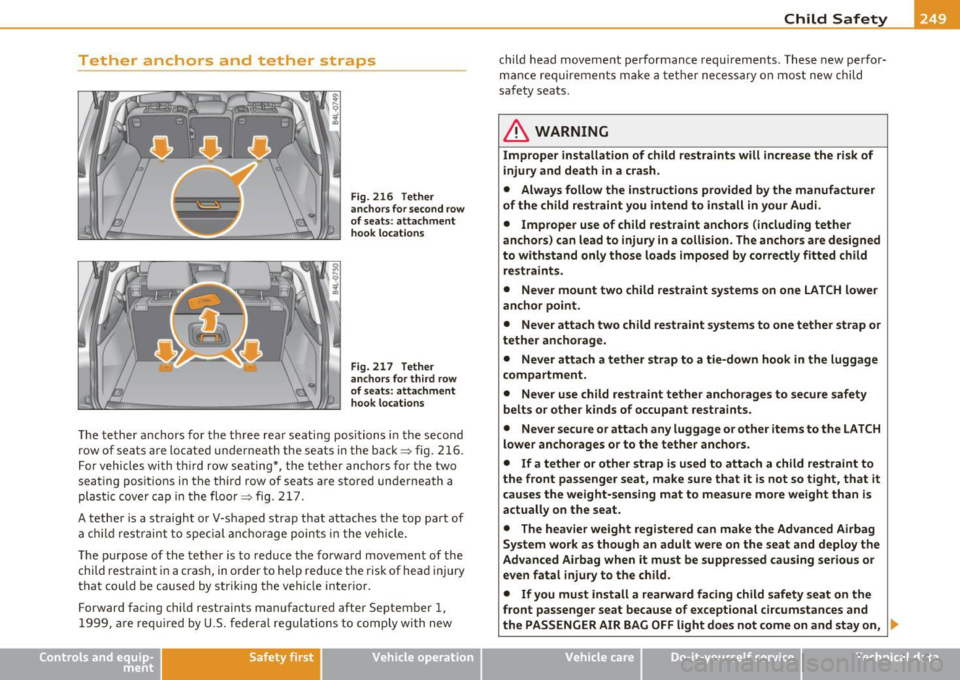
Fig. 216 Tether
anc hors fo r second row
of seats: attachment
h ook location s
Fig . 217 T ether
anch ors for third row
of seats: a tt ac hment
h ook location s
The tether anchors for the three rea r seating positions i n the s econd
row of seats are located u nderneath the seats in the back~ fig. 216.
For vehicles wi th t hir d row seating *, th e tet her anchors for the two
seating pos it io ns in th e third row of seats are stored un derneath a
p lastic co ve r cap in th e floor~ fig. 217 .
A tethe r is a straight o r V-shaped strap that attaches the top part of
a child restra int to special anch o rage points in t he vehicle .
Th e purpose of the te the r is to reduc e the fo rwa rd movemen t of t he
child rest raint in a cras h, in order to help reduce the risk of head injury
th at could be c au se d by striki ng the ve hicle in ter ior.
Forward facing child restraints man ufactured after September 1,
1 99 9, ar e re quir ed b y U.S. feder al regulat ions to co mply wi th new
Safety first Vehicle OP-eration
Child Safety
child head movem ent performance requ ireme nts . These new per for
ma nce re quiremen ts mak e a t eth er nece ssary on m ost new child
sa fety s eats .
& WARNING
Improper installation of child restraints will increase the risk of
injury and death in a crash.
• Always follow the instructions provided by the manufactu rer
of the child restraint you intend to install in your Audi.
• Improper use of child restraint anchors (including tether
anchors) can lead to injury in a collision . The anchors are designed
to withstand only those loads imposed by correctly fitted child
restraints.
• Never mount two child restraint systems on one LATCH lower
anchor point.
• Never attach two child restraint systems to one tether strap or
tether anchorage .
• Never attach a tether strap to a tie-down hook
in the luggage
compartment.
• Never use child restraint tether anchorages to secure safety
belts or other kinds of occupant restraints .
• Never secure or attach any luggage or other items to the LATCH
lower anchorages or to the tether anchors.
• If a tether or other strap is used to attach a child restraint to
the front passenger seat, make sure that it is not so tight, that it
causes the weight-sensing mat to measure more weight than is
actually on the seat.
• The heavier weight regi stered can make the Advanced Airbag
System work as though an adult were on the seat and deploy the
Advanced Airbag when it must be suppressed causing serious or
even fatal injury to the child.
• If you must install a rearward facing child safety seat on the
front passenger seat because of exceptional circumstances and
the PASSENGER AIR BAG
OFF light does not come on and stay on, ..
Vehicle care Do-it-yourselt service iTechnical data
Page 253 of 390
Child Safety -
-------------------"'---
The up ho lstery wou ld also be perma ne ntly stre tc h ed a round t he
t e th er strap . T his app lies esp eci ally to l eath er s eats .•
Using tether straps on rearward-facing
child restraints
Cu rren tly, few re a r-f acing child restra int s yste ms come w ith a t eth er.
Please read and hee d the c hild restraint system manufac turer's
i nst ructions car efu lly to d ete rm in e ho w to prop erl y i nsta ll the te the r.
& WARNING
A child in a rearward-facing child safety seat installed on the front
passenger seat will be seriously injured and can be killed if the
front airbag inflates· even with an Advanced Airbag System .
• The inflating airbag will hit the child safety seat or infant
carrier with great force and will smash the child safety seat and
child against the backrest, center armrest, or door.
• A tight tether or other strap on a rearward-facing child
restraint attached to the front passenger seat can put too much
pressure on the weight-mat in the seat and register a heavier
weight in the Advanced Airbag System. The heavier weight regis
tered can make the system work as though an adult were on the seat and deploy the Advanced Airbag when it must be suppressed
causing serious or even fatal injury to the child.
• If you must install a rearward facing child safety seat on the
front passenger seat because of exceptional circumstances and
the PASSENGER AIR BAG OFF light does not come on and stay on ,
immediately install the rear-facing child safety seat in a rear
seating pos ition and have the airbag system inspected by your
Audi dealer. •
Controls and equip ment Safety first Vehicle operation
Additional Information
Sources of information about child
restraints and their use
T he re are a numbe r of sources of additional inf ormat ion abo ut child
re straint s ele ction , insta llation an d use:
N HTSA adv ises t hat t he b est ch ild saf ety s eat is th e on e that f its your
child and fits in yo ur vehicle, a nd that yo u will use cor rectly an d
c o nsis ten tly.
Try before you b uy!
U.S National Highway Traffic Safety Administration
T el. : 1-8 88- 327-42 36 (TTY : 1-80 0-4 24 -9153)
www .nhtsa .gov
National SAFE KIDS Campaign
Te l.: (202) 662-0600
www. safe kids .o rg
Safety BeltSafe U .S.A
T el. : (800) 745-SAFE ( Eng lish)
Te l.: (800) 747-SA NO (Spa nish )
www .c ars eat .org
Transport Canada Information Centre
Te l.: 1 (800) 333-0371 or call 1 (613) 998 -8616 if you are i n the
Ott awa are a
www .t c.gc.ca/ roadsaf ety
Audi Customer CARE
Te l.: (800) 822-2834 •
Vehicle care Do-it-yourself service Technical data
Page 255 of 390

_________________________________________ I_ n_ t_ e_ ll_,igent technology ,__E~-
fore-and-aft and lateral directions, the brake pressure and the
steering angle are all measured.
The direction in which the driver wishes to travel is determined with
the aid of the steering angle and vehicle speed and is continually
compared with the actual behavior of the vehicle. If the two do not
match, for example, when the vehicle starts hydroplaning on a wet
road, ESP will automatically brake the appropriate whee l to correct
the problem.
The vehicle is then stabi lized by the forces acting on the whee l during
braking. If the vehicle is
oversteering (rear tends to skid out of the
turn), the brakes are main ly applied on the wheel that is on the
outs ide of the curve. In the case of a vehicle that is
understeering
(tendency to slide out of the curve), the brakes are applied as needed
on the wheel that is on the inside of the curve or additionally on the
other wheels. An acoustic s ignal indicates when ESP brake application
cuts in=> &.
The system operates across the entire speed range in combination
with the ABS system ~
page 256 . If the Anti -Lock Brake System
(ABS) ma lfunctions, the ESP wi ll be out of action as well.
Activating
When you turn on the engine, ESP will automatically be activated and
will perform a self-test. As soon as the test is comp leted, the system
is in normal operating mode .
Offroad mode
ESP should normally be operated in normal mode because this
ensures maximum vehicle stability. If necessary, you can activate the
ESP offroad mode by pressing the button=>
page 252, fig. 220 to
obtain maximum traction and braking ability when driving off paved
roads at low speeds. In ESP offroad mode, the ESP indicator light
=> page 16 illuminates and the message ESP Offroad Caution!
Limited driving stability
appears briefly in the disp lay.
The ESP offroad mode can be useful in the following exceptiona l situ
ations when slip or a highly effe ctive different ial loc king funct ion is
desirable. Examples:
Controls and equip ment Safety first Vehicle operation
•
when driving w ith tire chains,
• when driving in deep snow or on loose ground,
• when driving on uneven surfaces with the wheels severely
unloaded (articulation), and
• when rocking the vehicle loose a fter it has become stuck.
When the unusual situation is past, you should sh ift back to the
normal ESP operating mode by pushing the button again. The
message
ESP/ ASR on then appears briefly in the display.
Hill descent control
The hill descent control is switched on in ESP offroad mode. When
slowly descending steep gradients on loose ground or when the axles
are art iculated, hill descent control provides assistance by automati
cally applying the brakes to keep vehicle speed constant. The vehicle
is also rende red easier to steer by select ive distribution of braking
force. Hill descent control intervenes when:
• the accelerator pedal is not pressed,
• the vehicle is travelling less than 12 mph (20 km/h),
• a steep gradient is detected,
• wheel behavior indicates loose ground or conditions with poor
adhesion (e.g. also axle articulat ion).
Hill descent control operates both dr iving forward and in reverse.
Active hi ll descent control is deactivated by pressing the accelerator
pedal until the conditions for activation already listed are met aga in .
& WARNING
• The Electronic Stabilization Program is nevertheless subject to
the laws of physics . It is particularly important to pay attention to
this fact on wet and slippery roads. It is therefore important that
you always adapt your driving to the condition of the road and
traffic conditions. Do not allow the increased safety provided by
the Electronic Stabilization Program system to lull you into
accepting additional safety risks. ..
Vehicle care Do-it-yourself service Technical data
Page 256 of 390
Intelligent technology
'-----------------------------------------------
& WA RNING (conti nu ed )
• Plea se be aware th at in ESP offroad mode , particularly on a
s mooth and slippery road, the wheels may have an incr eased
tendency to spin and the vehicle may break awa y -danger of skid
ding!
• Stabilit y is limited in the ESP offroad mode. •
Electronic differential lock (EDL)
The electronic differential lock monitors the rotational
speed of the drive wheels.
General notes
The electronic differe ntia l lock (EDL) helps the ca r to sta rt moving,
acce lerate and climb a gradient on surfaces provi ding poor or almost
no grip. W ithout ED L, th is would be d iff ic ul t, if not impossible .
How the system works
The EDL operates automatically . It mo nitors the rotational speed of
w heels wi th the help of the ABS sensors ==>
page 256 . If a not iceab le
slip is detected at the wheels (e .g . o n slippery g round on one side),
the spin ning whee ls are braked and power is transferred to the other
wheels. This is done up to a speed of about 60 mph ( 100 km/h) .
Noises from the brake system signa l that wheel spin is being
cont rolled.
Driv ing off
W hen d rivi ng off, always be sure to keep road conditions in mind as
you acce lerate. If one drive wheel spins because it is on a surface with
less grip, apply
plenty of th rottle until t he car starts to move .
Overheating of brakes
To prevent the disc b rake of the bra ked wheel from overhea ting if
subjected to excessive loads on this whee l, t he EDL cuts out tempo
ra rily. The vehicle rema ins operat iona l and behaves in the same way
as a veh icle without EDL. As soon as the brake has coo
led down, EDL sw itches on again auto
m atically.
& WARNING
• When accelerating on slippery surfaces, such as on ice or snow,
always be careful when depressing the accele rator pedal. Even
with the EDL working , the drive wheels c an spin and reduce your
ability to control your car . Risk of crash!
• The increased safety afforded by EDL does not mean that you
can take safety risks . Always adapt your d riv ing style to the road
c ondition s and traffic situation.
[ i ] Tips
If a fa ult occurs in the A BS, the ED L is also no t fu nct io ni ng. This is
ind icated by the ABS warn ing light==>
page 19. •
Anti-Slip Regulation System (ASR)
The Anti- S lip Re gula tion System preven ts the drive n
w heels from spinning when the car is acc ele rating .
General notes
The Anti-S lip Reg ulation Sys tem (ASR) is in tegr ated in the ele ctroni c
stabilization program (ESP) . When the ve hicle starts up and acceler
a tes, the whee ls are p reven ted from sp inning by adjust ing t he engine
power to match the amoun t of grip ava ilable from the road surface.
How the system works
ASR performs automatica lly, i.e. witho ut the driver 's intervent ion.
With the aid o f th e ABS sensors ==>
page 256, ASR moni to rs the speed
of the driven wheels. If the whee ls start to spin, engine torque is
reduced automatically unt il the tires find enough grip to lock onto
the road s urface. The system is active ac ross the en tire speed range .
'1>