ECU AUDI Q7 2010 Owner´s Manual
[x] Cancel search | Manufacturer: AUDI, Model Year: 2010, Model line: Q7, Model: AUDI Q7 2010Pages: 390, PDF Size: 93.04 MB
Page 199 of 390
______________________________________________ D_ ri _v _ i_n _,,g ,c.._ S_a_ f_ e_ l..:: y __ l!'II
the driver's s ide B-pillar. The tire pressure label lists the recom
mended co ld tire in flatio n press ures fo r th e ve hicle at its max imum
capacity weight and the tires that were on your vehicle at the time it
was manufactured . For recommended tire press ures for normal loa d
conditions, p lease see chapte r=>
page 318. •
Tie-downs
The luggage compartment is equippe d with four tie
do wns to sec ure lu gga ge a nd oth er items.
Use the t ie-downs to sec ure yo ur cargo properly=> page 195,
"Lo ad ing t he lugg age comp artmen t".
In a co llision, the laws of physics mean that even sma ller it ems that
are loose in the vehicle will become heavy missiles that can cause
ser iou s injury. Ite ms i n t he vehi cle pos se ss e ne rgy w hich va ry w it h
vehicle speed and the we ight of the item. Vehicle speed is t he most
s ig nifi ca nt f acto r.
For examp le, in a frontal coll is io n at a speed of 30 mph (48 km/h),
the forces acting on a 1 0-lb (4. 5 kg) object are a bout 20 times t he
normal weig ht o f the item. T his means that t he weight o f the ite m
wou ld s uddenly be a bo ut 200 lbs. (90 kg) . You can imagine the inju
r ies tha t a 200 lbs . (9 0 kg) item fly ing free ly throug h the p ass enge r
compartment cou ld cause i n a collision lik e this .
& WARNING
Weak , damaged or improper straps used to secure item s to tie
downs can fail during hard braking or in a collision and cause
serious personal injury.
• Always use suitable mounting straps and properly secure items
to the tie-downs in the luggage compartment to help prevent
items from shifting or flying forward as dangerous missiles.
• When the rear seat backre st is folded down, always use suit
able mounting straps and properly secure items to the tie-downs
Controls and equip ment Safety first Vehicle operation
& WARNING
(co ntinued )
in the luggage compartment to help prevent items from flying
forward as dangerous missiles into the passenger compartment.
• Never attach a child safety seat tether strap to a tie -down. •
Reporting Safety Defects
Applicable to U.S.A.
If you believe that your vehi cle has a defect
which could cause a crash or could cause injury
or death , you should immediately inform the
National Highway Traffic Safety Administration
(NHTSA) in addition to notifying Audi of
America, Inc.
If NHTSA receives similar complaints, it may
open an investigation, and if it find s that a
safety defe cts exist s in a group of vehicles, it
may o rder a recall and remedy campaign.
However , NHTSA cannot become involved in
individual problems between you, your dealer,
or Audi of America, Inc.
To contact NHTSA, you may call the Vehicle
Safety Hotline toll-free at:
Tel.: 1-888-327-4236 (TTY: 1-800-424-9153)
or write to:
Administrator
Vehicle care Do-it-yourself service Technical data
Page 205 of 390
& WARNING (continued)
• Never let any person ride with their feet on the instrument
panel or sticking out the window or on the seat.
• Never remove a safety belt while the vehicle is moving. Doing
so will increase your risk of being injured or killed.
• Never wear belts twisted.
• Never wear belts over rigid or breakable objects in or on your
clothing, such as eye glasses, pens, keys, etc., as these may cause
injury.
• Never allow safety belts to become damaged by being caught
in door or seat hardware.
• Do not wear the shoulder part of the belt under your arm or
otherwise out of position .
• Several layers of heavy clothing may interfere with correct
positioning of belts and reduce the overall effectiveness of the
system.
• Always keep belt buckles free of anything that may prevent the
buckle from latching securely.
• Never use comfort clips or devices that create slack in the
shoulder belt. However, special clips may be required for the
proper use of some child restraint systems.
• Torn or frayed safety belts can tear, and damaged belt hard
ware can break in an accident. Inspect belts regularly. If webbing, bindings, buckles, or retractors are damaged, have belts replaced
by an authorized Audi dealer or qualified workshop.
• Safety belts that have been worn and loaded in an accident
must be replaced with the correct replacement safety belt by an
authorized Audi dealer. Replacement may be necessary even if
damage cannot be clearly seen. Anchorages that were loaded
must also be inspected.
• Never remove, modify, disassemble, or try to repair the safety
belts yourself.
Safety first Vehicle OP-eration
Safety belts
& WARNING (continued)
• Always keep the belts clean. Dirty belts may not work properly
and can impair the function of the inertia reel=>
page 285,
"Safety belts". •
Safety belts
Fastening safety belts
Seat first -everybody buckle up!
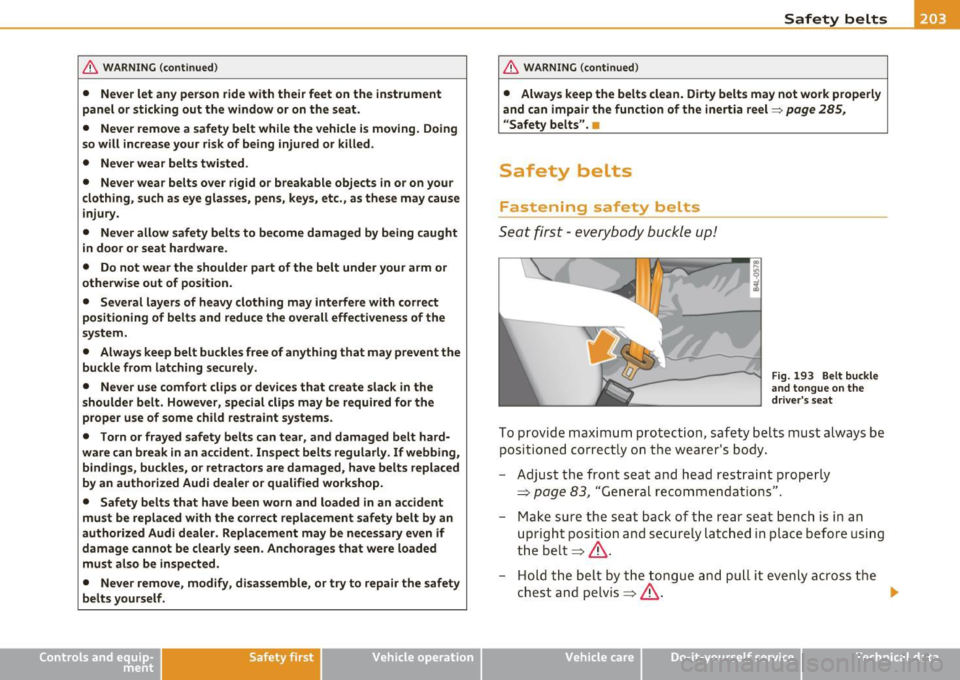
Fig. 193 Belt buckle
and tongue on the
driver's seat
To provide maximum protection , safety belts must always be
positioned correctly on the wearer's body.
- Adjust the front seat and head restraint properly
=>
page 83 , "General recommendations" .
- Make sure the seat back of the rear seat bench is in an
upright position and securely latched in place before using
the belt =>& .
- Hold the belt by the tongue and pull it evenly across the
chest and pelvis=>& . _,.
Vehicle care Do-it-yourselt service iTechnical data
Page 206 of 390
___ s_ a_ f_ e_ t_ y~ b_ e_ lt_s _____________________________________________ _
- Insert t he tongue into the correct buck le of your seat until
you hear it latch secure ly==> fig. 193 .
- Pull on the be lt to make sure tha t it is secure ly la tched in
the buck le.
Automatic safety belt retractors
Every safety be lt is equipped with an automatic be lt retractor on the
shoulder be lt. This feat ure locks the be lt whe n the belt is pulled out
fast, during hard braking and in an acc ident. The belt may also lock
w hen you dr ive up or dow n a steep hill or throug h a sharp curve.
Dur ing normal driv ing the belt lets you move freely.
Safety belt pretensioners
The safety belts are equipped w ith a belt pretensioner that helps to
t ighten the safety be lt and remove sla ck when the p re tensioner is
act ivated. The function of the pretensioner is monitored by a warn ing
light =>
page 17.
Switchable locking feature
Every sa fety be lt ex ce pt t he one on the driver sea t is eq uipped wi th a
switchab le locking feature that
must be used when the safety belt is
used to at tach a child safety seat. Be s ure to read t he importa nt info r
mation about this feature=>
page 241.
& WARNING
Improperly positioned safety belts can c au se se rious injury in a n
accident =>
page 204, "Safety b elt po sition ".
• Safety belt s offer optimum p rotection only when the seat back
i s upr ight and belts are properly positioned on the body .
• Always make sure th at the rear seat backre st to which the
center rear safety belt is attached i s secur ely latched when ever the
rear cente r sa fety belt is be ing u sed . If the ba ckre st is not securely
latched, the pas senger will move forward with th e backre st during
sudde n braking, in a sudden maneuve r and especiall y in a crash .
& WARNING (continued )
• Never attach the safety belt to the buckle fo r another seat .
Attaching the belt to the wrong buckle will reduce safety belt
effectiveness and can cause ser ious personal injury.
• A pass enger who i s not properly restrained can be seriou sly
i njured by the safety belt itself when it mo ves from the stronger
part s of the body into critical area s like the abdomen.
• Alway s loc k the convertible locking retractor when you a re
securing a child safety seat in the vehicle=>
page 243. •
Safety belt position
Correct belt position is the key to getting maximum
pro tection from safety belts .
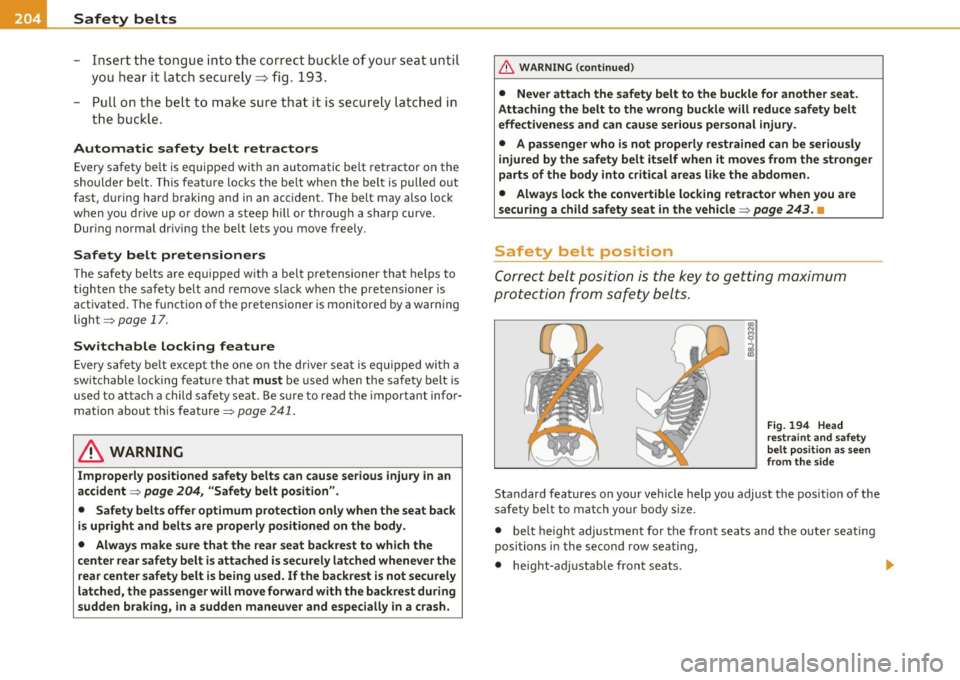
Fig. 194 H ead
r e str aint a nd safet y
belt po sit ion a s seen
from the side
Standard features on your vehicle help you adjust the position of the
safety belt to match your bo dy size.
• belt h eigh t adjustment for the front seats and the oute r seat ing
positions in the second row seating,
• height-ad justable front seats. .,
Page 207 of 390
& WARNING
Improperly positioned safety belts can cause serious personal
injury in an accident. • The shoulder belt portion of the safety belt must be positioned
over the middle of the occupant's shoulder and never across the
neck or throat.
• The safety belt must lie flat and snug on the occupant's upper
body => fig. 194. Pull on the belt to tighten if necessary.
• The lap belt portion of the safety belt must be positioned as
low as possible across pelvis and never over the abdomen. Make
sure the belt lies flat and snug =>
page 204, fig. 194. Pull on the
belt to tighten if necessary.
• A loose-fitting safety belt can cause serious injuries by shifting
its position on your body from the strong bones to more vulner
able, soft tissue and cause serious injury.
• Always read and heed all WARNINGS and other important
information =>
page 202. •
Safety first Vehicle OP-eration
Safety belts
Pregnant women mus.t also be c:orrectly
restra ined
The best way to protect the fetus is to make sure that
expectant mothers always wear safety belts correctly -
throughout the pregnancy.
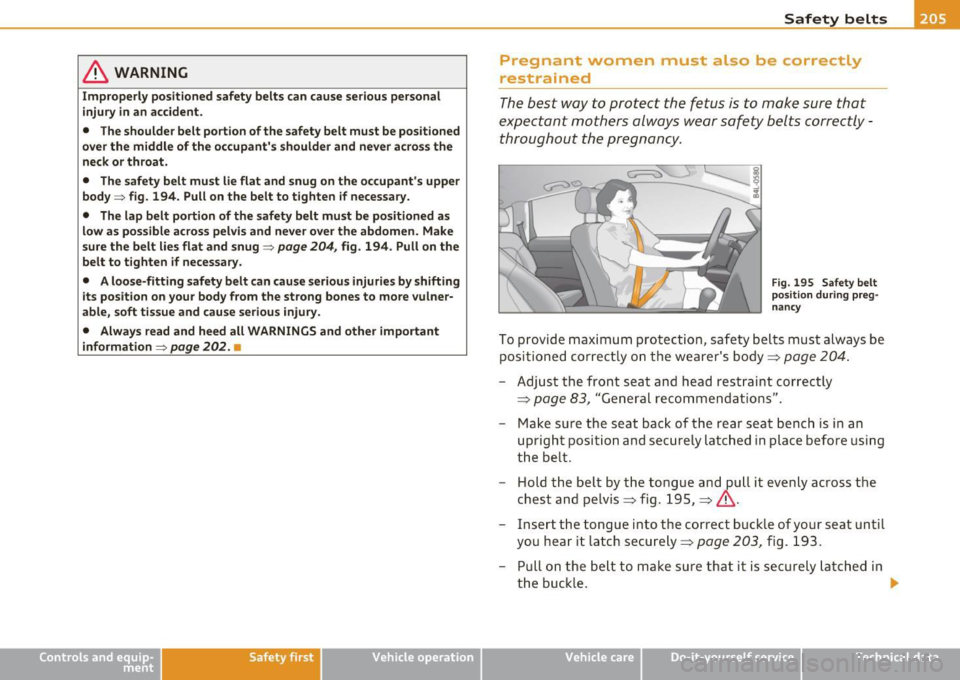
Fig. 195 Safety belt
position during preg
nancy
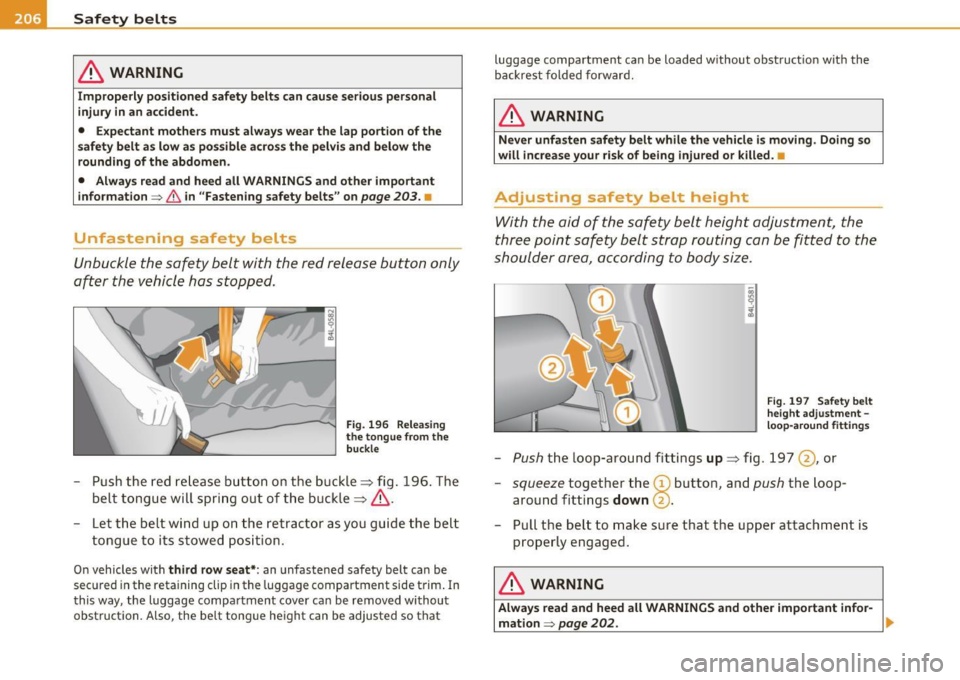
To provide maximum protection , safety belts must always be
positioned correctly on the wearer's body=>
page 204.
- Adjust the front seat and head restraint correctly
=>
page 83, "General recommendations".
- Make sure the seat back of the rear seat bench is in an
upright position and securely latched in place before using
the belt .
- Hold the belt by the tongue and pull it evenly across the
chest and pelvis=> fig. 195 , =>
/1 .
- Insert the tongue into the correct buckle of your seat until
you hear it latch securely=>
page 203, fig. 193.
- Pull on the belt to make sure that it is securely latched in
the buckle.
IJ),
Vehicle care Do-it-yourselt service iTechnical data
Page 208 of 390
•--=S..:a :..:f..:e :..:t:= Y :....:: b:....:e:..: l:..: t :..::s _____________________________________________ _
& WARNING
Improperly positioned safety belts can cause serious personal
injury in an accident.
• Expectant mothers must always wear the lap portion of the
safety belt as low as possible across the pelvis and below the
rounding of the abdomen.
• Always read and heed all WARNINGS and other important
information ~
& in "Fastening safety belts" on page 203. •
Unfastening safety belts
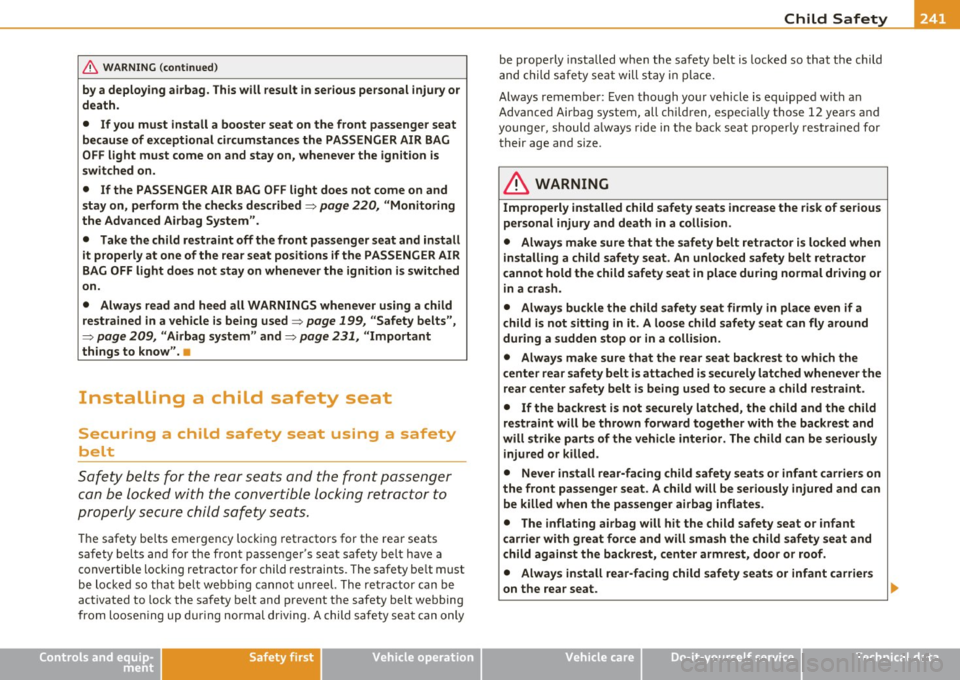
Unbuckle the safety belt with the red release button only
after the vehicle has stopped.
Fig. 196 Releasing
the tongue from the
buckle
- Push the red release button on the buckle=> fig. 196. The
belt tongue will spring out of the buckle=>& .
- Let the belt wind up on the retractor as you guide the belt
tongue to its stowed position.
On vehicles with third row seat* : an unfastened safety belt can be
secured in the retaining clip in the luggage compartment side trim. In
this way, the luggage compartment cover can be removed without
obstruction. Also, the belt tongue height can be adjusted so that luggage compartment can be loaded without obstruction with the
backrest folded
forward.
& WARNING
Never unfasten safety belt while the vehicle is moving. Doing so
will increase your risk of being injured or killed.•
Adjusting safety belt height
With the aid of the safety belt height adjustment, the
three point safety belt strap routing can be fitted to the
shoulder area, according to body size .
Fig. 197 Safety belt
height adjustment -
loop-around fittings
-Push the loop-around fittings up => fig. 197 @ , or
- squeeze together the© button, and push the loop-
around fittings
down @.
- Pull the belt to make sure that the upper attachment is
properly engaged.
& WARNING
Always read and heed all WARNINGS and other important infor- mation:::;:,
page 202. .,
Page 243 of 390
_____________________________________________ C _h_i_ld _ S_ a_ f_ e_ t__. y'--- __
& WA RNING (c on tinued )
by a deploying airbag . This will result in se rious personal injury or
death.
• If you must install a booste r seat on the front passenger seat
because of exceptional cir cumstance s the PASSENGER AIR BAG
OF F light must come on and stay on , whenever the ign ition is
s wit ched on .
• If the PASSENGER
AIR BAG OFF light does not come on and
stay on, perform the checks described => page 220, " Monitoring
the Advanced Airbag System".
• Take the child re straint off the front passenger seat and install
it prope rly at one of the rear seat positions if the PASSENGER AIR
BAG OFF light does not stay on whenever the ignition i s sw itched
on.
• Always read and heed all WARNINGS whenever u sing a child
restrained in a vehicle is being used=>
page 199 , "Safety belts",
=> page 209, "Airbag sy ste m " and => page 231, "Important
things to know ".•
Installing a child safety seat
Securing a child safety seat using a safety
belt
S afet y belts f or t he rear se ats a nd the fr ont pa ssenger
can be l ocke d wit h the co nverti ble lockin g retract or to
p ro p erly sec ure chi ld safety seats .
The safety be lts emergency lo ck ing retractors for the rear seats
safety belts and fo r the fron t passe nger's seat safety belt have a
convertib le locking retractor for child restraints . The safety be lt must
be locked so that belt webbing cannot u nreel. The retractor can be
activated to lock the safety be lt and prevent the safety belt webbing
from loose ning up du ring normal dr iv ing. A child safety seat can only
Controls and equip ment Safety first Vehicle operation be properly
installed when the safety belt is locked so that the child
and child s afety se at will s tay in place.
Always remember: Even though yo ur vehicle is equipped w ith a n
Advanced Airbag system, all chi ldren, especia lly those 12 yea rs and
younger, should a lways ride in th e back sea t pro perly res train ed fo r
their age and size .
& WARNING
Improperly installed child safety seats increase the risk of serious
personal injury and death in a collision.
• Always make sure that the safety belt retractor is locked when
installing a child safety seat . An unlocked safety belt retractor
cannot hold the child safety seat in place during normal driving o r
in a crash.
• Always buckle the child safety seat firmly in place even if a
child is not sitting in it . A loose child safety seat can fly around
during a sudden stop or in a collision.
• Always make sure that the rear seat backrest to which the
center rear safety belt is attached is securely latched whenever the
rear center safety belt is being used to secure a child restraint .
• If the backrest is not securely latched, the child and the child
restraint will be thrown forward together with the backrest and
will strike parts of the vehicle interior. The child can be seriously
injured or killed.
• Never install rear -facing child safety seat s or infant carrier s on
the front passenger seat . A child will be seriously injured and can
be killed when the pa ssenger airbag inflates.
• The inflating airbag will hit the child safety seat or infant
carrier with great force and will sma sh the child safety seat and
child against the backrest, center armrest, door or roof .
• Always in stall rear-facing child safety seats or infant carrier s
on the rear seat. _,.
Vehicle care Do-it-yourself service Technical data
Page 245 of 390
_____________________________________________ C _h_i_ld _ S_ a_ f_ e_ t ... Y'--- __
& WARNING (continued)
the weight-mat in the seat and register a heavier weight in the
Advanced Airbag System. The heavier weight registered can make
the system work as though an adult were on the seat and deploy
the Advanced Airbag when it must be suppressed causing serious
or even fatal injury to the child.
• Make sure that the PASSENGER AIR BAG OFF light comes on
and stays on all the time whenever the ignition is switched on.
• If the PASSENGER AIR BAG OFF light does not come on and
stay on, immediately install the rear-facing child safety seat in a
rear seating position and have the airbag system inspected by
your Audi dealer. •
Activating the convertible locking retractor
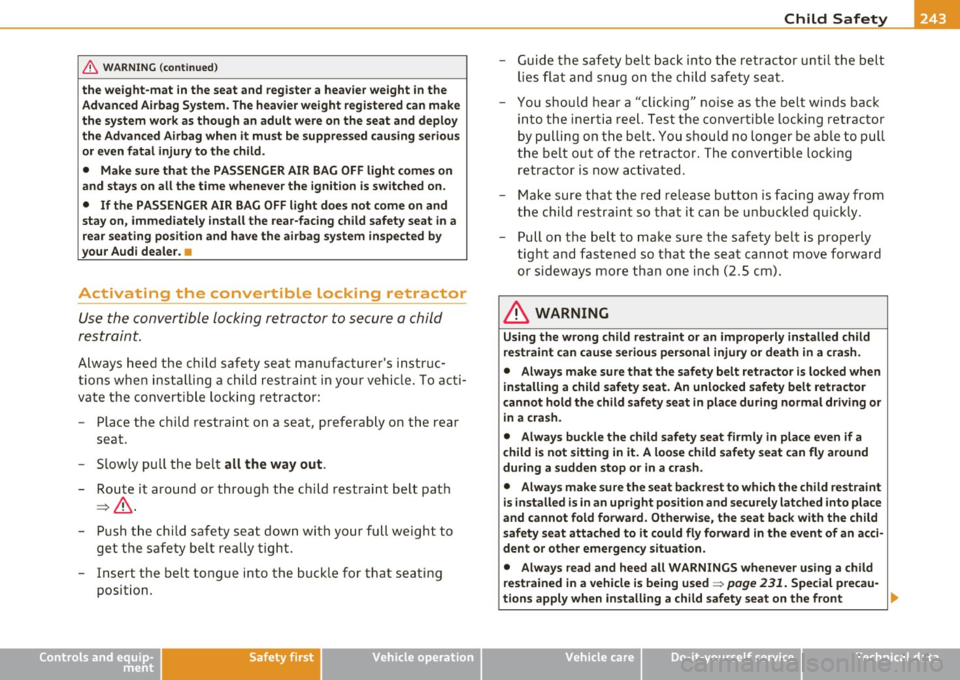
Use the convertible locking retractor to secure a child
restraint.
Always heed the child safety seat manufacturer 's instruc
tions when installing a child restraint in your vehicle. To acti
vate the convertible locking retractor:
- Place the child restraint on a seat, preferably on the rear
seat .
- Slowly pull the belt
all the way out.
- Route it around or through the child restraint belt path
=>& .
- Push the child safety seat down with your full weight to
get the safety belt really tight.
- Insert the belt tongue into the buckle for that seating
position.
Controls and equip ment Safety first Vehicle operation
-
Guide the safety belt back into the retractor until the belt
lies flat and snug on the child safety seat.
- You should hear a "clicking" noise as the belt winds back into the inertia reel. Test the convertible lock ing retractor
by pulling on the belt. You should no longer be able to pull
the belt out of the retractor. The convertible lock ing
retractor is now activated.
- Make sure that the red release button is facing away from the child restraint so that it can be unbuckled quickly .
- Pull on the belt to make sure the safety belt is properly tight and fastened so that the seat cannot move forward
or sideways more than one inch (2 .5 cm) .
& WARNING
Using the wrong child restraint or an improperly installed child
restraint can cause serious personal injury or death in a crash.
• Always make sure that the safety belt retractor is locked when
installing a child safety seat. An unlocked safety belt retractor
cannot hold the child safety seat in place during normal driving or
in a crash.
• Always buckle the child safety seat firmly in place even if a
child is not sitting in it. A loose child safety seat can fly around
during a sudden stop or in a crash.
• Always make sure the seat backrest to which the child restraint
is installed is in an upright position and securely latched into place
and cannot fold forward. Otherwise, the seat back with the child
safety seat attached to it could fly forward in the event of an acci
dent or other emergency situation.
• Always read and heed all WARNINGS whenever using a child
restrained in a vehicle is being used=>
page 231. Special precau-
tions apply when installing a child safety seat on the front
lill-
Vehicle care Do-it-yourself service Technical data
Page 247 of 390
Child restraint manufacturers offer LATCH lower anchorages on the ir
c hild seats with hook-on or push-on connectors attached to adjust
able straps .
I n addition to the LATCH lower anchorages, these child restraint
systems usually require the use of tet he r straps to he lp keep the child
restra int f irm ly in place.
& WARNING
Improper installation of child restraints will increase the risk of
injury and death in a crash.
• Always follow the instructions provided by the manufacturer
of the child restraint you intend to install in your vehicle.
• Never install a child restraint without a properly attached top
tether strap if the child restraint manufacturer's instructions
require the top tether strap to be used.
• Improper use of child restraint LATCH lower anchorage points
can lead to injury in a colli sion . The LATCH lower anchorage points
are designed to withstand only those loads imposed by correctly
fitted child restraints .
• Never mount two child restraint systems on one LATCH lower
anchorage point .
• Never secure or attach any luggage or other item to the LATCH
lower anchorages .
(I) Tips
• In Canada, the terms "top tether " with " lower universa l anchor
ages" (or "lower universal anchorage bars") are used to describe the
system .
• In other countries, the term "ISO FIX" is used to describe the lower
anchorages. •
Safety first Vehicle OP-eration
Location
Child Safety
Fig. 210 Schematic
overview: LATCH
anchorage point loca
tions
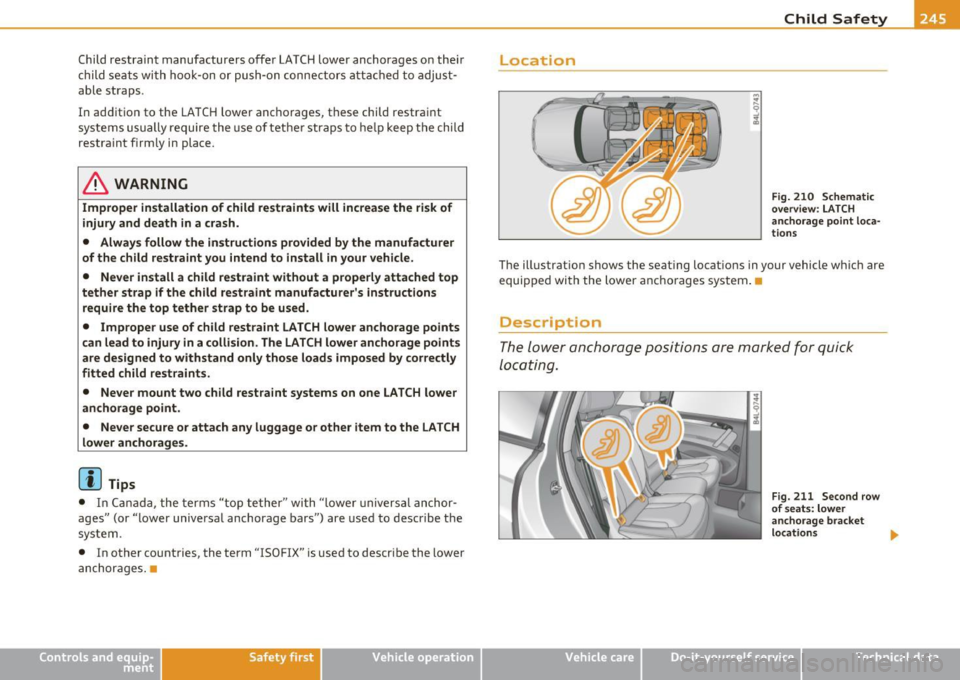
The illustrat ion shows the seating locations in your vehicle whic h are
equipped with the lower anchorages system. •
Description
The lower anchorage positions are marked for quick
locating.
Vehicle care
Fig. 211 Second row
of seats: lower
anchorage bracket
locations ..
Do-it-yourselt service iTechnical data
Page 248 of 390
___ C_h _i_ld _ S_ a_ f_ e_ t_,, y'-----------------------------------------------
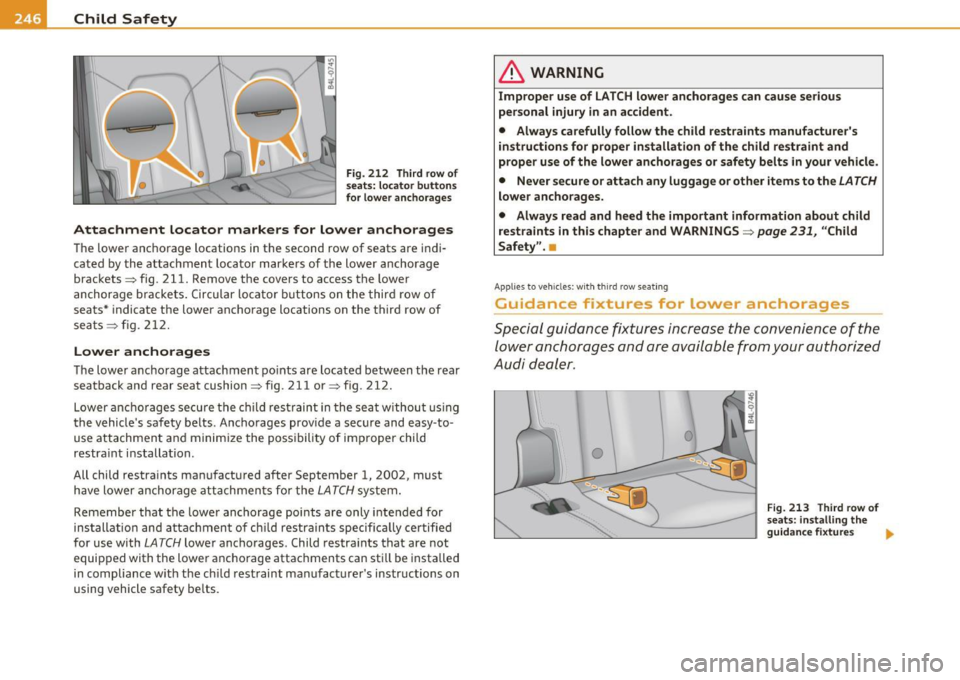
Fig. 212 Third row of
seats: locator buttons
for lower anchorages
Attachment locator markers for lower anchorages
The lower anchorage locations in the second row of seats are indi
cated by the attachment locator markers of the lower anchorage
brackets :::::, fig . 211. Remove the covers to access the lower
anchorage brackets. Circular locator buttons on the third row of
seats * indicate the lower anchorage locations on the third row of
seats :::::, fig. 212.
Lower anchorages
The lower anchorage attachment points are located between the rear
seatback and rear seat cushion:::::, fig. 211 or:::::, fig . 212.
Lower anchorages secure the child restraint in the seat without using
the vehicle's safety belts . Ancho rages prov ide a secure and easy-to
use attachment and minim ize the poss ibility of improper chi ld
restra int installation .
All child restra ints manufactured after September 1, 2002, must
have lower anchorage attachments for the
LATCH system.
Remember that the lower anchorage points are only intended for
ins tallatio n and attachment of child restrain ts specifica lly certified
for use with
LATCH lower anchorages . Child restraints that are not
equipped with the lower anchorage attac hments can still be installed
in compliance w ith the ch ild restraint manufact urer's instructions on
using vehicle safety be lts.
& WARNING
Improper use of LATCH lower anchorages can cause serious
personal injury in an accident.
• Always carefully follow the child restraints manufacturer's
instructions for proper installation of the child restraint and
proper use of the lower anchorages or safety belts in your vehicle.
• Never secure or attach any luggage or other items to the
LATCH
lower anchorages.
• Always read and heed the important information about child
restraints in this chapter and WARNINGS :::::,
page 231, "Child
Safety". •
Applies to veh icles: wi th third row seating
Guidance fixtures for lower anchorages
Special guidance fixtures increase the convenience of the
lower anchorages and are available from your authorized
Audi dealer.
o,
Fig. 213 Third row of
seats: installing the
guidance fixtures ..
Page 249 of 390
I
I I
I I
I I
0
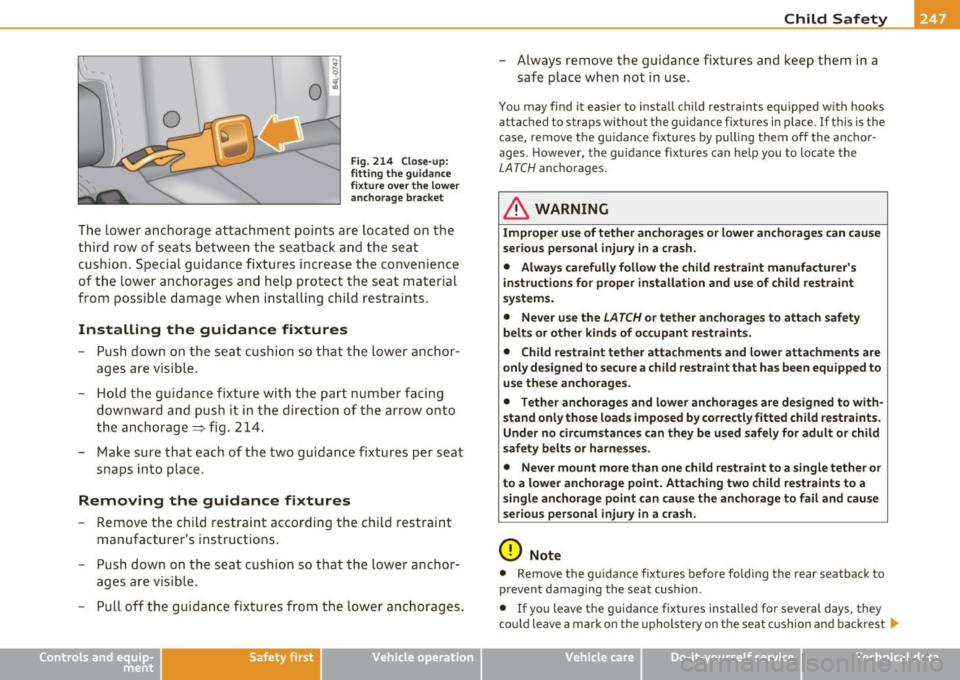
Fig. 214 Close-up:
fitting the guidance
fixture over the lower
anchorage bracket
The lower anchorage attachment points are located on the
third row of seats between the seatback and the seat
cushion. Special guidance fixtures increase the convenience
of the lower anchorages and help protect the seat material
from possible damage when installing child restraints.
Installing the guidance fixtures
- Push down on the seat cushion so that the lower anchor
ages are visible.
- Hold the guidance fixture with the part number facing
downward and push it in the direction of the arrow onto
the anchorage => fig. 214.
- Make sure that each of the two guidance fixtures per seat snaps into place.
Removing the guidance fixtures
- Remove the child restraint according the child restraint
manufacturer's instructions.
- Push down on the seat cushion so that the lower anchor
ages are visible.
- Pull off the guidance fixtures from the lower anchorages.
Safety first Vehicle OP-eration
Child Safety
-Always remove the guidance fixtures and keep them in a
safe place when not in use.
You may find it easier to install child restraints equipped with hooks
attached to straps without the guidance fixtures in place. If this is the
case , remove the guidance fixtures by pulling them off the anchor
ages. However , the guidance fixtures can help you to locate the
LATCH anchorages.
& WARNING
Improper use of tether anchorages or lower anchorages can cause
serious personal injury in a crash.
• Always carefully follow the child restraint manufacturer's
instructions for proper installation and use of child restraint
systems.
• Never use the
LATCH or tether anchorages to attach safety
belts or other kinds of occupant restraints.
• Child restraint tether attachments and lower attachments are
only designed to secure a child restraint that has been equipped to
use these anchorages.
• Tether anchorages and lower anchorages are designed to with
stand only those loads imposed by correctly fitted child restraints.
Under no circumstances can they be used safely for adult or child
safety belts or harnesses.
• Never mount more than one child restraint to a single tether or
to a lower anchorage point. Attaching two child restraints to a
single anchorage point can cause the anchorage to fail and cause
serious personal injury in a crash.
0 Note
• Remove the guidance fixtures before folding the rear seatback to
prevent damaging the seat cushion .
• If you leave the guidance fixtures installed for several days, they
could leave a mark on the upholstery on the seat cushion and backrest•
Vehicle care Do-it-yourselt service iTechnical data