brake light AUDI Q7 2010 Owner´s Manual
[x] Cancel search | Manufacturer: AUDI, Model Year: 2010, Model line: Q7, Model: AUDI Q7 2010Pages: 390, PDF Size: 93.04 MB
Page 148 of 390

llffl..__A_ d_a_ p,__ t_iv _ e_ C_r _u _ i_ s _e _ C_ o_ n_t _ r_ o _ L ___________________________________________ _
tained. The ACC system is not switched off, and increased attention
to the traffic situation is absolutely necessary. The followi ng may be
reasons why the message
ACC functionality limited appears:
• The ACC sensor is dirty . The ACC system is not reacting, or is not
reacting correctly, to moving vehicles up ahead in yo ur la ne of travel.
• There may be very light traffic on and there is nothing that marks
the side of the road (for example , guard rai ls, traffic signs, trees). As
soon as a moving vehicle up ahead is detected aga in, ACC becomes
active again and the message disappears.
The ACC sensor is located behind the area to the right of the front
license plate.
If the ACC sensor is dirty or blocked, clean the area to
restore system operation .
Parking brake !
The text message Parking brake! appears, when the parking brake is
applied. ACC is turned off. A warning tone so unds as a reminder.
Stationary object ahead
The text message Stationary object ahead appears, when you want
to activate the system and there is a stationary vehicle or an object
immediately in front of you.
Gradient too steep
The text message Gradient too steep appears when the max imum
gradient for proper ACC operation has been exceeded. Adaptive
Cru ise Control is turned off . A warning tone also sounds as a
reminder.
ACC off: manual control !
The text message ACC off: manual control! appears after the vehicle
has been brought to a standst ill by the Adapt ive Cruise Control. In
this case you must depress the brake pedal to prevent the vehicle
from rolling . A warn ing tone sounds as a reminder.
Selector lever position I
Th e text message Selector lever position! appears when the selector
lever is moved to position
N. In th is position, Adaptive Cruise Cont rol
is not available. •
Applies to vehicles : w it h Adap tiv e Cru ise Control
Driver intervention prompt
The driver intervention prompt calls on the driver to take
over the situation.
Fig . 140 I nstrument
cluster: Driver inter·
vention prompt
In certain situations, the brak ing power of the Adaptive Cruise
Control is not enough to maintain an adequate distance to the vehicle
up ahead. In these situations, the Adaptive C ruise Control calls the
driver to take action.
The
driver intervention prompt a lerts you vis ually and aud ibly to take
over .
• A red vehicle is shown in the instrument cluster display
:::::,fig. 140.
• T he text
DISTANCE! appears in the status line.
• The indicator light
<::::>11, ,~ in the speedometer blinks red .
• A warning tone sounds.
Page 149 of 390

__________________________________________ A_ d_ a_,_ p_t _iv _ e_C_ r_u _i _ s _e _C_ o_n_ t_ r_ o_ l __ l!'II
[I) Tips
• Adaptive Cru ise Control is sw itched off after pressing the foo t
brake . The speed saved up this poi nt can be resumed.
• T o resume the saved speed, release the brake pedal and p ress the
control lever~
page 139, "Turning Adaptive Cruise Control off
temporar ily ".
• If you use the accelerato r to go faster than the speed of the
vehicle ahead of you, the driver intervention prompt will not be
accompanied by a warning signal.
• If the speed you prev iously set is exceeded, the indicator light in
the speedometer will switch off. •
Appli es to vehi cles : w ith A dap tive Cru ise Cont rol
MMI settings
Individual settings for Adaptive Cruise Control c an be
selected in the MMI.
Settings for t he Driving program ca n be adjusted ind ividually
to the par ticu lar user and save d in the MMI. Th is can only be
done with the engi ne r unning .
- Sele ct : F unc tion b utt on
I C A R]> Systems* > adaptive
cruise control
> Driving program .
Setting the driving program
In the Driving program menu you can ad just the characteristics o f
Ad aptive Crui se Con trol to yo ur own preferences u sing Dynamic ,
Standard or Comfort .
Saving settings
Your individ ual sett ings are automatica lly saved and ass igned to the
remote con trol key being used (remote key sto rage) . If the key is
given to anothe r person, t he saved sett ings rema in as they are. •
Controls and equip
ment Safety first
System Limitations
App
lies to ve hicle s: with Adap tive C ru ise Co ntro l
General information
The radar sensor has limits that the driver must kno w to
be a ble t o use ACC proper ly.
Th e Ad apt ive Cr uise Con trol works wi thin limi ts th at a re also rela ted
to radar sensor range and sight distance. In some situations ACC may react unus ually or late from the drive r's point of view. Therefore,
always be atte ntive to what is happe ning around you and always be
ready to interve ne, if necessary:
• when driving aro und curves ~
page 148
• when ve hicles up front are not in line wit h your vehicle
~ page 148
• when other ve hicles are changing lanes~ page 148
• when other vehicles are difficult to detect~ page 149
• when ve hicles up ahe ad are not mov ing o r o bst acle s ar e in you r
trave l lane ~
page 149
& WARNING
The radar sensor 's function and range can be reduced by rain , snow
and heavy spray . Moving vehicles up ahead may not be promptly
detected or may not be detected at all.
• Always pay careful attention to the traffic situation and be
ready to intervene and be ready to take complete control when
ever necessary .•
Vehicle care Technical data
Page 163 of 390
__________________________________________ A_ u _ t_o _m_ a_ t_ i _c _ t_ra _ n_s _ m_ i_ s _s _ i_ o _n _ __.fflll
Automatic transmission
tiptronic ® (6-speed automatic
transmission)
General information
Your vehicle is equipped with an e lectron ically contro lled automatic
transmission . Upshifting and downshifting takes place
outomoti
colly.
The transmission is also equipped with tiptronic®. It allows the driver
to shift gears
manually if desired ~ page 165. •
Driving the automatic transmission
Starting th e engine
- The selector lever must be in Nor P.
Starting off
- Press and hold the brake pedal.
Con tro ls a nd e quip
m en t
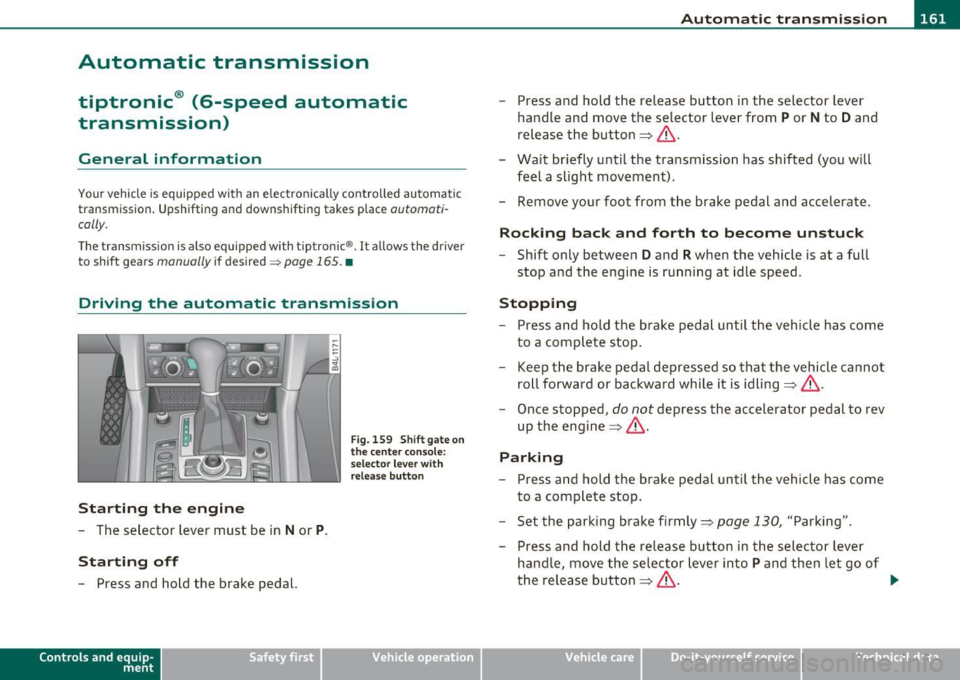
Fig . 159 Shift gate on
the ce nte r co nso le :
selec tor lever with
r elease b utto n
Vehicle OP-eration
-Press and hold the release button in the selector lever
handle and move the selector lever from
P or N to D and
release the button =:> & .
- Wait briefly until the transmission has shifted (you will
feel a slight movement).
- Remove your foot from the brake pedal and accelerate .
Rocking back and forth to become unstuc k
-Shift only between D and R when the vehicle is at a full
stop and the engine is running at idle speed.
Stopping
- Press and hold the brake pedal until the veh icle has come
to a complete stop .
Keep the brake pedal depressed so that the vehicle cannot
roll forward o r backward while it is idling =:> & .
- Once stopped,
do not depress the accelerator pedal to rev
up the engine=:> &.
Parking
-Press and hold the brake pedal unt il the veh icle has come
to a complete stop .
- Set the parking brake firmly =:>
page 130, "Parking".
- Press and hold the release button in the selecto r lever
handle, move the selector lever into
P and then let go of
the release button:::;,& . .,,_
Vehicle care Do-it-yourselt service iTechnical data
Page 165 of 390
______________________________________________ A_ u_ t_ o_ m_ a_ t_ ic_ t_r _a _n_ s_m _ i_s _s_ i_o _n _ ___.lJII
Select R only when the vehicle is at a full stop and the eng ine is
running at id le speed ~
& in "Driving the automatic transmission"
on
page 161 .
Before you move the selector lever to R, press both the button in the
hand le of the selector lever
and the brake pedal at the same t ime.
When the ignition is on, the backup lights illuminate when the
selector lever is moved into
R.
N -Neutral
The transmission is in neutral in this position . Shift to this position
for standing with the brakes applied~
page 163.
When the vehicle is stationary or at speeds below 3 mph (S km/h),
you must always apply the footbrake before and wh ile moving the
lever out of
N .
D -Normal position for driving forward
Position D is for normal city and highway driving. It ranges from zero
to top speed and all gears shift automatically, depending on engine
load, driving speed and automatically selected shift programs.
When the vehicle is stationary or at speeds below 3 mph (S km/h),
you must always apply the foot brake before and while moving the
lever to
D out of N.
In certa in circumstances it may be advantageous to temporarily
switch to the manual shift program to manua lly select gear ratios to
match specific driving conditions~
page 165.
S -Sport position
Select this position for sportier performance. In this position, the
transmission will not upshift as soon, allowing the vehicle to use the
increased power available at higher engine speeds to achieve livelier
acceleration.
When the vehicle is stat ionary or at speeds be low 3 mph (5 km/h),
you must always apply the foot brake before and while moving the
lever to
S out of N.
Con tro ls a nd e quip
m en t Vehicle
OP-eration
& WARNING
Read and follow all WARNINGS~ & in "Driving the automatic
transmission" on
page 161.
0 Note
Coasting downh ill with the transmission in N and the engine not
running will result in damage to the automatic transmission and
possibly the cata lytic converter. •
Automatic Shift lock (ASL)
The Automatic Shi~ Lock safeguards you against acci
dentally shifting into a forward or the reverse gear and
causing the vehicle to move unintentionally.
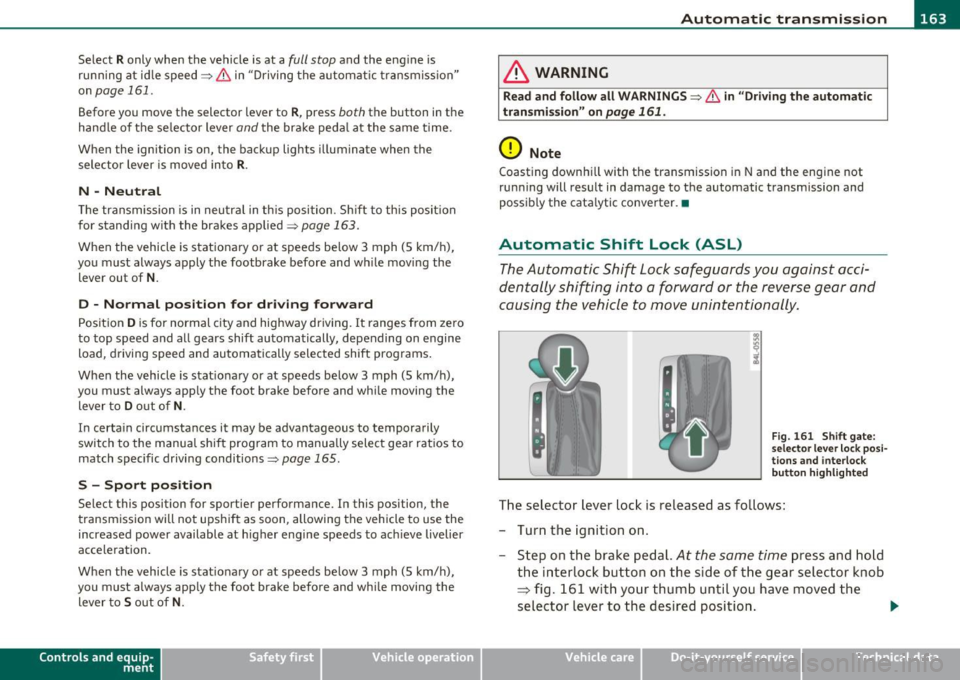
Fig. 161 Shift gate:
selector lever lock posi
tions and interlock
button highlighted
The selector lever lock is released as follows:
- Turn the ignition on.
- Step on the brake pedal.
At the same time press and hold
the interlock button on the side of the gear selector knob
~ fig. 161 with your thumb until you have moved the
selector lever to the desired position . _..
Vehicle care Do-it-yourselt service iTechnical data
Page 166 of 390

1111....__A_ u_ t_o _m_ a_ t_ic _ t_ r_ a_ n_s _m_ i _s_ s_ i_ o_ n ____________________________________________ _
Automatic selector lever lock
The selector lever is locked in the P and N positions when the ignition
is turned on . To move the lever from these positions the driver must
depress the brake pedal. As a reminder to the driver, the following
warning appears in the instrument cluster display when the selector
is in
P and N:
When stationary apply foot brake while selecting gear
A time delay element prevents the selector lever from locking when
it is moved through the
N position (going from R to D). The locking
element will lock the selector lever if the lever is left in N (Neutral) for
more than approximately 1 second, without the brake pedal being
pressed .
At speeds above about 3 mph (5 km/h) the Automatic Shift Lock is
automatically deactivated in the
N position.
Interlock button
The lock button on the selector lever prevents the lever from being
accidentally shifted into ce rtain positions. Pressing this button deac
tivates the selector lever lock. Depending on the direction of the
shift, the selector lever locks at different positions . The positions are
highlighted in the illustration ~
page 163, fig. 161.
Ignition key safety interlock
The key cannot be removed from the ignition unless the selector lever
is in the
P park position . When the ignition key is removed, the
selector lever will be locked in the
P position. •
Kick-down
The kick-down feature allows the vehicle to generate
maximum acceleration.
When you press the accelerator pedal beyond the resistance point
that is reached at full throttle, the transmission will select a lower
gear ratio based on vehicle speed and engine RPM. The engine RPM
will be controlled to produce maximum vehicle acceleration as long as you continue to press the accelerator pedal beyond this
resistance
point .
& WARNING
Be careful when using the kick-down feature on slippery roads.
Rapid acceleration may cause the vehicle to skid. •
Dynamic shift program (DSP)
The automatic transmission is electronically controlled.
The transmission is self adapting and will automatically select the
best shift program suited to the driving conditions and driving style.
The transmission will select one of the
economy programs when you
drive at a steady speed or a gradually changing speed without heavy
acceleration . This achieves optimum fuel efficiency, with early
upshifting and delayed downshifting.
The transmission will automatically select the
sporty shift programs
when you drive at higher speeds, or with heavy acceleration and
frequently changing speeds. Upshifts are delayed to make full use of
engine power . Downshifting takes place at higher engine speeds than
in the economy programs.
The selection of the most suitable shift program is a continuous ,
automatic process. The driver can also make the transmission switch
to a sporty program by
quickly pressing down the gas pedal.
This causes the transmission to shift down to a lower gear to achieve rapid acceleration, e .g. for quickly passing another vehicle. You do
not need to press the gas pedal into the kick -down range . After the
transmission has upshifted, the original program is selected
according to your driving style.
An additional shift program allows the automatic transmission to
select the proper gear for uphill and downhill gradients.
This keeps the transmission from shifting up and down unnecessarily
on hills. The transmission will shift down to a lower gear when the .,_
Page 167 of 390
______________________________________________ A_ u_ t_ o_ m_ a_ t_ ic_ t_r _a _n_ s_m _ i_s _s_ i_o _n _ ___.1111
driver presses the brake pedal on a downhill gradient . This makes use
of the braking effect of the engine without the need to shift down
manually .•
Manual shift program
Using the manual shift program you can manually select
gears.
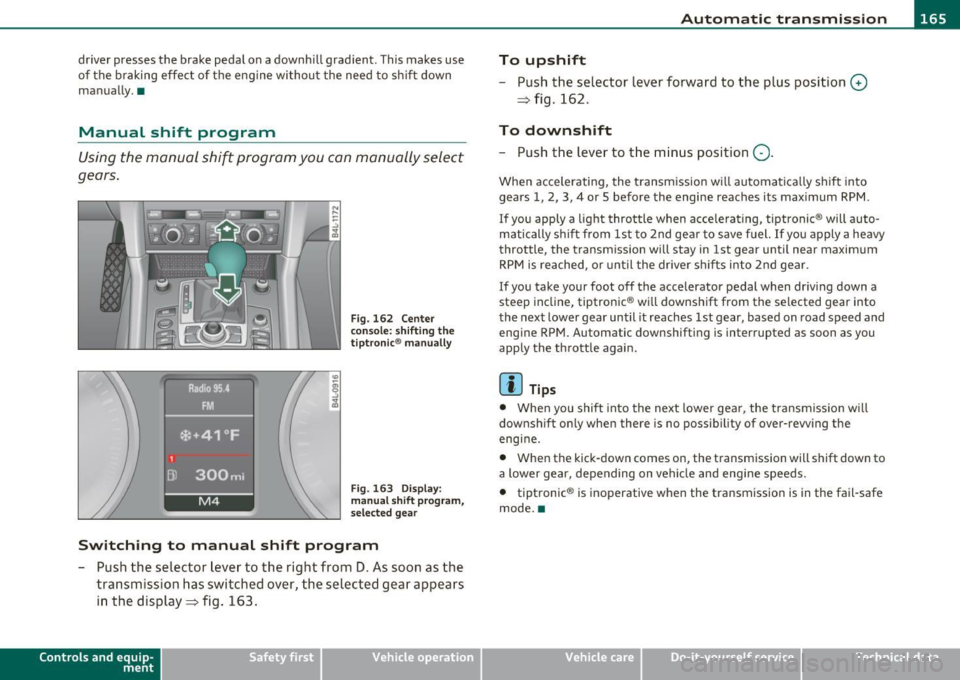
Fig. 162 Center
console : shifting the
tiptronic ® manually
Fig . 163 Display:
manual shift program,
selec ted gear
Switching to manual shift program
-Push the selector lever to the right from D. As soon as the
transmission has switched over, the selected gear appears
in the display => fig . 163.
Con tro ls a nd e quip
m en t Vehicle
OP-eration
To upshift
-Push the selector lever forward to the plus position 0
=> fig . 162.
To downshift
- Push the lever to the minus position Q.
When accelerating, the transm ission w ill automatically shift into
gears 1, 2, 3, 4 or 5 before the engine reaches its maximum RPM .
I f you apply a light throttle when accelerating, tiptronic ® will auto
matically shift from 1st to 2nd gea r to save fuel. If you apply a heavy
throttle, the transmission will stay in 1st gear until near maximum
RPM is reached, or until the driver shifts into 2nd gear.
If you take your foot off the accelerator pedal when driv ing down a
st eep incline, tiptronic ® will downshift from the selected gear into
the next lower gear until it reaches 1st gear, based on road speed and
e ngine RPM. Automatic downsh ifting is interrupted as soon as you
apply the throttle again.
[ i ] Tips
• When you shift into the next lower gear, the transmission will
downshift on ly when there is no possibility of over-rewing the
engine.
• When the kick -down comes on, the transmission will shift down to
a lower gear, depending on vehicle and engine speeds.
• tiptronic ® is inoperative when the transmission is in the fail-safe
mode. •
Vehicle care Do-it-yourselt service iTechnical data
Page 185 of 390
_____________________________________________________ H_ o_m_ e_ L_i_n _k_ ®_ • __ _
Homelink ®
Universal remote control
Applies to veh icles: w ith Hom eli nk ® universal remote control
General information
The Homelink ® feature can learn up to three radio
frequency codes for most current transmitters used for
operating garage doors, estate gates, home or outdoor
lighting systems, and other devices.
You must first program the Homelink ® transm itter before you can
use the system=>
page 184, "Programming the Home link® trans
mitter".
I n order to program the Homelink ® transmitter for devices utilizing
rolling code, a second person on a ladder who can safe ly reach the
garage door opener motor is recommended. It is also necessary to
locate the "learn" button on your garage door opener motor. Refer to
the operating instructions for the opener, as the location and color of
this button may vary by manufacturer.
You can still use the original remote control for the device at any
time.
& WARNING
• Never use the Homelink'"' transmitter with any garage door
opener that does have not the safety stop and reverse feature as
required by federal safety standards. This includes any garage
door opener model manufactured before Aprill, 1982.
• A garage door opener which cannot detect an object, signaling
the door to stop and reverse does not meet current federal safety
standards. Using a garage door opener without these features
increases risk of serious injury or death.
Controls and equip
ment Safety first
& WARNING
(continued)
• For safety reasons never release the parking brake or start the
engine while anyone is standing in front of the vehicle.
• A garage door or an estate gate may sometimes be set in
motion when the Homelink ® remote control is being
programmed. If the device is repeatedly activated, this can over
strain motor and damage its electrical components -an over
heated motor is a fire hazard!
• To avoid possible injuries or property damage, please always
make absolutely certain that no persons or objects are located in
the range of motion of any equipment being operated.
rn Tips
• If you would like more information on Homelink ®, where to
purchase the Homelink ® compatible products, or would like to
purchase the Homelink ® Home Lighting Package, please call toll
free: 1-800-355-3515.
• For Declaration of Compliance to United States FCC and Industry
Canada regulations=>
page 369. •
Vehicle care Technical data
Page 186 of 390

1111..__H_ o_m_ e_ L_ i _n_ k_ ® _______________________________________________ _
Applies to veh icles : w ith Homelin k® un iversa l remote control
Programming the Homel ink ® transmitter
The transmitter is programmed in two phases . For rolling
code transmitters, a third phase is also necessary .
111111
-
1111111
Fig. 180 Over head
console: Homelink ®
keypad
Fig. 181 F ront
bumper, dri ver side:
locat ion of transmitter
unit
Phase 1: progr amming th e overhead k eypad
1. Make sure your vehicle is within operating range of the
remote controlled garage door opener .
2. Set the parking brake~
& in "General information " on
page 183 .
3. Turn the ignition on . Do not start the engine! 4
. Press and hold the two outside Homelink ® buttons
G) and
@ for approximately 20 seconds until indicator light@
=> fig.
180 begins to flash . Then release both buttons . Do
not hold the buttons for longer than 30 seconds .
- This procedure only needs to be performed
once. It erases
the factory-set default codes and does not have to be repeated to program additional remote controls .
5. Press and hold the Homelink ® button
G) , @ or@ until
the indicator light@ starts flashing
slowly . Release the
button .
-The system will remain in programming mode for 5
minutes. Co to the front of the vehicle and proceed with
phase
2 .
Phase 2:
programming the bumper mounted transmit
ter
6. Hold the original r emote control at a distance between 0-
6 in.
(0 -15 cm) from the bumper below the appropriate
headlight for your vehicle => fig .
181 (use the shortest
distance possible) .
7. Aim the remote control just below the
driver side head
light .
8. Press and hold the activation button on the remote control.
- May be different in Canada . If so, press and re-press
(cycle) the activation button on yo ur remote control every
two seconds. .-,,
Page 255 of 390

_________________________________________ I_ n_ t_ e_ ll_,igent technology ,__E~-
fore-and-aft and lateral directions, the brake pressure and the
steering angle are all measured.
The direction in which the driver wishes to travel is determined with
the aid of the steering angle and vehicle speed and is continually
compared with the actual behavior of the vehicle. If the two do not
match, for example, when the vehicle starts hydroplaning on a wet
road, ESP will automatically brake the appropriate whee l to correct
the problem.
The vehicle is then stabi lized by the forces acting on the whee l during
braking. If the vehicle is
oversteering (rear tends to skid out of the
turn), the brakes are main ly applied on the wheel that is on the
outs ide of the curve. In the case of a vehicle that is
understeering
(tendency to slide out of the curve), the brakes are applied as needed
on the wheel that is on the inside of the curve or additionally on the
other wheels. An acoustic s ignal indicates when ESP brake application
cuts in=> &.
The system operates across the entire speed range in combination
with the ABS system ~
page 256 . If the Anti -Lock Brake System
(ABS) ma lfunctions, the ESP wi ll be out of action as well.
Activating
When you turn on the engine, ESP will automatically be activated and
will perform a self-test. As soon as the test is comp leted, the system
is in normal operating mode .
Offroad mode
ESP should normally be operated in normal mode because this
ensures maximum vehicle stability. If necessary, you can activate the
ESP offroad mode by pressing the button=>
page 252, fig. 220 to
obtain maximum traction and braking ability when driving off paved
roads at low speeds. In ESP offroad mode, the ESP indicator light
=> page 16 illuminates and the message ESP Offroad Caution!
Limited driving stability
appears briefly in the disp lay.
The ESP offroad mode can be useful in the following exceptiona l situ
ations when slip or a highly effe ctive different ial loc king funct ion is
desirable. Examples:
Controls and equip ment Safety first Vehicle operation
•
when driving w ith tire chains,
• when driving in deep snow or on loose ground,
• when driving on uneven surfaces with the wheels severely
unloaded (articulation), and
• when rocking the vehicle loose a fter it has become stuck.
When the unusual situation is past, you should sh ift back to the
normal ESP operating mode by pushing the button again. The
message
ESP/ ASR on then appears briefly in the display.
Hill descent control
The hill descent control is switched on in ESP offroad mode. When
slowly descending steep gradients on loose ground or when the axles
are art iculated, hill descent control provides assistance by automati
cally applying the brakes to keep vehicle speed constant. The vehicle
is also rende red easier to steer by select ive distribution of braking
force. Hill descent control intervenes when:
• the accelerator pedal is not pressed,
• the vehicle is travelling less than 12 mph (20 km/h),
• a steep gradient is detected,
• wheel behavior indicates loose ground or conditions with poor
adhesion (e.g. also axle articulat ion).
Hill descent control operates both dr iving forward and in reverse.
Active hi ll descent control is deactivated by pressing the accelerator
pedal until the conditions for activation already listed are met aga in .
& WARNING
• The Electronic Stabilization Program is nevertheless subject to
the laws of physics . It is particularly important to pay attention to
this fact on wet and slippery roads. It is therefore important that
you always adapt your driving to the condition of the road and
traffic conditions. Do not allow the increased safety provided by
the Electronic Stabilization Program system to lull you into
accepting additional safety risks. ..
Vehicle care Do-it-yourself service Technical data
Page 256 of 390
Intelligent technology
'-----------------------------------------------
& WA RNING (conti nu ed )
• Plea se be aware th at in ESP offroad mode , particularly on a
s mooth and slippery road, the wheels may have an incr eased
tendency to spin and the vehicle may break awa y -danger of skid
ding!
• Stabilit y is limited in the ESP offroad mode. •
Electronic differential lock (EDL)
The electronic differential lock monitors the rotational
speed of the drive wheels.
General notes
The electronic differe ntia l lock (EDL) helps the ca r to sta rt moving,
acce lerate and climb a gradient on surfaces provi ding poor or almost
no grip. W ithout ED L, th is would be d iff ic ul t, if not impossible .
How the system works
The EDL operates automatically . It mo nitors the rotational speed of
w heels wi th the help of the ABS sensors ==>
page 256 . If a not iceab le
slip is detected at the wheels (e .g . o n slippery g round on one side),
the spin ning whee ls are braked and power is transferred to the other
wheels. This is done up to a speed of about 60 mph ( 100 km/h) .
Noises from the brake system signa l that wheel spin is being
cont rolled.
Driv ing off
W hen d rivi ng off, always be sure to keep road conditions in mind as
you acce lerate. If one drive wheel spins because it is on a surface with
less grip, apply
plenty of th rottle until t he car starts to move .
Overheating of brakes
To prevent the disc b rake of the bra ked wheel from overhea ting if
subjected to excessive loads on this whee l, t he EDL cuts out tempo
ra rily. The vehicle rema ins operat iona l and behaves in the same way
as a veh icle without EDL. As soon as the brake has coo
led down, EDL sw itches on again auto
m atically.
& WARNING
• When accelerating on slippery surfaces, such as on ice or snow,
always be careful when depressing the accele rator pedal. Even
with the EDL working , the drive wheels c an spin and reduce your
ability to control your car . Risk of crash!
• The increased safety afforded by EDL does not mean that you
can take safety risks . Always adapt your d riv ing style to the road
c ondition s and traffic situation.
[ i ] Tips
If a fa ult occurs in the A BS, the ED L is also no t fu nct io ni ng. This is
ind icated by the ABS warn ing light==>
page 19. •
Anti-Slip Regulation System (ASR)
The Anti- S lip Re gula tion System preven ts the drive n
w heels from spinning when the car is acc ele rating .
General notes
The Anti-S lip Reg ulation Sys tem (ASR) is in tegr ated in the ele ctroni c
stabilization program (ESP) . When the ve hicle starts up and acceler
a tes, the whee ls are p reven ted from sp inning by adjust ing t he engine
power to match the amoun t of grip ava ilable from the road surface.
How the system works
ASR performs automatica lly, i.e. witho ut the driver 's intervent ion.
With the aid o f th e ABS sensors ==>
page 256, ASR moni to rs the speed
of the driven wheels. If the whee ls start to spin, engine torque is
reduced automatically unt il the tires find enough grip to lock onto
the road s urface. The system is active ac ross the en tire speed range .
'1>