tow AUDI Q7 2010 Owner´s Manual
[x] Cancel search | Manufacturer: AUDI, Model Year: 2010, Model line: Q7, Model: AUDI Q7 2010Pages: 390, PDF Size: 93.04 MB
Page 341 of 390

_____________________________________________ W __ h_a_ t_ d_o_ I_ d_o _ n_ o_ w _ ? __ _
& WARNING (continued)
-Never store the inflatable spare tire or jack and tools in the
passenger compartment.
- Always store all jacking equipment, tools, and the inflatable
spare tire in the luggage compartment.
- Tighten the knurled retaining screw for the inflatable spare
tire securely.
0 Note
• The inflatable spare tire has been developed specifically for this
vehicle model. It must not be exchanged or used for other vehicle
models . Similarly, inflatable tires from other vehicle models must
not be used.
• Normal summer or winter tires must not be installed on the inflat
able tire rim. •
Inflating inflatable spare tire
-Remove the compressor from the luggage compartment
~ page 338, fig. 250.
- Unscrew the valve stem from the spare tire.
- Screw the tire filler hose from the compressor firmly onto
the valve of the spare tire.
- Insert the plug from the compressor into a socket of the
vehicle ~
page 104.
- Switch the compressor on .
- Let the compressor run until it has reached SO PSI (3.5
bar). Switch the compressor off after running for
12 minutes at the most - danger of overheating!
Safety first
& WARNING
The compressor and the tire filler hose can become extremely hot
while they are running · danger of burns!
0 Note
Switch the compressor off after running for 12 minutes at the most
danger of overheating! Allow the compressor to cool down for a few
minutes before you use it again.
[ i] Tips
The compressor must not be connected to the cigarette lighter
socket, as this socket does not provide the required power.•
Changing a wheel
Before changing a wheel
Observe the following precautions for your own and your
passenger's safety when changing a wheel.
- After you experience a tire failure, pull the car well away
from moving traffic and try to reach
level ground before
you stop ~& -
- All passengers should
leave the car and move to a safe
location (for instance, behind the guardrail)~ &.
- Engage the
parking brake to prevent your vehicle from
rolling unintentionally~ &.
- Move
selector lever to position P ~ & .
- If you are tow ing a trailer: unhitch the trailer from your
vehicle. ..,_
Vehicle care Do-it-yourself service Technical data
Page 354 of 390

Ill Emergency situations 1..--=---=;..._ ____________ _
Emergency situations
General
This chapter is intended for trained emergency crew s and working
pe rsonnel who have the necessary tool s and equipment to perform
the se operation s. •
Starting by pushing or towing
0 Note
Yo ur vehicle is equipped with an automatic t ransmission . Conse
quently, the engine ca nnot be started by push ing or tow ing .•
Starting with jumper cables
I f necessary, the engine can be started by connectin g it to
the bat tery of another vehicle.
If the eng ine shou ld fa il to start because of a discharged or weak
battery, the battery can be connected to t he battery of
another
veh icle, us ing a pair of jumper cables to start the eng ine .
Jumper cables
Use only jumper cables of sufficiently large cro ss section to carry the
sta rter cur rent safely . Refer to the m an ufa ct ur er's specificat ions.
Use only j umpe r cab les with
insulated te rm inal clamps wh ich are
distinct ly marked :
plus(+) cable in most cases colored red
minus (-) cable
in most cases colored b lack .
& WARNING
Batterie s contain el ectricity, acid, and gas . Any of the se can cause
very serious or fatal injury. Follow the inst ructions below for safe
handling of your vehicle 's battery.
• Always shield your eyes and avoid leaning over the battery
whenev er po ssible .
• A discharged battery can freeze at temperatures just below
32 °F (0 °C ). Before connecting a jumper cable, you must thaw the
frozen battery completely, otherwise it could explode.
• Do not allow battery acid to contact eyes or sk in . Flush any
contacted area with water immedi ately .
• Improper use of a booste r battery to start a vehicle may cause
an explosion .
• Vehicle batteries generate e xplosive gases. Keep sparks, flame
and lighted cigarettes away from batterie s.
• Do not try to jump start any vehicle with a low acid level in the
battery.
• The voltage of the booster battery must also have a 12-Volt
rating. The capacity (Ah) of the booster battery should not be
lower than that of the discharged battery . Use of batteries of
different voltage or substantially different "Ah " rating may cau se
an e xplosion and personal injury.
• Never charge a frozen battery . Gas trapped in the ice may cause
an explosion.
• Never charge or use a battery that has been frozen. The battery
case may have be weakened .
• Use of batteries of different voltage or substantially different
capacity (Ah) rating may cause an explosion and injury . The
capacity (Ah) of the booster battery should not be lower than that
of the discharged battery. .,_
Page 357 of 390
Emergency situations --------------=---:.-----JftPII
Emergency towing with
commercial tow truck
General hints
Your Audi requires special handling for towing.
The following information is to be used by commercial tow truck
operators who know how to operate their equipment safely.
• Never tow your Audi, towing will cause damage to the engine
and transmission.
• Never wrap the safety chains or winch cables around the brake
lines.
• To prevent unnecessary damage, your Audi must be transported
with a flat bed truck.
• To load the vehicle on to the flat bed, use the towing loop found
in the vehicle tools and attach to the front or rear anchorage
=> page 355 and=> page 356 .
& WARNING
A vehicle being towed is not safe for passengers. Never allow
anyone to ride in a vehicle being towed, for any reason. •
Vehicle OP-eration
Front towing loop
Do not install the front towing loop until it is needed.
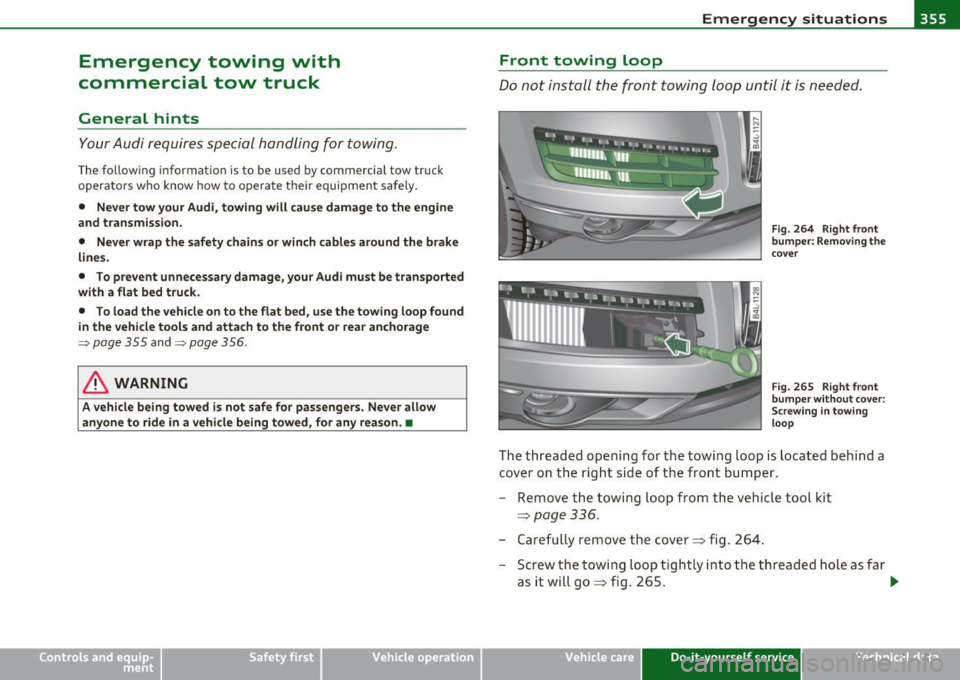
Fig. 264 Right front
bumper: Removing the
cover
Fig. 265 Right front
bumper without cover:
Screwing in towing
loop
The threaded opening for the towing loop is located behind a
cover on the right side of the front bumper.
- Remove the towing loop from the vehicle tool kit
=> page 336.
-Carefully remove the cover:::::, fig. 264.
- Screw the towing loop tightly into the threaded hole as far
as it will go=:> fig. 265 .
~
Vehicle care Do-it-yourself service iTechnical data
Page 358 of 390
lffll.,___E_ m_ e_r-=g :.. e_ n_c -=y '-- s_i_t _u _a _ t_ i_ o _ n_ s ____________________________________________ _
When it is no longer needed, unscrew the towing loop and put it back
into the vehicle toolkit. Be sure to have the towing loop stored in the
vehicle at all times.
& WARNING
If the towing loop is not screwed in as far as it will go, the thread
can pull out when the vehicle is towed· potential risk of an
accident. •
Rear towing loop
Do not install the rear towing loop until it is needed.
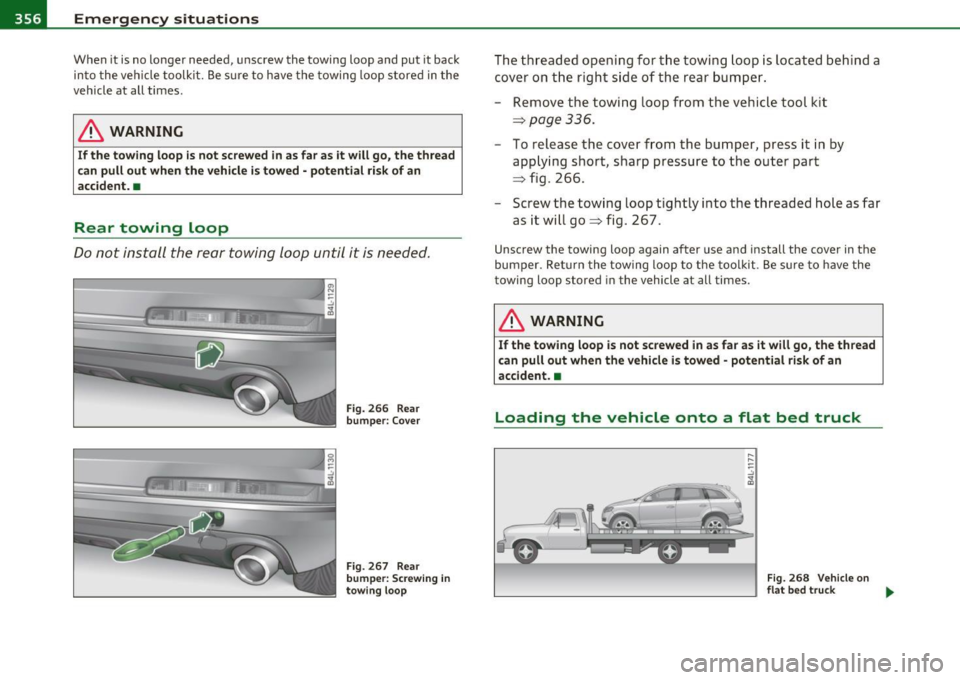
Fig. 266 Rear
bumper: Cover
Fig. 267 Rear
bumper: Screwing in
towing loop
The threaded opening for the towing loop is located behind a
cover on the right side of the rear bumper.
- Remove the towing loop from the vehicle tool kit
=> page 336.
-To release the cover from the bumper, press it in by
applying short, sharp pressure to the outer part
=> fig . 266.
- Screw the towing loop tightly into the threaded hole as far
as it will go=> fig. 267 .
Unscrew the towing loop again after use and install the cover in the
bumper. Return the towing loop to the toolkit. Be sure to have the
towing loop stored in the vehicle at all times.
& WARNING
If the towing loop is not screwed in as far as it will go, the thread
can pull out when the vehicle is towed -potential risk of an
accident. •
Loading the vehicle onto a flat bed truck
Fig. 268 Vehicle on
flat bed truck ..
Page 359 of 390

____________________________________________ E_m _ e_ r-= g=- e_ n_c -=y _ s_it _ u_ a_t _io _ n_ s _ __.ffllll
Front hook up
- Align the vehicle with the centerline of the car carrier
ramp.
- Attach the winch hook to the front towline eye previously
installed.
R ear hoo k up
Align the vehicle with the centerline of the car carrier
ramp .
- Attach the winch hook to the rear towline eye previously
installed .
[ i ] Tips
Check carefully to make sure the hook -up is secure before mov ing the
car up the flatbed truck ramp .•
Vehicle OP-eration
Lifting vehicle
Lifting with workshop hoist and with floor
jack
The vehicle may only be lifted at the lifting points illus
trated.
- Read and heed WARNING~ /1:)..
Fig . 269 Front l ifti ng
p oin t
Fig . 270
R ear lift in g
point
- Locate lifting points~ fig . 269 and~ fig . 270 .
- Adjust lift ing arms of workshop hoist or floor jack to
match vehicle lifting points .
Vehicle care Do-it-yourself service iTechnical data
Page 363 of 390
________________________________________________ G_e_ n_e_ r _a_ l_i_n _f_ o_ r_m _ a_t_ i_ o _ n __ _
The safety compliance sticker
is your assurance that yo ur new vehicle complies with all applicable
Fede ral Motor Veh icle Safe ty Standards which were i n effect at the
time the vehicle was manufact ured . Yo u can fi nd this sticker on the
left doo r jamb.
It shows the mont h and year of prod uct io n and the
vehicle identification number of your veh icle (perforation) as well as
the Gross Vehicle Weight Rating (GV WR) and the Gross Axle Weight
Rating (GAWR).
The high voltage warning label
is located o n the loc k carrier.
The spark ignition system complies with the
Canadian standard ICES-002. •
Weights
Gross Vehicle Weight Rating
The Gross Vehicle Weight Rating (GVWR), and the Gross Axle Weight
Rating (GAWR) for front and rear are listed on a sticker on the left
door jamb.
T he Gross Vehicle Weight Rating includes the weight of the basic
vehicle pl us f ull f uel tank, oil and coo la nt, plus max im um load, whi ch
includes passenger we ight (150 lbs/68 kg per des ignated seating
position) and luggage weight~& .
Gross Axle Weight Rating
The Gross Axle Weight Ra ting is the maximum lo ad that can be
applied at each axle of the vehicle~&.
Vehicle capacity weight
The vehicle capacity weight (max. load) is listed on the dr iver's side B
pillar.
Safety first
Roof weight
Th e maxim um permiss ib le roof weight is 220 lb (100 kg ). T he roof
we ight is made up of the weight of the roof rac k system and t he
we ight of the o bject being transported ~
page 101, "Loading the
roof rack" .
& WARNING
• The Gross Vehicle Weight Rating for your Audi Q7 vehicle,
found on the safety compliance label on the driver's side B-pillar,
must never be exceeded under any circumstances . Exceeding the
Gross Vehicle Weight Rating of your vehicle is likely to damage
your vehicle, and such damage will not be covered by your Limited
New Vehicle Warranty. E xceeding the Gross Vehicle Weight
Rating will also change the performance and handling character
istics of your vehicle, which could cause a crash resulting in serious
injury or death.
• The Gross Vehicle Weight Rating fo r your Audi Q7 would be
exceeded if your vehicle is simultaneously equipped with
Panoramic sl iding sunroof; third -row seating ; trailer towing
equipment (factory or dealer-in stalled), and running boards
( dealer-installed). UNDER NO CIRCUMSTANCES MAY ALL SUCH
ITEMS BE INSTALLED ON THE SAME VEHICLE.
• The actual Gross Axle Weight Rating at the front and rear a xles
s hould not exceed the permis sible weights , and their combination
must not exceed the Gross Vehicle We ight Rat ing.
• Exceeding permissible weight ratings can result in vehicle
damage, accidents and personal injury .
0 Note
• The vehicle capac ity we ight figures apply when the load is dist rib
u ted evenly i n the vehicle (p assenge rs and luggage). When trans
porting a heavy load i n the luggage compartment, carry the load as
ne ar to the rear ax le as possible so th at th e ve hicle's hand ling is not
impaired. -.,
Do-it,yourself service Technical data
Page 369 of 390
_____________________________________________ C_o_ n_s _u_ m __ e_r _ I_ n_ f_o _r_ m_ a_ t_ i _o_ n __ __
reliab ility. For deta iled vehicle maintenance cons ult your Warra nty &
Main tenan ce bookle t.
Under difficult operating conditions, for example at extremely low
outside temperatures, in very dusty regions, when towing a trailer
very frequently, etc., some service wo rk shou ld be performed
between the intervals specified. This app lies particu larly to:
• oil changes, and
• cleaning or rep lacing the air fi lter.
<£> For the sake of the environment
By regular ly maintaining your vehicle, you help make sure that emis
sion standards are mainta ined, t hus mi nimizing adve rse e ffects o n
the environment. •
Important considerations for you and your
vehicle
T he increasing use of electronics, sophisticated fuel injection and
em ission cont rol systems, and t he generally increasing techni cal
complex ity of today's automobiles, have stead ily reduced the scope
of mai ntenan ce and repairs w hich can be ca rried out by ve hicle
owners.
Also , safety and environm ental concerns p lace very strict
limits on the nature of repairs and adjustments to engine and trans
mission parts wh ich an owner can perform.
Maintenance, adj ustments and repairs usua lly req uire specia l tools,
test ing devices and other eq uipment available to specially t rained
workshop personnel in order to assure proper performance, re li
ability and safety of the vehicle and its many systems.
Improper maintenance, adjustments and repairs can impair the oper
ation and reliabili ty of your ve hicle and even void you r vehicle
warranty. Therefore, p roof of servicing in accordance with the main
t enance schedu le may be a condit ion fo r uphold ing a possible
warranty cla im made w it h in the warranty period .
Safety first
Above all, operational safety can be adversely affected, creating
unnecessary r is ks for you and you r passe ngers.
If in doubt about a ny servic ing, have it done by your authorized Audi
dealer or any other properly eq uipped and qualified works hop. We
st rongly urge you to give you r a utho rized Aud i dealer the opportunity
to perform a ll scheduled maintenance and necessary repairs. Your
dealer has t he facilities, o rigina l part s and trained spe ciali sts to keep
your vehicle running properly.
Performing limit ed maint enance yourself
The following pages describe a lim ited number of procedures which
can be perfo rmed on your vehicle w it h ordi na ry tools, should t he need
ar ise and trained personnel be unava ilab le. Before performing any of
t hese p rocedures, always tho roughly read all of the applicable text
and carefu lly follow the instructions given. Always rigorous ly observe
t he
WARNINGS p rov ided .
Before you ch eck anyth ing in the eng ine compartment, alwa ys read
and heed all WARNINGS~
& and~ & in "Working in the engine
compartmen t" on
page 297.
& WARNING
• Seriou s pe rs onal injury may occ ur as a result of improperly
perform ed maintenan ce, adju stments or repair s.
• Always be extremely careful when work ing on the vehicle.
Alway s foll ow commonly acc epted safety practic es and general
c ommon sense . N ever ri sk per son al injury .
• Do not attempt any of the maint enance, che cks or repair s
de scrib ed on the following p ages if you are not fully familiar with
the se or ot her procedure s with re spect to the vehicle , or are uncer
tain how to proceed .
• Do not do any work without the prop er tool s and equipment .
Ha ve the ne cessary work done by your authorized Audi dealer or
an other properly equipped and qu alified workshop. _,.
Do-it,yourself service Technical data
Page 374 of 390
-Alphabetical inde x Plff ___,__ ______________ _
A
Accessories . .. .. ..... .... ... ..... .. 368
Adap tive Ai r Suspension ....... ...... 176
Cargo mode in the MM I ........ ... 181
Controls . . . . . . . . . . . . . . . . . . . . . . . . 177
Description .. .. .. .. .. .. .. .... ... 1 76
H igh leve l ... .. .. .. .. .. .... ..... 177
H ighway level .. ...... ..... .. .. .. 17 7
Inst rume nt cl uste r d isplay ....... .. 179
Jacking mode when changing a flat tire ...
180 Spe
cial d riving si tua tions ... .. .. ... 147
Status messages . . . . . . . . . . . . . . . . . 145
Switching on and of f ....... .. .. .. . 13 7
System limi ts . ... .. .. .... .. .. .. . 147
T emporarily tu rning off ... .. .... .. 139
warning/indicator lights . .. .. ... .. . 143
Adaptive Light ..... ... ... ... .. .. .. .. 68
defect ive ...... ...... .... .. .. .... 35
AdBlue . .. .. ...... ....... .... .. .. . 292
Filling .. .. ... .... .... ..... .... .. 294
Messages in the instrument cluster display
293
Low level .. .. .. .. .. .. ..... ..... . 177 Add ing
No rma l level ............ .. .... . .
Segmen t disp lay .. .. .. .. .... .... .
Sett ing t he driving modes ....... . . 17
7
178
17 8
Tr ailer towi ng mode ....... ... .. .. 1 80
Us ing switch fo r ca rgo mode .... .. . 18 1
Wa rning/indicator lights ... .. ... ... 18
Adaptive Cr uise Co ntro l .. ..... ... .. .. 1 34
Cha ng ing speed . .. .... .. ......... 138
Dr ive r information ....... ...... . .
Drive r inte rvention prompt .. .... . . 1
4 2
14 6 E
ngine coolant ........... ...... . 30 6
E ngine oil ...... ...... .... .. .. ... 302
W indshield washer fl uid ... .. .. .. .. 312
Additiona l accessories ... ... . ... .. .. . 368
Additives Engine oil ....... ..... .. .. .. .. .. . 302
Adjusting Inst rument cl uste r illum ination .. .. . 13
Steeri ng col umn elect rically .. ... .. . 123
Steering col umn manually . ... .. .. . 122
Dr iv ing in tra ffic . ... ... ... .... .. .
Dr iv ing p rogram . ... .. .. ... .... . . 1
36
1 47 Adjusting front seats
............. .. .. 83
Error messages . . . . . . . . . . . . . . . . . . 145
Open road ..... .. .. .. .. ... .... .. 136
Override ............ .... .... .. .. 136 Ai
r conditioning
See C limate contro ls ....... .. .. .. . 109
Air d istr ib ution
Request for driver to assume control Climate controls
...... ..... .... .. 113 Airbag
Warning/ind icator lights . .......... 1 7
Airbag system . .. ...... ....... .. 209, 226
Advanced Airbag System . .. ...... . 213
Adva nced Airbag System compone nts 216
Care .. .. .............. ......... 223
Child restraints .... ....... ... .. .. 233
Chi ld ren ........ .. .. .. .. .. .... .. 232
Compo nents (fron t airbags) .. .. .. .. 216
D ange r of fitting a child safe ty se at on the
front passenge r seat ....... .... . 211
Disposal . ................ ... .. .. 223
Fro nt airbags .. .. ... .. . .. ... . 2 13,21 4
How do the fro nt airbags wo rk? ... .. 218
How many airb ags does my vehicle have? .
216
How the Advanced Airbag System compo- nent s work toge ther ............ 217
Importa nt things to know ... .. .. .. 20 9
Indicator light . ... .. ...... ... . ... 22 0
M onitoring . ... .. .. ...... ... . ... 220
PASSENGER AIR BAG OFF light .. ... 22 1
Repa irs ............ .. .. .. .... .. 223
Safety instruct ions .. ............. 222
Side airbags .. .. .. .. ............. 225
Side curtain airbags ............. .
We ight-sens ing mat ....... ... .. . .
W hen m ust the system be inspected?
All Wheel Drive .. .. . ... ......... .. . . 228
232
220
258
Save speed . .. .. .. .. .. .. ........ .
Sett ing d istance ...... .. ........ . 136
138
140
1
40
14 7 Four-zone automatic comfort air
conditioning ............... ... . Alloy wheels . . . . . . . . . . .
. . . . . . . . . . . . 28 0
1 17
All-wheeldrive
Sett ing t ime interval ... ....... ... .
Sett ings .... ............. .... .. . Ai
r pollutants filter
Climate controls ................ . W
inte r tir es .. .. ... ... ... ... .... . 330
109
Page 378 of 390
-Alphabetical inde x _ ___,_ ______ .::..:....=.:..:..__ __________________________ _
Dimensions ... ............ ....... .. 362
Dipstick
Reading the dipstick properly ......
301
Distance control system
See Adaptive Cruise Control ...... .. 134
Doors
Power child safety lock .............
52
Driver information system ......... .... 22
Digital speedometer ............... 24
Driver information messages ........ 27
Open door or rear lid warning ....... 24
Outside tempera ture display ..... ... 23
Sound system display .. .. ..... ..... 23
Drive r seat
See Seating position .............. 190
D. , river s seat . . . . . . . . . . . . . . . . . . . . . . . . 84
Driver's seat memory .............. ... 87
Activating remote control key .... ...
88
Recalling a seat position ............ 87
Storing a seat position ... .... .. .... 87
Driving messages .................... 27
Driving mode
See Adaptive Air Suspens ion . .... .. 178
Driving offroad
Driving through water .... .. ... ...
267
Dr iving tips .. ............ .... ... 266
Rules of behavior ........ .... .... 266
Sand and mud ................. .. 267
Snow -covered g round .. .. .... ..... 267
Unpaved roads . .. .. .. .. .... ..... 267
Driving safely . .. ..... ... ........... 188
Driving through water ... .. .. .. .... .. 267
D. . t· riving 1me .... .... ...... .......... 37
Duplicate key .. .. .. ..... ..... ... .. .. 40
Dust filter
Climate controls .................
109
E
Easy entry feature 124
Electric seat adjustment
See Power seat . . . . . . . . . . . . . . . . . . . 84
Electronic differential lock (EDL)
How the system works . ......... ..
254
Warning/indicator l ights ... ... ... .. 19
Electronic immobilizer ................ 43
Electronic power control
(EPC) warn ing/indicato r light ...... ..
16
Electronic speed limiter ... ..... ..... .. 26
Electronic stabilization program (ESP)
Hill descent control ........ ... .. . 252
How the system works .......... .. 252
Offroad mode ............ .. ..... 252
Warning/indicator l ights . .. .. .. .. .. 16
Emergency flasher . . . . . . . . . . . . . . . . . . . 68
Wa rning/indicator l ights ... .. .... .. 17
Emergency locking of doors ... .. .. .. .. 48
Emergency operation
Panoramic sliding sunroof .. ..
62, 63, 64
Rear lid ....... .. .... .. .. .. .... .. 52
Emergency start ing ........... ... .. . 352
Emergency towing .... ..... .... .. .. . 355
Energy management ........... .... . 259
Battery power .. .. .. .. .. .... ..... 260
Driver notification ............... . 260
Engine
Compartment ............... .. ..
298
Coolant ................. ... ... . 304
Hood . .. .. ..... .......... .. .. .. 296
Starting .. .... .. .. .. .. .. .... 124, 125
Starting with jumper cables .. .... .. 352
Stopping ........... ...... .... .. 126
Engine compartment
Safety instructions ...............
297
Working the engine compartment .. 297
Engine coolant system ............... 304
Adding coolant ............ .. .. .. 306
Checking coolant level ............ 305
Checking the engine coolant level . .. 305
Malfunction .. .. .. .. .... ... ..... .. 30
Radiator fan . .. .. ............... 307
Engine coolant temperature
Temperature gauge .. .... .. .. .. .. . 10
Engine data ................. .. .. .. 363
Engine hood
Closing ........ ... ... ... .. .. ....
297
How to release the hood .......... 296
Engine oil ............. ...... .... .. 299
Adding ............. .. .... .... .. 302
Additives .. ............ .... ... .. 302
Changing .. ..... ...... ... ... .. .. 303
Checking the engine oil level .... . .. 301
Consumption .. .. .... .. ...... .. .. 300
Indicat ions and conditions requiring extra
checking . .. .. .. .. .............
301
Oil grades . .. .. .... ............. 299
Recommended oil check intervals ... 301
Specifica tion and viscosity ..... .. .. 299
Page 381 of 390
___________________________________________ A_ l::.. p _h _a_ b_ e_t _ic _a_ l_ in_ d _ e_x __ _
Installing the upper tether strap on the
anchorage .....................
250
Instrument cluster illumination ........ 13
Instruments and controls .............. 10
General illustration . ........... .. ... 9
Interior lights Front .............. ...... .. .. .. .. 70
Rear .................. .... ...... 70
Intermittent wiping Rain sensor . ............. .. .. .. ..
72
J
Jack .............................. 336
Jumper cables ...................... 353
Jump-starting ...................... 352
K
Key ...... ...... .... .. .. .. .... .. .. .. 40
Battery replacement .. .. .... ....... 42
Coded settings ............ ...... . 109
Convenience opening and closing of
windows ......... .. ... ... ... ... 58
Emergency key ................ .. ..
40
Key replacement .................. 40
Master key ......... .. .. .. .. .... .. 40
Valet key .................... .... 40
Key coded settings
Climate controls .................
109
Keyless entry remote contro l ... .. .... .. 41
Kick-down
tip tronic ® ... ................... .
164
Controls and equip
ment Safety first
L
LATCH
............ ... ... .......... 244
Description ......................
245
Guidance fixtures for lower anchorages . .
246
Installing a child restraint ......... 248
Location ...................... .. 245
Mounting and relea 1sing the anchorage
hook ........................ .. 248
Lateral angle ........... .... ........ 266
Leather ...... .. .. ...... .. ... ...... 283
Cleaning ..... ........... ........ 284
Level adjustment
See Adaptive Air Suspension ........ 176
Lifting jack .. .................. ... .. 342
Lift ing vehicle ...................... 357
Light
Exterior lighting in the mirror housing . 68
leaving home .................. .. . 68
See also Ambience lighting ......... . 71
Light sensor defective ................ 33
Lighting
See Ambience lighting ............. 71
Lighting in the mirror housing .......... 68
L ights .......................... ... . 65
Coming home ........ ...... ... ...
66
Daytime running lights ... .. ... ..... 66
Emergency flashers ............. .. . 68
Exterior lights ....................
66
Front fog lights . ...... ............ 67
Headlights ....... ................ 65
High beam . . . . . . . . . . . . . . . . . . . 65, 69 High beam warning/indicator
light ...
19
Leaving home ..................... 66
Rear fog lights ........... ... ...... 67
Side marker lights .......... .. ... .. 65
Turn signals .............. .... .. .. 69
Xenon headlights . .. .......... ..... 65
Loading the lugg age compartment .....
195
Loading the roof rack ................ 101
Locking
Power locking switch ........... .. ..
47
Rear lid/trunk lid ... .. .. ........... 49
Remote control key .... .... .. .. .. .. 45
Using the key ..................... 46
Lower universal anchorage bars (Canada) .. .
244
Lower universal anchorages (Canada) .. . 244
Luggage Stowing ........................
195
Luggage compartment ................ 94
Cargo net ........................ 96
Expanding .. ...... ...............
94
Retractable cover .. .. .. ........... 96
Ski sack .................. ...... .. 99
See also Loading the luggage
compartment ..................
195
luggage compartment
Tie-down rings . .................. .
95
M
Maintenance ....................... 366
Malfunction Indicator Lamp (MIL) ...
17 , 26
Vehicle operation Vehicle care Do-it-yourself service Technical data