engine AUDI Q7 2011 Owner´s Manual
[x] Cancel search | Manufacturer: AUDI, Model Year: 2011, Model line: Q7, Model: AUDI Q7 2011Pages: 392, PDF Size: 93.29 MB
Page 357 of 392

Emergency situations --------------=----PfN:t'II
Emergency situations
General
This chapter is intended for trained emergency crew s and working
personnel who ha ve the necessar y tools and equipment to perform
the se operations . •
Starting by pushing or towing
(D Note
Your vehicle is equipped with an a utomat ic transmission. Conse
que ntly, the eng ine can not be started by pushing or towing. •
Starting with jumper cables
If necess ary, the engine can be started by connecting it to
the battery of an other vehicle .
If the engine shou ld fai l to start because of a discharged or weak
battery, the battery can be co nnecte d to the battery of
another
vehicle, using a pair of jumper cable s to start the engine .
Jumper cables
Use only jumpe r cables of suffic iently large cross section to carry t he
sta rter cur ren t safely . Refe r to the manufacture r's specifications.
Use on ly j umper cab les with
insulated te rm ina l clamps w hich are
distinct ly marked :
plus(+) cable in most cases colo red red
minus (-) cable i n most cases colored black.
Safety first
& WARNING
Batterie s contain electricity, acid, and gas . Any of these can cause
very serious or fatal injury . Follow the inst ructions below for safe
handling of your vehicle 's battery .
• Always shield your eyes and avoid leaning over the battery
whenever possible.
• A discharged battery can freeze at temperatures just below
32 °F (0 °C). Before connecting a jumper cable, you must thaw the
frozen battery completely , otherwise it could explode.
• Do not allow battery acid to contact eyes or skin . Flush any
contacted area with water immediately .
• Improper use of a booster battery to start a vehicle may cause
an explosion.
• Vehicle batteries generate e xplos ive gases. Keep spa rks, flame
and lighted cigarettes away from batteries.
• Do not try to jump start any vehicle with a low acid level in the
battery.
• The voltage of the booster battery must also h ave a 12 -Volt
rating. The capacity (Ah) of the booster battery should not be
lower than that of the discharged battery. Use of batter ies of
different voltage or sub stantially different "Ah " rating may cau se
an explosion and personal injury.
• Never charge a frozen battery . Ga s trapped in the ice may cause
an e xplosion.
• Never charge or use a battery that has been frozen. The battery
case may have be weakened.
• Use of batteries of different voltage or substantially different
capacity (Ah ) rating may cause an explosion and injury . The
capacity (Ah ) of the booster battery should not be lower than that
of the discharged battery. _..
Vehicle care Do-it-yourself service Technical data
Page 358 of 392

lffll.___E_ m_ e_r-= g:.. e_ n_c-= y'-- s_ i_t _u _a_ t_ i_ o _ n_ s ____________________________________________ _
& WARNING (continued)
• Before you check anything in the engine compartment, always
read and heed all WARNINGS ~
page 290, "Engine compart
ment".
0 Note
• Applying a higher voltage booster battery will cause expensive
damage to sensitive electronic components, such as control units,
relays, radio, etc.
• There must be no electrical contact between the vehicles as other
w ise current could already start to flow as soon as the positive(+)
terminals are connected.
[ i ] Tips
• The discharged battery must be properly connected to the
vehicle's electrical system. When jump starting or charging the
battery, never connect the negative ground cable to the battery nega
tive post because the battery manager system must be able to detect
the battery's state of charge. Always connect the negative ground
cable to the negative ground post of the battery manager control
unit. •
Use of jumper cables
fvfake sure to connect the jumper cable clamps in exactly
the order described below!
Fig. 264 Engine
compartment: Connec
tors for jumper cables
and charger
Fig. 265 Jump
starting with the
battery of another
vehicle: A -discharged
vehicle battery, B -
booster battery
The procedure described below for connecting jumper cables
is intended to provide a jump start for your vehicle.
Vehicle with discharged battery:
-Turn off lights and accessories, move lever of automatic
transmission to
N (Neutral) or P (Park) and set parking
brake.
~
Page 359 of 392

_____________________________________________ E_ m_ e_r-= g ::.. e_ n_c-= y'- s_ i_t _u _a_ t_ i_ o _ n_ s __ ffl'II
Connect POSITIVE (+) to POSITIVE (+) (red)
- Open the red cover on the posi tive pole~ page 356,
fig . 264.
1. Connect one e nd of the pos itive cable (red) on the
jump
start bolt~
page 356, fig. 265 © (Bolts under red cover
= "positive") of the vehicle to be started @.
2 . Connect the other end to the pos itive terminal @ of the
booster battery ®·
Connect NEGATIVE(-) to NEGATIVE(-)
(black)
3 . Connec t one end to the negative te rmi nal @ of the
booster battery ®·
4. Conn ect t he other end o f the n ega tive cabl e (black) to t he
jump start bolt© (Bolts w it h hex head = "n egat ive") of
the vehic le to be s tarte d
@.
Starting the engine
- Start the engine of t he vehicle w ith the booster battery.
Run the engi ne at a moderate speed.
- Start e ng ine w it h discharged ve hicle battery in the usu al
ma nner .
- If the engine fai ls to star t: do no t ke ep the s tar ter
crank ing for lo nger than 10 secon ds. W ait for abou t
30 seco nds and then t ry again .
- Wi th engine running, remove jum per cable s from bot h
v eh icle s in t he exact
re vers e order.
- C lose the re d cove r on the positive pole.
Safety first
T he battery is vented to the outside to prevent gases from entering
t he ve hicl e inter ior. Make su re t hat t he ju mper clamps are we ll
connected with the ir
metal parts in full contact with the battery
terminals .
& WARNING
To avoid serious per sonal injury and damage to the vehicle, heed
all warnings and instructions of the jumper cable manufacturer . If
in doubt, call for road service .
• Jumper cables must be long enough so that the vehicles do not
tou ch.
• When connecting jumper cables , make sure that they cannot
get caught in any moving part s in the engine compartment .
• Before you che ck anything in the engine compartment , always
read and heed all WARNINGS~
page 290, "Engine compart
ment ".
0 Note
Improper hook-up of j umper cab les can ruin the generator.
• Always co nnect POSITIVE(+) to POSI TIVE(+), and NEGATIV E(- )
to NEGA TIVE( -) ground post of the battery manager cont rol unit.
• Check that all screw p lugs on the battery ce lls are sc rewed in
firmly. If not, tighten p lugs prior to connecting clamp on negative
battery terminal.
• Please note that the proced ure for connecting a jumper cable as
described above applies specifically to t he case of your vehicle being
jump started . When you a re giving a jump start to another vehicle, do
not connect the negative( -) cab le to the nega tive (-) te rm inal on the
discharged battery©~
page 356, fig. 265. Instead, securely
c onne ct the negative (- ) cab le to ei ther a so lid met al componen t th at
is f irm ly bolted to the eng ine b lock or to the eng ine b lock itself. If the
ba ttery tha t is bei ng charged does not ven t to t he ou tside, escap ing
battery gas could ignite and explode! •
Vehicle care Do-it-yourself service Technical data
Page 360 of 392
III...__E_ m_ e_r -=g :.. e_ n_c -=y '-- s_i_t _u _a _ t_ i_ o _ n_ s ____________________________________________ _
Emergency towing with
commercial tow truck
General hints
Your Audi requires special handling for towing.
The following information is to be used by commercial tow truck
operators who know how to operate their equipment safely.
• Never tow your Audi, towing will cause damage to the engine
and transmission.
• Never wrap the safety chains or winch cables around the brake
lines.
• To prevent unnecessary damage, your Audi must be transported
with a flat bed truck.
• To load the vehicle on to the flat bed, use the towing loop found
in the vehicle tools and attach to the front or rear anchorage
~ page 358 and~ page 359 .
& WARNING
A vehicle being towed is not safe for passengers. Never allow
anyone to ride in a vehicle being towed, for any reason. • Front towing Loop
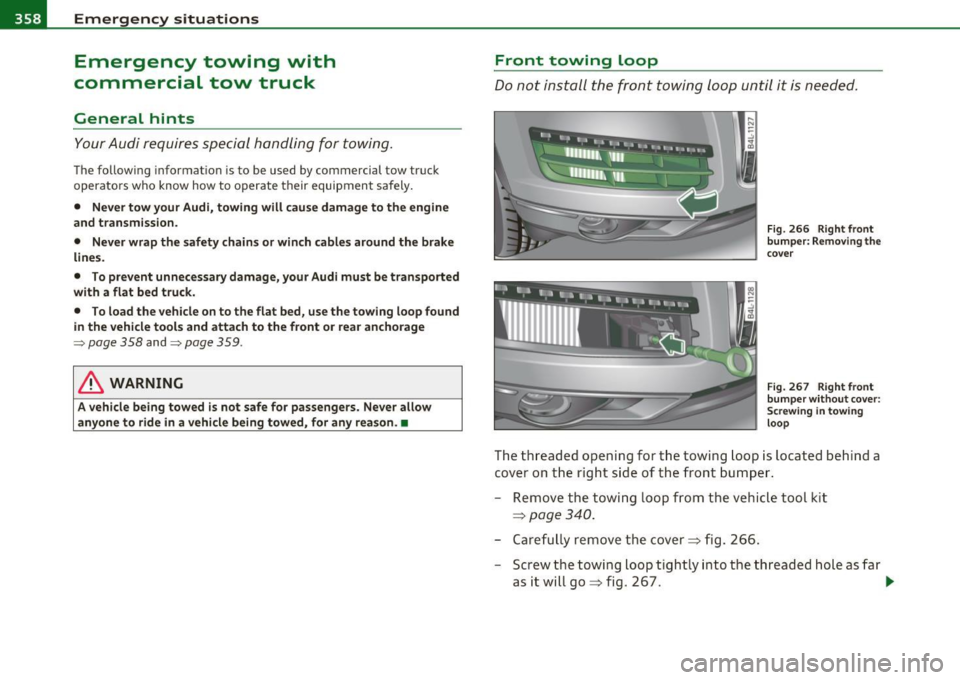
Do not install the front towing loop until it is needed.
Fig. 266
Right front
bumper: Removing the
cover
Fig. 267 Right front
bumper without cover:
Screwing in towing
loop
The threaded opening for the towing loop is located behind a
cover on the right side of the front bumper.
- Remove the towing loop from the vehicle tool kit
=> page 340.
- Carefully remove the cover=:> fig. 266.
- Screw the towing loop tightly into the threaded hole as far
asitwillgo =:>fig .267 . ..,
Page 363 of 392

_______________________________________________ E_ m_ e_r_, g::;._ e_n _ c""' y:.- s_ it_u_ a_t _ i_o _n_ s __ _
- Insert a rub ber pad between the floor jack/workshop hoist
and the lift ing points .
If you must lift your vehicle with a floor jack to work underneath,
be sure the vehicle is safely supported on stands intended for this
purpose .
Front lifting point
The lifti ng point is located o n the flo or pan reinfo rcemen t about a t
the same leve l as the jack mounting point::::;,
page 360, fig. 271. Do
not lift th e vehicle at the vertical sill reinforcement.
Rear lifting point
T he lifting po int is loc ated on the ve rtic al rei nfo rcement of the lowe r
sill for the on boa rd jack ::::;,
page 360, fig. 272.
Lifting with vehicle jack
Refer to ::::;, page 346.
& WARNING
• To reduce the risk of serious injury and vehicle damage.
- Always lift the vehicle only at the special work shop hoist and
floor jack lift points illustrated::::;,
page 360, fig. 2 71 and
::::;, page 360, fig. 272.
- Failure to lift the vehicle at these po int s could cause the
vehicle to t ilt or fall from a lift if there i s a change in vehicle
weight di stribution and balance. This m ight happen , for
ex ample, when heavy components such as the engine block or
transmission are removed.
• When removing heavy component s like these, anchor vehicle
to hoist or add corre spo nding weights to maintain the center of
gravity. Otherwise, the vehicle might tilt or slip off the ho ist,
causing serious personal injury.
Safety first
0 Note
• Be aware of the following poin ts before lifting the vehi cle:
- The vehicle should never be lifted or jacked up from under
neath the engine oil pan , th e tran smis sion housing , the front or
rear a xle or the body side members. Th is could lead to serious
damage .
- To avoid damage to the underbody or chassis frame, a rubber
pad mu st be inserted betwe en the floor jack and the lift points .
- Before driving over a wo rkshop hoist , check that the vehicle
weight doe s not ex ceed the permis sible lifting capacity of the
ho ist.
- Before driving ov er a work shop hoist , en sure that there is
sufficient clearance between the hoist and low parts of the
vehicle .•
Vehicle care Do-it-yourself service Technical data
Page 364 of 392

., __ G_ e_n_ e_r _a _ l_ in_ f_o _r_ m_ a_ t_io _ n _______________________________________________ _
General information
Explanation of technical data
Some of the technical data listed in this manual requires
further explanation.
The technical data for your vehicle is listed in the charts starting on
~ page 365. This sect ion prov ides genera l information, notes and
restrictions which app ly to this data .•
Veh icle identification
The key data is given on the vehicle identification number
(VIN) plate and the vehicle data sticker.
F ig. 273 V ehicle I den
t ifi ca tion Nu mbe r
(V IN ) plate: locat io n
o n d river's s id e d ash
p an el Fi
g. 27 4 Th e vehi cle
i d enti ficati on l abel -
in side the l ugga ge
co mpa rtme nt
The Vehicle Id ent ifi cat ion Number (VlN )
is located on the driver's s ide so that it is visible from the outside
through the windshield ~ fig . 273 . You can also d isp lay the Vehicle
Identification Number of your vehicle in the MMI. Se lect funct ion
button [CAR]>
S yst em s* > Vehicle ID number (VIN ).
The vehicle identifica tion lab el
is located in the luggage compartment under the cargo floor cover.
The label~ fig . 274 shows the following vehicle data:
© Production control No.
@ Vehicle identification No.
® Type code n umber
@ Type designat io n/eng ine output in Kilow atts
© Engine and transmission code letter
© Paint No./Interior
(j) Optional equipment No.'s
Vehicle data 2 to 7 are also found in your Warranty
& Maintenance
booklet . .,,
Page 367 of 392
____________________________________________________ D_ a_t_ a __ _
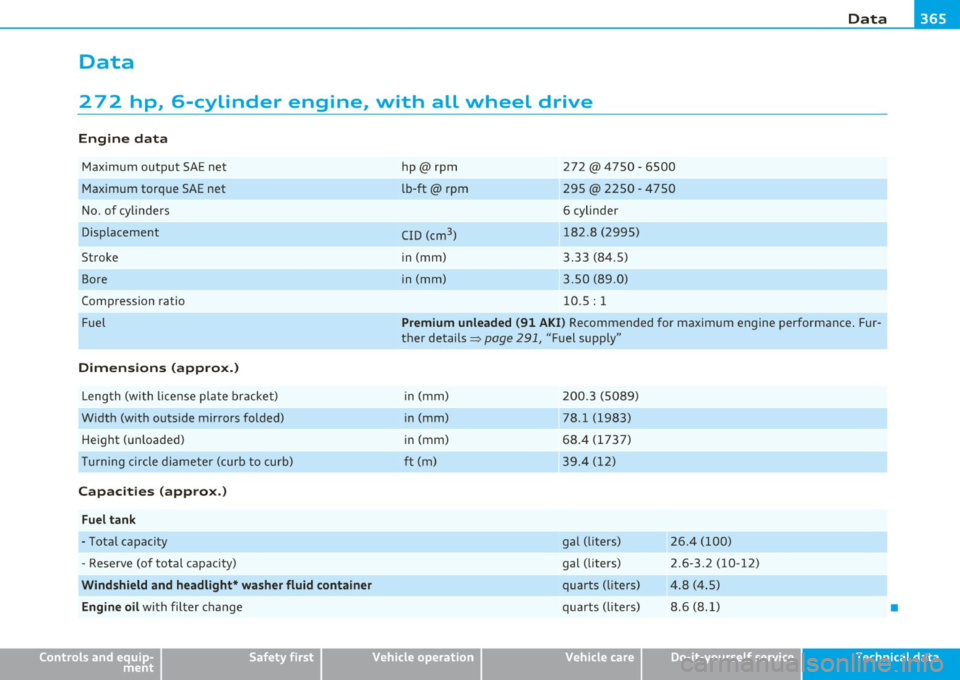
Data
2 72 hp, 6-cylinder engine, with all wheel drive
Engin e data
Maximum output SAE net
Maximum torque SAE net
No. of cy linders
Displacement
Stroke Bore
Compression ratio
Fuel
Dimensions (approx.)
Leng th (wi th l ice nse p la te br acke t)
W idth (w ith outs ide mir rors folded)
He ight (un loaded)
Tu rning circle diameter (curb to curb)
Capacities (approx.)
Fuel tank
- Tota l capacity
- Reserve (of total capacity)
Windshield and headlight* wa sher fluid container
Engine oil
with filter change
Safety first
hp@rpm
lb-ft@ rpm
CID (cm
3 )
in (mm)
in (mm) 272@ 4750
-6500
295@ 2250 -4750
6 cylinder 182 .8 (2995)
3 .33 (84.5)
3 .50 (89.0)
10.5: 1
Premium unleaded (91 AKI) Recommended for maximum engine perfo rmance . Fur
th er details~ pag e 291, "Fuel supply"
in (mm)
i n (mm)
in (mm)
f t (m) 2
00 .3 (5089)
78 .1 (1983)
68.4 (1737)
39. 4 (12)
gal (liters)
gal (liters)
quarts (l ite rs)
quarts ( lite rs) 26
.4 (100)
2.6-3.2 (10-12)
4.8 (4. 5)
8 .6(8.1)
•
Do-it,yourself service Technical data
Page 368 of 392
___ D_ a_ t_a ___________________________________________________ _
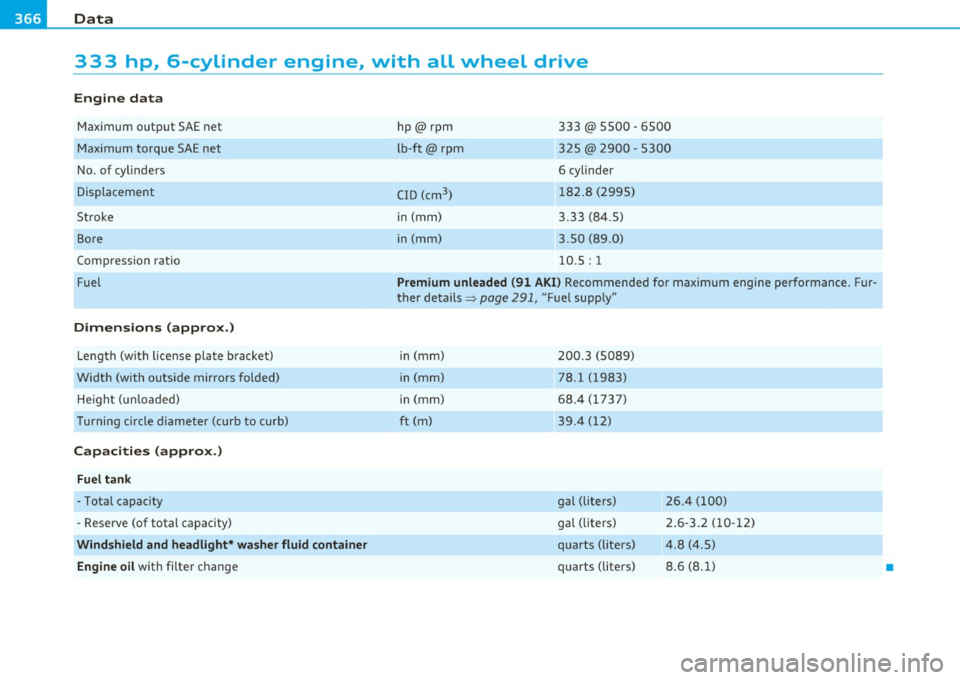
333 hp, 6-cylinder engine, with all wheel drive
Engine data
Maximum output SAE net
Maximum torque SAE net
No. of cylinders
Displacement
Stroke
Bore
Compression ratio
Fuel
Dimensions (approx.)
Length (with license plate bracket)
Width (with outside mirrors folded) He ight (unloaded)
Turning circle diameter (curb to curb)
Capacities (approx.)
Fuel tank
-Total capacity
- Reserve (of total capacity)
Windshield and headlight* washer fluid container
Engine oil with filter change hp @rpm
lb
-ft@ rpm
CID (cm
3 )
in (mm)
in (mm)
333 @ 5500 -6500
325
@ 2900 -5300
6 cylinder
182.8 (2995)
3.33 (84.5)
3.50 (89 .0)
10.5: 1
Premium unleaded (91 AKI) Recommended for maximum engine pe rformance . Fur
ther details~
page 291, "Fuel supply"
in (mm)
in (mm)
in (mm)
ft (m)
200 .3 (5089)
78.1 (1983)
68.4 (1737)
39 .4 (12)
gal (liters)
gal (liters)
quarts ( liters)
quarts (liters) 26 .4 (100)
2.6-3.2 (10-12)
4 .8 (4.5)
8.6 (8.1)
•
Page 369 of 392
_________________________________________________ D_a_ t_ a __ __
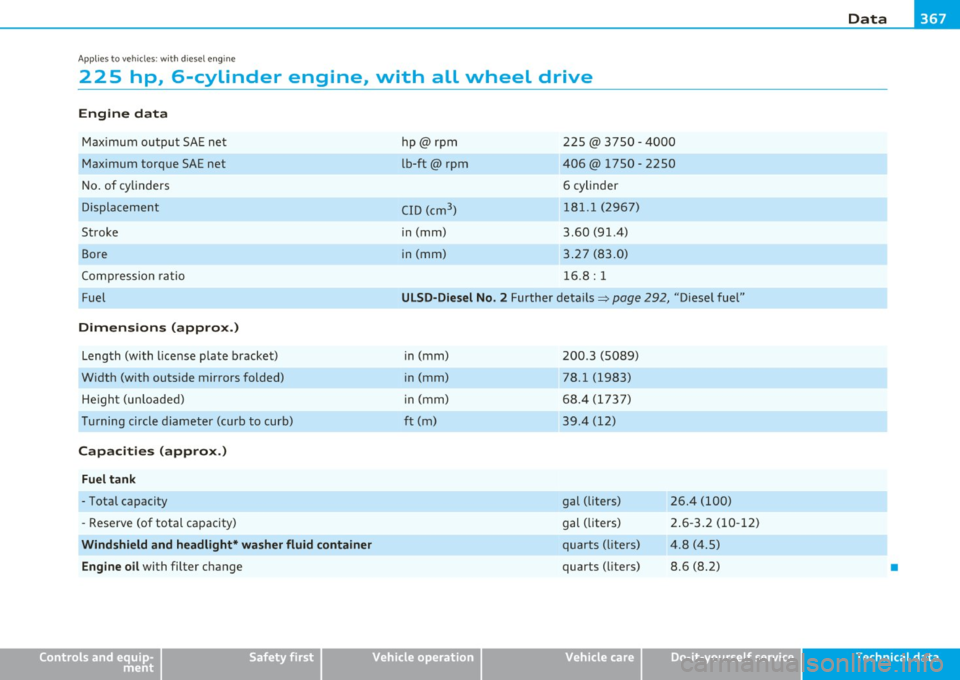
App lies to veh icles : with di esel e ngine
225 hp, 6-cylinder engine, with all wheel drive
Engine data
Max imum outpu t SA E net
Maximum torque SAE net
N o. of cy linders
Displaceme nt
Stroke Bore
Com pression ra tio
Fuel
Dimensions (approx.)
Leng th (with license p late bracke t)
W idth (w ith outs ide mirrors folded)
He igh t (u nloade d)
Turning circle diameter (curb to curb)
Capacities (approx.)
Fuel tank
- Tota l capacity
- R eserve (of total capacity)
Windshield and headlight* washer fluid container
Engine oil
with filter c hange
Safety first
hp@rpm
lb-ft@ rpm
C ID (cm
3
)
in (mm)
in (mm) 22
5@ 3750 - 4000
406@ 1750 - 2250
6 cylinder
181. 1 (2967)
3 .60 (91.4)
3 .27 (83.0)
16 .8: 1
ULSD-Diesel No . 2 Further details=> page 292, "Diese l fuel"
i n (mm)
in (mm)
i n (mm)
ft (m) 200
.3 (5089)
78 .l (1983)
68 .4 (17 37)
39 .4 (12)
gal (liters)
gal ( liters)
qu arts (lite rs)
quarts ( liters) 26.4 (100)
2
.6- 3.2 (10 -12)
4.8 (4.5)
8.6 (8.2)
Do-it,yourself service
•
Technical data
Page 370 of 392
___ C_ o_n_ s _ u_m_ e_ r_ I_ n_ f_o _r_ m_ a_ t_io _ n _____________________________________________ _
Consumer Information
Warranty coverages
Your Audi is cov ered by the following warrantie s:
• New Vehicle Limited Warranty
• Limited Warranty Against Corrosion Perforation
• Emissions Control System Warranty
• Emissions Performance Warrant y
• California Emissions Control Warranty (USA vehicles only)
• California Emissions Performance Warranty (USA vehicles only)
Detailed informa tion regarding your warran ties can be fo und in your
Warranty & Maintenance boo klet .•
Operating your vehicle outside the
U.S.A. or Canada
Government regulat ions in the United States and Canada req uire t hat
au tomobiles meet spe cific emi ss ion regula tions and safe ty s tan
dards . There fore, ve hicles bui lt for the U.S.A . and Canada differ from
vehicles so ld in othe r countries.
If you plan to take your vehicle ou tside the continental lim its of the
United States or Canada, the re is the possibility that
• unle aded fue ls for vehicle s w ith c ataly tic converte r may n ot be
available;
• fue l may have a conside rably lower octa ne rat ing . Imp roper f ue l
may cause engine damage;
• serv ice may be inadequate due to lack of proper serv ice fac ilities,
too ls or testing eq uipment;
• replacement parts may not be read ily avai lab le . • N
avigation syst ems for veh icles built fo r th e U.S.A. and Canada
w ill not necessar ily work in Europe, and may not wo rk in other coun
tries outs ide North Ame rica.
0 Note
Audi canno t be responsib le for mech anical dam age th at could res ult
from inadeq uate fue l, se rvice o r parts ava ilability. •
Audi Service Repair Manuals and
Literature
Audi Off ic ia l Facto ry Service Manuals and Lite rature are published as
so on a s po ssibl e afte r mo del intro duction . Se rvice Manuals and lite r
ature are avai lab le to order from t he Aud i Tec hnical Lite rature
O rder ing Cente r at:
www.audi .techliterature .com •
Maintenance
General
Your vehicle has been des igned t o help keep m ainten ance re quire
ments to a min imum. However, a certain amount of regular ma inte
n an ce i s still ne cessary to assure your ve hicle's sa fe ty, ec onomy and
re liability . For deta iled veh icle maintena nce consult your Warranty
&
Maint enance bookle t.
Under difficult operating conditions, for example at extreme ly low
outs ide temperatures, in very dusty regions , when towing a trai le r
very frequent ly, etc., some se rv ic e w ork s hou ld be perfo rmed
between t he intervals specif ied. This app lies part icularly to: .,_