air condition AUDI Q7 2011 Owner´s Manual
[x] Cancel search | Manufacturer: AUDI, Model Year: 2011, Model line: Q7, Model: AUDI Q7 2011Pages: 392, PDF Size: 93.29 MB
Page 180 of 392
lffllL__.!.A~d~a!!p~t~iv~e~A~i r'......=S:.!u:!:s~p:.::e:.!n..::s==.:_:io~n:..:.... ________________________________________ _
Adaptive Air Suspension
Air suspension and damping
Applies to veh icles : w ith Adap tive Air Suspens ion
Description
Air suspension and damping can be adjus ted separately.
Adaptive Air Suspens ion is an e lectron ically controlled springing and
damping sys tem. This chass is sys tem makes it eas ie r on the d river by
adapting to the particular si tuation through imperceptible control
processes.
T he
Adaptive Air Su spen sion component regu lates ground clea rance
depending on vehicle speed and driver input . It funct ions indepen
dently from the load cond it io n. Ac ce le rating to a speed above a
predetermined limit will make the vehicle lower itse lf. On the other
hand, dr iv ing more slowly res ults in the vehicle r aising again at
specific speeds.
T he
damping component provides individua l control of the damping
forces . For example , w ith damping characte rist ics set to p rovide
greater comfort, damping is set somewhat harder for a brief period
only as req uir ed, for example, whe n going a ro und a curve or when
brak ing.
Sett ings
Adaptive Air Suspension provides the driver with the opportun ity to
set the chass is characte rist ics also to their individual p refe rence.
With the driving modes
Comfort, Automatic and Dynamic the dr iver
has three chass is sett ings available, ranging from comfort to spo rty.
The
Offroad mode ca n be selected for dr iv ing on poor quality
s tr etc hes of road. In addition,
Li~ provides a fif th mode, w hich can be
selected when exceptiona lly high g round clearance is needed
==> page 179, "C hass is controls ".
T he modes are set in MMI
==> page 180 .
& WARNING
The height of th e parked vehicle can change du e to temperature
fluctuations or changes in load.
0 Note
• Whenever you park yo ur vehicle, always make sure there is
ade qua te clearance above and below t he ve hicle. The height of the
parked vehicle can change as the result of temperature fluctuations,
c hanges in loa d condition and changes in the dr iv ing mode (ground
cleara nce).
• If the veh icle is be ing transported (e .g . by tow truck, tra in , sh ip,
etc.), mount the tie-down cha ins/cables over the running su rface
(circumference) of the tires. Never se cure the vehi cle by the ax le, the
suspension struts or the front or rear tow line eye. For technical
reaso ns, the p ressure in the suspension st ru ts may change dur ing the
t ransport, whic h could result in the vehicle no longer being secured
pro perly.
• If you are goi ng to tow a trailer w ith a tra iler h itch that was
not
ins talled accor ding to f actory s pecifi cations, you mus t activa te t he
t rai ler operation mode manually:::::,
page 182.
[{] Tips
• Before you ca n raise your vehicle using the vehicle jack (for
example, when c hangi ng a flat tire) or a vehicle lift, you must activate
t he jac kin g mode :::::,
page 182.
• On some mode ls, the vehicle can reach its maximum speed on ly in
t he
Automatic and Dynamic modes .•
Page 182 of 392
ffl..__A_ d_a_ p,__ t_iv _ e_ A_ i_r _ S_ u_s _, p'--- e_n _ s_ i_ o _ n ___________________________________________ _
• Automatic lowering: When a speed of about 75 mph ( 120 km/h)
is exceeded for more than 30 seconds, the vehicle is automatically
lowered by 0 .6 inch (15 mm) to
low level .
• Automatic raising: The vehicle is automatically raised to normal
level
again, if the speed falls below about 44 mph (70 km/h) for a
period of 2 minutes . The vehicle is raised immediately when speed
falls below about 22 mph (35 km/h) .
Offroad
Select the offroad mode when you have to travel over poor quality
sections of road (e.g. trails) . In this mode, the vehicle is raised to
high
level 1,
and damping characteristics for poor road stretches are
selected. When switching to offroad mode, the Adaptive Air Suspen
sion indicator appears automatically in the instrument cluster display
~page 181 .
The offroad mode can only be activated at speeds below 37 mph
(60 km/h). Offroad mode ends automatically and the automatic
mode is activated when a speed of approximately 50 mph (80 km/h)
is exceeded.
Lift
Select the lift mode when exceptionally high ground clearance is
needed at a reduced speed. In this mode, the vehicle is raised to
high
level
2 . When switching to lift mode , the Adaptive Air Suspension
indicator appears automatically in the instrument cluster display
~page 181 .
The lift mode can be activated only at speeds below 12 mph (20
km/h) . When a speed of about 25 mph (40 km/h) is exceeded, the
system automatically leaves
lift mode and the offroad mode is acti
vated . The instrument cluster display automatically switches the
display to Adaptive Air Suspension to indicate reduced ground
clearance. •
Appli es to veh icles : with Adapt ive Air Su spens ion
MMI se ttings
Driving modes are adjusted in the MMI and the current
vehicle level is displayed.
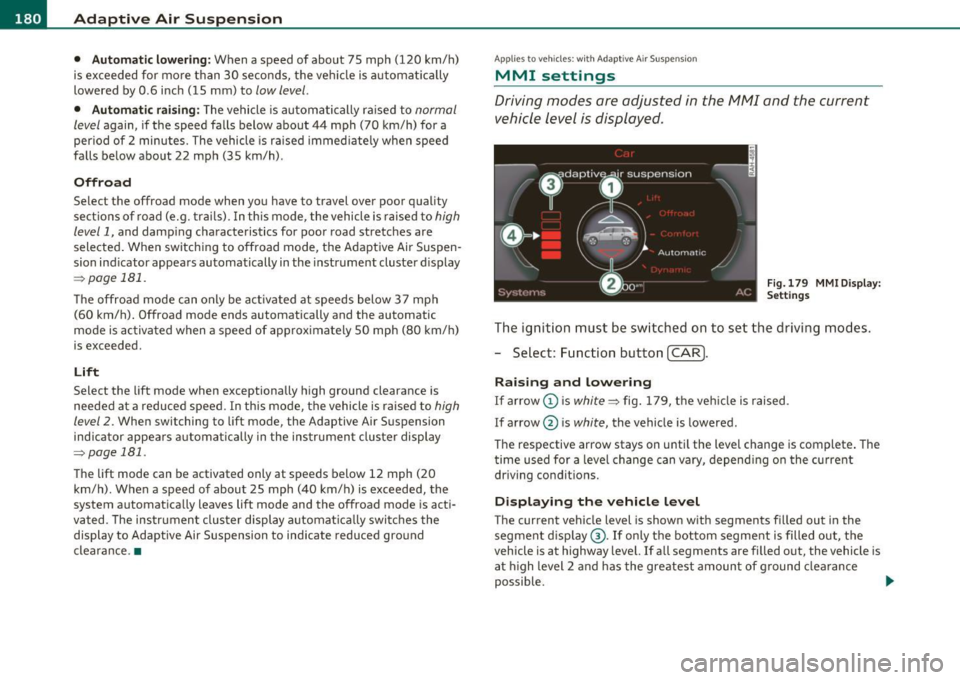
Fig.179 MMI Display:
Settings
The ignition must be switched on to set the driving modes.
- Select: Function button
(CAR].
Raising and lowering
If arrow (Dis white ~ fig. 179, the vehicle is raised.
If arrow @ is
white, the vehicle is lowered .
The respective arrow stays on until the level change is complete. The
time used for a level change can vary, depending on the current
driving conditions.
Displaying the vehicle level
The current vehicle level is shown with segments filled out in the
segment display ®·
If only the bottom segment is filled out, the
vehicle is at highway level. If all segments are filled out, the vehicle is
at high level 2 and has the greatest amount of ground clearance
possible. .,_
Page 184 of 392

1111....__A_ d_ a_,_ p_t _i_ v _e _ A_i_ r_ S_ u_ s ... p,_ e_n_ s_ io_ n __________________________________________ _
Raising and l owering
If a rrow (Dis solid red=> page 181, fig. 180 or white => page 181,
fig. 181, the veh icle is raised .
If arrow
0 is solid red or white, the vehicle is lowered .
T he respective arrow stays on until the level change is complete . The
time required for a level change can vary, depending on the current
dr iving cond it ions .
Displ aying the vehicle le vel
The current vehicle leve l is show n wit h segments fi lled ou t in the
segment display@. If only the bottom segment is filled out, the
vehicle is at highway leve l. If all segments a re filled o ut, the vehicle is
at high level 2 and has the greatest amount of ground clearance
possible.
W hile the vehicle is being ra ised or lowe red, t he target leve l is ind i
cated by an arrow © next to the correspond ing segment. The arrow
disappe ars aga in whe n the vehicle is a t the target level. •
Applies to veh icles: w ith Ad ap tiv e A ir Suspens ion
Jacking mode when changing a flat tire
This mod e must be activated in the MMI bef ore raising
the vehicle with a jack or on a vehicle
li~ .
-Select: Fu nction button [CAR)> function butto n [SETUP ]
> Jacking mode .
The veh icle jack mode must be activated before c hanging a whee l so
that the automatic contro l processes for t he air s uspensio n do not
make lifting w ith the vehicle jack more difficult.
The check lamp in the instr ument cluster display illuminates in
vehicle jac k mode.
W Tips
Th e veh icle ja ck mode is switc hed off automat ica lly at speeds above 9
mph (15 km/h). •
Appli es to veh icles : with tow ing h itc h and Adaptive Air Sus pen sion
Towing a trailer
Automatic lowering is not desirable when towing a
trailer.
- Selec t: Fu nct ion button [CARI > fun ction but ton [S ETUP I
> Towing mode .
As long as towing mode is activated, a ve hicl e w ith a t railer appears
in the
adaptive air suspension main menu.
Level Adjustment when towing a trailer
• Before h itching up the trailer and befo re adjust ing the tongue
we igh t at the trailer, the automatic or com fort mode mu st be
selected so that the vehicle can be at normal leve l=>
page 180, "MMI
se ttings" .
• If dr iv ing in dynamic mode is desired, this mode
must be selected
befo re hitc hing up the tra iler and before adjus ting the tongue
we ight. However, note that yo ur vehicle is lowered and ground clear
ance is reduced.
• If you have to drive under diff icu lt road conditions, you can select
offroad or li ft mode, aft er hitching up the trai le r or after adjust ing
the tongue weight .
• If the vehicle is at
normal level, an d you se lec t offro ad mode wh ile
traveling at speeds higher than 22 mph (35 km/h), the vehicle will
no t b e raised. O ffroad mode will a ppear as t he active mode in the
MMI D isplay.
• If the veh icle is in o ffro ad mode at
high level 1, it automatic a lly
lowers to
normal level when the vehicle is traveling at speeds
exceeding approximate ly 31 mph ( SO km/h). The vehicle is automat -...
Page 193 of 392
________________________________________________ D_ r_ i_ v _i_n ""'g "-- S_a_ f_ e_ l _,,y'-- __
Important things to do before driving
Safety is everybody's job! Vehicle and occupant safety always depends on the informed and careful driver.
For your safety and the safety of your passengers, before
driving always:
- Make sure that all lights and signals are operating
correctly.
- Make sure that the tire pressure is correct.
- Make sure that all windows are clean and afford good visi-
bility to the outside.
- Secure all luggage and other items carefully::::>
page 107.
-Make sure that nothing can interfere with the pedals.
- Adjust front seat, head restraint and mirrors correctly for your height .
- Instruct passengers to adjust the head restraints according to their height.
- Make sure to use the right child restraint correctly to
protect children ::::,
page 233, "Child Safety".
- Sit properly in your seat and make sure that your passen gers do the same::::,
page 85, "General recommenda
tions".
- Fasten your safety belt and wear it properly. Also instruct
your passengers to fasten their safety belts properly
=:> page 201. •
Controls and equip
ment Safety first Vehicle operation
What impairs driving safety?
Safe driving is directly related to the condition of the
vehicle, the driver as well as the driver's ability to concen
trate on the road without being distracted .
The driver is responsible for the safety of the vehicle and all
of its occupants. If your ability to drive is impaired, safety
risks for everybody in the vehicle increase and you also
become a hazard to everyone else on the road::::,,& . There
fore:
Do not let yourself be distracted by passengers or by using
a cellular telephone.
NEVER drive when your driving ability is impaired (by
medications, alcohol, drugs, etc.).
- Observe all traffic laws, rules of the road and speed limits
and plain common sense .
- ALWAYS adjust your speed to road, traffic and weather
conditions.
- Take frequent breaks on long trips. Do not drive for more than two hours at a stretch.
- Do NOT drive when you are tired, under pressure or when
you are stressed .
& WARNING
Impaired driving safety increases the risk of serious personal
injury and death whenever a vehicle is being used.•
Vehicle care Do-it-yourself service Technical data
Page 200 of 392
• ....__D_ r_iv _i_ n_, g=-- S_ a _ f_e _,Ly _ ______________________________________________ _
& WARNING (conti nu ed )
• Pleas e obse rve information on s afe driving => page 190.
& WARNING
To help prevent poi sonous exhau st ga s from being drawn into the
vehicle, always keep the rear lid closed while driving.
• Never transport object s larger than tho se fitting completely
into the luggage area because the rear lid cannot be fully closed.
• If you ab solutely must drive with the rear lid open, observe the
following notes to reduce the ris k of po isoning:
- Close all windows,
- Close the Pano ramic sliding sunroof*,
- Open all air outlets in the instrument panel,
- Swit ch off the air recirculation,
- Set the fresh air fan to the h ighest speed.
& WARNING
Alway s make sure that the doors, all windows, the Panorami c
sliding sunroof* and the rear lid are secur ely closed and locked to
reduce the risk of injury when the vehicle is not being used.
• After closing the rear lid, always make sure that it is properly
clo sed and locked .
• Never leave your vehicle unattended especially with the rear lid
left open . A child could crawl into th e vehicle through the luggage
compartment and close the rear lid becoming trapped and unable
to get out . Being trapped in a vehicle can lead to serious personal
injury.
• Never let children play in or around the vehicle.
• Never let passengers ride in the luggage compartment. Vehicle
occupants must alway s be properly restrained in one of the
vehicle 's seating positions.
W Tips
• Air circulation helps to reduce window fogging. Sta le air escapes
to the outside th rough vents in the trim panel. Be sure to keep these
slo ts free and open.
• Th e tire pressure m ust correspond to the load . The tire pressure is
shown o n th e t ire pressu re label. The tire pressure label is located o n
the driver's side 8-pillar . The tire p ress ure label lists the recom
me nded co ld tire inflation pressures fo r th e ve hicle at its max imum
capacity weight and the tires that were on your vehicle at t he time it
was manufactured. For recommended t ire pressu re s for normal loa d
conditions, p lease see chapter=>
page 322. •
Tie-downs
The lug gage c omp artm ent is equ ipped with fo ur tie
do wns to secur e luggag e and oth er items .
Use the t ie-downs to sec ure yo ur cargo properly => page 197,
"Load ing the l uggage comp artmen t".
In a co llision , the laws of physics mean that even smaller items that
are loose in the vehicle will become heavy m issi les t hat can ca use
ser ious injury. Items in the vehicle possess energy which va ry with
veh icle speed and the weight of the item . Vehicle speed is the most
sign ifi cant factor .
For example, in a frontal coll is ion at a speed of 30 mp h (48 km/h),
the forces a cting on a 1 0-lb (4.5 kg) o bje ct are about 20 times the
normal weight of the item. This means that the weight of the item
wou ld sudden ly be abo ut 200 l bs. (9 0 kg). You can imagine the inju
r ies that a 200 lbs. (90 kg) item flying freely through the passenger
compar tment cou ld cause in a collision like this .
liJ,
Page 215 of 392
Airbag system Ill
----------------=--=---
Child restraints on the front seat - some important things to know
- Be su re to re ad t he i mpo rt a nt i nfo rmation a nd heed the
WA RNINGS fo r i mporta nt details about chil dre n and
Advanced Airbags ~
page 233.
Even t hough your ve hicle is eq uipped with an Advanced Airbag
System, ma ke ce rtain that a ll chi ld ren, especia lly those 12 years an d
younger, always r ide in the back seat prope rly rest rained fo r th eir age
and si ze. The airbag on the passenger side makes the front seat a
po tentially da ngerous place fo r a child to r ide. The fro nt seat is not
the safest place for a ch ild in a forward-facing child safety seat. It can
be a very dange rous place fo r an i nfan t or a child in a rearward-fac ing
seat.
Th e Advanced Ai rbag System in your vehicle has been cer tified to
comply with the req uirements of Un ited States Federa l Moto r Veh icle
Sa fety Standard 208 as applicable at the time your vehicle was manu
factured.
The Standard requires the front airbag on the passenger side to be
tu rne d off ("s uppressed") if a c hild up to abou t one ye ar of age
restra ined in o ne of the rear -facing or forward -fac ing infant
restra ints listed in Federa l Moto r Vehicle Safety Standard 208 with
whic h the Advanced Airbag System in yo ur vehicle was cert ified has
been installed on the front passenger seat. For a listing of the ch ild
restra in ts that were used to certify compliance with the US Saf ety
Standard =>
page 235.
The PASSENGER AIR BAG OFF ligh t in th e in st rume nt p anel t ells you
when the front Advanced A irbag on the passenger side has been
tur ned off by the ele ct ronic con trol uni t.
Each time you t urn on the ignition, t he
PASSENGER AIR BAG OFF
light will come on for a few seconds and:
• will stay on if th e front passenger se at is no t oc cupied
Controls and equip
ment Safety first
Vehicle operation
• will stay on if there is a small ch ild or child restra int on the front
p assenge r se at
• will go off if the front passenger seat is occup ied by an adult as
reg iste red by t he weight -sens ing mat =>
page 222 , "M oni tor ing t he
Advanced Airbag System" .
T he
PASSENGER AIR BAG OFF light comes o n when t he control unit
de tects a total weight on t he front passenger seat that req uires the
front airbag to be t urned off .
If th e total weight o n the front passenger seat is more than th at of a
typical 1 year-o ld child but less than the weight of a small adult, the
fr on t a ir bag on the passenge r si de c an deploy (t he
PASSENGER AIR
BAG OFF
light does not come on) . If the PASSENGER AIR BAG OFF
light does not come on, the front airbag on the passenger side has
not been turned off by the electronic co ntrol unit and can deploy if
the control unit senses an impact t hat meets the conditions stored in
its memory.
For example, the airbag may deploy if:
• a small child that is heavier than a typical 1 year -old child is on the
front passenger seat (regard less of whether the chi ld is in one of the
child safety seats listed =>
page 235), or
• a child who has outgrown child restraints is on the front passenger
sea t.
If the fro nt passenger a irbag is tur ned off, the
PASSENGER AIR BAG
OFF
lig ht comes on in the instr ument cluster an d stays on.
Th e fron t airbag on t he pa sse nger side may
not de ploy ( the
PASSENGER AIR BAG OFF li ght does not illum inate and stay lit) even
if a small ad ult or teenager, or a passenger who is no t sitting upright
with their back against a non-reclined backrest w ith the ir feet on the
vehicle floor in front of the seat is on the front passenger seat
=>
page 192, " P roper seat ing pos itio n for the dr iver".
If the front passenger ai rbag dep loys, the Federal Standard requires
t he a irbag to mee t the "low risk" deployme nt cr iter ia to reduce the
risk of inj ury through interaction with the a irbag. "Low r isk" deploy
me nt o ccurs in those cras hes t hat tak e pla ce a t lower decelerat io ns as
I),
Vehicle care Do-it-yourself service Technical data
Page 218 of 392
........ _A_ ir_ b_ a-=g :..- s.:o.y _s _t _e_ m _______________________________________________ _
& WARNING (conti nued)
• Airbag work mo st effectivel y when us ed with p roperly worn
safety belts .
• Therefore, always wear your safety belts and make sure that
everybody in your veh icle is properly restrained .
& WARNING
A person on the front passenger seat , especially infants and small
c hildren, will receive seriou s injuries and can even be killed by
being too close to the a irbag when it inflates.
• Although the Advanced Airbag System in your vehicle is
designed to turn off the front passenger a irbag if an infant or a
small child is on the front passenger seat, nobody can absolutely
guarantee that deployment under these special conditions is
impossible in all conceivable situations that may happen during
the useful life of your vehicle.
• The Advanced Airbag System can deploy in a ccordance with the
" low risk" option under the U.S. Federal Standard if a child that is
hea vier than the t ypical one-year old child is on the front
passeng er seat and the other condition s for airbag deployment
are met.
• Accident statistics have shown that children are generally safer
in the rear seat area than in the front seating position .
• For their own safety, all children , especially 12 years and
younger, should always ride in the back properly res trained for
their age and size. •
Advanced front airbag system
Your vehicle is equipped with a front Advanced Airbag System in
compliance wit h Unit ed St ates Fe d er al Motor Vehi cle Safe ty Standar d
208 as applicab le at the time your vehicle was manufactured . The front Advanced A
irbag System supplements the safety belts to
prov ide ad ditional prote ct ion for th e d river's and front passenger's
heads and uppe r bodies in fro nta l crashes. The ai rbags i nflate only in
fronta l impacts when the vehicle dece leration is high enoug h.
Th e front Adva nced A irbag Sys tem for the fron t seat oc cupan ts is not
a s ubstitute for your safety be lts. Rathe r, it is part o f the overall occu
p an t restr aint sy stem in y our ve hicl e. Always remembe r that the
airbag system ca n only help to protect you, if you are sitting upr ight,
we aring your sa fe ty be lt and we aring it prope rly. T his is why you and
your passengers must always be properly restra ined, not just because
t he law requires you to be.
Th e A dvan ced A irbag Syst em in your veh icle has been c ertified to
meet the "low r isk" req uir ements fo r 3 an d 6 year-old c hildren on the
pas senge r side and ve ry small ad ults o n the dr ive r side. T he low r is k
dep loyment cr iteria a re intended to help reduce the risk of injury
t hroug h in teraction wi th the front a irbag tha t can oc cur, fo r ex am ple,
by being too close to the steering wheel and instrument panel whe n
t he air bag i nflates .
In add it ion , the system has been cert ified to comply with t he
"supp ression" requirements of the Safety Standa rd, to t urn off the
front airbag for infants 12 mont hs old and young er w ho are
restrained on the front passenger seat in child restra ints that are
listed in the Standard=>
pag e 235, "Child restra ints and A dvan ced
Airbags".
"Su pp ression" req uires t he front a irbag on the passenger side to be
t ur ned off if:
• a child up to about one year of age is restra ined on the front
passenge r seat in one of t he rear-faci ng or forwa rd-facing infant
restraints listed in Federa l Motor Vehicle Safety Standard 208 w it h
w hich the Adv anced Airbag Sys tem in yo ur vehicle w as ce rt ified. Fo r a
list ing of the child restra ints that were used to certify your vehicle's
c omp li a nce with the US Safety Stand ard =>
page 235,
• weight less than a thresho ld level stored in the contro l unit is
detec ted on t he fro nt p assenger se at.
Page 219 of 392
_______________________________________________ A_ ir_ b_ a_,,,g '--- s.:.y _s _t_ e _ m ___ lffll
When a perso n is detected on t he front passenger seat, weigh ing
more th an t he tot al we igh t of a ch ild t hat i s abo ut 1 ye ar old
restra ined in o ne of the rea r-facing or forward-fac ing infant
restra ints (liste d in Fed eral Moto r Ve hicl e Safety Stan dard
20 8 with
w hic h the Advanced Airbag System in your veh icle was c ert ified), the
front airbag on the passenge r side may o r may not dep loy.
Th e
PASSENGER AIR BAG OFF ligh t comes on when the ele ct ro nic
control u nit detects a total weig ht on t he front passenger seat that
re qui res t he fr on t air bag t o be tur ned o ff. If the
PASSENGER AIR
BAG OFF
lig ht does not come on, the fro nt airbag o n the passenger
s ide has not been turned of f by the con trol un it and can dep loy i f the
cont rol un it se nses an impact that meets the conditions stored in its
memory.
If the tota l weight on the fro nt passenger sea t is more than that of a
typical
1 year-o ld, but less than the weight of a small adult, t he front
a irbag o n the p assenge r si de may dep loy (t he
PASSENGER AIR BAG
OFF
light does not come on).
For example , the airbag may deploy if:
• a small child tha t is heav ie r th an a typical 1 year-old child is on t he
front passenger seat (regard less of whet he r the ch ild is in one of the
c hild s afe ty sea ts listed=>
page 23 5),
• a child who has outgrown child restraints is on the fro nt passenger
se at.
If the front passe nger a irbag is turned off, the
PASSENGER AIR BAG
OFF
ligh t in the center o f the i nstr ument pa nel will come on and s tay
on .
T he front airbag on the passenger side may
not dep loy (t he
PASSENGER AIR BAG OFF light do es not illum inate and s tay lit) if:
• a small adu lt or teenager is on the fro nt passenger seat
• a p assenge r w ho is not si tt ing upri ght w it h t hei r ba ck again st a
non -reclined backrest with their feet on the veh icle floo r in front of
t he seat is on the fro nt pa ssenge r seat .
If the fro nt passenger airbag deploys, the Federa l Standard requ ires
t he a irb ag to mee t the " low r is k " deployme nt c riter ia to help reduce
Controls and equip
ment Safety first Vehicle operation
the
risk of i njury t hrough interaction with t he a irbag. "Low r isk"
dep loyment o ccurs in t hose cra sh es t hat tak e p lace at lowe r decele r
ations as defi ned in the elect ronic contro l u ni t.=>
page 222
Always remember: Even thou gh your vehicle is eq uipped with
Advanced A irbag s, th e sa fe st pla ce for childre n is properly res trained
on the back seat. Please be sure to rea d th e important informat io n i n
t he sec tio ns tha t foll ow and be su re to heed all of the WAR NIN GS.
& WARNING
To reduce the risk of injury when an airbag inflates, always wear
safety belts p roperly .
• If you are unrestrained, leaning forward, sitting sideways or
out of position in any way , your ri sk of injury is much higher.
• You will also receive serious injuries and could even be killed if
you are up again st the airbag or too close to it when it inflates -
even with an Advanced Airbag=>
page 211.
& WARNING
A child in a rearward-facing child safety seat installed on the front
pas senger seat will be seriously injured and can be killed if the
front airbag inflates - even with an Advanced Airbag System.
• Although the Advanced Airbag System in your vehicle is
designed to turn off the front airbag when a rearward-facing child
restraint has been installed on the front passenger seat, nobody
can absolutely guarantee that deployment is impossible in all
c onceivable situations that may happen during the useful life of
your vehicle .
• The inflating airbag will hit the child safety seat or infant
carrier with great force and will smash the child safety seat and
c hild against the backre st, center armre st, door , or roof .
• Always install rearward-facing child restraints on the rear seat.
• If you must install a rearward facing child safety seat on the
front passenger seat because of exceptional circumstances and
IIJ,,
Vehicle care Do-it-yourself service Technical data
Page 224 of 392
-Airbag system
PMI------=----------------
& WARNING (conti nued)
• Never recline the front passenger's seat to transport objects.
Items can also move into the area of the s ide airbag or the front
airbag during braking or in a sudden maneu ver. Objects near the
airbags can become projectiles and cause injury, particularly when
the seat is reclined .
• Never tilt the front pa ssenger seat backrest forward when the
vehicle is moving. An inflating ai rbag will force the backrest back
ward and can injure rear seat occupants.
& WARNING
The fine dust created when airbags deploy can cau se breathing
problem s for people with a history of a sthma or other breathing
condition s.
• To reduce the ri sk of breathing problems, those with asthma or
other respiratory conditions should get fresh air right away by
getting out of the vehicle or opening windows or door s.
• If you are in a collision in which airbags deploy , wash your
hands and face with mild soap and water before eating .
• Be careful not to get the dust into your eyes, or into any cuts or
scratche s.
• If the residue should get into your eyes, flush them with
water. •
Monitoring the Advanced Airbag
System
Airbag monitoring indicator light t !
T wo separate indicators mon it o r the funct io n of the
Adv anced Airb ag System: the airbag mon it ori ng indicat or
light and the
PASSENGER AIR BAG OFF light.
The Advanced A irbag System (includ ing the electronic contro l unit,
s e nsor c ircui ts a nd sys tem wi ring) is mon ito red conti nuous ly to ma ke
sure that it is funct ion ing properly whenever the ign ition is on. Each
ti me you turn on the ignit io n, the airbag mon itorin g indic ator light
I
w ill come o n fo r a few seconds (self d iagnostics).
The system must be inspected when the indicator
light ~:
• does not come on when t he ign it ion is switched on
• does not go out a few seconds after you have switched on the igni
tion, or
• comes on while driving
If an a irbag system malfunction is detected, t he in dicator lig ht w ill
first start flashing to catch t he d river's attention and then stay on
con tinuous ly to serve as a constant reminder to have t he system
inspected immediately.
If a ma lf u nctio n occur s that t urns t he fron t airbag on the passenger
side off, the PASSENGER AIR BAG OFF light will come on and stay on
whenever the ignition is on.
& WARNING
An airbag system that is not fun ctioning properly cannot provide
supplemental protection in a frontal crash.
• If the airbag indicator light comes on , it means that there may
be something wrong with the Advanced Airbag System. It is .,..
Page 225 of 392

Airbag system -----------------=--=---
& WARNING (continued)
possible that the airbag will inflate when it is not supposed to, or
will not inflate when it should.
• Have the airbag system inspected immediately by your autho·
rized Audi dealer. •
PASSENGER AIR BAG OFF light
Fig. 203 Section from
the instrument panel:
PASSENGER AIR BAG
OFF light
The PASSENGER AIR BAG OFF light is located in the center of the
instrument panel=> fig. 203.
The
PASSENGER AIR BAG OFF light will come on and stay on to tell
you when the front Advanced Airbag on the passenger side has been turned
off by the electronic control unit. Each time you turn on the
ignition, the
PASSENGER AIR BAG OFF light will flash for a few
seconds and:
• will stay on if the front passenger seat is not occupied
• will stay on if there is a small child or child restraint on the front
passenger seat
• will go out if the front passenger seat is occupied by an adult as
registered by the weight-sensing mat
The
PASSENGER AIR BAG OFF light must come on and stay on if the
ignition is on and
Controls and equip
ment Safety first
Vehicle operation
• a car bed has been installed on the front seat, or
• a rearward-facing child restraint has been installed on the front
passengerseat,or
• a forward-facing child restraint has been installed on the front
passengerseat,or
• the weight registered on the front passenger seat is equal to or
less than the combined weight of a typical 1 year-old restrained in
one of the rear-facing or forward-facing infant restraints listed in
Federal Motor Vehicle Safety Standard 208 with which the Advanced
Airbag System in your vehicle was certified.
If the front passenger seat is not occupied, the front airbag will not
deploy, and the
PASSENGER AIR BAG OFF light will stay on. Never
install a rearward -facing child restraint on the front passenger seat,
the safest place for a child in any kind of child restraint is at one of the
seating positions on the rear seat=>
page 213, "Child restraints on
the front seat -some important things to know" and=>
page 233,
"Child Safety ".
If the PASSENGER AIR BAG OFF light comes on when one of the
conditions listed above is met, be sure to check the light regularly to
make certain that the
PASSENGER AIR BAG OFF light stays on
continuously whenever the ignition is on. If the
PASSENGER AIR BAG
OFF
light does not appear on and does not stay on all the time, stop
as soon as it is safe to do so and
• reactivate the system by turning the ignition
off and then turning
it on again;
• remove and reinstall the child restraint . Make sure that the child
restraint is properly installed and that the safety belt for the front
passenger seat has been correctly routed through the child restraint
as described in the child restraint manufacturer 's instructions;
• make sure that the convertible locking feature on the safety belt
for the front passenger seat has been activated and that the safety
belt has been pulled tight. The belt must not be loose or have loops
of slack so that the sensor below the safety belt latch on the seat can
do its job=>
page 243. •
Vehicle care Do-it-yourself service Technical data